University of Pennsylvania
ScholarlyCommons
Publicly Accessible Penn Dissertations
2017
Omnichannel Operations Management
Fei Gao
University of Pennsylvania, [email protected]
Follow this and additional works at:
https://repository.upenn.edu/edissertations
This paper is posted at ScholarlyCommons.https://repository.upenn.edu/edissertations/2296
For more information, please [email protected].
Recommended Citation
Gao, Fei, "Omnichannel Operations Management" (2017).Publicly Accessible Penn Dissertations. 2296.
Omnichannel Operations Management
Abstract
This dissertation studies how a firm could effectively make use of different selling channels to provide
consumers with a seamless shopping experience. In the three essays, by analyzing stylized models where firms operates both online and offline channels and consumers strategically make channel choices, we examine the impacts of different types of omnichannel strategies in different industries. In the first essay, we focus on a specific omnichannel fulfillment strategy, i.e., buy-online-and-pick-up-in-store (BOPS). We find it may not be profitable to implement BOPS on products that sell well in stores. We also consider a decentralized retail system where store and online channels are managed separately, and find it is rarely efficient to allocate all BOPS revenue to a single channel. In the second essay, we study how retailers can effectively deliver product and inventory information to omnichannel consumers who strategically choose whether to gather
information online/offline and whether to buy products online/offline. Specifically, we consider three information mechanisms: physical showrooms, virtual showrooms, and availability information. Our main result is that these information mechanisms may sometimes change customers’ channel choice in a way such that total product returns increase and total retail profit decreases. In the third essay, we look at the restaurant industry. Specifically, we study the impacts of different self-order technologies on service operations. Online technology, through websites and mobile apps, allows customers to order and pay before coming to the store; offline technology, such as self-service kiosks, allows store customers to place orders without interacting with a human employee. We develop a stylized queueing model and study the impacts of self-order technologies on customer demand, employment levels, and restaurant profits. We find there could be a win-win-win situation, where everyone in the market, i.e., consumers (including those who do not use the technology), workers and the firm, could benefit from the implementation of the self-order technologies.
Degree Type Dissertation
Degree Name
Doctor of Philosophy (PhD)
Graduate Group
Operations & Information Management
First Advisor Xuanming Su
Keywords
OMNICHANNEL OPERATIONS MANAGEMENT
Fei Gao
A DISSERTATION
in
Operations, Information and Decisions
For the Graduate Group in Managerial Science and Applied Economics
Presented to the Faculties of the University of Pennsylvania
in
Partial Fulfillment of the Requirements for the
Degree of Doctor of Philosophy
2017
Supervisor of Dissertation
Xuanming Su, Murrel J. Ades Professor of Operations, Information and Decisions
Graduate Group Chairperson
Catherine Schrand, Celia Z. Moh Professor, Professor of Accounting
Dissertation Committee
Gerard P. Cachon, Fred R. Sullivan Professor of Operations, Information, and Decisions
OMNICHANNEL OPERATIONS MANAGEMENT
c
COPYRIGHT
2017
Fei Gao
This work is licensed under the
Creative Commons Attribution
NonCommercial-ShareAlike 3.0
License
To view a copy of this license, visit
ACKNOWLEDGEMENT
First and foremost, I would like to express my sincere gratitude to my advisor, Professor
Xuanming Su, for his guidance and support. I am truly fortunate to work with him. His
guidance helped me in all the time of research and writing of this thesis. I could not have
imagined having a better advisor and mentor for my PhD study.
I am also extremely grateful to Professors Gerard Cachon and Morris Cohen, who are also on
my dissertation committee, for their detailed and insightful comments on my dissertation.
Moreover, I really appreciate their generous support and advice during my job market
process.
Finally, and most importantly, I would like to thank my parents, Hong Liang and Jianshe
ABSTRACT
OMNICHANNEL OPERATIONS MANAGEMENT
Fei Gao
Xuanming Su
This dissertation studies how a firm could effectively make use of different selling channels
to provide consumers with a seamless shopping experience. In the three essays, by
analyz-ing stylized models where firms operates both online and offline channels and consumers
strategically make channel choices, we examine the impacts of different types of
omnichan-nel strategies in different industries. In the first essay, we focus on a specific omnichanomnichan-nel
fulfillment strategy, i.e., buy-online-and-pick-up-in-store (BOPS). We find it may not be
profitable to implement BOPS on products that sell well in stores. We also consider a
de-centralized retail system where store and online channels are managed separately, and find
it is rarely efficient to allocate all BOPS revenue to a single channel. In the second essay,
we study how retailers can effectively deliver product and inventory information to
om-nichannel consumers who strategically choose whether to gather information online/offline
and whether to buy products online/offline. Specifically, we consider three information
mechanisms: physical showrooms, virtual showrooms, and availability information. Our
main result is that these information mechanisms may sometimes change customers
chan-nel choice in a way such that total product returns increase and total retail profit decreases.
In the third essay, we look at the restaurant industry. Specifically, we study the impacts of
different self-order technologies on service operations. Online technology, through websites
and mobile apps, allows customers to order and pay before coming to the store; offline
tech-nology, such as self-service kiosks, allows store customers to place orders without interacting
with a human employee. We develop a stylized queueing model and study the impacts of
self-order technologies on customer demand, employment levels, and restaurant profits. We
(including those who do not use the technology), workers and the firm, could benefit from
TABLE OF CONTENTS
ACKNOWLEDGEMENT . . . iii
ABSTRACT . . . iv
LIST OF ILLUSTRATIONS . . . viii
CHAPTER 1 : Introduction . . . 1
CHAPTER 2 : Omnichannel Retail Operations with Buy-Online-and-Pick-up-in-Store 3 2.1 Introduction . . . 3
2.2 Literature Review . . . 6
2.3 Model . . . 9
2.4 Information Effect and Convenience Effect . . . 15
2.5 Heterogeneous Customers . . . 22
2.6 Decentralized System . . . 27
2.7 Conclusion . . . 31
CHAPTER 3 : Online and Offline Information for Omnichannel Retailing . . . 34
3.1 Introduction . . . 34
3.2 Literature Review . . . 38
3.3 Base Model . . . 40
3.4 Physical Showrooms . . . 44
3.5 Virtual Showrooms . . . 48
3.6 Availability Information . . . 51
3.7 Joint Implementation . . . 54
3.8 Extensions . . . 59
CHAPTER 4 : Omnichannel Service Operations with Online and Offline Self-Order
Technologies . . . 64
4.1 Introduction . . . 64
4.2 Literature Review . . . 68
4.3 Base Model . . . 71
4.4 Online Self-Order Technology . . . 72
4.5 Offline Self-Order Technology . . . 80
4.6 Profit Implications . . . 86
4.7 Extensions . . . 90
4.8 Conclusion . . . 92
APPENDIX . . . 95
A.1 Decentralized System in Heterogeneous Market . . . 95
A.2 Model Extensions to Chapter 2 . . . 96
A.3 Detailed Analyses of Scenarios When Multiple Mechanisms are Provided Si-multaneously . . . 105
A.4 Model Extensions to Chapter 3 . . . 108
A.5 Numerical Study for Chapter 3 . . . 127
A.6 Model Extensions to Chapter 4 . . . 129
A.7 Proofs . . . 142
LIST OF ILLUSTRATIONS
FIGURE 1 : Do consumers buy the product in store? . . . 16
FIGURE 2 : Impacts of BOPS hassle costhb and cross-selling benefitr . . . . 20
FIGURE 3 : Market Segmentation with and without BOPS . . . 25
FIGURE 4 : When do consumers go to store? . . . 26
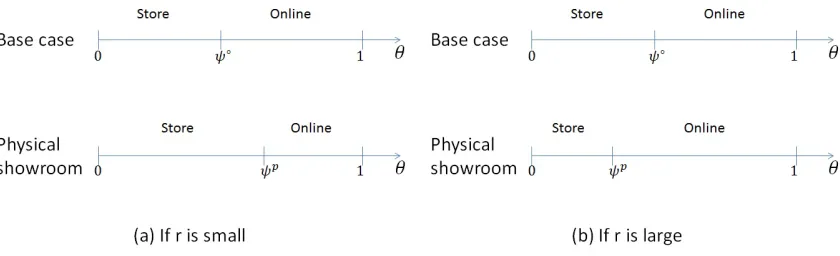
FIGURE 5 : Comparison of consumer behavior with and without physical
show-room . . . 47
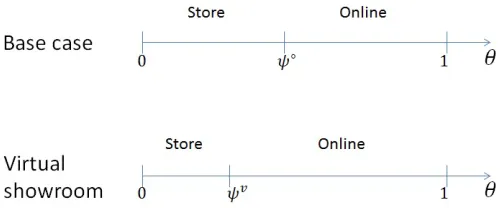
FIGURE 6 : Comparison of consumer behavior with and without virtual showroom 50
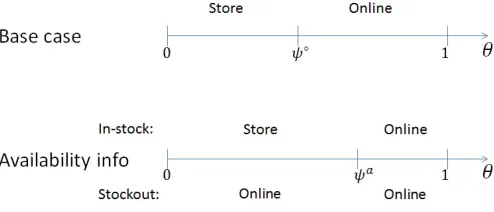
FIGURE 7 : Comparison of consumer behavior with and without availability
information . . . 53
FIGURE 8 : Impact of Online Self-Order Technology on Workforce Level . . . 79
FIGURE 9 : Do consumers buy the product in store? . . . 98
FIGURE 10 : Do strategic consumers buy the product in store? . . . 103
FIGURE 11 : Proportion of instances that physical showrooms backfire (i.e.,πo >
πp) . . . 129
FIGURE 12 : Proportion of instances that virtual showrooms backfire (i.e.,πo >
πv) . . . 130
FIGURE 13 : Proportion of instances that total workforce level increases after the
implementation of online self-order technology (i.e.,ko1+k2o> k1b+k2b)141 FIGURE 14 : Proportion of instances that total workforce level increases after the
implementation of offline self-order technology (i.e.,k1s+k2s> kb1+k2b)142 FIGURE 15 : Proportion of instances that online self-order technology generates
CHAPTER 1 : Introduction
The general topic of this dissertation is omnichannel operations management. Nowadays,
firms have many different channels to reach their customers. Instead of treating different
channels as independent silos, more and more firms realize the need to integrate different
channels to provide customers with a seamless shopping experience. This dissertation
stud-ies the impacts of various omnichannel strategstud-ies on consumer behavior and firm operational
efficiency through three essays.
In the first essay, we look at a specific omnichannel fulfillment strategy in the retail industry.
Many retailers have recently started to offer customers the option to buy online and pick
up in store (BOPS). We study the impact of the BOPS initiative on store operations. We
build a stylized model where a retailer operates both online and offline channels. Consumers
strategically make channel choices. The BOPS option affects consumer choice in two ways:
by providing real-time information about inventory availability and by reducing the hassle
cost of shopping. We obtain three findings. First, not all products are well-suited for
in-store pickup; specifically, it may not be profitable to implement BOPS on products that
sell well in stores. Second, BOPS enables retailers to reach new customers, but for existing
customers, the shift from online fulfillment to store fulfillment may decrease profit margins
when the latter is less cost effective. Finally, in a decentralized retail system where store
and online channels are managed separately, BOPS revenue can be shared across channels
to alleviate incentive conflicts; it is rarely efficient to allocate all the revenue to a single
channel.
In the second essay, we study how retailers can effectively deliver online and offline
infor-mation to omnichannel consumers who strategically choose whether to gather inforinfor-mation
online/offline and whether to buy products online/offline. Information resolves two types of
uncertainty: product value uncertainty (i.e., consumers realize valuations when they inspect
and availability uncertainty (i.e., store visits are futile when consumers encounter
stock-outs). We consider three information mechanisms: physical showrooms allow consumers to
learn valuations anytime they visit the store, even during stockouts;virtual showrooms give
consumers online access to an imperfect signal of their valuations; availability information
provides real-time information about whether the store is in stock. Our main results follow.
First, physical showrooms may prompt retailers to reduce store inventory, which increases
availability risk and discourages store patronage. Second, virtual showrooms may increase
online returns and hurt profits, if they induce excessive customer migration from store to
online channels. Third, availability information may be redundant when availability risk
is low, and may render physical showrooms ineffective when implemented jointly. Finally,
when customers are homogeneous, these mechanisms may not exhibit significant
comple-mentarities and the optimal information structure may involve choosing only one of the
three.
In the third essay, we shift focus to restaurant industry. Many restaurants have recently
im-plemented self-order technologies across both online and offline channels. Online technology,
through websites and mobile apps, allows customers to order and pay before coming to the
store; offline technology, such as self-service kiosks, allows store customers to place orders
without interacting with a human employee. In this essay, we develop a stylized
theoreti-cal model to study the impact of self-order technologies on customer demand, employment
levels, and restaurant profits. Our main results follow. First, customers using self- order
technologies experience reduced waiting cost and increased demand, and moreover, these
benefits may even carry over to customers who do not use these technologies. Second,
al-though public opinion suggests that self-order technologies facilitate job cuts, we find instead
that some firms should increase employment levels, and paradoxically, this recommendation
holds for firms with high labor costs. Finally, we find that firms should implement online
CHAPTER 2 : Omnichannel Retail Operations with
Buy-Online-and-Pick-up-in-Store
2.1. Introduction
As consumers become accustomed to online shopping, brick-and-mortar retailers have
in-creasingly supplemented their shops with online businesses (Financial Times, 2013). The
online channel has traditionally been viewed as a separate way to sell products. Today,
however, many retailers have realized the need to integrate their existing channels to
en-rich customer value proposition and improve operational efficiency. As a result, there is
an emerging focus on “omnichannel retailing” with the goal of providing consumers with
a seamless shopping experience through all available shopping channels (Bell et al., 2014;
Brynjolfsson et al., 2013; Rigby, 2011). When asked about omnichannel priorities, the
re-tailers surveyed by Forrester Research reported that fulfillment initiatives ranked higher
than any other channel integration program; moreover, among all omnichannel fulfillment
initiatives, allowing customers to buy online and pick up in store (BOPS) is regarded as the
most important one (Forrester, 2014). According to Retail Systems Research (RSR), as of
June 2013, 64% of retailers have implemented BOPS (RSR, 2013).
Retailers benefit from allowing customers to pick up their online orders in store.
Specifi-cally, BOPS generates store traffic and potentially increases sales (New York Times, 2011).
According to a recent UPS study, among those who have used an in-store pickup option,
45% of them have made a new purchase when picking up the purchase in store (UPS, 2015).
Typically, a substantial amount of store sales is generated through such cross-selling: it is
estimated that, on average, when a customer comes to the store intending to buy $100
worth of merchandise, they leave with $120 to $125 worth of merchandise (Washington
Post, 2015). Thus, unsurprisingly, more and more retailers are starting to offer the BOPS
functionality on their websites (RSR, 2013).
retailers generally agree that BOPS should not be a blanket functionality that is blindly
applied to all products across all categories. According to senior vice president and general
manager of Walmart.com, Steve Nave, one of the reasons for being selective is to focus on
those products that would “drive more customers into the stores” (Time, 2011). On the
websites of major retailers such as Toys R Us, customers will find that some products are not
eligible for BOPS. For example, new releases such as the LEGO Star Wars Sith Infiltrator
are not available for store pickup. These items are sold in stores, but shoppers need to check
their local stores for availability if they do not wish to wait for online delivery. In contrast,
for most of the extensive line of LEGO products sold on toysrus.com, the BOPS option is
available. Since retailers typically carry large numbers of SKUs online, a key challenge is
to understand the main criteria for selecting which product to allow for in-store pickup.
Many retailers regard BOPS as a way to reach new customers, as this new fulfillment option
has become increasingly popular among shoppers (New York Times, 2011). With BOPS,
consumers experience instant gratification, avoid shipping and delivery changes, and enjoy
the convenience of hassle-free shopping (their items have already been picked and packed
by store staff by the time they arrive). With this unique combination that has never
been offered before, it is not unrealistic for retailers to expect market expansion. However,
another more pessimistic view is that BOPS simply shifts customers from online fulfillment
to store fulfillment; customers who use BOPS would have purchased online anyway. To
understand the impact of BOPS on retailers’ bottom-lines, it is useful to distinguish between
the demand cannibalization and demand creation scenarios described above.
The advent of BOPS blurs the distinction between store and online operations. Although
BOPS orders originate online, they are fulfilled using inventory in retail stores.
Conse-quently, a successful BOPS implementation requires good coordination between the online
and offline channels. Very few retailers have completely dismantled their online and
of-fline channel silos, maintaining a single accounting ledger with an associated organizational
chan-nels are operated by separate teams, the company needs to decide how to allocate BOPS
revenue. On this subject, there is no consensus: 46% of retailers allow the online channel to
receive full credit for the transaction, 31% award full credit to the store channel, and 23%
divide them between channels (Forrester, 2014). This lack of consensus is not surprising,
since both channels have legitimate reasons to claim credit. The store incurs operating costs
for fulfilling demand, while the online channel is the source of demand in the first place.
In this chapter, we focus on the following research questions:
1. For what types of product will the BOPS option be profitable?
2. How does BOPS impact the retailer’s customer base?
3. How should BOPS revenue be allocated between store and online channels?
To address these questions, we develop a stylized model that captures essential elements of
omnichannel retail environments. There is a retailer who operates online and store channels,
with the goal of maximizing total expected profit over both channels. Consumers
strate-gically choose among buying online, buying in store, and buying online for store pickup,
to maximize individual utility. We first analyze the centralized system; specifically, for a
particular product with given financial parameters, we study optimal inventory decisions
under BOPS and examine the impact of BOPS on total profits. Using these results, we
de-termine whether a product should be carried in store and whether BOPS should be offered.
Finally, we consider the decentralized system and examine how to allocate BOPS revenue
between channels.
Our first main finding is that BOPS may not be suitable for all products. Specifically, for
products that are bestsellers in retail stores, the benefit of BOPS may be outweighed by the
drawback, which is as follows. Since products that are available for store-pickup must be
in stock, BOPS indirectly discloses real-time store inventory status. Customers initiating a
In this way, stockouts of blockbuster products may drive customers away, thus reducing
store traffic and cross-selling opportunities. In other words, BOPS may compromise the
function of bestselling products in attracting customers to the store.
Our second result is that BOPS helps retailers expand their market coverage. As BOPS
mitigates the stockout risk and hassle costs during the shopping journey, more people will be
willing to consider buying from the retailer. However, apart from attracting new customers,
BOPS can also sway the channel choices of existing customers. Among these existing
cus-tomers, some who had waited for their orders to be shipped to them (i.e., online fulfillment)
may now choose to pick up their orders (i.e., store fulfillment) instead. This shift is
unprof-itable if the profit margin is lower in stores compared to the online channel.
Finally, in decentralized systems where store and online channels are operated by separate
entities, we identify a misalignment of incentives. Specifically, the store neglects the fact
that potential BOPS customers may purchase online instead when there is no stock in the
store for them to pick up. Online sales generate value for the company but the store is not
explicitly compensated when they occur. Consequently, the store stocks too much inventory
if they retain 100% of BOPS revenue. To correct for this potential incentive problem, it is
optimal to give the store channel partial credit for fulfilling BOPS demand.
2.2. Literature Review
This chapter studies the management of online and offline channels. With the advent of
e-commerce around the turn of the century, many manufacturers or suppliers introduced a
direct online selling channel, which competes with their own retail partners. Much of the
literature on channel management studies this type of business setting. Chiang et al. (2003)
study a price setting game between a manufacturer and its independent retailer. They find
the manufacturer is more profitable even if no sales occur in the direct channel, because the
manufacturer can use the direct channel to improve the functioning of the retail channel
the retailer. Some other papers also study the pricing game, but are more concerned with
specific pricing mechanisms, e.g., price matching between channels (Cattani et al., 2006)
and personalized pricing (Liu and Zhang, 2006). Apart from pricing, Tsay and Agrawal
(2004) consider firms’ sales effort and find that both parties can benefit from the addition
of a direct channel. Chen et al. (2008) study service competition between the two channels
and characterize the optimal channel strategy for the supplier. Netessine and Rudi (2006)
study the practice of drop-shipping, where the supplier stocks and owns the inventory and
ships products directly to customers at retailers’ request. In contrast to this stream of
work, we focus on the case where a single retailer manages both online and store channels,
as commonly observed in retail environments today.
Omnichannel management has received a lot of attention in industry; the topic is broadly
surveyed in Bell et al. (2014), Brynjolfsson et al. (2013) and Rigby (2011). In addition,
there are a few other papers. Ansari et al. (2008) empirically study how customers migrate
between channels in a multichannel environment and the role of marketers in shaping
mi-gration through their communications strategy. Chintagunta et al. (2012) study consumer
channel choice in grocery stores and empirically quantify the relative transaction costs when
households choose between the online and offline channels. Ofek et al. (2011) focus on the
impact of product returns on a multichannel retailer, and use a theoretical model to
ex-amine how pricing strategies and physical store assistance levels change as a result of the
additional online outlet. Gallino and Moreno (2014) empirically investigate the impact of
BOPS on a retailer’s sales in both online and offline channels. Interestingly, they find that
instead of increasing online sales, the implementation of BOPS is associated with a
reduc-tion in online sales and an increase in store sales and traffic. While most papers in this area
are empirical, we develop a tractable theoretical framework. Using our model, we study
omnichannel inventory management and channel coordination within the firm.
There are models in operations management that study the role of inventory availability
when visiting stores. Dana and Petruzzi (2001) is the first paper that extends the classic
newsvendor model by assuming demand is a function of both price and inventory level.
Since then, many researchers have investigated how to attract people to pay the hassle
cost to come to the store: Su and Zhang (2009) show that it is always beneficial to the
retailer if he can credibly make an ex ante quantity commitment. Yin et al. (2009) compare
the efficacy of two different in-store inventory display formats to manipulate consumer
expectations on the availability. Allon and Bassamboo (2011) explore the issue of cheap
talk when the information shared by the retailer is not verifiable. Alexandrov and Lariviere
(2012) examines the role of reservations in the context of revenue management. Cachon
and Feldman (2015) focus on retailer’s pricing issue and find that a strategy that embraces
frequent discounts is optimal. In this chapter, we study a new way to attract customers to
store, BOPS, by which the retailer shares with customers the real-time information about
store inventory status.
A critical feature of our model is that customers will make additional purchases once they
enter the store. There are many papers in marketing (e.g., Li et al. (2005); Ak¸cura and
Srinivasan (2005); Li et al. (2011)) and operations management (e.g., Netessine et al. (2006);
Gurvich et al. (2009); Armony and Gurvich (2010)) examining how to make use of the
cross-selling opportunities during the interaction with consumers. In this chapter, instead
of studying the design of a cross-selling strategy, we will focus on the impact of cross-selling
benefits on the implementation of the new omnichannel fulfillment strategy, i.e., BOPS.
This chapter provides a different angle to the stream of work on strategic customer behavior
in retail management. Su (2007) study a dynamic pricing problem with a heterogeneous
population of strategic as well as myopic customers and show that optimal price paths could
involve either markups or markdowns. Aviv and Pazgal (2008) study two types of markdown
pricing policies (i.e., contingent and announced fixed-discount) in the presence of strategic
consumers. There is a rich body of work on operational strategies that consider strategic
(Su and Zhang, 2008), quick response (Cachon and Swinney, 2009), opaque selling (Jerath
et al., 2010), posterior price matching (Lai et al., 2010) and product rollovers (Liang et al.,
2014). Most of the existing literature consider models in which consumers decide whether
to make an immediate purchase or to wait for future discounts. In contrast, we concentrate
on consumers’ channel choice. In other words, instead of studying the decision of when to
buy, we pay attention to the decision of where to buy.
The topic of decentralization has been studied by many researchers in the operations
man-agement area. There are two streams of literature, focusing on interfirm and intrafirm
coordination. For the former, there is a large body of literature on the design of optimal
contracts to optimize supply chain performance; see, for example, Lee and Whang (1999);
Taylor (2002); Cachon and Lariviere (2005). Readers can refer to Cachon (2003) for a
com-prehensive review. The other research stream addresses conflicts of interest within a firm.
Harris et al. (1982) study an intrafirm resource allocation problem where different divisional
managers of the firm possess private information that is not available to the headquarters.
Porteus and Whang (1991) examine different incentive plans to coordinate the marketing
and manufacturing managers of the firm. A similar cross-functional coordination problem
is also studied by Kouvelis and Lariviere (2000). In retail assortment planning, Cachon and
K¨ok (2007) study category management, where each category is managed separately by
different managers. In line with this research stream, we look at incentive conflicts between
the store channel and the headquarters of an omnichannel retailer.
2.3. Model
There is a retailer who sells a product through two channels, store and online, at price p.
In the store channel, the retailer faces a newsvendor problem: there is a single inventory
decisionq to be made before random demand is realized, so there may eventually be unmet
demand or leftovers in the store. The unit cost of inventory is c, and the salvage value of
leftover units is normalized to zero. The online channel is modeled exogenously: the retailer
on store operations and can be separately applied to any particular product the retailer
carries.
The market demand D is random and follows a continuous distribution F and density f.
Consumers choose between store and online channels to maximize their utility. Each
indi-vidual consumer has valuationv for the product. When shopping in store, each consumer
incurs hassle cost hs (e.g., traveling to the store or searching for the product in aisles);
similarly, when shopping online, each consumer incurs hassle costho (e.g., paying shipping
fees or waiting for the product to arrive). There is a key difference between store and online
hassle costs: hs is incurred before customers find and purchase the product in the store,
whereasho is incurredafter customers make the purchase online. To ensure that consumers
are willing to consider both channels, we assume that both hassle costs are smaller than
the surplus v−p.
We first consider the scenario before BOPS is introduced; here, each consumer makes a
choice between shopping online directly or going to the store. If she chooses to buy online
directly, her payoff is simply given by
uo=v−p−ho.
On the other hand, if she chooses to go to the store, her payoff is
us=−hs+ ˆξ(v−p) + (1−ξˆ)(v−p−ho).
To understand this expression, note that the consumer first incurs the hassle costhsupfront.
Then, once she is in the store, she may encounter two possible outcomes: (1) if the store has
inventory, then she can make a purchase on the spot and receive payoffv−p; (2) if the store
is out of stock, she can go back to buying the product online and receive payoffv−p−ho.
The consumer expects the former to occur with probability ˆξ. Based on this belief, the
Next, we consider retailer’s decision problem. First, the retailer anticipates that a fraction
ˆ
φ∈[0,1] of customers will visit the store; i.e., if total demand isD, the retailer expects that
the number of customers coming to the store will be ˆφD. Given this belief, the retailer’s
profit function is
π(q) =pEminφD, qˆ −cq+rEφDˆ +wE1−φˆD+wEφDˆ −q+. (2.1)
Given the store inventory levelq, the newsvendor expected profit from selling the product
in the store channel is shown in the first two terms above. In addition, since customers
tend to make additional purchase when they come to the store (UPS, 2015; Washington
Post, 2015), there is an additional profitr from every customer coming to the store; this is
the third term in the profit function above. The last two terms above show the retailer’s
online profit, the fourth represents profit from customers who shop online directly and the
last represents profit from customers who switch to online after encountering stockouts in
store. With the profit function above, the retailer chooses q to maximize expected profit.
To study the strategic interaction between the retailer and the consumers, we shall use the
notion of rational expectations (RE) equilibrium (see Su and Zhang (2008, 2009); Cachon
and Swinney (2009)). One important feature of a RE equilibrium is that beliefs must be
consistent with actual outcomes. In other words, the retailer’s belief ˆφ must coincide with
the true proportionφof consumers choosing the store channel, and consumers’ beliefs over
in-store inventory availability probability ˆξ must agree with the actual in-stock probability
corresponding to the retailer’s chosen quantity q. According to Deneckere and Peck (1995)
and Dana (2001), this probability is given by A(q) = Emin(φD, q)/E(φD) where φ >0.
The reason is as follows. Conditional on her own presence in the market, an individual
consumer’s posterior demand density is g(x) =xf(x)/ED. Therefore, given this posterior
demand density, the availability probability isR (min (φx, q)/φx)g(x)dx=A(q), since the
product is available with probability min(φx, q)/φx when there are x consumers in the
to the RE equilibrium as “equilibrium” for brevity.
Definition 1. A RE equilibrium (φ, q,ξ,ˆ φˆ) satisfies the following:
i Given ξˆ, ifus≥uo, then φ= 1; otherwise φ= 0;
ii. Given φˆ, q = arg maxqπ(q), where π(q) is given in (2.1);
iii. ξˆ=A(q);
iv. φˆ=φ.
Conditions (i) and (ii) state that under beliefs ˆξ and ˆφ, consumers and the retailer are
choosing the optimal decisions. Conditions (iii) and (iv) are the consistency conditions.
First, it is easy to see that there always exists anonparticipatory equilibrium (0,0,0,0). If
the retailer expects no one comes to the store to buy the product, he will stock nothing
there, i.e.,q = 0; If consumers believe there is no inventory in the store, they will not come,
i.e., φ= 0. In the end, we have a self-fulfilling prophecy and beliefs are trivially consistent
with the actual outcome.
Is there any participatory equilibrium where consumers are willing to visit store and the
retailer has stock in the store as well (i.e., φ= 1 and q > 0)? When such an equilibrium
exists, it Pareto-dominates the nonparticipatory equilibrium, because it generates positive
payoffs for both the retailer and consumers. We shall adopt the Pareto dominance
equi-librium selection rule. The following proposition gives the equiequi-librium result; we use the
superscript (·◦) to denote the equilibrium outcome for this basic scenario. All proofs in this
dissertation are presented in Appendix A.7.
Proposition 1. If hs ≤ ξ◦ ·ho and p −c > w, then customers visit store and q◦ =
¯
F−1(p−cw). Otherwise, no one comes to store and q◦= 0. Here,ξ◦ = Emin
D,F¯−1 c p−w
ED is
the equilibrium in-stock probability at the store.
According to Proposition 1, in order to have positive sales in the store, we need to ensure
retailer, it is profitable for him to sell through the store channel only if he could get a
higher margin by selling offline than online (i.e., p−c > w). Nonetheless, even if store
fulfillment is attractive to the retailer, store sales can occur only if consumers are willing
to pay a visit to the store. The first condition of Proposition 1 ensures that: (i) the store
in-stock probability is large enough, and (ii) the online hassle cost dominates the store
hassle cost, so that when put together, consumers are willing to risk encountering stockouts
and come to the store. Under the conditions of Proposition 1, there is a participatory
equilibrium.
Now, we turn to the scenario where the retailer implements BOPS on the product. With
this added functionality, consumers assess information online and face one of two possible
situations. The first possibility is that the product is out of stock at the store and BOPS
is not an option; in this case, the consumer simply buys from the online channel. The
other possibility is that the product is in stock and BOPS is feasible; in this case, the
consumer chooses where to shop and we discuss this decision problem below. We stress that
with the introduction of BOPS, consumers no longer have to form beliefs about inventory
availability because this information is immediately accessible online. In other words, a
useful by-product of BOPS is inventory availability information, which is provided on a
real-time basis.
When BOPS is a viable option, the consumer faces a choice between three alternatives:
buy online, buy in store, or use BOPS. To distinguish between the last two options, we
introduce a new model parameterhb, which is the hassle cost associated with using BOPS.
Although BOPS consumers still need to go to the store after making their purchases online,
the process is different from buying in store; for example, BOPS consumers do not search
for products in store because their orders would already have been picked and packed by
store staff. Therefore, the BOPS hassle costhb differs from the store and online hassle costs
hs, ho. With this setup, all three alternatives yield the utilityv−p−hi, where the hassle
maximization boils down to choosing the shopping mode with the lowest cost. When the
online channel offers the lowest hassle cost, consumers never go to the store. When the
store hassle cost is lowest, consumers buy in store but only after verifying online that the
product is in stock. When the BOPS hassle cost is lowest, consumers place orders online
for store pickup.
We are now ready to write down the retailer’s profit function with BOPS. When consumers
choose to go to the store (i.e., when the online hassle costho exceeds either the store hassle
cost hs or the BOPS hassle cost hb), the profit function is
π(q) =pEmin (D, q)−cq+rEmin (D, q) +wE(D−q)+.
This is because when the store inventory level is q, there are on average Emin(D, q)
cus-tomers who come to the store, since they come to the store only when a corresponding unit
is available. The first two terms above correspond to the newsvendor profit from selling the
product and the third term corresponds to the additional cross-selling profit. Finally, when
demand exceeds store inventory, customers who find that the store is out of stock can still
choose to buy online; this yields the last term. In the other case where all consumers prefer
shopping in the online channel (i.e., when ho is the smallest hassle cost), the retailer will
stock nothing in the store (i.e.,q= 0) and earn an expected profitπ =wED.
We use superscript (·∗) to denote the market outcome with BOPS, which is given in the
following proposition:
Proposition 2. If min(hs, hb)≤ho and p−c > w−r, then customers visit the store and
q∗ = ¯F−1
c p+r−w
. Otherwise, no one comes to store and q∗= 0.
Proposition 2 (after BOPS) differs from Proposition 1 (before BOPS) in three significant
ways. First, the condition hs ≤ ξ◦ ·ho in Proposition 1 is weakened to min(hs, hb) ≤
ho in Proposition 2; in particular, the term corresponding to the in-stock probability ξ◦
the introduction of BOPS. Indeed, BOPS provides real-time inventory information that
essentially guarantees availability once an order is placed. In this way, BOPS attracts
consumers to the store. The second difference is that the conditionp−c > win Proposition
1 is weakened to p−c > w−r in Proposition 2. The former condition requires the margin
to be higher in store than online for the retailer to carry the product in store, but the latter
condition combines the store margin with the cross-selling benefit. In other words, BOPS
makes it more attractive for retailers to carry products in store; due to the cross-selling
benefit r, the retailer may wish to carry a product in store even when the store margin
is lower than the online margin. However, inventory now becomes more important: with
BOPS, the retailer loses both the product marginp−cas well as the cross-selling benefitr
in the event of a stockout. This brings us to the third difference between Propositions 1 and
2: the critical fractile and hence the in-stock probability is higher with BOPS. This occurs
because the underage cost increases from p−c−wtop−c−w+r after the introduction
of BOPS. Consequently, the retailer has the incentive to increase inventory to lure more
customers to the store.
In summary, we find that BOPS impacts store operations in two main ways. First, BOPS
expands the set of products that may be offered at the store. For such products, omnichannel
consumers who were previously unwilling to buy in store can be swayed by BOPS to visit
the store. These products may originally be online exclusives but are now profitable to bring
to retail stores. Second, for products that were originally carried at the store, BOPS leads
to an increase in the in-stock probability. In other words, the store channel stocks more
inventory, and would consequently end up with more leftover inventory. Excess inventory
appears to be an inevitable downside of BOPS implementations (Reuters, 2014); despite
this downside, the next section shows that BOPS may be accompanied by increased profits.
2.4. Information Effect and Convenience Effect
In this section, we compare the market outcomes before and after the introduction of BOPS
two main effects of BOPS, i.e., the information effect and the convenience effect.
Let us first describe the framework for our analysis. Based on Propositions 1 and 2, we note
there are three parameter regions. In some cases, consumers who were initially unwilling
to visit the store will find the trip more appealing after the BOPS option is made available.
In some other cases, BOPS will have no impact on channel choice: consumers always prefer
a particular channel regardless of the BOPS option. These possibilities are summarized in
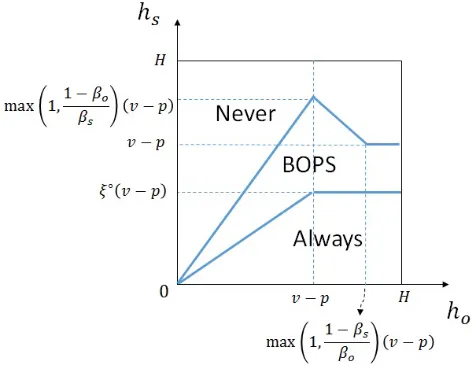
Figure 1 below. Specifically, our three parameter regions are as follows:
i. In the “Always” regions (i.e., hs ≤
EminD,F¯−1 c p−w
ED ho and p−c > w), consumers
always buy the product in store, regardless of the implementation of BOPS;
ii. In the “Never” regions (i.e., min(hs, hb)> ho orp−c≤w−r), consumers never come
to the store, preferring to buy the product online;
iii. In the “BOPS” regions (i.e.,hs> Emin
h
D,F¯−1 c p−w∧1
i
ED ho, min(hs, hb)≤hoandp−c >
w−r), consumers come to the store only if BOPS is available. The “BOPS” regions
are further labeled “Information” or “Convenience” as discussed below.
Figure 1: Do consumers buy the product in store?
(a)hb> hs (b)hb≤hs
In the following analysis, we will examine the impact of BOPS on the retailer’s profit by
separately considering different parameter regions in Figure 1. We begin with the following
Proposition 3. Ifhs∈
EminhD,F¯−1 c p−w∧1
i
ED ho, ho
#
andp−c > w−r, then customers visit
the store only if BOPS is available. Further, BOPS increases total profit (i.e., π∗ > π◦).
The conditions in Proposition 3 correspond to the “BOPS” regions labeled “Information”
in Figures 1a and 1b. In these parameter regions, BOPS influences consumer shopping
behavior through the information sharing mechanism discussed in the previous section.
By revealing real-time information about store inventory status, BOPS draws additional
customers to the store; these customers were previously unwilling to visit the store because
they were discouraged by the possibility of stockouts. In such cases, Proposition 3 confirms
that BOPS leads to increased profit for the retailer. This increase in profit arises because
the store profit marginp−c, combined with the cross-selling benefit r, exceeds the online
margin w. In other words, through information provision, BOPS brings about a demand
shift to the more profitable store channel.
There is a subtle difference between the two “BOPS (Information)” regions of Figures 1a
and 1b. Although demand shifts to the store in both cases, they occur in different ways.
In the “BOPS (Information)” region of Figure 1a, since the pickup hassle cost hb exceeds
the store hassle cost hs, offering BOPS induces consumers to buy in store after verifying
availability online, without actually using the BOPS functionality. On the other hand, in
the corresponding region of Figure 1b, consumers indeed buy online and pick up in store
when the option is available. We separately discuss these two behaviors in the next two
paragraphs.
When consumers verify availability online without actually using the BOPS functionality,
BOPS simply serves as a source of information. The same market outcome arises if the
re-tailer simply provides real-time availability information on the website (i.e., directly showing
whether or not store is in stock). This strategy has been adopted by retailers such as Gap
and Levi’s. Our model can be applied to study this pure information sharing mechanism,
an interesting dynamic: after the implementation of BOPS as an added online
functional-ity, online sales may decrease, while store sales may increase. This phenomenon was first
identified by Gallino and Moreno (2014), who undertake a comprehensive empirical study
of a US retailer with a recent BOPS implementation.
On the other hand, when the pickup process is relatively hassle-free, consumers will indeed
buy online and pick up in store. In this case, apart from eliminating the risk of stockouts as
described above, BOPS also provides consumers with a more convenient means of shopping.
In this sense, comparing the two “BOPS (Information)” regions in Figures 1a and 1b,
consumer surplus is higher in the latter than in the former.
The next proposition examines the “BOPS” region labeled “Convenience” in Figure 1b.
Proposition 4. If hb≤ho< hs and p−c > w−r, customers visit the store only if BOPS
is available. Further, BOPS increases total profit (i.e., π∗ > π◦).
The above result highlights the importance of shopping convenience for BOPS to attract
consumers to the store. By additionally providing convenience, BOPS becomes more
pow-erful than a pure information sharing mechanism. In the “BOPS (Convenience)” region of
Figure 1b, a pure information sharing mechanism can never attract customers to the store;
even if customers are guaranteed availability in store, they still prefer to buy online because
the online hassle cost is lower than the store hassle cost (i.e., ho < hs). However, once
BOPS is available and provides convenience that trumps an online order (i.e., hb < ho),
customers may prefer to buy online and pick up in store. This shopping mode benefits the
retailer because customers may buy additional products (yielding profitr) when they pick
up their products. As long as the store margin p−cand cross-selling benefit r exceeds the
online margin w, the convenience dimension of BOPS will lead to increased profit for the
retailer.
Proposition 4 provides a word of caution for retailers. Although making the pickup process
should exercise care in preserving the cross-selling benefit. In particular, some retailers
have introduced drive-through service that allows customers to receive their orders without
leaving their cars (New York Times, 2012; Bloomberg, 2012). Although this will help to
reduce hassle in the pickup process, it will also prevent people from entering the store and
thus lead to a loss of the cross-selling benefit r. According to Proposition 4, if the margin
from selling this particular product in the store is very high (i.e., p−c > w), then it is
still profitable for the retailer to implement BOPS even ifr = 0. However, if profit margins
are lower in store than online, then the cross-selling profit r plays an important role; in
this case, drive-through service may hurt the retailer’s overall profit by neutralizing the
advantages of cross-selling.
There is a delicate balance between pickup convenience and cross-selling potential. While
consumers appreciate a more convenient pickup process, retail managers wishing to make
the most out of the cross-selling opportunity may choose to locate the pick-up counter at
far corners of the store so that shoppers have to walk through the entire store before picking
up their online orders (Retail Dive, 2015). This tradeoff is illustrated in Figure 2. At one
extreme, setting the pickup counter at the back of store maximizes both pickup cost hb
and cross-selling benefit r (i.e., the dotted L-line). At the other extreme, providing drive
through pickup service minimizes both hb and r (i.e., the dashed L-line). As both hb and
r increase, the L-line in Figure 1 moves up and left, and the “BOPS” region changes. The
optimal location of the L curve depends on retailer’s portfolio of products. According to
Figure 2, if most of the retailer’s products have high store profit margins (i.e.,p−cis large)
and can be easily purchased online (i.e., ho is small), then the retailer should seek to make
the pickup process more convenient; in contrast, if most of the retailer’s products have low
store profit margins (i.e.,p−cis small) and are difficult to purchase online (i.e.,hois large),
then setting the pickup counter far from the store entrance is a better strategy.
The next proposition tells a different side of the story. Although BOPS brings about many
Figure 2: Impacts of BOPS hassle costhb and cross-selling benefit r
Proposition 5. If hs ≤
Emin
D,F¯−1 c p−w
ED ho and p−c > w, customers visit the store
regardless of the implementation of BOPS. Further, if r > 0, then BOPS decreases total
profit (i.e.,π∗ < π◦).
The conditions of Proposition 5 correspond to the “Always” regions in Figures 1a and 1b.
In these regions, consumers choose to visit the store regardless of BOPS. Here, BOPS has
an important but easily overlooked effect. Prior to the introduction of BOPS, all customers
were already willing to visit the store, but after BOPS is made available, fewer consumers
will come to the store. This is because customers who attempt to place an order online but
find that the item is not in stock for pickup will no longer go to the store. As store traffic
decreases, the retailer loses the potential profit from cross-selling. The loss of cross-selling
benefits (i.e., wheneverr >0) leads to a reduction in total profits, as shown in Proposition
5. Since BOPS can be selectively implemented, our result suggests that the BOPS option
should not be offered on products that have been attracting considerable demand to the
store.
Our results differ from existing findings in the literature because we study a different
infor-mation sharing mechanism. In our model, BOPS provides real-time inforinfor-mation about the
store inventory status, i.e., customers are informed that the product is available until
inven-tory runs out. However, in Su and Zhang (2009), the focus is on quantity commitment, i.e.,
the retailer may be able to use a small amount of store inventory to attract a large number
of customers to visit the store. In particular, when the cross-selling benefit is very large, the
retailer may still choose to stock the product in the store even if it is more profitable to sell
online, with the hope of attracting customers to make additional purchases in store. Such
a “loss leader strategy” is no longer feasible when the retailer implements BOPS, because
customers have access to real-time store inventory information and will not visit the store
after the product is out of stock. Therefore, we find that BOPS, by providing real-time
inventory information, may decrease profits, while Su and Zhang (2009) find that quantity
commitment is generally valuable.
In summary, BOPS has two effects: it provides customers with real-time information about
in-store inventory availability and it introduces a new shopping mode that may add
conve-nience to customers. The former effect (information effect) helps attract customers to the
store by letting them know about inventory availability, but it is a double-edged sword in
that when inventory is not available, it turns away customers who might be willing to visit
the store. The latter effect (convenience effect) applies when customers use the store pickup
functionality, as opposed to simply using BOPS as a source of availability information; it
draws customers to the store and may even open up new sources of demand.
When put together, the information and convenience effects of BOPS yield different profit
implications. Figures 1a and 1b present a clear distinction: in the “BOPS” regions, BOPS
leads to higher profits, but in the “Always” regions, BOPS leads to lower profits. The
difference between these two regions is that, prior to the introduction of BOPS, consumers
were already willing to visit the store in the latter but not in the former. These results
suggest that BOPS should be offered for products with weak store sales but not those with
strong records to begin with. In other words, it is likely profitable to implement BOPS on
2.5. Heterogeneous Customers
In this section, we incorporate customer heterogeneity. For example, some customers may
reside further away from the store than others; some may be more impatient than others
and are thus more averse to waiting for online delivery. In our model, the store and online
hassle costs hs, ho may now differ across customers. Specifically, customers are uniformly
distributed across the following “square”{(hs, ho)|hs∈[0, H], ho ∈[0, H]}, whereH > v−p
(i.e., some customers have a prohibitively high hassle cost in one channel). The goal is to
study the impact of BOPS on a retailer’s customer base in such a heterogeneous market.
We begin by considering the scenario in the absence of BOPS. In this case, each customer
has three options: go to the store, buy online, or leave the market. The corresponding
utilities are:
us = −hs+ ˆξ(v−p) + (1−ξˆ)u+o,
uo = v−p−ho,
ul = 0,
where ˆξdenotes the belief about store inventory availability as before. Note that customers
who find the store out of stock will buy online only if doing so is preferred over leaving the
market. As customers make utility-maximizing choices (which depend on their hassle costs
hs, ho), the market is divided into four segments, as depicted in Figure 3(a). Specifically,
there are “pure online” customers (who buy online directly), “store→online” customers (who
visit the store but switch online when the store is out of stock), “pure store” customers (who
visit the store exclusively), as well as customers who simply leave the market. Denote the
fractions of these four types of customer as αo, αso, αs, and αl, respectively. Given that
consumers are uniformly distributed in {(hs, ho)|hs ∈[0, H], ho ∈[0, H]}, we can find that
αo = vH−p −
ˆ
ξ(v−p)2
2H2 ,αso= ˆ
ξ(v−p)2 2H2 ,αs =
ˆ
ξ(v−p)(H−(v−p))
H2 , and αl =
[H−(v−p)][H−ξˆ(v−p)]
On the supply side, the retailer faces the following profit function:
π(q) =pEmin (( ˆαs+ ˆαso)D, q)−cq+rE( ˆαs+ ˆαso)D
+wEαˆoD+wEαˆsαˆ+ ˆsoαso(( ˆαs+ ˆαso)D−q)+
(2.2)
where ˆαo, ˆαso, ˆαs, and ˆαl denote the retailer’s beliefs over theα’s above. Given the store
inventory level q, the newsvendor expected profit from selling the product in the store
channel is shown in the first two terms above. The third term captures the additional
cross-selling profit r from every customer coming to the store. The last two terms above show
the retailer’s online profit. The fourth represents profit from customers who shop online
directly; the last represents profit from customers who switch to online after encountering
stockouts in store, in which case we assume store customers have equal chance of being
rationed. With the profit function above, the retailer chooses q to maximize expected
profit.
Definition 2. A RE equilibrium (αo, αso, , αs, αl, q,ξ,ˆαˆo,αˆso,αˆs,αˆl) satisfies the following:
i Given ξˆ, then αo = vH−p −
ˆ
ξ(v−p)2
2H2 , αso =
ˆ
ξ(v−p)2
2H2 , αs =
ˆ
ξ(v−p)(H−(v−p))
H2 , and αl =
[H−(v−p)][H−ξˆ(v−p)]
H2 ;
ii. Given αˆo,αˆso,αˆs and αˆl, q= arg maxqπ(q), where π(q) is given in (2.2);
iii. ξˆ=A(q), where A(q) = Emin((αs+αso)D,q)
E(αs+αso)D ;
iv. αˆs =αs, αˆo =αo, αˆso=αso and αˆl=αl.
The following proposition gives the RE equilibrium. As before, we use the superscripts ·◦
and ·∗ to denote the no-BOPS and BOPS scenario, respectively.
Proposition 6. If p −c > w2H−v−(vp−p), then there are customers visiting store (α◦s =
ξ◦(v−p)(H−(v−p))
H2 >0, α◦so =
ξ◦(v−p)2
2H2 >0) and q◦ = (α◦s+α◦so) ¯F−1
c p−w2H−v−(vp−p)
, where
the equilibrium store in-stock probability is ξ◦ =
min D,F¯−1 c p−w v−p
2H−(v−p)
!!
ED . Otherwise, no
Next, we turn to the scenario where the retailer implements BOPS on the product. When a
customer uses BOPS, she experiences hassle in both online and offline worlds. For example,
she needs to go through the online payment process and she also has to go to the store
to pick up the product. As a result, we assume the hassle cost of using BOPS is given by
hb = βshs+βoho, where βs, βo ∈ (0,1). Further, as explained before, all customers have
access to information about store inventory status before they visit the store.
Now, we consider customer choice in the presence of BOPS. There are two cases to consider.
First, when the store is in stock, the consumer faces a choice between four alternatives: buy
online (with payoffv−p−ho), buy in store (with payoffv−p−hs), use BOPS (with payoff
v−p−hb), or leave (with payoff 0). Based on their individual hassle costs, consumers
choose their shopping mode with the highest payoff. Second, when the store is out of stock,
only customers with ho < v−p will choose to buy online, while the rest will leave. With
the above decisions, the market is divided into six segments, as depicted in Figure 3(b).
In addition to the four segments described before, we now see “BOPS→online” customers
(who use BOPS if the store is in stock but switch online otherwise) and “pure BOPS”
customers. Denote the fraction of these two new types of customer as α∗bo and α∗b. We can
calculate the sizes of these six customer segments as follows:
αi∗=
Z Z
A∗i
1
H2dhsdho, i=o, so, s, l, bo, b
where
A∗o={(hs, ho)|v−p−ho>max(v−p−hs, v−p−hb,0)}
A∗so={(hs, ho)|v−p−hs>max(v−p−ho, v−p−hb,0), v−p−ho>0}
A∗s={(hs, ho)|v−p−hs>max(v−p−ho, v−p−hb,0),0> v−p−ho}
A∗l ={(hs, ho)|0>max(v−p−ho, v−p−hs, v−p−hb)}
A∗bo={(hs, ho)|v−p−hb >max(v−p−ho, v−p−hs,0), v−p−ho>0}
Figure 3: Market Segmentation with and without BOPS
Next, the retailer’s profit function can be expressed as follows:
π(q) =pEmin ((α∗s+α∗b +αso∗ +α∗bo)D, q)−cq+rEmin ((α∗s+αb∗+α∗so+α∗bo)D, q)
wEα∗oD+wE α
∗ so+α∗bo
α∗
s+α∗b +α∗so+α∗bo
((α∗s+α∗b+αso∗ +α∗bo)D−q)+
To understand this expression, note when the store inventory level isq, there are on average
Emin((α∗s+α∗b +αso∗ +α∗bo)D, q) customers who come to the store, since they come to the
store only when a corresponding unit is available. The first two terms above correspond
to the newsvendor profit from selling the product and the third term corresponds to the
additional cross-selling profit. The last two terms represent the profit from the online
channel: the fourth term is the profit from those who buy online directly, while the fifth
term is the profit from those who prefer to go to store but buy online instead because of
store stockouts.
Proposition 7. When there is BOPS, the market outcome is given as follows:
• if p−c > w α ∗ so+α∗bo
α∗
s+α∗b+α∗so+α∗bo
−r, then there are customers visiting store and
q∗= (α∗s+α∗b +α∗so+α∗bo) ¯F−1 c
p+r−w α
∗ so+α∗bo α∗s+α∗
b+α∗so+α∗bo
!
;
• if p−c≤w α ∗ so+α∗bo
α∗
s+α∗b+α∗so+α∗bo
With a homogeneous population of customers, we identified three possible scenarios (as
shown in Figure 1 in Section 2.4). Consumers may: (i) always visit the store, (ii) never visit
the store, or (iii) visit the store only after BOPS is implemented. With a heterogeneous
consumer population, these types of behavior may coexist, as shown in Figure 4 (which
is obtained from comparing Figures 3(a) and 3(b)). In other words, there are three types
of customers, each exhibiting a specific response to BOPS. Moreover, the retailer’s profit
from each type of customer follows the same pattern as before. If a consumer always visits
the store (as those in the “Always” region), then the retailer’s profit from this customer
decreases after BOPS is implemented; she stops coming to the store once she knows that the
store is out of stock and thus the retailer loses the potential cross-selling benefit. Next, if a
consumer visits the store only after BOPS is implemented (as those in the “BOPS” region),
then BOPS increases retailer’s profit. Finally, if a consumer never shops in the store (as
those in the “Never” region), then offering BOPS does not affect the retailer’s profit.
Figure 4: When do consumers go to store?
The next proposition shows the impact of BOPS on the retailer’s overall customer base.
Proposition 8.
i. BOPS helps to expand market coverage, i.e.,α∗s+α∗o+α∗b+α∗so+α∗bo> α◦s+α◦o+α◦so;
exists w¯ such that the implementation of BOPS decreases total profit (i.e., π∗ < π◦)
if βs+βo<1 andw >w¯.
Before BOPS is implemented, customers who face high hassle costs in both store and online
channels do not consider purchasing from the retailer. Part (i) of Proposition 8 shows that
BOPS could provide a way for the retailer to reach these customers. By alleviating the risk
of stockouts and reducing the hassle of shopping, BOPS could attract some new customers
to join the market. This market expansion effect could also be seen from the reduction of
the “leave” region in Figure 3(b) compared to Figure 3(a).
While reaching out to new customers, BOPS may change the behavior of existing customers.
Specifically, the more convenient BOPS is, the more existing online customers will choose
to pick up their orders in store; this shift will hurt profits if the store profit margin is lower
than the online profit margin. This potential drawback of BOPS may exist even whenr= 0,
as shown in Proposition 8(ii). In other words, apart from possibly eliminating cross-selling
opportunities (when r >0) as discovered earlier, BOPS has another potential drawback of
shifting demand to a less profitable store channel.
2.6. Decentralized System
In this section, we study the scenario where the store and online channels are operated by
two separate teams, with the goal of understanding how BOPS revenue should be allocated.
We begin by examining the case with homogeneous customers and then later extrapolate our
findings to the case with heterogeneous customers. (A detailed analysis of the decentralized
system for the heterogeneous market is given in Appendix A.1.) We assume that the
conditions in Proposition 2 hold (i.e., min(hs, hb)≤ho andp−c > w−r) and BOPS hassle
cost is lowest (i.e.,hb<min(hs, ho)); otherwise, there would be nobody using BOPS and the
issue of revenue allocation becomes irrelevant as the system collapses into two independent
channels.
words, for every customer who purchases online and picks up in the store, the store earns
θpfrom selling the product. Note that once the customer comes to the store, the store could
also get an additional profit r through cross-selling. Therefore, the total revenue that the
store could receive from fulfilling each unit of BOPS demand is θp+r. Then, the store’s
expected profit as a function of the stocking decision ˜q is given below. Here, we use the
“tilde” symbol (˜·) to denote the decentralized case.
˜
πs= (θp+r)Emin (D,q˜)−cq˜
Proposition 9. In the decentralized system, the store will stockq˜∗ which is given as follows:
• If θp+r−c >0, then q˜∗= ¯F−1θpc+r;
• If θp+r−c≤0, then q˜∗= 0.
In practice, according to the survey conducted by Forrester Research (Forrester, 2014), the
two most common revenue sharing schemes are either giving the store full credit (i.e.,θ= 1)
or letting the online channel keep all the revenue (i.e., θ= 0). According to Proposition 9,
whenθ= 1, the store will definitely stock the product to serve BOPS users, because he can
not only receive a positive profit margin from selling this particular product, but he may
also be able to cross sell other products to those who come to store for pickup. However, if
θ= 0, BOPS customers represent a pure cost to the store; then, the store may choose not
to stock the product in store, unless the cross-selling benefit is large enough to offset the
loss from serving BOPS customers (i.e., r > c).
What is the optimal share of BOPS revenue that should be allocated to the store? We
use ˜π∗(θ) to denote total profit in the decentralized system with revenue allocation θ.
For any given θ, the next proposition compares decentralized and centralized inventory
decisions and shows that the store is usually either overstocked or understocked, relative to
the centralized benchmark. However, there is an optimal revenue share, under which the
Proposition 10. Total profit π˜∗(θ) is quasiconcave in θ. Moreover,
• if θ < p−pw, then q˜∗ < q∗ and π˜∗(θ)< π∗;
• if θ= p−pw, then q˜∗ =q∗ and π˜∗(θ) =π∗;
• if θ > p−pw, then q˜∗ > q∗ and π˜∗(θ)< π∗.
Proposition 10 points out an incentive conflict between the store channel and the retail
organization. If the store channel obtains a large share of BOPS revenue, they tend to
stock too much. This is because the store channel considers only store profits but neglects
the fact that customers may still be willing to shop online after the store runs out of
inventory for customers to pick up. In contrast, if the store is allocated only a small share
of BOPS revenue, they tend to stock too little. Since the store channel incurs the inventory
cost for fulfilling BOPS demand, it is natural to suppress inventory to decrease exposure
to potential losses. In general, it is optimal to give the store partial credit for the revenue
earned from BOPS customers. In fact, our result also shows that such a simple revenue
sharing mechanism is sufficient for the retailer to fully coordinate the store and online
channels.
Proposition 10 shows that the optimal revenue shareθ∗ = p−pw coordinates the decentralized
system and achieves the centralized optimal profit π∗. With this optimal revenue share,
the incentives of the store channel are aligned with the entire organization. According to
Proposition 9, the decentralized store channel holds stock if and only if θp+r−c > 0.
However, from the perspective of the entire organization, as we have shown in the previous
section, it is optimal to stock the product in the store as long asp−c > w−r, i.e., whenever
the store marginp−c, combined with the cross-selling benefitr, exceeds the online margin
w. The revenue share θ that aligns both sets of incentives is preciselyθ∗ = p−pw.
Note that the optimal share for the store channelθ∗= p−pw is decreasing in w. The reason