R E S E A R C H
Open Access
Efficient non-uniform deblurring based
on generalized additive convolution model
Hong Deng, Dongwei Ren, David Zhang, Wangmeng Zuo
*, Hongzhi Zhang and Kuanquan Wang
Abstract
Image with non-uniform blurring caused by camera shake can be modeled as a linear combination of the homographically transformed versions of the latent sharp image during exposure. Although such a geometrically motivated model can well approximate camera motion poses, deblurring methods in this line usually suffer from the problems of heavy computational demanding or extensive memory cost. In this paper, we develop generalized additive convolution (GAC) model to address these issues. In GAC model, a camera motion trajectory can be decomposed into a set of camera poses, i.e., in-plane translations (slice) or roll rotations (fiber), which can both be formulated as convolution operation. Moreover, we suggest a greedy algorithm to decompose a camera motion trajectory into a more compact set of slices and fibers, and together with the efficient convolution computation via fast Fourier transform (FFT), the proposed GAC models concurrently overcome the difficulties of computational cost and memory burden, leading to efficient GAC-based deblurring methods. Besides, by incorporating group sparsity of the pose weight matrix into slice GAC, the non-uniform deblurring method naturally approaches toward the uniform blind deconvolution. Experimental results show that GAC-based deblurring methods can obtain satisfactory
deblurring results compared to both state-of-the-art uniform and non-uniform deblurring methods and are much more efficient than non-uniform deblurring methods.
Keywords: Camera shake, Image deblurring, Non-uniform deblurring, Blind deconvolution, Fast Fourier transform
1 Introduction
Image blur is generally inevitable due to various fac-tors such as defocus and camera shake. Blind deblurring from a real-world blurry image that needs to estimate the blur procedure and latent sharp image is a very ill-posed problem. Recently, several hardware-assisted approaches had been developed [1–6], by which additional infor-mation can be acquired to reduce the ill-posedness of the blind deblurring. These hardware-assisted approaches can provide much easier deviation of the blur or sharp image, but require complex camera configurations [1, 2] or dedicatedly designed hardware support [3–6], far from taking the place of traditional imaging devices. At the same time, in the era of ubiquitous acquisition of dig-ital images using portable imaging devices, e.g., digdig-ital camera, mobile phone, camera shake is often unavoid-able during exposure procedure, a major cause that ruins
*Correspondence: [email protected]
School of Computer Science and Technology, Harbin Institute of Technology, 92 West Dazhi Street, 150001 Harbin, China
a photograph. For effective and efficient deblurring, it is crucial to develop appropriate forward blur model that can well explain the image degradation process of camera shake and then to design proper regularizers and efficient optimization algorithms.
Earlier approaches on camera shake deblurring usually assume that the blur is spatially invariant, due to which the blurry observation can be simply modeled as con-volution of sharp image and blur kernel, and deblurring can thus be modeled as a blind deconvolution prob-lem [7–12], where much attention had been devoted to design effective optimization algorithms. Since the con-volution operation can be computed efficiently via fast Fourier transform (FFT), these blind deconvolution algo-rithms are commonly efficient. On one hand, Fergus et al. [7] adopted a mixture of Gaussians for representing the distribution of gradients and introduced a variational Bayesian (VB) approach [13] to estimate the blur kernel. The theoretical and experimental analysis by Levin et al. [8] demonstrated the advantages of VB over maximum a posterior (MAP) and inspired a number of VB-based
blind deconvolution algorithms [7, 8, 14, 15]. On the other hand, by enforcing sparser priors [10, 16, 17] or exploiting edge prediction step [9, 18–21] to select salient edges in latent image, several carefully designed MAP algorithms can also exhibit promising performance. Most recently, discriminative learning approaches had been developed to learn proper priors for better estimating blur kernel [22–25].
However, camera shake blurring is often spatially vary-ing and consequently cannot be simply modeled as a single blur kernel. Thus, how to reasonably model camera shake blurring plays a central role in non-uniform deblur-ring problem that can be categorized from two aspects. One direct strategy is to approximate the non-uniform blur as multiple blur kernels, where the blurry image is divided into several regions, and each region takes uni-form blur. The multiple blur kernels can then be estimated from each region by performing uniform blind deconvolu-tion method locally [26, 27]. The method proposed by Cao et al. [27] incorporated natural and text-specific dictionar-ies for the blind deblurring of natural scene text image. For non-uniform deblurring, they simply adopted the strat-egy of estimating the dedicated blur kernel for each text field. However, this kind of approach does not consider the global constraints on local blur kernels based on cam-era motion trajectory. The other geometrical strategy is based on the projective motion path blur model (PMPB) [28], where a camera shake trajectory can be decomposed into a sequence of camera poses lying in the 6D camera pose space (x-,y-,z-axes rotation andx-,y-,z-axes transla-tion), and consequently, the sharp image projected by each pose is a homography, which is then weighted accord-ing to its exposure time, resultaccord-ing in the blurry image. By far, there are mainly two simplified 3D geometrical models to approximate the 6D subspace, i.e., Whyte et al. [29] suggested to employ x-(pitch), y-(yaw), and z-(roll) axes rotation, while Gupta et al. [30] proposed to adopt x- andy-axes (in-plane) translation andz-axis rotation. By combining the global camera motion constraint and the efficient filter flow (EFF) framework [31], Hirsch et al. sug-gested to construct local uniform blur models guided by the geometrical constraint [32].
Even in the simplified 3D camera pose subspace [29, 30], non-uniform deblurring methods still suffer the prob-lem of high computational cost or extensive mem-ory burden, placing prominent restriction on its wide applications. To speed up the blur estimation step, Gupta et al. [30] pre-computed a sparse matrix for each homography transform, and thus, the forward non-uniform blur operator can be equivalently defined as the weighted sum of the homography transform matri-ces, and Hu and Yang [33] further restricted the possible camera pose in a low dimensional subspace. Although the pre-computation techniques can relatively relax the
computational inefficiency, these accelerated methods [30, 33] take increasing memory burden to store the huge homography transform matices. Even so, subsequent computation of homography transform matrices is still computationally costly, and thus, it is interesting to ask thatis it possible to design forward blur model to benefit from FFT for efficient non-uniform deblurring?
In this paper, we propose generalized additive convolu-tion (GAC) model, by which a camera moconvolu-tion trajectory can be decomposed into in-plane translations (slice) or roll rotations (fiber), resulting in slice GAC model or fiber GAC model. In slice GAC model, a homography is formulated as the rotation of the convolution image of slice and sharp image, and in fiber GAC model, a homography is the inverse polar transform of the con-volution of a kernel with the transformed sharp image (please refer to Section 3.2 for detailed proof ), in which the convolution operation can be efficiently computed with the help of FFT. By this way, the GAC-based for-ward blur models only require several FFTs and a number of pixel-wise operations, significantly reducing computa-tional complexity, and concurrently only the basis kernels and a number of rotation matrices are required to be stored so that the problem of memory burden is also relaxed. Furthermore, a greedy algorithm is proposed to generate a more compact set of slices and fibers from any camera motion trajectory, resulting in hybrid GAC model, a more promising way to concurrently solve the problems of computational inefficiency and memory burden. As for the optimization algorithm, we adopt the MAP frame-work to alternatively estimate non-uniform blur and latent image, in which generalized accelerated proximal gradi-ent (GAPG) algorithm [34], a much efficigradi-ent optimization algorithm for non-blind deconvolution, is employed for GAC-based non-uniform deblurring.
Moreover, in slice GAC, we introduce group spar-sity, i.e.,l2,1-norm, on the pose weight matrix along the rotation angle dimension, interestingly providing a way to make non-uniform deblurring approach toward uni-form blind deconvolution. Under alternative minimiza-tion framework, we also propose an effective soluminimiza-tion to solve this problem. With the group sparsity constraint, more slices with rotation angles around 0 can be activated, and extremely when all the slices except angle 0 are inac-tivated, the non-uniform delburring method can degrade to uniform blind deconvolution.
We summarize our contributions as follows:
(1) We develop GAC framework together with two GAC models, i.e., slice GAC and fiber GAC, for forward modeling of camera shake blurring, by which FFT can be employed for efficient computation. (2) To further reduce the computational complexity, a
greedy algorithm is proposed to generate hybrid GAC from any camera motion trajectory, resulting in a more compact GAC model.
(3) As for the optimization algorithm, we adopt a fast gradient method, i.e., GAPG [34], to estimate latent image, contributing to the faster convergence of the deblurring algorithm.
(4) By imposing group sparsity of pose weight matrix in slice GAC, we interestingly provide a way to connect uniform and non-uniform deblurring.
The rest of the paper is organized as follows. Section 2 provides a brief review on camera shake models and optimization algorithms. Section 3 presents the pro-posed GAC models, which in Section 4 are embedded in non-uniform deblurring, and can be efficiently solved via GAPG. Section 5 presents experimental results, and finally, Section 6 concludes this paper.
2 Prerequisites and related work
For efficient non-uniform deblurring, it is crucial to design forward blur models and efficient optimization algorithms. In this section, we briefly review the original projective motion path blur (PMPB) model and its simpli-fied 3D approximation, and the optimization algorithms in MAP-based deblurring.
2.1 Homography-based model
In the PMPB model, a camera shaken image is geometri-cally the integration of what the camera “sees” along the motion trajectory that can be modeled in a 6D camera pose space includingx-,y-, andz-axes rotation andx-,y-, and z-axes translation. With the discretion of the time t and camera pose space, the integration can be rewrit-ten as the weighted summation of all homographies in the discrete camera pose space, where a homography is the transformed sharp image projected by corresponding camera pose.
For each posejalong the camera motion trajectory, the corresponding homography can be represented as:
Hj=C
whereC is the matrix of camera intrinsic parameters,d is the depth of the scene, andRj andtj are the rotation matrix and translation vector, respectively.
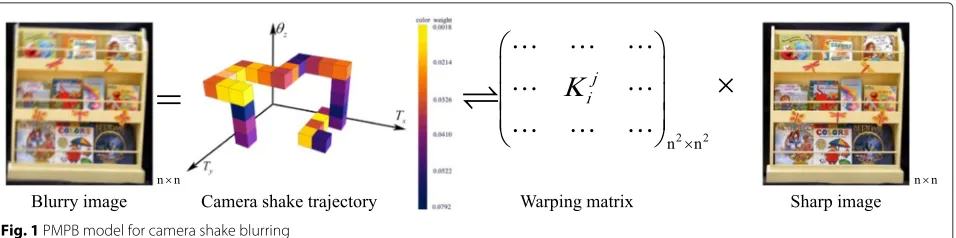
GivenHj, we can construct the corresponding warping matrixKj. Figure 1 shows a flowchart of PMPB model, and the PMPB model treats the process of non-uniform blur as a summation over the images transformed by the warping matrix
b=
jwjKjx+v=Kx+v (2)
wherewjis the fraction of time the camera spent at posej,
b∈Rn×nis the blurry image,x∈Rn×nis the latent sharp image,K is the sparse warping matrix with sizen2×n2, andvdenotes the additive Gaussian white noise.
PMPB is faithful to real-world camera motion, but has too many unknowns to be estimated. Fortunately, recent studies have shown that the full 6D camera pose space can be well approximated by the discrete 3D subspace of pitch, yaw, and roll rotations [29], or the 3D subspace of in-plane translations and roll rotation in wide focal lengths range [30], which are both effective [35]. In [33], constrained camera pose subspace was further introduced to refine the set of camera poses. Interestingly, the global camera motion constraint can be adopted to guide the construc-tion of local blur kernels [32]. However, the method in [29] suffers from the problem of heavy computational load to compute huge warping matrices, while the methods in [30, 33] suffer from the extensive memory burden prob-lem to store huge warping matrices.
2.2 Additive convolution model
Deng et al. [36] suggested an additive convolution (AC) model for non-blind deblurring, where non-uniform blur is modeled as the weighted summation of the convolution of the sharp image with a set of basis convolution kernels
b=C
i=1αi◦(x⊗ki) (3) whereki is thei-th basis convolution kernel,αi denotes thei-th weight matrix,⊗denotes the convolution oper-ation, ◦ denotes the pixel-wise multiplication operator, andCis the number of basis convolution kernels. With FFT, the computational complexity of AC model is only O(Cn2logn). Furthermore, principal component analysis (PCA) is adopted to learn the basis convolution kernels in advance. However, when applied to blind non-uniform deblurring, both the basis kernels and the weighted maps should be updated in each iteration, making it unpractical in blind deblurring of camera shaken images.
Fig. 1PMPB model for camera shake blurring
the global geometric model rather than the locally uni-form approximation. Compared with [36], the basis con-volution kernels and the weighted maps can be efficiently constructed based on the camera motion trajectory, and thus is easy to update.
2.3 MAP-based blind deblurring
Given the blurry imageb, MAP strategy is usually adopted to estimate the blur K and the latent sharp image x by minimizing the negative logarithm of posterior probabil-ity with respect toKandx,
−logp(K,x|b)∝ −logp(y|K,x)−logp(x)
−logp(K) (4)
∝1
2K x−b
2+1(x)+2(K)
where1(x) denotes the regularizer on the latent sharp image and2(K)denotes the regularizer on the blur oper-ator. For non-uniform blur, K x = jwjKjx, where the blur operator is parameterized by the weights wj. Like the alternative updating strategy commonly adopted in uniform blind deconvolution [16, 18], the estimation of weight matrix W and latent imagex should be alterna-tively performed.
To constrain the ill-posed problem for better deblur-ring quality, proper regularizers should be imposed. In 3D camera pose subspace, only a few poses are active given a camera motion trajectory so that it is reasonable to intro-duce sparsity onW. In [29, 33],l2-norm of weight matrix or its gradient is imposed, where the estimation of W
is a linear least square problem, which can be solved by gradient-based optimization method, while in [30], non-convex regularizer is introduced, which is optimized by an iterative re-weighted least squares (IRLS).
As for updating the latent clear image, the edge predic-tion step is usually necessary to guarantee the algorithm converge to the desired solution, so that the sparsity, e.g., total variation [29, 33], is also imposed. In earlier researches, simple but efficient optimization method, e.g., Rachardson-Lucy (RL) algorithm, was adopted to solve the problem [28]; however, the deblurring results often
suffer from ringing artifacts. As a non-blind deconvolu-tion problem, fast gradient-based optimizadeconvolu-tion method has been intensively studied [37, 38]. The iterative shrink-age thresholding algorithm (IST) [37] was first proposed, and due to its simplicity and efficiency, two accelerated IST-based algorithms had been developed, i.e., FISTA [39] and TwIST [38], which both possess higher convergence rate. Furthermore, Zuo and Lin proposed the GAPG algo-rithm [34], which further accelerated the convergence rate of APG algorithm.
In this paper, the GAC-based deblurring problem is solved in the alternative minimization framework, where the updating of pose weight matrix with both sparsity and group sparsity regularizers can be solved, and the updat-ing of latent clear image can be efficiently solved by GAPG algorithm.
3 Generalized additive convolution model for camera shake
In this section, we first propose the general form of the GAC model and then decompose camera motion trajec-tory into slices and fibers, which provides a solution to specify GAC model for efficient modeling of camera shake blurring. Finally, we propose a greedy algorithm to gen-erate hybrid GAC model and discuss the memory and computational complexity of the GAC model.
3.1 Generalized additive convolution model
The form of the GAC model is defined as
b=C
i=1fi
gi(x)⊗ki (5)
where fi and gi are two pixel-wise operators. GAC is the generalization of the AC model [36], by defining
3.2 Decomposition of slice and fiber
In this subsection, we show that camera poses in the 3D camera pose subspace [30] can be decomposed into slices and fibers, which then provides proper choices to design
ki,fi, andgiin GAC model to reduceCvalue.
In the 3D camera pose subspace [30], pose in a camera motion trajectory is parameterized as
θ =θz,tx,ty (6)
whereθzis the roll angle andtxandtyare the translations alongx- andy- axes, respectively. For each pose in the 3D camera subspace,θj=
the homography [40] can be defined as:
Hθj =CMθjC
As in [30, 33], we also assume that the camera intrin-sic parameters are known in advance, and the calibration matrix has the standard form:
C= distance,mx_ccdis the maximum width of the CCD,mx_im is the maximum width of the related image,αy=f∗mmyy_ccd_im is quantified in the same manner,f is the focal length, and (x0,y0)is the center coordinate.
GivenHθj, we can construct the corresponding warping
matrixKθj (more detailed explanations can be found in
[30, 33, 36]). We then have that the homography transform can be decomposed into in-plane translation followed by roll rotation, yielding the following proposition.
Proposition 1.
ofxto the pixel located at
[lx1,lx2, 1] ofKθjx. Based on Eq. (10),H
Proposition 1 indicates thatKθjxis the combination of
two atom operations, i.e., first translating the imagexby tx,jandty,jalongx-axis andy-axis respectively, and then rotating the translated image by roll angleθz,j. So we can rewriteKθj,rxandKθj,txas
Kθj,rx=Rθz,j(x) (11)
Kθj,tx=ktj⊗x (12)
whereRθz,j denotes the pixel-wise image rotation
opera-tion, and the translation convolution kernel is defined as
ktj(x,y)
1, ifx=tx,jandy=ty,j
0, else (13)
The non-uniform forward blur model Eq. (2) can be further formulated as
Kx=
θjwθjKθjx=
θjwθjKθj,rKθj,tx (14)
where wθj denotes the contribution (weight) of pose θj.
It should be noted that the poses along a real camera motion trajectory form a connected 1D path, and thus, the weights of most poses are zeros. So in Eq. (14), we can only consider the subset of poses with positive weights,
P =θj:wθj >0
.
Finally, we define two special classes of subsets of P: slice and fiber. A slice Sθ is defined as Sθ = {θj = {θz,j,tx,j,ty,j} : θj ∈ P andθz,j = θ}, while a fiber
Ft is defined as Ft = {θj = {θz,j,tx,j,ty,j} : θj ∈
following, we will introduce how to construct slices and fibers fromPand how to reformulate camera shake as the GAC model.
3.3 Slice-based GAC
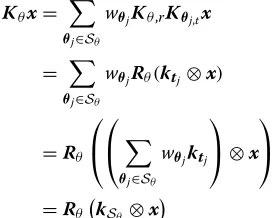
Figure 2 shows an example of a slice of camera poses which have the same roll angle. Given a sliceSθ, the blur caused by camera motion withinSθ can be formulated as
Kθx=
θj∈Sθ
wθjKθ,rKθj,tx
=
θj∈Sθ
wθjRθ(ktj⊗x) (15)
=Rθ
⎛ ⎝ ⎛
⎝
θj∈Sθ
wθjktj
⎞
⎠⊗x
⎞ ⎠
=RθkSθ ⊗x
wherekSθ denotes the slice kernel with respect to the roll angleθ.
For a general camera motion trajectoryP, we first clas-sify the poses inPinto a number of non-intersected slices with P = ∪θ{Sθ}, and then, the non-uniform blur in
Eq. (14) can be equivalently reformulated as
Kx=
θRθ
kSθ ⊗x (16)
It is obvious that this is a GAC model with fθ(x) = Rθ(x)andgθ(x) =x. If the range of the roll angles is dis-cretized intonzintervals, we can see that the numberCin slice GAC should be not higher thannz.
Similarly, we can define the adjoint operatorKTyas
KTy=
θk˜Sθ⊗R T
θ(y) (17)
where k˜Sθ is the adjoint operator of kSθ constructed by flipping thekSθ upside-down and left-to-right, andRTθ is the strict adjoint operator of the discrete version ofRθ. It
Fig. 2Poses of a camera motion trajectory which form a slice
is obvious that the adjoint operator in Eq. (17) is also a GAC model and can be efficiently computed.
Finally, we discuss some implementation issues of slice GAC. To implementRθ, one can simply adopt the Matlab commandimrotate. To enhance the efficiency, we main-tain a lookup table (LUT) for each discrete roll angle to record the correspondence of the coordinates before and after rotation. By discretizing the range of roll angles into nz intervals, we pre-compute and store nz LUTs. In the continuous case,R−θ is the adjoint operator ofRθ, but in the discrete case, the error caused by discretization and interpolation cannot be overlooked. Thus, instead of using
R−θ, we adopt the strictly adjoint operatorRTθ.
3.4 Fiber-based GAC
Figure 3 shows an example of a fiber of camera poses which have the same translation t =[tx,ty]T, which applies a visual validation of our fiber-based GAC model. Given a fiber Ft, the non-uniform blur caused by the camera motion alongFtcan be formulated as
Ktx=
θj∈Ft
wθjKθj,rKθj,tx
=
θj∈Ft
wθjRθz,j(Kθj,tx) (18)
=IPTwt⊗PT(Kθtx)
whereθt =[ 0,tx,ty]T,Kθtxdenotes the in-plane transla-tion operatransla-tion, and PT(·)and IPT(·)stand for the polar transform and inverse polar transform [41], respectively.
(a)
Fiber(b)
Sharp image(c)
Gupta et al.(d)
F-GACIn the polar transform, we use the same interval to dis-cretize angular and roll angles, and thus, the basis filterwt can be defined as
whereθ1is the minimal roll angle andθnzis the maximal roll angle.
We compare the model in Eq. (18) with the 3D cam-era pose subspace model in [30] for the simulation of blur caused by camera shake along a fiber. Figure 3 shows the blurry images obtained by using these two methods. One can easily see that the difference between Fig. 3c, d is insignificant, which demonstrates that the model in Eq. (18) can be used for modeling camera shaken image with a series of roll rotations.
For a general camera motion trajectoryP, we first clas-sify the poses inPinto a number of non-intersected fibers with P = ∪t{Ft}, and then, the non-uniform blur in Eq. (14) can be equivalently reformulated as
Kx= plane translations is discretized into nx × ny intervals, then the number C in fiber GAC should be not higher thannxny.
We can then define the adjoint operatorKTyas
KTy= are the adjoint operators of PT and IPT, respectively. To enhance the computational efficiency, two extra LUTs are pre-computed to record the correspondence of polar and inverse polar transform, respectively. Moreover, we use the strict adjoint operators of PT and IPT, i.e., PTT and
IPTT, to avoid the inconsistence caused by discretization and interpolation.
3.5 Hybrid GAC for modeling
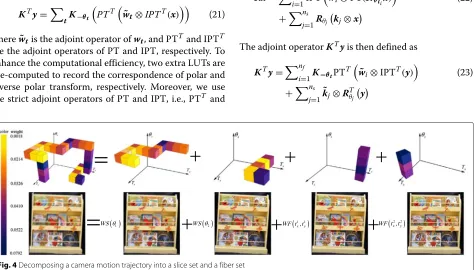
For GAC, the key to save computational cost is to reduce C, the number of basis filters. Given a general cam-era motion trajectory as shown in Fig. 4, neither pure slice-based nor pure fiber-based GAC can guarantee suf-ficiently small value of C. However, in a hybrid (slice and fiber mixed) decomposition, only two slices and two fibers are required to model the camera motion trajec-tory, so that the computational complexity is significantly reduced. Thus, we propose a greedy method to decom-pose a camera motion trajectory into a hybrid set of slices and fibers to reduce theCvalue.
Given the pose subset P and the 3D weight matrix
W with W(θz,tx,ty), the weight of the pose θ =
θz,tx,ty , in each iteration, the proposed method first finds a candidate slice Sθˆ
z, and a candidate fiberFˆtx,tˆy,
compare their relative contributions, and then choose the slice or fiber with higher weights. By this way, we can obtain a slice set θj,Sj,kj :j=1, ...,ns and a fiber set ti,Fi,wj :i=1, ...,nf
. As shown in Fig. 4, the proposed greedy algorithm can successfully decom-pose the camera motion trajectory into two slices and two fibers. The detailed algorithm is summarized in Algorithm 1.
Based on the slice set and the fiber set, the non-uniform caused by camera shake can be reformulated as
Kx=nf
The adjoint operatorKTyis then defined as
KTy=nf
Algorithm 1Greedy algorithm for hybrid GAC
α, null fiber set and null slice set.
2: whilee/e0> εdo
With FFT, the computational complexity of the model in Eq. (22) isO((ns+nf)n2log2n). Ifnsandnfare small, GAC would be more efficient than the other methods. Letnzbe the number of intervals for the roll angle. It is reasonable to assume that(ns+nf) <nz; otherwise, we can use the pure slice-based GAC model.
To further improve the computational efficiency, the LUT method can be adopted for fast image rotation, polar and inverse polar transform, and nz + 2 LUTs should be pre-computed and stored in memory. In [30, 33], a sparsen2×n2matrix was constructed for each pose in the 3D camera pose subspace. Compared with the model in [30, 33], GAC can achieve much better tradeoff between memory and computational complexity.
In [32], camera shake blurring is approximated as the sum of R2 uniformly blurry patches, and the computa-tional complexity of the model in [32] is O(R2(n/R + w)2log2(n/R+w)), wherew×w is the size of the blur kernel. Compared with [32], when R andw are higher, GAC would be computationally more efficient, and our experimental results also validates the efficiency of GAC against the model by Hirsch et al. [32]. Moreover, the model in [32] is a locally uniform approximation of the camera shake blurring model, while GAC can be strictly equivalent with the geometric model in [30].
4 GAC-based non-uniform deblurring
In this section, by incorporating the proposed GAC for-ward blur model into existing deblurring model, the
GAC-based non-uniform deblurring can be efficiently solved. Then, by imposingl2,1-norm regularizer on pose weight matrixW, the slice GAC deblurring can approach toward uniform blind deconvolution.
4.1 GAC-based deblurring via GAPG
In typical non-uniform deblurring methods, TV reg-ularizer on latent image and l2-norm regularizer on pose weight matrix are imposed, yielding the deblurring formulation
where λ and τ are trade-off parameters. By substitut-ing the forward blur model with any GAC model, we come to the GAC-based non-uniform deblurring method, which can be solved by alternatively updating pose weight matrix W and latent clear image x. By fixing x, we use the method in [33] to update W, while by fixing W, we develop an efficient solution to x based on GAPG algorithm.
In [34], GAPG was developed to solve uniform non-blind deblurring, where the Lipschitz constant is general-ized to diagonal matrix that can guarantee faster conver-gence rate. By introducing two auxiliary variablesdhand
dv, we reformulate the TV-based model into the following equivalent problem
λmax ≤√μK2+ √ηDh2+ √ηDv2 2withη=1, Dh2 ≤ 2, andDv2 ≤ 2 [34]. The diagonal Lipschitz matrix is
Lf =diag(λmaxI,ηI,ηI) (27)
By using smallerλmaxandη, GAPG algorithm will con-verge faster. For non-uniform blur, we chooseK2 = 1 based on the following proposition.
Proposition 2.
K2≤1
Proof.In matrix analysis, we have
K2≤
K1K∞
where ·1 and·∞ denote the largest l1-norm of the columns and rows, respectively. For the uniform blur pro-cedureb=Kx, where each row ofK is a shifted version constraint ki ≥ 0,∀i and the normalization constraint
iki =1,l1-norm of any blur kernel is 1, i.e.,||k(i,j)||1= 1. Thus, we have ||K||∞ = 1. Similarly, ||K||1 = 1 can be derivated from [34]. Thus, the inequality is proved.
The updating of subproblems should be performed sev-eral iterations. With the properly chosen Lipschitz matrix, each variable has it own Lipschitz constant, rather than the largest one adopted in APG algorithm, so that the GAPG-based deblurring method has a faster convergence rate.
4.2 Connection with uniform blind deconvolution
We impose group sparsity, i.e., l2,1-norm, on weight matrixW along roll angle dimension to connect GAC-based non-uniform deblurring and uniform blind decon-volution
whereτθjis the trade-off parameter controlling the weight of all slices with angleθj, and by settingτθj=0< τθi,∀i>j,
the slices with larger rotation angle will be gradually inac-tivated, and naturally, the non-uniform deblurring will approach toward uniform blind deconvolution.
To solve the this problem, we also adopt the alternative minimization strategy, where the updating of latent clear image shares the same solution via GAPG as Section 4.1. Due to the non-smoothness ofl2,1-norm regularizer, we propose an effective solution to solve it. By introducing auxiliary variableW, the problem can be reformulated as
min
where δ is the positive penalty parameter. For the W -subproblem, it is also a linear least square problem, which can be efficiently solved [33], and for theW-subproblem, it is a standardl2,1-norm optimization problem, which can be solved by group shrinkage operator [42].
The slice GAC with group sparsity provides a natu-ral connection of non-uniform deblurring and uniform deconvolution. When there are only camera in-plane translations, i.e., no roll rotation, the camera shake blur-ring will be uniform, and the slice GAC can play like the traditional uniform blind deconvolution method. Other-wise, roll rotations will cause the non-uniform blur, where slice GAC can play like non-uniform deblurring method.
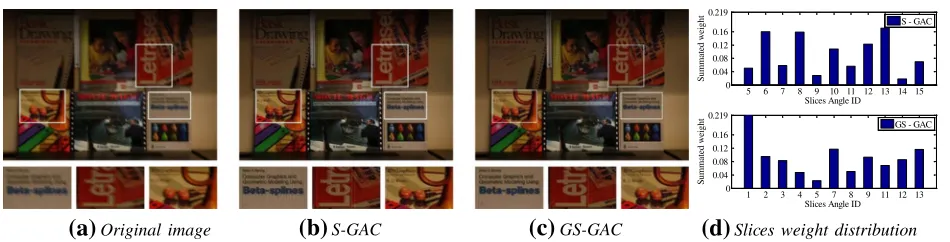
Figure 5 shows a deblurring example of the standard slice GAC (S-GAC) and slice GAC with group sparsity
(a)
Original image(b)
S-GAC(c)
GS-GAC5 6 7 8 9 10 11 12 13 14 15
(a)
Books(b)
Butcher Shop(c)
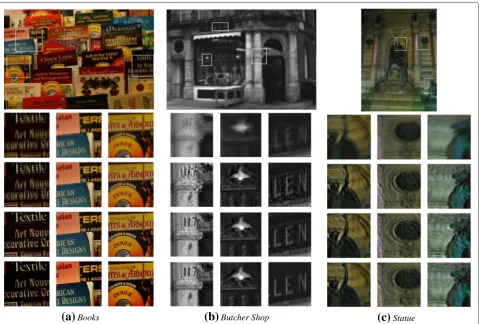
StatueFig. 6The results of different GAC models on three real camera-shaken images. For the close-ups, fromtoptobottom rowsare the input real camera-shaken images, deblurring results by F-GAC, deblurring results by S-GAC, deblurring results by H-GAC.aBooks.bButcher shop.cStatue
(GS-GAC) on a real camera-shaken image. From the dis-tribution of pose weights shown as Fig. 5d, the group sparsity constrains the slices gathering at small rotation angles, where especially slices with angle 0 dominate, while in slice GAC, the activated poses are more randomly distributed. Thus, for the blurry image with slight roll rotation shown as Fig. 5a, GS-GAC performs much better than S-GAC, significantly suffering less artifacts.
5 Experimental results
In this section, we evaluate the performance of proposed GAC deblurring methods. First, three GAC variants, i.e., slice-based GAC (S-GAC), fiber-based GAC (F-GAC),
and hybrid GAC (H-GAC), are compared in terms of com-putational time, memory usage, and visual quality. Due to its superiority over S-GAC and F-GAC, H-GAC is then compared with the state-of-the-art geometrical methods, i.e., Whyte et al. [29], Gupta et al. [30], and Hu and Zhang [33], and the state-of-the-art EFF-based methods, i.e., Hirsch et al. [32], Xu et al. [16], and Cao et al. [27]. Finally, in the comparison with the state-of-the-art uni-form deblurring methods [9, 21, 24, 43], slice GAC with GS-GAC is adopted. All the experiments are conducted on a PC with Intel Core i5-2400 3.10 GHz CPU and 16 G RAM memory, and the proposed method is implemented in Matlab.
Table 1Running time (s) and peak memory usage (GB) of different GAC models
Image ID Image size Time Memory
F-GAC S-GAC H-GAC F-GAC S-GAC H-GAC
Books 512×768 947 698 543 1.71 1.75 1.60
Butcher Shop 401×601 486 403 351 0.95 0.97 0.97
(a)
Cabin(b)
Car-in-yard(c)
Dim-Petrol-Station(d)
Petrol-Station(e)
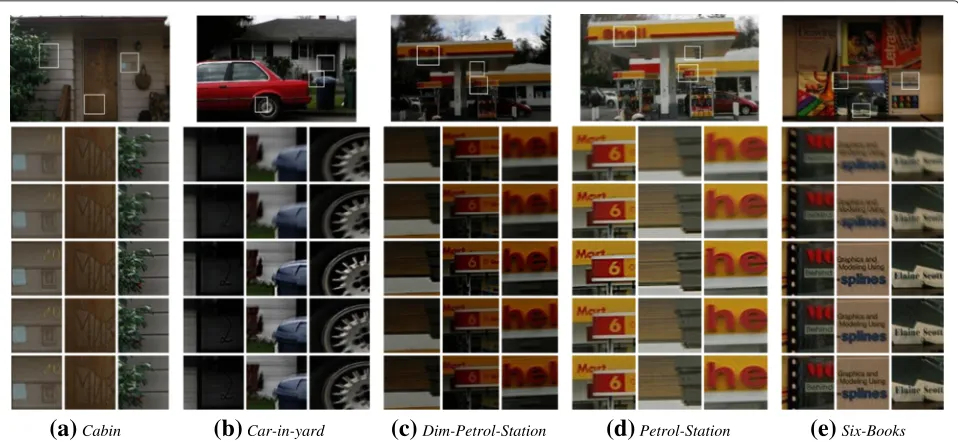
Six-BooksFig. 7Visual comparison of GAC model with three geometrical methods on five images. Fromtoptobottom rows: blurry images, close-ups of blurry images, deblurring results of Whyte et al. [29], Gupta et al. [30], Hu and Yang [33], and GAC, respectively.aCabin.bCar-in-yard.cDim-Petrol-Station. dPetrol-Station.eSix-Books
5.1 Comparison of three GAC variants
On three real-world camera-shaken images shown as Fig. 6, three GAC variants are evaluated in terms of run-ning time and memory usage. As shown in Table 1, the three GAC methods have comparable peak memory cost to each other, while in terms of running time, H-GAC is more efficient than both S-GAC and F-GAC, since the set of slices and fibers decomposed by H-GAC is usually more compact, thus having lower computational complexity.
From the restoration quality shown as Fig. 6, H-GAC and S-GAC perform better than F-GAC in recovering more details and achieving more visual plausible deblur-ring quality. Due to its superiority over both S-GAC and F-GAC, H-GAC is adopted in the following comparison with non-uniform deblurring methods.
5.2 Comparison with geometrical methods
We use five real-world camera-shaken images, shown in the top row of Fig. 7, to compare GAC with three
Table 2Running time (s) of the four geometrical methods
Image ID Image size Whyte Gupta Hu and GAC et al. et al. Yang
Cabin 512×768 98,872 7789 2113 514 Car-in-yard 512×768 87,527 8829 7495 531 Dim-Petrol-Station 512×768 88,767 8512 2512 596 Petrol-Station 406×679 89,673 7982 1402 308 Six-Books 512×768 96,732 7356 2601 572
geometrical methods, i.e., Whyte et al. [29], Gupta et al. [30], and Hu et al. [33], where their deblurring results are obtained by running source codes or executable programs provided by authors. Although GAC costs more mem-ory than that of Whyte et al.’s [29] shown as Table 2, it is at least 100× faster, and in terms of deblurring qual-ity shown as Fig. 7, GAC performs much better than that of Whyte et al.’s [29] in achieving clearer and plausible texture details. At the same time, Gupta et al.’s [30], Hu and Yang’s [33], and the proposed GAC model actually adopt the same 3D subspace to approximate the full 6D camera pose space and consequently can obtain the simi-lar deblurring results. Thus, it is more critical to evaluate their performance in terms of computational efficiency and memory usage. Tables 2 and 3 show that GAC not only is at least 2.5× faster but also significantly relaxes memory burden than Gupta et al.’s [30] and Hu and Yang’s [33].
Table 3Peak memory usage (GB) of the four geometrical methods
Image ID Image size Whyte Gupta Hu and GAC et al. et al. Yang
Cabin 512×768 1.00 14.00 10.06 2.06
Car-in-yard 512×768 0.98 14.04 10.20 1.93
Dim-Petrol-Station 512×768 0.91 13.98 10.20 1.03
Petrol-Station 406×679 0.92 14.01 8.25 1.44
(a)
Butcher shop(b)
Coke(c)
Statue(d)
Books(e)
Sixbooks(f)
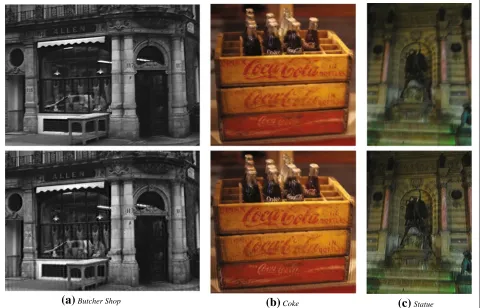
DimpetrolstationFig. 8Set of real camera-shaken images for comparing with non-geometrical methods
5.3 Comparison with non-geometrical methods
Using the images in Fig. 8, we further compare GAC with four non-geometrical methods proposed by Harmeling et al. [44], Hirsch et al. [32], Xu et al. [16], and Cao et al. [27].
Since neither source code nor executable program of Harmeling et al. [44] and Hirsch et al. [32] is available, we collected the deblurring results from their papers or web-sites. The non-geometrical methods greatly rely on the reasonability of region division and often sacrifice image details to smooth out possible artifacts at region bound-aries. As shown in Fig. 9a, b, GAC can achieve more visually plausible deblurring results, while the results by Harmeling et al. [44] and Hirsch et al. [32] are visually
over-smoothed. Although the method by Cao et al. [27] is designed for better recovering clear text, the camera shake blurring in text field is not fully removed and sig-nificant artifacts are included in the results, like the first two images in Fig. 10. Moreover, GAC also performs bet-ter than the method by Cao et al. [27] in text-less fields. Xu et al. [16] and Cao et al. [27] respectively provided the exe-cutable program and source codes, so in Table 4, we report the CPU running time and memory usage comparison with Xu et al. [16] and Cao et al. [27] on several camera-shaken images shown in Fig. 8, from which one can see that GAC also performs better than Xu et al. or Cao et al. [27]. As for deblurring quality shown as Fig. 9c, GAC can
(a)
Butcher Shop(b)
Coke(c)
Statue(a)
Original(b)
Cao et al.(c)
GACFig. 10Deblurring effect comparison with Cao et al. [27].aOriginal.bCao et al. [27].cGAC
Table 4Running time (s) and peak memory usage (GB) comparison of Cao et al. [27] and hybrid GAC
Image ID Image size Time Memory
Xu et al. Cao et al. GAC Xu et al. Cao et al. GAC
Butcher shop 401×601 922 1520 351 2.24 0.43 1.50
Coke 680×731 1434 800 952 4.54 0.66 3.61
Statue 710×523 1334 4236 716 2.90 0.48 1.67
Books 512×768 4698 2053 596 2.94 0.54 2.03
Sixbooks 512×768 2270 3786 572 2.91 0.55 1.95
obtain comparable if not superior deblurring result than Xu et al. [16].
5.4 Comparison with uniform deblurring methods
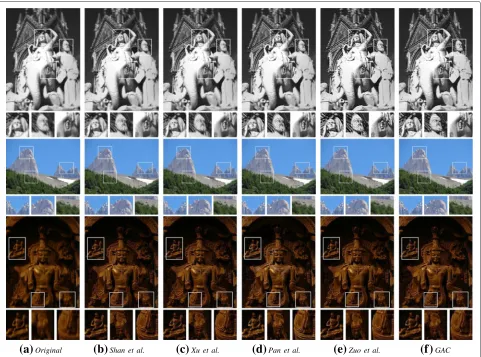
In the comparison experiments with the state-of-the-art uniform deblurring methods, i.e., Shan et al. [9], Xu et al. [21], Zuo et al. [24], and Pan et al. [43], we adopt GS-GAC, which performs better in handling spatially invariant blurry images. In Fig. 11, the first image is of non-uniform blur with slight roll rotations, from which one can see that GAC can achieve more visually plausible deblurring results, such as the statue’s face is recovered more clearly, while the uniform deblurring methods usu-ally suffer from ringing artifacts. Then, on two spatiusu-ally invariant blurred images, GAC can also achieve satisfac-tory deblurring results, since the imposed group sparsity enforces the GAC method to play like uniform deblurring method.
6 Conclusions
In this paper, by designing GAC model to geometrically represent camera shake blurring, non-uniform deblurring is efficiently addressed. Since the slices and fibers decom-posed from the camera motion trajectory can be formu-lated as convolution, all the GAC methods can exploit FFT for efficient optimization. Compared with the meth-ods in [30, 33], the proposed method only needs several FFTs and to store several basis convolution kernels and look-up-tables in memory. By incorporating group spar-sity into pose weight matrix, the GAC-based deblurring methods can also work like uniform blind deconvolu-tion, better handling uniform blurry images. Compared with non-uniform deblurring methods, GAC method has a much lower peak memory usage and is much more efficient. Compared with uniform deblurring methods, GAC method also can achieve satisfactory deblurring results.
(a)
Original(b)
Shan et al.(c)
Xu et al.(d)
Pan et al.(e)
Zuo et al.(f)
GACCompeting interests
The authors declare that they have no competing interests.
Acknowledgements
This work is supported in part by NSFC grants (61271093, 61471146, 61173086) and the program of ministry of education for new century excellent talents (NCET-12-0150).
Received: 4 August 2015 Accepted: 3 February 2016
References
1. S McCloskey, Y Ding, J Yu, Design and estimation of coded exposure point spread functions. IEEE Trans. Pattern Anal. Mach. Intell.34(10), 2071–2077 (2012)
2. S McCloskey, inECCV. Velocity-dependent shutter sequences for motion deblurring (Springer, Crete, Greece, 2010)
3. A Levin, R Fergus, F Durand, WT Freeman, Image and depth from a conventional camera with a coded aperture. ACM Trans. Graph.26(3), 70 (2007)
4. N Joshi, SB Kang, CL Zitnick, R Szeliski, Image deblurring using inertial measurement sensors. ACM Trans. Graph.29(4), 30 (2010)
5. Y-W Tai, H Du, MS Brown, S Lin, Correction of spatially varying image and video motion blur using a hybrid camera. IEEE Trans. Pattern Anal. Mach. Intell.32(6), 1012–1028 (2010)
6. Y-W Tai, N Kong, S Lin, SY Shin, inCVPR. Coded exposure imaging for projective motion deblurring (IEEE, San Francisco, USA, 2010), pp. 2408–2415
7. R Fergus, B Singh, A Hertzmann, ST Roweis, WT Freeman, Removing camera shake from a single photograph. ACM Trans. Graph.25(3), 787–794 (2006)
8. A Levin, Y Weiss, F Durand, WT Freeman, inCVPR. Understanding and evaluating blind deconvolution algorithms (IEEE, Miami, USA, 2009), pp. 1964–1971
9. Q Shan, J Jia, A Agarwala, High-quality motion deblurring from a single image. ACM Trans. Graph.27(3), 73 (2008)
10. D Krishnan, T Tay, R Fergus, inCVPR. Blind deconvolution using a normalized sparsity measure (IEEE, Colorado Springs, USA, 2011), pp. 233–240
11. TS Cho, S Paris, BKP Horn, WT Freeman, inCVPR. Blur kernel estimation using the radon transform (IEEE, Colorado Springs, USA, 2011), pp. 241–248
12. Z Hu, M-H Yang, inECCV. Good regions to deblur, vol. 7576 (Springer, Firenze, Italy, 2012), pp. 59–72
13. J Miskin, DJ MacKay, inAdv. Ind. Compon. Anal. Ensemble learning for blind image separation and deconvolution (Springer, Edinburgh, UK, 2000), pp. 123–141
14. A Levin, Y Weiss, F Durand, WT Freeman, inCVPR. Efficient marginal likelihood optimization in blind deconvolution (IEEE, Colorado Springs, USA, 2011), pp. 2657–2664
15. SD Babacan, R Molina, MN Do, AK Katsaggelos, inECCV. Bayesian blind deconvolution with general sparse image priors, vol. 7577 (Springer, Firenze, Italy, 2012), pp. 341–355
16. L Xu, S Zheng, J Jia, inCVPR. Unnatural l0 sparse representation for natural image deblurring (IEEE, Columbus, USA, 2013), pp. 1107–1114
17. J Kotera, F Šroubek, P Milanfar, inCompt. Anal. Images Patterns. Blind deconvolution using alternating maximum a posteriori estimation with heavy-tailed priors, vol. 8048 (Springer, York, UK, 2013), pp. 59–66 18. S Cho, S Lee, Fast motion deblurring. ACM Trans. Graph.28(5), 145 (2009) 19. N Joshi, R Szeliski, D Kriegman, inCVPR. PSF estimation using sharp edge
prediction (IEEE, Anchorage, USA, 2008), pp. 1–8
20. L Sun, S Cho, J Wang, J Hays, inICCP. Edge-based blur kernel estimation using patch priors (IEEE, Cluj-Napoca, Romania, 2013), pp. 1–8 21. L Xu, J Jia, inECCV. Two-phase kernel estimation for robust motion
deblurring (Springer, Crete, Greece, 2010), pp. 157–170
22. K Schelten, S Nowozin, J Jancsary, C Rother, S Roth, inWACV. Interleaved regression tree field cascades for blind image deconvolution (IEEE, Hawaii, USA, 2015)
23. CJ Schuler, M Hirsch, S Harmeling, B Schölkopf, inNIPS. Learning to deblur (NIPS, Montréal, Canada, 2014)
24. W Zuo, D Ren, S Gu, L Lin, L Zhang, inCVPR. Discriminative learning of iteration-wise priors for blind deconvolution (IEEE, Boston, USA, 2015), pp. 3232–3240
25. Z Hu, M-H Yang, Learning good regions to deblur images. Int. J. Comp. Vis.115(3), 345–362 (2015)
26. H Ji, K Wang, inCVPR. A two-stage approach to blind spatially-varying motion deblurring (IEEE, Rhode Island, USA, 2012), pp. 73–80 27. X Cao, W Ren, W Zuo, X Guo, H Foroosh, Scene text deblurring using
text-specific multiscale dictionaries. IEEE Trans. Image Process.24(4), 1302–1314 (2015)
28. Y-W Tai, P Tan, MS Brown, Richardson-Lucy deblurring for scenes under a projective motion path. IEEE Trans. Pattern Anal. Mach. Intell.33(8), 1603–1618 (2011)
29. O Whyte, J Sivic, A Zisserman, J Ponce, Non-uniform deblurring for shaken images. Int. J. Comp. Vis.98(2), 168–186 (2012)
30. A Gupta, N Joshi, CL Zitnick, M Cohen, B Curless, inECCV. Single image deblurring using motion density functions, vol. 6311 (Springer, Crete, Greece, 2010), pp. 171–184
31. M Hirsch, S Sra, B Schölkopf, S Harmeling, inCVPR. Efficient filter flow for space-variant multiframe blind deconvolution (IEEE, San Francisco, USA, 2010), pp. 607–614
32. M Hirsch, CJ Schuler, S Harmeling, B Schölkopf, inICCV. Fast removal of non-uniform camera shake (IEEE, Barcelona, Spain, 2011), pp. 463–470 33. Z Hu, M-H Yang, inBMVC. Fast non-uniform deblurring using constrained
camera pose subspace (BMVA, Guildford, UK, 2012)
34. W Zuo, Z Lin, A generalized accelerated proximal gradient approach for total-variation-based image restoration. IEEE Trans. Image Process.20(10), 2748–2759 (2011)
35. R Köhler, M Hirsch, B Mohler, B Schölkopf, S Harmeling, inECCV. Recording and playback of camera shake: benchmarking blind deconvolution with a real-world database (Springer, Firenze, Italy, 2012), pp. 27–40
36. H Deng, W Zuo, H Zhang, D Zhang, An additive convolution model for fast restoration of nonuniform blurred images. Int. J. Comp. Math.91(11), 2446–2466 (2014)
37. I Daubechies, M Defrise, C De Mol, An iterative thresholding algorithm for linear inverse problems with a sparsity constraint. Comm. Pure. Appl. Math.57(11), 1413–1457 (2004)
38. JM Bioucas-Dias, MA Figueiredo, A new twist: two-step iterative shrinkage/thresholding algorithms for image restoration. IEEE Trans. Image Process.16(12), 2992–3004 (2007)
39. A Beck, M Teboulle, Fast gradient-based algorithms for constrained total variation image denoising and deblurring problems. IEEE Trans. Image Process.18(11), 2419–2434 (2009)
40. S Stanˇcin, S Tomažiˇc, Angle estimation of simultaneous orthogonal rotations from 3d gyroscope measurements. Sensors.11(9), 8536–8549 (2011)
41. R Matungka, YF Zheng, RL Ewing, Image registration using adaptive polar transform. IEEE Trans. Image Process.18(10), 2340–2354 (2009) 42. J Yang, W Yin, Y Zhang, Y Wang, A fast algorithm for edge-preserving
variational multichannel image restoration. SIAM J. Imag. Sci.2(2), 569–592 (2009)
43. J Pan, Z Hu, Z Su, M-H Yang, inCVPR. Deblurring text images via l0-regularized intensity and gradient prior (IEEE, Columbus, USA, 2014), pp. 2901–2908
![Table 4 Running time (s) and peak memory usage (GB) comparison of Cao et al. [27] and hybrid GAC](https://thumb-us.123doks.com/thumbv2/123dok_us/886546.1106552/13.595.59.540.86.522/table-running-time-peak-memory-usage-comparison-hybrid.webp)