University of Pennsylvania
ScholarlyCommons
Publicly Accessible Penn Dissertations
2017
Understanding Surface Hopping Algorithms And
Their Applications In Condensed Phase Systems
Wenjun Ouyang
University of Pennsylvania, [email protected]
Follow this and additional works at:https://repository.upenn.edu/edissertations Part of thePhysical Chemistry Commons
Recommended Citation
Ouyang, Wenjun, "Understanding Surface Hopping Algorithms And Their Applications In Condensed Phase Systems" (2017). Publicly Accessible Penn Dissertations. 2508.
Understanding Surface Hopping Algorithms And Their Applications In
Condensed Phase Systems
Abstract
While electron transfer plays an important role in a variety of fields, our understanding of electron transfer relies heavily on quantum mechanics. Given the high computational cost of quantum mechanics calculations and the limits of a computer's capability nowadays, the straightforward use of the Schrodinger equation is extremely limited by the dimensionality of the system, which has spurred the advent of many approximate methods. As a mixed quantum-classical approach, fewest-switches surface hopping (FSSH) can treat many nuclei as classical particles while retaining the quantum nature of electrons. However appealing, though, FSSH has some notable drawbacks: FSSH suffers from over-coherence (in addition to its inability to capture presumably rare nuclear quantum effects). Here, in this thesis, we revisit the issue of decoherence from the perspective of entropy, unraveling the nature of the erroneous coherence associated with FSSH trajectories and further justifying the improvements made by the recently proposed augmented-FSSH. Going beyond traditional Tully-style surface hopping technique, we also study new flavors of surface hopping that treat a manifold of electronic states to capture dynamics near metal surfaces. Moreover, we highlight how surface hopping can be used to study electrochemistry and we thoroughly benchmark the surface hopping algorithms against mean-field approaches. This thesis captures 4 years of research which has successfully analyzed the guts of the surface hopping approach for nonadiabatic dynamics both in solution and at a metal surface.
Degree Type
Dissertation
Degree Name
Doctor of Philosophy (PhD)
Graduate Group
Chemistry
First Advisor
Joseph E. Subotnik
Keywords
Anderson-Holstein model, decoherence, electrochemistry, electron transfer, mixed quantum-classical approach, surface-hopping
Subject Categories
UNDERSTANDING SURFACE HOPPING ALGORITHMS AND THEIR
APPLICATIONS IN CONDENSED PHASE SYSTEMS
Wenjun Ouyang
A DISSERTATION
in
Chemistry
Presented to the Faculties of the University of Pennsylvania
in
Partial Fullfillment of the Requirements for the
Degree of Doctor of Philosophy
2017
Supervisor of Dissertation
Dr. Joseph E. Subotnik
Professor of Chemistry
Graduate Group Chairperson
Dr. Gary A. Molander
Hirschmann-Makineni Professor of Chemistry
Dissertation Committee
Dr. Andrew M. Rappe, Blanchard Professor of Chemistry
DEDICATION
To my parents for their love and support that raises me up.
To my wife without whom I could not survive the difficulties along the way and
ACKNOWLEDGMENT
I would like to thank my advisor Dr. Joseph Subotnik whom it is my greatest
for-tune and honor to work with. His support and help in both my research and life
has been invaluable in these unforgettable five years’ experience as an international
student. He is knowledgeable and willing to teach and help me with the best of his
expertise when I stumbled in my research. He is accommodating and creates a great
environment for everyone in the group. His enthusiasm in science has inspired me to
learn more and deeper. His critical thinking has motivated me to think differently
and comprehensively. Going through five years for the Ph.D. is definitely not easy,
but Dr. Subotnik has made it tractable and enjoyable and more meaningful.
I would also like to thank my dissertation committee: Dr. Andrew Rappe, Dr.
Marsha Lester and Dr. Michael Topp. It is my great pleasure to be able to have
them in my committee and they have provided me with invaluable advice along the
way to today. Without them, I could not have been as successful today.
My sincere gratitude goes to the Subotnik’s group as well: Dr. Brian Landry,
Dr. Ethan Alguire, Dr. Xinle Liu, Dr. Andrew Petit, Dr. Amber Jain, Dr. Greg
Medders, Qi Ou, Wenjie Dou, Nicole Bellonzi, Zuxin Jin, and Gaohan Miao. It is
my great fortune to be able to work with these very smart and nice people. Their
ABSTRACT
UNDERSTANDING SURFACE HOPPING ALGORITHMS AND THEIR
APPLICATIONS IN CONDENSED PHASE SYSTEMS
Wenjun Ouyang
Dr. Joseph E. Subotnik
While electron transfer plays an important role in a variety of fields, our
under-standing of electron transfer relies heavily on quantum mechanics. Given the high
computational cost of quantum mechanics calculations and the limits of a computer’s
capability nowadays, the straightforward use of the Schr¨odinger equation is extremely
limited by the dimensionality of the system, which has spurred the advent of many
approximate methods. As a mixed quantum-classical approach, fewest-switches
sur-face hopping (FSSH) can treat many nuclei as classical particles while retaining the
quantum nature of electrons. However appealing, though, FSSH has some notable
drawbacks: FSSH suffers from over-coherence (in addition to its inability to capture
presumably rare nuclear quantum effects). Here, in this thesis, we revisit the issue of
decoherence from the perspective of entropy, unraveling the nature of the erroneous
coherence associated with FSSH trajectories and further justifying the improvements
made by the recently proposed augmented-FSSH. Going beyond traditional
Tully-style surface hopping technique, we also study new flavors of surface hopping that
treat a manifold of electronic states to capture dynamics near metal surfaces.
More-over, we highlight how surface hopping can be used to study electrochemistry and we
thoroughly benchmark the surface hopping algorithms against mean-field approaches.
This thesis captures 4 years of research which has successfully analyzed the guts of
LIST OF CONTENTS
DEDICATION ii
ACKNOWLEDGMENT iii
ABSTRACT iv
LIST OF ILLUSTRATIONS ix
CHAPTER 1 Introduction 1
CHAPTER 2 Estimating the Entropy and Quantifying the Impurity
of a Swarm of Surface-Hopping Trajectories: A New Perspective on
Decoherence 12
2.1 Introduction . . . 12
2.2 Background: The Entropy of a Wigner Wavepacket on One Electronic Surface . . . 16
2.3 The Impurity of a Partial Wigner Wavepacket on Multiple Electronic Surfaces . . . 17
2.3.1 Exact Dynamics from the Schr¨odinger Equation . . . 18
2.3.2 The Quantum-Classical Liouville Equation (QCLE) . . . 20
2.3.3 FSSH Algorithm and the Calculation of Impurity . . . 22
2.4 Results . . . 24
2.4.1 Tully Problem #1: Avoided Crossing . . . 26
2.4.2 Tully Problem #3: Extended Couplings . . . 31
2.4.3 Impurity . . . 40
2.5.1 Exact Quantum Dynamics Predicts Nonlocal Coherences and
Phase Oscillations . . . 44
2.5.2 FSSH Predicts Local Coherences: An Analytical Measure of FSSH Impurity . . . 46
2.5.3 The Efficiency of FSSH Comes at the Expense of Ignoring Re-coherences and Not Conserving Impurity . . . 49
2.6 Conclusions . . . 51
2.7 Acknowledgments . . . 52
CHAPTER 3 Surface Hopping with a Manifold of Electronic States I: Incorporating Surface-Leaking to Capture Lifetimes 53 3.1 Introduction . . . 53
3.2 Surface-Leaking FSSH . . . 55
3.2.1 Tully’s Fewest-Switches Surface Hopping . . . 55
3.2.2 Surface-Leaking Algorithm . . . 57
3.2.3 SL-FSSH . . . 59
3.3 Results . . . 62
3.3.1 Model #1: One System State Couples to a Set of Nonparallel Bath States . . . 64
3.3.2 Model #2 and #3: Two System States With One Couples to a Set of Bath States . . . 73
3.4 Discussion . . . 75
3.4.1 Decoherence: Averaging over an Initial Wigner Wavepacket . . 75
3.4.2 The Mass Dependence of the Bath Dynamics . . . 79
3.4.3 Wide Band Approximation . . . 83
CHAPTER 4 A Surface Hopping View of Electrochemistry:
Non-Equilibrium Electronic Transport through an Ionic Solution with a
Classical Master Equation 90
4.1 Introduction . . . 90
4.2 Theory . . . 94
4.2.1 The Model Hamiltonian . . . 94
4.2.2 Boundary Conditions and Electron Transfer . . . 98
4.2.3 Algorithm . . . 100
4.2.4 Linear Response Theory . . . 102
4.3 Atomistic Details . . . 104
4.4 Results . . . 105
4.4.1 I-V Curve . . . 106
4.4.2 Position of Charged Solute (B−) Atoms . . . 110
4.4.3 Position of Electron Transfer . . . 113
4.5 Discussion . . . 118
4.5.1 Nonlinearity and Electron Transfer . . . 118
4.5.2 Interfacial Reaction . . . 122
4.6 Conclusions and Future Directions . . . 124
4.7 Acknowledgments . . . 126
CHAPTER 5 The Dynamics of Barrier Crossings for the General-ized Anderson-Holstein Model: Beyond Electronic Friction and Con-ventional Surface Hopping 127 5.1 Introduction . . . 127
5.2 Theory . . . 130
5.3 Results and Discussion . . . 135
5.3.1 Parabolic Diabats . . . 135
5.3.2 Electronic Friction for Small Γ . . . 137
5.3.3 Quartic versus Quadratic Diabatic Potentials . . . 139
5.4 Conclusions . . . 141
5.5 Acknowledgments . . . 142
CHAPTER 6 Conclusions 143
APPENDIX A 1D Exact Quantum Scattering Calculation 146
LIST OF ILLUSTRATIONS
1.1 Schematic figure of the surface-leaking algorithm . . . 6
1.2 Diabatic PESs, PMF and EF . . . 11
2.1 The adiabatic PESs of Tully’s problems . . . 25
2.2 FSSH data for Tully #1 at median time . . . 27
2.3 Exact quantum dynamics for Tully #1 at median time . . . 28
2.4 FSSH data for Tully #1 at long time . . . 29
2.5 Exact quantum dynamics for Tully #1 at long time . . . 30
2.6 FSSH data for Tully #3 at median time . . . 33
2.7 A-FSSH data for Tully #3 at median time . . . 34
2.8 Exact quantum dynamics for Tully #3 at median time . . . 35
2.9 FSSH data for Tully #3 at long time . . . 36
2.10 A-FSSH data for Tully #3 at long time . . . 37
2.11 Exact quantum dynamics data for Tully #3 at long time . . . 38
2.12 FSSH and A-FSSH data for Tully #3 at long time . . . 39
2.13 The total impurity for FSSH and A-FSSH . . . 41
2.14 The reduced electronic density matrix for Tully #1 . . . 42
2.15 The reduced electronic density matrix for Tully #3 . . . 43
3.1 Three model problems for SL-FSSH . . . 63
3.2 Model #1: Transmission probability density with large kinetic energy 67 3.3 Model #1: Transmission probability density with small kinetic energy 68 3.4 Model #1: Reflection probability density with small kinetic energy . 69 3.5 Model #1: Surface-leaking and exact transmission and reflection prob-abilities vs. kinetic energy . . . 71
3.6 Model #1: Surface-leaking and exact transmission and reflection prob-abilities vs. coupling strength . . . 72
3.7 Model #3: FSSH, SL-FSSH and exact result of transmission probabil-ity vs. kinetic energy . . . 76
3.8 Model #3: FSSH, SL-FSSH and exact results of transmission proba-bility vs. coupling strength . . . 77
3.9 Model #1: Schematic figure of the dynamics . . . 80
3.10 Model #1: Gaussian averaged transmission probability density with small kinetic energy . . . 81
3.11 Model #1: Transmission probability density with small kinetic energy and different masses . . . 82
4.1 Schematic picture of the Lennard-Jones liquid and electronic hybri-dazation funciton . . . 96 4.2 Cumulative net electron transfer count . . . 107 4.3 The current as a function of the voltage applied . . . 108 4.4 The average number of charged atoms in the system vs. voltage . . . 109 4.5 Normalized distribution of the z coordinates for the positions of the ion 114 4.6 The normalized z-coordinate distribution of the solute atoms during
electron transfer . . . 116 4.7 The normalized z-coordinate distribution of the solute atoms during
electron transfer with larger voltage . . . 117 4.8 The NEMD velocity profiles . . . 121 4.9 I-V curves calculated from NEMD simulations, linear response theory
and a kinetic theory . . . 123 4.10 Cumulative net electron transfer count with different Lennard-Jones
constants . . . 125
5.1 Shifted diabatic harmonic potential energy surfaces and the rates vs. coupling strength . . . 136 5.2 Anharmonic diabatic potential energy surfaces and rates vs. coupling
CHAPTER 1
Introduction
Electron transfer is a ubiquitous process seen in many applications. For instance, in
order to more efficiently harness the solar energy, it is vital for scientists to understand
how excited electrons relax within any solar device: if the excited electrons recombine
quickly with the holes, we cannot harvest any helpful energy other than heat.
Elec-tron transfer also plays a vital role in electrochemistry. The interfacial phenomena in
electrochemistry are dominated by the interplay between molecular dynamics,
elec-tronic interaction and electron transfer, so understanding electron transfer dynamics
is essential for a better understanding of interfacial phenomena.
One straightforward technique to simulate electron transfer is to perform exact
quantum dynamics. However tempting, exact quantum dynamics is feasible only for
very small systems with low dimensionality because the computational cost increases
exponentially. While exact quantum dynamics does not look promising in solving
real-life problems, it does serve as a very useful benchmark of other approximate
techniques, as we will see in the early chapters of this thesis.
To model realistic systems, one attractive category of approximate techniques
is mixed quantum-classical (MQC) methods. In a MQC method, the universe is
separated into two parts – one of them is treated quantum mechanically and the
other classically – so the computational cost can be reduced dramatically while
pre-serving the desired quantum effects. A typical separation treats electrons quantum
mechanically while nuclei classically: the rationale behind this separation is the huge
electron transfer. There are many methods embracing the MQC spirit, including
Meyer-Miller-Stock-Thoss (MMST)/Poisson bracket mapping equation (PBME)1–9,
multiple spawning10–12 and fewest-switches surface hopping (FSSH)13. Among the
different methods, FSSH is appealing for its simplicity, intuitiveness and high
effi-ciency. Basically, FSSH prescribes that the nuclei are propagated classically on one
of all involved potential energy surfaces (active PES) and the electronic wave
func-tion is propagated according to the Schr¨odinger equation under the instantaneous
nuclear configuration; the electronic transitions dictated by the change of electronic
wave function are modeled by nuclei hoppings between PESs (i.e. changing the active
surface). Thus the nuclear dynamics influence the electronic dynamics through the
instantaneous nuclear configuration, and the electronic dynamics exert feedback on
the nuclear dynamics via induced hops between PESs. In practice, FSSH usually runs
in the adiabatic basis.
We will briefly review the basics of FSSH here. We consider a Hamiltonian in a
diabatic basis:
H=Tn+He (1.1)
whereTnis the nuclear kinetic energy operator andHeis the electronic Hamiltonian.
By diagonalizing He, we obtain the electronic Hamiltonian in adiabatic basis:
He= X
j
Vjj|Φji hΦj| (1.2)
where Vjj is the adiabatic energy (PES) of state j and |Φji is the corresponding
adiabat. We further define the derivative coupling as:
We expand the electronic wave function using the adiabats:
|Ψ(r,R, t)i=X j
cj(t)|Φj(r;R)i (1.4)
Herecj(t) are the time-dependent expansion coefficients. According to the Schr¨odinger
equation, the equation of motion for the coefficients is:
i~c
.
i = Xj
cj
Vij −i~ D
Φi
.
Φj E
= X
j
cj
Vij −i~
.
R·dij
(1.5)
According to FSSH, we make the ansatz that the equation of motion for the nuclei is
simply Newtonian:
dRα
dt =
Pα
Mα (1.6)
dPα
dt =−∇αVλλ(R) (1.7)
Hereα labels a classical degree of freedom and λ is the label for active surface.
Now, let us turn our attention to the hopping probability. We first define the
electronic density matrix element as:
aij ≡cic∗j (1.8)
With this definition, the population on state i is simplyaii while the time derivative
of the population will be:
.
As a sidenote, in the adiabatic basis the first term will be zero as Vij = 0 for i6= j.
The bij can be interpreted as the population reduction on state i that enters state j.
The hopping probability from active stateλ to another state j can be defined as:
gλj = ∆tbjλ
aλλ
(1.10)
∆t is the time step in the simulation. Eq. (1.10) was guessed by Tully13 to be the
hopping probability between adiabatic PESs. Thus, to determine if we need to hop to
another state, we first set all negativegλjto zero. We then compare a random number
ξ (between 0 and 1) to gλj in the following fashion. Assuming λ = 1, if ξ < g12 we
attempt to hop to state 2. If g12 < ξ < g12+g13 we attempt to hop to state 3, etc.
Before we actually change the active surface, however, we need to conserve the energy
of the trajectory by scaling the momentum (assuming that we hop from state λ to
state j):
Pnew =P+ ∆Pdˆλj(R) (1.11)
X
α
(Pα,new)2
2Mα +Vjj(R) = X
α
(Pα)2
2Mα +Vλλ(R) (1.12)
Here ˆdλj(R) is the normalized derivative coupling vector at configuration R. IfPnew
is a complex number, the hop is not energetically feasible so the hop is frustrated
and the active surface remains unchanged. Otherwise the hop is allowed, the active
surface is changed and the momentum is scaled. The premise of rescaling in the
direction of the derivative coupling was first suggested and justified by Herman14–19,
and later incorporated by Tully13.
FSSH is not without its issues or limitations. One significant issue is the
when one derives FSSH rigorously20. Essentially, FSSH never damps the coherence
between wavepackets on different PESs, so spurious phenomena appear when two
wavepackets move away from each other. The errors associated with over-coherence
can be consequential given that dephasing and decoherence phenomena for
photo-excited molecules is crucial21,22. Previously, many researchers have proposed schemes
to add decoherence to the FSSH algorithm20,23–38. With this in mind, we will survey
the decoherence issue in chapter 2. However, we will focus on a subject which has
often been neglected, namely the entropy production of surface hopping algorithm.
We find that FSSH cannot conserve the entropy of a closed system, rather the
en-tropy increases when electronic transition occurs. That being said, if we consider
only the electronic subsystem, we find FSSH performs better in recovering the exact
entropy. Nevertheless, in order to reproduce the exact entropy for the model
prob-lems, we show that additional decoherence must be imposed on the FSSH algorithm.
In particular, if we invoke a corrected algorithm – augmented-FSSH (A-FSSH)39,40
– entropic results are greatly improved. Using a frozen Gaussian analysis, we
fur-ther derive an analytical expression for estimating the error in entropy as predicted
by FSSH. This calculation also highlights why, by eliminating the highly oscillatory
coherence when the two wavepackets move apart, A-FSSH improves the stability of
long time dynamics.
In chapter 3, we will investigate another limitation of FSSH. In this chapter, we
focus on the fact that, according to FSSH, electronic states are handled by exact
quantum dynamics, i.e. the Sch¨odinger equation. Just as we have learned from the
story of exact quantum dynamics above, computational cost increases exponentially if
there are a large number of electronic states presented; thus, electron transfer between
than issues of efficiency, frustrated hops in FSSH – which are essential for maintaining
detailed balance – can also lead to artifacts with very many electronic states. To go
beyond standard FSSH, we note that surface-leaking (SL)41 was suggested long ago
to simulate incoherent relaxation into an electronic bath but lacks the capability of
modeling nonadiabatic electronic transitions. The basic idea of surface leaking is that
when an excited molecule couples to a electronic bath, the electron can stochastically
leak into the continuum. When the electron leaks into the continuum, the nuclei will
make a vertical transition to the lower state. Please see Fig. 1.1 for a schematic figure
of the surface-leaking algorithm.
A*-B
A-B
+e
-Figure 1.1: Schematic figure of the surface-leaking algorithm. A∗ denotes the excited state of atom (or molecule) A and B is another atom (or molecule) in its ground state. The upper state is coupled to the continuum of states on the right hand side. After the electron leaks into the continuum, the nuclei will make a vertical transition to the lower state.
By incorporating surface-leaking into FSSH, in chapter 3 we propose a new
algo-rithm SL-FSSH that successfully captures the lifetime of the discrete states within the
wide band limit as well as nonadiabatic transitions between discrete states with
rea-sonable accuracy. SL-FSSH is far more efficient than standard FSSH for treating an
marking SL-FSSH, we will find only partial success when going beyond the wide
band approximation. In particular the narrow band limit is captured but the
transi-tion between wide and narrow band is incorrectly predicted. Further study is required
to capture the electronic relaxation beyond the wide band limit.
Now, the SL technique just discussed (chapter 3) is limited to gas phase
phenom-ena. In chapters 4-5, we will study new SH-like techniques for treating molecules near
metal surfaces. While many researchers in electrochemistry focus on the statistical
mechanics of interfacial phenomena, the dynamics of electron transfer between a metal
surface and a molecule nearby can be modeled by a surface hopping (SH) approach
known as a Classical Master Equation (CME)42. For such a system, FSSH is not
fea-sible because of the intractable computational complexity associated with the large
number of states used to model the metal surface. Note here, Shenvi et al.43–45 have
discretized the continuum of states modeling the metal and run independent-electron
surface hopping (IESH) on the discretized states. While IESH is more efficient than
FSSH, one still has to deal with a large number of states. By contrast, by adopting
an implicit treatment of the continuum of electronic states, the CME does not need
to propagate the wave function as in Eq. (1.5) and the computational complexity is
reduced dramatically. Basically, the probability of electron transfer is dictated by
both the energy difference associated with the change of charge state and the Fermi
level of the metal surface.
Anderson-Holstein model:
H =Hs+Hb+Hc, (1.13a)
Hs=E(x)d†d+V0(x) +
p2
2m, (1.13b)
Hb =
X
k
(k−µ)c
†
kck, (1.13c)
Hc=
X
k
Wk
c†kd+d†ck
, (1.13d)
d and d† are the annihilation and creation operator for electronic impurity level. ck
and c†k are the annihilation and creation operator for electronic bath states. µ is the
Fermi level of the electronic bath. If V0(x) is the diabatic PES for the unoccupied
state, we define the diabatic PES for the occupied state to be:
V1(x)≡V0(x) +E(x). (1.14)
The simplest classical master equation can be written as:
∂P0(x, p, t)
∂t =
∂V0(x, p)
∂x
∂P0(x, p, t)
∂p −
p m
∂P0(x, p, t)
∂x
−Γ
~
f(E(x))P0(x, p, t)
+Γ
~(1−f(E(x)))P1(x, p, t), (1.15a)
∂P1(x, p, t)
∂t =
∂V1(x, p)
∂x
∂P1(x, p, t)
∂p −
p m
∂P1(x, p, t)
∂x
+Γ ~
f(E(x))P0(x, p, t)
−Γ
~(1−f(E(x)))P1(x, p, t). (1.15b)
func-coupling between molecule and metal surface. The first two terms in each equation
capture the classical propagation of the population Pi along surfaceVi while the
sec-ond two terms dictate the population hopping between two states. In Fig. 1.2, we
plot V0 and V1 for the simplest case: two displaced harmonic oscillators.
In chapter 4, using a very simple molecular dynamics force field combined with
Eq. (1.15), we will simulate the electronic transport through an ionic solution
assum-ing weak electronic couplassum-ing between metal and molecule. Beyond showassum-ing steady
state currents, we will compare nonequilibrium results with those from linear response
theory to demonstrate nonequilibrium effects. These comparisons between
nonequi-librium and equinonequi-librium simulations expand our understanding about how the voltage
and coupling strength move the system away from equilibrium. Furthermore, we build
a kinetic model to reveal the competition between two major processes involved: mass
transport of charge carriers and electron transfer at the electrode surface. The
com-petition is often ignored in simple linear response theories and, by employing the
kinetic model and applying the nonequilibrium velocity profile, we are able to
con-verge linear response results to our nonequilibrium simulation results. In the future, a
more challenging task will be to consider interfacial reactions as well. One easy means
to do so would be to change the force field so as to simulate the trapping of charge
carriers on the electrode surface. However, a more realistic model really requires a
much more sophisticated treatment of electron structure and electron transfer. We
leave this task to the next generation of students.
Finally in chapter 5, we study electron transfer in both the strong and weak
elec-tronic coupling regimes. We will survey and benchmark two different approaches,
namely electronic friction (EF)46 and surface hopping (SH/CME)47, using a
presence of a manifold of electronic states at high temperature using MQC dynamics.
Most research into the AH model has focused on low temperature physics48–59.
Now, unlike SH/CME dynamics, EF models nuclear dynamics using a potential
of mean force (PMF, Eq. (1.16)) and employs an extra electronic friction (Eq. (1.17))
to model the coupling of nuclear motion to the manifold of electronic states. The
PMF (U(x)) and electronic friction (γe) are defined as
U(x) =V0(x)− 1
β log 1 +e
−βE(x)
. (1.16)
γe= ~
β
Γ f(E(x))(1−f(E(x)))
dE(x)
dx
2
. (1.17)
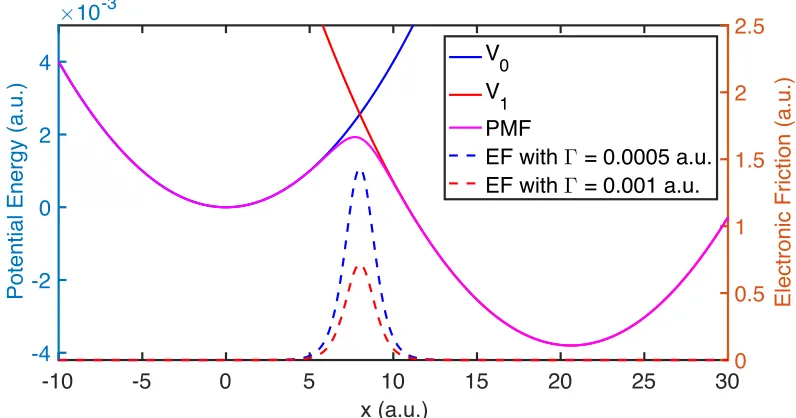
See Fig. 1.2 for a comparison between diabatic PESs and PMF, and the electronic
friction with small and large electronic coupling. Here, as above, we take the
sim-plest case where V0 and V1 are chosen as dispalced harmonic oscillators. The CME
(Eq. (1.15)) and the EF (Eqs. (1.16)-(1.17)) offer two very different perspectives on
nonadiabatic dynamics. The former should be valid with weak molecule-metal
cou-pling, the latter with strong molecule-metal coupling. Notice that, according to EF
dynamics (Eq. (1.17) and Fig. 1.2), the friction is strongest when the two diabats
cross, such that the electron is constantly hopping back and forth between molecule
and metal.
Surprisingly, in chapter 5, using a shifted harmonic model problem, we find that
EF agrees with the Marcus’s theory even in the nonadiabatic limit. Furthermore,
we find a connection between the Kramer’s theory in the overdamped limit and the
Marcus’s theory, which justifies the correctness of EF dynamics in the nonadiabatic
limit. This hidden connection is perhaps the most exciting result of the present thesis.
from excited dynamics.
Finally, among all the algorithms studied in this thesis, we find a newly proposed
broadened CME (BCME)60,61 performs very well in all the cases and we anticipate
BCME should perform well when describing more realistic systems. According to the
BCME, one effectively runs simulation with SH dynamics on two broadened diabatic
surfaces. See Fig. 5.1(a) in chapter 5.
-10 -5 0 5 10 15 20 25 30
x (a.u.)
-4 -2 0 2 4
Potential Energy (a.u.)
×10-3
0 0.5 1 1.5 2 2.5
Electronic Friction (a.u.)
V0
V
1
PMF
EF with Γ = 0.0005 a.u. EF with Γ = 0.001 a.u.
Figure 1.2: Diabatic PESs (V0 and V1), PMF (Eq. (1.16)) and electronic friction (Eq. (1.17)) with small (Γ = 0.0005 a.u.) and large (Γ = 0.001 a.u.) electronic coupling.
In the end, this thesis summarizes 4 years of research analyzing how to model
nonadiabatic dynamics both in solution and at a metal surface. Several interesting
results are presented in chapters 2-5. Looking forward, the most interesting question
is how well the BCME performs in a more realistic condensed phase system. Beyond
electron transfer, modeling chemical reactions at metal surfaces in real time is essential
CHAPTER 2
Estimating the Entropy and Quantifying the Impurity of a Swarm of
Surface-Hopping Trajectories: A New Perspective on Decoherence
This chapter is adapted from The Journal of Chemical Physics, Volume 140, Issue
20, Page 204102, 2014.
2.1 Introduction
If the universe is governed by the laws of quantum mechanics and began originally
in a pure state (with zero total entropy), then the universe must always remain in a
pure state thereafter (with zero total entropy). If the universe (with N particles) is
governed by the laws of classical mechanics with density ρ(R, ~~ P ,0) in phase space at
time 0, then the total time-dependent entropy
Scl(t) = Z Z
ρ(R, ~~ P) log(ρ(R, ~~ P)h3N)dR3NdP3N (2.1)
will be conserved throughout time, ∂Scl/∂t = 0. Now both of these predictions do
not match up with the second law of thermodynamics. Starting with Boltzmann’s
celebrated H-theorem62,63 there has been a great deal of literature explaining how
the “effective” entropy of the entire universe tends to grow, provided that one defines
the “effective” entropy as the sum of the entropy of many individual subsystems
(each entangled with their surroundings). These entropic statements hold both for
quantum and classical mechanics. For example, in the case of Boltzmann’s H-theorem
function:
f(R, P) = N
Z
· · ·
Z
ρ(R, R2, . . . R3N, P, P2, . . . P3N)dR2. . . dR3NdP2. . . dP3N (2.2)
SH(t) = Z Z
f(R, P) log(f(R, P)h)dRdP (2.3)
Because the notion of quantum entropy is different from the notion of classical
en-tropy, the question of entropy evolution inevitably arises for mixed quantum-classical
simulations. In particular, for Tully’s fewest switches surface hopping (FSSH)
al-gorithm (which is used extensively nowadays to simulate the dynamics of electronic
relaxation38,64–70), one expects interesting questions about entropy to manifest
them-selves for the FSSH algorithm. After all, by treating quantum electrons separately
from classical nuclei, nuclear-electronic coherence and decoherence can become fuzzy
and counting states (and measuring entropy) may be nontrivial.
To our knowledge, to date there has been no standard definition for the total
entropy of a FSSH calculation, much less a discussion about the role of entropy in
FSSH nonadiabatic dynamics. While many researchers (including the authors) in
the past have focused on “decoherence” corrections to the FSSH algorithm that aim
to fix up the algorithm20,23–38 , the total entropy of a FSSH calculation has not
been quantified previously nor have the origins of irreversibility in FSSH dynamics
been fully explored (though the question of detailed balance has been studied71,72).
Given the importance of dephasing and decoherence phenomena21,22for photo-excited
molecules (with a system of electrons and a bath of nuclei), we believe a thorough
analysis of surface-hopping entropy is prudent, and the goal of the present paper is
to provide such an analysis in detail.
from the Martens-Kapral mixed quantum classical Liouville equation (QCLE)74–83. In
particular, according to Refs. 20,73, there is a simple prescription for approximating
the partial Wigner transform of the full nuclear-electronic density matrix starting
from a swarm of FSSH trajectories. From such a prescription, we will calculate the
impurity of an FSSH calulation (i.e. one minus the purity) which can serve as an
approximate “FSSH entropy” for systems that are nearly pure.
Finally, armed with a tool to calculate impurity, we will show that total impurity
is not conserved for a closed quantum system propagated by FSSH dynamics. In
other words, even though a pure quantum state in a closed system should remain
pure forever, the impurity of a FSSH calculation increases, as if there is always some
external friction that mixes pure states and moves the system toward equilibrium.
We will examine why impurity increases and how decoherence emerges in the
con-text of partially Wigner transformed wavepackets. Inevitably, our analysis will reach
back to the approximations invoked in Ref. 20. Specifically, according to Ref. 20,
FSSH dynamics will approximate true QCLE dynamics provided that (i) wavepacket
separation is not followed by wavepacket recoherence and (ii) the equation of
mo-tion (EOM) for the off-diagonal electronic density matrix element is modified from
the original time-dependent electronic Schr¨odinger equation. Formally, modifying the
off-diagonal EOM requires a swarm of interacting (rather than independent) FSSH
trajectories, but we have argued that approximations for independent trajectories are
possible (e.g., A-FSSH39,40). Modification of the off-diagonal EOM is necessary to
force the electronic coherences between surfaces 1 and 2 to move along the average
surface – with a force (F1+F2)/2 – as the QCLE stipulates. (This notion of an average
surface has also been discussed by many other authors84–87. ) As we will show, the
An outline of this article is as follows. In Section 2.2, we review the different
definitions of impurity for a Wigner wavepacket moving on one electronic surface. In
Section 2.3, we make a straightforward definition of impurity for a Wigner wavepacket
moving along multiple electronic energy surfaces, and in Sections 2.3.1, 2.3.2, we verify
that this new definition of impurity is conserved by both the Schr¨odinger equation
and the QCLE for a partially Wigner transformed density matrix. In Section 2.3.3,
we define the impurity for a FSSH calculation. In Section 2.4, we present results for
two model Hamiltonians together demonstrating that surface hopping methods do not
conserve the total impurity of the universe. Finally in Section 2.5, we rationalize this
increase in impurity by studying the case of two frozen Gaussians, where an apparently
mixed (i.e. not pure) density matrix arises when one ignores off-diagonal elements
of the partial Wigner density matrix that oscillate rapidly in phase space. In this
sense, decoherence emerges as the result of a stationary phase approximation. For a
seasoned practitioner of surface hopping, who may not be surprised to learn that FSSH
dynamics do not conserve the total impurity of the universe, note that this article
presents a new analytic formulat for estimating FSSH impurity (in Section 2.5.2).
Our notation will be as follows. For indices, i, j, klabel adiabatic electronic states;
M, L, K label joint nuclear-electronic states; α is a general nuclear coordinate; µand
η are indices for a grid point in phase space. For physical quantities, ρ refers to the
full nuclear-electronic density matrix; Φ denotes an adiabatic electronic wavefunction;
Ψ is a joint nuclear-electronic wavefunction; Aij is the partially Wigner transformed
density matrix calculated from surface hopping data; and AWij is the exact partially
2.2 Background: The Entropy of a Wigner Wavepacket on One Electronic
Surface
While there are many ways to calculate the quantum entropy88, the only approach
that satisfies all of the Shannon constraints89 is the von Neumann entropy:
S=−Tr(ρlnρ) (2.4)
where ρ is the quantum density matrix. Unfortunately, in practice, calculating the
logarithm in Eq. (2.4) requires diagonalization of the density matrix, which is not
realistic in general for systems with many nuclear degrees of freedom.
For this article, we would like to calculate an approximate entropy of a general
Wigner wavepacket in phase space, which is a subject with a long history88. For one
electronic surface, the Wigner transform is defined by
AW(R, ~~ P , t) = 1 2π~
Z
d ~Xei ~P·X/~~
*
~ R− X~
2
ρ(t) ~ R+ ~ X 2 + (2.5)
As is well known,AW(R, ~~ P , t) can take on negative values and thus, however
tempt-ing, one cannot simply apply Eq. (2.1) by substituting ρcl(R, ~~ P) = AW(R, ~~ P). Of
course, one could transform to the Husimi distribution, but then the equation of
mo-tion becomes significantly more complicated. As a practical matter, for a Wigner
wavepacket, we require a tractable and easy means to evaluate entropy.
Beyond the von Neumann entropy, a feasible way to estimate the entropy has been
proposed as one minus the purity (impurity)88,90,91:
S(t) = 1−(2π~)D Z
d ~Rd ~P
AW(R, ~~ P , t) 2
where D is the number of degrees of freedom. Eq. (2.6) has a number of appealing
properties:
• The impurity is conserved in time according to the time-dependent Schr¨odinger
equation.
• The impurity is 0 for pure states.
• The impurity is positive for mixed states.
Below, we will generalize Eq. (2.6) to the case of many electronic states, and thus
evaluate the impurity of a FSSH calculation. Note that, formally, the defintion of
impurity in Eq. (2.6) is a valid approximation of the von Neumann entropy Eq. (2.4)
only when the universe is close to pure, so that one can expand the density matrix
ρ= 1−z in powers ofz.
2.3 The Impurity of a Partial Wigner Wavepacket on Multiple Electronic
Surfaces
For a physical problem with multiple PESs, the partially Wigner transformed density
matrix is81,82
AWij (R, ~~ P , t)≡
1 2π~
3NZ
d ~Xei ~P·X/~ ~ *
Φi(R~);R~ − X~
2
ρ(t)
Φj(R~);R~ +
~ X
2 +
(2.7)
wheren Φi(
~
R)Eo are the basis of adiabatic electronic wavefunctions at nuclear
is to calculate the impurity as:
S(t) ≡ 1−(2π~)3N Z
d ~R
Z
d ~P TrAW(R, ~~ P , t)2
= 1−(2π~)3N X i,j
Z
d ~R
Z
d ~P AWij(R, ~~ P , t)·AWji(R, ~~ P , t) (2.8)
2.3.1 Exact Dynamics from the Schr¨odinger Equation
To prove that Eq. (2.8) is a meaningful definition of impurity for a system with several
accessible electronic states, we must first prove that, according to this definition,
impurity is conserved in time when a closed system is propagated by the Schr¨odinger
equation. To prove this fact, one starts from a density matrix
ρ=
NK
X
K=1
bK|ΨK(t)i hΨK(t)| (2.9)
In principle,ρcan represent a pure state (NK = 1) or a mixed state (NK >1). The set
{|ΨK(t)i} here denote a basis of orthonormal, fully coupled nuclear-electronic
(2π)3Nδ(X~), one can calculate the impurity in Eq. (2.8):
S(t) = 1−(2π~)−3NX M,L
bMbL Z
d ~P
Z
d ~RX
i,j Z
d ~X
Z
d~Y ei ~P·(X+~ Y~)/~
×
*
Φi(R~);R~ − X~
2
ΨM(t) + *
ΨM(t)
Φj(R~);R~ +
~ X 2 + × *
Φj(R~);R~ −
~ Y 2
ΨL(t) + *
ΨL(t)
Φi(R~);R~ +
~ Y
2 +
= 1−X
M,L
bMbL Z
d ~RX
i,j Z
d ~X
Z
d~Y δ(X~ +Y~)
×
*
Φi(R~);R~ − X~
2
ΨM(t) + *
ΨM(t)
Φj(R~);R~ +
~ X 2 + × *
Φj(R~);R~ −
~ Y 2
ΨL(t) + *
ΨL(t)
Φi(R~);R~ +
~ Y
2 +
= 1−X
M,L
bMbL Z
d ~R
Z
d ~X
× X
i *
Φi(R~);R~ −
~ X 2
ΨM(t) + *
ΨL(t)
Φi(R~);R~ −
~ X 2 + ! × X j *
Φj(R~);R~ +
~ X 2
ΨL(t) + *
ΨM(t)
Φj(R~);R~ +
~ X
2 + !
(2.10)
Now, using the fact that the set of adiabatic electronic eigenstates n Φi(
~
R)Eo is
complete, so that an electronic trace is invariant to the nuclear position associated
with the adiabats,
S(t) = 1−X
M,L
bMbL Z
d ~R
Z
d ~XTre " *
~ R−X~
2
ΨM(t) + *
ΨL(t) ~ R− X~
2 + #
×Tre " * ~ R+ ~ X 2
ΨL(t) + *
where Tre signifies a trace over electronic states. Now, switching variables to
~
ω1 =R~ +
~ X
2 , ~ω2 =
~ R− X~
2, Z
d ~R
Z
d ~X →
Z
d~ω2 Z
d~ω1 (2.12)
we find that the expression for impurity reduces to:
S(t) = 1−X
M,L
bMbLTreTrn
|ΨM(t)i hΨL(t)|
TreTrn
|ΨL(t)i hΨM(t)|
= 1−X
M,L
bMbL|hΨM(t)|ΨL(t)i| 2
= 1−X
M
b2M (2.13)
where Trn is the trace over nuclei. Thus, in the end, the impurity according to
Eq. (2.8) is clearly time independent and satisfies our intrinsic notation of impurity:
it is zero for pure states and positive for mixed states. Note that, in Eq. (2.13),
S(t) is in fact identical to the fully quantum mechanical impurity, S(t) = 1−Tr(ρ2).
This agreement between the semiclassical and quantum mechanical impurities arises
only because the impurity in Eq. (2.8) is second order in the density matrix. More
generally, we are unaware of a simple semiclassical formula to estimate even Tr(ρ4)
(much less Tr(ρlnρ)) starting from the Wigner representation.
2.3.2 The Quantum-Classical Liouville Equation (QCLE)
Having proved that the impurity in Eq. (2.8) is conserved according to exact quantum
dynamics, we can show that the impurity of Eq. (2.8) is also conserved in time exactly
is
∂S
∂t = −(2π~)
3NX
i,j Z
d ~R
Z
d ~P
∂ ∂tA
W
ij (R, ~~ P , t)·A W
ji(R, ~~ P , t)
+AWij (R, ~~ P , t)· ∂
∂tA
W
ji(R, ~~ P , t)
= −(2π~)3NX i,j
2 Z
d ~R
Z
d ~PRe
∂ ∂tA
W
ij(R, ~~ P , t)·AWji(R, ~~ P , t)
(2.14)
According to the QCLE, the partially Wigner transformed density matrix evolves
according to
∂ ∂tA
W
ij(R, ~~ P , t) =
−i
~ X
k
VikAWkj −AWikVkj
−X
k,α
Pα
Mα d
α
ikAWkj −AWikdαkj
−X
α
Pα
Mα
∂AWij
∂Rα −
1 2
X
k,α
Fikα∂A
W kj
∂Pα +
∂AW
ik
∂PαF
α kj
!
(2.15)
When we substitute Eq. (2.15) into Eq. (2.14), we find that
∂S
∂t = (2π~)
3N Z ∞
−∞
d ~R
Z ∞
−∞
d ~P Re "
2i
~ X
i,j,k
VikAWkjA W ji −A
W
ikVkjAWji
+ X
i,j,k,α 2Pα
Mα d
α ikA
W kjA
W ji −A
W ikd α kjA W ji +X i,j,α 2Pα
Mα
∂AW
ij
∂Rα A
W ji
+ X
i,j,k,α
Fikα∂A
W kj
∂Pα A
W ji +
∂AWik
∂PαF
α kjA
W ji
!#
= (2π~)3N Z ∞
−∞
d ~R
Z ∞
−∞
d ~P Re " 2i ~ X i,j
(Vii−Vjj) AWij
2
+X
α 2Pα
Mα
X
i,j,k
dαikAWkjAWji −X
i,j,k
AWikdαkjAWji
!
+X
i,j,α 2Pα
Mα
∂AWij
∂RαA
W ji
+X XFikα∂A
W kj
∂PαA
W ji +
X∂AWik
∂PαF
The first two terms are clearly zero (because there is no real part). Now for the third
and sixth term, by changing the summation index {i, j, k} → {k, i, j}, one finds
∂S
∂t = (2π~)
3N Z ∞
−∞
d ~R
Z ∞
−∞
d ~P Re "
X
α 2Pα
Mα
X
k,i,j
dαkjAWjiAWik −X
i,j,k
AWikdαkjAWji
!
+X
i,j,α 2Pα
Mα
∂AW
ij
∂RαA
W ji + X α X k,i,j
Fkjα∂A
W ji
∂PαA
W ik + X i,j,k ∂AW ik
∂PαF
α kjA
W ji
!#
= (2π~)3N X i,j,k,α
Z ∞
−∞
d ~R
Z ∞
−∞
d ~P
∂ ∂Rα
Pα
MαA
W ij A W ji + ∂
∂Pα A
W ikF α kjA W ji
= 0 (2.17)
In the last equality, we assume that the density matrix decays to zero sufficiently
fast (as it must for any closed system). Thus, the impurity of a partially transformed
Wigner wavepacket is conserved in time according to the QCLE. This exact
conserva-tion of impurity is somewhat not obvious since the QCLE itself is an approximaconserva-tion
of the quantum Liouville equation. In the future, it might prove interesting to
ex-plore the time evolution of the true von Neumann entropy defined in Eq. (2.4) (rather
than the impurity) according to the QCLE; such an investigation would necessarily
be more complicated than the present article.
2.3.3 FSSH Algorithm and the Calculation of Impurity
Let us now describe how to evaluate Eq. (2.8) with data computed from a surface
hopping simulation. Without loss of generality, we will restrict ourselves to a system
with two electronic states and one spatial dimension. For a typical surface hopping
calculation, one is given a swarm ofNs trajectories, each trajectory carrying an active
surface variableλ= 1,2 (specifying nuclear motion) and a set of electronic amplitudes
A12(R, P, t) are constructed as follows73:
Aii(R, P, t) = 1
Ns X
l
δ(R−Rl(t))δ(P −Pl(t))δi,λl(t) (2.18)
Aij(R, P, t) = 1
Ns X
l
δ(R−Rl(t))δ(P −Pl(t))σijl (2.19)
Here, l is the label for each trajectory andσij is defined as cic∗j. Note that Eq. (2.19)
is not unique (according to Ref. 73) but, in our experience, it has been the most
numerically stable. Finally, we can calculate the impurity with Eq. (2.8) as:
S(t) = 1−2π~
Z
dR
Z
dP(A11(R, P, t)2+ 2|A12(R, P, t)| 2
+A22(R, P, t)2) (2.20)
In practice, special care must be taken when evaluating the impurity above because
the sum must be evaluated on a finite grid in phase space, with the grid sizes ∆R
and ∆P. Let [Rmin, Rmin+ ∆R, . . . , Rmax −∆R, Rmax] be a grid in position-space,
and [Pmin, Pmin+ ∆P, . . . , Pmax−∆P, Pmax] be a grid in momentum-space. Then, we
evaluate the partial Wigner transform at a grid point (Rµ, Pη) by
Aii(Rµ, Pη, t) = 1 Ns X l Θ ∆R 2 −
Rl(t)−Rµ Θ ∆P 2 −
Pl(t)−Pη
(2.21)
Aij(Rµ, Pη, t) = 1 Ns X l Θ ∆R 2 −
Rl(t)−Rµ Θ ∆P 2 −
Pl(t)−Pη
σijl
(2.22)
where Θ(x) is the Heaviside step function. The impurity is then
S(t) = 1−2π~X
µ,η
A11(Rµ, Pη, t)2+ 2|A12(Rµ, Pη, t)| 2
+A22(Rµ, Pη, t)2
∆R∆P
one hand, if ∆R and ∆P are too large, the entire wavepacket can be averaged into
one big bin so one does not recover the continuous integral in Eq. (2.20). On the
other hand, if ∆R and ∆P are too small and we do not have enough trajectories,
some bins will contain zero data points because of incomplete sampling, and our final
distribution will appear scattered and distorted. We have done our best to converge
our results to the correct impurity, using 40,000 trajectories.
2.4 Results
To test our approach above, we investigate two standard one-dimensional problems
from Tully’s original paper13, the simple avoided crossing and the problem of
ex-tended coupling. The adiabatic PESs of the two problems are shown in Fig. 2.1. We
study two different variations of surface hopping: 1. Tully’s original fewest-switches
surface hopping (FSSH) and 2. our group’s decoherence-improved augmented fewest
switches surface hopping (A-FSSH) algorithm39,40. The A-FSSH algorithm was
de-signed to build collapsing events on top of FSSH dynamics in order to better simulate
wavepacket separation and decoherence from the perspective of the electronic
subsys-tem following the pioneering work of Prezhdo26, Rossky24,25,32,33, Hammes-Schiffer28,
Truhlar29–31,34–36 and Schwartz92,93. In other words, A-FSSH was designed to better
estimate the reduced electronic density matrix
σe(t) = Z Z
d ~Rd ~PA(R, ~~ P , t) =
σ11(t) σ12(t)
σ21(t) σ22(t)
(2.24)
with corresponding electronic impurity
Se(t) = 1−Tre σe2(t)
−10 −5 0 5 10 −0.02
−0.01 0 0.01 0.02 0.03 0.04
Energy or Energy/distance (a.u.)
r (a.u.) Tully Problem #1 V11(x)
V 22(x) d12(x)/50
−10 −5 0 5 10 −0.25
−0.2 −0.15 −0.1 −0.05 0 0.05 0.1 0.15 0.2
r (a.u.) Tully Problem #3
Energy or Energy/distance (a.u.)
V11(x) V
22(x) d
12(x)
Figure 2.1: The adiabatic PESs for the two standard one-dimensional problems in Tully’s original paper13.
assuming that nuclear wavepackets on different surfaces separate irreversibly.
At time zero, we prepare a Gaussian wavepacket far to the left (x = −15 a.u.)
of the scattering region, starting off on the lower adiabatic PES with width σ = 1
and a momentum of positive 20 a.u.. The particle mass is 2000 a.u.. We transform
to the Wigner representation in phase space to initialize a swarm of surface hopping
trajectories. At a set of different times, we take snapshots of the swarm of trajectories,
digest the corresponding trajectory information into the phase-space grids discussed
above, and then compute the impurity. For reasons of intuition, we also plot the
partial Wigner distribution in phase space for two separate times: (i) right after a
wavepacket is spawned and the wavepackets are still close to the coupling region, and
(ii) at long times, when the wavepackets are already far removed from the coupling
2.4.1 Tully Problem #1: Avoided Crossing
For Tully Problem #1, the electronic Hamiltonian in a diabatic basis is13:
V11(x) = A[1−exp(−Bx)], x > 0
V11(x) = −A[1−exp(Bx)], x < 0
V22(x) = −V11(x)
V12(x) = V21(x) =Cexp(−Dx2) (2.26)
where A = 0.01, B = 1.6, C = 0.005, and D = 1.0, all in atomic units. See Fig. 2.1
for a picture.
For this problem, the dynamics are simple: a wavepacket enters the coupling
region on the lower adiabat and spawns a new wavefunction on the upper adiabat.
Eventually, two wavepackets emerge from the coupling region – both propagating
forward (in the positive x direction).
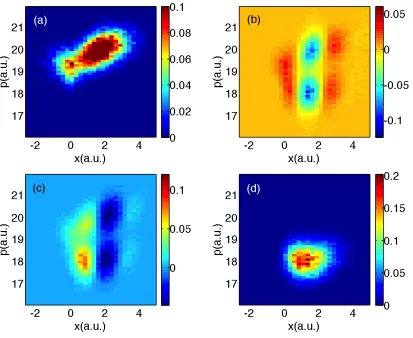
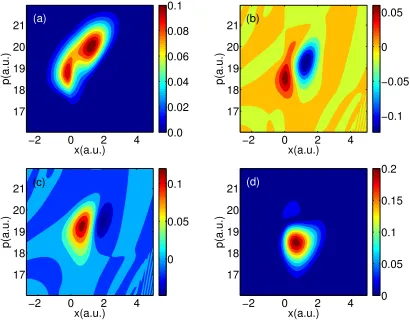
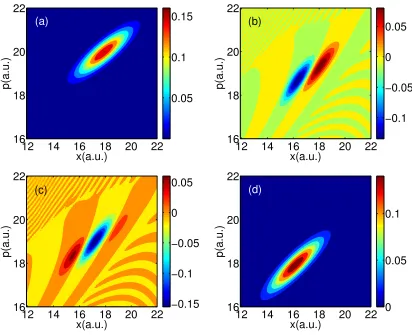
In Figs. 2.2-2.5, we plot the elements of the partially Wigner transformed density
matrix for surface hopping calculations versus exact quantum dynamics. Here, we use
FSSH surface hopping dynamics; note that A-FSSH and FSSH are almost identical
here. The data are plotted at short and long times after the crossing event.
From the data, we see that the FSSH and exact results for the populations AW11
and AW22 agree quite well at all times. However, the FSSH algorithm only partially
recovers the correct form for AW12. Whereas exact quantum dynamics predicts only
two peaks (one positive, the other negative) for the coherence, FSSH predicts multiple
peaks that are correlated with the diagonal peaks. The agreement gets worse for long
times. According to exact quantum dynamics, there are also small oscillations in
Figure 2.2: FSSH data for Tully #1. The densities are plotted in phase space at time 1590 a.u., (a) top-left A11; (b) top-right Re(A12); (c) bottom-left Im(A12); and (d) bottom-rightA22.
x(a.u.)
p(a.u.)
−2 0 2 4
17 18 19 20 21 0.0 0.02 0.04 0.06 0.08 0.1 x(a.u.) p(a.u.)
−2 0 2 4
17 18 19 20 21 −0.1 −0.05 0 0.05 x(a.u.) p(a.u.)
−2 0 2 4
17 18 19 20 21 0 0.05 0.1 0.15 0.2 x(a.u.) p(a.u.)
−2 0 2 4
17 18 19 20 21 0 0.05 0.1 (a) (c) (b) (d)
x(a.u.)
p(a.u.)
12 14 16 18 20 22 16 18 20 22 0.05 0.1 0.15 x(a.u.) p(a.u.)
12 14 16 18 20 22 16 18 20 22 −0.1 −0.05 0 0.05 x(a.u.) p(a.u.)
12 14 16 18 20 22 16 18 20 22 0 0.05 0.1 x(a.u.) p(a.u.)
12 14 16 18 20 22 16 18 20 22 −0.15 −0.1 −0.05 0 0.05 (a) (c) (b) (d)
2.4.2 Tully Problem #3: Extended Couplings
For Tully problem #3, the electronic Hamiltonian in a diabatic basis is13:
V11(x) = −A
V22(x) = A
V12(x) = Bexp(Cx), x < 0
V12(x) = B[2−exp(−Cx)], x >0 (2.27)
whereA = 0.0006, B = 0.1 andC= 0.9, all in atomic units. See Fig. 2.1 for a picture.
For this model Hamiltonian, the dynamics are more complicated than the previous
problem. Here, one wavepacket begins far to the left on the lower adiabat and, moving
to the right, a second wavepacket is spawned on the upper adiabat. Afterwards, the
two wavepackets continue moving right and leave the coupling region. At time 1650
a.u., the wavepacket on the lower adiabat is moving quickly to the right and eventually
it will transmit with nearly 100% probability. At the same time, the wavepacket on
the upper adiabat has slowed down and is in the process of turning around; this
wavepacket will reflect with nearly 100% probability. Later on, before time t= 3300
a.u., the reflecting wavepacket on the upper adiabat will spawn another wavepacket
on the lower adiabat, and both of these wavepackets will then move together to the
left asymptotically.
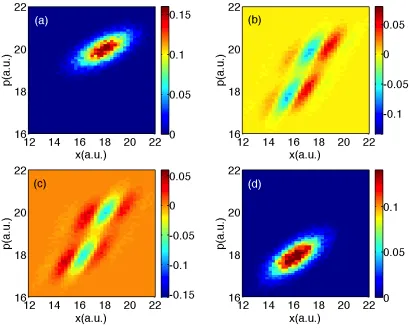
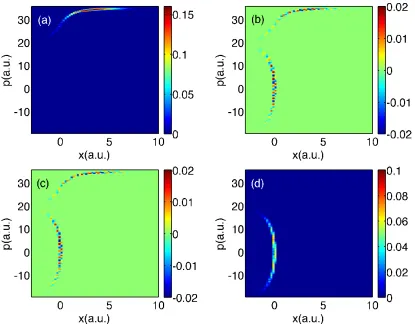
In Figs. 2.6-2.8, we plot results for A-FSSH, FSSH and exact quantum dynamics at
time 1650 a.u., not long after the spawning event. Note that the population data from
FSSH and A-FSSH track the exact quantum dynamics data nearly quantitatively.
coherence matrix element is centered midway between the AW
11 and AW22 population
matrix elements. By contrast, FSSH predicts that the coherences should be centered
on the population peak positions (just as for Tully problem #1). At the same time,
because of a collapsing event triggered by wavepacket separation, A-FSSH predicts
almost exactly zero coherence.
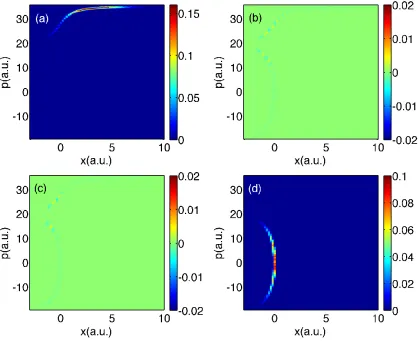
Finally, for long times (t = 3300 a.u.), we plot all data in Figs. 2.9-2.11. Focusing
first on populations, exact quantum dynamics reveals a small peak in between the two
centers of populations around (x, p) ≈ (5,5); this feature is absent from the surface
hopping data and will be explained in Section 2.5.1. Otherwise, the surface hopping
data looks qualitatively correct.
With regards to the coherences in Figs. 2.9-2.11, exact quantum dynamics
pre-dicts that the off-diagonal matrix element is incredibly small except for a small peak
midway between the two population centers at (x, p) ≈(5,5) and phase oscillations
are observed around that peak. Neither A-FSSH nor FSSH find such a peak nor such
oscillations; these features will also be explained below.
Interestingly, notice that, if one looks at A12 in Fig. 2.9 around the transmitting
peak at (x, p) = (30,45), the FSSH decoherence problem is barely visible. In fact, the
FSSH coherence density appears almost as small as the A-FSSH coherence density,
even though we know that, for this specific problem, the FSSH methodology breaks
down26,92; unlike A-FSSH, the FSSH algorithm fails to account for the bifurcation
between transmitting and reflecting wavefunctions. To explain this surprising feature,
recall that, for these figures, we are averaging over finite chunks of phase space; as
we have explained in Ref. 94, Tully problem #3 is pathological because, by chance,
averaging removes FSSH’s decoherence problems. To prove that the FSSH coherences
Figure 2.6: FSSH data for Tully #3: Time is 1650 a.u.. Same notation as in Fig. 2.2.
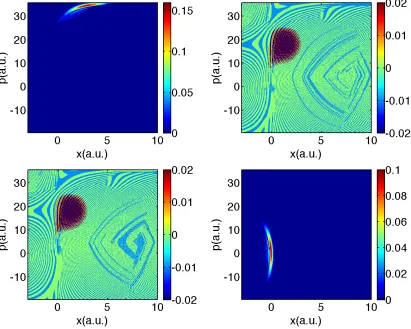
cancellation of sign, in Fig. 2.12 we plot the function:
Anorm12 (R, P, t)≡ 1
Ns X
l
δ(R−Rl(t))δ(P −Pl(t))σijl
(2.28)
From Fig. 2.12, it is clear that each FSSH trajectory carries an electronic density
matrix with a large off-diagonal component, and the FSSH algorithm does well only
because averaging over a phase space volume allows for a fortuitous sign
p(a.u.)
−10
0
10
20
30
−20
−10
0
10
20
30
0
0.02
0.04
0.06
0.08
p(a.u.)
x(a.u.)
−10
0
10
20
30
−20
−10
0
10
20
30
0
0.02
0.04
0.06
0.08
(a)
(b)
2.4.3 Impurity
Having analyzed the capacity of surface hopping methods to recover the partial
Wigner transform densities in phase space, in Fig. 2.13 we plot the total impurity
(S(t), Eq. (2.20)) as function of time both for FSSH and A-FSSH trajectories. Here,
∆Rand ∆P are chosen by insisting that the total impurity be zero at time zero, and
we have checked that our data are changed only slightly by altering the grid sizes.
According to Fig. 2.13, we find that the total impurity grows in time for both
FSSH and A-FSSH as soon as particles start hopping in between surfaces. As we will
show in Section 2.5.2, one can evaluate this growth in total impurity analytically for
simple problems (e.g., for Tully #1). From the data in Sections 2.4.1 and 2.4.2, it is
clear that this growth in total impurity can be attributed to the off-diagonal errors
of FSSH.
Interestingly, according to Fig. 2.13, even though A-FSSH incorporates
decoher-ence, FSSH and A-FSSH yield very similar total impurities. This coincidence can be
explained by the simple fact that neither algorithm captures the exact coherence and
neither can correctly recover recoherences. The premise of the A-FSSH algorithm is
that, since recoherences cannot be captured correctly by any Tully-style surface
hop-ping algorithm, one should damp the electronic coherences after wavepackets separate
so that long time dynamics (without recoherences) will be stable and accurate95. In
other words, A-FSSH was designed to recover the correct impurity of the electronic
subsystem (which is entangled with the nuclei).
To prove that A-FSSH delivers on this promise, we plot the elements of reduced
electronic density matrix and electronic impurity (Se(t), Eq. (2.25)) in Figs. 2.14-2.15.
From the figures, we observe that A-FSSH recovers qualitatively the exact reduced
0 500 1000 1500 2000 2500 3000 0
0.1 0.2 0.3 0.4 0.5
Time(a.u.)
Total Impurity
Tully#3 FSSH Tully#3 AFSSH Tully#1 FSSH Tully#1 AFSSH
Tully#1 4|c1|4|c2|4
Figure 2.13: The total impurity S(t) from Eq. (2.20) for the FSSH and A-FSSH algorithms for Tully problems #1 and #3. We also plot Eq. (2.42), an approximate analytical result for frozen Gaussians. The total impurity of the exact quantum system is zero for all time.
electronic density matrix for Tully problem #3. Moreover, in both cases, A-FSSH
exactly reproduces the impurity of the electronic subsystem (which grows in time as
would be expected). Note that FSSH recovers neither the correct reduced electronic
0 1000 2000 3000 0.4 0.6 0.8 1 1.2 1.4 Time(a.u.) σ1 1 FSSH A−FSSH Exact
0 1000 2000 3000 −0.1 0 0.1 0.2 Time(a.u.) R e( σ1 2 ) FSSH A−FSSH Exact
0 1000 2000 3000 −0.2 −0.1 0 0.1 0.2 0.3 Time(a.u.) Im ( σ1 2 ) FSSH A−FSSH Exact
0 1000 2000 3000 −0.2 0 0.2 0.4 0.6 Time(a.u.) Electronic Impurity FSSH A−FSSH Exact (a) (b) (c) (d)
0 1000 2000 3000 0.4 0.6 0.8 1 1.2 1.4 Time(a.u.) σ 1 1 FSSH A−FSSH Exact
0 1000 2000 3000 −0.4 −0.3 −0.2 −0.1 0 0.1 Time(a.u.) R e ( σ1 2 ) FSSH A−FSSH Exact
0 1000 2000 3000 −0.1 0 0.1 0.2 0.3 0.4 Time(a.u.) Im ( σ1 2 ) FSSH A−FSSH Exact
0 1000 2000 3000 −0.2 0 0.2 0.4 0.6 Time(a.u.) Electronic Impurity FSSH A−FSSH Exact (a) (b) (c) (d)
2.5 Discussion: Frozen Gaussian Dynamics in a Partially Transformed
Wigner Phase Space
2.5.1 Exact Quantum Dynamics Predicts Nonlocal Coherences and Phase
Oscillations
The data in Sections 2.4.1 and 2.4.2 highlighted the fact the surface hopping dynamics
can recover the populations well (compared to the exact partial Wigner transform),
but off-diagonal coherences are not as accurate. These results should not be very
sur-prising to a reader familiar with Ref. 20, where it was shown that (i) the on-diagonal
equations of motion for FSSH are almost exactly the same as the corresponding QCLE
equations of motion; but (ii) the off-diagonal equations of motion for FSSH need a
severe correction to approximate the corresponding QCLE equations of motion. And
formally, these corrections require interacting (rather than independent) trajectories.
In the present manuscript, we have seen that the FSSH errors in off-diagonal
coher-ence lead effectively to a growth in total impurity over time.
To better interpret our data from Sections 2.4.1 and 2.4.2, we will now find it
useful to investigate wavepacket bifurcation in phase space from the perspective of
frozen Gaussian nonadiabatic dynamics. With a frozen Gaussian ansatz, the total
nuclear-electronic wavefunction has the following form20:
Ψ(~r, ~R, t) =c1g(R~;R~1(t), ~P1(t))Φ1(~r;R~) +c2g(R~;R~2(t), ~P2(t))Φ2(~r;R~) (2.29)
where g represents a nuclear Gaussian wavepacket
g(R~;R~s(t), ~Ps(t)) ≡ Y
α
1
πa2 Rα
1/4 exp
−
(Rα−Rα s(t))2 2a2
Rα
According to Eq. (2.7), the partial Wigner transform for a frozen Gaussian is (for
i= 1,2)
AW11(R, ~~ P) = |c1| 2
(π~)3N Y
α exp
−(Rα−Rα1)2
a2 Rα
exp
−(Pα−P1α)2a2Rα
~2
(2.31)
AW22(R, ~~ P) = |c2| 2
(π~)3N Y
α exp
−(Rα−Rα2)2
a2 Rα
exp
−(Pα−P2α)2a2Rα
~2
(2.32)
AW12(R, ~~ P) = c1c
∗
2 (π~)3N
Y
α exp
−(Rα−1 2(R
α
1 +Rα2))2
a2 Rα
×exp
−
(Pα− 1 2(P
α
1 +P2α))2a2Rα
~2
exp
i(R2α−Rα1)Pα
~
×exp
i(P1α−P2α)Rα
~
exp
i(P2α−P1α)(Rα2 +Rα1) 2~
(2.33)
By integrating the squares of Eqs. (2.31)-(2.32) and plugging into Eq. (2.20), it is
straightforward to prove (as it must be) that the impurity of a frozen Gaussian ansatz
is always zero, S = 0.
Two key observations emerge from Eqs. (2.31)-(2.33):
1. According to exact quantum dynamics, the off-diagonal coherence matrix
ele-mentAW12 should pick up a phase that oscillates very quickly throughout phase
space, proportional to (R~1 −R~2) and (P~1 −P~2).
2. According to exact quantum dynamics, the off-diagonal coherence density in
phase space is not centered at the same location as the on-diagonal population
densities. In particular, the off-diagonal coherence density matrix is centered
at (R~1+R~2)/2,(P~1+P~2)/2
.
qual-2.11. The nonlocality of the AW
12 density in phase space is also completely consistent
with the QCLE which postulates that, to first order in ~, AW
12 coherences should be
propagated with forces (F~1+F~2)/2 [while the populations AW11 (AW22) are propagated,
of course, alongF~1 (F~2)].
As a sidenote, we mention that, even for a wavefunction with two frozen Gaussians
onthe same electronic surface AW11 – the first wavepacket centered at (R~(a)1 , ~P(a)1 ) and
the second wavepacket centered at (R~(b)1 , ~P(b)1 ) – one still finds a nonlocal peak in the
Wigner transform centered at (R~(a)1 +R~(b)1 )/2 and (P~(a)1 +P~(b)1 )/2. These nonlocal
peaks are a well-known feature of Wigner transforms96, and this explains the peak in
the middle of Fig. 2.11(a).
Overall, partially Wigner transformed density matrices can produce complicated,
nonlocal phase space densities.
2.5.2 FSSH Predicts Local Coherences: An Analytical Measure of FSSH
Impurity
Let us now consider frozen Gaussian dynamics from the perspective of the FSSH and
A-FSSH algorithms, and calculate our definition of impurity. To simplify the notation,
we define f1(R, ~~ P) and f2(R, ~~ P) as the normalized nuclear densities in phase space
for adiabats 1 and 2 (for i= 1,2):
fi(R, ~~ P) = 1 (π~)3N
Y
α exp
−
(Rα−Rα i)2
a2 Rα
exp
−
(Pα−Pα i )2a2Rα
~2
, (2.34)
For the FSSH algorithm, the diagonal elements of the partially Wigner transformed
density matrix are then (for i= 1,2)