BLUE BRAIN TECHNOLOGY
Swati
Assistant Professor, Dept of CS, C.R.M. JAT PG college Hissar, Haryana (India)
ABSTRACT
The man is called intelligent because of brain. Today we are developed because we can think, and other animals can”t do. But we loss the knowledge of a brain when the body is destroyed after the death of man. That knowledge might have been used for the development of the human society. What happen if we create a brain and up load the contents of natural brain into it. “Blue brain” –The name of the world’s first brain. That means a machine that can function as human brain. This paper define a technology an artificial brain that can think, response, take decision, and keep anything in memory. The main aim is to upload human brain into machine. So that man can think, take decision without any effort. After the death of the body, the virtual brain will act as the man .So, even after the death of a person we will not loose the knowledge, intelligence, personalities, feelings and memories of that man that can be used for the development of the human society.
Keywords: Blue Gene Supercomputer, Nanobotes, Neurons, Sensory System.
I. INTRODUCTION
Human brain is the most valuable creation of God. The man is intelligent because of the brain. It is complex than any circuitry in the world. So, question may arise ―is it really possible to create a human brain?‖ The answer is ―Yes‖. Because what ever man has created today always he has followed the nature. But today it is
possible due to the technology. The Blue Brain System is an attempt to reverse engineer the human brain and recreate it at the cellular level inside a computer simulation. The project was founded in May 2005 by Henry Markram at the EPFL in Lausanne, Switzerland.Goals of the project are to gain a complete understanding of the brain and to enable better and faster development of brain disease treatments. The research involves studying slices of living brain tissue using microscopes and patch clamp electrodes. Data is collected about all the many different neuron types. This data is used to build biologically realistic models of neurons and networks of neurons in the cerebral cortex. The simulations are carried out on a Blue Gene supercomputer built by IBM, hence the name "Blue Brain". The simulation software is based on Michael Hines's NEURON, together with other custom-built components. As of August 2012 the largest simulations are of micro circuits containing around 100 cortical columns such simulations involve approximately 1 million neurons and 1 billion synapses. A full human brain simulation (86 billion neurons) should be possible by 2023 provided sufficient funding is received.
II. WHAT IS BLUE BRAIN OR VIRTUAL BRAIN
?
with a huge amount of storage capacity, processing power and an interface between the human brain and artificial one. Through this interface the data stored in the natural brain can be up loaded into the computer. So the brain and the knowledge, intelligence of anyone can be kept and used for ever, even after the death of the person.
III. WHY WE NEED BLUE BRAIN?
Today we are developed because of our intelligence. Intelligence is the in born quality that cannot be created .Some people have this quality, so that they can think up to such an extent where other cannot reach. Human society is always in need of such intelligence and such an intelligent brain to have with. But the intelligence is lost along with the body after the death. The virtual brain is a solution to it. The brain and intelligence will be alive even after the death. We often face difficulties in remembering things such as people names, their birthdays, and the spellings of words, proper grammar, important dates, history facts, and etcetera. In the busy life everyone wants to be relaxed. Can’t we use any machine to assist for all these? Virtual brain may be a better solution for it. What will happen if we upload ourselves into computer, we were simply aware of a computer, or maybe, what will happen if we lived in a computer as a program?
IV. HOW IT IS POSSIBLE?
First, it is helpful to describe the basic manners in which a person may be uploaded into a computer. Raymond Kurzweil recently provided an interesting paper on this topic. In it, he describes both invasive and non-invasive techniques. The most promising is the use of very small robots, or nanobots. These robots will be small enough to travel throughout our circulatory systems. Travelling into the spine and brain, they will be able to monitor the activity and structure of our central nervous system. They will be able to provide an interface with computers that is as close as our mind can be while we still reside in our biological form. Nanobots could also carefully scan the structure of our brain, providing a complete readout of the connections between each neuron. They would also record the current state of the brain. This information, when entered into a computer, could then continue to function like us. All that is required is a computer with large enough storage space and processing power.But we have to now think technically. We need not know how the brain actually functions, to transfer it to a computer. We need only know the media and contents. Henry Markram, director of the Blue Brain Project, says we are ten years away from a functional artificial human brain.Reconstructing the brain piece by piece and building a virtual brain in a supercomputer—these are some of the goals of the Blue Brain Project.
V. FUNCTIONING OF HUMAN BRAIN
The human ability to feel, interpret and even see is controlled, in computer like calculations, by the magical nervous system. Yes the nervous system is quite like magic because we can’t see it, but its working through electric impulses through your body. One of the world’s most "intricately organized" electron mechanisms is the
5.1 Sensory Input
When our eyes see something or our hands touch a warm surface, the sensory cells, also known as Neurons, send a message straight to your brain. This action of getting information from your surrounding environment is called sensory input because we are putting things in your brain by way of your senses.
5.2. Integration
Integration is best known as the interpretation of things we have felt, tasted, and touched with our sensory cells, also known as neurons, into responses that the body recognizes. This process is all accomplished in the brain where many neurons work together to understand the environment.
5.3 Motor Output
Once our brain has interpreted all that we have learned, either by touching, tasting, or using any other sense, then our brain sends a message through neurons to effecter cells, muscle or gland cells, which actually work to perform our requests and act upon the environment. How we see, hear, feel, smell, and take decision.
VI. BRAIN SIMULATION
Table 1: Comparison Between Natural and Simulated Brain
Natural Brain Simulated Brain
INPUT
In the nervous system in our body the neurons are responsible for the message passing. The body receives
the input by sensory cells. This sensory cell produces electric impulses which are received by neurons. The neurons transfer these electric impulses to the brain.
INPUT
In a similar way the artificial nervous system can be created. The scientist has created artificial neurons by replacing them with the silicon chip. It has also been tested that these neurons can receive the input from the sensory cells. So, the electric impulses from the sensory
cells can be received through these artificial neurons.
INTERPRETATION
The electric impulses received by the brain from neurons are interpreted in the brain. The interpretation in the brain is accomplished by means of certain states of many neurons.
INTERPRETATION
The interpretation of the electric impulses received by the artificial neuron can be done by means of registers. The different values in these register will represent different states of brain.
OUTPUT
Based on the states of the neurons the brain sends the electric impulses representing the responses which are further received by sensory cell of our body to respond neurons in the brain at that time.
OUTPUT
Similarly based on the states of the register the output signal can be given to the artificial neurons in the body which will be received by the sensory cell.
MEMORY
There are certain neurons in our brain which represent certain states permanently. When required, this state is represented by our brain and we can remember the
MEMORY
past
things. To remember things we force the neurons to represent certain states of the brain permanently or for any interesting or serious matter this is happened implicitly.
permanently and when required these information can be received and used.
PROCESSING
When we take decision, think about something, or make
any computation, logical and arithmetic computations are done in our neural circuitry. The past experience stored and the current inputs received are used and the states of certain neurons are changed to give the output.
PROCESSING
In the similar way the decision making can be done by the computer by using some stored states and the received input and the performing some arithmetic and logical calculations.
6.1 Neuron
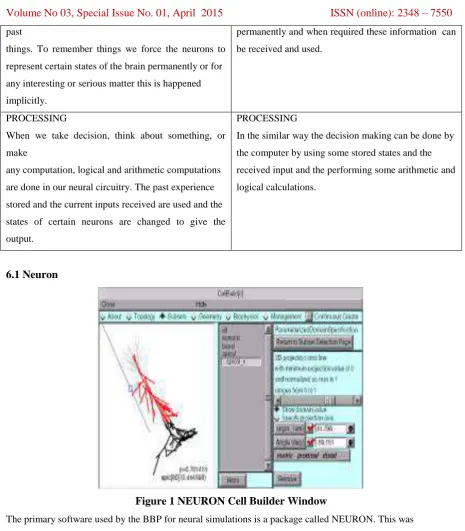
Figure 1 NEURON Cell Builder Window
The primary software used by the BBP for neural simulations is a package called NEURON. This was developed starting in the 1990s by Michael Hines at Yale University and John Moore at Duke University. It is written in C, C++, and FORTRAN. The software continues to be under active development and, as of July 2012, is currently at version 7.2. It is free and open source software, both the code and the binaries are freely available on the website. Michael Hines and the BBP team collaborated in 2005 to port the package to the massively parallel Blue Gene supercomputer.
6.2 Workflow of Neuron
simulation brought to life. A basic unit of the cerebral cortex is the cortical column. Each column can be mapped to one function, e.g. in rats one column is devoted to each whisker. A rat cortical column has about 10,000 neurons and is about the size of a pinhead. The latest simulations, as of November 2011, contain about 100 columns, 1 million neurons, and 1 billion synapses. Techniques are being developed for multiscale simulation whereby active parts of the brain are simulated in great detail while quiescent parts are not so detailed. The simulations reproduce observations that are seen in living neurons. The plan is to build a generalized simulation tool, one that makes it easy to build circuits. There are also plans to couple the brain simulations to avatars living in a virtual environment, and eventually also to robots interacting with the real world. The ultimate aim is to be able to understand and reproduce human consciousness.
6.3 Bbp-Sdk
The BBP-SDK (Blue Brain Project - Software Development Kit) is a set of software classes (APIs) that allows researchers to utilize and inspect models and simulations. The SDK is a C++ library wrapped in Java and Python.
6.4 Visualizations of Results
Figure 2 RTNeuron Visualization of a Neuron
6.5 Rtneuron
RTNeuron is the primary application used by the BBP for visualization of neural simulations. The software was developed internally by the BBP team. It is written in C++ and OpenGL. RTNeuron is ad-hoc software written specifically for neural simulations, i.e. it is not generalisable to other types of simulation. RTNeuron takes the output from Hodgkin-Huxley simulations in NEURON and render them in 3D. This allows researchers to watch as activation potentials propagate through a neuron and between neurons. The animations can be stopped, started and zoomed, thus letting researchers interact with the model. The visualizations are multi-scale that is they can render individual neurons or a whole cortical column. The image right was rendered in RTNeuron.
VII. COMPUTER HARDWARE/ SUPERCOMPUTERS
7.1 Blue Gene/P
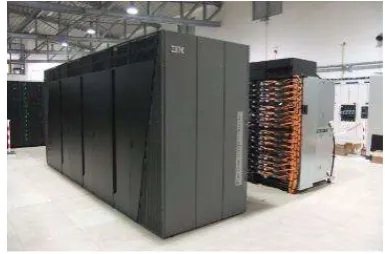
machine was upgraded to a Blue Gene/P. The machine is installed on the EPFL campus in Lausanne (Google map) and is managed by CADMOS (Center for Advanced Modeling Science).
he computer is used by a number of different research groups, not exclusively by the Blue Brain Project. In mid-2012 the BBP was consuming about 20% of the compute time. The brain simulations generally run all day, and one day per week (usually Thursdays). The rest of the week is used to prepare simulations and to analyze the resulting data. The supercomputer usage statistics and job history are publicly available online - look for the jobs labeled as "C-BPP".
Blue Gene/P technical specifications
4,096 quad-core nodes
Each core is a PowerPC 450, 850 MHz Total: 56 teraflops, 16 terabytes of memory 4 racks, one row, wired as a 16x16x16 3D torus 1 PB of disk space, GPFS parallel file system Operating system: Linux SuSE SLES 10
Figure 3 Blue Brain Storage Rack
7.2 Silicon Graphics
A 32-processor Silicon Graphics Inc. (SGI) system with 300 Gb of shared memory is used for visualization of results.
7.3 Commodity Pc Clusters
Clusters of commodity PCs have been used for visualization tasks with the RTNeuron software
JuQUEEN is an IBM Blue Gene/Q supercomputer that was installed at the Jülich Research Center in Germany in May 2012. It currently performs at 1.6 peta flops and was ranked the world's 8th fastest supercomputer in June 2012. It's likely that this machine will be used for BBP simulations starting in 2013, provided funding is granted via the Human Brain Project. In October 2012 the supercomputer is due to be expanded with additional racks. It is not known exactly how many racks or what the final processing speed will be. The JuQUEEN machine is also to be used by the research initiative. This aims to develop a three-dimensional, realistic model of the human brain.
VIII.
MERITS AND DEMERITS
With the blue brain project the things can be remembered without any effort, decisions can be made without the presence of a person. Even after the death of a man his intelligence can be used. The activity of different animals can be understood. That means by interpretation of the electric impulses from the brain of the animals, their thinking can be understood easily. It would allow the deaf to hear via direct nerve stimulation, and also be helpful for many psychological diseases. Due to blue brain system human beings will become dependent on the computer systems. Technical knowledge may be misused by hackers; Computer viruses will pose an increasingly critical threat.
IX. APPLICATIONS
1.
Gathering and Testing 100 Years of Data.2.
Cracking the Neural Code3.
Understanding Neocortical Information Processing4.
A Novel Tool for Drug Discovery for Brain Disorders5.
A Global Facility6.
A Foundation for Whole Brain Simulations7.
A Foundation for Molecular Modeling of Brain FunctionX. CONCLUSION
In conclusion, we will be able to transfer ourselves into computers at some point. Most arguments against this outcome are seemingly easy to circumvent. They are either simple minded, or simply require further time for technology to increase. The only serious threats raised are also overcome as we note the combination of biological and digital technologies. While the road ahead is long, already researches have been gaining great insights from their model. Using the Blue Gene supercomputers, up to 100 cortical columns, 1 million neurons, and 1 billion synapses can be simulated at once. This is roughly equivalent to the brain power of a honey bee. Humans, by contrast, have about 2 million columns in their cortices. Despite the sheer complexity of such an endeavor, it is predicted that the project will be capable of this by the year 2023.
REFERENCES
[2] Henry Markram, "The Blue Brain Project", Nature Reviews Neuroscience, 7:153-160, 2006 February. PMID 16429124.
[3] http://bluebrainproject.epfl.ch. [4] http://research.ibm.com/bluebrain.