Effects of Feedback on Chest
Compression Quality: A Randomized
Simulation Study
Michael Wagner, MD,a,bKatharina Bibl, MD,aEmilie Hrdliczka,aPhilipp Steinbauer,aMaria Stiller,aPeter Gröpel, PhD,c Katharina Goeral, MD,aUlrike Salzer-Muhar, MD,dAngelika Berger, MD, MBA,aGeorg M. Schmölzer, MD, PhD,b,e Monika Olischar, MDa
abstract
OBJECTIVES:Our aim for this study was to test whether visual and verbal feedback compared
with instructor-led feedback improve the quality of pediatric cardiopulmonary resuscitation (CPR).
METHODS:There were 653 third-year medical students randomly assigned to practice pediatric CPR on 1 of 2 manikins (infant and adolescent;n= 344 andn= 309, respectively). They were further randomly assigned to 1 of 3 feedback groups: The instructor feedback (IF) group (n= 225) received traditional, instructor-led feedback without any additional feedback device. The device feedback (DF) group (n= 223) received real-time visual feedback from a feedback device. The instructor and device feedback (IDF) group (n= 205) received verbal feedback from an instructor who continuously reviewed the trainees’performance using the feedback device. After the training, participants’CPR performance was assessed on the same manikin while no feedback was being provided.
RESULTS:For the primary outcome of total compression score, participants in the DF and
IDF groups performed similarly, with both groups showing scores significantly (P ,.001) better than those of the IF group. The samefindings held for correct hand position and the proportion of complete release. For compression rate, the DF group was at the higher end of the guideline for 100 to 120 chest compressions per minute compared with the IF and IDF groups (bothP, .001). No effect of feedback on compression depth was found.
CONCLUSIONS:Chest compression performance significantly improved with both visual and verbal
feedback compared with instructor-led feedback. Feedback devices should be implemented during pediatric resuscitation training to improve resuscitation performance.
WHAT’S KNOWN ON THIS SUBJECT:High-quality chest compressions (CCs) require optimal hand position, adequate depth (one-third of the chest’s diameter), complete release, and a frequency of 100 to 120 CCs per minute. Feedback devices (visual or verbal) were shown to improve the quality of training, although evidence remains inconclusive.
WHAT THIS STUDY ADDS:We provide more evidence to the topic of feedback in resuscitation trainings, including a large number of equally experienced participants, revealing that visual feedback and visual combined with verbal feedback improve CC performance compared with instructor-led training in infant and adolescent manikin settings.
To cite:Wagner M, Bibl K, Hrdliczka E, et al. Effects of Feedback on Chest Compression Quality: A Randomized Simulation Study.Pediatrics. 2019;143(2):e20182441 Divisions ofaNeonatology, Pediatric Intensive Care, and Neuropediatrics, anddPediatric Cardiology, Department
of Pediatrics and Adolescent Medicine, Medical University of Vienna, Vienna, Austria;bCentre for the Studies of Asphyxia and Resuscitation, Neonatal Research Unit, Royal Alexandra Hospital, Edmonton, Alberta Health Services, Edmonton, Canada;cDepartment of Applied Psychology: Work, Education, and Economy, University of Vienna, Vienna, Austria; andeDivision of Neonatology, Department of Pediatrics, University of Alberta, Edmonton, Canada
Drs Wagner, Bibl, and Olischar conceptualized and designed the study, drafted the initial manuscript, analyzed the data, and reviewed and revised the manuscript; Drs Goeral and Gröpel, Ms Stiller, Ms Hrdliczka, and Mr Steinbauer designed the data collection instruments, collected data, conducted the initial analyses, and reviewed and revised the manuscript; Drs Schmölzer, Salzer-Muhar, and Berger conceptualized and designed the study, coordinated and supervised data collection, and critically reviewed the manuscript for important intellectual content; and all authors approved thefinal manuscript as submitted and agree to be accountable for all aspects of the work.
DOI:https://doi.org/10.1542/peds.2018-2441
The authors of a large multicenter observational study reported that the incidence of pediatric cardiopulmonary resuscitation (CPR) is∼1.4%.1Unfortunately, only∼40% of children receiving CPR survive to hospital discharge, and survival with good neurologic outcome remains rare.1–4These outcomes are partially related to poor CPR quality, which could be improved by providing high-quality CPR supported by regular simulation-based training in both pediatric basic and advanced life support.4–7Therefore, in the 2015 European Resuscitation Council guidelines, it is stated that high-quality chest compressions (CCs) require the following: (1) optimal hand position, (2) compressing the lower part of the sternum by at least one-third of the anterior-posterior diameter of the chest (equivalent to 4 cm in infants and 5 cm in
adolescents), (3) using a compression rate of 100 to 120 CCs per minute, and (4) allowing for complete chest recoil between each CC.8
To improve the quality of CPR, various feedback devices, including (1) the SkillReporter Resusci Anne or Resusci Baby QCPR,9–11(2)
a computer-based voice advisory manikin feedback system,12or (3) palm-sized devices that can be placed between the trainee’s hands and the manikin’s or patient’s chest (eg, Philips MRx Q-CPR Defibrillator Management and Feedback,13 CPREzy-Pad,14and Zoll Pocket15), are available. The immediate CPR feedback is then given visually (via a monitor) or verbally (eg,“slightly increase the frequency of
compressions”), to either an instructor or the person providing CPR. Although these feedback devices seem promising, the evidence remains inconclusive, with authors of several simulation studies reporting a significant improvement of CPR performance,16,17whereas others were unable tofind any benefit when compared with traditional,
instructor-led trainings.18–20We aimed to assess whether visual or verbal feedback by using a feedback device compared with instructor-led feedback would improve CPR performance and quality in an infant and an adolescent manikin during CPR training.
We hypothesized that both the visual and verbal feedback would improve CPR performance more than the instructor-led feedback during a CPR training.
METHODS
This prospective, randomized, unblinded simulation trial was done at the Vienna Pediatric Simulation Training Center at the Medical University of Vienna and is reported according to the Consolidated Standards of Reporting Trials approach with the extension for simulation-based research.21The local ethics committee approved the study, and the local data protection committee approved the study questionnaire. Third-year medical students from the Medical University of Vienna who were required to do their mandatory pediatric CPR training were included. Participants signed an informed consent form before participation and were then randomly assigned into 2 manikin groups: Group 1 performed CPR training using a quality of cardiopulmonary resuscitation (QCPR) infant manikin (Laerdal Medical GmbH, Stavanger, Norway); group 2 performed QCPR training using a QCPR Resusci Anne (Laerdal Medical GmbH) with a built-in compression spring needing 30 kg of weight for 5-cm CCs (therefore representing the CPR effort required for an adolescent). Both manikin groups were further randomly assigned into 3 feedback groups: (1) the instructor feedback (IF) group: participants completed the CPR training with feedback from their instructor without the assistance of a feedback device (1 instructor was
assigned to each participant and gave constant feedback); (2) the device feedback (DF) group: participants received direct visual feedback from a feedback device during CPR training but did not received any feedback from an instructor; and (3) the instructor and device feedback (IDF) group: participants received direct verbal feedback from an instructor who continuously observed the participants’actual CC quality on the feedback device. The verbal feedback in both the IF and IDF groups included positive active coaching from the instructor (eg,“continue with that frequency,” “you are doing good,”or“keep going”).
Randomization
The study included 3 different randomization steps to reduce potential biases. Because the
pediatric CPR training was conducted in supervised group sessions, participants werefirst divided into small training groups of 10 to 11 persons each by using a computer-generated list of random numbers (Microsoft Excel; Microsoft, Redmond, WA). Second, the small training groups (n= 64) were assigned (computerized random numbers) to either the infant or the adolescent manikin group and 1 of the feedback groups. Finally, by using sealed envelopes, 1 of 5 instructors was randomly allocated to each training group; each instructor thus supervised 12 to 13 training groups in total. The allocation was done by a student assistant.
Instructors and Feedback Device
knowledge about the CPR algorithm. The feedback devices included the Resusci Baby QCPR manikin or the Resusci Anne manikin, which are both equipped with integrated sensors measuring various CC parameters (eg, CC rate, depth, hand position, and complete release), and the SimPad touchscreen with the SkillReporter software (Laerdal), a palm-sized device that provides real-time visual feedback. Depending on the group allocation, the SimPad was either visible to the participant (DF group), visible to the instructor only (IDF group), or masked to both (IF group). Participants in the IF and IDF groups received verbal feedback from the instructor.
Study Procedure
Before the training, participants reviewed the current pediatric CPR guidelines8and watched
a demonstration of the CPR algorithm by an instructor. Participants were then allocated to their randomly assigned groups and completed 2 distinct phases: a training phase followed by an assessment. In the training phase, participants practiced CPR with feedback for 2 minutes. Participants worked in teams of 2, whereby only the participant performing CCs was studied without evaluating the other performing the ventilations. To standardize the time between training and assessment, participants were assigned to the assessment in the same order as during the training phase, which was after∼45 minutes (this was because of the course design). Participants moved to the assessment phase and completed another 2-minute CPR on the same manikin. Notably, no feedback was provided in the assessment phase; the SimPad screen was hidden and not visible to either the participant or the instructor.
The tables on which the manikins were placed were all at the same height (72 cm or 28.36 in) for all groups. Smaller participants were provided with a step stool (24 cm or
9.45 inches in height) to improve their efficiency of QCPR.24The number of trainees who used the step stool was recorded. Data collection was conducted in group sessions, with 10 to 11 participants per session.
Outcomes
The primary outcome of the study was the total compression score, which is a composite score calculated by the SkillReporter software and consists of correct hand position, adequate depth, compression rate, and complete release per 2-minute cycle. For these parameters, the target measures were chosen according to the 2015 European Resuscitation Council guidelines.8 Every participant received 100% for each variable if the criteria of the guidelines were executed accurately. Any deviation decreased the score to as low as 0% along an S-curve depending on the amount of deviations, with small deviations reducing the score less than large deviations. More detailed information on software scoring can be retrieved on the manufacturer’s Web site.25 Secondary outcomes of the study involved all subcomponents of the total compression score, including correct hand position, mean CC depth, CC depth compliance, mean CC rate, CC rate compliance, and the proportion of complete release.
Sample Size
In the sample size calculation, it was assumed that the main effects of the 3 different feedback methods on the CC performance would compose the 3 primary comparisons. Hence, allowing for Bonferroni adjustment,
P,.017 was considered statistically significant for each of these 3 comparisons. Although the difference between the 2 manikin conditions was not assumed, we checked this assumption and thus included the interaction in the sample size calculation. Given the inconclusive evidence of recent research,16–20we estimated a small-to-middle effect
size for the sample size calculation. The calculation with G*Power software was used to predict that a total sample size of 604 would give sufficient power (95%) to detect a significant difference at thealevel of .017. We estimated that 12% of the groups would be excluded owing to technical issues with data
acquisition,26so we aimed to recruit at least 676 participants in total.
Statistics
All statistical analyses were
performed with SPSS 24.0 (IBM SPSS Statistics, IBM Corporation, Armonk, NY). To ensure homogeneity of the groups, a 2 (manikin: infant and adolescent)33 (feedback: IF, DF, and IDF) analysis of variance was conducted on participants’age and physical characteristics (height, weight, and BMI), and ax2test was used to compare the distribution of men and women and experienced versus unexperienced participants across conditions. To test the study hypothesis, a 233 analysis of variance was conducted on each of the study outcomes. In case of significant main effect of feedback (P,.05, 2-tailed), post hoc comparisons were performed with Bonferroni correction (P,.017, 2-tailed) between any 2 pairs of feedback groups while adjusting for the main effect of manikin. In case of significant interaction, post hoc comparisons were performed by using the Bonferroni correction (P, .017, 2-tailed) between any 2 pairs of feedback groups separately for each manikin condition. Parameters with a skewed data distribution were log transformed before analysis.
RESULTS
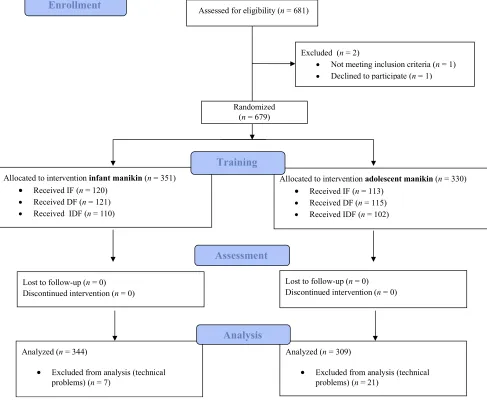
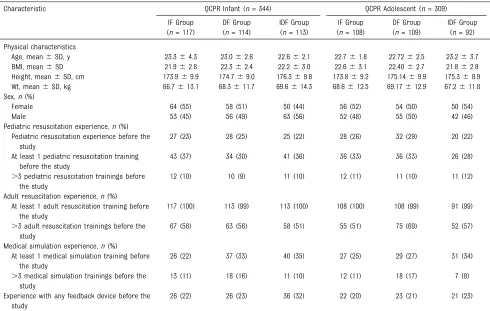
of technical issues with the feedback devices). A total of 653 third-year medical students were included as participants in thefinal analysis (Fig 1). No significant difference was found in participants’age and physical characteristics among the study groups (Table 1). Similarly, the distribution of men and women and experienced versus unexperienced participants was equal across the groups.
Total Compression Score
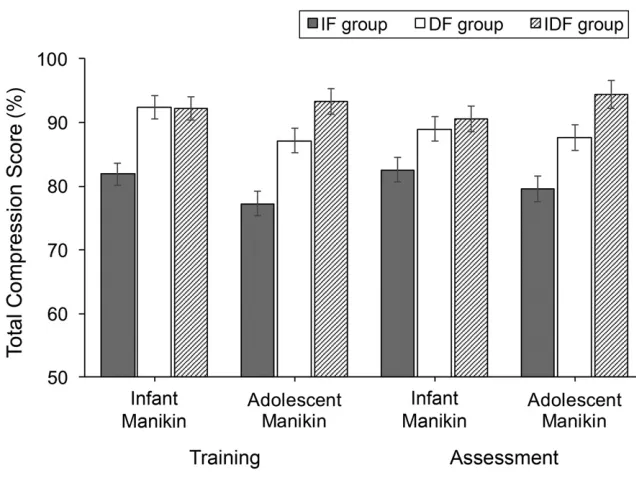
All tested CC parameters are presented in Table 2, and Fig 2 reveals the total CC score across the
groups and phases. During the training phase, participants in the DF and IDF groups had a 10- to 13-point higher total CC score compared with the IF group (P,.001 andP,.001, respectively), whereas the DF and IDF groups had similar total CC scores. In the assessment, again, participants in the IF group performed worse than participants in both the DF (P,.001) and IDF (P,.001) groups, whereas the 2 latter groups did not differ.
Hand Position
In the training, correct hand position was more pronounced in both the DF and IDF groups than in the IF group
(P= .001 andP,.001, respectively), whereas the DF and IDF groups did not differ. In the assessment, the DF and IDF groups also showed better hand position than the IF group (P= .006 andP,.001, respectively), whereas the 2 former groups did not differ.
Compression Depth Mean CC Depth
There were no significant differences among the feedback groups in either the training or the assessment phase. There was only an overall significant difference between the infant and adolescent manikin groups in both
FIGURE 1
phases (P,.001 andP,.001, respectively), merely reflecting the differences in required CC depth for adolescents and infants.
CC Depth Compliance
During the training phase, participants in the DF group
performed 7% to 10% more CCs with adequate depth than participants in both the IF (P,.001) and the IDF (P,.001) groups but only when using the infant manikin. In the assessment, the compliance was generally higher in the DF group than in the IF group (P= .016), whereas the DF and IDF groups, and the IF and IDF groups did not differ in CC depth compliance.
Compression Rate Mean CC Rate
In the training, there were no significant differences among the feedback groups. During assessment,
the DF group performed∼5 CCs per minute more compared with the IF (P,.001) and IDF (P,.001) groups, and the IDF group also had a higher overall mean CC rate than the IF group (P= .009).
CC Rate Compliance
During training, participants in the DF group performed 14% fewer CCs with adequate rate than participants in the IDF group (P= .006) but only in the adolescent manikin setting. During the assessment, the DF group had a 15% to 20% lower CC rate compliance than both the IF
(P= .001) and IDF (P= .001) groups, whereas the 2 latter groups did not differ. These differences were, again, only in the adolescent manikin condition.
Complete Release
In the training, the DF group had higher percentages of complete release than both the IF (P,.001)
and IDF (P= .007) groups, and the IDF group was also better than the IF group (P,.001), but only in the adolescent manikin condition. During the assessment, the IF group had a 20% to 30% worse complete release compared with both the DF (P,.001) and IDF (P= .003) groups, whereas the 2 latter groups did not differ in complete release. Again, these differences were only visible when using the adolescent manikin.
DISCUSSION
Authors of several studies reported that the use of feedback devices can improve CPR quality.26–29With our study, we added that both visual feedback and verbal feedback combined with visual feedback significantly improved CPR performance in medical students when compared with instructor-based feedback alone. Participants who received training with a feedback
TABLE 1Demographic Data of Participants
Characteristic QCPR Infant (n= 344) QCPR Adolescent (n= 309)
IF Group (n= 117)
DF Group (n= 114)
IDF Group (n= 113)
IF Group (n= 108)
DF Group (n= 109)
IDF Group (n= 92) Physical characteristics
Age, mean6SD, y 23.364.3 23.062.6 22.662.1 22.761.8 22.7262.5 23.263.7
BMI, mean6SD 21.962.8 22.362.4 22.263.0 22.663.1 22.4062.7 21.862.8
Height, mean6SD, cm 173.969.9 174.769.0 176.369.8 173.869.2 175.1469.9 175.368.9
Wt, mean6SD, kg 66.7613.1 68.3611.7 69.6614.3 68.6612.5 69.17612.9 67.2611.8
Sex,n(%)
Female 64 (55) 58 (51) 50 (44) 56 (52) 54 (50) 50 (54)
Male 53 (45) 56 (49) 63 (56) 52 (48) 55 (50) 42 (46)
Pediatric resuscitation experience,n(%) Pediatric resuscitation experience before the
study
27 (23) 28 (25) 25 (22) 28 (26) 32 (29) 20 (22)
At least 1 pediatric resuscitation training before the study
43 (37) 34 (30) 41 (36) 36 (33) 36 (33) 26 (28)
.3 pediatric resuscitation trainings before the study
12 (10) 10 (9) 11 (10) 12 (11) 11 (10) 11 (12)
Adult resuscitation experience,n(%) At least 1 adult resuscitation training before
the study
117 (100) 113 (99) 113 (100) 108 (100) 108 (99) 91 (99)
.3 adult resuscitation trainings before the study
67 (58) 63 (56) 58 (51) 55 (51) 75 (69) 52 (57)
Medical simulation experience,n(%) At least 1 medical simulation training before
the study
26 (22) 37 (33) 40 (35) 27 (25) 29 (27) 31 (34)
.3 medical simulation trainings before the study
13 (11) 18 (16) 11 (10) 12 (11) 18 (17) 7 (8)
Experience with any feedback device before the study
device had significantly higher total compression scores (Fig 2), both during the training and, more importantly, in the subsequent
assessment with no feedback provided. This indicates that the training was, at least, short-term transferred in subsequent performance.
Our results are supported by a study of simulated adult-life support by Buléon et al26and Wutzler et al.29 The authors of both studies reported that the use of a real-time feedback device improved the quality of CCs, whereas the CPR quality declined after 2 minutes of CCs without a feedback device, as documented by Buléon et al.26Authors of studies of simulated infant CPR reported similar results. Lee et al30found that feedback from a smartwatch resulted in higher correct CC depth during infant CPR. Similarly, Binder et al31demonstrated a reduction in mask leak and an increase in tidal volume delivery during simulated neonatal CPR when a respiratory function monitor was visible. Furthermore, Cheng et al32 showed that compliance with resuscitation guidelines improved when using a feedback device during training and real-life CPRs.
Within the IF group, we observed a relatively poor CPR quality, as
TABLE 2CC Parameters
Parameter QCPR Infant (n= 344) QCPR Adolescent (n= 309)
IF Group (n= 117), Mean6SD
DF Group (n= 114), Mean6SD
IDF Group (n= 113), Mean6SD
IF Group (n= 108), Mean6SD
DF Group (n= 109), Mean6SD
IDF Group (n= 92), Mean6SD Training
Total compression score, %
81.9622.4 92.4610.9a 92.265.9b 77.3630.0 87.2623.7a 93.267.6b
Correct hand position, % 88.1621.9 95.4610.4a 96.066.0b 83.8629.5 93.7616.3a 96.067.8b
Compression depth, mm 40.962.4 42.261.3 41.061.8 55.264.4 54.465.7 55.764.1
Compression depth compliance, %
87.7624.0 97.466.7a 90.4614.0c 64.3630.9 71.5629.9 65.0630.1
Compression rate, per min 108.567.7 108.068.2 109.166.3 109.467.1 110.1610.5 110.866.0
Compression rate compliance, %
61.9623.7 70.0622.4 72.1615.3 78.9625.2 70.5631.9 84.6615.1c
Full release, % 81.0624.7 90.3612.5 88.2614.5 51.1633.3 82.5622.9a 75.9619.7b,c
Assessment
Total compression score, %
82.6623.7 89.0618.5a 90.6614.4b 79.6630.6 87.5621.6a 94.468.0b
Correct hand position, % 89.3623.3 93.0618.0a 94.3614.3b 86.3630.9 94.7619.0a 98.567.4b
Compression depth, mm 41.761.9 42.161.3 41.462.0 56.364.7 55.364.3 56.364.0
Compression depth compliance, %
93.5617.7 97.768.1 93.2616.0 59.4635.4 66.9631.8 65.2634.3
Compression rate, per min 109.867.3 116.067.3a 111.866.7c 112.366.7 117.467.9a 113.765.0c
Compression rate compliance, %
61.5624.4 52.4631.3 62.9626.3 80.4627.2 65.9635.7a 85.1622.3c
Full release, % 84.5625.6 88.6620.7 88.1618.5 47.0635.2 77.0625.5a 69.2630.5b
aIndicates a significant difference (Bonferroni test) between the DF group and IF group. bIndicates a significant difference (Bonferroni test) between the IDF group and IF group. cIndicates a significant difference (Bonferroni test) between the IDF group and DF group.
FIGURE 2
indicated by the data from the feedback device, which is in line with previous studies.27Cheng et al7 reported a poor perception of CPR quality among health care providers, which improved when using a real-time visual feedback device. Deakin et al33showed that the accuracy of CCs without a feedback device resulted in a poor judgment of accurate depth (64.4% of CCs were out of the target depth). Moreover, MacKinnon et al34 described a positive effect of a feedback device on self-motivated learning and CPR performance. Our data support that CPR training with a feedback device can help promote self-motivated learning during daily clinical routines. However, although real-time feedback devices improved CPR quality during real-life in-hospital adult cardiac arrests, the return of spontaneous circulation or survival was similar between studied groups.35 An evaluation of a feedback device in real pediatric CPR revealed poor rates for correct depth (39%) and release (84%).36Further studies are needed to evaluate the necessity of training intervals, long-term impacts, and patient outcome.
The above effect of feedback devices on self-motivated learning deserves mention. In the current study, the DF group outperformed the IF group in almost all relevant CC parameters except the CC rate compliance, which may also be a consequence of enhanced motivation. As indicated by the mean CC rate, the DF group was at the higher end of an adequate CC rate, which presumably resulted in exceeding the 120 CCs per minute limit more frequently, thereby decreasing the CC rate compliance. We may assume that this“ over-increased”rate was due to increased
motivation when working with the feedback device. However, this“ over-motivation”effect was eliminated when the visual feedback and the verbal feedback from the instructor were combined (the IDF group).
In our study, the training and assessment phases were performed on the same day, with the training phase revealing a positive effect on the assessment later on. A possible implication for hospital bedside settings might be that completing a short CPR training session at the start of the day would pay off later that day if there were actual clinical CPR events. Whether the training effect would last for a longer time period could not be tested with the present data.
With our study, we confirmed that feedback device–only training is feasible and associated with improved CPR quality. Considering the above over-motivation effect, although some CPR parameters were significantly improved in the DF group compared with the IDF group, we strongly recommend regular instructor-led resuscitation trainings, including feedback devices, to provide feedback on all aspects of CPR performance.
The large number of participants and the randomization to 6 different groups are strengths of our study. Furthermore, the recruitment of only third-year medical students
decreased the potential bias of experience or expertise but, at the same time, limited the generalization of thefindings to a broader clinician population. Blinding of study subjects and instructors was not feasible and might have influenced our results. However, the outcome assessor was
blinded to group allocation during analysis. Finally, we solely focused on CCs without measuring ventilation quality, which is an important aspect of CPR in pediatric patients.
CONCLUSIONS
Direct visual feedback to providers or verbal feedback provided via an instructor who observed the visual feedback from the manikin significantly improves CC
performance in third-year medical students during simulated pediatric resuscitation when compared with traditional, instructor-based feedback alone. Feedback devices should be integrated into pediatric resuscitation training to improve resuscitation performance.
ACKNOWLEDGMENTS
We thank our instructors and pediatricians for their help in implementing and continuing this project. A special thank you to Professor Manfred Marx, Professor Gudrun Burda, Professor Adam Cheng, and the Netzwerk
Kindersimulation, who helped with their special knowledge and critical discussion on this important topic to start andfinalize this project.
ABBREVIATIONS
CC: chest compression CPR: cardiopulmonary
resuscitation DF: device feedback IDF: instructor and device
feedback
IF: instructor feedback
QCPR: quality of cardiopulmonary resuscitation
Address correspondence to Michael Wagner, MD, Division of Neonatology, Pediatric Intensive Care, and Neuropediatrics, Department of Pediatrics and Adolescent
Medicine, Medical University of Vienna, Waehringer Guertel 18-20, 1090 Vienna, Austria. E-mail: [email protected]
PEDIATRICS (ISSN Numbers: Print, 0031-4005; Online, 1098-4275).
FINANCIAL DISCLOSURE:The authors have indicated they have nofinancial relationships relevant to this article to disclose, other than the declared funding.
FUNDING:Dr Schmölzer is a recipient of the Heart and Stroke Foundation and University of Alberta Professorship of Neonatal Resuscitation, a National New Investigator of the Heart and Stroke Foundation of Canada, and an Alberta New Investigator of the Heart and Stroke Foundation, Alberta. We thank the public for
donating to these funding agencies. We acknowledge funding from the Laerdal Foundation for Acute Medicine for this research project. None of the funders had any role in study design, data collection and analysis, decision to publish, or preparation of the manuscript.
POTENTIAL CONFLICT OF INTEREST:The authors have indicated they have no potential conflicts of interest to disclose.
REFERENCES
1. Berg RA, Nadkarni VM, Clark AE, et al; Eunice Kennedy Shriver National Institute of Child Health and Human Development Collaborative Pediatric Critical Care Research Network. Incidence and outcomes of cardiopulmonary resuscitation in PICUs.Crit Care Med. 2016;44(4): 798–808
2. Ortmann L, Prodhan P, Gossett J, et al; American Heart Association’s Get With the Guidelines–Resuscitation Investigators. Outcomes after in-hospital cardiac arrest in children with cardiac disease: a report from Get With the Guidelines–Resuscitation.
Circulation. 2011;124(21):2329–2337
3. Nadkarni VM, Larkin GL, Peberdy MA, et al; National Registry of
Cardiopulmonary Resuscitation Investigators. First documented rhythm and clinical outcome from in-hospital cardiac arrest among children and adults.JAMA. 2006;295(1):50–57
4. Topjian AA, Berg RA, Nadkarni VM. Pediatric cardiopulmonary resuscitation: advances in science, techniques, and outcomes.Pediatrics. 2008;122(5):1086–1098
5. Sutton RM, Wolfe H, Nishisaki A, et al. Pushing harder, pushing faster, minimizing interruptions…but falling short of 2010 cardiopulmonary resuscitation targets during in-hospital pediatric and adolescent resuscitation.
Resuscitation. 2013;84(12):1680–1684
6. Idris AH, Guffey D, Aufderheide TP, et al; Resuscitation Outcomes Consortium (ROC) Investigators. Relationship between chest compression rates and outcomes from cardiac arrest.
Circulation. 2012;125(24):3004–3012
7. Cheng A, Overly F, Kessler D, et al; International Network for Simulation-Based Pediatric Innovation, Research, Education (INSPIRE) CPR Investigators. Perception of CPR quality: influence of
CPR feedback, Just-in-Time CPR training and provider role.Resuscitation. 2015; 87:44–50
8. Maconochie IK, Bingham R, Eich C, et al; Paediatric Life Support Section Collaborators. European Resuscitation Council guidelines for resuscitation 2015: section 6. Paediatric life support.
Resuscitation. 2015;95:223–248
9. Martin P, Theobald P, Kemp A, Maguire S, Maconochie I, Jones M. Real-time feedback can improve infant manikin cardiopulmonary resuscitation by up to 79%–a randomised controlled trial.
Resuscitation. 2013;84(8):1125–1130
10. Skorning M, Beckers SK, Brokmann JC, et al. New visual feedback device improves performance of chest compressions by professionals in simulated cardiac arrest.Resuscitation. 2010;81(1):53–58
11. Smart JR, Kranz K, Carmona F, Lindner TW, Newton A. Does real-time objective feedback and competition improve performance and quality in manikin CPR training–a prospective observational study from several European EMS.Scand J Trauma Resusc Emerg Med. 2015;23:79
12. Wik L, Myklebust H, Auestad BH, Steen PA. Retention of basic life support skills 6 months after training with an automated voice advisory manikin system without instructor involvement.
Resuscitation. 2002;52(3):273–279
13. Yeung J, Davies R, Gao F, Perkins GD. A randomised control trial of prompt and feedback devices and their impact on quality of chest compressions–a simulation study.Resuscitation. 2014; 85(4):553–559
14. Dine CJ, Gersh RE, Leary M, Riegel BJ, Bellini LM, Abella BS. Improving cardiopulmonary resuscitation quality and resuscitation training by combining audiovisual feedback and debriefing.
Crit Care Med. 2008;36(10):2817–2822
15. Pozner CN, Almozlino A, Elmer J, Poole S, McNamara D, Barash D.
Cardiopulmonary resuscitation feedback improves the quality of chest compression provided by hospital health care professionals.Am J Emerg Med. 2011;29(6):618–625
16. Sutton RM, Donoghue A, Myklebust H, et al. The voice advisory manikin (VAM): an innovative approach to pediatric lay provider basic life support skill education.Resuscitation. 2007;75(1): 161–168
17. Spooner BB, Fallaha JF, Kocierz L, Smith CM, Smith SC, Perkins GD. An evaluation of objective feedback in basic life support (BLS) training.Resuscitation. 2007;73(3):417–424
18. Pavo N, Goliasch G, Nierscher FJ, et al. Short structured feedback training is equivalent to a mechanical feedback device in two-rescuer BLS:
a randomised simulation study.Scand J Trauma Resusc Emerg Med. 2016;24: 70
19. Zapletal B, Greif R, Stumpf D, et al. Comparing three CPR feedback devices and standard BLS in a single rescuer scenario: a randomised simulation study.Resuscitation. 2014;85(4): 560–566
20. Chamberlain D, Smith A, Woollard M, et al. Trials of teaching methods in basic life support (3): comparison of simulated CPR performance afterfirst training and at 6 months, with a note on the value of re-training.
Resuscitation. 2002;53(2):179–187
22. Wagner M, Mileder LP, Goeral K, et al. Student peer teaching in paediatric simulation training is a feasible low-cost alternative for education.Acta Paediatr. 2017;106(6):995–1000
23. Krautter M, Dittrich R, SafiA, et al. Peyton’s four-step approach: differential effects of single instructional steps on procedural and memory performance -a cl-arification study.Adv Med Educ Pract. 2015;6:399–406
24. Cheng A, Lin Y, Nadkarni V, et al. The effect of step stool use and provider height on CPR quality during pediatric cardiac arrest: a simulation-based multicentre study.CJEM. 2018;20(1): 80–88
25. Laerdal. CPR scoring explained. 2015. Available at: http://cdn.laerdal.com/ downloads-test/f3784/Att_2_to_ 00021778.pdf. Accessed November 8, 2017
26. Buléon C, Delaunay J, Parienti JJ, et al. Impact of a feedback device on chest compression quality during extended manikin CPR: a randomized crossover study.Am J Emerg Med. 2016;34(9): 1754–1760
27. Brennan EE, McGraw RC, Brooks SC. Accuracy of instructor assessment of chest compression quality during
simulated resuscitation.CJEM. 2016; 18(4):276–282
28. Johnson M, Peat A, Boyd L, Warren T, Eastwood K, Smith G. The impact of quantitative feedback on the
performance of chest compression by basic life support trained clinical staff.
Nurse Educ Today. 2016;45:163–166
29. Wutzler A, Bannehr M, von Ulmenstein S, et al. Performance of chest compressions with the use of a new audio-visual feedback device: a randomized manikin study in health care professionals.Resuscitation. 2015; 87:81–85
30. Lee J, Song Y, Oh J, et al. Smartwatch feedback device for high-quality chest compressions by a single rescuer during infant cardiac arrest: a randomized, controlled simulation study [published online ahead of print February 12, 2018].Eur J Emerg Med. doi:doi:10.1097/MEJ.0000000000000537
31. Binder C, Schmölzer GM, O’Reilly M, Schwaberger B, Urlesberger B, Pichler G. Human or monitor feedback to improve mask ventilation during simulated neonatal cardiopulmonary resuscitation.Arch Dis Child Fetal Neonatal Ed. 2014;99(2):F120–F123
32. Cheng A, Brown LL, Duff JP, et al; International Network for
Simulation-Based Pediatric Innovation, Research, & Education (INSPIRE) CPR Investigators. Improving cardiopulmonary
resuscitation with a CPR feedback device and refresher simulations (CPR CARES Study): a randomized clinical trial.JAMA Pediatr. 2015;169(2): 137–144
33. Deakin CD, Sidebottom DB, Potter R. Can rescuers accurately deliver subtle changes to chest compression depth if recommended by future guidelines?
Resuscitation. 2018;124:58–62
34. MacKinnon RJ, Stoeter R, Doherty C, et al. Self-motivated learning with gamification improves infant CPR performance, a randomised controlled trial.BMJ Simul Technol Enhanc Learn. 2015;1(3):71–76
35. Abella BS, Edelson DP, Kim S, et al. CPR quality improvement during in-hospital cardiac arrest using a real-time audiovisual feedback system.
Resuscitation. 2007;73(1):54–61
36. Hsieh TC, Wolfe H, Sutton R, Myers S, Nadkarni V, Donoghue A. A comparison of video review and feedback device measurement of chest compressions quality during pediatric
cardiopulmonary resuscitation.
DOI: 10.1542/peds.2018-2441 originally published online January 30, 2019;
2019;143;
Pediatrics
Schmölzer and Monika Olischar
Peter Gröpel, Katharina Goeral, Ulrike Salzer-Muhar, Angelika Berger, Georg M.
Michael Wagner, Katharina Bibl, Emilie Hrdliczka, Philipp Steinbauer, Maria Stiller,
Study
Effects of Feedback on Chest Compression Quality: A Randomized Simulation
Services
Updated Information &
http://pediatrics.aappublications.org/content/143/2/e20182441 including high resolution figures, can be found at:
References
http://pediatrics.aappublications.org/content/143/2/e20182441#BIBL This article cites 35 articles, 4 of which you can access for free at:
Subspecialty Collections
http://www.aappublications.org/cgi/collection/critical_care_sub Critical Care
dev_sub
http://www.aappublications.org/cgi/collection/teaching_curriculum_ Teaching/Curriculum Development
b
http://www.aappublications.org/cgi/collection/medical_education_su Medical Education
following collection(s):
This article, along with others on similar topics, appears in the
Permissions & Licensing
http://www.aappublications.org/site/misc/Permissions.xhtml in its entirety can be found online at:
Information about reproducing this article in parts (figures, tables) or
Reprints
DOI: 10.1542/peds.2018-2441 originally published online January 30, 2019;
2019;143;
Pediatrics
Schmölzer and Monika Olischar
Peter Gröpel, Katharina Goeral, Ulrike Salzer-Muhar, Angelika Berger, Georg M.
Michael Wagner, Katharina Bibl, Emilie Hrdliczka, Philipp Steinbauer, Maria Stiller,
Study
Effects of Feedback on Chest Compression Quality: A Randomized Simulation
http://pediatrics.aappublications.org/content/143/2/e20182441
located on the World Wide Web at:
The online version of this article, along with updated information and services, is
by the American Academy of Pediatrics. All rights reserved. Print ISSN: 1073-0397.