Differences in Parent-Toddler
Interactions With Electronic Versus
Print Books
Tiffany G. Munzer, MD,aAlison L. Miller, PhD,b,cHeidi M. Weeks, PhD,dNiko Kaciroti, PhD,c,eJenny Radesky, MDa
abstract
OBJECTIVES:Previous research has documented less dialogic interaction between parents andpreschoolers during electronic-book reading versus print. Parent-toddler interactions around commercially available tablet-based books have not been described. We examined parent-toddler verbal and nonverbal interactions when reading electronic versus print books.
METHODS:We conducted a videotaped, laboratory-based, counterbalanced study of 37 parent-toddler dyads reading on 3 book formats (enhanced electronic [sound effects and/or animation], basic electronic, and print). We coded verbalizations in 10-second intervals for parents (dialogic, nondialogic, text reading, format related, negative format-related directives, and off task) and children (book related, negative, and off task). Shared positive affect and collaborative book reading were coded on a scale of 1 to 5 (5 = high). Proc Genmod and Proc Mixed analyzed within-subjects variance by book format.
RESULTS:Parents showed significantly more dialogic (print 11.9; enhanced 6.2 [P,.001]; basic 8.3 [P,.001]), text-reading (print 14.3; enhanced 10.6 [P= .003]; basic 14.4 [P,.001]), off-task (print 2.3; enhanced 1.3 [P= .007]), and total (29.5; enhanced 28.1 [P= .003]; basic 29.3 [P= .005]) verbalizations with print books and fewer format-related verbalizations (print 1.9; enhanced 10.0 [P,.001]; basic 8.3 [P, .001]). Toddlers showed more book-related verbalizations (print 15.0; enhanced 11.5 [P, .001]; basic 12.5 [P= .005]), total verbalizations (print 18.8; enhanced 13.8 [P, .001]; basic 15.3 [P,.001]), and higher collaboration scores (print 3.1; enhanced 2.7 [P = .004]; basic 2.8 [P = .02]) with print-book reading.
CONCLUSIONS:Parents and toddlers verbalized less with electronic books, and collaboration was lower. Future studies should examine specific aspects of tablet-book design that support parent-child interaction. Pediatricians may wish to continue promoting shared reading of print books, particularly for toddlers and younger children.
WHAT’S KNOWN ON THIS SUBJECT:When preschoolers read electronic books with parents, parents may show less dialogic reading, and talk is often focused on the technology. It is not known whether toddler-parent interactions differ when reading commercially available electronic books compared with print.
WHAT THIS STUDY ADDS:Parents engaged in more dialogic reading with fewer technology-related verbalizations and more parent-toddler verbalizations with print books compared with electronic books. Print books elicited a higher quality of parent-toddler collaborative reading experience compared with electronic books.
To cite:Munzer TG, Miller AL, Weeks HM, et al. Differences in Parent-Toddler Interactions With Electronic Versus Print Books.Pediatrics. 2019;143(4):e20182012
aDepartment of Pediatrics, Medical School,bDepartments of Health Behavior and Health Education,dNutritional
Sciences, andeBiostatistics, School of Public Health, andcCenter for Human Growth and Development, University of Michigan, Ann Arbor, Michigan
Dr Munzer conceptualized and designed the study, coordinated and supervised data collection, drafted the initial manuscript, and reviewed and revised the manuscript; Dr Miller conceptualized and designed the study and reviewed and revised the manuscript; Dr Weeks conducted the data management, processing, and analyses and reviewed and revised the manuscript; Dr Kaciroti created the data analysis plan, conducted the data analysis, and reviewed and revised the manuscript; Dr Radesky conceptualized and designed the study, coordinated and supervised data collection, and reviewed and revised the manuscript; and all authors approved thefinal manuscript as submitted and agree to be accountable for all aspects of the work.
DOI:https://doi.org/10.1542/peds.2018-2012
Shared book reading is 1 of the most important developmental activities parents can engage in with their children.1Shared book reading exposes children to more sophisticated speech and
knowledge,2,3and provides unhurried time to build attachment,2,4in turn promoting executive functioning skills.5Nonverbal interactions during shared book reading, such as parental warmth and child enthusiasm, foster interest in reading and are associated with improved literacy later in life.6,7 In particular, parent dialogic reading practices (comments and questions that go beyond the written word and connect the story to child
experiences) are believed to promote child expressive language,
engagement, and literacy.8–10
With rapid increases in electronic-book and mobile-device
ownership,11,12a growing amount of children’s reading is taking place electronically on electronic readers or tablets. However, pediatricians are unsure whether to promote their use because previous studies suggest both benefits and drawbacks to electronic reading for preschoolers and older children.13,14Previous literature has shown that electronic books may facilitate engagement, particularly among reluctant preschoolers and kindergarteners who are learning to read.14–16Certain embedded tools, such as dictionaries, may improve vocabulary and story comprehension in
kindergarteners.15,17,18However, preschoolers and kindergarteners also reproduced fewer narrative details19and sequenced story events with lower accuracy after reading enhanced electronic books compared with print books.13,20Lower
comprehension during electronic-book reading may be due to less adult verbal elaboration14and scaffolding16 and extraneous“hot-spot”
enhancements, which may distract from story content.17Yet, adult verbal elaboration and parental scaffolding
is crucial for young children’s learning,21particularly regarding digital media.22–24
An existing gap in knowledge is how toddlers and parents interact around electronic books. Developmentally, toddlerhood (∼24–36 months old) is characterized by emerging language and social-emotional skills as well as immature executive functioning skills. These developmental differences may make toddlers particularly
susceptible to the distractions25in enhanced electronic books. Additionally, because of their
immature memoryflexibility, toddlers depend more on adult scaffolding to transfer information from digital media to the real world,26,27have more difficulty learning information presented in digital media compared with in-person interactions,23and retain information better when digital media are viewed with an adult.24 Only 1 electronic-book study has been conducted in toddlers,finding that toddlers remembered a novel word better on an electronic book compared with print, but parents read the text and pointed more when interacting over print.27This study used an electronic book without digital enhancements that was not commercially available; therefore, results do not generalize to tablet-based books available to families.22 To our knowledge, no studies have examined dialogic and nonverbal interactions between parents and toddlers when reading
electronic books.
For pediatric providers to make informed decisions about recommending electronic books, more needs to be known about differences in parent-child interactions during these types of reading encounters with toddlers, a developmental range that is underrepresented in current literature. In this study, we aim to address these gaps by examining the frequency of parent verbalizations that are important to early language
and literacy (eg, dialogic reading), child verbalizations, and quality of the shared book-reading experience during the reading of commercially available electronic and print books.
METHODS
Study Design
We conducted an experimental, laboratory-based study consisting of a video-recorded free play, book-reading protocol, and surveys lasting ∼75 minutes. Toddler-parent dyads were assigned to 1 of 36
counterbalanced book-format orders. Parents were compensated $50 for participating. The University of Michigan Institutional Review Board approved this study.
Participants
We recruited 37 parent-toddler dyads from the University of Michigan online research registry (UMhealthresearch.org) and
community-based settings, including pediatric offices, child care centers, and community centers. To not bias recruitment toward parents with particular digital media views, language stated generically that the study involved coming to the University of Michigan, where“you and your child would be videotaped while playing with toys and books.” Parents contacted researchers via the research registry, e-mail, or phone and underwent phone-based screening. Inclusion criteria were as follows: (1) child age 24 to 36 months, (2) child did not have a developmental delay or serious medical condition, (3) parent read English sufficiently to complete questionnaires and consent, (4) parent was a legal and/or physical custodial guardian, and (5) parent and child did not have uncorrected hearing or vision impairments.
Procedure
laboratory room was set up to approximate a living room and contained a 1-way mirror, couches, 3 books in boxes (2 tablet books and 1 print book), and video cameras.
Participantsfirst completed a 5-minute, video-recorded free play with nondigital toys. They then completed a random, preassigned reading activity with an enhanced electronic book, a basic electronic book, and a print book occurring in
counterbalanced order (Fig 1). Figure 2 includes 1 example permutation. Books were placed in open boxes labeled 1 to 3 out of children’s reach. Parents received instructions to start with the book in box 1, that they have“5 minutes to look at it,”and to complete books sequentially as prompted.
Book Formats
Three Mercer Mayer“Little Critter” books (Just Grandma and Me, All by Myself, andJust a Mess) were chosen because of their similar length, reading difficulty, and availability in all 3 formats. Print books were 838-inch softcovers. Basic electronic-book capabilities allowed for swiping to turn the pages and tapping
illustrations to elicit the appearance of words but without autonarration or additional features, such as sound effects. Enhanced electronic books contained audiovisual hot spots: tapping illustrations would result in the appearance and narration of the word (eg, tapping a seagull picture resulted in the appearance and
narration of the word“seagull”) coupled with sound effects. Tapping other pictures or turning a page produced a sound effect (eg, tapping a dog would produce the sound of a dog panting, and turning the page to a beach produced sounds of ocean waves). Although autonarration of the story was disabled on both
electronic-book formats, tapping and holding down an individual sentence in the enhanced electronic book would narrate that text, but this feature was only briefly used by 2 dyads. Basic and enhanced electronic books were preloaded on a 10-inch Samsung Galaxy tablet computer, which contained no other applications. Parents received instruction to select“read it myself” such that the electronic book was not narrating the book text.
Survey Measures
Parents completed surveys regarding covariates for potential inclusion in statistical models, including
demographic information (parent age, sex, educational attainment,
household income, race and/or ethnicity, relationship to child, and marital status; child’s age, sex, ethnicity, and prematurity) and standardized measures of child
language, social-emotional
development, and digital media–use practices.
The MacArthur-Bates Communicative Developmental Inventory (CDI) short form assessed toddler language development. This 100-word validated28and reliable29vocabulary checklist generated a percentile score from total words produced and accounted for age.24
The Brief Infant-Toddler Social and Emotional Assessment (BITSEA) is a validated30and reliable2542-item questionnaire that screens for child social-emotional problems. Parents rated items on a 3-point Likert scale generating the Problem and
Competence subscales (Cronbach a= 0.68 and 0.58, respectively). Standardized questions assessed the frequency of home child digital media use (including tablet, smartphone, and electronic-book usage) and parental mediation strategies (instructive, restrictive, and coviewing).31
Coding Parent-Toddler Verbal Interactions
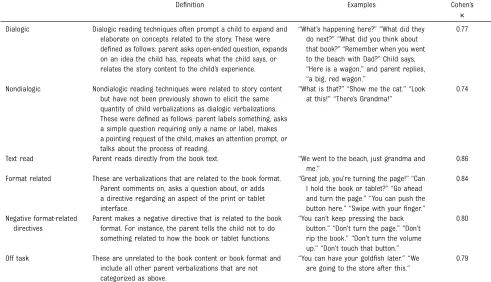
We developed a verbal coding scheme based on previous literature on dialogic reading8and shared electronic-book reading.14For each 10-second interval, researchers coded 1 for a specific verbalization
occurring or 0 for not occurring; interval verbalization counts were summed within each 5-minute book condition. Verbalization categories were not mutually exclusive; parents and children could have.1 type per 10-second interval, although each sentence was only coded in 1 category. Please see the coding definitions in Tables 1 and 2 for FIGURE 1
Reading protocol. The reading protocol consisted of a preassigned sequential reading activity of an enhanced electronic book, a basic electronic book, and a print book occurring in a counterbalanced fashion in 1 of 6 book-format permutations: (1) enhanced, basic, print; (2) enhanced, print, basic; (3) basic, enhanced, print; (4) basic, print, enhanced; (5) print, basic, enhanced; or (6) print, enhanced, basic. Within each book-format permutation, the order of 3 different book titles was counter-balanced, achieving a total of 36 unique permutations. Thus, all participants read the same 3 books, but not all books were read in the same format or order across participants.
FIGURE 2
parent and child verbalizations. Parent and child utterances were independently summed to calculate total verbalizations. Undergraduate students blinded to the hypothesis coded to reliability with Cohen’skof at least 0.70.
Coding Parent-Toddler Nonverbal Interactions
We developed 2 global coding schemes based on existing literature on shared print-book reading to assess parent-toddler nonverbal interactions: shared positive affect32 and collaborative book-reading experience.33–35Codes were applied
on the basis of the full 5 minutes per book condition on a scale of 1 to 5 (Table 3). The 5-minute free-play session was also coded for shared positive affect and examined as a potential covariate representing baseline parent-child interaction quality.
Analysis
We conducted Poisson regressions using Proc Genmod to compare each verbal outcome by book format, adjusting for total elapsed time, given the occasional variation in reading duration. Proc Mixed was used to compare differences in positive affect
and collaborative book reading by book format. All models included a repeated measures statement to allow for within-subjects comparison of verbal and nonverbal outcomes by book-format condition. Although the counterbalanced design accounted for between-subjects variance in factors known to influence book-reading behaviors, such as
sociodemographic characteristics, we included covariates infinal models withP,.05 to improve modelfit (eg, order of book presentation, parent income, race and/or ethnicity, child sex, CDI or BITSEA score, and home media practices). A sensitivity TABLE 1Coding Definitions and Examples of Parent Verbalizations
Definition Examples Cohen’s
k Dialogic Dialogic reading techniques often prompt a child to expand and
elaborate on concepts related to the story. These were defined as follows: parent asks open-ended question, expands on an idea the child has, repeats what the child says, or relates the story content to the child’s experience.
“What’s happening here?” “What did they do next?” “What did you think about that book?” “Remember when you went to the beach with Dad?”Child says,
“Here is a wagon,”and parent replies,
“a big, red wagon.”
0.77
Nondialogic Nondialogic reading techniques were related to story content but have not been previously shown to elicit the same quantity of child verbalizations as dialogic verbalizations. These were defined as follows: parent labels something, asks a simple question requiring only a name or label, makes a pointing request of the child, makes an attention prompt, or talks about the process of reading.
“What is that?” “Show me the cat.” “Look at this!” “There’s Grandma!”
0.74
Text read Parent reads directly from the book text. “We went to the beach, just grandma and
me.”
0.86
Format related These are verbalizations that are related to the book format. Parent comments on, asks a question about, or adds a directive regarding an aspect of the print or tablet interface.
“Great job, you’re turning the page!” “Can I hold the book or tablet?” “Go ahead and turn the page.” “You can push the button here.” “Swipe with yourfinger.”
0.84
Negative format-related directives
Parent makes a negative directive that is related to the book format. For instance, the parent tells the child not to do something related to how the book or tablet functions.
“You can’t keep pressing the back button.” “Don’t turn the page.” “Don’t rip the book.” “Don’t turn the volume up.” “Don’t touch that button.”
0.80
Off task These are unrelated to the book content or book format and include all other parent verbalizations that are not categorized as above.
“You can have your goldfish later.” “We are going to the store after this.”
0.79
TABLE 2Coding Definitions and Examples of Child Verbalizations
Definition Examples Cohen’s
k Book related Child labels a picture, answers a parent question, repeats what
the parent is saying, or talks about a function of the book.
“I want to read this.” “I press the button.”
“Look, a spider!”
0.81
Negative Child says no or makes a comment in a defiant or negative manner.
“No, Daddy, I do it.” “I hold it.” 0.71
Other These are verbalizations that do not fall into the above categories. Unintelligible utterances that are not clearly related to the book were also included.
analysis excluding 1 participant who cried during the entirety of 1 book-reading condition did not reveal differences; therefore, all participants were included. All analyses were completed in SAS 9.4 (SAS Institute, Inc, Cary, NC).
RESULTS
As shown in Table 4, children were 29.2 months old, and parents were 33.5 years old. Of the parents, 81% were mothers, 76% had a 4-year college degree or more, and 89% were married. Of the children, 54% were boys, 57% were non-Hispanic white, 16% were non-Hispanic African American, and 27% were of other race and/or ethnicity.
Figure 3 shows the number of intervals containing each type of parent verbalization. Parent dialogic verbalizations were greater with print (11.9 intervals [SE = 1.1]) versus either enhanced electronic (6.2 intervals [SE = 0.7];P,.001) or basic electronic books (8.3 intervals [SE = 0.9];P,.001). Parent nondialogic verbalizations were greater with print (17.7 [SE = 0.7]) versus basic electronic books (15.7 [SE = 0.8];P= .008). Parents read the book text more with print (14.3 [SE = 1.0];P= .003) or basic electronic (14.4 [SE = 1.1];P,.001) compared
with enhanced electronic books (10.6 [SE = 0.9]). Parents made fewer related and negative
format-related directives when engaging over print books versus enhanced or basic electronic books (Fig 3). Parents had TABLE 3Nonverbal Coding Definitions
Shared Positive Affect Collaborative Book Reading
Definition Quantity of shared enjoyment between dyad Quality of shared reading experience
Intraclass correlation 0.84 0.75
Code 1 A score of 1 was marked by little positive shared affect or enjoyment, several instances of negative affect that occur more frequently than instances of positive affect, and/or the child having a tantrum or refusal of prolonged duration or high frequency.
A score of 1 was marked by greater distance between the parent and child, the parent making few attempts to engage the child or being overly directive and/or intrusive, or the child missing social bids from the parent or being confrontational and/or defiant.
Code 3 A score of 3 was marked by small-to-moderate amounts of
positive affect between the dyad with brief but unsustained instances of negative affect, or the dyad may be primarily affectively neutral.
A score of 3 was marked by some instances of close dyad proximity with some instances of greater distance between them, some attempts of parent-child engagement but less in frequency than a code 4 or 5, and/or the dyad seeming more focused on the reading task than on each other.
Code 5 A score of 5 was marked by frequent displays of shared
positive affect with the dyad showing definite pleasure with each other (eg, high frequency of smiling, laughing, praise, and warmth).
A score of 5 was marked by the dyad being comfortably nestled together with a shared view of the book, a highly responsive parent, and an actively engaged child who exhibits minimal defiance.
TABLE 4Participant Characteristics (N= 37)
Sample Result
Child age, mo, mean (SD) 29.2 (4.2)
Parent age, y, mean (SD) 33.5 (4.0)
Parent relationship to child,n(%)
Mother 30 (81)
Father 7 (19)
Child sex,n(%)
Boys 20 (54)
Girls 17 (46)
Child race and/or ethnicity,n(%)
White, non-Hispanic 21 (57)
African American, non-Hispanic 6 (16)
Hispanic or other 10 (27)
Parent education,n(%)
Some college courses 4 (11)
2-y college degree 5 (13)
4-y college degree 14 (38)
More than 4-y college degree 14 (38)
Parent marital status,n(%)
Single 4 (11)
Married 33 (89)
Child has used tablet to read a book,n(%)
Almost never 23 (62)
Rarely 2 (5)
Occasionally 4 (11)
Often 6 (16)
Most of the time 2 (5)
Daily time spent reading books together,n(%)
Not used 8 (22)
,30 min 16 (43)
30 min–1 h 9 (24)
1–2 h 3 (8)
3–4 h 1 (3)
CDI percentile, mean (SD) 52.9 (33.4)
BITSEA Problem subscale, mean (SD) 6.7 (3.8)
more total verbalizations when interacting over print books (29.5 [SE = 0.2]) versus enhanced electronic books (28.1 [SE = 0.4];P= .003) and more so over basic electronic books (29.3 [SE = 0.3];P= .005) versus enhanced electronic books.
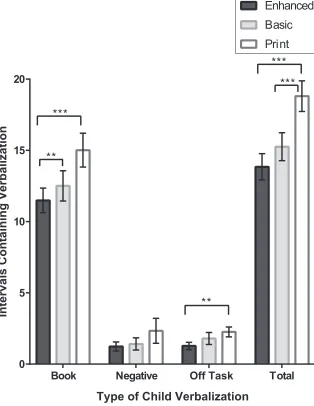
Figure 4 includes the number of intervals containing each type of toddler verbalization. Toddlers’ book-content verbalizations were greater with print (15.0 [SE = 1.2]) versus either enhanced electronic (11.5 [SE = 0.9];P,.001) or basic electronic books (12.5 [SE = 1.1];P= .005). Toddlers had no differences in negative verbalizations across all formats but had more off-task verbalizations with print (2.3 [SE = 0.3]) versus enhanced electronic books (1.3 [SE = 0.3];P= .007). Total toddler verbalizations were greater with print (18.8 [SE = 1.1]) versus either enhanced electronic (13.8 [SE = 0.9];P,.001) or basic electronic books (15.3 [SE = 1.0];P,.001).
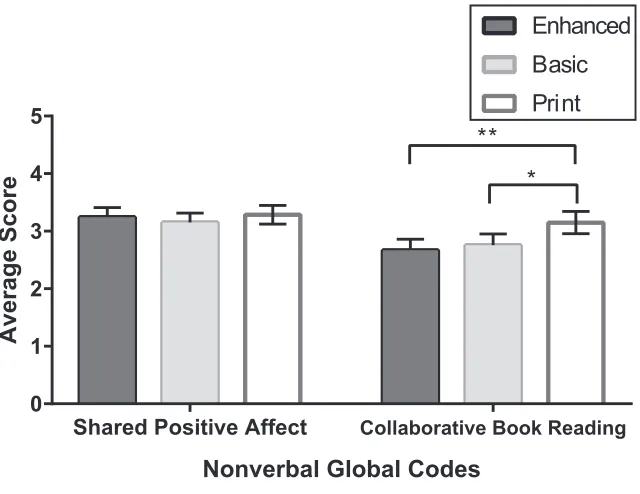
Figure 5 includes nonverbal outcomes by book format. Shared positive affect was similar across all book formats. Dyads’collaborative
book-reading scores were higher with print (3.1 [SE = 0.2]) versus either enhanced electronic (2.7 [SE = 0.2];
P= .004) or basic electronic books (2.8 [SE = 0.2];P= .02).
DISCUSSION
Developmental benefits of shared book reading have been attributed to the quality of parent-child
interactions occurring around books, particularly in prereaders such as toddlers, who rely heavily on parents to understand story content.8These interactions include the quantity of words spoken, how parents tailor content to children’s experiences to support learning, and asking open-ended questions to promote child expressive language.5,8Ourfindings suggest that high-quality dialogic practices are less common, and parents and toddlers speak less overall and in a less collaborative manner, when reading electronic books compared with print. Parents read the text less in enhanced electronic books, making more format-related comments and
negative directives when reading electronic books.
Similar to previous studies in preschoolers,17we found that electronic-book enhancements were likely interfering with parents’ability to engage in dialogic reading. Dialogic, parent-guided conversation promotes toddler expressive-language development and supports preliteracy skills, which are crucial for independent reading,8far more than reading only text or making simple (nondialogic) comments, although these are also important.1 Parents strengthen their children’s ability to acquire knowledge by relating new content to their children’s lived experiences.21,36 There is a large body of literature showing that this type of adult scaffolding is especially important for toddlers to transfer information from digital media to the real world because toddlers in particular learn and retain novel information better from in-person interactions than from digital media.22–24,26,27,37However, such practices occurred less frequently with electronic books, which raises the question of whether electronic books have lower
educational potential for toddlers.
Parents also asked fewer simple questions, commented about the storyline less, and read less during electronic-book conditions compared with print. These behaviors are important because they promote child receptive language by exposing children to novel vocabulary and more complex syntax than
conversations occurring during daily activities.1
Even interactions over basic electronic books contained fewer dialogic and total parent
verbalizations compared with print, suggesting that affordances of the tablet (and not only the interactive design) may be influencing parents’ behavior. Parents and children may conceptualize tablets as being FIGURE 3
individually used rather than shared objects. Indeed, 1 study revealed that children tend to create solitary spaces when engaging in tablet play
compared with traditional toy play, leaving less space for their parents to coview and ignoring parent bids for attention.38Similarly, parents reported a sense of pride and relief when their children independently engaged with a tablet device without help,39and we acknowledge that this independence may be perceived as a potential benefit of electronic books. We hypothesize that the tablet itself may reduce opportunities for
parent-child interactions during book reading.
Children changed their behavior as a function of book format, verbalizing more when reading the print book. Thisfinding may be related to greater parent dialogic reading with print books versus electronic books, which provides positive reinforcement for toddler speech. Children’s tendency to become occupied in repeated tapping or swiping on electronic books may also have supplanted speech production. Repetitive tapping and swiping may not constitute
sufficient engagement to learn new concepts because it is thought to represent cause-and-effect play rather than“minds-on”activity.21 True meaningful engagement (active involvement occurring in a rich social context without distractions) fosters the most effective learning from media.21Previous research in preschoolers supports this concept because distracting digital
enhancements interfere with parent scaffolding, which leads to reduced child story comprehension and fewer child verbalizations.13,14
Opportunities to practice expressive language, such as those occurring with print books, are important because early language skills strongly predict future linguistic and cognitive aptitude in school.40
The high frequency of format-related verbalizations (eg, directing the child to turn the page) observed during both electronic-book conditions may displace book-related verbal
exchanges that dyads engaged in with print books. This is consistent with previous research: although parents showed the same number of verbal exchanges with preschoolers around electronic versus print books, exchanges tended to be related to technology rather than story content.14It is possible that parents made more format-related
verbalizations to orient their children to a new experience because
electronic books were novel to 62% of the children in this sample; however, 79% had previously played with tablets and/or mobile devices. The negative and directive nature of parent format-related verbalizations may indicate a need for more behavioral management with
electronic books compared with print.
Parents and children had more off-task verbalizations with the print book versus electronic book, which is similar to previous studies in preschoolers.14This could be related to persuasive tablet-design features, which may command parent and FIGURE 4
child attention, at the expense of attending to one another, an effect that is known to occur with traditional screen media, such as television.41–43It is challenging to discern whether this attentional focus resulted in improved learning because toddler reading
comprehension is difficult to assess. However, as mentioned above, toddlers may be engaged in ways that may be less educationally enriching when reading electronic compared with print books.
Our study was thefirst to examine nonverbal aspects of electronic-book reading in toddlers both through shared positive affect and collaborative book reading. These nonverbal behaviors during reading are important because they foster a love of reading7and promote secure parent-child attachment,1which has been implicated in resilience,44 physical health,45and quality of future relationships.46Comparable to previous studies in preschoolers,14 dyads with high shared positive affect consistently showed this across all
formats, suggesting that electronic books may be equally enjoyable for dyads despite other limitations. The quality of collaborative reading was likely lower for electronic books because observationally, parents and toddlers frequently sat separately, could not easily view the book, or appeared to struggle for tablet possession. These behaviors during tablet-based play are documented in recent work38and merit further study. Our results may explain previous findings that parents report preferring shared reading over print versus electronic books with toddlers.47
Limitations include the small sample size from 1 geographic area, the use of only 1 type of book-reading application (which limits
generalizability), and that the age range of our study sample precluded assessment of reading
comprehension.48Strengths include experimental methodology, the use of commercially available books available in 3 formats, a diverse sample, and the within-subjects
design, which allowed for direct comparison of the reading experience within each dyad. Future studies should consider other facets of nonverbal interactions or moderating effects of dyad characteristics, such as parent literacy level, child
temperament, or home media-use practices. Replication of this study by using different applications (this application had a particular set of enhancements) in other contexts, such as home or school settings, is necessary. Although parent-child interactions are critical for toddler learning, directly examining toddler learning from print versus electronic books is another important area for future work.
CONCLUSIONS
Given the decreased quantity of parent-child verbalizations and quality of interactions occurring with the electronic books that we studied, pediatricians may wish to
recommend print books over electronic books with distracting features for parent-toddler shared reading. In considering affordances of electronic books that promote learning, software designers should limit irrelevant audiovisual
enhancements for toddlers. Parents reading electronic books with toddlers should consider engaging as they would with print and minimize focus on elements of the technology itself.
ACKNOWLEDGMENTS
We thank Rosa Ball, Ranya Alkhayyat, Joy Boakye, and Anastasia Pacifico for their diligent and wonderful work on this study.
ABBREVIATIONS
BITSEA: Brief Infant-Toddler Social and Emotional
Assessment CDI: Communicative
Developmental Inventory FIGURE 5
Address correspondence to Tiffany G. Munzer, MD, Department of Pediatrics, University of Michigan Medical School, 300 N. Ingalls St, 1024 NW, Ann Arbor, MI
48109-5406. E-mail: [email protected]
PEDIATRICS (ISSN Numbers: Print, 0031-4005; Online, 1098-4275).
Copyright © 2019 by the American Academy of Pediatrics
FINANCIAL DISCLOSURE:Dr Radesky is paid to write articles for PBS Parents and is on the board of directors and consults for Melissa and Doug; the other authors have indicated they have nofinancial relationships relevant to this article to disclose.
FUNDING:Funded by the 2017 Academic Pediatric Association Reach Out and Read Young Investigator Award (principal investigator: Dr Radesky), which made it possible to conceptualize, implement, collect, and analyze data and write this article, and supported by theEunice Kennedy ShriverNational Institute of Child Health
and Human Development (grant 5T32HD079350-02), which made it possible to conceptualize and write this article. Funded by the National Institutes of Health (NIH).
POTENTIAL CONFLICT OF INTEREST:Dr Radesky is paid to write articles for PBS Parents and is on the board of directors and consults for Melissa and Doug; the other authors have indicated they have no potential conflicts of interest to disclose.
REFERENCES
1. Zuckerman B. Promoting early literacy in pediatric practice: twenty years of reach out and read.Pediatrics. 2009; 124(6):1660–1665
2. Isbell R, Sobol J, Lindauer L, Lowrance A. The effects of storytelling and story reading on the oral language complexity and story comprehension of young children.Early Child Educ J. 2004; 32(3):157–163
3. Deckner DF, Adamson LB, Bakeman R. Child and maternal contributions to shared reading: effects on language and literacy development.J Appl Dev Psychol. 2006;27(1):31–41
4. Xie QW, Chan CHY, Ji Q, Chan CLW. Psychosocial effects of parent-child book reading interventions: a meta-analysis.Pediatrics. 2018;141(4): e20172675
5. Mendelsohn AL, Cates CB, Weisleder A, et al. Reading aloud, play, and social-emotional development.Pediatrics. 2018;141(5):e20173393
6. Baker L, Mackler K, Sonnenschein S, Serpell R. Parents’interactions with theirfirst-grade children during storybook reading and relations with subsequent home reading activity and reading achievement.J Sch Psychol. 2001;39(5):415–438
7. Kassow DZ. Parent-child shared book reading: quality versus quantity of reading interactions between parents and young children.Talaris Research Institute. 2006;1(1):1–9
8. Whitehurst GJ, Arnold DS, Epstein JN, Angell AL, Smith M, Fischel JE. A picture book reading intervention in day care
and home for children from low-income families.Dev Psychol. 1994;30(5): 679–689
9. Arnold DS, Whitehurst GJ. Accelerating language development through picture book reading: A summary of dialogic reading and its effect. In: Dickinson DK, ed.Bridges to Literacy: Children, Families, and Schools. Hoboken, NJ: Wiley-Blackwell; 1994:103–128
10. Lever R, Sénéchal M. Discussing stories: on how a dialogic reading intervention improves kindergartners’oral narrative construction.J Exp Child Psychol. 2011; 108(1):1–24
11. Perrin A.Book Reading 2016. Washington, DC: Pew Research Center; 2016
12. Kabali HK, Irigoyen MM, Nunez-Davis R, et al. Exposure and use of mobile media devices by young children.Pediatrics. 2015;136(6):1044–1050
13. Krcmar M, Cingel DP. Parent–child joint reading in traditional and electronic formats.Media Psychol. 2014;17(3): 262–281
14. Chiong C, Ree J, Takeuchi L, Erickson I.
Comparing Parent-Child Co-Reading on Print, Basic, and Enhanced E-Book Platforms: A Cooney Center Quick Report. New York City, NY: The Joan Ganz Cooney Center; 2012
15. Korat O, Shamir A, Arbiv L. E-books as support for emergent writing with and without adult assistance.Educ Inf Technol. 2011;16(3):301–318
16. Lauricella AR, Barr R, Calvert SL. Parent–child interactions during traditional and computer storybook
reading for children’s comprehension: implications for electronic storybook design.Int J Child Comput Interact. 2014;2(1):17–25
17. Bus AG, Takacs ZK, Kegel CA. Affordances and limitations of electronic storybooks for young children’s emergent literacy.Dev Rev. 2015;35:79–97
18. Lewin C. Exploring the effects of talking book software in UK primary
classrooms.J Res Read. 2000;23(2): 149–157
19. De Jong MT, Bus AG. Quality of book-reading matters for emergent readers: an experiment with the same book in a regular or electronic format.J Educ Psychol. 2002;94(1):145
20. Parish‐Morris J, Mahajan N, Hirsh‐ Pasek K, Golinkoff RM, Collins MF. Once upon a time: parent–child dialogue and storybook reading in the electronic era.
Mind Brain Educ. 2013;7(3):200–211
21. Vygotsky L. Zone of proximal development. In: Cole M, ed.Mind in Society: The Development of Higher Psychological Processes. Cambridge, MA: Harvard University Press; 1987:157
22. Strouse GA, Ganea PA. Toddlers’word learning and transfer from electronic and print books.J Exp Child Psychol. 2017;156:129–142
23. Krcmar M, Grela B, Lin K. Can toddlers learn vocabulary from television? An experimental approach.Media Psychol. 2007;10(1):41–63
Paper presented at:Proceedings of the Annual Meeting of the Cognitive Science Society; August 1–3, 2013; Montreal, QC
25. Welsh MC, Pennington BF, Groisser DB. A normative‐developmental study of executive function: a window on prefrontal function in children.Dev Neuropsychol. 1991;7(2):131–149
26. Strouse GA, Troseth GL, O’Doherty KD, Saylor MM. Co-viewing supports toddlers’word learning from contingent and noncontingent video.
J Exp Child Psychol. 2018;166:310–326
27. Barr R. Memory constraints on infant learning from picture books, television, and touchscreens.Child Dev Perspect. 2013;7(4):205–210
28. Dale PS. The validity of a parent report measure of vocabulary and syntax at 24 months.J Speech Hear Res. 1991;34(3): 565–571
29. Nordahl-Hansen A, Kaale A, Ulvund S. Inter-rater reliability of parent and preschool teacher ratings of language in children with autism.Res Autism Spectr Disord. 2013;7(11):1391–1396
30. Karabekiroglu K, Briggs-Gowan MJ, Carter AS, Rodopman-Arman A, Akbas S. The clinical validity and reliability of the Brief Infant-Toddler Social and Emotional Assessment (BITSEA).Infant Behav Dev. 2010;33(4):503–509
31. Valkenburg PM, Krcmar M, Peeters AL, Marseille NM. Developing a scale to assess three styles of television mediation:“instructive mediation,”
“restrictive mediation,”and“social coviewing”.J Broadcast Electron Media. 1999;43(1):52–66
32. Frosch CA, Cox MJ, Goldman BD. Infant-parent attachment and Infant-parental and child behavior during parent-toddler
storybook interaction.Merrill-Palmer Q. 2001;47(4):445–474
33. Eyberg SM, Robinson EA.Dyadic Parent-Child Interaction Coding System. Seattle, WA: Parenting Clinic, University of Washington; 1981
34. Rocissano L, Slade A, Lynch V. Dyadic synchrony and toddler compliance.Dev Psychol. 1987;23(5):698
35. Sonnenschein S, Munsterman K. The influence of home-based reading interactions on 5-year-olds’reading motivations and early literacy development.Early Child Res Q. 2002; 17(3):318–337
36. Wadsworth BJ.Piaget’s Theory of Cognitive and Affective Development: Foundations of Constructivism. White Plains, NY: Longman Publishing; 1996
37. Reiser RA, Tessmer MA, Phelps PC. Adult-child interaction in children’s learning from“Sesame Street”.ECTJ. 1984;32(4):217–223
38. Hiniker A, Lee B, Kientz JA, Radesky JS. Let’s play!: digital and analog play between preschoolers and parents. In:
Proceedings of the 2018 CHI Conference on Human Factors in Computing Systems; April 21–26, 2018; Montreal, QC
39. Radesky JS, Eisenberg S, Kistin CJ, et al. Overstimulated consumers or next-generation learners? Parent tensions about child mobile technology use.Ann Fam Med. 2016;14(6):503–508
40. Marchman VA, Fernald A. Speed of word recognition and vocabulary knowledge in infancy predict cognitive and language outcomes in later childhood.
Dev Sci. 2008;11(3):F9–F16
41. Kirkorian HL, Pempek TA, Murphy LA, Schmidt ME, Anderson DR. The impact of background television on parent-child interaction.Child Dev. 2009;80(5): 1350–1359
42. Pempek TA, Kirkorian HL, Anderson DR. The effects of background television on the quantity and quality of child-directed speech by parents.J Child Media. 2014;8(3):211–222
43. Schmidt ME, Pempek TA, Kirkorian HL, Lund AF, Anderson DR. The effects of background television on the toy play behavior of very young children.Child Dev. 2008;79(4):1137–1151
44. Mikulincer M, Florian V. The
relationship between adult attachment styles and emotional and cognitive reactions to stressful events. In: Simpson JA, Rholes WS, eds.
Attachement Theory and Close Relationships. New York: Guilford Press; 1998:143–165
45. Puig J, Englund MM, Simpson JA, Collins WA. Predicting adult physical illness from infant attachment: a prospective longitudinal study.Health Psychol. 2013; 32(4):409–417
46. Brennan KA, Shaver PR. Dimensions of adult attachment, affect regulation, and romantic relationship functioning.Pers Soc Psychol Bull. 1995;21(3):267–283
47. Strouse GA, Ganea PA. Parent-toddler behavior and language differ when reading electronic and print picture books.Front Psychol. 2017;8:677
DOI: 10.1542/peds.2018-2012 originally published online March 25, 2019;
2019;143;
Pediatrics
Radesky
Tiffany G. Munzer, Alison L. Miller, Heidi M. Weeks, Niko Kaciroti and Jenny
Differences in Parent-Toddler Interactions With Electronic Versus Print Books
Services
Updated Information &
http://pediatrics.aappublications.org/content/143/4/e20182012 including high resolution figures, can be found at:
References
http://pediatrics.aappublications.org/content/143/4/e20182012#BIBL This article cites 39 articles, 5 of which you can access for free at:
Subspecialty Collections
http://www.aappublications.org/cgi/collection/media_sub
Media
ub
http://www.aappublications.org/cgi/collection/psychosocial_issues_s
Psychosocial Issues
al_issues_sub
http://www.aappublications.org/cgi/collection/development:behavior
Developmental/Behavioral Pediatrics following collection(s):
This article, along with others on similar topics, appears in the
Permissions & Licensing
http://www.aappublications.org/site/misc/Permissions.xhtml in its entirety can be found online at:
Information about reproducing this article in parts (figures, tables) or
Reprints
DOI: 10.1542/peds.2018-2012 originally published online March 25, 2019;
2019;143;
Pediatrics
Radesky
Tiffany G. Munzer, Alison L. Miller, Heidi M. Weeks, Niko Kaciroti and Jenny
Differences in Parent-Toddler Interactions With Electronic Versus Print Books
http://pediatrics.aappublications.org/content/143/4/e20182012
located on the World Wide Web at:
The online version of this article, along with updated information and services, is
by the American Academy of Pediatrics. All rights reserved. Print ISSN: 1073-0397.

![Figure 3 shows the number ofintervals containing each type ofnondialogic verbalizations weregreater with print (17.7 [SE = 0.7])versus basic electronic books (15.7[SE = 0.8];(14.4 [SE = 1.1];book text more with print (14.3 [SE =1.0];basic electronic books](https://thumb-us.123doks.com/thumbv2/123dok_us/9250519.1461779/5.585.217.540.358.728/figure-ofintervals-containing-ofnondialogic-verbalizations-weregreater-electronic-electronic.webp)