GLOBAL JOURNAL OF ADVANCED ENGINEERING TECHNOLOGIES AND
SCIENCES
TOWARDS CONFIGURING INFORMATION SYSTEMS FOR MANAGING
COLLABORATIVE PROJECTS
Satinder Kaur*, Simmi Bagga
*
Assistant Professor, Department of Computer Science & Engineering, GNDU, RC, Sathiala, Distt.
ASR, INDIA
Assistant Professor, Sant Hira Dass Kanya MahaVidyalaya, Kala Sanghian, Distt Kpt. INDIA
ABSTRACT
Information Systems have an eminent role for successful management of large projects which involve multi-bodies. These bodies have to work together and also share important information for successful scheduling and development of the project. So, management of information systems is very necessary to provide centralized documents in order to satisfy information needs of different persons having different interests and roles for the project. So, a need arises for a platform which is able to develop the above mentioned information systems. This paper discusses the functional requirements for these information systems. A methodology has also been configured for developing information systems which serve the development of collaborative projects.
KEYWORDS: Project Management Information Systems (PMIS), usability, Business and Education Projects (BEP), workflows, use cases.
INTRODUCTION
An efficient project management information system is primary need for successful development of collaborative projects, as these projects involve persons from academic institutions, government sectors and business enterprises [1]. This PMIS must have high data quality, full usability and proper functionality in order to satisfy different users who work under different situations [2]. To develop information systems for these projects mainly a tailored process is implemented. Recognition of proper project category and determination of user specific requirements are perquisites for successful tailoring. After that search for Project Management (PM) application from existing databases and extracts its information system. Customize this information system according to needs is the next step in tailoring. The main objective of this paper is to describe the necessary features of such information systems. Based on literature review, a configuration for PMIS is described which act as a platform for management of educational and business projects. Platform will allow exchange of information between different persons from different bodies in systematic and structured manner. The next section describes the existing PMIS and BEP platforms. Section 3 outlines the research methodology adopted. Section 4 represents the final configuration of PMIS systems.
LITERATURE REVIEW
The main objective of PMIS is to provide information for managing projects and generating reports. It provides information for administrating, configuring, planning, controlling and executing the collaborative projects. It can provide the information only if it has standardized set of tools for these puposes [3]. These tools are also responsible for collecting, combining and sharing the project information among different persons which have different functions in project development and control [4].
Figure 1: Information needed for configuring PMIS
Determine processes or workflows for
these data items
Determine attributes of each data item
Determine dataitems or workflows
Software vendors provide the buildup PMIS for PM applications. The PMIS has tools associated with them which allow configuring and modifying them. However, these tools do not allow modification at the code level. One has to provide the information regarding data entities involved with their attributes and processes or workflows for successful configuration as shown in Figure 1. To implement this step one can use knowledge base systems [4]. However, one can also use the methodology presented in this paper.
The existing BEP platform is based on PMIS Redmine [5] which is available freely on internet. BEP projects use the whole functionality of Redmine and even they can extend it according to project needs. Redmine operating facilities involve work item tracking, Gantt charts, calendar, news, document and file management, email notifications, wiki, forum, time tracking and reporting. It also provide administrative facilities like support for multiple projects, role based access control, work item configuration (work items, fields, workflows), Multilanguage support etc. which are enough for a BEP [6] platform.
METHODOLOGY ADOPTED
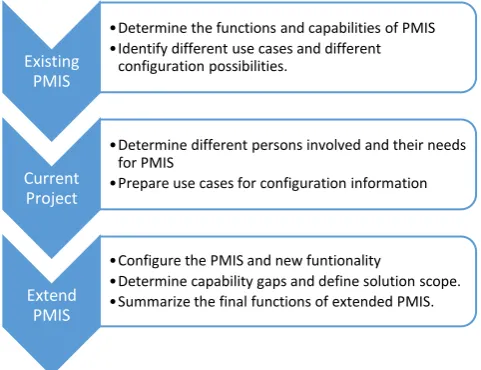
Our research methodology does not depend on existing knowledge databases rather it first analyze the existing PMIS which is suitable for the current project. It also analyze the project configuration requirements to determine which amendments are needed in existing PMIS. Then it determines the various configuration possibilities so that PMIS platform can be extended. After selection of configuration method, new functionality is added in the platform and capability gaps are accessed. Finally it defines the solution scope and summarizes the functions of extended PMIS as shown in Figure 2.
Figure 2: Methodology Adopted
This section generalises the functions of PMIS and proposes the configuration of BEP platform to extend its functionality so that it can deal with collaborative projects which involve business, education and research disciplines together.
Project types and use cases:
The BEP platform is developed in order to provide online PMIS for managing business, educational and research projects [6]. The main target groups of collaborative projects are academic institutions, business or private organisations and government sectors. Business group can be further divided into two subgroups i.e. general and IT. Each group involve different personnel having different roles for development of project. These persons interact with their respective project managements for their information needs. PMIS is accessed by all these managements through BEP platform. The common use cases are discussed below:
Common personnel: These persons are responsible for whole project. They directly interact with BEP platform for managing the whole project. They are divided into two roles.
o Project manager/ Coordinator o Project Owner
Government institution personnel: These persons are from government sector side. These are of two Existing
PMIS
•Determine the functions and capabilities of PMIS •Identify different use cases and different
configuration possibilities.
Current Project
•Determine different persons involved and their needs for PMIS
•Prepare use cases for configuration information
Extend PMIS
•Configure the PMIS and new funtionality
o Project team members: They interact with general and IT project managements. o Guest lecturer and Mentor: They have interaction with educational project management. o Consultant and Partners: They access only research project management.
Academic Personnel: They involve three roles.
o Researchers who access research project management.
o Academic persons and students who access educational project management.
All the four management bodies depend upon BEP platform for their information needs. So, each person has a fixed template to provide and access information in centralized location.
Project Managements, information items and workflows:
The general PM case has the information items which are also acquired by other three managements with some additional items or values. General PM Standards are defined in ISO21500 [7], IPMA competence baseline [8] [9] and PRINCE [10]. IT PM needs information regarding project scope, testing and quality assurance. The required information also vary according to lifecycles, methods and methodologies adopted for software development as waterfall [11], DSDM [12], Scrum [13] [14], Kanban [15], iterative [16], spiral [17]. Existing researches [18] [19] [20] [21] survey provide information regarding items and workflows needed for research PM as shown in Table 1. Educational PM needs information items those serve its two processes i.e. organizational and teaching. List of various workflows along with description is shown below:
Activity :Defines work performed during course of project.
Deliverable : Defines any unique and variable products, results or capability to perform a service that is required to be produced to complete a process, phase, or project.
Metric :Defines performance, quality metrics for progress monitoring and measurement of success.
Risk: Defines uncertain events or condition, if it occurs, has a positive or negative effect on one or more project objectives.
Procurement: Defines necessary purchases (and related contracts) of products, services or results needed from outside the project team.
Meeting: Defines physical meeting performed during course of project. Online Meeting: Defines online meeting performed during course of project.
Issue : Define points or matter in questions or in dispute, or a point or matter that is not settled and is under discussion or over which there are opposing views or disagreements.
Change Request: Defines formal proposal to modify any document, deliverable, or baseline. Task: Define works for a member of the team. Use in IT project - similar to activity.
Review: Define code, design, deployment or other kind reviews and it results. Bug; Define errors, problem or potential problem in application, IS etc.
User Story :Defines requirements to project deliverables used in Agile development models Requirement: Defines requirements to project deliverables.
Feature: Define main functions of developed software
Test case :Defines tests and test scenarios that are need to pass developed software. Epic :Captures a large body of work.
Research Issue :Define research objectives, problems and requirements.
From the table one can select the various use cases and workflows for managing the information systems of the project. Then, basic administration needs should be identified. BEP platform support the following administration functions:
Creation of project
Define roles and select project members for various responsibilities Group users into organizations
Use case Information Items Work flows or processes
Examples
General PM Work breakdown structure, Activities, Milestones, Schedule;
Costs, Budget, Baseline;
Resources, Roles, Project team, Stakeholders; Deliverables, Project documents, Plans;
Reviews, Progress data, Reports, Metrics, Key Performance Indicators, Measurements;
Risks;
Procurements and Contracts; Meetings;
Issue log; Change request; Lessons learned; Configuration items;
Calendars, Notifications, Actual work lists.
Activity,
Deliverable, Metric, Risk, Procurement, Meeting, Online Meeting, Change Request
PMBOK, ISO21500, IPMA competence baseline and PRINCE2.
IT PM General PM +
Bug / defect; User story;
Task; Requirement; Change Request; Issue; Feature;
Test case / Test Epic; Backlog, Burndown chart; Review / code review.
Activity,
Deliverable, Metric, Risk, Procurement, Meeting, Online Meeting, Change Request, Task, Review, Bug, User Story, Requirement, Feature, Test case, Epic
Waterfall, iterative, spiral or agile for developing various softwares.
Research PM Research issues;
Project scope, schedule with deliverables and milestones;
Resource and equipment; Project cost;
Progress report, technical report; Problems;
Risks;
Procurements; Reviews;
Document management; Project management dashboard; Communication and meetings.
Activity,
Deliverable, Metric, Risk, Procurement, Meeting, Online Meeting, Change Request, Review, Research Issue
Erasmus +, FP7, Horizon2020 projects, government research project grants, university research projects, PhD research etc.
Educational PM
General PM +
Different kind of outputs and / or events: lecture, workshop, seminar, course, program, presentation, test, exam, publication.
Requirements for project results and deliverables especially for students prepared deliverables.
Activity,
Deliverable, Metric, Risk, Meeting, Online Meeting, Change Request, Requirement
study program renovation, course design, workshop development, studying towards an academic degree, project-based teaching, group work, problem-based learning,
CONCLUSION
This paper has discussed the issues related to management of information systems which deal in implementation of collaborative projects. It is shown that how to make the extended use of existing information systems. One needs to identify various use cases which interact with different target managements for information. One also has to identify proper information items and workflows for managements of target groups. After that, BEP platform is analyzed for above task which shows that it provides a lot of functions to implement an efficient PMIS if it is properly configured according to project needs.
REFERENCES
[1] Raymond L, Bergeron F. Project Management Information Systems: An Empirical Study of Their Impact on Project Managers and Project Success. Int J Proj Manag 2008;26(2):213–20.
[2] Ali ASB, Anbari FT, Money WH. Impact of Organizational and Project Factors on Acceptance and Usage of Project Management Software and Perceived Project Success. Proj Manag J 2008;39(2):5–33. [3] Bērziša S. Application of Knowledge and Best Practices in Configuration of Project Management
Information Systems. RTU Publishing House; 2012. 33.p.
[4] Vaishnavi, V., Kuechler B. Design Science Research in Information Systems [Internet]. Assocation for Information Systems. 2004. Available from: http://desrist.org/design-research-in-information-systems. [5] Redmine [Internet]. Available from: http://www.redmine.org/
[6] BEP Software Platform Overview. ISPEHE 2015.
[7] ISO 21500:2012 - Guidance on Project Management. ISO; 2012. 39 p.
[8] ICB: IPMA Competence Baseline [Internet]. IPMA [cited 2015 Aug 16]. Available from: http://ipma.ch/resources/ipma-publications/ipmacompetence-baseline/
[9] Fangel M. Proactive Project Management: How to Make Common Sense Common Practice. Fangel Consulting; 2013. 454 p.
[10] Hedeman B, Heemst GV Van, Fredriksz H. Project Management Based on PRINCE2 (Best Practice). 3rd ed. Van Haren Publishing; 2006.215 p.
[11]Waterfall Model [Internet]. [cited 2015 Aug 20]. Available from: http://www.waterfall-model.com/ [12]The DSDM Agile Project Framework [Internet]. DSDM Consorftium. [Cited 2015 Aug 20]. Available
from: http://www.dsdm.org/digdeeper/book/dsdm-agile-project-framework [13]Schwaber K. Agile Project Management with Scrum. Microsoft Press; 2004. 192 p.
[14]Scrum Framework [Internet]. Agiletrick. [Cited 2015 Aug 20]. Available from: http://agiletrick.com/about-agile/agile-frameworks/scrumframework/
[15]Brechner E. Agile Project Management with Kanban (Developer Best Practices), 1st ed. Microsoft Press; 2015. 160 p.
[16]SDLC - Iterative Model [Internet]. TuturialsPoint. [Cited 2015 Aug 20]. Available from: http://www.tutorialspoint.com/sdlc/sdlc_iterative_model.htm
[17]Boehm BW. A Spiral Model of Software Development and Enhancement. Computer (Long Beach Calif). IEEE Computer Society Press 1988; 21(5):61–72.
[18]Huljenic D, Desic S, Matijasevic M. Project Management in Research Projects. In: Proceedings of the 8th International Conference on Telecommunications, 2005 ConTEL 2005. IEEE; 2005. p. 663– 9.
[19]Rossi R, Mustafa PN. Project Management Principles Applied in Academic Research Projects. Issues Informing Sci Inf Technol 2013, 10:325–40.
[20]Ge N, Li H, Gao L, Zang Z, Li Y, Li J, et al. A Web-Based Project Management System for Agricultural Scientific Research. In: 2010 International Conference on Management and Service Science. IEEE; 2010. p. 1–3.