
Design And Optimisation Of Fast Dissolving Tablets Containing Metoprolol By Sublimation Method
12
0
0
Full text
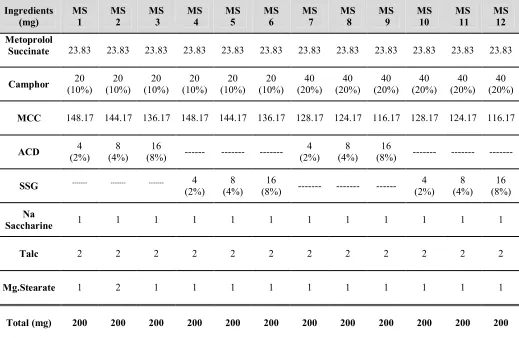
(2) Kurup N S et al. IRJP 1 (1) 2010 346-357 United States Food and Drug Administration (FDA) define orally disintegrating tablets as “A solid dosage form which contain a medicinal substance or active ingredient which disintegrates rapidly within a matter of seconds when placed upon a tongue.” US Food and Drug Administration Center for Drug Evaluation and Research (CDER) defines, in the ‘Orange Book’, an ODT as “a solid dosage form containing medicinal substances, which disintegrates rapidly, usually within a matter of seconds, when placed upon the tongue.” European Pharmacopoeia has described orally disintegrating tablets as ‘uncoated tablets intended to be placed in the mouth where they disperse rapidly before being swallowed’ and as tablets which should disintegrate within 3 min. Orally disintegrating tablets have been found to be the choice for Psychiatric as well as patient suffering from stroke, thyroid disorder, Parkinson’s diseases and multiple sclerosis, patients with nausea, vomiting and motion sickness3-8. MATERIALS AND METHODS Metoprolol Succinate was obtained as a gift sample from IPCA Laboratories Pvt. Ltd., Mumbai. Avicel PH 102 (microcrystalline cellulose; MCC), AcDiSol (Croscarmellose sodium ACD), Sodium starch Glycolate (SSG), were obtained from Signet Chemicals, Mumbai. Polyvinylpyrrolidone (PVP K 30) was obtained from Arihant Trading Co. Mumbai. Camphor, Ammmonium Bicarbonate, Sodium Saccharine, Talc and Magnesium Stearate used were of analytical grade. Formulation Of Tablets All the ingredients were sieved through 60# sieve. The subliming agents camphor9 and ammonium bicarbonate10 were used (separately) in two varying amounts (10%, 20%) respectively, the active ingredient and MCC were mixed together, PVP in IPA11 was used as binder, the wet mass was then sieved through 20# sieve. The resulting granules were dried at room temperature. These were then passed through 20# sieve and those retained on 40# were used further, mixed with the sweetener (0.5% Na Saccharine)12, superdisintegrants like ACD and SSG in three varying amounts (2%, 4%, 8%)13-16, talc and magnesium stearate. The granules were then weighed to a weight of 200 mg [11] and punched into tablets using 8mm punch17-23 (Table 1, 2 & 3 Figure 1). Evaluation Evaluation of Tablet Blends24: Angle Of Repose Angle of repose is determined by the following formula, Tan θ = h/r Therefore, θ = Tan-1 (h/r) Where, θ = Angle of repose h = height of the cone r = Radius of the cone base Angle of Repose less than 30 ° shows that material is free flowing. Bulk Density Bulk density was measured using a Densitometer. The bulk density is given by Pb=M/Vp Where, Pb =Bulk Density M = Weight of sample in gm Vp = Final volume of blend in cm3 Tap Density The tap density is given by, Pu=M/Vu Where, Pu = Tap Density M = Weight of sample in gm Vu= Final volume of blend after tapping in cm3. IRJP 1 (1) Dec 2010. Page 346-357.
(3) Kurup N S et al. IRJP 1 (1) 2010 346-357 Percent Compressibility It is an important measure obtained from bulk density and is defined as, C = Pb-Pu/Pb x100 If the bed of particles is more compressible the blend will be less flowable and flowing materials. Where, C = % Compressibility Pb = Bulk Density Pu = Tap Density Evaluation of tablets Appearance The tablets were evaluated for shape, color, odor, taste. Thickness & Diameter The size of tablets were evaluated my measuring their thickness and diameter by Vernier callipers. Hardness Crushing strength of the tablets was evaluated using Pfizer type Hardness Tester25. Friability Tablets were evaluated for friability using Roche Friability tester. Twenty tablets were weighed and placed into the friability tester, carried out at 25 rpm for 4 min (100 rotations). The tablets were dedusted and weighed. The pharmacopoeial (IP) limit of friability test for a tablet is not more than 1% of the original weight of the tablets26. Uniformity of weight IP procedure for uniformity of weight was followed, twenty tablets were taken and their weight was determined individually and collectively on a digital weighing balance. The average weight of the tablets was determined25, 26. Average weight of tablets(mg) Maximum percentage difference allowed 130 or less 10 130-324 7.5 More than 324 5 Drug Content Twenty tablets were weighed and powdered. Accurately a quantity of the powder equivalent to about 0.12 g of Metoprolol Succinate was weighed, dissolved in ethanol and appropriately diluted with ethanol, the resulting solution was filtered. Absorbance of the solution was measured at 273nm using UV-vis spectrophotometer25. In Vitro Disintegration Time Time taken by the tablets to disintegrate was performed on USP Disintegration Test Apparatus using 900ml of water as medium at 37ºC with disks25, 27, 28. Wetting Time Five circular tissue papers were placed in a Petri dish, 10 ml of water containing eosin, was added, tablet was placed on the surface of the tissue paper. The time required for water to reach the upper surface of the tablets was noted as the wetting time29, 30, 31. Modified Disintegration Test (I) Disintegration time of tablets was measured using a modified disintegration test method. Water (10ml) was taken in a petridish and tablet was carefully placed in the centre and agitated mildly. Time required for complete disintegration of tablet into fine particles was noted as the disintegration time31, 32. Modified Disintegration Test (II) This disintegration test was carried by placing the FDT in the basket of the USP dissolution basket type apparatus, water was dropped on it from a burette at a rate of 4 ml/min. The time required by the tablet to completely break into particles and pass down through the bottom mesh of the basket was noted as disintegration time27, 32. In Vitro Dissolution Studies The dissolution test for fast disintegrating tablets of Metoprolol Succinate was performed as follows, Apparatus: USP Type II. IRJP 1 (1) Dec 2010. Page 346-357.
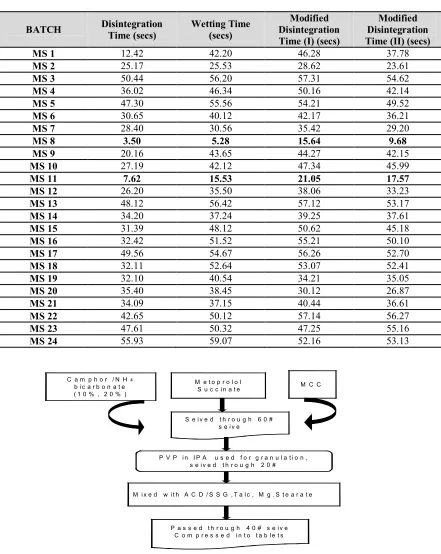
(4) Kurup N S et al. IRJP 1 (1) 2010 346-357 Dissolution Medium: Simulated gastric fluid pH 1.2 Volume: 900ml Speed: 100rpm Time Interval: 2, 5, 10, 15, 20, 30 mins. 5ml of the sample was withdrawn at specific time interval and replaced with fresh dissolution medium. The sample solution was diluted with the dissolution medium and analyzed by UV- vis spectrophotometer at 273nm26, 33, 34. RESULTS Tablet Blend parameters The angle of repose of all batches was found to be in the range of 20.15 -26.54, which indicated a good flow characteristic The percent compressibility was found in the range of 1.2-13.20, which indicated excellent flow characteristic. Hausner’s ratio for all batches was found to be 1.02 -1.15, which is less than 1.25, hence indicating good flow properties of the tablet blends24. Organoleptic Properties, Hardness & Friability The appearance of all the batches was found to be white, round and flat faced as all the excipients used were white in color, the punches used during compression were round and flat- faced. All the batches were found to be uniform in appearance. Test for tablet thickness and diameter was performed to ensure the batch-to-batch uniformity in thickness and diameter among all the formulations. The thickness of all the batches was found to be in the range of 3.9-4.3 mm and the diameter of all batches was found to be between 8.0-8.3 mm, which was in compliance with the punch size (8mm) used during compression The hardness of all batches was found to be in range of 3.8-4.3, as it was to be kept constant in this range during compression. Three tablets from each batch were tested with Pfizer hardness tester and the average of three was found. The friability of all the batches was found to less than 1% ranging from 0.087-0.243 %, thereby all the batches were found to pass the test for friability of tablets as per IP. Ten tablets were taken from each batch to test friability, the test was performed in triplicate. The bitter taste of Metoprolol Succinate was masked in all batches, with Na Saccharine, the tablets were found to be sweet in taste. The tablets were found to be free of any odour. Uniformity of Weight Weight variation test was performed as per IP, the test ensured that the fill in the die cavity was uniform for all the batches. Ten tablets were weighed individually and the average weight was found. The percent deviation calculated was less than 7.5% of the average weight (200 mg) of the tablet that is the tablet weight should lie between 185-215 mg for all batches. Hence, all batches comply with the test for weight variation as per IP. Drug Content Evaluation Assay/ determination of drug content was done spectrophotometrically on three tablets per batch and the average value was calculated. The drug content was found to be from 97.93% to 101.34% for all the batches. This suggested that the drug was dispersed uniformly between the tablet blend for all the batches. Disintegration Tests (Table 4, Figure 2, 3, 4 & 5) The disintegration test was performed as per IP on six tablets with discs, the average of six was taken as the disintegration time (seconds). The disintegration time range for batches containing 10% camphor (MS 1-MS 6) was found to be 12.4250.44 and those containing 20% camphor (MS 7- MS 12) showed a disintegration time from 3.50-28.40. Batches containing 10% ammonium bicarbonate (MS 13- MS 18) showed a range between 31.39-49.56, while those containing 20% ammonium bicarbonate (MS 19- MS 24) showed disintegration time between 32.10-55.93.. IRJP 1 (1) Dec 2010. Page 346-357.
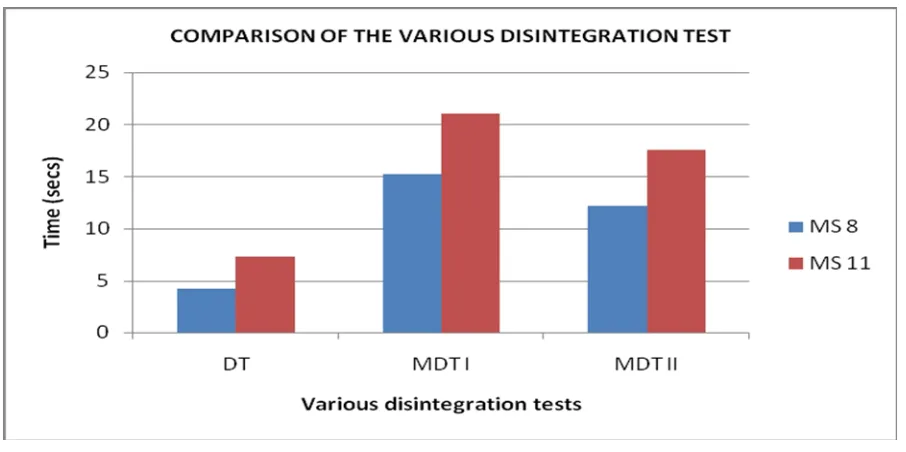
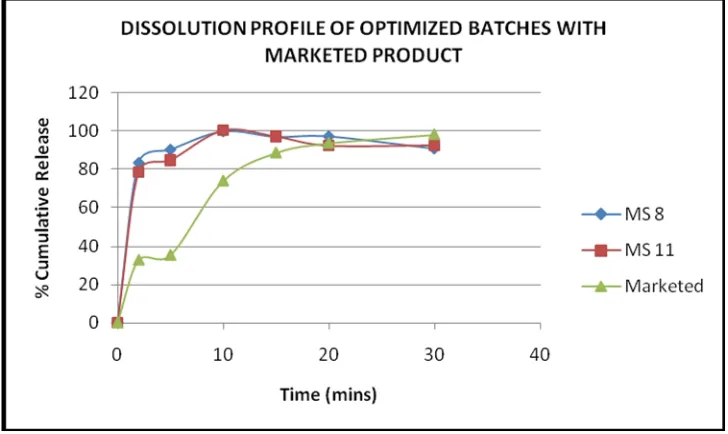
(5) Kurup N S et al. IRJP 1 (1) 2010 346-357 Among the batches made with a combination of 20% camphor & ACD (2%, 4%, 8%), the least disintegration time was found to be 3.50 which is for MS 8 (20% camphor, 4% ACD). Batches with combination of 20% camphor & SSG (2%, 4%, 8%), 7.26 was found to be the least disintegration time, which was for MS 11. Wetting time test was performed on three tablets of each batch, the average was taken as wetting time. The wetting time was found to be less than 1 min for all the batches, this is similar to the disintegration time of all the batches. The modified disintegration test I (MDT I), was also performed on three individual tablets from each batch. This test was performed to mimic the conditions of the tongue where the agitation is much less as compared to the stomach. Due to lack of agitation, the disintegration time by this method was found to be more as compared to that obtained from the USP disintegration test. All the tablets were found to disintegrate within 60 secs. Modified disintegration test II was performed to mimic the less amount of volume of the disintegration medium present in the mouth. Modified disintegration test II was performed on three tablets of each batch, the disintegration time was found to be less than 1 min for all batches. The fig. above states the correlation between the various disintegration test performed. As seen in the fig. disintegration time for MDT I and MDT II is similar for the respective batches as the conditions involve less volume of water and no agitation, the disintegration time obtained by the USP disintegration test differs significantly from these tests. The batches taken for comparison are those with least disintegration time among all batches. Dissolution Studies (Figure 6) The dissolution test was performed on six tablets as per IP. The two batches MS 8, MS 11 which were found to show the least disintegration time were found to show complete drug release in 10 mins as compared to the marketed product which showed complete drug release at the end of 30mins. Batches MS 8 and MS 11 were studied for stability under different conditions of temperature and relative humidity as per ICH for a period of 3 months and were found to be stable. DISCUSSION The disintegration time results as in Table no. 4 suggest that camphor is a better subliming agent than ammonium bicarbonate to aid faster disintegration of the tablets and the optimum amount to be used for faster disintegration is 20%. Further the disintegration time of batches containing superdisintegrants show that the optimum amount of ACD and SSG was found to be 4% in combination with 20% camphor. The batches with fastest disintegration time, MS 8 and MS 11disintegrated in less than 30 secs, which is in compliance with the USFDA limit for disintegration time for ODT4. The wetting time results of tablets containing ACD as super disintegrant showed a faster wetting time as compared to those containing SSG, as ACD readily breaks up the tablet into smaller particles as compared to the swelling nature of SSG, tablets containing SSG swell due to absorbance of water before breaking to smaller particles. In the dissolution studies of the batches containing subliming agent (10% and 20% camphor and 10% and 20% of ammonium bicarbonate) and superdisintegrant, 80% drug release was seen within 5 mins for all the batches. Batches prepared by the addition of only superdisintegrant, showed 80% dissolution within 15 mins. This suggested that addition of subliming agent in combination with superdisintegrant aided the dissolution of tablets significantly. Complete drug release was obtained in 10 mins for MS 8 (20% camphor, 4% ACD) and MS 11 (20% camphor, 4% SSG) batches whereas for other batches it was more than 15 mins. This indicated that the subliming agent camphor at the strength of 20% alongwith 4% superdisintegrant showed better dissolution profile. The dissolution results supported the findings of disintegration test and thereby confirmed that the batches MS8 and MS11 were found to be optimized for the required parameters hence stable fast disintegrating tablets of Metoprolol succinate were successfully prepared.. IRJP 1 (1) Dec 2010. Page 346-357.
(6) Kurup N S et al. IRJP 1 (1) 2010 346-357 ACKNOWLEDGEMENT We would like to thank IPCA laboratories Pvt. Ltd. for providing the gift sample of drug, Signet and Arihant Trading Co. for providing gift samples of excipients. REFERENCES 1. Sastry S, Nyshadham J. Recent technological advances in oral drug delivery – a review. Pharmaceutical Science & Technology Today April 2000; 3(4):138-145. 2. Reddy L. Fast Dissolving Drug Delivery Systems: A Review of the literature. Indian Journal of Pharmaceutical Sciences 2002; 64(4):331-335. 3. Yourong Fu, Shicheng Yang. Orally Fast Disintegrating Tablets: Developments, Technologies, Taste Masking and Clinical Studies. Critical Reviews in Therapeutic Drug Carrier Systems 2004; 21(6):433475. 4. Wagh M, Kothawade D. Techniques used in orally disintegrating drug delivery system. International Journal of Drug Delivery 2010; 2:98-107. 5. Kuchekar B, Bhise S. Design of Fast Dissolving Tablets. Indian Journal of Pharmaceutical Education & Research 2001; 35:150-152. 6. Shukla D, Chakraborty S. Fabrication and evaluation of taste masked resinate of respridone & its orally disintegrating tablets. Chem.Pharm.Bull 2009; 57(4):337-345. 7. EDQM, editors. Tablets. European Pharmacopoeia. 5th ed. 2005; 1:628. 8. Harada T, Narazaki R. Evaluation of the disintegration properties of commercial famotidine 20 mg orally disintegrating tablets using a simple new test and human sensory test. Chem.Pharm.Bull 2006; 54(8):1072-1075. 9. Furtado S, Deveswaran R. Development and characterization of orodispersible tablets of famotidine containing a subliming agent. Tropical Journal of Pharmaceutical Research 2008; 7 (4):1185-1189. 10. Rao N, Kulkarni U. Formulation and Evaluation of some ayurvedic churnas by vaccum drying technique. International Journal of Current Pharmaceutical Research 2010; 2:36-39. 11. Mohapatra A, Parikh R. Formulation, Development and Evaluation of patient friendly dosage form of metformin Part I: Orally disintegrating tablets. Asian Journal of Pharmaceutics 2008:167-171. 12. Patel M, Patel D. Fast dissolving Valdecoxib tablets containing solid dispersion of Valdecoxib. Indian Journal of Pharmaceutical Sciences 2006; 68 (2):222-226. 13. Gohel M, Parikh R. Improving the Tablet Characteristics and Dissolution Profile of Ibuprofen by Using a Novel Coprocessed Superdisintegrant: A Technical Note. AAPS PharmSciTech 2007; 8(1):Article 13. 14. Zhao N, Augsburger L. The Influence of Swelling Capacity of Superdisintegrants in Different pH Media on the Dissolution of Hydrochlorothiazide From Directly Compressed Tablets. AAPS PharmSciTech 2005; 6(01):120-126. 15. Priya V, Rao G. The Effect of Different Superdisintegrants and their Concentrations on the Dissolution of Topiramate Immediate Release Tablets. International Journal of Pharmaceutical Sciences and Nanotechnology 2009; 2 (2):531-536. 16. Zhao N, Augsburger L. Functionality Comparison of 3 Classes of Superdisintegrants in Promoting Aspirin Tablet Disintegration and Dissolution. AAPS PharmSciTech 2005; 6 (4):634-640. 17. Shirwarkar A, Ramesh A. Fast Disintegrating Tablets of Atenelol by Dry Granulation Method. Indian Journal of Pharmceutical Sciences 2004; 66(4):422-425. 18. Masreddy R. Development of Fast Dissolving tablets of Clozapine Using Two Different Techniques. Indian Journal of Pharmaceutical Science 2008; 70(4):526–528. 19. Kakade S, Mannur V. Formulation and evaluation of orally disintegrating tablets of sertraline. IJPRD 2010; 1(12):1-7. 20. Malke S, Shidhaye S. Formulation and Evaluation of Oxcarbazepine Fast Dissolve Tablets. Indian Journal of Pharmaceutical Sciences 2007; 69:211-214.. IRJP 1 (1) Dec 2010. Page 346-357.
(7) Kurup N S et al. IRJP 1 (1) 2010 346-357 21. Shahi S. Formulation design and optimization of orodispersible tablets of Etoricoxib by response surface methodology. Asian Journal of Pharmaceutics 2009; 3:104-112. 22. Potnis V. Development & evaluation of Ziprasidone HCl Fast Disintegrating/Dissolving Tablets using Complexation Technique. IJPER 2009; 43(3):300-307. 23. Zade P, Kawtikwar P. Formulation, Evaluation and Optimization of Fast dissolving tablet containing Tizanidine Hydrochloride. Int.J. PharmTech 2009; 1(1):34-42. 24. Bhowmik D. Fast Dissolving Tablet: An Overview. Journal of Chemical and pharmaceutical research 2009; 1(1):163-177. 25.Nagar M. Cinnarazine Orodispersible Tablets: A chitosan based fast mouth dissolving technology. International Journal of PharmTech Research 2009; 1(4):1079-1091. 26.Indian Pharmacopoeia Commission. Govt. of India. Indian Pharmacopoeia 2007:175-186,1139,1381. 27. Shukla D. Mouth Dissolving Tablets II: An Overview of Evaluation Techniques. Scientia Pharmaceutica 2009; 77:327-341. 28.Ishikawa T. Preparation and Evaluation of tablets rapidly disintegrating in saliva containing bittertaste-masked granules by compression method. Chem.Pharm.Bull 1999; 47 (10):1451—1454. 29. Marin M, Margarit M. Characterization and solubility study of solid dispersion of flunarizine and polyvinypyrrolidone. Il Farmaco 2002; 57:723-727. 30. Dabbagh M, Taghipour B. Investigation of solid dispersion technique in improvement of physicochemical characteristics of ibuprofen powder. Iranian Journal of Pharmaceutical Sciences 2007; 3(2):69-76. 31. Giri T. Rapidly disintegrating fast release tablets of diazepam using solid dispersion: development and evaluation. Journal of Scientific & Industrial Research 2008; 67:436-439. 32. Motohiro O. US Patent Application 20010014340 Aug 2001. 33. Klancke J. Dissolution testing of orally disintegrating tablets. Dissolution Technology 2008:6-8. 34. Bhandari S, Sripuram P. Formulation and characterization of floating gelucire matrices of metoprolol succinate. Dissolution Technology 2010:34-39.. Table 1: Role and amount of ingredients used for preparation of fast disintegrating tablets by Sublimation method Ingredients Metoprolol Succinate Camphor/NH4 bicarbonate PVP in IPA Na Saccharine ACD/SSG Talc Magnesium Stearate Microcrystalline cellulose Total tablet weight. IRJP 1 (1) Dec 2010. Amount 25mg 10-20% qs 0.5% 2-8% 1% 0.5% qs 200 mg. Role Active Subliming agent Binder Sweetner Superdisintegrant Glidant Lubricant Diluent ------. Page 346-357.
(8) Kurup N S et al. IRJP 1 (1) 2010 346-357 Table 2: Batch formula of batches MS 1- MS 12 prepared by Sublimation method using Camphor (subliming agent) Ingredients (mg). MS 1. MS 2. MS 3. MS 4. MS 5. MS 6. MS 7. MS 8. MS 9. MS 10. MS 11. MS 12. Metoprolol Succinate. 23.83. 23.83. 23.83. 23.83. 23.83. 23.83. 23.83. 23.83. 23.83. 23.83. 23.83. 23.83. Camphor. 20 (10%). 20 (10%). 20 (10%). 20 (10%). 20 (10%). 20 (10%). 40 (20%). 40 (20%). 40 (20%). 40 (20%). 40 (20%). 40 (20%). MCC. 148.17. 144.17. 136.17. 148.17. 144.17. 136.17. 128.17. 124.17. 116.17. 128.17. 124.17. 116.17. ACD. 4 (2%). 8 (4%). 16 (8%). ------. -------. -------. 4 (2%). 8 (4%). 16 (8%). -------. -------. -------. -------. -------. -------. 4 (2%). 8 (4%). 16 (8%). -------. -------. ------. 4 (2%). 8 (4%). 16 (8%). Na Saccharine. 1. 1. 1. 1. 1. 1. 1. 1. 1. 1. 1. 1. Talc. 2. 2. 2. 2. 2. 2. 2. 2. 2. 2. 2. 2. Mg.Stearate. 1. 2. 1. 1. 1. 1. 1. 1. 1. 1. 1. 1. Total (mg). 200. 200. 200. 200. 200. 200. 200. 200. 200. 200. 200. 200. SSG. Table 3: Batch formula of batches MS 13- MS 24 prepared by Sublimation method using Ammonium bicarbonate (subliming agent) Ingredients (mg). MS 13. MS 14. MS 15. MS 16. MS 17. MS 18. MS 19. MS 20. MS 21. MS 22. MS 23. MS 24. Metoprolol Succinate. 23.83. 23.83. 23.83. 23.83. 23.83. 23.83. 23.83. 23.83. 23.83. 23.83. 23.83. 23.83. Ammonium bicarbonate. 20 (10%). 20 (10%). 20 (10%). 20 (10%). 20 (10%). 20 (10%). 40 (20%). 40 (20%). 40 (20%). 40 (20%). 40 (20%). 40 (20%). MCC. 148.17. 144.17. 136.17. 148.17. 144.17. 136.1 7. 128.1 7. 124.17. 116.17. 128.17. 124.17. 116.17. ACD. 4 (2%). 8 (4%). 16 (8%). ------. -------. -------. 4 (2%). 8 (4%). 16 (8%). -------. -------. -------. SSG. -------. -------. -------. 4 (2%). 8 (4%). 16 (8%). -------. -------. ------. 4 (2%). 8 (4%). 16 (8%). Na Saccharine. 1. 1. 1. 1. 1. 1. 1. 1. 1. 1. 1. 1. Talc. 2. 2. 2. 2. 2. 2. 2. 2. 2. 2. 2. 2. IRJP 1 (1) Dec 2010. Page 346-357.
(9) Kurup N S et al. IRJP 1 (1) 2010 346-357 Magnesium Stearate. 1. 2. 1. 1. 1. 1. 1. 1. 1. 1. 1. 1. Total (mg). 200. 200. 200. 200. 200. 200. 200. 200. 200. 200. 200. 200. TABLE 4: Various disintegration tests BATCH. Disintegration Time (secs). Wetting Time (secs). MS 1 MS 2 MS 3 MS 4 MS 5 MS 6 MS 7 MS 8 MS 9 MS 10 MS 11 MS 12 MS 13 MS 14 MS 15 MS 16 MS 17 MS 18 MS 19 MS 20 MS 21 MS 22 MS 23 MS 24. 12.42 25.17 50.44 36.02 47.30 30.65 28.40 3.50 20.16 27.19 7.62 26.20 48.12 34.20 31.39 32.42 49.56 32.11 32.10 35.40 34.09 42.65 47.61 55.93. 42.20 25.53 56.20 46.34 55.56 40.12 30.56 5.28 43.65 42.12 15.53 35.50 56.42 37.24 48.12 51.52 54.67 52.64 40.54 38.45 37.15 50.12 50.32 59.07. C a m p h o r /N H b ic a r b o n a t e (1 0 % , 2 0 % ). 4. Modified Disintegration Time (I) (secs) 46.28 28.62 57.31 50.16 54.21 42.17 35.42 15.64 44.27 47.34 21.05 38.06 57.12 39.25 50.62 55.21 56.26 53.07 34.21 30.12 40.44 57.14 47.25 52.16. M e to p r o lo l S u c c in a t e. S e iv e d. th ro u g h s e iv e. Modified Disintegration Time (II) (secs) 37.78 23.61 54.62 42.14 49.52 36.21 29.20 9.68 42.15 45.99 17.57 33.23 53.17 37.61 45.18 50.10 52.70 52.41 35.05 26.87 36.61 56.27 55.16 53.13. M C C. 60#. P V P in I P A u s e d f o r g r a n u l a t i o n , s e iv e d t h r o u g h 2 0 #. M ix e d. w it h A C D / S S G , T a lc , M g . S t e a r a t e. P a s s e d t h r o u g h 4 0 # s e iv e C o m p r e s s e d in t o t a b le t s. Fig 1: Process flow of Metoprolol Succinate tablets by sublimation method. IRJP 1 (1) Dec 2010. Page 346-357.
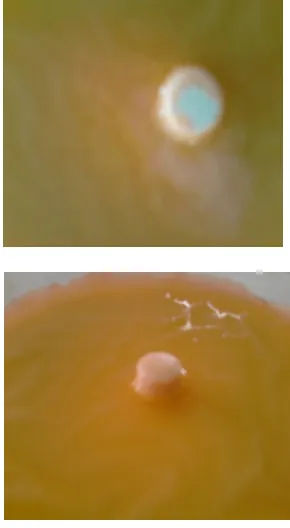
(10) Kurup N S et al. IRJP 1 (1) 2010 346-357. Fig 2: Wetting Time of batch MS 8. Fig 3: Modified Disintegration Time (I) for batch MS 11. IRJP 1 (1) Dec 2010. Page 346-357.
(11) Kurup N S et al. IRJP 1 (1) 2010 346-357. Fig 4: Modified Disintegration Time (II) for batch MS 8. Fig 5: Comparison of various disintegration tests for batches MS 8 and MS 11. IRJP 1 (1) Dec 2010. Page 346-357.
(12) Kurup N S et al. IRJP 1 (1) 2010 346-357. Fig 6: Dissolution Profile of batches found to be optimized along with marketed product. Source of support: Nil, Conflict of interest: None Declared. IRJP 1 (1) Dec 2010. Page 346-357.
(13)
Figure
+2
Related documents
An analysis of the economic contribution of the software industry examined the effect of software activity on the Lebanese economy by measuring it in terms of output and value
National Conference on Technical Vocational Education, Training and Skills Development: A Roadmap for Empowerment (Dec. 2008): Ministry of Human Resource Development, Department
The projected gains over the years 2000 to 2040 in life and active life expectancies, and expected years of dependency at age 65for males and females, for alternatives I, II, and
Keith Mann, the academic dean at Stanford, wrote to the Duke Dean Walter Dellinger that Jim’s teaching had earned him.. Copyright © 2016
It was decided that with the presence of such significant red flag signs that she should undergo advanced imaging, in this case an MRI, that revealed an underlying malignancy, which
The growth responses of these transgenic lines to the mtETC inhibitor atovaquone and the Plasmodium - specific DHODH inhibitor DSM1 showed strain-specific dif- ferences in
2- complexes; however they form 1:2 and 1:1 complexes of energetically most favorable stoichiometry verified by Job's method and molar ratio method. Even if,
Liver transplantation has been accepted as therapy for children with end stage liver disease largely because of significant improvement in overall sur- vival rates.’ As
