PLC Based Solar Tracking Panel Assembly
Sushma.V.R
1, Sneha.V.M
21,2
Department of Electrical and Electronics Manipal Institute of Technology
Manipal, Karnataka, India
Abstract— Sun is a low cost source of electricity and instead
of using the generators; solar panel can convert direct sun rays to electricity. Conventional solar panel, fixed with a certain angle, limits there area of exposure from sun due to rotation of Earth. In pursuing to get the maximum energy converted from the sun, an automatic system is required which should be capable to constantly rotate the solar panel. The automatic solar tracking system solves this problem. There are single axis trackers and dual axis trackers. In this paper we will discuss PLC based dual axis tracker. Dual axis trackers have two degrees of freedom that act as axes of rotation. PLC based I/O configuration is used as the hardware along with the comparison unit of photosensitive resistance for detecting the ray strength and shift the panel towards the maximum output from the sun. Stepper motor arrangement is used to rotate the panel to the desired position
.
The system tracks by comparing the intensity of light falling on the sensors. Based on the sensors output the motor can rotate the solar panel to meet the sun’s maximum position. Thus, solar panel can be driven by the motor which in turn gets the input signals from the PLC. Precise control of the stepper motors is possible by using the PLC. By giving a suitable delay between each step, the time for rotation of the solar panel to a particular position can also be controlled.Keywords— solar panel; dual axis trackers; PLC; stepper
motor
I. INTRODUCTION
Light gathering is dependent on the angle of incidence of light from Sun to the solar cell’s surface, and the closer to perpendicular, the greater the power. If a flat solar panel is mounted on level ground, it is obvious that over the course of the day the sunlight will have an angle of incidence close to 90 degree in the morning and the evening. At such an angle, the light gathering ability of the cell is essentially zero, resulting in no output. As the day progresses to mid-day, the angle of incidence approaches zero degree, causing a steady increase in power until at the point where the light incident on the panel is completely perpendicular, and maximum power is achieved. As the day continues towards dusk, the reverse happens, and the increasing angle causes the power to decrease again towards minimum again. From this background, we see the need to maintain maximum power output from the panel by maintaining an angle of incidence as close to zero degree as possible. By tilting the solar panel to continuously face the Sun, this can be achieved. This process of sensing andfollowing the position of Sun is known as solar tracking. A solar tracker is a device onto which solar panels are fitted which tracks the motion of the Sun across the sky ensuring that maximum amount of sunlight strikes the panels
throughout the day. The solar tracker will attempt to navigate to the best angle of exposure of light from the sun. There are two types of trackers single axis trackers and dual axis trackers.
Single axis trackers have one degree of freedom that acts as an axis of rotation. Dual axis trackers have two degrees of freedom that act as axes of rotation. Dual axis trackers allow for optimum solar energy levels due to their ability to follow the sun vertically and horizontally. No matter where the sun is in the sky, dual axis trackers are able to angle themselves to be in direct contact with the sun.
II. METHODOLOGY
A. Identifying The Stepper Motor
Check for the number of wires coming out. If it 5 or 6 or 8 it is a unipolar stepper motor. If it’s 4 wire it is bipolar stepper motor which requires two phase to drive. The motor used in the proposed project is of type: 5 wire and 6 wire unipolar stepper motor.
B. Identifying The Resistance Of The Windings
Using the DMM the resistances between all pairs of wires are measured. We will get different values depending on the pair of leads we measure. The lowest resistance which we find is the coil resistance. One wire will read about one half the resistances to all other wires when compared to the resistance between other pairs. This wire is the common wire. No wires are joined in this case.
C. Observed Resistance Of The Windings
TABLEI
RESISTANCE OF THE WINDINGS OF FIVE WIRE UNIPOLAR STEPPER MOTOR
Red – Yellow = 33 ohm Yellow – Brown = 69 ohm Red – Brown = 33 ohm Yellow – Orange = 69 ohm Red – Orange = 33 ohm Yellow – Black = 69 ohm Red – Black = 33 ohm Yellow – Red = 33 ohm Brown – Orange = 69 ohm Orange – Black = 69 ohm Brown – Black = 69 ohm
TABLEIII
RESISTANCE OF THE WINDINGS OF SIX WIRE UNIPOLAR STEPPER MOTOR
Orange – White = 1.6 ohm White – Blue = 1.5 ohm Orange – Blue = 2.7 ohm White – Yellow=0.27
Mohm Orange – Yellow = 0.58
Mohm
Orange – Black =0.99 Mohm White – Red = 0.25Mohm Orange – Red =0.16 Mohm Red – Blue =0.25Mohm Yellow – Black = 1.5 ohm Red – Black =0.45Mohm
D. Identifying The Leads Of The Stepper Motor
Unipolar stepper motor has four or five coils out of which four wires will be excited by the pulses from the control circuit and the remaining wire is given to the power supply. To identify the individual coils in order of sequence first connect the common lead to the positive of the battery or power supply .Connect any one of the four leads to the ground. This will be coil 4 .with coil 4 still grounded connect another lead to ground .If the shaft doesn’t move we have coil 2. If the shaft rotates clockwise we have coil 3. If the shaft rotates counter clockwise we have coil 1. Repeat until we identify all the four coils.
E. Observed Colour Code
TABLEIIIII
OBSERVED COLOUR CODE OF FIVE WIRE STEPPER MOTOR
Coil 1- Yellow Coil 2 – Brown Common – Red Coil 3 – Orange Coil 4 – Black
TABLEIVV
OBSERVED COLOUR CODE OF SIX WIRE STEPPER MOTOR
Coil 1- Red Coil 2 – Orange Coil 3 – Yellow Coil 4 – Blue Common – White
and Black
F. Interfacing Of ULN2003 With 5 Wire Unipolar Stepper Motor And PLC
PLC used is Siemens –Simatic S71200 and the software used is TIA (Totally Integrated Automation Software). Input to the driver ULN2003a is the PLC output. The motor is connected to the output of the driver. 5V supply is given to the motor. The outputs of the PLC Q0, Q1, Q2, and Q3 is given to the input pins of ULN2003a driver and connected to pin number 1, 2, 3, and 4 respectively. The output from the ULN2003a, pin no 16, 15, 14, and 13 is connected to the coils coil1, coil2, coil3, coil4 of the stepper motor respectively. The common wire is connected to the pin no 9 and to +5V respectively. Pin no 8 of driver is grounded.
Fig1: Stepper motor interfaced with plc and ULN2003 IC
G. Interfacing of TIP122 with 6 Wire Unipolar Stepper Motor and PLC
include a TIP122, a 1k ohmresistor and a diode. The resistors are used for limiting the current and the diodes are used to avoid back EMF. Interfacing of TIP122 with 6 wire unipolar stepper motor is as follows:
Fig2: Interfacing of TIP122 with six wire unipolar stepper motor
The common terminal of both winding are shorted and connected to the motor supply . When logic 0 input is provided to the base of TIP122,the corresponding motor will remain floating as the impedance between collector and emitter of TIP122 is very high .So no current flows through the motor winding .When logic 1 input is provided to the base of TIP122 , its collector and emitter gets shorted as a result the motor wire will be grounded resulting in current flow to the corresponding coil .
Input to the driver TIP122 is the PLC output. The motor is connected to the output of the driver. 5V supply is given to the motor. The outputs of the PLC Q4, Q5, Q6, and Q7 is given as inputs to TIP122 driver and connected to its base. The output from the TIP122, i.e. the collector output is connected to coils of the stepper motor. The common wires are connected to 5V supply. Emitter of TIP122 is grounded.
Fig 3: Six wire motor interfaced with driver
H. PLC Program Logic to Drive the Stepper Motor
TABLEV
SINGLE PHASE EXCITATION OF STEPPER MOTOR
I. LDR Matrix Sun Sensor
distributed around a circle . If the position of the collector is not optimum , the shadow of the cylinder covers one or two photoresistors. The photoresistors are mounted circular , around the cylinder . There are two important observations about MSS operation :
The MSS works in a digital kind of way : each LDR has 2 states ; illuminated state and shaded state .
The sensor is robust,low cost and determines a simple digital control of the actuators of sun trackers.
Fig 4: LDR matrix sun sensor
J. Comparator Circuit
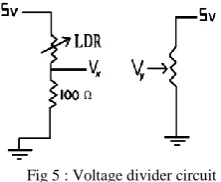
The comparator circuit includes two LM324 IC’s, trim pot (500 ohm) -8 nos , 100 ohm resistors (7 nos) ,8 LDR’s and 220 ohm resistor (1 no) . The comparision is based on the voltage comparision from the voltage divider circuit . The voltage divider circuit is as follows
.
Fig 5 : Voltage divider circuit
LM324 IC has four comparators in one IC package. One comparator has two analog input terminals V+ and V- and one binary digital output Vo. The output is ideally:
K. Working of the Comparator Circuit
The voltage Vx and Vy are given to the input terminals 2
and 3 of LM324 IC respectively. The potentiometer is adjusted such that its voltage is in between the voltage of LDR and 100 ohm voltage divider circuit. Both these voltages are compared by the comparator in LM324 IC .Whenever the voltage Vx > Vy, the output of the comparator will be zero and
whenever the voltage Vx < Vy, the output of the comparator
will be one. Similarly all the 8 LDR’s outputs are converted to voltage and are compared by the comparator circuit. The logic states can be measure by using the DMM. Thus we get Digital output which can be given as logic state one or zero to the PLC.
Fig 6: Sensor connected to the comparator circuit
L. Interfacing the Sensor and Comparator Circuit to PLC
The comparator circuit gives two logic states zero and one .It gives logic state zero when there is light falling on the LDR and logic state one when there is no light falling on the LDR. The output of the comparator circuit is given to the PLC as input .All the eight outputs of the comparators are given to the input pins namely I0, I1, I2, I3, I4, I5, I6 and I7 of the PLC
respectively.
M. Output of the Comparator Circuit
Sun rises in the east and sets in the west. Tracking Sun in the same direction at different positions using the flashlight, the following logic states were obtained from the comparator circuit.
Fig 7: Observed sensor output
III.WORKING OF SOLAR TRACKER
STEP 1: Initially input pin of PLC is switched on to start the whole process
STEP 2: As soon as the input is on motor one (5 wire unipolar motor) will start rotating. After the motor one completes its rotation motor two (6 wire stepper motor) rotates to a predefined angle.
STEP 3: Once the initial rotation is completed then depending on Sun’s position the sensor output will be given to the PLC as input. The output of the PLC will be given as input to the motor
Fig 8: Final Interfacing of the Hardware with PLC
IV.RESULT ANALYSIS
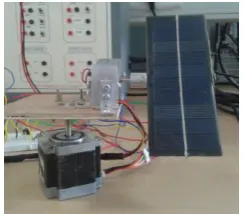
The hardware designed is a dual axis solar tracker which is rotated by two motors. As Sun starts to change its position during the day the solar panel tracks Sun on the basis of the Sensor outputs given to it. Following are the different positions of the solar panel at different intervals of time:
CASE 1: The figure below shows the solar panel’s position in the morning
.
Fig 9 : Solar panel’s position in the morning
CASE 2: The below figure shows the solar panel’s position at noon.
Fig 10 : Solar panel’s position at noon
CASE 3: The below figure shows the solar panel’s position in the evening.
V. CONCLUSION
Solar power, unlike other energy sources is now considered to be the best alternative due to its versatility in terms of renewability, cost-effectiveness, improved operating efficiency and its unlimited reserve, mainly being the Sun. Sun moves from east to west and tracking the sun during its movement helps us to achieve maximum utilization of the solar energy. The solar panels, being the modern technology of alternative power source is the best possible way to absorb maximum amount of sunlight and converting into usable electricity, and thus achieving increasing popularity since the realization of fossil fuels shortcomings
.
The objective of the proposed work was to design a PLC basedautomated tracking of solar panel for maximum throughput using photo sensors. Solar panel will track Sun based on the output from the sensor successfully. The sensor output keeps varying based on the amount of sunlight falling on it. The output from the sensor is converted to digital (logic zero or one) and given to the PLC as input. The PLC output drives the motor to the position. The stepper motor is used for precise control of the solar panel here. The solar panel along with the sensor is interfaced and the tracking of solar panel is efficient. PLC provides precise control signals to the motor which rotates to the particular position based on the sensor’s output. Tracking of the solar panel is achieved with a precision of ten degree.
ACKNOWLEDGEMENT
In performing our research, we had to take the help and guideline of some respected persons, who deserve our greatest gratitude. We would like to show our gratitude to Santhosh.K.V for giving us a good guideline throughout numerous consultations. In addition we would like to thank Manipal Institute of Technology, Manipal for providing us with all the lab equipments to carry out this research.
REFERENCES
JOURNAL / CONFERENCE PAPERS
[1] Bajpai P, Kumar S, “Design, development and performance test of an automatic two-axis solar tracker system”, Annual IEEE Conference Publication, India Conference (INDCON) 2011, Electr. Eng. Dept., IIT Kharagpur, Kharagpur, 16-18 Dec. 2011, 1–6.
[2] Esram T, Kimball JW, Krein PT, Chapman PL, Midya P, ”Dynamic maximum power point tracking of photovoltaic arrays using ripple correlation control”, IEEE Transactions. 2006 ;21(5),Illinois Univ., Urbana, IL, Sept. 2006, 1282–1291.
[3] Feng-run Liu, Le Xiao, Wen-jia Li,” The design of automatic solar tracking system for solar cell”, IEEE 2nd International Conference on Artificial Intelligence, Management Science and Electronic Commerce (AIMSEC) 2011; North China University of Technology, China, 8-10 Aug. 2011, 4451–4454
[4] Huifeng Jiao, Jianzhong Fu, Yuchun Li, Jintao Lai, “Design of automatic two-axis sun-tracking system”, IEEE International Conference on Mechanic Automation and Control Engineering (MACE) 2010, Dept. of Mech. Eng., Zhejiang Univ., China,26-28 June 2010,2323–2326.
[6] L Milea, M Dascalu, O Oltu, A Zafiu. “Two axes detector for photovoltaic panels’ automatic full angle orientation,” Semiconductor Conference (CAS) IEEE International Conference Publication, 2010, Politeh. Univ. of Bucharest, Romania,11-13 Oct. 2010, 125-128.
[7] Ponniran A, Hashim A, Munir HA,”A design of single axis sun tracking system”, 5th International Power Engineering and Optimization Conference (PEOCO2011), 2011, Fac. of Electr & Electron. Eng., Univ. Tun Hussein Onn Malaysia, Malaysia, 6-7 June 2011 107-110.
[8] Salsabila Ahmad, Suhaidi Shafie and Mohd Zainal Abidin Ab Kadir, “A High Power Generation, Low Power Consumption Solar Tracker “, IEEE International Conference on Power and Energy (PECon) 2012, University Malaysia Perlis, Malaysia, 2-5 December 2012, 366-371.
[9]Shunjie Han,Yue Han and Meng Han ,”Research and Implementation of the Dual Mode Solar Automatic Tracking System”, Power and Energy Engineering Conference (APPEEC) 2012 , Changchun University of Technology, China, 27-29 March 2012, 1-4 .
[10] Weiping Luo ,” A solar panels automatic tracking system based on Omron PLC”, Asian Control Conference(ASCC)2009, Wuhan University of Science & Engineering, China, 27-29 Aug. 2009,1611-1614.
[11]Zhang Bao-jian, Gao Guo-hong, Zhu Yan-li.”Designment of automatic tracking system of solar energy system”, 2nd International Conference on Industrial Mechatronics and Automation, 2010, Comput. Sci. Dept., Henan Inst. of Sci. & Technol., China, 30-31 May 2010689–691.