Published online January 23, 2015 (http://www.sciencepublishinggroup.com/j/ajam) doi: 10.11648/j.ajam.20150301.14
ISSN: 2330-0043 (Print); ISSN: 2330-006X (Online)
Numerical solution of mixed convective laminar boundary
layer flow around a vertical slender body with suction or
blowing
Md. Hasanuzzaman
1, Masud Rabbani
2, M. M. Touhid Hossain
1, M. Arif Hossain
1, R. Nandi
21
Department of Mathematics, Khulna University of Engineering & Technology, Khulna-9203, Bangladesh 2
Department of CSE, Khulna University of Engineering & Technology, Khulna-9203, Bangladesh
Email address:
[email protected] (M. Hasanuzzaman)
To cite this article:
Md. Hasanuzzaman, Masud Rabbani, M. M. Touhid Hossain, M. Arif Hossain, R. Nandi. Numerical Solution of Mixed Convective Laminar Boundary Layer Flow around a Vertical Slender Body with Suction or Blowing. American Journal of Applied Mathematics.
Vol. 3, No. 1, 2015, pp. 14-20. doi: 10.11648/j.ajam.20150301.14
Abstract:
In this paper, the numerical solution of mixed convective laminar boundary layer flow around a vertical slender body with suction or blowing has been investigated. Firstly, the governing boundary layer partial differential equations have been made dimensionless and then simplified by using Boussinesq approximation. Secondly, similarity transformations are introduced on the basis of detailed analysis in order to transform the simplified coupled partial differential equations into a set of ordinary differential equations. The transformed complete similarity equations are solved numerically by using computer software. Finally, the flow phenomenon has been characterized with the help of obtained flow controlling parameters such as suction parameter, buoyancy parameter, Prandtl number, body-radius parameter and other driving parameters. Finally the effects of involved parameters on the velocity and temperature distributions are presented graphically. It is found that a small suction or blowing can play a significant role on the patterns of flow and temperature fields.Keywords:
Similarity Solution, Mixed Convection, Vertical Slender Body, Suction or Blowing1. Introduction
The convective heat and mass transfer process takes place due to the buoyancy effects owing to the differences of temperature and concentration, respectively. In studying the fluid flow around a heated body it is usual to neglect the buoyancy effect when a forcing velocity exists. Under some circumstances, such an assumption is not reasonable, the buoyancy forces considerably modifying the boundary layer characteristics. In dealing with the transport phenomena, the thermal and mass diffusions occurring by the simultaneous action of buoyancy forces are of considerable interest in practice. Mixed convection flows, or combined forced and free convection flows, arise in many transport processes in engineering devices and in nature. These flows are characterized by the buoyancy parameter (measure of the influence of the free convection in comparison with that of forced convection on the fluid flow) which depends on the flow configuration and the surface heating conditions.
Ramanaiah et al. [1] considered the problem of mixed convection over a horizontal plate subjected to a temperature
semi-infinite porous plate have been considered by Hossain
et al. [10, 11]. Ramanaiah et al. [13] studied the similarity solutions of free, mixed and forced convection problems in a saturated porous media. Hossain et al. [14] and Md. Hasanuzzan et al [17] obtained a complete similarity solution of the unsteady laminar combined free and forced convection boundary layer flow about a heated vertical porous plate in viscous incompressible fluid. The combined free and force convective laminar fluid motion caused by a heated (or cooled) vertical slender body moving through a viscous fluid has not so far been considered for a large scale study. Van Dyke [15] successfully analyzed a natural convection flow near a vertical thin needle for the case of a constant surface temperature. Kuiken [16] has studied the axi-symmetric free convective boundary layer along an isothermal vertical cylinder of constant thickness.
The purpose of the present study is, therefore, to find a possible similarity solution of the combined free and force convective laminar fluid motion caused by a heated (or cooled) axi-symmetric slender body of finite axial length immersed vertically in a viscous incompressible fluid. The thermal distributions on the outer surface of the body as well as the motion of the body itself are assumed to be unsteady. Furthermore, throughout the investigation, the effect of suction or blowing has been taken into consideration. We are attempted to investigate the effects of several involved parameters on the velocity and temperature fields and other flow parameters like skin friction and heat transfer coefficients across the boundary layer. We are also tried to calculate the role of suction or blowing velocity on these parameters as well. The numerical results including the velocity and temperature fields are to be presented graphically for different selected values of the established dimensionless parameters. It is expected that the effects of suction and blowing play an important role on the velocity and temperature fields, so that their effects should be taken into account with other useful parameters associated.
2. Basic Equations of the Flow and
Mathematical Analysis
Fig (1). Physical configuration and coordinate system
An axi-symmetric heated (or cooled) slender body of finite axial length is immersed vertically in a viscous fluid of variable properties. The surface temperature (=Tw ), the velocity and the temperature of the undisturbed fluid ( ueandTe ) close to the body surface but outside the boundary-layer are all general functions of x and t. rw is the
radial distance from the axis of symmetry to the surface of
the body, x is the distance measured along the axis of symmetry of the body and t is the time. The physical configuration and the coordinate system of the problem are shown in Fig.1.
The influence of body force generated by buoyancy effects on the flow field near the surface is significant if the Froude number of such a flow field is of order unity. That is the non dimensional form of the buoyancy force is
)
1
(
0
2
≅
−
U
L
g
T
T
T
x ce e w
(1)
where gx is the gravity component in the x-direction, Lc is a
suitable characteristic length and U is a suitable characteristic velocity. The non-dimensional form of the equations expressing conservation of mass, momentum and energy for a Boussinesq fluid are follows:
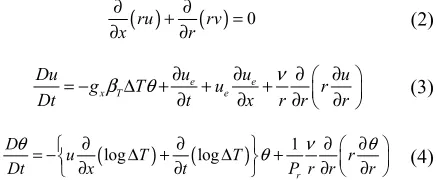
( )
ru( )
rv 0x r
∂ + ∂ =
∂ ∂ (2)
e e
x T e
Du u u u
g T u r
Dt t x r r r
ν
β θ ∂ ∂ ∂ ∂
= − ∆ + + +
∂ ∂ ∂ ∂ (3)
(
)
(
)
1log log
r D
u T T r
Dt x t P r r r
θ ∂ ∂ θ ν ∂ ∂θ
= − ∂ ∆ +∂ ∆ + ∂ ∂
(4)
Where
ρ
is the density, P is the pressure,µ
andλ
are the dynamic and second coefficients of viscosity, T the temperature, k the thermal conductivity Cp the specific heatat constant pressure and
P T
aT ∂ − = ρ− ρ
β 1 the coefficient of cubical expansion of the fluid.
0 0
0
0
T
,
T
T
T
,
and
T
T
T
T
−
=
∆
∆
=
W−
e=
is treated here as constant temperature for the ambient fluid. Since the Boussinesq from of the state relations isρ=ρ( )
T , it follows thatρ
e=
ρ
0(constant). T andT
W in general depend on both x and t. A solution of the equations (2)-(4) is now sought, these equations being valid in the limit Re→
∞
and E→
0. Higher order effects are not discussed here, as the present investigation concerns the first order boundary- layer approximations only.3. Similarity Transforms
The complexity of the above governing differential equations makes the use of simplifying approximations desirable so that tractable solutions may be obtained. The method of similarity provides a convenient and accurate procedure for computing heat transfer, skin friction and other laminar boundary-layer characteristics, Guided by this idea independent variables (x,r,t) are changed to a new set of variables
(
ξ,φ,τ)
where the relations between the two setsare
( )
x t r tx
, 2 , ,
2
γ φ τ
The continuity equation (2) is identically satisfied by introducing a stream function
ψ
(
x,r,t)
defined byr ru ∂ ∂ = ψ , x rv ∂ ∂ =
− ψ , we have,
( )
( )
∂ ∂ = ∂ ∂ = t x r u , 2 2 γψ φ ψ .Using for the moment, a non-dimensional factor U (x, t) for the velocity component u is given by
(
ξ
φ
τ
)
γ
(
ξ
φ
τ
) (
ψ
ξ
φ
τ
)
ψ
, , = UF , , + , 0, , where(
)
=∫
φ φφ
τ
φ
ξ
0 ,, d and
U u
F
φ
0 is the value ofφ
on the body.That is
(
, ))
2 2 0 t x rW γφ = . The velocity components u and v are found to be u=UL,
−
rv
=
(
γ
U
F
)
ξ−
φ
γ
ξU
F
φ−
r
Wv
W , where−
r
Wv
W=
ψ
ξ(
ξ
,
φ
0,
τ
)
which represents the non-zero wall velocity called suction or blowing velocity normal to the porous surface, so that fluid can either be sucked or blown throughout. Physically,v
W < 0 andv
W > 0 represent the suction and blowing velocity through the porous surface respectively. For uniform suction (or blowing)v
W = constant. However,v
W≠
0
implies that the surface is impermeable to the fluid. In view of the above transformation, equations (2) to (4) become(
)
{
}
{
(
)
}
(
)
3 0 3 9
2
1 2 2 4 5 6
2
0
a F a a a F
a a F F a F a F a a
ϕϕ ϕ ϕϕ
ϕϕ ϕ ϕ
ν ϕ ϕ
ϑ
+ + + +
+ + − − + + = (6)
(
)
{
}
{
(
)
}
(
)
(
)
3 0 3 9
1 2 7 8
2
0
r
a a a a
P
a a F a a F
ϕ ϕ ϕ ϕ ϕ ν ϕ ϑ ϕ ϑ ϑ ϑ + + + + + + − + = (7) where
( )
( )(
)
( )
( )
( ) ( )
( ) ( )
( ) ( )
( )
( )
{
( )
( )
}
( ) (
)
( )
{
}
( )
( )
0 1 2 2 3 4 2 1 5 6 7 8 2 2 9 , , , 2 , , , , , log , log , 2 , W x Te e e
W
W W
i a
ii UL UL UL a a
r
iii a
UL
iv a
UL
v UL a
vi UL a
vii g T a
UL
viii u u u a
UL
ix T a
x UL T a
r r xi r V a and
x t τ ξ ξ ξ τ ξ ξ τ ξ τ ξ γ γ γ γ γ γ γ γ ν β ν ν ν ϕ γ = = + = + = = = = − ∆ = + = ∆ = ∆ = − − = = (8)
The boundary conditions which are imposed in order to determine the solutions of the transformed boundary layer
equations (6)-(7) are given by:
( )
0 =Fϕ( )
0 =0F Fϕ
( ) ( )
∞ =ϑ0 =1, ϑ( )
∞ =0 (9)The relations in equation (8) furnish us with the conditions under which similarity solutions are obtained provided that all a's must be constants and thus the equations (6)-(7) will
become non-linear ordinary differential equations. In view of the conditions (ii) and (i) stated in equation (8), we have
( )
ξ τγ =a0 +B and γUL=(a1+a2)ξ+A
( )
τ where A( )
τ iseither a function of
τ
or constant and B( )
ξ is a function ofξ
or constant. The above two relations one obtains( ) ( )
. ( )4 0 1 a a a d dB d dA + = ξ ξ τ τ (10) Since γ(ξ, τ) and UL (ξ, τ) depend wholly on the choice of
A (τ) and B (ξ), the equation (10) plays a significant role in determining the possible four cases of similarity solutions:
(A)both
( )
( )
ξξ
ττ d
dB d
dA
and are finite constants,
(B)both
( )
( )
ξξ
ττ d
dB d
dA
and are zero.
(C)
( )
=0but( )
≠0ξξ
ττ d
dB d
dA ,
(D)
( )
≠0but( )
=0ξ ξ τ τ d dB d dA
3.1. Similarity Case to Be Considered
Of these four similarity cases, only the Case (A) for which both dAdτand dB dξ are finite constants has been studied here. Thus we have γ =a0τ+B
( )
ξ and( )
. )( 1 2
ξ
τ
γ
UL= a +a +A Substituting these in the conditions (i) to (ix) of the equation (8) yields the relations between the constants as follows: a0 =a1=a2=0 , a rW 2B2 3= ,
=
4
a
arbitrary, 4 ,5 τ β B a T x e K TB g a − ∆ − = 4 6 a
a = , a7 =a4 ,
0
8
=
a
anda
9 = arbitrary. Substituting the constants and choosing F=α
1f andφ
=α
1η
the above equations (6) to(7) reduce to:
(
)
(2 ) 1 02 2
2
0 + + + − + =
+ ϑ η ηηη ηη η e F W u U f f F f
R (11)
(
)
(
2
)
0
2
η
+
R
0ϑ
ηη+
+
P
rF
Wϑ
η−
P
rϑ
=
(12) The boundary conditions are( )
0 = fη( )
0 =0 , fη( )
∞ =1,ϑ
( )
0 =1,ϑ
( )
∞ =0f (13)
where is also chosen α =1 α2, U2 u2 a5 a4 e
F = , a4α1 ν=1 and
writing r2 2 1B R0 W α = with
) ( 2 e T x
F g T Cu
U =− β ∆ . The terms 4 5 2 2 a a u
flow effects. The flow is said to be aided when
U
F2u
e2is greater than zero and called an opposing when this parameter is less than zero. WhenU
F2<<
u
e2 the flow becomes a forced flow, whereas forU
F2<<
u
e2 the flow becomes a free convection flow. The skin friction and heat transfer coefficientsτ
w andq
w associated with the equations (11)and (12) are: 2
( )
00 ηη
ν µ
τ R f
C ue W =
and
( )
0 2 0ϑην R
C T K qW
∆ −
= . The
∆
T
–variation for this isC t
e T∞
∆ .
4. Numerical Solution and Discussions
The set of differential equations (11)–(12) with the boundary conditions (13) are solved by using computer software. Here the velocity fη , temperature
ϑ
aredetermined as a function of coordinate
η
. The skin frictioncoefficient fηη(0) and the heat transfer rate -
ϑ
η(0)
are alsoevaluated for this case and numerical results thus obtained in terms of the similarity variables are displayed in graphs and tables for several selected values of the established parameters
F
w,U
F2u
e2, R0 andPr
below. The effects ofW
F
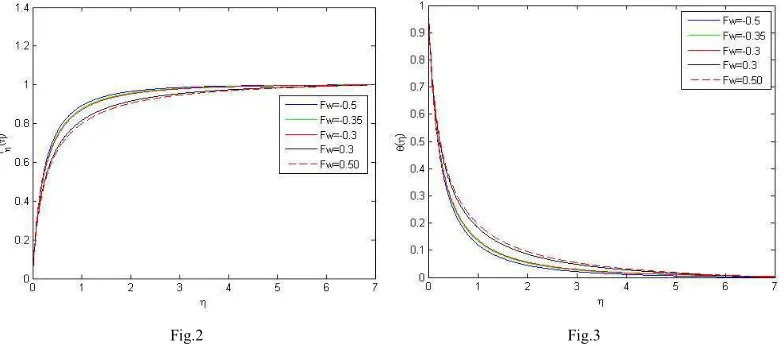
on the velocity and temperature fields are plotted in Figure 2 and Figure 3, respectively. From Figures it is observed that, in all cases the velocity is starting at zero, and then velocity increases with the increase ofη
near the leading edge and finally moves towards 1.0 asymptotically but temperature is starting at 1.0, then it decreases asymptotically and finally leads to zero with the increase ofη
. From Figure 2 we see that for the case of suction(
FW >0)
, the velocity increases with decreasing FW but for blowing case(
FW <0)
, velocity increases with the increase ofthe magnitude of blowing. The usual stabilizing effect of the suction parameter on the boundary layer growth is also evident from this figure.
Fig.2 Fig.3
Fig (2). Velocity profiles and Fig (3). temperature profiles for different values of
w
F (with fixed values of 2 2=0.5 e F u
U , R0 =0.1 and Pr=0.71).
From Figure 3 it is observed that for both the cases of suction and blowing, temperature decreases quickly close to the leading edge and away from it temperature decreases asymptotically and finally leads to zero with the increase of
η
. For the case of suction(
FW >0)
, temperature decreaseswith decreasing suction. But for the case of blowing
(
FW <0)
, temperature decreases more with the increase of the magnitude of blowing.Figure 4 and Figure 5 show the effect of bouncy parameter
2 2
e F u
U on the velocity and temperature fields respectively. Physically, the flow is said to be aided when 2 2
e F u
U > 0 and is called an opposing flow when 2 2
e F u
U < 0. Further, when 2
2
e
F u
U << , the flow becomes forced flow, whereas for
2 2
e F
u <<U the flow becomes a free convection flow. We see from the Figure 4 that with the increase in 2 2
e F u U from negative to positive values, in all cases the velocity is starting at zero and increasing asymptotically to 1.0. But with the increase in 2 2
e F u
U the rate of change of velocity increases slightly. Thus before being asymptotically goes to 1.0 far away; velocity is higher for higher values of 2 2
e F u
U within the boundary layer. Since the energy equation given by (17) is independent of the buoyancy parameter 2 2
e F u
Fig. 4 Fig. 5
Fig (4). Velocity profiles and Fig (5). temperature profiles for different values of 2 2
e
F u
U (with fixed values of 0.5
w
F = , 0.1
0=
R andPr=0.71).
The body radius parameter R0 depends on the shape of the
slender body. The velocity and temperature profiles exhibit remarkable changes with the variation of R0 as observed from
the body radius parameter
R
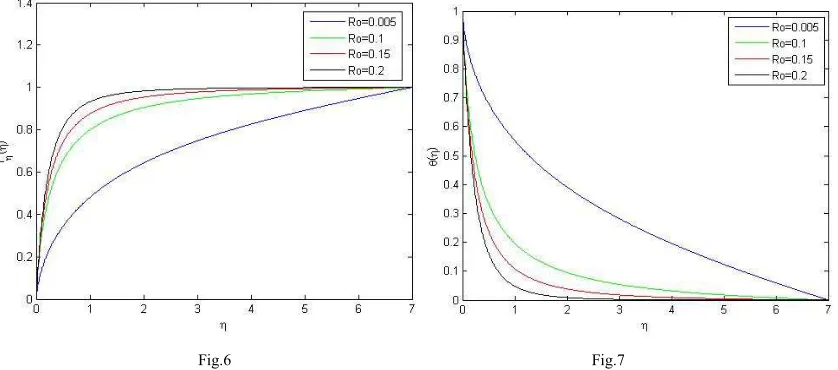
0 depends on the shape of the slender body. There is a remarkable consequence of the variation ofR
0 on the velocity and temperature fields as are observed in Figure 6 and Figure 7. Like before, for all values ofR
0, velocity starts from zero and then increases with the increase ofη
and finally tends to 1.0, whereas temperaturelaunches from 1.0, then decreases with increasing
η
and finally asymptotically leads to zero, for large value ofη
. We see from Figure 6 that within the boundary layer, velocity highly increases with the increase ofR
0 , before asymptotically being 1.0 for large value ofη
. From Figure 7 it is observed that temperature decreases sharply with the increase inR
0 before being zero asymptotically for higher value ofη
.Fig.6 Fig.7
Fig (6). Velocity profiles and Fig (7). temperature profiles for different values of R0 (with fixed values of =.0.5 w
F , 2 2=0.5
e F u
U and Pr=0.71)
The last controlling parameter is the Prandtl number
Pr Cp k
µ
=
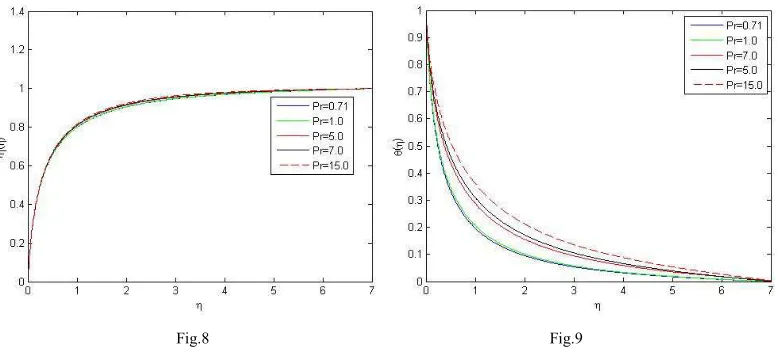
which depends on the properties of the medium. Here velocity exhibits minor changes while temperature exhibits significant changes with the variation of Prandtl number Pr . As observed from Figure 8 that, velocity
increases negligibly with the increase of Pr before being 1.0
asymptotically in all cases for large value of
η
. From Figure 9, we see that, temperature decreases momentously with the decrease in Pr and asymptotically leads to zero for higherη
.Fig.8 Fig.9
Fig(8). Velocity profiles and Fig (9). temperature profiles for different values of Pr (with fixed values of 0.5
w
F = , 2 2=0.5
e
F u
U and R0=0.1).
Table 1. Values proportional to the coefficients of skin-friction ( //(0)
f ) and
heat transfer ( / (0) ϑ
− ) with the variation of suction parameter
w F (for fixed 2 2=0.5
e
F u
U , R0=0.1 andPr=0.71) w
F f//(0) −ϑ/(0)
0.50 0.52341 -1.52677
0.30 0.840835 -2.839873
-0.30 -0.49478 3.80024
-0.50 -0.38129 3.0243
Table 2. Values proportional to the coefficients of skin-friction (f//(0)) and heat transfer ( /
(0) ϑ
− ) with the variation of buoyancy parameter 2 2
e
F u
U (for fixed Fw=0.5, 0.1
0=
R andPr=0.71)
2 2
e
F u
U f//(0) −ϑ/(0)
-2.0 0.69423 -1.52677
0.5 0.52341 -1.52677
1.0 0.49312 -1.52677
5.0 0.30218 -1.52677
Table 3. Values proportional to the coefficients of skin-friction f//(0) and
heat transfer −ϑ/(0) with the variation of driving parameter R0 (for fixed 5
. 0 =
w
F , 2 2=0.5 e F u
U and Pr=0.71.
0
R //(0)
f −ϑ/(0)
0.005 0.52340 -1.52677
0.10 0.52341 -1.62166
0.15 0.51021 -1.63965
0.2 0.50385 -1.70361
Table 4. Values proportional to the coefficients of skin-friction (f//(0)) and heat transfer (−ϑ/(0)) with the variation of Prandtl number Pr(for fixed
5 . 0 =
w
F , 2 2=0.5
e F u
U and R0=0.1)
Pr f//(0) −ϑ/(0)
0.71 0.52341 -1.52677
1.00 0.39925 -1.40267
5.00 0.07591 1.50934
7.0 0.04762 1.75093
5. Conclusion
Numerical solution of mixed convective laminar boundary layer flow around a vertical slender body with suction or blowing with the similarity case
τ
d
dAand
( )
ξξ
d
dB are finite constants has been studied in this paper. On the basis of the findings the following conclusions can be drawn:
(a) Velocity increases with the decrease of suction but for the case of blowing the velocity increases with the increase of the magnitude of blowing. Temperature decreases with decreasing suction but it decreases more with the increase of the magnitude of blowing. (b) With the increase in the buoyancy parameter 2 2
e F
u
U
from negative to positive values, the velocity enhanced slightly and thus the velocity goes to 1.0 asymptotically within a short range. No effect of buoyancy parameter 2 2e F u
U on the temperature field is observed.
(c) Velocity highly increases with the increase of R0 and finally leads to 1.0 asymptotically for large
η
. Temperature decreases sharply with the increase ofR0 and finally approaches zero asymptotically for large
η
.(d) With the increase in Pr , the velocity increases
negligibly and finally leads to the value 1.0 asymptotically for large value of
η
.Temperature decreases momentously with decreasing Pr and finally approaches zero asymptotically.References
[1] Ramanaiah, G. Malarvizhi, G. and Merkin, J. H.: A unified treatment of mixed convection on a permeable horizontal plate, Wäfirme-und Stoffübertragung, 26, 187–192, 1991. [2] Sparrow, E. M., Eichorn, E. and Gregg, J. L.: Combined
[3] Afzal, N. and Banthiya, N. K.: Mixed convection over a semi-infinite vertical flat plate, J. Appl. Math. Phys., 28, 993–1004, 1977.
[4] Hussain, T. and Afzal, N.: Computer extension of perturbation series for mixed convection on a vertical plate: favourable and adverse flows, Fluid Dyn. Res., 4, 107–121, 1988.
[5] Merkin, J. H., Pop, I. and Mahmood, T: Mixed convection on a vertical surface with a prescribed heat flux: the solution for small and large Prandtl numbers, J. Eng. Math., 25, 165–190, 1991.
[6] Watanabe, T.: Forced and free mixed convection boundary layer flow with uniform suction or injection on a vertical flat plate, Acta Mech., 89, 123–132, 1991.
[7] Sattar M.A.: Free and forced convection boundary layer flow through a porous medium with large suction, International Journal of Energy Research, 17, 1–7, 1993.
[8] Deswita, L. Nazar, R., Ahmad R., Ishak, A and Pop, I.: Similarity Solutions of Free Convection Boundary Layer Flow on a Horizontal Plate with Variable Wall Temperature, European Journal of Scientific Research, Vol. 27(2), 188–198, 2009.
[9] Hossain, M. M. T. and Mojumder, R.: Similarity solution for the steady natural convection boundary layer flow and heat transfer above a heated horizontal surface with transpiration, Int. J. of Appl. Math. and Mech., 6(4), 1–16, 2010.
[10] Hossain, M. M. T., Mojumder, R. and Hossain, M. A.: Solution of natural convection boundary layer flow above a semi-infinite porous horizontal plate under similarity transformations with suction and blowing, Daffodil International University Journal of Science and Technology, 6(1), 43–51, 2011.
[11] Hossain, M. A., Hossain, M. M. T. and Mojumder, R.: Further study of similarity solutions of unsteady natural convection flow above a heated horizontal semi-infinite porous plate with suction and blowing, Proceeding of the International Conference on Mechanical, Industrial and Energy Engineering 2010, 23-24 December, MIE10-095-1–6, 2010.
[12] Ishak, A. Nazar, R. and Pop, I.: Dual solutions in mixed convection boundary-layer flow with suction or injection, IMA Journal of Applied Mathematics, 1−13, 2007.
[13] Ramanaiah, G. and Malarvizhi, G.: Unified treatment of similarity solutions of free, mixed and forced convection problems in saturated porous media, Proceedings of Sixth Int. Conf. on Numerical Methods in Thermal Problems, Swansea, U.K. 431−439, 1989.
[14] Hossain, M. M. T., Mandal B. and Hoossain M. A.: Similarity Solution of Unsteady Combined Free and Force Convective Laminar Boundary Layer Flow about a Vertical Porous Surface with Suction and Blowing, Procedia Engineering, 56 (2013), 134–140.
[15] Van Dyke, M.: Free convection from a vertical needle, Problems of Hydrodynamics and Continuum Mechanics (SIAM Publication, Philadelphia, Penn.), 1969.
[16] Kuiken, H. K.: The thick free-convective boundary layer along a semi-infinite isothermal vertical cylinder, ZAMP, 25, 497, 1974.