ISSN: 2231-5381
http://www.ijettjournal.org
Page 783
Obstacle Detection and Avoidance Autonomous Car
K.Vasavi #1 M.V.S.Praveen*2,
#
Student & Electronics and Instrumentation & GITAM University Visakhapatnam, Andhra Pradesh, India
Abstract— Driving models are needed by many researchers to improve traffic safety and to advance autonomous vehicle design. To be most useful, a driving model must state specifically what information is needed and how it is processed. So we developed an “Obstacle Avoidance and Detection Autonomous Car” based on sensor application. The essential part of this autonomous car is that it drives taking the energy from solar panel. This paper explains the method of interfacing the solar panel, relay circuit board, IR sensor to the car and how to send the command to the microcontroller to drive the car autonomously.
Keywords—IR Sensors, Relay, Solar Panel, 12V Battery, DC Motors, 8051 Microcontroller.
I. INTRODUCTION
Driving models are needed by many researchers. Intelligent vehicle designers need them to make driver aids that work in dynamic traffic situations. Traffic engineers need them to improve the safety of highways. Robot vehicle builders need them to drive vehicles autonomously in traffic. To be most useful, a driving model must be detailed and complete. A detailed model must state specifically what decisions must be made, what information is needed, and how it will be used.
So, based on these criteria we developed an Autonomous car which detect and avoid the obstacle. The main task is that whenever a car finds the obstacle in its path, it detects or senses it using IR sensor and avoid the obstacle to move in its path.
II. SYSTEM ANALYSIS
The main objective of this autonomous car is to detect and avoid obstacle. This autonomous car is controlled by the IR sensors via DC motor and Relay circuit board by taking energy or power from both battery and solar panel i.e. whenever the 12V battery get discharged, the solar panel take the thermal energy from Sun and provides it to battery.
A. BLOCK DIAGRAM
Thermal Energy
Fig.1 Block diagram of Obstacle detection and Avoidance Autonomous Car.
The above block diagram shows the overall co-ordination of the autonomous car. The structure consists of motors, relay circuits i.e. dual coil 12v dc relay board, IR sensors, Solar panel, 12v battery, 5v regulator. Whenever the 12v battery get discharged, the solar panel takes the thermal energy provided by the sun and charges the battery. As IR sensor and microcontroller requires 5v to operate, in order to convert the 12v into 5v,we require 5v regulator to regulate the 12v voltage. IR sensor is given as input to the microcontroller and it drives the DC motor using relay board.
A. HARDWARE REQUIRED
8051 Microcontroller
IR Sensors (Infra Red Sensor)
Relays
Solar Panel
DC Motor
Regulator
sun
Solar panel
12V Battery
5V Regulator
IR Sensor
8051
Micr ocont roller
Relay
ISSN: 2231-5381
http://www.ijettjournal.org
Page 784
B. SOFTWARE REQUIRED
Embedded C programming
Keil C compiler
Flash Magic
III. HARDWARE DESCRIPTION
A. 8051 MICROCNTROLLER
A microcontroller is a small, low-cost and self contained computer-on-a-chip that can be used as an embedded system. A few microcontrollers may utilize four-bit expressions and work at clock rate frequencies, which usually include:
An 8 or 16 bit microprocessor.
A little measure of RAM.
Programmable ROM and flash memory.
Parallel and serial I/O.
Timers and signal generators.
Analog to Digital and Digital to Analog conversion
Microcontrollers usually must have low-power
requirements since many devices they control are battery-operated. Microcontrollers are used in many consumer electronics, car engines, and computer peripherals and test or measurement equipment. And these are well suited for long lasting battery applications. In 1981, Intel Corporation introduced an 8-bit microcontroller called the 8051.The 8051 family has largest number of diversified (multiple sources) suppliers, which were originated by Intel, and several companies This robot is built with P89V51RD2 microcontroller which manufactured from Philips Company. The 8051 is an 8-bit processor, meaning that the CPU can work on only 8 8-bits of data at a time. Data larger than 8 bits has to be broken into 8-bit pieces to be processed by the CPU. The 8051 is also referred as “system on chip”.
Fig 2. 8051 microcontroller Block diagram
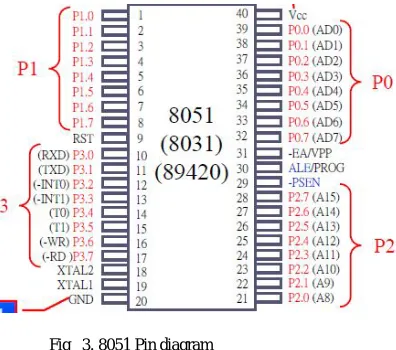
The pin diagram of 8051 microcontroller is shown below:
Fig 3. 8051 Pin diagram
The 8051 has following features. They are:
TABLE 1: FEATURES OF 8051
FEATURES QUANTITY
ROM 4K bytes
RAM 128 bytes
I/O PORTS 32
TIMERS 2
SERIAL PORT 1
INTERRUPT SOURCES 6
The 8051 is 40 pin microcontroller. There are minimum six requirements for proper operation of microcontroller. Those are:
Power supply section
Pull-ups for ports (it is must for PORT0)
Reset circuit
Crystal circuit
ISP circuit (for program dumping)
EA/VPP pin is connected to VCC.
B.IR SENSORS
ISSN: 2231-5381
http://www.ijettjournal.org
Page 785
devices that are frequently used to detect and respond toelectrical or optical signals. There are certain features which have to be considered when we choose a sensor. There are:
Accuracy
Environment condition-usually has limits for
temperature/humidity
Range-Measurement limit or sensor
Calibration- Essential for most of the measuring devices as the readings changes with time.
Resolution- Smallest increment detected by the
sensor
Cost
Repeatability- The reading that varies is repeatedly measured under the same environment.
Some commonly used sensors along with their principle and applications are temperature sensors, IR sensor, and UV sensor. In order to fulfill our requirement, IR sensor is required.
IR sensor devices detect infrared wavelengths, or light made up of electronic radiation with wavelength between 0.7 to 1000 microns, a system of measurement equal to one millionth of a meter. This wavelength range makes up the infrared band, which emits radiation temperatures detectable by IR sensors.
Fig 4. IR SENSOR
The basic idea is to make use of IR LEDS to send the infrared waves to the object. Another IR diode of the same type is to be used to detect the reflected wave from the object. The diagram is shown below.
Fig 5 Basic Idea of IR Sensor
The transmitter part of the sensor is an Infrared (IR) Led which transmits continuous IR rays to be received by an IR receiver. The output of the receiver varies depending upon its reception of IR rays. Since this variation cannot be analyzed as such, therefore this output can be fed to a comparator. Here operational amplifier (op-amp) of LM358 is used as comparator.
When the IR receiver does not receive signal the potential at the inverting input goes higher than that at non-inverting input of the comparator. Thus the output of the comparator goes low and LED does not glow. When the IR receiver receives signal the potential at the inverting input goes low. Thus the output of the comparator goes high and the LED starts glowing.
C. RELAYS
Relay is an electromagnetic device which is used to isolate two circuits electrically and connect them magnetically. They are very useful devices and allow one circuit to switch another one while they are completely separate. They are often used to interface an electronic circuit (working at a low voltage) to an electrical circuit which works at very high voltage. For example, a relay can make a 5V DC battery circuit to switch a 230V AC mains circuit. Thus a small sensor circuit can drive, say, a fan or an electric bulb.
Fig 6. Basic circuit of Relay
These device is consist of a coil of wire is covered with an iron core. When electricity is applied to a V1 & V2 means coil of wire it becomes magnetic, hence the term electro magnet. The A, B & C terminals are SPDT Switch controlled by an electro magnet. When electricity is applied to v1 & v2, the electromagnet acts upon the SPDT switch so that the B, C terminals are connected. When the electricity is disconnected, then A, C terminals are connected. If electricity is
ISSN: 2231-5381
http://www.ijettjournal.org
Page 786
off the reverse EMF doesn’t worked means, we are usingflywheel diode. This diode doesn’t allow the current in the previous block.
D. SOLAR PANEL
A solar cell also called a photovoltaic cell is an electrical device that converts the energy of light directly into electricity by the photovoltaic effect. It is a form of photoelectric cell, in that it’s electrical characteristics—e.g. current, voltage, or resistance—vary when light is incident upon it. When it is exposed to light, it can generate and support an electric current without being attached to any external voltage source, but do require an external load for power consumption.
Fig 7.Solar Panel
The operation of a photovoltaic (PV) cell requires 3 basic attributes:
The absorption of light, generating either electron-hole pairs or excitons.
The separation of charge carriers of opposite types. The separate extraction of those carriers to an
external circuit.
E. 7805 VOLTAGE REGULATOR
7805 is a voltage regulator integrated circuit. It is a member of 78xx series of fixed linear voltage regulator ICs. The voltage source in a circuit may have fluctuations and would not give the fixed voltage output. The voltage regulator IC maintains the output voltage at a constant value. The xx in 78xx indicates the fixed output voltage it is designed to provide. 7805 provides +5V regulated power supply. Capacitors of suitable values can be connected at input and output pins depending upon the respective voltage levels.
Fig 8.7805 Voltage Regulator
The Pin Description is:
Input voltage (5V-18V) Input
Ground (0V) Ground
Regulated output; 5V (4.8V-5.2V) Output
F. ACRYLIC SHEET
Acrylic sheet is a material with unique physical properties and performance characteristics. It weighs half as much as the finest optical glass yet is equal to it in clarity and is up to 17 times more impact resistant. Acrylic sheet is made in over 250 colors, in thickness from 0.30 to 4.25 and can transmit ultraviolet light or filer it out, as required.
Fig 9. Acrylic Sheets
G. DC MOTORS
An electric motor is an electromechanical device that
converts electrical energy into mechanical energy. Most electric motors operate through the interaction of magnetic fields and current carrying conductors to generate force.
ISSN: 2231-5381
http://www.ijettjournal.org
Page 787
Fig 10. DC MOTOR
DC motors are found in applications as small as toy and disk drives, or in large sizes to operate still rolling mills and paper machines. Modern Dc motors are nearly always operated in conjunction with power electronic devices.
H. DC BATTERY
Fig 11. DC Battery
The above figure shows the DC Rechargeable battery which provides 12V DC voltage.
IV.SOFTWARE REQUIREMENT
A. Kiel-C Compiler:
Many companies provide the 8051 assembler, some of them provide shareware version of their product on the Web, Kiel is one of them. We can download them from their Websites. However, the size of code for these shareware versions is limited and we have to consider which assembler is suitable for our application.
B. Kiel U Vision2:
This is an IDE (Integrated Development Environment) that helps you write, compile, and debug embedded programs. It encapsulates the following components:
A project manager
A make facility
Tool configuration
Editor
A powerful debugger
Fig. 12. IDE Window
C. Flash Magic:
Flash Magic is a tool which used to program hex code in EEPROM of micro-controller. It is a freeware tool. It only supports the micro-controller of Philips and NXP. You can burn a hex code into those controllers which supports ISP (in system programming) feature.
ISSN: 2231-5381
http://www.ijettjournal.org
Page 788
V. AUTONOMOUS CAR OPERATIONIt consists of IR sensor, situated at the front view of the car. A solar panel on the top and 12v DC Battery at the back side of the car. When we provide the supply voltage from the 12v DC Battery, the car rotates in forward direction. If any obstacle occurs, the car senses the obstacle by IR Sensor and it get stop. It will wait for few seconds and avoid the obstacle.
YES NO
Fig 14. FLOW CHART
A motor is DC motor of 1kg torque and 100 rpm. When power supply is ON, motor starts moving in forward direction. When we place an object over the sensor, it gets sense, the motor stops the rotation. . It will wait for 10 seconds, and then it rotate to left direction through right side motors. It waits for 5
seconds, then it rotate to right direction through left side motors. It avoid the obstacle and it again move in forward or straight direction. If it doesn’t sense the motor stats rotation.
A. CIRCUIT DIAGRAM
The circuit diagram shows the operation of Autonomous Car, which has Solar panel, 12v DC Battery, 5v voltage Regulator, IR Sensor, 8051 microcontroller, Relays and DC Motor.
IR sensors always emit the light. It consists of transmitter and receiver. When we place an object or any obstacle near the transmitter, it get reflected and received by the receiver. The output of the sensor is high and it is given to the Microcontroller.
P89V51RDB2 is a product ID number of the 8051
microcontroller. The commands have send through
programming the control such that whenever IR sensor get sensed it drives the motor through Relay board.
Fig 15.CIRCUIT DIAGRAM
A relay consists of 5 terminals-VCC, GND, Normal open (NO),Normal Close(NC) and Common(C).For rotation of motor in both clockwise and anticlockwise direction, we require two relays. As the car requires the motor to move in forward direction, the common terminal of the relays is connected to the one polarity of the motor, the other polarity is connected to ground. The NC and NO terminals of relay is given power supply.
START
MOTOR RUNNING
IF SENSOR=
1
MOTOR RUNNING
MOTOR RUNNING
MOTOR RUNNING
MOTOR RUNNING
MOTOR RUNNING
MOTOR RUNNING
ISSN: 2231-5381
http://www.ijettjournal.org
Page 789
VI. RESULTSA. FRONT VEIW OF HANDY HAND
Fig 16. Front view of Autonomous Car
This is the front view of the autonomous car which consists of a IR sensor and one solar panel.
B. TOP VIEW OF THE OBJECT
Fig 17. Closing the object
The figure shows the top view of the autonomous car which consists of solar panels and DC battery.
C. OBSTACLE DETECTING OBJECT
Fig 18. Detecting/Sensing the object
When the obstacle occurs, the sensor get senses and motor get stopped for 10 seconds.
D. OBSTACLE AVOIDANCE
Fig 19. Front view of Autonomous Car
After 10 seconds it rotates to left direction through right motors keeping left motor constant.
E. MOVING TOWARDS THE PATH
ISSN: 2231-5381
http://www.ijettjournal.org
Page 790
After rotating to left direction, it waits for 5 seconds, andthen rotate to right direction through left motors keeping right motors constant. And then it moves towards its path.
VII. CONCLUSION AND FUTURE SCOPE
An autonomous Car detects and avoids the obstacle by programming the microcontroller using Embedded C language by using Keil uvision 3.
In future, we can extend the applications by using Ultrasonic sensor instead of IR sensor for calculating the travel distance of the car and Image processing techniques for recognizing the object.
.
VIII. REFERNCES
[1]. Muhammad Ali Mazidi and Janice Gillispie Mazidi, the 8051 Microcontroller and Embedded Systems by, Pearson Education.
[2]. Kenneth B. Rexford and Peter R. Giuliani (2002).Electrical control of machines (6th ed.). Cengage Learning .p. 58. ISBN 978-0-7668-6198-4.
[3]. Wikipedia.org/wiki/relay
[4]. Reusch, William (1999).”Infrared Spectroscopy”. Michigan State Univesity.Retrieved 2006-10-27.
[5]. Rchelicopterfun.com/rc-lipo-batteries.html
[6]. “Toshiba to Launch Innovative Rechargeable Battery
Business” (Press release). Toshiba. 11 December
2007.Retrieved 25 June 2009.
[7].
science.howstuffworks.com/environmental/energy/solar-cell.htm
[8]. Alfred Smee (1849). Elements of electro-biology,: or the voltaic mechanism of man; of electro-pathology, especially of the nervous system; and of electro-therapeutics. London: Longman, Brown, Green, and Longmans. p. 15.
[9]. Peter Gevorkian (1 August 2007). Sustainable energy systems engineering: the complete green building design resource. McGraw-Hill Professional. pp. 498–. ISBN 978-0-07-147359-0. Retrieved 29 February 2012.
[10]. "Light sensitive device" U.S. Patent 2,402,662 Issue date: June 1946.
[11]. K. A. Tsokos, "Physics for the IB Diploma", Fifth edition, Cambridge University Press, Cambridge, 2008, ISBN 0-521-70820-6
[12]. Perlin, John (2004). "The Silicon Solar Cell Turns 50". National Renewable Energy Laboratory. Retrieved 5 October 2010.
[13]. Engineersgarage.com/articles/solar-energy-panels-cells. [14]. D.S. Kim, A.M. Gabor, V. Yelundur, A.D. Upadhyaya, V. Meemongkolkiat, A. Rohatgi (18 May 2003). "String ribbon silicon solar cells with 17.8% efficiency". Proceedings of 3rd World Conference on Photovoltaic Energy Conversion, 2003 2: 1293–1296. ISBN 4-9901816-0-3.