ISSN: 2231-5381
http://www.ijettjournal.org
Page 129
Face Granulation Scheme for Identity Proving After
Plastic Surgery
Miphy Tom#1, Jubilant J Kizhakkethottam #2
#1
PG scholar,#2Assistant Professor #1#2
C S E Department, St. Joseph’s College of Engineering and Technology, Palai, Kottayam, India
Abstract
—
The importance of biometric authentication is increasing rapidly because it verifies the claimed user identity. There are different types of biometrics available such as finger print, facial scan, retinal scan, voice print. From these, face is one of the most commonly used biometric. Hence the development of face recognition system seems to be useful. There are many techniques people use to evade their identification. Plastic surgery is one of them. Plastic surgery is a surgical procedure to correct the facial anomalies or to improve the appearance of the face. Matching of images before and after the plastic surgery process is the difficult task for automatic face recognition systems because of the wide variations created due to plastic surgery. Here propose a method to match before and after surgery images so one can prove the identity. For this image is divided in to different granules and features are extracted using SIFT and Efficient LBP to get different information’s from the face granules. The features are selected using SWARM Optimization feature selection algorithmKeywords— Plastic surgery, SIFT, Efficient LBP, SWARM Optimization Algorithm.
I. INTRODUCTION
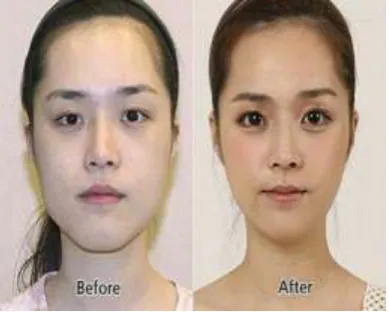
Plastic surgery procedures are gaining popularity because of cost effective and its improved results for facial appearances. The patients who are suffering from unstructured features can also use the plastic surgery. The existing face recognition system fails to match the face after plastic surgery. Fig. 1 shows images of a patient who has undergone facial plastic surgery.
Face Recognition after Plastic Surgery was first introduced by Singh et al. [1] examines the increasing popularity of plastic surgery. From the survey of plastic surgery popularity, the idea of including plastic surgery images along with face recognition system arise. This paper presents matching surgically altered face images through face granular approach. In the face granular approach the face image is divided in to several parts to find out different facial combinations which help to match before and after plastic surgery images. From the different facial combinations can verify which plastic surgery procedure changes the face. Plastic surgeries can be done not only for the specified parts but also for the entire face. Plastic procedures can be even permanent. So one have to prove the identity is necessary.
Fig 1: Plastic surgery images
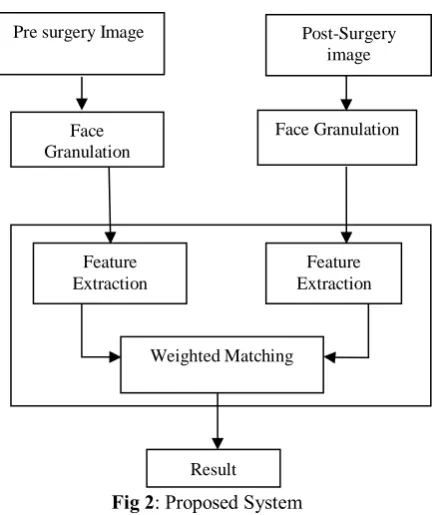
The proposed algorithm initially generates different face granules for both before and after plastic surgery images. The face granulation is the first module of the proposed system. After the face granulation the features are extracted for each granule by using two complementary feature extractors. This is because of each face granules give different information such as some gives the texture information where as some gives fiducial features such as eyes, nose etc[2]. Two feature extractors are efficient local binary pattern (LBP) and Scale Invariant Feature Transform (SIFT). For each face granule the features are extracted and calculate the weights for corresponding descriptors of SIFT feature and LBP feature. The features are selected using SWARM Optimization algorithm. After the selection of features the matching is done according to the selected features.
II. PROPOSEDSYSTEM
ISSN: 2231-5381
http://www.ijettjournal.org
Page 130
approach. By using face granulation approach can find out the changes occurred after plastic surgery. Thus gives high identification accuracy compared to the existing system. SWARM Optimization algorithm offers less computation time for selecting the features and yield reasonably accurate identification results.
A. Face Image Granulation
In this module different features are generated by three levels of granularity. The granules contain information such as nose, ears, forehead, cheeks and the combination of two or more features [10]. The loaded image is applied to a face detector to get the frontal face. The detected frontal face is divided in to several granules through three level of granularity. In the first level of granularity [2] the image is applied to Gaussian and Laplacian operator to get different smoothen image which helps to find out different plastic surgery procedures. In the second level of granularity the image is divided in to horizontal and vertical parts whereas third level of granularity the image is divided in to 16 parts to match each granule with others in after plastic surgery image.
Fig 2: Proposed System
1) First level of granularity: In first level of granularity the face granules are generated by applying the Gaussian Fig.3 and Laplacian fig4 pyramidal operators. Gaussian pyramidal operator generates a sequence of low pass filtered images in which iteratively convolving each of the component images. Convolution operator is used with the half of the size of image to get the pyramidal structure. By applying this operator can get the blurred image from level 0 to level3. The Laplacian pyramidal operator generates a series of band-pass filtered images which provides edge information. The difference of Gaussian operator gives the band pass images. The first level
of granularity provides different information at multiple resolution so that, can identify whether which plastic surgery procedure is used like skin lifting. From the first level of granularity can get 6 granules.
2) Second Level of Granularity: In the second level of granularity the image is divided in to horizontal fig5 and vertical granules fig6. It provides resilience to variations in inner and outer facial regions. It uses the relation between horizontal and vertical granules to address the variations in forehead, chin, ears, and cheeks caused due to plastic surgery procedures. From this level can get different combinational pattern of eyes, nose, cheek and chin. From the second level of granularity can get 18 granules.
3) Third Level of Granularity: In the third level of granularity is done by dividing the image into 16 granules based on the golden ratio template algorithm fig7. The human face golden ratio means the most beautiful face ratio. It has three parts that means from hairline to eyebrow, from eyebrow to nose and from nose to chin. In this level the faces are divided according to these three parts. Here the human face golden ratio is used to define the facial feature size.
Fig.3: first level of granularity by applying Gaussian operator
Fig.4: first level of granularity by applying Laplacian operator
Fig.5: second level of granularity (Horizontal face granules)
Pre surgery Image Post-Surgery
image
Face Granulation
Face Granulation
Feature Extraction
Feature Extraction
Weighted Matching
ISSN: 2231-5381
http://www.ijettjournal.org
Page 131
Fig.6: second level of granularity(Vertical face granules)
Fig.7: third level of granularity
B. Feature Extraction
Feature extraction is used in pattern recognition and also in image processing to reduce dimensionality. Feature Extraction can be used to detect and isolate various desired portions or shapes (features) of an image. Texture and fiducial features can be extracted using different feature extractors. There are two popular feature extractors are used to extract distinct features from different face granules. Here the feature extractors are Efficient Local Binary Patterns [3] and Scale Invariant Feature Transform [4].
1) Efficient LBP: Local Binary Pattern (LBP) is a
simple yet very efficient texture operator. Each pixels of an image compared with 8 neighbouring pixels to get binary pattern. This is done by setting the centre pixel as the threshold and compared it with the neighbouring pixel. If the neighbouring pixel having the value greater than or equal to the threshold value then assign 1 to the corresponding pixel otherwise 0. It takes the binary pattern by left to right reading pattern. From this binary pattern calculate the decimal value for the corresponding centre pixel. It is used for texture analysis. The most important property of the LBP operator is
its robustness to grey-scale changes caused. If any illumination variations occurs to the image the features can successfully extracted through LBP. Another important property is its computational simplicity, which makes it possible to analyse images in challenging real-time settings.
2) SIFT: SIFT is a scale and rotation invariant
descriptor that generates an image based on image gradients. It can be used for feature extraction. SIFT algorithm is used for object identification. In proposed method the 40 granules are undergone for feature extraction. It uses a sparse descriptor is computed around the detected interest points. Here the SIFT descriptor is computed in a dense manner. The descriptors are used for matching the images. For any object in an image, interest points on the object can be extracted to provide feature descriptors of the object. This descriptors extracted from the before surgery image can be used to locate the object in a test image that is after surgery image containing many other objects.
C. Feature Selection
Features are selected using SWARM Optimization approach [8]. It is a computational method that optimizes a given problem by iteratively attempting to enhance each candidate solutions with regard to a given measure of quality. SWARM Optimization approach [5] optimizes a problem by having a population of candidate solutions. Each particle has a weight and they solve the problem by comparing it with the corresponding neighbours. If the candidate who has higher value than the remaining particle, it will update the global best value. Each particle goes through the global value and updating to be done. The movement of each particle is influenced by its local position and each particle is guided towards the positions that have the best value or the nearer solution. The best known position is updated as global best positions found by other particles. This expected that the swarm moves towards the best solutions. Fig 12 explains the algorithm for SWARM Optimization.
III.RESULTS
The proposed algorithm is evaluated by considering two datasets. One dataset consists of images that are taken before plastic surgery and the second one contains images after plastic surgery fig8.
After reading the input images, the image is under gone the granulation scheme contains three levels of granularity. Fig9 are the face granules read from the granulation scheme. Features are extracted from these resultant granules. Feature extraction are done by LBP and SIFT. Below figure shows the result of feature extraction fig10 and fig11.
ISSN: 2231-5381
http://www.ijettjournal.org
Page 132
Fig.9: face granulesFig.10: LBP Feature image
Fig.11: SIFT Feature images
The weights for the corresponding features are calculated for each face granules. And from each calculated weight pair is compared with each granules. The selections of features are done by SWARM Optimization approach. High identification accuracy features are selected for each face granules. Matching is done by comparing each face granules with after plastic surgery images. Maximum compared face granules give the resultant output. If the compared result is greater than the threshold value, then print as MATCHED otherwise NOT MATCHED.
ISSN: 2231-5381
http://www.ijettjournal.org
Page 133
IV.CONCLUSIONS
This research presents an efficient face matching algorithm in plastic surgery using an evolutionary granular algorithm. Input for the system is the images from before and after plastic surgery and then perform the face matching algorithm for both images. In Genetic algorithm the original image itself is taken as input and found the match with surgical images. The disadvantage of this approach is some results gave incorrect match. In proposed system the granular approach is used, so that several face granules are used as input for the feature extraction. SWARM optimization algorithm selects the first level of granularity processes the image with Gaussian and Laplacian operators and second level of granularity the image is divided into horizontal and vertical granules of different size to get different information content. Proposed swarm optimization algorithm [5][6][7] finds the best particles based on two level mentioned above and move particle i to j if the best recognition result are found than the existing recognition results. Detailed analysis on the contribution of granular levels and individual face granules corroborates the hypothesis that the proposed algorithm unifies diverse information from all the granules to address the non-linear variations in the pre and post-surgery images and have high degree of identification accuracy.
REFERENCES
[1] Singh, R., Vatsa, M., Bhatt, H., Bharadwaj, S., Noore, A., Nooreyezdan, S Plastic surgery: a new dimension to face recognition Information Forensics and Security,IEEE Transactions on 5 (2010) 441-448. [2] Himanshu S. Bhatt, Samarth Bharadwaj, Richa Singh, and Mayank
Vatsa “Recognizing Surgically Altered Face Images Using Miobjective Evolutionary Algorithm” Ieee Transactions On Information Forensics And Security, Vol. 8, No. 1, January 2013
[3] T. Ahonen, A. Hadid, and M. Pietik¨ainen, “Face recognition with local binary patterns,” in Proc. Euro. Conf. Comput. Vis., 2004, pp. 469–481. [4] D. G. Lowe, “Distinctive image features from scale-invariant keypoints,”
Int. J. Comput. Vis., vol. 60, no. 2, pp. 91–110, 2004.
[5] J. Kennedy and R. Eberhart, Particle swarm optimization,• Proc. IEEE International Conference on Neural Networks, pp. 1942-1948, 1995. [6] R. C. Eberhart and Y. Shi, Comparison between Genetic Algorithms and
Particle Swarm Optimization, Proc. 7th international Conference on Evolutionary Programming, pp. 611- 616, 1998.
[7] X. Li, A Non-dominated Sorting Particle Swarm Optimizer for Multi-objective Optimization, in Proceedings of the Genetic and Evolutionary Computation Conference (GECCO 2003), ser. Lecture Notes in Computer Science, vol. 2723. Springer, 2003, pp. 37“48.
[8] H. A. Firpi and E. Goodman, “Swarmed feature selection,” in Proceedings of the 33rd Applied Imagery Pattern Recognition Workshop. Washington, DC, USA: IEEE Computer Society, 2004, pp. 112–118.
[9] B. Heisele, P. Ho, J. Wu, and T. Poggio, “Face recognition: Component-based versus global approaches,” Comput. Vis. Image Understand., vol. 91, pp. 6–21, 2003.