International Journal of Educational Methodology
Volume 5, Issue 3, 407 - 420.
ISSN: 2469-9632 http://www.ijem.com/
Examination of the Relationship between Prospective Teachers’
Occupational Anxiety and Technological Pedagogical Content Knowledge
by Canonical Correlation
Gulden Kaya-Uyanik
Sakarya University, TURKEY Duygu Gur-Erdogan
*
Sakarya University, TURKEY Sakarya UniversityOzlem Canan-Gungoren, TURKEY
Received: July 11, 2018 ▪ Revised: July 27, 2018 ▪ Accepted: August 15, 2019
Abstract: In this study, it is aimed to examine the relationship between prospective teachers' occupational anxiety and technological pedagogical content knowledge. Correlational model was used in this study. The participants consisted of 481 prospective teachers studying at Sakarya University Faculty of Education in the spring term of 2018-2019 academic year. Technological Pedagogical Content Knowledge Scale (TPACKS) and Occupational Anxiety Scale (OAS) were used as data collection instruments. As a result of canonical correlation analysis, it was determined that technological pedagogical content knowledge affects occupational anxiety by 62%.
Keywords: Occupational anxiety, Technological pedagogical content knowledge (TPACK), canonical correlation.
To cite this article: Kaya-Uyanik, G., Gur-Erdogan, D., & Canan-Gungoren, O. (2019). Examination of the relationship between prospective teachers’ occupational anxiety and technological pedagogical content knowledge by canonical correlation. International Journal of Educational Methodology, 5(3), 407-420. https://doi.org/10.12973/ijem.5.3.407
Introduction
Stress ensphering humanity in the chaos of the 21st century, also affects teachers and prospective teachers for various reasons. Although the causes of stress vary due to temporary conditions, it can be said that they cause teacher's anxiety which is negatively reflected in the teaching learning process and thus in the students' learning process. In this context, it is important to know the sources of anxiety related to the teachers’ and prospective teachers’ education process and to identify the sources to increase their knowledge and experience to reduce anxiety in order to obtain the desired quality in the education process.
Anxiety for Teaching Profession
While anxiety is called stress or tension directly experienced by the person in response to specific life situations (Coates & Thoresen, 1976). Teachers' Occupational Anxiety is defined as emotional reaction that occurs as a result of being negatively affected by a situation that they perceive as threatening or unpleasant and the mechanisms they take to deal with this situation (Kyriacou & Sutcliffe, 1978). Anxiety, which is a weakening feeling (Zeidner, 2007), is a condition that teachers face for many different reasons that they frequently experience. Pratt (1978) and Strassmeier (1995) explained the causes of anxiety as inability to cope with teaching problems, non-cooperative children, aggressive children, anxiety for children's learning, and staff relationships. In the study conducted by Kyriacou (2001), teachers expressed the following causes for their anxiety; their workload, students' behaviors and discipline, lack of promotion chance, poor working conditions, and inadequate relations with colleagues, students and administrators. Student behavior, workload and employment conditions all make statistically and substantively significant contributions to teacher anxiety levels (Ferguson, Frost & Hall, 2012). In studies conducted with prospective teachers, it has been shown that discipline (Ahlering, 1963; Brown, 1975; Capel, 1997; Dropkin & Taylor, 1963; Fuller & Venmaan, 1984; Guillaume & Rudney, 1993; Kokkinos, 2007; Mandzuk & Hasinoff, 2010; Travers et al., 1953; Wey, 1951; York, 1968), regulation of the school equipment and physical conditions (Brown & Ralph, 1992; Campbell & Williamson, 1974; Cooper & Kelly, 1993; Fuller & Brown, 1975; Thompson, 1963), academic qualifications (Aftab & Khatoon, 2012; Erickson & Rudd, 1967; Fuller, 1969; Mondal, Shrestha & Bhaila, 2011; Thompson, 1963; York, 1968), ability to plan teaching (Campbell & Williamson, 1974; Fuller & Brown, 1975; Guillaume & Rudney, 1993; Skaalvik &
*Correspondence:
Duygu Gur-Erdogan, Sakarya University, Faculty of Education, Sakarya- TURKEY. [email protected]
KAYA-UYANIK ET AL. / Relationship between Occupational Anxiety and TPACK
Skaalvik, 2015; Thompson, 1963; York, 1968), ability to evaluate teaching (Campbell & Williamson, 1974; Capel, 1997; Erickson & Rudd, 1967; Morton, Vesco., Williams & Awender, 1997; Ngidi, & Sibaya, 2003; Thompson, 1963; York, 1968) and relationships with students and other teachers or families (Capel, 1997; Fuller & Brown, 1975; Guillaume & Rudney, 1993; Mandzuk & Hasinoff, 2010; Shillingford-Butler, Patel & Ngazimbi, 2012; Skaalvik & Skaalvik, 2007; Sorenson & Halpert, 1968; Yee, 1968) can be seen as a cause of anxiety. Although the causes of anxiety expressed in the studies vary according to time, sampling, and country, Fuller (1969) classified the teachers' anxiety in three classes as self-centered anxiety related to the teacher himself, student-oriented or student-centered anxiety, and educational anxiety or task-centered anxiety. Based on this classification, in the study conducted by Cabi and Yalcinalp (2009), the student-centered anxiety category was defined in two sub-categories as communication and teaching, the task-centered anxiety category is defined in the occupational disability sub-category, and the self-centered category is defined in six sub-categories: appointment, school life, economic, professional acceptance, environment, and personal-professional anxiety. These categories were then identified as factors of the anxiety scale for the teaching profession developed by Cabi and Yalcinalp (2013). The first factor was “Task Centered Anxiety”, the second factor was “Economic/Social Centered Anxiety” and the third factor was “Student/Communication Centered Anxiety”. The fourth factor was named “Colleague and Parent Centered Anxiety”, the fifth factor was “Personal Development Centered Anxiety”, the sixth factor was “Appointment-centered Anxiety”, the seventh factor was “Adaptation-Centered Anxiety”, and the eighth factor was “School Management Centered Anxiety”.
Task-Centered Anxiety: The teaching task of the individual is the focus of task-centered anxiety. A prospective teacher with task-centered anxiety is concerned about being a good instructor (Cabi & Yalcinalp, 2009).
Economic / Social Centered Anxiety: At this level of anxiety, teachers have anxiety because they think their economic income from teaching profession will not be enough and restrict their social life.
Student / Communication Centered Anxiety: A prospective teacher who has student-centered anxiety thinks about how to meet each student's mental, physical, social or emotional needs and intensifies in this area (Atmaca, 2013).
Colleague and Parent-Centered Anxiety: It can be said that the focus of colleagues and parent-centered anxiety are the situations that may arise due to teachers’ and prospective teachers’ problems in their communication with their colleagues and parents of their students, and the thought that their colleagues and parents may find them unqualified. Personal Development Centered Anxiety: These are the anxiety that arise from the belief that the teacher should educate and develop himself / herself in subjects such as content knowledge and occupational knowledge.
Appointment-centered anxiety: In particular, the focal points of the prospective teachers' appointment-centered anxiety are that the number of graduates from the Faculty of Education and the number of vacancies opened by the Ministry of National Education do not coincide, and that there are agglomeration in some areas (Alpaslan, Bozgeyikli & Avci 2017).
Adaptation-Centered Anxiety: These are the anxiety arising from the idea of not being able to adapt themselves to the teaching profession and the region or city where they will be teaching.
School Management Centered Anxiety: The conditions of the school and the thoughts about the attitude and organizational structure of the school administration are the focus of school management centered anxiety.
Teachers' occupational anxiety may be influenced by many factors and seem to be related to various personal, social and physical conditions, so it is a potentially harmful and widespread problem for teachers and students (Coates & Thoresen, 1976). If prospective teachers graduate with high levels of anxiety, they are more likely to pass on this anxiety on to their students (Daniels, Mandzuk, Perry & Moore, 2011). One of the most effective ways of reducing anxiety is to increase the level of knowledge. Manthei and Gilmore (2006) emphasize that for the ability to organize classes and manage students' behavior, teachers need to provide behavior management skills through initial and continuing teacher education. Teachers should be equipped in terms of classroom organization, gaining the content knowledge throughout teacher education, and keeping pace with the developing technologies, as well as having the knowledge of educational technology, and gaining pedagogical content knowledge in order to manage student behaviors. The more knowledge of technological pedagogical content the prospective teachers have in their initial teacher education, the more likely it is that their anxiety levels will decrease.
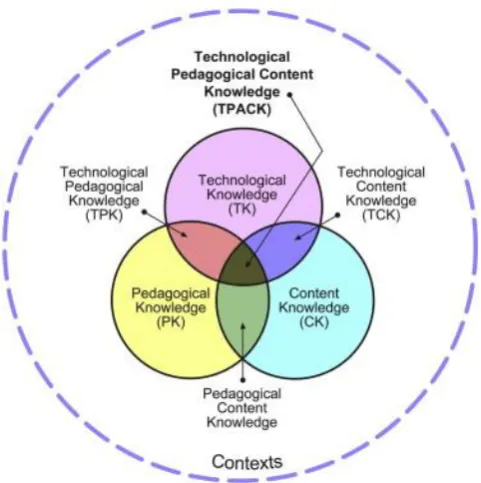
Technological Pedagogical Content Knowledge
Figure 1. Technological Pedagogical Content Knowledge Model (Mishra & Koehler, 2006)
Technology Knowledge (TK): “teacher knowledge about traditional and new technologies that can be integrated into curriculum” (Koehler et al., 2014)
Content Knowledge (CK): “teacher knowledge about actual subject matter that is to be learned or taught” (Mishra & Koehler, 2006)
Pedagogical Knowledge (PK): “teacher knowledge in classroom management, assessment, lesson plan development, and student learning, the methods and processes of teaching” (Schmidt et al., 2009)
Pedagogical Content Knowledge (PCK): “an understanding of how particular topics, problems, or issues are organized, represented, and adapted to the diverse interests and abilities of learners, and presented for instruction” (Shulman, 1986)
Technological Content Knowledge (TCK): “teacher knowledge of how technology can create new representations for specific content” (Schmidt et al., 2009)
Technological Pedagogical Knowledge (TPK): “teacher knowledge of how various technologies can be used in teaching, and to understanding that using technology may change the way teachers teach” (Schmidt et al., 2009)
Technological Pedagogical Content Knowledge (TPACK): “teacher knowledge required by teachers for integrating technology into their teaching in any content area” (Schmidt et al., 2009)
TPACK, also referred to as basic teacher competencies, with an emphasis on technology on PCK (Niess, 2011) is teacher knowledge for teaching with 21st century technologies. Given today's technology, TPACK has become the required and expected compulsory competency for teachers. What makes teachers feel this anxiety is the fact that they feel insufficient about these skills, they think they have inadequate and incomplete information on this subject, and that they cannot cope with technology. In this case, it is thought that it will affect the anxiety levels related to the teaching profession. It is seen that the increase in anxiety levels will affect the teaching process and this will affect students' education process negatively. In this context, this study aims to investigate whether the prospective teachers' occupational anxiety is related to technological pedagogical content knowledge.
Methodology Research Method
KAYA-UYANIK ET AL. / Relationship between Occupational Anxiety and TPACK
Participants
The participants consisted of 481 prospective teachers studying at Sakarya University, Faculty of Education, (Sakarya, Turkey) in the spring term of 2018-2019 academic year. In the canonical correlation analysis, it is emphasized that having 20 times the total number of variables in the sets is important for the reliability of the findings (Stevens, 2009). In this research, there are seven variables in the set of Technological Pedagogical Content Knowledge: technology knowledge (TK), pedagogical knowledge (PK), content knowledge (CK), technological content knowledge (TCK), pedagogical content knowledge (PCK), technological pedagogical knowledge (TPK) and technological pedagogical content knowledge (TPACK). There are eight variables in the occupational anxiety data set: task centered anxiety (TA), economic/social centered anxiety (ESA), student/communication centered anxiety (SCA), colleague and parent centered anxiety (CPA), personal development centered anxiety (PDA), appointment centered anxiety (APA), adjustment centered anxiety (ADA) and school management centered anxiety (SMA). Accordingly, there are 15 variables in the data set of the study. So that, at least 300 participants should be present in the study group for the reliability of the findings obtained from the canonical correlation. Therefore, it can be said that the number of participants in the study group is sufficient for the reliability of the findings obtained from the research. Table 1 shows the demographic characteristics of the participants.
Table 1. Demographic characteristics of the participants
Demographic features N Percentage
Gender Female Male 343 138 71,3 28,7
Department
Primary School Teaching 163 33,9
Mathematics Teaching 100 20,8
Turkish Language Teaching 70 14,6
Pre-school Teaching 59 12,3
English Language Teaching 52 10,8
Science Teaching 37 7,7
Age
19 142 29,5
20 151 31,4
21 119 24,7
22 69 14,3
Total 481 100
When Table 1 is examined, it can be seen that the study group consisted of 481 teacher candidates, 343 of whom were female (71.3%) and 138 (28.7%) were male. Distribution of prospective teachers according to departments; 163 (33.9%) from the Department of Primary School Teaching, 100 (20.8%) from the Department of Mathematics Teaching, 70 (14.6%) from the Department of Turkish Language Teaching, 59 (12.3%) from the Department of Preschool Teaching, 52 (10.8%) from the Department of English Language Teaching, and 37 (7.7%) of the Science Teaching Department. In addition, the ages of 481 prospective teachers in the study group ranged from 19 to 22 years. The study group was determined by appropriate sampling considering accessibility.
Data Collection Tools
Technological Pedagogical Content Knowledge Scale (TPACKS) and Occupational Anxiety Scale (OAS) were used as data collection instruments.
Occupational Anxiety Scale (OAS): The scale was developed by Cabi and Yalcinalp (2013) in order to ensure that prospective teachers’ anxiety about the teaching profession can be measured accurately. Cabi and Yalcinalp's (2009) study was used as the basis for the process of creating the items of the scale. The opinions of 7 experts from the content of education and assessment were used to determine the scope validity of the scale. Factor analysis was performed to determine construct validity. The total variance explanation percentage of the 8 factors was found to be 65,724. The Cronbach's alpha coefficients of the eight factors in the scale ranged from 0.94 to 0.67. The total reliability coefficient was 0.95 and Spearman Brown's two-half correlation was 0.84. The eight factors included in the scale were “Task Centered Anxiety”, “Economic/Social Centered Anxiety”, “Student/Communication Centered Anxiety”, “Colleague and Parent Centered Anxiety”, “Personal Development Centered Anxiety”, “Appointment-centered Anxiety”, “Adaptation-Centered Anxiety” and “School Management-“Adaptation-Centered Anxiety”.
evaluated between “strongly disagree” and “strongly agree”. When the reliability values of the scale were taken into account on the basis of factors, it was seen that they took values between .82 and .89.
Data Analyses
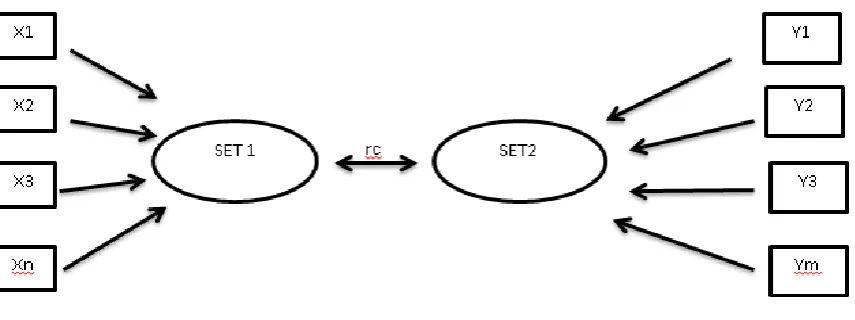
In this study, the relationship between prospective teachers' professional anxiety and technological pedagogical content knowledge was examined with canonical correlation which is one of the multivariate analysis techniques. Canonical correlation is a multivariate method that examines the relationships between two sets of variables [(X1, X2,…, Xn and Y1, Y2,…, Ym; n≥2 and m≥2)], each having at least two variables (Bordens & Abbott, 2011; Kalayci, 2009; Varmuza & Filzmoser, 2009).
Instead of examining the relationship levels of the variables in the data sets, it is important that the relationship between the two data sets be controlled with a single analysis in order to control the Type I error that may interfere with the measurement process (Stangor, 2010; Tabachnick & Fidell, 2007). Type I error is the result of accepting meaningful relationships that are not significant, and canonical correlation analysis reduces this error risk.
In canonical correlation analysis, dependent and independent variable sets can be determined depending on the problem situation and analyzes can be made between variable sets without determining this situation. In this case, the nomenclature Set1 and Set2 is preferred for two sets of variables and the purpose of the canonical correlation is to determine the relationship between Set1 and Set2 (Pedhazur, 1997; Stevens, 2009).
There are stages in canonical correlation analysis. These stages can be summarized as following:
• First, canonical variables are obtained. Canonical variables arise from linear components that will maximize the relationship between two sets of variables (Afifi & Clark, 2004; Leech, Barlett & Morgan, 2005). Both canonical variables are located on the right and left sides of the canonical correlation equation and are called canonical variable pairs (Tabachnick & Fidell, 2007).
• Next, pairs of canonical variables called canonical function or canonical root are identified. Each canonical function consists of two canonical variables (Hair, Black, Babin & Anderson, 2010). The maximum number of pairs of canonical variables that can be generated in the canonical correlation analysis is equal to the number of variables of the set which has less variables (Cohen, Cohen, West & Aiken, 2003).
• Then, the relationship between pairs of canonical variables called canonical function or canonical root is calculated. The relationship between the first pair of canonical variables is calculated in such a way that the relationship between the variable sets is the highest (Afifi and Clark, 2004). Then, the second canonical variable pair is formed and this process is continued.
The general scheme of the canonical correlation analysis is shown in Figure 2.
Figure 2. General Scheme for Canonical Correlation Analysis
In this research, canonical correlation analysis was used. The research aims to reveal the relationship between technological pedagogical content knowledge data set which consist of weighted combinations of TK, PK, CK, TCK, PCK, TPK and TPACK variables and occupational anxiety data set which consists of weighted combinations of TA, ESA, SCA, CPA, PDA, APA, ADA and SMA variables. There were 7 variables in one of the two variable sets and 8 variables in the other. Therefore, the maximum number of canonical variable pairs is 7.
KAYA-UYANIK ET AL. / Relationship between Occupational Anxiety and TPACK
Results
This section presents the findings of the canonical correlation analysis conducted in order to examine whether the prospective teachers' occupational anxiety is related to technological pedagogical content knowledge or not. In the canonical correlation, firstly, the relationships between the variables in the first variable set (technological pedagogical content knowledge factors) were examined and the correlation coefficients between the variables differed from 0.47 to 0.82. The relationships between the variables in the second variable set (occupational anxiety factors) ranged between 0.29 and 0.70. When the correlation values between the first variable set and the second variable set were examined, it was found that the highest relationship was between 0.37 and TA and PCK, and the other relationships were below 0.30. The calculated canonical correlation coefficients, Wilks’ Lambda, chi-square values, degree of freedom and significance tests are given in Table 2.
Table 2. Correlation coefficients of canonical variables, Wilks ’Lambda and significance tests
Canonic Correlation Wilks’ Lambda Chi-square df sig.
1 ,845 ,716 157,313 56,000 ,000
2 ,624 ,892 93,586 42,000 ,000
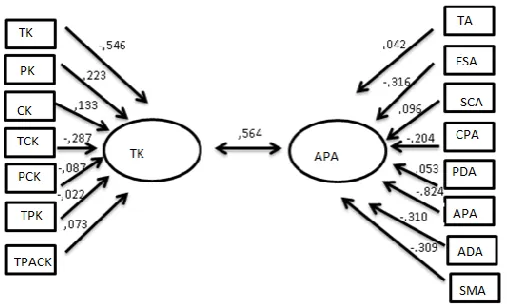
3 ,564 ,940 89,286 30,000 ,003
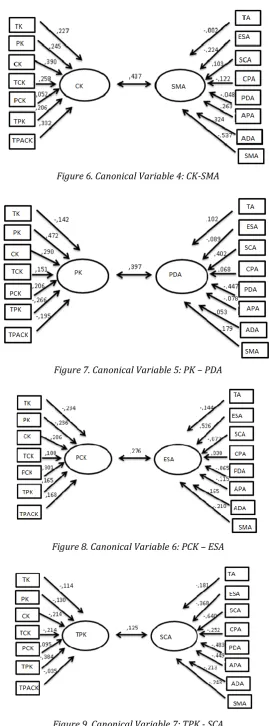
4 ,437 ,966 76,403 20,000 ,009
5 ,397 ,984 67,449 12,000 ,012
6 ,276 ,994 53,015 6,000 ,021
7 ,125 ,999 40,301 2,000 ,045
The square of the canonical correlation coefficients indicates the paired variance which was defined among the variable sets. When the correlation coefficients calculated in Table 2 were examined, it is seen that correlation of the first canonical correlation set is ,845 and explains 71% of the paired variance. Similarly, the second canonical cluster correlation is ,624, which is 39% of the paired variance. The third canonical cluster correlation is ,564 and explains 32% of the paired variance in Table 2. The fourth canonical cluster correlation is found to be ,437 and found to account for 19% of the paired variance. The fifth canonical cluster correlation is 397 and explains 16% of the paired variance. The sixth canonical cluster correlation is ,276 and explains 8% of the paired variance, while the correlation of the seventh canonical cluster is ,125 and explains 2% of the paired variance.
Table 2 also includes Wilks’ Lambda and Chi-square values. These values give information about the significance level of the calculated canonical correlation values. As it can be seen in Table 2, it can be said that all the correlation coefficients calculated for the seven canonical sets are significant (p <0.05). Table 3 contains the standardized canonical coefficients showing the part explained by the canonical variables in their own sets, including the correlations between the canonical variables and the actual variables indicating the weight of each variable in forming the linear combination.
Table 3. Standardized correlation coefficients of the variables in the first set (Standardized Canonical Correlation Coefficients Set-1)
1 2 3 4 5 6 7
1.TK -,003 ,849 -,752 ,147 -,168 -,317 -,399
2.PK -,333 -,320 ,504 ,026 ,518 -,924 -,004
3.CK ,403 ,393 ,468 ,318 ,534 ,852 -,947
4.TCK ,141 -,259 -,891 ,408 ,604 -,079 ,275
5.PCK -,680 ,649 -,634 -,719 ,166 ,561 ,825
6.TPK -,567 -,636 ,635 -,983 -,763 ,095 -,076
7.TPACK ,021 ,509 ,395 1,416 -,645 ,093 ,876
When the relationship between the variables in the first set and the canonical variables in Table 3 is examined, the equation created for the first canonical variable is the following;
U1 = -,680 * PCK + -,567 * TPK + ,403 * CK + -,333 * PK +,141 * TCK +,021 * TPACK + -,003 * TK. Similarly, the equation for the other six canonical variables can be formed. It is also possible to determine the first set variable from table 3 that contributes the most to canonical variables. Accordingly, the most contributing variable to the first canonical variable is PCK; the most contributing variable to the second canonical variable is TK; TCK is the most contributing variable to the third canonical variable, TPACK is the most contributing variable to the fourth canonical variable, TPK is the most contributing variable to the fifth canonical variable, PK is the variable that contributes the most to the sixth canonical variable and CK is the variable that contributes the most to the seventh canonical variable.
Table 4. Standardized correlation coefficients of the variables in the second set (Standardized Canonical Correlation Coefficients Set-2)
1 2 3 4 5 6 7
1.TA -,927 ,265 -,439 ,058 ,106 -,132 ,304
2.ESA -,063 ,131 -,307 -,610 -,013 ,934 -,102
3.SCA ,245 ,064 ,539 ,161 ,846 ,042 -,935
4.CPA -,275 ,762 ,071 ,147 -,008 ,303 ,019
5.PDA -,022 -,224 ,549 ,013 -,937 -,528 -,671
6.APA ,245 ,330 -,920 ,188 -,232 -,279 -,368
7.ADA -,115 -,403 ,128 ,980 ,299 -,125 ,239
8.SMA ,193 -,640 -,206 -,929 ,347 -,823 -,160
When the relationship between the variables in the second set in Table 4 and canonical variables is examined, the equation created for the first canonical variable is as follows:
V1 = -, 927 * TA + -, 275 * CPA +, 245 * SCA +, 245 * APA +, 193 * SMA + -, 115 * ADA + -, 063 * ESA + -, 022 *PDA. Similarly, the equation for the other six canonical variables can be formed.
It is also possible to determine the first set variable that makes the most contribution to the canonical variables from Table 4. Accordingly, the most contributing variable to the first canonical variable is TA; the most contributing variable to the second canonical variable is CPA; the most contributing variable to the third canonical variable is APA, the fourth contributing variable is the ADA, the fifth contributing variable is the most contributing variable to the ESA, the sixth canonic variable is the most contributing variable to the ESA and the seventh canonical variable is seen to be SCA. In canonical correlation analysis, canonical loads show the amount of variance explained by the canonical variables in their own sets. The explained variance ratio refers to the average of the squares of the canonical loads of each canonical variable in the set (set1 or set2). The canonical loads of the variables belonging to the first canonical set are given in Table 5.
Table 5. Canonical loads of the variables of the first canonical set (Canonical Loads Set-1)
1 2 3 4 5 6 7
1.TK -,222 ,279 -,546 ,227 -,142 -,234 -,114
2.PK -,231 ,059 ,223 ,245 ,472 -,236 -,130
3.CK -,211 ,095 ,133 ,390 ,290 ,286 -,214
4.TCK -,297 -,425 -,287 ,258 ,151 ,188 -,214
5.PCK -,283 ,128 -,087 ,052 ,206 ,301 ,095
6.TPK -,212 -,230 -,022 ,206 -,266 ,165 -,384
7.TPACK -,725 -,040 ,073 ,332 -,195 ,168 -,035
When the correlations between each canonical variable and the variables in the cluster is greater than 0.30, it indicates that the variable is a part of the cluster (Tabachnick & Fidell, 2007). As shown in Table 5, TPACK in the first cluster, TCK in the second cluster, TK in the third cluster, CK in the fourth cluster, PK in the fifth cluster, PCK in the sixth cluster and TPK in the seventh cluster are part of the cluster. Table 6 shows the canonical loads of the variables related to the second canonical set.
Table 6. Canonical loads of the variables of the second canonical set (Standardized Canonical Correlation Coefficients Set-2)
1 2 3 4 5 6 7
1.TA -,944 ,042 -,124 -,002 ,102 -,144 -,181
2.ESA -,541 -,369 -,316 -,224 -,089 ,526 -,368
3.SCA -,605 ,105 ,096 ,103 ,402 -,072 -,640
4.CPA -,761 ,072 -,204 -,122 ,068 ,038 -,252
5.PDA -,718 -,202 ,053 -,048 -,447 -,065 -,483
6.APA -,168 ,050 -,824 ,263 -,078 -,115 -,449
7.ADA -,507 -,652 -,310 ,324 ,053 ,165 -,213
8.SMA -,508 -,406 -,309 -,537 ,179 -,210 -,243
KAYA-UYANIK ET AL. / Relationship between Occupational Anxiety and TPACK
Figure 3. Canonical Variable 1: TPACK – TA
Figure 4. Canonical Variable 2: TCK – ADA
Figure 6. Canonical Variable 4: CK-SMA
Figure 7. Canonical Variable 5: PK – PDA
Figure 8. Canonical Variable 6: PCK – ESA
KAYA-UYANIK ET AL. / Relationship between Occupational Anxiety and TPACK
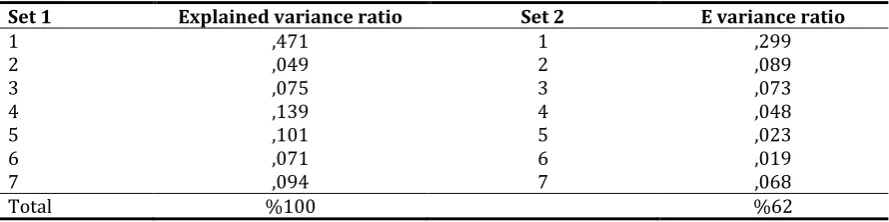
In order to examine the relationship between the first canonical variable set and the second variable set, redundancy indices were calculated. Unnecessary indices and canonical variables are expressed in the cross-set ratio. In Table 7, redundancy indices for canonical variables are given.
Table 7. Unnecessary indexes of canonical variables
Set 1 Explained variance ratio Set 2 E variance ratio
1 ,471 1 ,299
2 ,049 2 ,089
3 ,075 3 ,073
4 ,139 4 ,048
5 ,101 5 ,023
6 ,071 6 ,019
7 ,094 7 ,068
Total %100 %62
When Table 7 is examined, the seven canonical variables of the first set explain 100% of the variance in set 1. All of these variables showed a significant relationship. The seven canonical variables of the second set explain 62% of the variance in set1. All were statistically significant. In this case, it can be said that technological pedagogical content knowledge affects occupational anxiety by 62%.
Discussion and Conclusion
In this study, the relationship between prospective teachers' occupational anxiety and technological pedagogical content knowledge was examined with canonical correlation. Technological pedagogical content knowledge was arranged as the first set in canonical correlation, and occupational anxiety remained as the second set. It was seen that technological pedagogical content knowledge explained occupational anxiety by 62%. In this case, it can be said that technological pedagogical content knowledge affects occupational anxiety by 62%. The reason is that technological pedagogical content knowledge is a certain accumulation of knowledge required by the teacher in order to perform teaching successfully in complex and varied contexts (Park & Oliver, 2007). Technology knowledge, content knowledge, or pedagogical knowledge alone is not sufficient to contribute to the professional development of teachers, unless combined. When technology is included in teaching, it can be said that technological pedagogical content knowledge is necessary (Lee & Tsai, 2010). TPACK is not only important in the classroom but is also necessary for teachers to improve themselves professionally and it is clear that it is essential for all teachers (Kola & Sunday, 2015). However, teachers and prospective teachers have anxiety when they feel that they are inadequate to have all the information they need to do better and feel a lack of confidence in their profession (Beyhan, Bariseri & Sisman, 2018). Many experimental studies show that teachers have difficulty in designing technology-integrated courses for student-centered learning (Koh, 2018). As a result, the idea of lack of knowledge results in a lack of self-confidence. Consequently, it causes occupational anxiety. In the study conducted by Gokmen and Ekici, (2018), a negative and moderate relationship was found between the prospective teachers' self-efficacy perceptions and their occupational anxiety. This study supports the research results and the relationship between technological pedagogical content knowledge and occupational anxiety.
In addition, when the canonical variable sets were examined, the highest relationship was found between technological pedagogical content knowledge and task anxiety. Cabi and Yalcinalp, (2009) explained the prospective teachers' work anxiety as being a good instructor. Especially with the developing technology recently, the expectation from education and teachers has increased reflecting on teachers’ competence to be a good instructor. Teachers working in schools and prospective teachers studying at universities need to develop themselves and gain knowledge and skills in order to use technology at desired level in educational activities (Korucu & Bicer, 2017). The reason is that the main purpose of the education system is to educate individuals who adapt to the changes that arise from globalization and technological developments (Gopinathan & Sharpe, 2007). This responsibility and duty imposed on the teacher explains the high level of effect on the task anxiety of the teachers. The fact that Ertekin and Gulsecen (2001) found that young teachers who had the opportunity to use computers were more knowledgeable and less anxious than experienced teachers supported this situation.
appointments have been carried out with the support of information communication technologies explains the effect of technology knowledge on appointment-centered anxiety. Another result that emerged in the study is the effect between content knowledge and school management centered anxiety. School management-centered anxiety may be due to the uncertainty of the attitudes of the school management and school method that prospective teachers will encounter in the school environment in the case of appointment. In particular, people have anxiety about being observed by a supervisor when doing a job. Capel (1997) in his study revealed that the main cause of stress in individuals is assessment and observation. In particular, the fact that managers are looking at their teachers' level of competence in content knowledge explains the relationship between content knowledge and management-centered anxiety. Gabriel (1957), in “an analysis of the emotional problems of teachers in the classroom”, concluded that the content knowledge and teaching anxiety depends on the evaluation of the supervisors (As cited in Vogeli, 2015). In addition, the pedagogical knowledge necessary for the individual to recognize himself / herself, to understand and to empathize is very important for the teaching profession. Therefore, it is an accumulation of knowledge necessary for the teacher to educate and develop himself/herself both in subjects related to himself/herself and knowledge of the content and profession. Another finding obtained in the study is that pedagogical content knowledge affects economic/social centered anxiety. On the other hand, technological pedagogical knowledge affects student communication centered anxiety, albeit at a low level.
Consequently, in this research that examines the relationship between prospective teachers' occupational anxiety and technological pedagogical content knowledge, it has been found that the highest relationship was between technological pedagogical content knowledge and task anxiety. Technology knowledge was also found to be associated with appointment-centered anxiety. On the other hand, there was low level relationship between pedagogical content knowledge and economic/social centered anxiety, technological pedagogical knowledge and student communication centered anxiety.
Suggestions
When the findings obtained from the study are examined, technological pedagogical content knowledge in general is found to be an important factor in the anxiety about the teaching profession. In particular, teachers and prospective teachers having high occupational anxiety may reflect these on their students and lead to negative student behaviours. Thoresen (1976) states that there is a strong positive relationship between teachers’ and students' stress (Vogeli, 2015). In this case, further studies to reduce the professional anxiety of teachers and prospective teachers are considered important. In order to reduce the prospective teachers' professional anxiety, it is important to equip prospective teachers with sufficient knowledge about technological pedagogical content knowledge, which has a significant effect on professional anxiety. In particular, teacher training programs can be revised to include content that can integrate technological pedagogical content knowledge. In addition, the factors affecting professional anxiety can be examined in detail in further studies.
References
Afifi, A., & Clark, V. (2004). Computer-aided multivariate analysis. Boca Raton, FL: Chapman & Hall/CRC.
Aftab, M., & Khatoon, T. (2012). Demographic differences and occupational stress of secondary school teachers.
European Scientific Journal, 8(5), 159-175.
Ahlering, I. (1963). Reactions by student teachers. The Clearing House, 37(6), 337-340
Alpaslan, G., Bozgeyikli H., & Avci, A. (2017). Sinif ogretmeni adaylarinin basari yonelimleri ile mesleki kaygi duzeylerinin incelenmesi [An investigation of primary school pre-service teachers' achievement goal orientations and occupational concerns]. Journal of Abant Izzet Baysal University Faculty of Education, 17(1), 189-211
Atmaca, H. (2013). Almanca, Fransizca ve Ingilizce ogretmenligi bolumlerinde okuyan ogretmen adaylarinin mesleki kaygilari. [The professional concerns of teacher candidates who enrolled in English, French and German teaching departments]. Turkish Studies - International Periodical for the Languages, Literature and History of Turkish or Turkic, 8 (10), 67-76.
Bandura, A. (1986). Social Foundations of Thought and Action. Englewood Cliffs, NJ: Prentice-Hall.
Beyhan, O., Bariseri, N., & Sisman, Y. S. (2018). An investigation of pre-service preschool teachers’ occupational anxiety levels in terms of different variables. Social Sciences and Education Research Review, 5(1), 59-71.
Bordens, K. S., & Abbott, B. B. (2011). Research design and methods: A process approach. New York, NY: The McGraw-Hill Companies.
Brown, M., & Ralph, S. (1992). Teacher stress. Research in Education, 4(1), 103-110
KAYA-UYANIK ET AL. / Relationship between Occupational Anxiety and TPACK
International Educational Technology Conference (pp. 579-584). Hacettepe University, Turkey. Retrieved from http://www.iet-c.net/publication_folder/ietc/ietc2009.pdf
Cabi, E., & Yalcinalp, S. (2013). Ogretmen adaylarina yonelik mesleki kaygi olcegi (MKO): gecerlik ve guvenirlik calismasi [Occupational anxiety scale for prospective teachers: a study on validity and reliability]. Hacettepe Universitesi Egitim Fakultesi Dergisi [Hacettepe University Journal of Education], 44, 85-96.
Campbell, L. P., & Williamson, J. A. (1974). Disregard those anxieties: Reassurance for student teachers. Southern Journal of Educational Research,8(1), 222-235
Capel, S. A. (1997). Changes in students’ anxieties and concerns after their first and second teaching practices.
Educational Research, 39(1), 211-228.
Coates, T. J., & Thoresen, C. E. (1976). Teacher anxiety: A review with recommendations. Review of Educational Research, 46(1), 159-184.
Cohen, J., Cohen, P., West, S. G., & Aiken, L. S. (2003). Applied multiple regression/ correlation analysis for the behavioral sciences. London: England, Lawrence Erlbaum Associates.
Cooper, C. L., & Kelly, M (1993). Occupational stress in head teachers: A national UK study. British Journal of Educational Psychology, 63(1), 130-143.
Daniels L. M., Mandzuk, D., Perry, R. P., & Moore C. (2011). The effect of teacher candidates’ perceptions of their initial teacher education program on teaching anxiety, efficacy, and commitment. Alberta Journal of Educational Research,
57(1), 88-106.
Dropkin, S., & Taylor, M. (1963). Perceived problems of beginning teachers and related factors. Journal of Teacher Education, 14(4), 384-390.
Erickson, J. K., & Rudd, J. B. (1967). Concerns of home economics students preceding their student teaching experience.
Journal of Home Economics, 59(1), 732-734.
Erktin, E., & Gulsecen, S. (2001). Egitimde bilisim teknolojilerinin kullanimini etkileyen psikolojik etmenler.[Psychological factors affecting the use of information technology in education]. Education and Science, 26 (121), 7-11.
Erkus, A. (2011). Davranis bilimleri icin bilimsel arastirma sureci.[Scientific research process for behavioral sciences].
Ankara, Turkey: Seckin.
Ferguson, K., Frost, L., & Hall, D. (2012). Predicting teacher anxiety, depression, and job satisfaction. Journal of Teaching and Learning, 8(1), 27-42.
Fraenkel, J. R., & Wallen, N. E. (2006). How to design and evaluate research in education (6th ed.). New York, NY: McGraw-Hill .
Fuller, F. F. (1969). Concerns of teachers: A developmental conceptualization. American Education Research Journal,
6(1), 207-226.
Fuller, F. F., & Brown, O. H. (1975). Becoming a teacher. In K. Ryan (Ed.), Teacher education (Seventy-fourth yearbook of the National Society for the Study of Education). Chicago, IL: University of Chicago Press.
Gopinathan, S., & Sharpe, L. (2007). The teacher is the key: Professionalism and the strategic state. In E. Thomas (Ed.), Teacher education dilemma and prospects (pp. 23-33). London, England: Routledge.
Gokmen, A., & Ekici, G. (2018). Biyoloji ogretmen adaylarinin ogretmen oz-yeterlik algi duzeyleri ile mesleki kaygilari arasindaki iliskinin incelenmesi. [Investigating the relationship between preservice biology teachers’ perception level of teacher self-efficacy and their occupational anxiety]. Anatolian Journal of Teacher,2(2), 17-28.
Guillaume, A. M., & Rudney, G. L. (1993). Student teachers’ growth toward independence: An analysis of their changing concerns. Teaching and Teacher Education, 9(1), 65-80.
Hair, J. F., Black, W. C, Babin, B. J., & Anderson, R. E. (2010). Multivariate data analysis. Englewood Cliffs, NJ: Prentice Hall.
Harris, J., Mishra, P., & Koehler, M.J. (2009). Teachers’ technological pedagogical content knowledge and learning activity types: curriculum-based technology integration reframed. Journal of Research on Technology in Education- JRTE, 41(4), 393–416.
Kalayci, S. (Ed.). (2009). Uygulamali cok degiskenli istatistik teknikleri [Applied multivariate statistical techniques]. Ankara: Asil.
Karasar, N. (1999). Bilimsel arastirma yontemi [Scientific research method]. Ankara: Nobel Yayin Dagitim.
Koehler, M. J., & Mishra, P. (2009). What is technological pedagogical content knowledge? Contemporary Issues in Technology and Teacher Education, 9(1), 60-70.
Koh, J. H. L. (2018). TPACK design scaffolds for supporting teacher pedagogical change. Educational Technology Research and Development,67(3), 577–595. https://doi.org/10.1007/s11423-018-9627-5.
Kokkinos, C. M. (2007). Job stressors, personality and burnout in primary school teachers. British Journal of Educational Psychology, 77(1), 229-243. http://dx.doi.org/10.1348/000709905X90344
Kola, A. J, & Sunday, O. S. (2015). A Review of teacher self-efficacy, pedagogical content knowledge (PCK) and out-of-field teaching: focussing on Nigerian teachers. International Journal of Elementary Education, 4 (3), 80-85. doi: 10.11648/j.ijeedu.20150403.15
Korucu, A. T., & Bicer, H. (2017). Ogretmen adaylarinin mesleki kaygi durumlari ve teknoloji kabul ve kullanim durumlarinin incelenmesi.[Investigation of teacher candidates’ occupational anxiety status and technology acceptance and condition of use]. Journal of Instructional Technologies & Teacher Education, 6(3), 111-124.
Kyriacou, C., & Sutcliffe, J. (1978). Teacher stress: prevalence, sources and symptoms. British Journal of Educational Psychology, 48(2), 159-167.
Kyriacou, C. (2001). Teacher stress: directions for future research. Educational Review, 53(1), 27–35.
Lee, M. H., & Tsai, C.C (2010). Exploring teachers’ perceived self efficacy and technological pedagogical content knowledge with respect to educational use of the World Wide Web. Instr Sci, 38(1), 1-21. https://doi.org/10.1007/s11251-008-9075-4
Leech, N. L., Barlett, K. C., & Morgan, G. A. (2005). SPSS for intermediate statistics; Use and interpretation. Mahwah, NJ: Lawrence Erlbaum Associates.
Mandzuk, D., & Hasinoff, A. (2010). Slices of life: managing dilemmas in middle grades teaching. case studies for professional development. Westerville, OH: National Middle School Association.
Manthei, R., & Gilmore, A. (2006). Teacher stress in intermediate schools. Educational Research, 38 (1), 3-19.
Mishra, P., & Koehler, M. J. (2006). Technological pedagogical content knowledge: a framework for teacher knowledge.
Teachers College Record, 108(6), 1017–1054.
Mondal, J., Shrestha, S., & Bhaila, A. (2011). School teachers: Job stress and job satisfaction, Kaski, Nepal. International Journal of Occupational Safety and Health, 1(1), 27–33.
Morton L. L., Vesco R., Williams N. H., & Awender M. A. (1997). Student teacher anxieties related to class management, pedagogy, evaluation, and staff relations. British Journal of Educational Psychology, 67 (1), 69-89.
Niess, M. L. (2011). Investigating TPACK: knowledge growth in teaching with technology. Journal of educational computing research, 44(3), 299-317.
Ngidi, D. P., & Sibaya, P. T. (2003). Student teacher anxieties related to practice teaching. South African Journal of Education, 23 (1), 18-22.
Park, S., & Oliver, J. S. (2007). Revisiting the conceptualization of pedagogical content knowledge (PCK): PCK as a conceptual tool to understand teachers as professionals. Research in Science Education,38(3), 261–284.
Pedhazur, E. J. (1997). Multiple regressions in behavioral research: Explanation and prediction. New York: Holt, Rinehart & Winston.
Pratt, J. (1978). Perceived stress among teachers: the effects of age and background of children taught. Educational Review, 30(1), 3-14.
Sherry, A., & Henson, R. K. (2005). Conducting and interpreting canonical correlation analysis in personality research: A user-friendly primer. Journal of Personality Assessment, 84(1), 37-48.
Shillingford-Butler, M. A., Patel, S. H., & Ngazimbi, E. E. (2012). The Role of the professional school counselor in reducing. teacher anxiety; ideas and research you can use: VISTAS 2012. Retrieved from https://www.counseling.org/resources/library/vistas/vistas12/Arti cle_58.pdf
KAYA-UYANIK ET AL. / Relationship between Occupational Anxiety and TPACK
Skaalvik, E. M., & Skaalvik, S. (2007). Dimensions of teacher self-efficacy and relations with strain factors, perceived collective teacher efficacy, and teacher burnout. Journal of Educational Psychology, 99(3), 611-625.
Skaalvik, E. M., & Skaalvik, S. (2015). Job satisfaction, stress and coping strategies in the teaching profession—What do teachers say. International Education Studies, 8(3), 181-192.
Sorenson, G., & Halpert, R. (1968), Stress in student teaching. California Educational Research Journal, 19(1), 28-33 Stangor, C. (2010). Research methods for the behavioral sciences. Belmont, TN: Wadsworth Cengage Learning. Stevens, J. P. (2009). Applied multivariate statistics for the social sciences. New York, NY: Routledge.
Strassmeier, W. (1995). Occupational burden and job satisfaction-How can I reconcile both? The Special School, 4(1), 287-294.
Tabachnick, B. G., & Fidell, L. S. (2007). Using Multivariate Statistics (5th ed.). Boston, MA: Allynand Bacon.
Thompson, M. L. (1963). Identifying anxieties experienced by student teachers. Journal of Teacher Education, 14(1), 435-439.
Travers, R. M. W., Rabinowitz, W., & Nemovicher, E. (1953). The anxieties of a group of student teachers. In R. M. W. Travers, W. Rabinowitz, & M. H. Page (Eds.), Exploratory studies in teacher personality. New York: City College, Division of Teacher Education, Office of Research and Evaluation.
Varmuza, K., & Filzmoser, P. (2009). Introduction to multivariate statistical analysis in chemometrics. Boca Raton, FL: CRC Press.
Venmaan, S. (1984). Perceived problems of beginning teachers. Review of Educational Research, 54(2), 143-178.
Vogeli, A. (2015). Albania’s private school teachers and their stresses. Academic Journal of Interdisciplinary Studies, 4(1), 33-40. https://doi.org/10.5901/ajis.2015.v4n1s1p33
Wey, H. W. (1951). Difficulties of beginning teachers. School Review, 59(1), 32-57.
Yee, A. H. (1968). Interpersonal relationships in the student-teaching triad. Journal of Teacher Education, 19(1), 95-112. York, L. J. N. (1968). Relationships between problems of beginning elementary teachers, their personal characteristics, and
their preferences for inservice education (Unpublished doctoral dissertation). Indiana University, Bloomington, Indiana, USA.