181 |
P a g e
CLUSTER HEAD FAULT TOLERANCE MECHANSIM
USING DUAL CH FOR WIRELESS SENSOR
NETWORK
R.Priya
1, S.Kannadhasan
2 1P.G Student, Raja College of Engineering and Technology, Madurai, TamilNadu, (India),
2
Research Scholar, Raja College of Engineering and Technology, Madurai, TamilNadu, (India)
ABSTRACT
Wireless Sensor Networks (WSN) have become a critical research issue for a wide range of applications such as environmental monitoring, medical, habitat monitoring, surveillance and tracking systems with the improvement of wireless communication and VLSI technology.WSN is consisted of a large number of sensor nodes to collect the information and dispatch information. . As power is a limiting factor in a WSN, the major challenge in deploying a WSN is to enhance the network life time. So, it becomes inevitable to devise an efficient method of conserving the power. Wireless Sensor Networks have many nodes are connected to the network to calculate the network performance like transmission power. The power consumption is directly related to the size and weight of the nodes. It gains low cost and also to detect shortest path to transmitted the power through the network. The major design challenge for WSN is to extend the lifetime of sensor nodes longer and reduce power consumption important issue to prolong the lifetime of WSN.
Keywords:Graph Theory, Transmission Power, Shortest Path
I. INTRODUCTION
Wireless sensor networks (WSNs) have become a hot research topic in recent years. Wireless sensor network is
one of the pervasive networks which sense our environment through various parameters like heat, temperature,
pressure, etc… [1]Since sensor networks are based on the dense deployment of disposable and low-cost sensor
nodes, destruction of some nodes by hostile action does not affect a military operation as much as the
destruction of a traditional sensor, which makes the sensor network concept a better approach for battlefields.
[2]. The transmission between the two nodes will minimize the other nodes to show the improve throughput and
greater than spatial reuse than wireless networks to lack the power controls. Transmission Power technique to
improve the Network Life Time in Wireless Sensor Networks [3]. Wireless sensor networks (WSNs) are
emerging as an effective means for environment monitoring to improve the quality of life and safety in
emergency situations. Sensor networks are equipped with energy limited batteries, energy conservation in such
networks is prolong the network lifetime. Advances in wireless sensor network (WSN) technology has provided
182 |
P a g e
the characteristics of wireless sensor networks require more effective methods for data forwarding and
processing.
II. GRAPH THEORY
Graph theoretical ideas are highly research areas of computer science such data mining, image segmentation,
clustering, image capturing, networking etc., Modeling of network topologies can be done using graph concepts.
The shortest spanning tree in a weighted graph, obtaining an optimal match of nodes and distance and locating
the shortest path between two vertices in a graph.
Some algorithms are as follows:
1. Shortest path algorithm in a network
2. Finding a minimum spanning tree
3. Finding graph planarity
4. Algorithms to find adjacency matrices.
5. Algorithms to find the connectedness
6. Algorithms to find the cycles in a graph
7. Algorithms for searching an element in a data structure (DFS, BFS) and so on.
III. RELATED WORK
Many algorithms and techniques have been developed that utilize power in an efficient manner. Some of the
techniques and methods that are used to design the proposed algorithm are discussed here to know how power is
dynamically reconciled to meet the constraint of power depletion in nodes of the network.
Sorooshyari et.al. have addressed the problem of adjusting the transmission power level at each wireless radio
interface on a per packet basis, based on user and network applications. They have put forth a power control
policy that enables a user to address various user – centric and network – centric objectives. The proposed
power control policy is optimal with respect to users dynamically allocating transmit power.
Correia et. al. in have devised two transmission power control protocols for WSNs, which can be embedded into
any existing MAC protocol. The first, called Hybrid,
calculates the ideal transmission power using a closed control loop that iterates over the available transmissions
powers in order to maintain a target link quality. The second, called AEWMA, employs calculations to
determine the ideal transmission power based on the reception transmission power and average noise.
Arnab Nandi et. al. have propose power based transmission scheme for WSN where transmit power is adapted
depending on node density and channel conditions so as to maintain a desired level of signal detection
probability at a receiving node as demanded by sensing range. They have compared the energy level
performance and the proposed transmit power schemes. With respect to energy consumption, they have shown
that the proposed scheme consumes less energy than FTPS in moderate and high node spatial density region.
Jasmine Norman in their paper have developed Random Geometric Graphs a very influential and well-studied
model of large networks, such as sensor networks, where the network nodes are represented by the vertices of
183 |
P a g e
wireless nodes with uniform transmission ranges. In real life, there exist heterogeneous wireless networks in
which devices have dramatically different capabilities. The connectivity of a WSN is related to the positions of
nodes, and those positions are heavily affected by the method of sensor deployment. As sensors may be spread
in an arbitrary manner, one of the fundamental issues in a wireless sensor network is the coverage problem.
study connectivity and coverage in hybrid WSN based on dynamic random geometric graph.
B.Baranidharan in their paper have energy efficiency in wireless sensor network [WSNs] is the highly sorted
area for the researchers. Number of protocols has been suggested for energy efficient information gathering for
sensor networks. These protocols come under two broad categories called tree based approach and clustering
techniques. In these techniques clustering is more suitable for real time applications and has much more
scalability factor when compared with its previous counterpart. It presents the importance and factors affecting
the clustering. Surveyed the different clustering algorithms with its extensions till date and proposed the
clustering technique using Minimum Spanning Tree [MST] and shortest path concept with its strength and
limitations.
IV. PROPOSED WORK
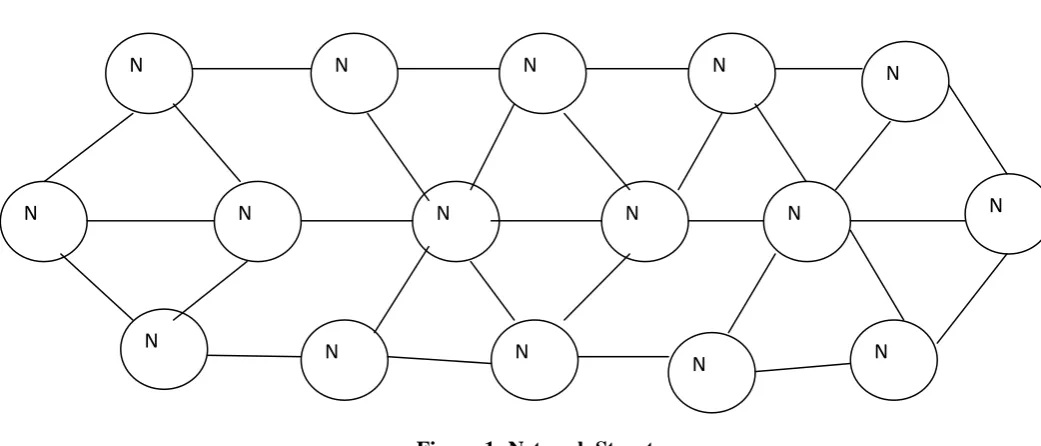
Figure 1: Network Structure
The main objective of the paper is to develop a transmission power technique using graph approach. The Graph
based Transmission Power is developed to prolong the lifetime of WSN by reducing the communication
mechanism with reduced processing and network power consumption. The basic ideology behind this novel
method is to reduce the transmission power of the node automatically so that the communication happens on a
one to one basis. The concept of the transmission technique is best implemented with Graph Theory. In Graph
Theory, the nodes are treated as vertices and the links between them are considered as edges of the graph.
Consider the network shown in Figure 1.
The sensors are deployed randomly in a WSN. The distance between the sensors nodes need to be calculated to
know the neighboring nodes of a particular node. Calculating the distance from the node also helps in finding
N
N
N
N
N
N
N
N
N
N
N
N
N
N
N
184 |
P a g e
the amount of power required to reach the next neighbor node. Network nodes are represented by the vertices
and also direct connectivity between the nodes by the edges. Sensor nodes are maximum flow from one node to
the other node to calculate the distance. The Combinatorial Structure is called as network structure. The Number
of vertices are connected to the source node in a network is called its neighbor node and the number of edges are
its size. Two or more edges of a network joining the same pair of vertices are called multiple edges. The
distance calculation and the neighborhood discovery form the basis for finding the shortest path that can be
taken to communicate between the source and the destination with reduced power requirement thereby
prolonging the life time of the network.
V. RESULT AND DISCUSSION
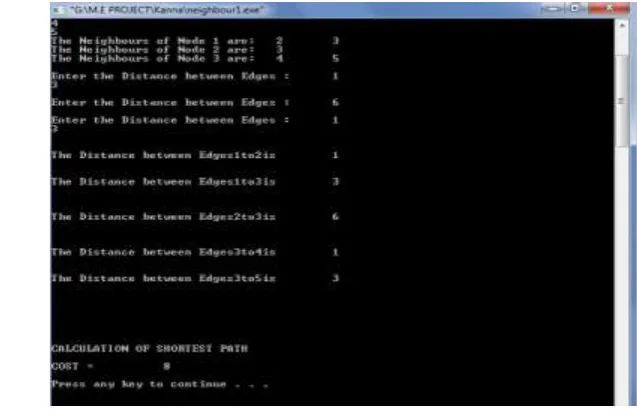
Figure 2: Node Result
Figure 2 shows the Number of nodes results in the given network of the wireless sensor networks.
185 |
P a g e
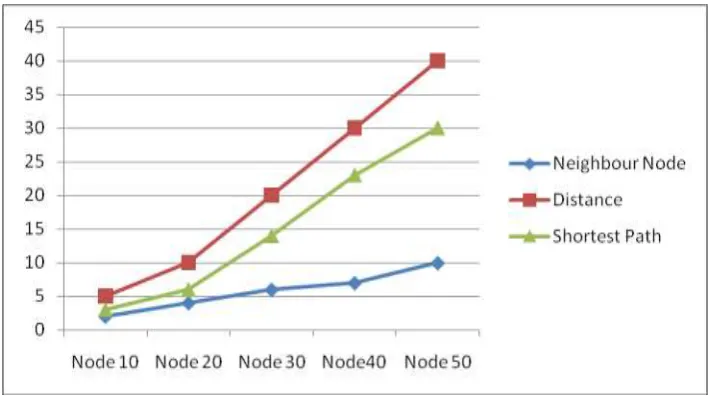
Figure 4: Comparison of Various Nodes
Figure 5: Power Consumption of various Nodes
Figure 3 shows that shortest path of given network based on the distance of the neighbouring node. Figure 4
shows the comparison of various node based on the distance, shortest path and neighbouring node of the given
network. Figure 5 shows that power consumption of various nodes.
VI. CONCLUSION
The proposed system of Transmission power technique is to enhance the lifetime of the entire sensor network.
The eligible sensor nodes are chosen depending on their power levels and association with number of nodes in
186 |
P a g e
accomplished showed that in this technique, sensor nodes utilize extremely less power and stay in the network
for a greater period of time.
REFERENCES
[1] Sorooshyari. S, Gajic Z, “Autonomous Dynamic Power Control for Wireless Networks: User-centric and Network centric consideration”, IEEE Trans. On Wireless Communications. Vol. 7, Issue 3. Pp 1004-1015.
March 2008.
[2] Correia L.T.H.A., Macedo D.F., Silva D.A.C., Santos A.L.D., Loureiro A.A.F. and Noguerira J.M.S.,
“Transmission Power Control in MAC Protocols for Wireless Sensor Networks”, Proc. of the 8th
ACM/IEEE International Symposium on Modelling, Analysis and Simulation of Wireless and Mobile
Systems (MSWiM’05), Montreal, Quebec, Canada, 2005. Pp 282- 289.
[3] Arnab Nandi, Sumit Kundu “On Energy Level Performance of Adaptive Power Based WSN in Presence of Fading” , International Journal of Energy, Information and Communications Vol. 3, Issue 2, May, 2012.
[4] Khemapech I., Miller A. and Duncan I., "A Survey of Transmission Power Control in Wireless Sensor
Networks", Proc. of the 8th Annual Postgraduate symposium on the Convergence of Telecommunications,
Networking and Broadcasting (PGNet 2007). 2007. Pp. 15-20.
[5] Pantazis N.A., Vergados D.D., Miridakis N.I. and Vergados D.J., "Power control schemes in wireless sensor
networks for homecare e-health applications", ACM International Conference Proceeding Series, Athens,
Greece, 2008.
[6] Kayhan Erciyes , Orhan Dagdeviren , Deniz Cokuslu , Deniz Ozsoyeller, “Graph Theoretic Clustering
Algorithms in Mobile Ad hoc Networks and Wireless Sensor Networks - Survey”, Appl. Comput. Math. 6
(2007), no.2, pp.162-180.
[7] Jin Wang, Tinghuai Ma, Qi Liu, Sai Ji, Sungyoung Lee, “A Novel Transmission Power Control Approach for Wireless Sensor Networks”, Sensor Letters, 2012
[8] Martin Kubisch, Holger Karl, Adam Wolisz, Lizhi Charlie Zhong, Jan Rabaey, “Distributed Algorithms for
Transmission Power Control in Wireless Sensor Networks”, proceeding of: IEEE Wireless
Communications and Networking, 2003
[9] Christopher Grin, “Graph Theory” Penn State Math 485 Lecture Notes Version 1.1, 2011-2012
[10] Monika Bathla, Nitin Sharma, “A Review Paper on Topology Control in Wireless Sensor Networks” IJECT
Vol. 2, Issue 2, June 2011
[11] Suman Banerjee, Archan Misra, “Adapting Transmission Power for Optimal Energy Reliable Multi-hop Wireless Communication”, Wireless Optimization Workshop (WiOpt'03), Sophia-Antipolis, France, March
2003.
[12] Niranjan Kumar Ray, Ashok Kumar Turuk, “Energy Efficient Techniques for Wireless Ad Hoc Network”,
[13] Shan Lin, Jingbin Zhang, Gang Zhou, Lin Gu, Tian He, and John A. Stankovic,“ATPC: Adaptive
Transmission Power Control for Wireless Sensor Networks”, SenSys '06 Proceedings of the 4th
187 |
P a g e
[14] S.G.Shirinivas, S.Vetrivel, N.M.Elango “Applications of Graph Theory in Computer Science - An
Overview”, International Journal of Engineering Science and Technology, Vol. 2(9), 2010, 4610-4621
[15] Connectivity and Coverage in Hybrid Wireless Sensor Networks using Dynamic Random Geometric Graph
Model, Author : Jasmine Norman, Vellore Institute of Technology, Vellore – 14, International journal on
applications of graph theory in wireless ad hoc networks and sensor networks (GRAPH-HOC) Vol.3, No.3,
September 2011 .
[16] A New Graph Theory based Routing Protocol for Wireless Sensor Networks, Author : B.Baranidharan,
B.Shanthi, SASTRA University, School of Computing, Thanjavur, India, International journal on
applications of graph theory in wireless ad hoc networks and sensor networks (GRAPH-HOC) Vol.3, No.4,
December 2011.
[17] Bhupendra Gupta , Srikanth K Iyer , D Manjunath , “Topological Properties Of The One Dimensional Exponential Random Geometric Graph”, Random Structures & Algorithms , Volume 32 , Issue 2 , 2008,
pp: 181-204
[18] Chen Avin , “Random Geometric Graphs: An Algorithmic Perspective” , Ph,D dissertation, University of
California , Los Angeles , 2006
[19] Chi-Fu Huang, Yu-Chee Tseng , “The Coverage Problem in a Wireless Sensor Network” ,
WSNA’03,September 19, 2003, San Diego, California, USA.
[20] J. Diaz D. Mitsche X. Pierez-Gimienez , “On the Connectivity of Dynamic Random Geometric Graphs,
Symposium on Discrete Algorithms” , Proceedings of the nineteenth annual ACM-SIAM symposium on