Role Of Ascorbic Acid In Imparting Tolerance To
Plants Against Oxidizing Pollutants
Priyanka Sharma, Reena Jain, ChirashreeGhosh
Abstract: Ascorbic acid is an antioxidant in plants which play important role in activation of many physiological and defense mechanisms. The level of ascorbic acid in plants is determinant of its tolerance against the adverse effect of oxidizing pollutants. The present study tries to relate the variation in ascorbic acid content with the tolerance and sensitivity of two selected plant species viz. Azadirachtaindica and Pongamiapinnata by calculating their Air Pollution Tolerance Index (APTI) during winter season from November to March in the urban city, Delhi, of North India. Moreover, ascorbic acid is also an important part of chloroplast; it protects different components of photosynthetic system from oxidative stress. Thus, to understand the role of ascorbic acid in imparting tolerance to plants against oxidizing pollutants the changes in chlorophyll content of the selected plant species with variation in ambient ozone concentration was analysed. It was found that as per APTI values Azadirachta sp. came under tolerant range with highest ascorbic acid content, whereas, Pongamia sp. was under intermediate range with less ascorbic acid content. It was statistically established, that ozone has no significant relation with chlorophyll content of Azadirachta sp. which has the highest ascorbic acid content. Whereas ambient ozone concentrations showed significant negative relation with the chlorophyll content of Pongamia sp. (p< 0.05). Thus, it was observed that the plants with high ascorbic acid content are tolerant and have greater ability to remediate pollutants.
Key Words: APTI, Ozone, Ascorbic Acid, Chlorophyll,Azadirachtaindica, Pongamiapinnata.Tolerant.
————————————————————
1
I
NTRODUCTIONSince industrialization air pollutants that have entered in the environment has changed the chemistry of atmosphere and adversely affected the health of humans and plants. Different oxidizing pollutants like, NOx¸ SOx and O3 affect
plant at biochemical and physiological level by causing oxidative stress and generation of Reactive oxygen species (ROS).Some plant species are sensitive and some are tolerant to such gaseous pollutants. Some of the gases and pollutants present in the environment are phytotoxic and results in different morphological and physiological deformities in plant. The level of such deformities will be high in sensitive plants and low in tolerant ones. Sensitive species are useful, as early warning indicator of pollution, and the tolerant ones help in reducing the overall pollution load leaving the air relatively free of pollutants [1]. Singh and Rao, [2] have suggested a method of determining Air Pollution Tolerance Index (APTI) by synthesizing the values of four different biochemical parameters i.e. leaf extract pH, ascorbic acid, total chlorophyll and relative water contents [3], [4], [5]. Among all the four parameters ascorbic acid acts as first line of defense against the oxidative stress of pollutants. Ascorbate is present in various organelles like- cytosol, chloroplast, vacuoles, mitochondria and also inside the cell wall [6], [7]. Ascorbic acid is a well known antioxidant and cellular reductant with an intimate and complex role in the response of plant to ozone stress [8], [9].
The effect of oxidative pollutant SO2 on the ascorbic acid
level of three economicaly important crop species Vignaradiata (Mung bean), Lycopersiconesculentum (Tomato) and Zea mays (Maize) was studied and it was recorded that maize crop which maintain high ascorbic acid content under high pollution level exhibited greater resistant to SO2 stress [10]. It was also studied, in both control and
ozone-treated (150 ppb ozone, 5h) leaves that the ascorbic acid pool was approximately two times higher in the ozone resistant Bel B tobacco leaves as compare to the ozone-sensitive Bel W3 leaves [11]. Ascorbic acid impart tolerance to plant by reacting rapidly with superoxide, singlet oxygen, ozone and hydrogen peroxide, thus participating in removal of these ROS which are generated during aerobic metabolism and during exposure to some pollutants and herbicides [12], [13].Thus, the tolerance of plant depends on the amount of Ascorbate present in the plant cellular component which imparts tolerance to plants from the negative effect of oxidative pollutants. With this intend, the present study aims to understand the effect of ascorbic acid level in imparting tolerance or sensitivity to naturalized plants against oxidizing pollution in ambient environment.
2
M
ATERIAL ANDM
ETHODSampling site was selected in urban Delhi in India which has been labeled as most polluted city in the world attributing to its fast paced growth in population and transport sector. Delhi has two major habitat types- 1. Ridge: This is a remnant of dry deciduous forest part of Aravalli hills, one of the oldest mountain range in the world. 2. Riverine: This includes river Yamuna and its fertile flood plain. The study was conducted at Delhi’s northern ridge area. The ridge consists of quartzite rocks which covers nearly, 6000 hectares area. Major vegetation of this area includes Azadiractaindica, Cassia fistula, Delonixregia, Pongamiapinnata, Acacia, etc. The northern ridge is surrounded by two major landuse configurations. The vegetation of this area faces heavy pollution load from its nearby high emitting traffic intersection and mixed cluster (commercial cum institutional area).
————————————————
PriyankaSharma , Environmental Pollution Laboratory, Department of Environmental Studies, University of Delhi, Delhi-110007. E-mail: [email protected]
ReenaJain Department of Chemistry, Hindu College, University of Delhi, Delhi-110007.
2.1BIOMONITORING
The sampling site was situated near the Ridge area and characterized by the similar flora, which is a tropical, thorny and xerophytic in character. Two trees species which were abundant in sampling site were selecte- Azadirachtaindica (Family: Meliaceae, Evergreen tree) and Pongamiapinnata (Family: Fabaceae, Decideous tree) Different physiological and biochemical analysis were carried out to decipher their tolerance and sensitivity level in relation to their ascorbic acid content. Foliar samples were collected during winter month (November to March), to study the monthly variation during this period. Sampling was done twice in a week from November to March. Since, ozone concentration increases during post monsoon month these months were appropriately selected to comprehend the oxidizing effect of O3 on plants. The regular Sampling was done with same plant species and three replicas of each species were taken for the authenticity of the data. To understand their tolerance and adaptive features to the pollution dynamics of that area Air Pollution Tolerance Index (APTI) was calculated. APTI was calculated by using the formula developed by Singh and Rao [2].
APTI = A (T+P) + R 10
Where,
A= Ascorbic acid content of leaf in mg/g fresh wt [14] T= Total chlorophyll content of leaf mg/g fresh wt [15] P = Leaf pH [2]
R= Percent Relative water content [2]
2.2POLLUTION MONITORING
Ozone data was collected from System for Air Quality Forecasting and Research (SAFAR) which is developed by the Indian Institute of Tropical Meteorology, Pune and weather information and forecasting is done by Indian Meteorological Department (IMD), both are constituents of Ministry of Earth Sciences, Govt of India.
2.3DATA ANALYSIS
The statiatical analysis of the data (n=8 for each month) was done by using Statistical package for social sciences (version SPSS 22.0). Parameters were expressed as mean ± S.D. A correlation analysis was done to infer the effect of ambient ozone on chlorophyll content of selected plant species.
3.
R
ESULT ANDD
ISCUSSION3.1 SEASONAL VARIATION IN APTI VALUES- ROLE OF ASCORBIC ACID IN IMPARTING TOLERANCE TO PLANTS
During winter season monthly variation in total chlorophyll content, ascorbic acid and APTI for the three plant samples is given in Table 1. Monthly variation of chlorophyll concentration was quiet distinct due to pollution stress. Among two tree species, A.indica possessed higher concentration of Chlorophyll compared to P.pinnata, which can be supported by various reports [16], [17]. The presence of azadirachtin, an insect repellent in the leaves of A.indica may be responsible for its higher chlorophyll content than the P.pinnata, which is a deciduous tree prone
3.2 VARIATION IN CHLOROPHYLL CONTENT WITH THE AMBIENT O3 CONCENTRATION
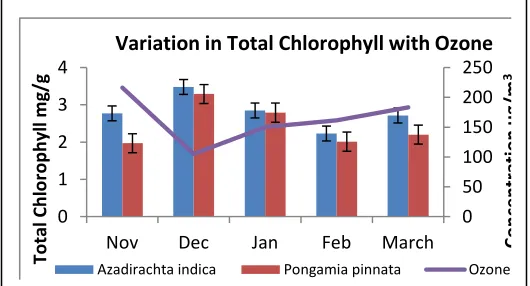
Variation of ambient O3 concentration with the total
chlorophyll content of the two tree species during winter months have been depicted in Figure 1 respectively. In Figure 1, the average concentration of O3 ranged between
5.58µg/m3 – 10.42µg/m3. It can be inferred from the graph, that ozone showed an inverse relation with chlorophyll content of all the two plant species. The major sources of ozone at the sampling site were, the nearby ring road area which is a major traffic intersection zone in sampling site and since the site was near thickly vegetated area, the biogenic VOC’s released from plants like- Mangiferaindica, Dalbergiasisoo, Populus, Morus alba etc. [23, 24] may also play a crucial role in ozone formation of that area. To understand the effect of ozone on the chlorophyll content of selected plant species we establish a statistical relationship between Chlorophyll content and ozone by using correlation analysis and it was clear from the analysis that chlorophyll of Pongamiapinnata significantly (p<0.05; r value = -.882) decreased with increase in ozone concentration in the ambient environment. Whereas, chlorophyll content of Azadirachtaindica did not show any significant relation with ozone dynamics.
Figure 1: Variation in Total chlorophyll with O3
Concentration and correlation analysis.
Ground level O3 has been shown capable of damaging or
inhibiting almost every step of the photosynthetic process from light capture to starch accumulation [25] and also enter leaves via stomata through normal process of gas exchange between leaf and its normal environment. Growing plants are exposed to many interacting biotic and abiotic factors that affect their performance and success
and responses to O3 [26]. One of the common features of
the effect of Ozone on plants is the visible leaf injury. Symptom induced by Ozone can be non-specific, appear as chlorosis, bronzing, diffuse pigmentation or senescence [27, 28, 29, 30]. Rinnan and Holopainen [31] reported the decrease in chloroplast area due to prolong ozone exposure.The result depicts that the plant with high ascorbic acid content are more tolerant and can protects its physiological and molecular functioning even under stress. Gallie and Zhong [19] reported that Ascorbic acid is the most abundant antioxidant in the plants and serves as a major contributor to the cell redox state. However, ozone exposure includes number of biochemical and physiological response. One such response includes the ozone induced antioxidant response. As per Sharma and Davis [32] apoplasticascorbate has been proposed to be the first line of defence against O3 pollution. The study also reported
that when chlorophyll content decreased ascorbic acid content increased. Moreover, when ozone concentration increased in the ambient environment ascorbic acid content also increased in response to rescue vegetation from oxidative stress. Similar results were also reported by Urzica et al [33] that exposure of oxidative stress showed increased ascorbic acid level and gene encoding enzymatic components of ascorbate-glutathione system are also up regulated in response to oxidative stress in Chlamydomonas. Ainsworth [34] reported that with increase in chronic exposure to O3, ascorbate content also increased
in Soyabeans. Interestingly in our study Azadirachtaindica had highest ascorbic acid content and its chlorophyll didn’t show significant effect with ozone whereas, chlorophyll content of Pongamiapinnata showed significant effect with ozone. So, the study clearly indicates that plants with higher ascorbic acid content can with stand higher ambient pollution stress.
4.
C
ONCLUSIONThe study clearly highlights the role of ascorbic acid in imparting tolerance to tree species. Seasonal variation in pollutants affects morphological and physiological structure of plants, specially the components of photosynthetic system. Ascorbic acid in tree species acts as first line defense and helps them to withstand the ill effects of pollutants. APTI study clearly explains that plants with high ascorbic acid content have ability to treat pollutants and are tolerant. Thus, further study should be done to explore the role of such tolerant plants in phytoremediation.
TABLE 1: MONTHLY VARIATION IN TOTAL CHLOROPHYLL CONTENT, ASCORBIC ACID AND APTI
Plant Samples
November December January February March
AzadirachtaIndica
Total chlorophyll content (mg/g) 2.77 ± 0.39 3.48 ± 0.79 2.85 ± 0.78 2.23 ± .06 2.71 ±0.39 Ascorbic Acid (mg/g) 27.58±8.47 22.95±9.58 31.92±7.77 44.47±9.91 40.77±8.24
APTI Value 34.71 31.84 38.79 45.7 46.59
PongamiaPinnata
Total chlorophyll content (mg/g) 1.97 ± 0.60 3.29 ± 0.13 2.79 ± .43 2.01 ± .38 2.2 ± 0.77 Ascorbic Acid (mg/g) 7.29 ±1.69 5.94 ± 2.48 9.2 ± 0.95 21.54±5.32 16.43±1.66
APTI Value 15.02 14.93 17.79 25.71 21.16
0 50 100 150 200 250
0 1 2 3 4
Nov Dec Jan Feb March Co
n
ce
n
tr
ation
u
g/
m
3
To
tal Ch
lo
ro
p
h
yl
l m
g/
g
Variation in Total Chlorophyll with Ozone
A
CKNOWLEDGEMENTThe author would like to thank DrGufranBeig (Indian Institute of Tropical Metreology, Pune) and Dr. S.K Peshin (IndiamMetreological Department, Delhi) for providing us with the useful SAFAR Data. The authors deeply acknowledge the University Grant Commission (UGC) and Delhi University, Research council R&D scheme for providing financial support for the study.
R
EFERENCES[1] Rao DN. Sulphur dioxide pollution versus plant injury with special reference to fumigation and precipitation. Proceedings Symposium on Air Pollution Control. (Indian Association for Air pollution Control), New Delhi, India. 1983; 1:91-96.
[2] Singh SK, Rao DN. Evaluation of plants for their tolerance to air pollution, In:Proceedings Symposium on Air Pollution Control, Indian Association for Air Pollution Control 1983; 1:218-224.
[3] Singh SK. Phytomonitoring of Urban-Industrial Pollutants: A New Approach. Environmental Monitoring and Assessment. 1993; 24, 27-34.
[4] Gaikwad US, Ranade CD, Gadgil JM. Plants as Bio-indicators of Automobile Exhaust Pollution- A Case study of Sangli City. IE(I) Journal-EN. 2006; 86: 26- 28. [5] Jyothi SJ, Jaya DS.Evalution of air pollution tolerance
index of selected plant species along roadsides in Thiruvananthapuram, Kerala.Journal of Environmental Biology.2010; 31: 379-386.
[6] Rautenkranz AAF, Li L, Machler F, Martinoia E, Oertli JJ. Transport of ascorbic and dehydroascorbic acid across protoplast and Vacuole membranes isolated from barley (HardleyVulgare L. cv. Gerbel) leaves. Plant Physiology.1994; 106: 187-193.
[7] Liso R, De Tullio MC, Ciraci S, Balestrini R, La Rocca N, Bruno L, Chiappetta A, Bitonti MB, Bonfante P, Arrigoni O. Localization of ascorbic acid, ascorbic acid oxidase, and glutathione in roots of Cucurbita maxima L. Journal of Experimental Botany. 2004; 55: 2589-2597.
[8] Conklin PN, Barth C. Ascorbic acid, a familiar molecule intertwined in response of plant to ozone, Pathogen and the onset of senescence. Plant Cell and Environment.2004; 8: 959-970.
[9] Romieu I, Castro-Giner F, Kunzli N, Sunyer J. Air pollution, oxidative stress and dietary supplementation: a review. EurRespir J. 2008; 31: 179–196.
[10]Chauhan A. Effect of SO2 on Ascorbic Acid Content in Crop Plants --First Line of Defence against Oxidative Stress. International Journal Of Innovative Research & Development. 2015; 4: 8-13.
[11]Pasqualini S, Battistelli A, Moscatello S, Ederli L, Proietti S, Antonielli M. Effects of Short-term ozone
fumigation on Carbohydrates in darkened tobacco leaves. Plant physiology and Biochemistry.2001; 39: 539-543.
[12]Sharma P, Jha AB, Dubey RS, Pessarakli M. Reactive Oxygen Species, Oxidative Damage, and Antioxidative Defense Mechanism in Plants under Stressful Conditions. Journal of Botany. 2012; Volume 2012: Article ID 217037, 1-26, doi:10.1155/2012/217037. [13]Poljšak B, Rok F. The Protective Role of Antioxidants in
the Defence against ROS/RNS-Mediated Environmental Pollution.Oxidative Medicine and Cellular Longevity. 2014; Volume 2014, Article ID 671539, 1-22.
[14]Law MY, Charles SA, Halliwell B. Glutathione and Ascorbic Acid in spinach (Spinaciaoleracea) Chloroplasts. Biochemistry Journal.1983; 210: 899- 903.
[15]Hiscox JD, Israelstam GF. A method for the Extraction of chlorophyll from leaf tissue without maceration.Can. J. Bot. 1979; 57: 1332-1334.
[16]Nivane SY, Chaudhari PR, Gajghate DG, Tarar JL. Foliar Biochemical Features of Plants as Indicator of Air Pollution. Bull Environ. Contam.Toxicol.2001; 67: 133- 140.
[17]Karthiyayini R, Ponnammal NR, Joseph R. Air Pollution Tolerance Index Of Certain Plants of Coimbatore- Ooty Highways, Near I.T.I Area, Coimbatore, Tamilnadu. Poll Res. 2005; 24(4): 801-803.
[18]Gadallah MAA. Effect of acid mist and Ascorbic acid treatment on the growth stability of leaf membranes, chlorophyll content and some mineral elements of CarthamusTinctorious, The Safflower.Water, Air and Soil Pollution.2000; 118: 311-327.
[19]Gallie DR, Zhong C. DehydroascorbateReductase Affects Leaf Growth, Development and Function. Plant Physiology.2006; 142: 775-787.
[20]Qingzhu LI, Yansu LI, Chaohan LI, Xianchang YU. Enhanced Ascorbic Acid Accumulation through Overexpression of DehydroascorbateReductase Confers Tolerance to Methyl Viologen and Salt Stresses in Tomato. Czech J. Genet.Plant Breed. 2012; 48(2): 74–86.
[21]Singh SK, Rao DN, Agrawal M, Pandey J, Narayan D. Air Pollution Tolerance Index of Plants. Journal of Environmental Management.1991; 32(1): 45-55. [22]Winner WE. The effects of SO2 on Photosynthesis and
[23]Varshney CK, Singh AP. Isoprene emission from Indian trees. Journal Of Geophysical Research. 2003; Vol. 108, NO. D24, 4803, doi:10.1029/2003JD003866. [24]Singh AP, Singh R, Mina U, Singh MP, Varshney CK.
Emissions of monoterpene from tropical Indian plant species and assessment of VOC emission from the forest of Haryana state. Atmospheric Pollution Research. 2011; 2(1): 72–79.
[25]Farage P, Long S, Lechner E, Baker N. The sequence of change within the photosynthetic apparatus of Wheat following short term exposure to Ozone.Plant physiology.1991; 95: 529-535.
[26]Lenka S, Lenka NK. Impact of Tropospheric Ozone on Agroecosystem: An Assessment. Journal of Agricultural Physics. 2012; 12(1): 1-11.
[27]Davison AW, Barnes JD. Effect of Ozone on Wild Plants.New Phytologist.1998; 139: 135-151.
[28]Gu¨nthardt-Goerg MS, Vollenweider P. Linking stress with macroscopic and microscopic leaf response in trees: new diagnostic perspectives. Environmental Pollution.2007; 147: 467-488.
[29]Heath RL. Modification of the Biochemical Pathways of plants induced by Ozone: what are the varied routes to change? Environmental Pollution.2008; 155: 453-463. [30]Borowiak K, Zbierska J, Budka A, Kayzer D. Principal
Component Analysis Of Chlorophyll Content In Tobacco, Bean And Petunia Plants Exposed To Different Tropospheric Ozone Concentrations. CEER. 2014; 12 (1): 5-16.
[31]Rinnan R, Holopainen T. Ozone Effect on the Ultra Structure of Peat Plants: Sphagnum Mosses, Vacciniumoxycoccus, Andromeda Polifolia and Eriophorumvaginatum. Annals of Botany. 2004; 94(4): 623-634.
[32]Sharma YK, Davis KR. The effect of ozone on antioxidant response in plants.Radical biology and Medicine. 1997; 23(3): 480-488.
[33]Urzica EI, Adler LN, Dudley Page M, Linster CL, Arbing MA, Casero D, Pellegrini M, Merchant SS, Clarke SG. Impact of Oxidative stress on Ascorbate Biosynthesis in Chlamydomonas via Regulation of the VTC2 Gene Encoding a GDP-L-galactosePhosphorylase.The Journal of Biological Chemistry.2012; 287: 14234-14245.