IJEDR1704090
International Journal of Engineering Development and Research (
www.ijedr.org
)
573
A Novel Technique for Design and Implementation of
Pattern Recognition Using Soft Computing
1V. Yadaiah,2Dr. R P Singh 1Research Scholar ,2 Research Guide 1SSSUTMS, Sehore,India, 2SSSUTMS, Sehore,India
________________________________________________________________________________________________________
Abstract— This work discussed about novel method for Soft computing has been introduced into medical image processing because it is an effective approach to handle uncertainties inherent in acquired image data. Soft computing approaches include fuzzy logic, neural networks, support vector machines, evolutional computation, probabilistic approaches, and chaos theory. Soft computing can be extended to include bio-informatics aspects using pattern recognition. Fuzzy system can be applied to the construction of more advanced intelligent pattern recognition systems used for industrial aspects.
IndexTerms—Fuzzy Logic, Uncertainty, Probabilistic, Support vector machine
________________________________________________________________________________________________________ INTRODUCTION
There are many traditional methods for pattern recognition which are used intensively. These days, the methodology of artificial neural is very popular. There are many things which needed to be cared in order to design a recognition system. These points are: definition of pattern classes, environment of sensors, representation of patterns, extraction of features, analysis of selection, test samples and their training and finally, the evaluation of performance.
In spite of a lot of research work done, the significant problem of complex patterns and their recognition with accurate location and scale have been unsolved. The pattern recognition techniques are widely used in many other applications such as data mining, face recognition, handwriting recognition etc. and in much more applications. A pattern can be anything. It can be human face, signals of speech, handwritten word etc. The problem of pattern recognition is classifies as classes which are defined by the system designer. The system designer has the full right to specify the needed constraints on the classes. With the advancement of technology, research works are going on inventing new techniques to make the process of data analysis less complex. Since, most of the companies have large databases, so the need of an automatic pattern recognition system is there and engineers are working in that direction. There are primarily three aspects to design a pattern recognition system. These are: pre-processing and acquisition of data, representation of data and decision making. These three components are essential for designing a pattern recognition system. Artificial neural networks are also used for the purpose of pattern recognition. The reason behind popularity of these networks is their capability to learn complex relationships easily and procedural algorithm used by these networks. Feed-forward network is the best type of neural networks which is used quite regularly for pattern recognition. The reason behind the most usage of this feed-forward network is the presence of multi-layer perceptron in it. The architecture of whole network is updated in order to track it by using artificial neural networks. The biggest advantage of using artificial neural networks is that they don’t depend much on the domain-specific knowledge and efficient algorithms used in it for the task of pattern recognition.
A number of special languages have been proposed for the description of patterns such as English and Chinese characters, chromosome images, spark chamber pictures, two-dimensional mathematics, chemical structures, spoken words, and fingerprint patterns. For the purpose of effectively describing high dimensional patterns, high dimensional grammars such as web grammars, graph grammars, tree grammars, and shape grammars have been used for syntactic pattern recognition.
RELATED WORK:
Soft Computing (SC) consists of several computing paradigms, including fuzzy logic, neural networks, and genetic algorithms, which can be used to produce powerful hybrid intelligent systems for solving problems in pattern recognition, time series prediction, intelligent control, robotics and automation. Hybrid intelligent systems that combine several SC techniques are needed due to the complexity and high dimensionality of real-world problems. Hybrid intelligent systems can have different architectures, which have an impact on the efficiency and accuracy of these systems, for this reason it is very important to optimize architecture design. The architectures can combine, in different ways, neural networks, fuzzy logic and genetic algorithms, to achieve the ultimate goal of pattern recognition, time series prediction, intelligent control, or other application areas.
PATTERN RECOGNITION APPLICATIONS
IJEDR1704090
International Journal of Engineering Development and Research (
www.ijedr.org
)
574
Desmond J Maddalena (1998) This review examines the role of soft computing methods such as artificial neural networks (ANNs), genetic algorithms (GAs), fuzzy logic (FL), chaos, fractals and cellular automata (CA) and their hybrids in the field of drug design. They have been found to be useful in a wide variety of areas including quantitative structure-activity relationship (QSAR), quantitative structure-property relationship (QSPR), variable selection, conformation searching, receptor docking, pharmacophore development, molecular design, combinatorial libraries, surface phenomena, kinetics and complex system studies. Based upon the studies examined, the use of soft computing techniques is likely to grow significantly in the future.Scott Starks (2002) This study presents a brief overview of our research in applications of soft computing and interval computations to aerospace problems, with a special emphasis on simulation and modeling.
Mehdi Sotudeh Chafi (2010) We propose a novel soft computing (SC) based approach to design fault detection and isolation (FDI) systems for industrial plants, in particular a highly nonlinear CNC X-axis drive system’s component fault detection. The aim of this study is twofold. One is to present a general description of various concepts such as the novel fuzzy-neuro architecture that uses fuzzy clustering to build a nominal model, fuzzy decision-making subsystems, a central processing unit for estimation of fault location, and finally RBF neural networks to estimate fault size. The other aim is to apply proposed method to diagnosis of component faults of a CNC X-axis drive system amid significant noise levels. Simulation results demonstrate the significance of the proposed approach.
S. Sharma (2012) As the amount of data in medical databases increases, systems for medical data retrieval are growing in popularity. Some of these analyses include inducing propositional rules from databases using many soft techniques, and then using these rules in an expert system. Diagnostic rules and information on features are extracted from clinical databases on diseases of congenital anomaly. This study explains the most current soft computing techniques and some of the adaptive techniques encompassing an extensive group of methods that have been applied in the medical domain and that are used for the discovery of data dependencies, importance of features, patterns in sample data, and feature-space dimensionality reduction. These approaches pave the way for new and interesting avenues of research in medical imaging and represent an important challenge for researchers.
RESULT AND DISCUSSION
Pattern recognition using soft computing (PRSC) solutions are unpredictable, uncertain and between 0 and 1. Pattern recognition using soft computing became a formal area of study in Computer Science in the early 2000s. Earlier computational approaches could model and precisely analyze only relatively simple systems. More complex systems arising in biology, medicine, humanities, management science and similar fields often remained intractable to conventional mathematical and analytical methods. However, it should be pointed out that simplicity and complexity of systems are relative, and many conventional mathematical models have been both challenging and very productive. Pattern recognition using soft computing deals with imprecision, uncertainty, partial truth, and approximation to achieve practicability, robustness and low solution cost. As such it forms the basis of a considerable amount of machine learning techniques. Recent trends tend to involve evolutionary and swarm intelligence based algorithms and bio-inspired computation.
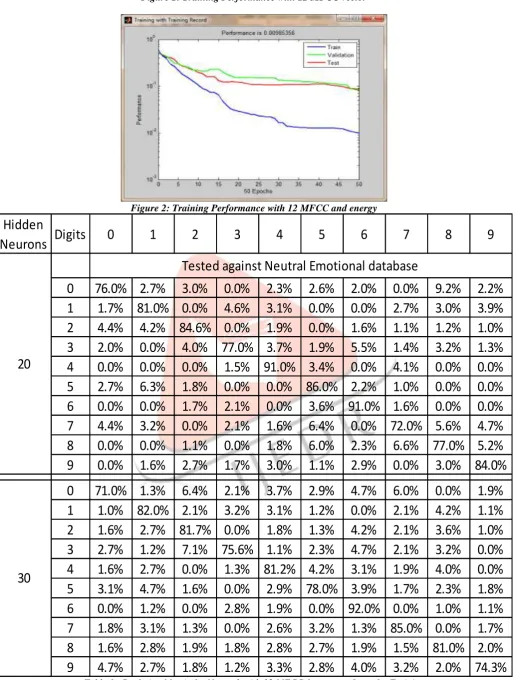
The analysis has been carried on the basis of number of neurons in the hidden layer as well as the number of speech features as input to the network is changed during its training. In the first phase the Input to the network is the 12 MFCC features of each frame of the word .In the second phase along with these energy of each frame is included as the 13th input to the network.
IJEDR1704090
International Journal of Engineering Development and Research (
www.ijedr.org
)
575
Figure 1: Training Performance with 12 MFCC vector
Figure 2: Training Performance with 12 MFCC and energy
Hidden
Neurons
Digits
0
1
2
3
4
5
6
7
8
9
0
76.0% 2.7%
3.0%
0.0%
2.3%
2.6%
2.0%
0.0%
9.2%
2.2%
1
1.7% 81.0% 0.0%
4.6%
3.1%
0.0%
0.0%
2.7%
3.0%
3.9%
2
4.4%
4.2% 84.6% 0.0%
1.9%
0.0%
1.6%
1.1%
1.2%
1.0%
3
2.0%
0.0%
4.0% 77.0% 3.7%
1.9%
5.5%
1.4%
3.2%
1.3%
4
0.0%
0.0%
0.0%
1.5% 91.0% 3.4%
0.0%
4.1%
0.0%
0.0%
5
2.7%
6.3%
1.8%
0.0%
0.0% 86.0% 2.2%
1.0%
0.0%
0.0%
6
0.0%
0.0%
1.7%
2.1%
0.0%
3.6% 91.0% 1.6%
0.0%
0.0%
7
4.4%
3.2%
0.0%
2.1%
1.6%
6.4%
0.0% 72.0% 5.6%
4.7%
8
0.0%
0.0%
1.1%
0.0%
1.8%
6.0%
2.3%
6.6% 77.0% 5.2%
9
0.0%
1.6%
2.7%
1.7%
3.0%
1.1%
2.9%
0.0%
3.0% 84.0%
0
71.0% 1.3%
6.4%
2.1%
3.7%
2.9%
4.7%
6.0%
0.0%
1.9%
1
1.0% 82.0% 2.1%
3.2%
3.1%
1.2%
0.0%
2.1%
4.2%
1.1%
2
1.6%
2.7% 81.7% 0.0%
1.8%
1.3%
4.2%
2.1%
3.6%
1.0%
3
2.7%
1.2%
7.1% 75.6% 1.1%
2.3%
4.7%
2.1%
3.2%
0.0%
4
1.6%
2.7%
0.0%
1.3% 81.2% 4.2%
3.1%
1.9%
4.0%
0.0%
5
3.1%
4.7%
1.6%
0.0%
2.9% 78.0% 3.9%
1.7%
2.3%
1.8%
6
0.0%
1.2%
0.0%
2.8%
1.9%
0.0% 92.0% 0.0%
1.0%
1.1%
7
1.8%
3.1%
1.3%
0.0%
2.6%
3.2%
1.3% 85.0% 0.0%
1.7%
8
1.6%
2.8%
1.9%
1.8%
2.8%
2.7%
1.9%
1.5% 81.0% 2.0%
9
4.7%
2.7%
1.8%
1.2%
3.3%
2.8%
4.0%
3.2%
2.0% 74.3%
Tested against Neutral Emotional database
20
30
Table 1: Confusion Matrix for Network with 12 MFCC features as Input for Training
IJEDR1704090
International Journal of Engineering Development and Research (
www.ijedr.org
)
576
Speech SignalFeatures of an extracted speech signal include the words spoken by the person, pitch, pitch range and mean etc. In this research, we use a word extract method as the most general autocorrelation approach. We extracted a pitch value every 0.1 seconds and we calculated the average of the values defined by pitch mean and variance value was acquired the equal data. We canceled out the noise from our data because noise is a big factor which decreases the efficiency of our system. We obtained the selection number by looking for a concave extreme point of energy after finding a search starting point and ending point of a sentence from pitch contour.
An Emotion Recognition Using Speech Signal
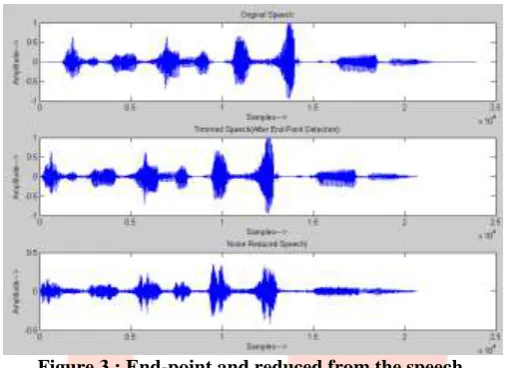
Speech is the primary form of communication used by humans. Along with the linguistic content of speech, the way a word is said is equally important. The tone of the speech contains cues to the emotional state of the person speaking, and we as humans naturally recognize these emotions. When translating using speech recognition systems, emotions are only noise that degrades the performance of the speech recognition systems. To find the emotion from speech we first find the End-point of the speech signal using the Rabiner and Sambur Algorithm, and then we reduce the noise by using the Boll’s algorithm.
Thereafter we separate-out the words from the speech signal, then we calculate the mel-frequency spectrum using the power spectrum. After this we extract the formant using the LPC. The figure 3 shows End point and reduced from speech.
Figure 3 : End-point and reduced from the speech.
SC includes fuzzy logic (FL), neural networks (NNs), and genetic algorithm (GA) methodologies. SC combines these methodologies as FL and NN (FL–NN), NN and GA (NN–GA) and FL and GA (FL–GA). Recent years have witnessed the phenomenal growth of bio-informatics and medical informatics by using computational techniques for interpretation and analysis of biological and medical data. Among the large number of computational techniques used, SC, which incorporates neural networks, evolutionary computation, and fuzzy systems, provides unmatched utility because of its demonstrated strength in handling imprecise information and providing novel solutions to hard problems. Soft computing has been introduced into medical image processing because it is an effective approach to handle uncertainties inherent in acquired image data. Some examples in the past 20 years are fuzzy connectedness approaches to image segmentation, fuzzy clustering methods particularly for human brain MR image segmentation, and statistical atlases and fuzzy models for object recognition and delineation. Soft computing approaches include fuzzy logic, neural networks, support vector machines, evolutional computation, probabilistic approaches, and chaos theory.
CONCLUSION
Soft Computing is dedicated to system solutions based on soft computing techniques. It provides rapid dissemination of important results in soft computing technologies, a fusion of research in evolutionary algorithms and genetic programming, neural science and neural net systems, fuzzy set theory and fuzzy systems, and chaos theory and chaotic systems. Soft Computing encourages the integration of soft computing techniques and tools into both everyday and advanced applications. By linking the ideas and techniques of soft computing with other disciplines, one can serve as a unifying platform that fosters comparisons, extensions, and new applications.
Reference
[1] Hassan et al., Improved SPC chart pattern recognition using statistical features, International Journal of Production Research, 2003, Vol. 41, Issue 7, pp. 1587-1603.
[2] J. David Evans et al., ‘Knowledge Representation and Pattern Recognition Skills of Elite Adult and Youth Soccer Players’, International Journal of Performance Analysis in Sport, 2012, Vol. 12, Issue 1, pp. 208-221.
[3] D. T. PHAM et al., Control chart pattern recognition using learning vector quantization networks, International Journal of Production Research, 1994, Vol. 32, Issue 3, pp. 721-729.
[4] K. Lavine et al., Authentication Of Fuel Spill Standards Using Gas Chromatography/Pattern Recognition Techniques, Analytical Letters, 2001, Vol. 34, Issue 2, pp. 281-293.
IJEDR1704090
International Journal of Engineering Development and Research (
www.ijedr.org
)
577
[6] Jie Zhang et al., Weave pattern recognition by measuring fiber orientation with Fourier transform, The Journal of The TextileInstitute, 2017, Vol. 108, Issue 4, pp. 622-630.
[7] Jingyi Yu et al., Discrimination of Alismatis Rhizoma based on chromatographic fingerprint, multiple components quantification, and pattern recognition analysis, Journal of Liquid Chromatography & Related Technologies, 2016, Vol. 39, Issue 19-20, pp. 861-868.
[8] Naotake Katoh et al., Design of Environmental Monitoring System of Nuclear Facility Based on a Method of Pattern Recognition, Journal of Nuclear Science and Technology 1977, Vol. 14, Issue 10, pp. 737-744.
[9] Jean-Marie Blin† et al., Pattern Recognition in Micro-Economics, Journal of Cybernetics 1973, Vol. 3, Issue 4, pp. 17-27. [10] Angkoon Phinyomark et al., A Review of Control Methods for Electric Power Wheelchairs Based on Electromyography
Signals with Special Emphasis on Pattern Recognition, IETE Technical Review, 2011, Vol. 28, Issue 4, pp.316-326.
[11] T.L. Isenhour et al., Applications of Pattern Recognition to Chemistry, C R C Critical Reviews in Analytical Chemistry, 1974, Vol. 4, Issue 1. pp. 1-44.
[12] Chih-Hsuan Wang et al., Decision tree based control chart pattern recognition, International Journal of Production Research, 2008, Vol. 46, Issue 17, pp. 4889-4901.
[13] R. G. S. Asthana et al., Feature Extraction (Pattern Detection) Methods in Pattern Recognition, IETE Journal of Research, 1973, Vol. 19, Issue 10, pp. 549-554.
[14] Maryam Zahabi et al., Effect of physical workload and modality of information presentation on pattern recognition and navigation task performance by high-fit young males, Ergonomics, 2017, pp. 1-12.
[15] Vengatesan K., Mahajan S.B., Sanjeevikumar P., Kulkarni R.M., Moin S. (2018) Similarity Measurement of Gene Using Arc Tan Function in Gene Ontology. In: Kalam A., Das S., Sharma K. (eds) Advances in Electronics, Communication and Computing. Lecture Notes in Electrical Engineering, vol 443. Springer, Singapore.
[16] Vengatesan K., and S. Selvarajan: Improved T-Cluster based scheme for combination gene scale expression data. International Conference on Radar, Communication and Computing (ICRCC), pp. 131-136. IEEE (2012).
[17] Kalaivanan M., and K. Vengatesan.: Recommendation system based on statistical analysis of ranking from user. International Conference on Information Communication and Embedded Systems (ICICES), pp.479-484, IEEE, (2013).