Integrated Parameter Based BOTNET C & C
Detection For Advanced Traffic Analysis In Wired
Network Technologies
Vinotha R and Seethamani P
Abstract: These days rapid PC organizing and the Internet brought extraordinary comfort,and various security issues likewise developed with the technologies.The Internet is filled up with threats to online security, botnets have gotten one of the most pernicious threats over the Internet. Criminal assaults are propelled from bots. Each Internet-connected PC, including:Personal computers,servers,IOT gadgets and cell phones can be changed into a bot by malware disease.Botnets are being utilized impressively for malware dissemination to target distinctive sectors.Bots are utilized to perform malevolent exercises fluctuating from data taking to utilizing as a take off platform for dispersed assaults. Such programming's gets introduced on client PC without their knowledge.In this, we portray the issue in creating compelling interruption location frameworks for botnet direction and control traffic recognition. Every discovery strategy dissects the system traffic and control correspondences recognition and square the associations.The three detection parameters are initially investigated, these are: Untrusted Destination by Identifier (UDI), malicious SSL certificate, Traffic Flow Causality(TFC). BotDet balances TP and FP rates with 90% and 10% separately.
Index Terms: Bot, Botmaster, malware,command & control server,alert correlation
—————————— ——————————
1
INTRODUCTION
Botnets plays a significant job in cybercrime. A botnet comprises of an enormous gathering of remotely controllable
PCs or bots. The bots are restricted by
using an character or association alluded to as the botmaster. Inspite of the fact that there are some uncommon instances of botnets that perform real errands, most botmasters have noxious targets and send bots only for criminal activities[1]. Without the information or assent of the proprietor, PCs are enrolled as a bot by malware debasement and as such sent in different bad behaviors, for example, DDoS (Distributed Denial of Service) assaults, spam, click coercion, thievery of delicate data, and even advanced dread based mistreatement. The word botnet alludes solely to pernicious botnets. The botmaster communicate with the bots in a unique correspondence framework, alluded to as the C&C (Command and Control) Infrastructure[2]. The botmaster is confined from the ambushing bots by widely appealing PCs or wandering stones that obfuscate the pursue again from discovered bots towards the botmaster by the C&C correspondence. The IoT botnet malware, named 'Mirai', spreads to helpless associated gadgets by consistently filtering the Internet for effectively hackable IoT frameworks secured by hard-coded passwords or factory defaults. It is hard to precisely characterize a botnet. Communication plays a significant job, however the sole capacity of malware to interface with different malignant cases is certifiably not an adequate condition to classify a tainted PC as a bot..Bot infected machines opens a backdoor and wait for the commands issued by attackers[4].
IRC systems are a well known mechanism for controlling bot systems.For Controlling and giving directions to an enormous number of bots one after another an aggressor embraces
different sorts of controlling
instruments.The components covered and the arrangement of directions traded among botnet components is proven in figure 1.
Figure 1: Working of IRC-based Botnet
2
RELATED
WORKS
For distinguishing C and C botnet traffic the two primary methodologies are in the writing. The first relies upon the production of nectar nets in the system [5]. This methodology is routinely used to comprehend and contemplate botnet innovation and quality. In any case, nectar markets are not constantly ready to distinguish bot contamination. The subsequent methodology relies upon the perception of inactive traffic [7].These philosophies can be classified in a steady progression in signature and anamoly based absolutely methodologies.Signature-based identification techniques use the known signature and behavior of existing zombie networks. They can therefore very well be used to identify only known zombie networks . Anomaly-based localization strategies can distinguish dark botnets when they try to identify dependent botnets by organizing traffic irregularities such as ————————————————
• Vinotha R is currently working as an Assistant Professor in the Department of IT, M.Kumarasamy college of engineering, Karur.E-mail:[email protected].
traffic on strange doors,traffic volumes, abnormal behavior of the structure and high inactivity of the system . Discovery methods can still be categorized into host-based totally and network-based totally methods. The host-based totally method detects botnets by using tracking and reading the internal components of a laptop system. while the network-primarily based technique video display units community visitors for botnets. snigger is a signature-based totally IDS [6] which could display and analyze network site visitors to fit recognized botnet signatures. snicker is made of many components that work together to discover malicious styles in traffic. Packets from community interfaces are obtained with the aid of the packet decoder and are ready to be preprocessed or despatched to the detection engine. Then, the applications are checked by unique plug-ins and, if anomalies are detected, the processor triggers an alert. This approach analyzes suspicious flows produced by way of filtering benign visitors from visitors created via a number. A ordinary host traffic profile is used for the purpose of filtering. The non-public behavior widespread of flows to dreams is inspected in an offer to create the host seasoned file.This approach completed a region rate of 100% and bogus positives of 8%. It present a number-based totally detection approach geared up to distinguish the presence of botnet c&c traffic at the watched tool, and moreover installation the shape of c&c correspondence used by the bot,e.g.,peer-to-peer(p2p) based totally, http-based totally or irc-based totally.as it does not look at the packet payloads, their identification method is free of the substance of the C&C messages[8]. Their approach for figuring out and sorting botnet C&C associations relies upon on three theories: (1) it's far conceivable to understand
botnet C&C correspondence and botnet non-C&C
correspondence, (2) it's miles practicable to apprehend botnet C&C correspondence and legitimate correspondence and (three) there are shared characteristics between diverse sorts of C&C and exclusive botnet families.
3 PROPOSED
WORK
3.1 BOTNET DESIGN AND SPECIFICATION
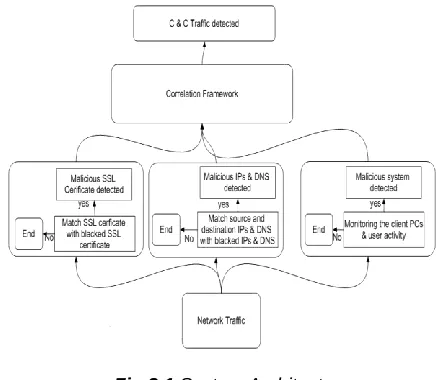
Botnet Detection has these basic steps. The first step includes four modules to recognize the different procedures used in C&C botnet communications. The next phase requires the use of a structure for an easy relationship, in order to vote between the individual recognition forms. The proposed method for detecting C&C botnet traffic is described.This methodology depends on the connection between's the occasions, which are the yields of the discovery modules.The proposed
approach comprises of two fundamental stages
correspondence. To this end,three identification modules have been proposed:Botnet C&C by SSL endorsement recognition module, Botnet C and C by untrusted goals location module and Botnet C&C by causal investigation of traffic streams discovery module Each recognition module is free of different modules and means to identify one system that can be utilized in C and C correspondence. The yields of these discovery modules ought to be submitted to the second stage where they are connected to raise a caution and square on botnet C&C traffic recognition. In the subsequent stage, the correlation structure takes occasions (the yields of our discovery modules) as an info and correlates them to raise a
caution and block on botnet C and C traffic detection. The correlation strategy depends on casting a ballot between the recognition techniques to settle on an official choice about the location. A portion of the recognition modules are boycott based, where a portion of these boycotts are openly distributed or secretly kept up. Data on various insight encourages without a moment's delay is utilized to naturally refresh every utilized boycott inside BotDet.
Fig 3.1 System Architecture
3.2 BOTNET C & C DETECTION BY IP ADDRESS
The module distinguishes an association between a contaminated host and a C and C server. The discovery module is based on a blacklist of malicious IP addresses from C&C servers, network traffic is processed and the source and destination IP addresses of each connection. correspond to the IP blacklist. The blacklist is automatically updated daily based on different information flows and detection is in real time. MIPD checks both sides of the association that IP provides to distinguish whether the association is to or from malicious IP. In general, we can write the algorithm as:
Input : Message from NN; for each new flow NN_IP do Read the NN_IP; X= NN_IP;
if X.equals.BOTN_IP X.Status=ANOMALOUS; signalAnomaly(X ); Show(x);
else
X.Status= getStatusOfAssociatedFlow(X); if X.Status=NORMAL
then
extractForwardReferences(X); endif
Fig 3.2 Botnet Detection by using IP Address
3.3 BOTNET C & C DETECTION BY DNS
A regular system used for C&C communication is the domain flow procedure, in which each contaminated machine independently uses a domain generation algorithm (DGA) to produce an overview of domain names [9].To avert tainted has from refreshing their malware, law requirement needs to preregister every one of the areas that a contaminated host inquiries consistently before the botnet proprietor registers them. This module distinguishes algorithmically produced area motion. The contaminated host inquiries for the presence of countless areas, while the proprietor needs to enlist just one. finally, this strategy activates massive numbers of dns inquiry disappointments when you consider that now not these place names are enlisted.Likewise, this strategy prompts an impressive parcel of DNS request disillusionments in light of the fact that not these territory names are enrolled. The distinguishing proof module relies upon DNS question disappointments originating from Domain-flux procedure. In general, we can write the algorithm as:
Input : Message from NN; for each new flow NN_DNS do Read the NN_DNS; Y= NN_IP;
If Y.eqauls.BOTDNS; Y .Status = ANOMALOUS; signalAnomaly(Y ); Show(x);
else
Y .Status = getStatusOfAssociatedFlow(Y); if Y .Status = NORMAL
then extractForwardReferences(Y); end if
end if end for
Fig 3.3 Botnet Detection by using DNS
3.4 BOTNET C & C DETECTION BY SSL CERTIFICATE
This identity module relies upon on a blacklist of malignant
SSL certificates.This boycott contains of sorts of SSL
declarations, SHA1 fingerprints and serial & situation of awful SSL
endorsements which are associated with malware and
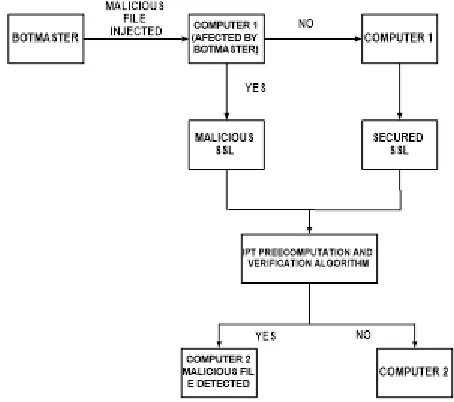
botnet sporting activities,the system traffic is prepared and every protected association are separated, and afterward the SSL testament utilized in each safe association is coordinated with SSL authentication boycott[3]. The blacklist is automatically up to date primarily based on specific intelligence and the detection is in real time. C&C trades are for the maximum component assured through at ease Sockets Layer (SSL) encryption, making it hard to perceive if the traffic is dangerous.
Fig.3.4 Botnet Detection by using SSL Certificate
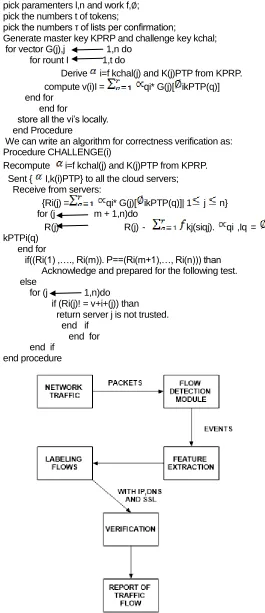
3.5 BOTNET C & C DETECTION BY CAUSAL ANALYSIS OF TRAFFIC FLOWS
Procedure
pick paramenters l,n and work f,∅; pick the numbers t of tokens;
pick the numbers τ of lists per confirmation;
Generate master key KPRP and challenge key kchal; for vector G(j),j 1,n do
for rount I 1,t do
Derive i=f kchal(j) and K(j)PTP from KPRP. compute v(i)I = qi* G(j)[ ikPTP(q)] end for
end for
store all the vi’s locally. end Procedure
We can write an algorithm for correctness verification as: Procedure CHALLENGE(i)
Recompute i=f kchal(j) and K(j)PTP from KPRP.
Sent { I,k(i)PTP} to all the cloud servers; Receive from servers:
{Ri(j) = qi* G(j)[ ikPTP(q)]| 1 j n}
for (j m + 1,n)do
R(j) R(j) - kj(siqj). qi ,Iq = kPTPi(q)
end for
if((Ri(1) ,…., Ri(m)). P==(Ri(m+1),…, Ri(n))) than Acknowledge and prepared for the following test. else
for (j 1,n)do if (Ri(j)! = v+i+(j)) than return server j is not trusted. end if
end for end if
end procedure
Fig 3.5 Botnet C & C Detection By Causal Analysis Of Traffic Flows
4.
EVALUATION
RESULTS
The invention modules have been configured to deplete the pcap files and bring log files. At that factor CF changed into applied to correspond the character modules' alarms to recognize C&C interchanges. outcomes from singular modules and CF were tantamount to the floor reality, and the estimations of genuine Positivity rate and fake Positivity rate were determined. regardless of the truth that the connection depending on one popularity module has the most extended TP, it likewise has the maximum elevated FP. The pleasant effects are for the relationship dependent on region modules, with TP of ninety% and FP of 10%.
5.CONCLUSION
AND
FUTURE
ENHANCEMENT
Malware keeps on running far reaching over the Internet, and among the numerous structures that advanced malware can expect, botnets speak to perhaps the gravest risk to Internet security. Through the huge scale bargain of helpless end has, botmasters can both abuse the secrecy of delicate client data for example, banking or interpersonal organization confirmation accreditations just as influence gatherings of bots as an underground computational stage for performing other unlawful exercises. The proposed methodology is based four location modules to raise an alarm and square on C&C traffic discovery. Every location module forms the system traffic and plans to distinguish one procedure utilized for C&C correspondences. It is accepted that the open door for utilizing this methodology in C&C traffic discovery would exceptionally diminish the bogus positive
pace of the location framework.
As destiny work, more acknowledgment modules will be
added to understand numerous techniques utilized in botnet C&C
trades.also, cautions from outer IDSs despatched on
the system can be gotten and bolstered into BotDet, that
may at last lessen the artificial wonderful tempo of the framework.
6
REFERENCES
[1] Lange, T., & Kettani, H. (2019). On security threats of botnets to cyber systems. Proceedings of the International Conference on Signal Processing and Integrated Networks (SPIN 2019), Noida, India, 473-480. Piscataway, NJ: IEEE.
[2] S.Belguith,N.Kaaniche,M.Laurent,A.Jemai,andR.Attia,‘‘PH OABE: Securely outsourcing multi-authority attribute based encryption with policy hidden for cloud assisted IoT,’’ Comput. Netw., vol. 133, pp. 141–156, 2018.
[3] I. Ghafir, V. Prenosil, M. Hammoudeh, L. Han, and U. Raza, ‘‘Malicious SSL certificate detection: A step towards advanced persistent threat defence,’’ in Proc. Int. Conf. Future Netw. Distrib. Syst., 2017, p. 27.
[4] S. Belguith, N. Kaaniche, A. Jemai, M. Laurent, and R. Attia, ‘‘PAbAC: A privacy preserving attribute based framework for fine grained access control in clouds,’’ in Proc. 13th Int. Joint Conf. e-Bus. Telecommun., 2016, pp. 133–146.
[5] S. García, A. Zunino, and M. Campo, ‘‘Survey on network-based botnet detection methods,’’ Secur. Commun. Netw., vol. 7, no. 5, pp. 878–903, 2014.
[6] P. Agarwal and S. Satapathy, ‘‘Implementation of
windows,’’Int.J.Innov.Adv.Comput.Sci.,vol.3, no. 3, May 2014
[7] S. Kumar, R. Sehgal, P. Singh, and A. Chaudhary. (2013). ‘‘Nepenthes honeypots based botnet detection.’’ [Online]. Available: https://arxiv.org/abs/1303.3071
[8] G. Fedynyshyn, M. C. Chuah, and G. Tan, ‘‘Detection and
classification of different botnet C&C channels,’’ in Autonomic and Trusted Computing (Lecture Notes in Computer Science), vol. 6906, J. M. A. Calero, L. T. Yang, F. G. Mármol, L. J. G. Villalba, A. X. Li, and Y. Wang, Eds. Berlin, Germany: Springer, 2011