30 _____________________
Moth Moth Myint Thein, Chaw Myat Nweand Hla Myo Tun
Department of Electronic Engineering, Mandalay Technological University, Mandalay
Students’ Attendance Management System Based
On RFID And Fingerprint Reader
Moth Moth Myint Thein, Chaw Myat Nweand Hla Myo Tun
Abstract: Today students’ (class) attendance is become more important part for any organizations/institutions. The conventional method of taking attendance by calling names or signing on paper is very time consuming and insecure, hence inefficient. This paper presents the manual students’ attendance management into computerized system for convenience or data reliability. So, the system is developed by the integration of ubiquitous computing systems into classroom for managing the students’ attendance using RFID and fingerprint reader. The system is designed to implement an attendance management system based on RFID and fingerprint reader which students need to use their student identification card ID and their finger ID to success the attendance where only authentic student can be recorded the attendance during the class. In this system, passive RFID tag and reader pairs are used to register the student ID cards individually, and fingerprint reader is used for attendance. This system takes attendance electronically with the help of the RFID and finger print device, and the records of the attendance are stored in a database. Students’ roll call percentages and their details are easily seenvia Graphical User Interface (GUI). This system will have the required databases for students’ attendance, teachers, subjects and students' details. This application is implemented by Microsoft Visual Studio and Microsoft SQL Server as IDE. C# language is used to implement this system.
Keywords: RFID Tag and Reader, fingerprint reader, Microsoft Visual Studio, Database
————————————————————
I.
I
NTRODUCTIONAttendance management is the act of managing attendance or presence in a work setting to minimize loss due to employee downtime. Attendance control has traditionally been approached using time clocks and timesheets, but attendance management goes beyond this to provide a working environment which maximizes and motivates employee attendance [10].The existing conventional attendance system requires students to manually sign the attendance sheetevery time they attend a class. As common as it seems, such system lacks automation, where a number of problems may arise. This includes the time unnecessarily consumed by the students to find and sign their name on the attendance sheet; some students may mistakenly or purposely sign another student's name. Also, the attendance sheet may get misplaced [1].As for system development and implementation, it should be able to help the lecturers to managing their student attendance systematically. The system must have database that contains student information and it must be able to help lecturer to manipulate data, update database, alert lecturers accordingly, and also nice interface to make it easier to use. Finally, the attendance system must be user friendly for commercial purpose. This system will focus on MTU regulation about attendance to class, and implement it to develop the system that will do all the attendance management automatically. By using RFID technology, it is easier and faster to detect students handling at that time and reduce assets losses. In this system the fingerprint recognition is also adopted to enable the process of identifying of student more reliable and secure for facilities management. RFID and fingerprint based attendance management system was developed to provide a faster, more secure, and more convenient method of user verification than passwords and tokens can provide for a reliable personal identification.
II.
S
YSTEMD
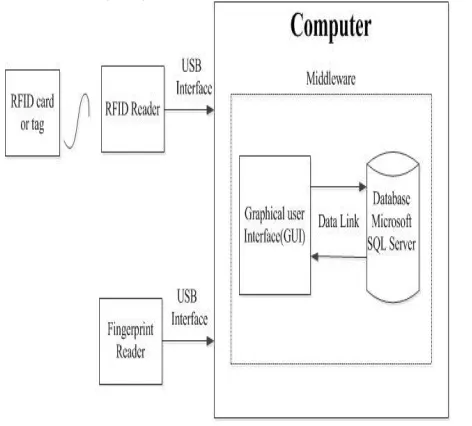
ESIGN32 ID, and his/her finger must press on fingerprint reader. These
RFID tag and fingerprint data send to a PC with a connected RFID-reader and fingerprint reader. The PC, in turn, sends all the data it has collected to the server database form Graphical User Interface (GUI).
Fig 1: Block Diagram of the Student Attendance System
III.
S
YSTEMA
RCHITECTUREA. CR10M RFID Reader
In this system, CR10MRFID reader is used.The RFID reader communicates with the RFID tag via radio waves and passes the information in digital form to a computer system. A reader contains an RF module, which acts as a transceiver of radio frequency signals. RFID reader receives RF transmissions from an RFID device and transmits to a host system for processing. The reader is a device that has one or more antennas that emit radio waves and receive signals back from the tag.
Fig 2: CR10M RFID Reader
Specifications of CR10M RFID Reader Frequency : 13.56 MHZ
Read Range : Up to 10 cm / Up to 5 cm Communication : USB Host
Operating temperature : -10˚C to +70˚C Power / Current:USB 5V DC/Max. 100mA
Features : Audible Buzzer, LED Green and Red
B.RFID Passive tag
Fig 3: Passive RFID Tag
A passive RFIDtag without a battery. When radio waves from the reader reach the chip’s antenna, it creates a magnetic field. The tag draws power from the field and is able to send back information stored on the chip. Passive tag collect’s hundreds of tags within 3 meters from a single reader and then it collects 20 tags moving at 3 mph or slower.
C. ZK 4500 Fingerprint Reader
Fingerprint reader which captures the image and a personal computer which: houses the database, runs the comparison algorithm and simulates the application function. The fingerprint scanner is connected to the computer via its USB interface. Basically this work does not involve the development of hardware. Using the ZK4500 Fingerprint Reader, the ZKFinger Software Development Kit (SDK) toolbox provided by the ZK finger SDK development Guide (will explain the detail) can be used as an interface between the fingerprint reader and the attendance software.
Fig 4: ZK4500 Fingerprint Reader
Specifications of ZK4500 Fingerprint Reader
Fingerprint Sensor- ZK4500 optical sensor(no film) Resolution- 500 DPI/ 256 gray
Sensing Area-15 x 8 mm Image Size-280 x 360 pixel Interface- USB 1.1 / 2.0
Operating Temperature-0-55.C / 32.-131.F Operating Humidity-20%-80%
USB Cable -150 cm Weight – 0.24kg
Dimension (W x H x D)-53 x 80 x 66 mm
D. Host Computer
33 any network is most often a PC or a workstation running
database or application software, or a network of these machines [4].
E. Middleware
The middleware is an interface required to manage the flow of data from the reader and to transmit it efficiently to the backend database management systems. The middleware monitors the number of tags present in the system and extracts relevant information from the readers [8].
F. Backend Database
The backend database primarily deals with the storage of relevant information recorded by the reader and communicated by the middleware. For example, the middleware in an automated security control system will store all tag readings taken by the reader in the database. This helps create log entries for the system [9].
IV. Software Design
To complete this system, the choosing of software for database and type of RFID and fingerprint reader are very important. The Microsoft SQL Server 2012is used for database and Microsoft Visual Studio 2012is used for GUI design. The C sharp language is used to implement the system. The C# language is familiar with many users and suitable for GUI design.
A. Microsoft Visual Studio
Microsoft Visual Studio is an integrated development environment (IDE) from Microsoft. It is used to develop computer programs for Microsoft Windows superfamily of operating systems, as well as web sites, web applications and web services. Visual Studio uses Microsoft software development platforms such as Windows API, Windows Forms applications, Windows Presentation Foundation and Windows Store. This IDE can connect with database by using query language. The C# language is used to write the program.
B. Microsoft SQL Server
Microsoft SQL Server is a relational database management system developed by Microsoft. As a database, it is a software product whose primary function is to store and retrieve data as requested by other software applications, be it those on the same computer or those running on another computer across a network (including the Internet).
C. C# language
C sharp is a programming language that is designed for building a variety of applications that run on the .NET Framework. C# is simple, powerful, type-safe, and object-oriented. The many innovations in C# enable rapid application development while retaining the expressiveness and elegance of C-style languages.
D. Flowchart of the system
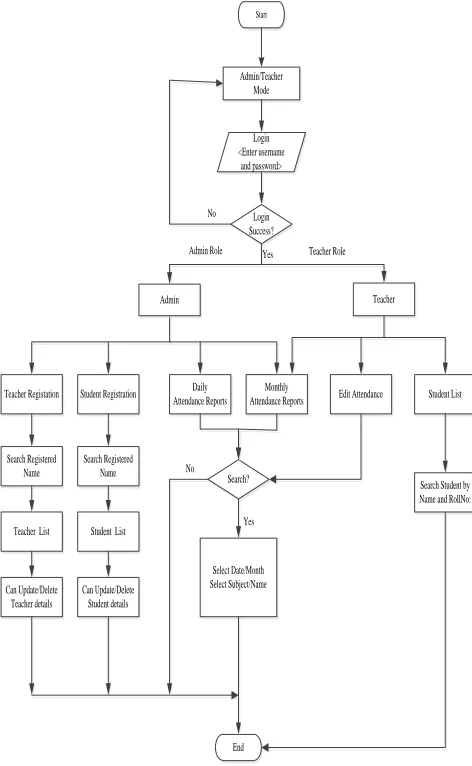
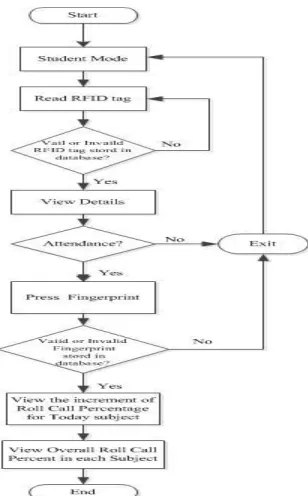
The system can be recognized easily by seeing the flow chart of the overall system shown in figure 5 and 6. This system is used by two categories of people mainly admin\teacher and student. Firstly in this system, admin and teacher must use admin/teacher mode and student must use student mode. Admin/Teacher needs to create own username and password
to log in this system. If admin/teacher inputs the username and password wrongly, the login program will not success and neither admin page nor teacher page will not display by the system. Either admin’s page or teacher’s page will appear for the correct name and password. Therefore, admin/teacher needs to key in the correct username and password to access this system. This system will identify admin/teacher according to their username and password. When admin/teacher enters from admin/teacher mode, admin can make teacher and student registration. Moreover, admin can update and delete teacher/student profiles. Admin/teacher can also be seen students list and daily/monthly attendance reports selected by student name, date and month. When students enter from student mode, system will take their RFID tag from RFID reader. If student’s ID tag number is valid stored in database, system will show their details. Then,if students want to get attendance for lecture, they need to press their finger on fingerprint reader. If these card ID and finger ID are matched with data stored in database, student will get roll call percentage for today subject. After attendance, students’ attendance will be shown in teacher screen. Here, if student clear off after pressing finger on fingerprint reader, teacher can erase his/her attendance. Moreover, students can also be seen their overall roll call percentages in each subject.
Start Admin/Teacher Mode Login <Enter username and password> Login Success? Teacher
Teacher Registation Student Registration Daily Attendance Reports
Monthly Attendance Reports
Search Registered Name
Teacher List
Can Update/Delete Teacher details
Search Registered Name
Student List
Can Update/Delete Student details Search? Select Date/Month Select Subject/Name Student List
Search Student by Name and RollNo:
End Yes
Yes
Admin Role Teacher Role No
No Admin
Edit Attendance
34 Fig 6: Flowchart for the Student Attendance System
V.
E
XPERIMENTALR
ESULTIn this experiment, ZK 4500 fingerprint reader, passive RFID tag and reader pairs are used. The host computer with Microsoft Visual Studio and SQL Server are also needed. The GUI design and the result are shown in fig 7 to 21 as follows.
Fig 7: Main page of Students’ Attendance Management System
In this page, admin/teacher must use admin/teacher mode and student must also use student mode for entering in this system.
Fig 8: Login Screen for admin and teacher
Admin/Teacher needs to create own username and password to log in this system. This system will identify admin/teacher according to their username and password. Therefore, the admin/teacher needs to key in the correct username and password to access this system.Admin may register to every student with RFID card ID and finger ID. At this position, the user needs to press finger three times. These registered ID number save in SQL server database shown in figure 9and 10.
35 Fig 10: Student Card ID and Finger ID database
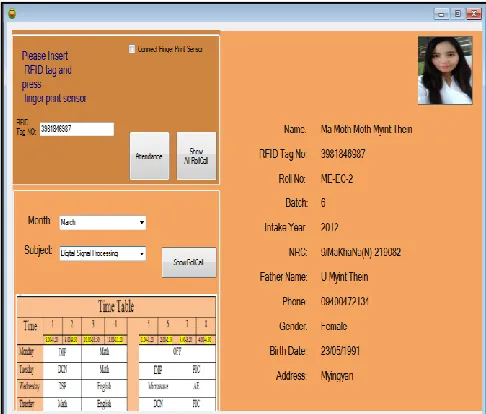
For attendance, student RFID card ID firstly read from RFID reader. According to their RFID card ID that have stored in database, system will show student details. Then student mustconnect fingerprint sensor for attend the lecture. For verification, student must press his/her finger on fingerprint reader. If these RFID card ID and finger ID are valid, student will get roll call percentage for today subject .Moreover student can also be seen all roll call percentages in each subject from Show AllRollCall button. These attendance steps are shown in step by step as following figure11 to 15.
Fig 11: Student Attendance Step1
Fig 12: Student Attendance Step2
Fig 13: Student Attendance Step3
36 Fig 15: Stduent Rol l Call percentage
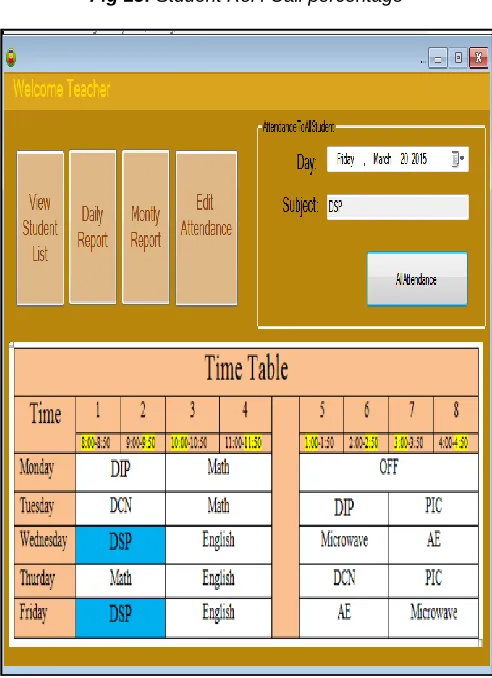
Fig 16: Teacher screen
Fig 17: Edit Attendance
Fig 18: Modify Edit Attendance
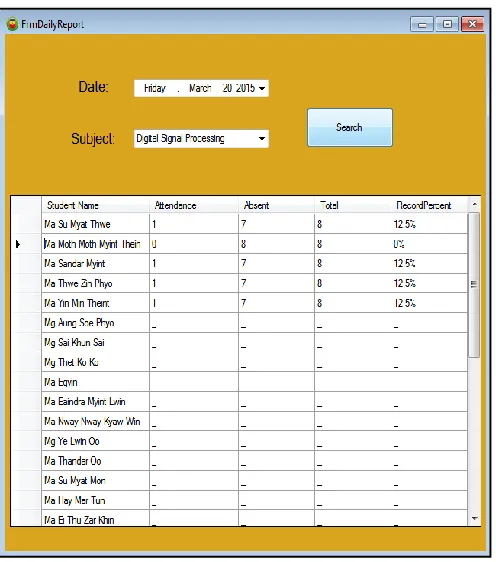
37 Fig 19: Daily Report before Edit Attendance
Fig 20: Daily Report after Edit Attendance
Figure 19 and 20 are comparison of students’ daily reports in attendance. Here, we attend lecture by 5 students. So, 5 students’ daily reports are shown in GUI. Admin and teacher can search student’s daily reports by selecting date and subject. Moreover, admin and teacher can only be seen monthly reports by selecting month and subject shown in Figure20 and 21.
Fig 21: Monthly Report after Edit Attendance
VI. C
ONCLUSIONSIn conclusion, this system mainly reviewed the research and development work with the help of passive RFID and ZK fingerprint reader. By developing this system, the knowledge of RFID and fingerprint reader system, the database construction, and GUI design using C# language are realized. In terms of performance and efficiency, this system has provided a convenient method of attendance marking compared to the traditional method of attendance system. By using databases, the data is more organized. Thus, it can be implemented in either an academic institution or in organizations. For this system, passive tags are better than the active tags because of low cost, low power consumption and also radio signals environmental factors. From a proper analysis of positive points and constraints on the component, this system can be safely concluded that the product is a highly efficient GUI based component. This application is working properly and meeting to all user requirements.
.
A
CKNOWLEDGMENTThe author would like to thank her supervisor, head and all of her teachers from Department of Electronic Engineering, Mandalay Technological University who gave good suggestions, guidance and supervision for supporting this research.
R
EFERENCES[1] Ononiwu G, Chiagozie, Okorafor G. Awaji. ―Radio Frequency Identification (RFID) Based Attendance System with Automatic Door Unit‖. In Academic Research International, ISSNL-L: 2223-9553. 2012; 2(2). http://wwhw.slais.ubc.ca/courses/libr500/04-05- wt2/www/A Farrell/HowDoesRFIDWork.htm
38 [3] Mohd Firdaus Bin Mahyidin. ―Student Attendance
Using RFID System‖ in University Malaysia, Pahang, May-2008. www.hbeconlab.com
[4] Longe O.O.(2009),‖Implementation of Student Attendance System using RFID Technology‖, B. Tech Project Report,LadokeAkintola University of Technology, Ogbomosho, Niger.
[5] V. Daniel Hunt, Albert Puglia, Mike Puglia. RFID-A Guide to Radio Frequency Identification. Wiley-Interscience. 2007. R. Want, ―Enabling Ubiquitous Sensing with RFID,‖ Computer, vol.37, no. 4, 2004, pp. 84–86.
[6] J. Schwieren1, G. Vasse, ―A Design and Development Methodology for Mobile RFID Applications based on the ID-Services Middleware Architecture‖, IEEE Computer Society, (2009), Tenth International Conference on Mobile Data Management: Systems, Service and Middleware.