4143 IJSTR©2020
Android-Based Comic Of Biotechnology For
Senior High School Students
Anjar Putro Utomo, Tika Restu Amalia, Mochammad Iqbal, Erlia Narulita
Abstract: Thepurpose of this study is to develop a valid comic based android on biotechnology topics for senior high school students of class XII. Its development uses the ADDIE model, which consists of five stages, namely analysis, design, development, implementation, and evaluation. The construction is carried out until the implementation stage only while the evaluation phase is not carried out. It's assessment implements validity testing by expert validators, readability tests and difficulty levels by 24 students, and user responses by teachers and students. As a consequent, the result showed a valid range with an average of 89.17% that is comic based android on biotechnology topics could be classified and directly used in the learning activities. Besides, the readability test and the level of difficulty indicated that this learning media could be classified as valid, with an average of 82.61%. All of those results stated that teachers and students as a user give a positive response to the learning media with an average of 89.17%. As a conclusion, comic based android on biotechnology topics are valid and ready to use in the learning process.
Keywords: Comics based on Android, validity, legibility, and level of difficulty, biotechnology
—————————— ——————————
1 INTRODUCTION
Significant technology development has a positive impact on life without exception in the field of education [10]. The technology usage can improve the achievement of instructional goals on education by implementing it to modify magnetic learning media [9]. Learning media serves as a tool to transfer messages in the form of knowledge from the teacher to the students [2]. The developed learning media is adjusted to the character of students so that students are more easily understood the material [2]. High school students now belong to the Z generation who are adept at using gadgets and gadget addicted [14]. The internet can be accessed freely at the same time; it hurts unresponsible usage [8]. Based on the results of the preliminary research questionnaire, out of 15 students who filled out the questionnaire, 60% of students use the smartphone for more than 4 hours. Students often access social media and browsing the internet on their smartphones. Consequently, students have smartphone experience dependency, which is difficult to escape from the gadget in their daily life. Thus this fact can be fundamental reason to develope an android based learning media, which is generally more attractive to students [14]. Android is easily accessible and rapidly expanding operating systems supporting application programs on smartphones [14]. In the context of Biology, Biotechnology has rapid growth along with the development of technology [18]. But there is no renewal biotechnology teaching and learning material in the schools particularly in Indonesia. Thus, students cannot fully understand as well as gain the new insight about development of Biotechnology — besides, the lack of expertise and experience possessed by teachers related to biotechnology topic because the teaching material is less attractive [25]. Based on the results of interviews with biology teachers, it is known that biotechnology materials, especially modern biotechnology,
have more specific and applicative material levels. The use of inappropriate media can cause misconception of the student to understand the concepts. It takes media that can visualize material to be more easily understood, namely by using interactive Biotechnology comic. The use of images can be used as a representation of an object in overcoming the boundaries of space and time from objects or events that are difficult to display in the classroom [7]. This study discusses the related biotechnology material visualized in Android-based comics.
2 RESEARCH METHODOLOGY
Development of this learning media using the ADDIE model (analysis, design, development, implementation, and evaluation) developed by [15].
2.1 Procedure of Research
1. Analysis Phase consisted of a) Need analysis conducted by interviews with XII grade biology teacher; b) Analysis of student characteristics, questionnaires distributed to students; c) Curriculum analysis, consisting of competency analysis to find out the essential competencies of biotechnology material; and d) Instructional analysis to find out indicators of learning. 2. Design Phase
a) Compilation of the media framework, consisting of determining biotechnology material in the media and media framework in the form of Android application design, characters, as well as dialogue scripts. b) Determination of Systematics, determine the layout
of images, text, along with the storyline.
c) Compilation of Assessment Instruments and rubrics for validators. This step makes readability, difficulty level, and a user response questionnaire either. 3. Development Phase
a) Preparation of Learning Media, design and draw a
storyboard manually. Then it is scanned to finish draft 1 of android application.
b) Assessment by experts carried out through validity testing by expert validators.
c) Revised Draft 1, revisions are made toward the media after the validator assessed draft one.
————————————————
Anjar Putro Utomo Science Education, Junior Lecturer, University of Jember, 68121. E-mail: [email protected] Tika Reatu Amalia Biology Education, Fresh Graduate, University of
Jember, 68121. E-mail: [email protected]
Mochammad Iqbal Biology Education, Senior Lecturer, University of Jember, 68121. Email: [email protected]
4144 4. Implementation Phase
This phase is a limited scale trial of 24 science students of Grade XII by filling out the readability, the level of difficulty, and user response questionnaire. Media assessment is also carried out by biology teacher class XII as a user.
2.2 Data Collection Techniques
Data were obtained from the results of interviews with biology teachers, questionnaires to students, and validation instruments for expert validators. Assessment by validators, teachers, and students serves as a reference for improving the media [23].
2.3 Data Analysis
1. ADDIE Model Development Results
Analysis of media development results outlines each step that has been carried out, which refers to the ADDIE development model.
2. Analysis of Validation Results, Readability Test and Difficulty Level, and Teacher Response
Assessment for validation test, readability test and level of difficulty, and teacher responses using a Likert scale with several categories (Table 1)
Table 1 Likert Scale Category Score
Excellent 4
Good 3
Less Good 2
Not Good 1
The average score of the evaluation of the developed media is obtained using the following formula:
P = Remarks:
P : percentage of total score
: Number of scores obtained for i aspect
: Number of maximum scores for i aspect
i : 1, 2, 3, ……., N
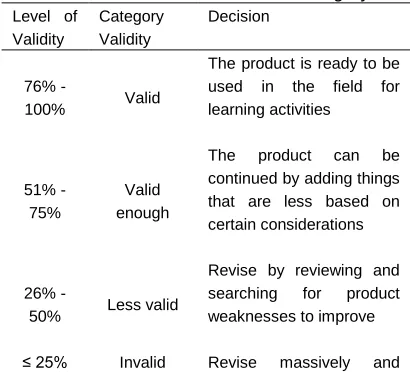
Percentage data that has been collected converted into descriptive quantitative data by the following table.
Table 2 Criteria for Validation Category Level of
Validity
Category Validity
Decision
76% -
100% Valid
The product is ready to be used in the field for learning activities
51% - 75%
Valid enough
The product can be continued by adding things that are less based on certain considerations
26% -
50% Less valid
Revise by reviewing and searching for product weaknesses to improve
≤ 25% Invalid Revise massively and
fundamentally about product content
Source: [3]
Also, There are some comments and sugestions from expert of learning media, science curriculum, and Biotechnology content. So it can be decided whether or not revisions are needed.
3. Analysis of User Response (Students)
The data used comes from the total score of all subcomponents for each aspect using a Likert scale with several categories (Table 3).
Table 3 Likert Scale
Category Scores
Strongly Agree 4
Agree 3
Disagree 2
Strongly Disagree 1
Calculation of the average score for each aspect observed using the formula:
P = Remarks:
P : percentage of total score
: Number of scores obtained for i-i aspect
: Number of maximum scores for i iI :, 1, 2, 3, ..., n
Conversion of average score obtained into qualitative values according to the criteria in [3].
Also, comments and sugesstions were obtained from students who had used Biotechnology comic based Android.
3 RESEARCH RESULTS
3.1 Phase Analysis
This stage consists of three types of analysis, namely: 1. Needs Analysis
Based on the results of interviews, it is known that modern biotechnology material has more abstract and challenging material levels, and there is no practicum for the content provided by the school because the equipment needed is costly and sophisticated. Students only understand the material using books and worksheets with technical and complicated language. So, from these facts, new media, Biotechnology comic based android, is urgently made to broaden new insights for students regarding biotechnology material in easy understanding. Developed learning media contains illustrations or visualizations of content represent biotechnology labs that are not carried out.
2. Analysis of Student Characteristics
4145 and browsingany other information. Based on these facts,
learning media based smartphone can be an innovative solution. The developed comics based smartphone are arranged in the form of androidapplication as a new media besides books and worksheets that can strength knowledge of biotechnology concept.
3. Curriculum Analysis
Based on the indicator of basic competencies, Biotechnology material that taught to students consists of the definition of biotechnology, types of biotechnology and differences, examples of conventional and modern biotechnology products, product manufacturing processes, and the impact or benefits obtained from the products.
3.2 Design Phase (Design)
This stage consists of 3 steps, among others: 1. Preparation of the Media Framework
The results obtained at this stage namely, the material of the comic must be relevant to the content that be taught to students according to the stage of curriculum analysis. The android application design contains four panels, namely biotech, comics, quizzes, and info. The characters in the comic are Acil, Ms. Aisyah, Sis Nunu, and Prof. Fatih. The dialogue manuscript is adjusted to the material presented in the media but determined by the theme in the next stage.
2. Determination of Systematics
The results from this stage are the layout, layout of images, text, and storyline. Design is used as a place of scenario while the plan of the model adjusted to the scene of the story displayed. The storyline with the theme "Explore Labirin" contains comic characters who trace every post in the labyrinth, which provides some critical material related to biotechnology. The item determines the dialogue script, which is made to be structured systematically.
3. Preparation of Product Assessment Instruments This stage collects the data from the assessment instrument for the validator, the user response questionnaire, and the readability questionnaire and the level of difficulty that has been validated by the instrument validator.
3.3 Development Stage (Development)
This stage consists of 3 steps, among other things: 1. Preparation of learning media
The results revealed that the comic based android contains eight chapters related to biotechnology material. It is converted into the form of Android that equipped with panels in the main menu; the media can be validated by the validator to obtain media assessments, responses, and suggestions.
2. Assessment of experts
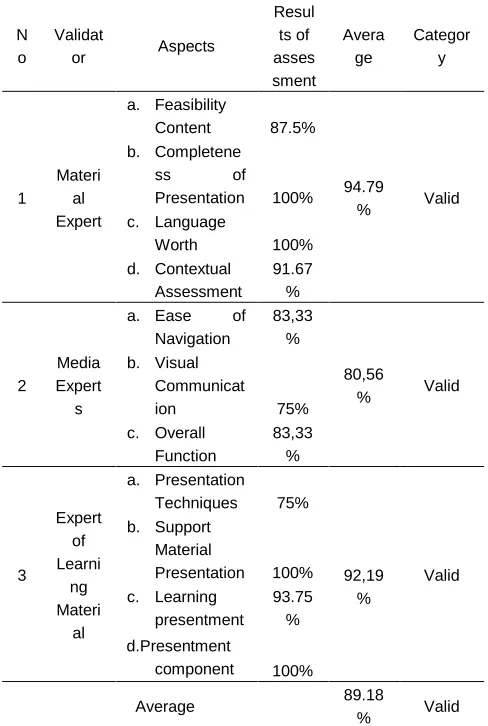
The results of the data analysis from the assessment by three validators (Table 4) showed the average validity of Biotechnology comic based Android is 89.18%, which is in the valid criteria. It means the product is ready to be used in the classroom for learning activities.
Table 4 Results of Data Analysis of expert Validation
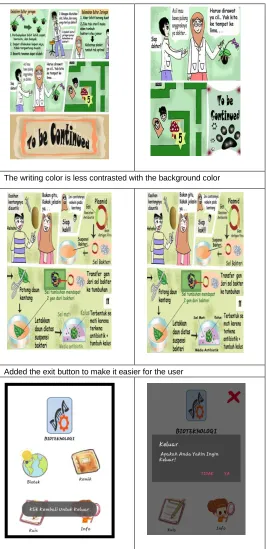
Addition feedback and suggestions received from the validator referenced to revise the comic, which is required the addition of more in-depth material as new insights. It must provide the exit button to make it easier for users, add the words "Go to Comic" to enter into the comic story, the writing is more enlarged or if the conversation in the comic is so dense can be broken down again, and some writing color is less contrasting with the background.
3. Revision of Draft 1
The results of this stage gained layout of learning media revisions according to the responses and suggestions from the validator (Table 5).
Table 5. The revision result based on validator sugesstions
Before Revision After Revision Solid Conversion are broken down again so that the writing is more visible
N o
Validat
or Aspects
Resul ts of asses sment
Avera ge
Categor y
1
Materi al Expert
a. Feasibility
Content 87.5%
94.79
% Valid b. Completene
ss of
Presentation 100% c. Language
Worth 100%
d. Contextual Assessment
91.67 %
2
Media Expert
s
a. Ease of Navigation
83,33 %
80,56
% Valid b. Visual
Communicat
ion 75%
c. Overall Function
83,33 %
3
Expert of Learni
ng Materi
al
a. Presentation Techniques 75%
92,19 %
Valid b. Support
Material
Presentation 100% c. Learning
presentment 93.75
% d.Presentment
component 100%
Average 89.18
4146 The writing color is less contrasted with the background color
Added the exit button to make it easier for the user
Added the words ―Go to Comic‖ to enter into the comic story
3.4 Implementation Phase(Implementation) 1. Readability Test Results and Difficulty
Tests conducted on 24 students of class XII IPA SMA Muhammadiyah 3 Jember after revised the comic (Table 5).
Table 6 Results of Analysis of Readability Tests and Level of Difficulties
Based on Table 6, it revealed that the average of readability test and the level of difficulty is 82.61%, which belongs to statistically valid. The challenges experienced by students are too small writing because some of the images are in a tense conversation. Revisions for the layout of learning media are carried out according to these difficulties so that students can understand comic stories easily.
2. Response Results of-based Comic Users Android
a) User Response (Teacher)
Learning media evaluation was carried out by Biology Teacher Class XII IPA 3 after comic revision from the experts (Table 7).
Table 7 Results of User Response Analysis by Biology Teacher Class XII Science
Based on Table 7, the assessment of learning media by biology teachers as a user is 82.08%, That is to say, the comic is ready to use in the classroom for learning activities.
User Aspects
Assessment Results from
a.
of Average
Stude nt
a. Components Aspects
of validity 82.12%
82.61% b. Content Aspect
Components 83.10%
Validator Aspect
Results of Assessmen
t
Average
Teacher
a. Material 80%
82.08% b. Presentation 81.25%
c.Overall
4147 b) User Response (Students)
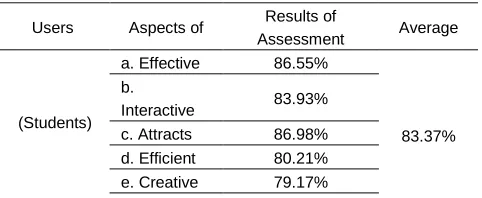
Based on Table 8, learning media assessment by Twenty-four students in Class XII IPA 3 as a user is 83.37%, meaning the learning media is ready to use without revisions. As of from the description above related to the response from the teacher and students showed that the comic has been valid and very feasible to be used as additional media in the class so that students can get a different view regarding biotechnology material.
Table 8 Results of User Response Analysis by 24 students of Class XII Science 3
4 DISCUSSION
4.1 Development processes of the learning media draft
Biotechnology has a gradual rapid development in the worldwide. Therefore in the context of science education, students should know the latest biotechnology products for their knowledge and skill development in their Biotechnology learning processes [18]. Otherwise, interviews were conducted with biology teachers aimed at identifying biotechnology learning in the classroom to observe and prove that based on [25], teachers in Indonesia have problems in teaching biotechnology, namely lack of Biotechnology concept so that the content is theoretically explained which is difficult for students to understand. Moreover, based on the results of interviews, the student's handbooks and worksheet have non update material. Consequently, students' insights about biotechnology applications are still limit.Explanation of theory in books and student's worksheet generally uses complicated terminology and explanation that makes students bore. Hence, it needs a interactive Biotechnology comic to facilitate students in comfortably understanding the material. Besides, based on [5], comics have followed contextual stories for students to easy imagine and understand something.In order to ensure kind of student's characteristics of Class XII IPA 3, this study administered the questionnaires. Because according to [23], the selection of learning media must adjust to the student's characteristics, learning styles, and facilities at the school. In the other hand, it is common for senior high school students to spend much more time using smartphones in their learning activities. It is due to students who belong to generation Z who are difficult to escape from gadgets [8]. Nevertheless wrong smartphoneusage can affect negative impact on students. Based on those characters, smartphone-based media strongly recommended to be used as a learning media. Androidis an operating system
that supports application programs on smartphones easily accessible, containing learning or exciting things [14]. Androidto fit the character of students as generation Z will make students are more interested in reading and understanding the material. Interactive Biotechnology comic use aims to quickly provide visualization of material related to everyday life [25]. The stories in the comics made are contextual containing several well-known examples of biotechnology products especially Indonesia product, such as tempe, yogurt, tissue culture, and Humulin (human insulin). The design of Biotechnology comic application in Android by determining the panel used. Determination of the design aims to detailing what components are needed to be inserted. The decision of systematic of design is made to facilitate the development of the Biotechnology comic by determination of the layout framework, the layout of the image, and the storyline. The purpose of determining the layout is to make systematic comic images. The aim of layout image decission is to determine the position of image in order to form an illustrative story. Then, structuring of storyline by the theme "Explore the Maze". It emerges to make the readers have experience adventure feel in the maze while learning biotechnology. Also, It is to attract the students to reading Biotechnology comic which is interspersed with elements of edutainment.The construction of a storyboard contains the initial sketch of the story, serves to facilitate the arrangement of the media of comic to being more structured [14]. Storyboards are drawn manually according to the chapter sequence that is designed and scanned forimages. Comic coloring aims to students becoming more interested and motivated to learn [26]. Besides, image editing is made by giving a text balloon as a space to fill in the text according to the dialog text that has been made [14].
4.2 Validation from Experts
1. Material Expert Validator
The purpose of the material validation is to see the suitability of the Biotechnology content in the comic so as the content is appropriate with the indicators of student competence achievement. Four aspects are used, among other: the feasibility of content, completeness of presentation, language feasibility, and contextual assessment. The first aspect, the appropriateness of the content includes the suitability of the material with KD (basic copetences), the accuracy of the material, and the material update with a percentage of 87.5%. This value is classified as valid. Accordingly, the content of the media is feasible without the need for revisions.According to [20], the material must be fit with basic competencies so as the indicators can be adequately achieved. Based on the validator's assessment of the aspect of content eligibility, it revealed a valid result by meaning it has met the criteria of a good learning media as well as accurate and up-to-date material to reach basic competencies. The second aspect, the completeness of the content presentment, includes the technique of coheren content presentment which were classified as valid with the percentage of 100%. The meaning of the content presentment is coherent Users Aspects of Results of
Assessment Average
(Students)
a. Effective 86.55%
83.37% b.
4148 arrangement the words for scientific names or other general
words correctly. According to [18], students prefer to read comics compared to textbooks because pictorial comics are more enjoyable with systematic and coherent storylines while textbooks contain theories with descriptions of sentences that are more difficult to understand. The third aspect, the feasibility of language contains subcomponents of communicative, dialogical, and interactive, as well as conformity with the development of students getting percentage of 100% that classified as valid. The fourth aspect is the contextual assessment, includes the essence and contextual components with a percentage of 91.67% that classified as valid. According to [18], the language in comics is more straightforward, concise, clear, and dense; hence, students more easily understand Biotechnology content. Based on validator asessment, the language used is contextual, which is closely related to everyday life. The use of Biotechnology product example in the surrounding community can make student easier to construct new knowledge from previous knowledge as well as integrating it with knowledge received from their classroom learning. Ergo, the overall average is 94.79% which is classified as valid. It means the Biotechnology content from the learning media is suitable to use in learning activities.
2. Media Expert Validator
There are three aspects of assessment, namely ease of navigation, visual communication, and overall functions. The first aspect result, ease of navigation includes the comfort of use of the application, ease of navigation in the selection of materials, and the program can run well is 83.33% that classified as valid. According to [4], the existence of navigation can bring users to the desired menu option. Based on the validator's assessment, navigation in the application is relatively easy to be operated by the user and does not confuse the user.The second aspect, the result of visual communication, the media display that consist of communicative media, balance of text and graphics composition, layout, quality of image display, background color with text, and type and size of letters is 75% with quite valid category. The media requires revisions in some texts whose colors still lack contrast toward the background or conversations that are too dense. Accordingly, they can be broken down to make text and images being able to be clearly seen. Also, the font size is more enlarged to make it clearer when read. The third aspect, the result of overall function, includes the function of the application in order to help the user in understanding the material or the attractiveness of the application is 83.33% that classified as valid. In another word, the language used is communicative, which makes it easier for students to understand the presented material. The overall average obtained is 80.56% which is classified as valid. Thus the media is suitable for use in learning, but revisions are needed before being used in the real classroom. Based on suggestions from the validator, it is necessary to provide an exit button from the application, and it has been provided in the revised application of Biotechnology comic.
3. Expert Validator for Development of Teaching Materials
There are four aspects of assessment, spesifically presentment techniques, supporting the presentment of material, learning presentment, and components presentment. The result of first aspect, the presentment techniques that consist of logic and coherent concept as well as the relationship among sub-chapters is 75%. This value is quite valid. Accordingly, the revisions are needed to be made regarding the technique presentment. The result of second aspect, supporting the presentment of material that consist of the suitability and accuracy of illustrations and material as well as the learning motivation stimulator is 100%. This value is classified as valid. Hence, the illustrations of the material used are correct and can increase students' reading interest. The third aspect result, the presentment of learning consisting the involvement of communicative students and the presentment of various media is 93.75% which is classified as valid. Thus designed Biotechnology comic is communicative and interactive with a variety of medipresentment so as the users, especially students, are more easily interested in reading this learning media. The fourth aspect result, the component presentment consisting illustrations that make it easier for students to understand the important contents with the acquisition of a percentage of 100% that classified as valid. Furthermore, the illustration of the material is easily understood, thus the essence of each submission can be known. Broadly speaking, the percentage of validation obtained at 92.19%, which is classified as valid. Accordingly, the media is suitable for use in learning. Based on input from the validator, revisions are needed, such as improvements to the writing in the illustrations that need to be more adjustment to make it easier for users in reading the illustrations of Biotechnology comic.
4.3 Revised Draft 1
Revision or improvement of learning media after draft 1 based on the assessment of expert validation aims to correct errors in order to make more suitable use for students.
a) Implementation Phase (Implementation)
The phase that implement Biotechnology comic based android to Biology teachers in class XII IPA as an users, followed by a limited trial in the class by giving questionnaire of readability test, level of difficulty, and response of the user (students).
1. User Response (Teacher)
4149 The second aspect, presentment includes the display of the
media, such as images, writing, layout, language used, as well as navigation availability. This aspect got a value of 81.25%, which means valid, thus no revisions are needed. The third aspect, namely the overall function that can encourage students' curiosity, contextual student learning activities, stimulating a pleasant atmosphere and present the benefits as well as the importance of the material in life. This aspect gets a value of 85%, which means valid because the story contains examples of biotechnology commonly found in the local community.
2. Readability Test and Difficulty Level
This test aims to determine the level of readability of the media by students and find out the difficulties experienced when using the media. The results of the assessment obtained a percentage of 82.61%, which is classified as valid so as the media can be used in the learning process with a bit revisions. It means the students got the problematic experience in some quite small font writing when using media. Hence, it makes difficult for students to read the comic. This difficulty is used as a reference in order to improve the appearance of comics by increasing the font size. Therefore, it makes easier for students to read the dialogues on comics.
3. User Response (Students)
Questionnaire responses contain the assessments related to learning media in general, both from afective aspects, interactive aspects, interesting aspects, practical aspects, as well as creative aspects. The first aspect, the practical aspect includes the effectiveness of the material described in detail, from easy to difficult, presentment of examples of material, as well as material related to the development of technology with a value acquisition of 86.55%. This value is classified as very feasible. It means the material presented does not need to be revised because the material is described using understanable language by material examples that are closely related to everyday life. The second aspect, the interactive aspect includes the appearance on Android, such as the ease of using the main menu, the appropriatness contents of display to the menu choices, understanable display images, usage font, biology terminology written, and the language used. These are in 83.93%, which means it is very feasible. Therefore, the display on Android does not require a revision. The third aspect, interesting aspect, including media for associating concepts with the reality and fostering students' curiosity. It got 86.98%, which means it is very feasible. Hence, media does not need to be revised due to it has presented integrated with everyday life. The fourth aspect, the efficient aspect is on a value of 80.21%, which means it is very feasible. Thus the media does not need to be revised as well as for the fifth aspect, which is creative. It got 79.17%, which is classified as very feasible. Accordingly, It presents material and media that can be used as one of learning media for learning fun. The results of the assessment of 24 students, in general, amounted to 83.37%, which means it is very feasible to use as a learning media for Biotechnology content in Senior High School.
In a nutshell, the Android-based comic media is feasible to be used as an additional learning material for biotechnology because it is proven that Android-based media is appropriate with generation Z. Based on [8], generation Z grows and develops around advanced technology so as students are very skillful at using Android. The material presented in Biotechnology comic forms can attract students' reading interest because it has elements of entertainment and learning (edutaintment). Based on [1], it is known that comics play a positive role in developing students'reading habits because it uses the help of interactive images. At the same time, the result of media assessment raises the advantages of Android-based Biotechnology comic. This comic can comply with advancement of technology. In consequent, students as the Z generation prefer it, besides Biotechnology comic can increase students reading interest which can be seen from the students' enthusiasm when conducting learning media trials. Moreover, the media in the comic form is more interesting. Thus students are easier to understand the core of Biotechnology material. On the other hand, it has the disadvantage which is included several types of smartphones that cannot install the Androidapplication due to full memory usage or smartphone does not support the application to be installed. At the same time, for students who don't like comics because they have a visual style, they will feel bored. Thus, it cannot be adequately received. In a conclussion, Biotechnology comic based android is powerfully can be used as additional learning media besides textbook and worksheets that can be read before entering learning activities as literacy activities for biotechnology content. The existence of literacy can increase students' interest in reading and understanding, which provides exciting content to provide learning motivation for students to enter learning activities. Lastly, the comic can be read everywhere and anytime beyond the school time.
5 CONCLUSION AND IMPLICATION
The Biotechnology comic based android is worthy of being learning media due to it is appropriate with Z generation identity with the gadget for easy mobility in anything, anytime, and anywhere. And It has proven by the results of the validator's evaluation, readability and difficulty levels, as well as teacher and student responses in this study.
ACKNOWLEDGEMENTS
I would like to deliver thank to all of the authors due to all of authors equally contributed to this study. Also thanks to University of Jember for all of the support to us for finishing this research.
REFERENCES
4150 [2] Anjarwati, D., Winarno, A., dan Churiyah M.
(2016). Improving Learning Outcomes by Developing Instructional Media-Based Adobe Flash Professional CS 5.5 on Principles of Business Subject. Journal of Research & Method in Education, 6(5), 1-6.
[3] Arikunto, S. (2010). Prosedur penelitian suatu Pendekatan Praktik. Yogyakarta: Rineka Cipta. [4] Bustomi, AY 2010. Aplikasi Pembelajaran Panca
Indra pada Manusia Berbasis Android. Jurnal Telematika, 3(1), 25-36.
[5] Danaswari, RW, Kartimi, dan Roviati, E. (2013). Pengembangan Bahan Ajar dalam Bentuk Media Komik untuk Meningkatkan Hasil Belajar Siswa Kelas X SMAN 9 Cirebon pada Pokok Bahasan Ekosistem. Jurnal Scientiae Educatia,2(2), 1-17. [6] Fatmala, D. dan Yelianti, U. (2016).
Pengembangan Media Pembelajaran Multimedia Interaktif Berbasis Android pada Materi Plantae untuk Siswa SMA Menggunakan Eclipse Galileo.
Jurnal Biodik, 2(1), 1-6.
[7] Hadi, WS dan Dwijananti. (2015). Pengembangan Komik Fisika Berbasis Android sebagai Suplemen Pokok Bahasan Radioaktivitas untuk Sekolah Menengah Atas. Jurnal Pendidikan Fisika,4(2), 1-24.
[8] Hariadi, B., Dewiyani, MJ, dan Sudarmaningtyas, P. (2016). Development of Web-Based Learning Application for Generation Z. International Journal of Evaluation and Research in Education. 5(1), 60-68.
[9] He, T. dan C. Zhu. 2017. Digital informal learning among Chinese university students: the effects of digital competence and personal factors.
International Journal of Educational Technology in Higher Education, 14 (44), 1-19.
[10] Husain, C. (2014). Pemanfaatan Teknologi Informasi dan Komunikasi dalam Pembelajaran di SMA Muhammadiyah Tarakan. Jurnal Kebijakan dan Pengembangan Pendidikan, 2(2), 184-192. [11] Indrastyawati, C., Paidi, & Ciptono. (2016).
Development of Sensory System Learning Media Based On Android To Improve Motivation And Learning Outcomes Students. Jurnal Pendidikan Biologi, Vol. 5, No. 7.
[12] Jengathe, G. dan Rojatkar, DV (2015). Use of
Android in Education System. International Journal of Electrical and Electronics Research, 3(4), 133-137.
[13] Kathuria, A. dan Gupta, A. (2015). Challenges in Android Application Development: A Case Study.
International Journal of Computer Science and Mobile Computing, 4 (5), 294 – 299.
[14] Koendoro, D. (2007). Yuk Bikin Komik. Bandung: Mizan.
[15] Lee, W. & Owens, D, L. (2004). Multimedia Based Instructional Design. Second Edition. United States of America: John Wiley & Sonc, Inc.
[16] Mukhlis, H. (2015). Pahami Remaja Generasi Z. Tanggerang.
[17] Pohan, JE, Atmazaki, dan Agustina. (2014). Pengembangan Modul Berbasis Pendekatan Kontekstual pada Menulis Resensi di Kelas IX SMP 7 Padang Bolak. Jurnal Bahasa, Sastra dan Pembelajaran, 2(2), 1-11.
[18] Purwanto, D. (2013). Pengembangan Media Komik IPA Terpadu Tema Pencemaran Air sebagai Media Pembelajaran untuk Siswa SMP Kelas VII. Jurnal Pendidikan Sains, 1(1), 71-76.
[19] Rawa, NS, dan Bhoke, W. (2017). Pengaruh Penggunaan LKS Matematika Berbentuk Komik Terhadap Motivasi Belajar Siswa Sekolah Dasar.
Jurnal Math Educator Nusantara (JMEN), 3(1), 1-57.
[20] Riani, S., Hindun, I., Budiyanto, MAK (2013). Pengembangan Media Pembelajaran 9 Pengembangan Media Pembelajaran Berbasis Multimedia Interaktif untuk Meningkatkan Pemahaman Materi Bioteknologi Modern Siswa Kelas XII SMA. Jurnal Pendidikan Biologi Indonesia. 1(1), 9-16.
[21] Rohmatan, NF (2016). Pengembangan Permainan Ular Tangga Sebagai Media Pengayaan Pada Mata Pelajaran Dasardasar Perbankan di SMK Negeri Mojoagung. Jurnal Pendidikan Akuntansi, 4(3), 1-6.
[22] Sanjaya, P., Suwatra, W., Suartama, K. (2015). Pengembangan Multimedia Interaktif dengan Menggunakan Model ADDIE pada Mata Pelajaran IPS Kelas VIII Semester Ganjil Tahun Pelajaran 2014/2015 di SMP Negeri 2 Seririt. Journal Edutech, 3(1), 1-10.
[23] Sugiyono. (2012). Metode Penelitian Administrasi. Bandung: Alfa-beta.
[24] Susilana, R. dan Riyana, C. (2009). Media Pembelajaran: Hakikat, pengembangan, Pemanfaatan, dan Penilaian. Bandung: CV. Wacana Prima.
[25] Syarifuddin, MH dan Sumbawati, MS (2016). Pengembangan E-Komik sebagai Media Pembelajaran Keamanan Jaringan Materi Kriptografi. Jurnal IT-Edu, 1(1), 30-36.
[26] Utariyanti, I. F. Z., Wahyuni, S., & Zaenab, S. (2015). Pengembangan Media Pembelajaran Berbasis Komik Dalam Materi Sistem Pernapasan Pada Siswa Kelas VIII MTs Muhammadiyah Malang. Jurnal Pendidikan Biologi Indonesia, Vol. 1, No. 3, 343-355.
[27] Utomo, AP, Novenda, IL, Budiarso, AS, dan Narulita, E. (2017). Development of Learning Material of Biotechnology Topic Based on STEAM-LW Approach for Secondary School in Coastal Area. International Journal of Humanities Social Sciences and Education (IJHSSE), 4(11), 121-127. [28] Waluyanto, HD (2005). Komik sebagai Media