IJEDR1701098
International Journal of Engineering Development and Research (www.ijedr.org)632
A Comprehensive Review on Technologies
Applications of IoTs (Internet of Things)
Mrs. Meeta Prajapati
Lecture in Co mputer Engineering, Govern ment Po lytechnic, Gandhinagar,Gandhinagar, Gu jarat, India
Abstrac t: - Recent ye ar Interne t of Things (IoT) is a technological re volution, which pr ovi des connec te d worl d vision of Things. De vices, systems and people are c onnecte d wi th one another in such a way that the y c an c orrespond with eac h other over Internet. So the for m of c ommunicati on fr om human -human is now twiste d into human, human-things. In this paper intr oduces Inter net of Things (IoTs), whic h offers capabilities to classified and connect worl dwi de substanti al objects into a unifie d syste m. As a part of inter net of thi ngs, serious concerns are raised over admittance of personal infor mation pertaining to indi vi dual pri vac y and de vice. This revie w summarizes the basic introduc tion, Technol ogies and applicati on of IoTs.
Keyword- Interne t of Things, RFID, Wireless Sensor Network, de velopment, cl oud.
I. INTRODUCTION
"Internet of Things" called IoT, re lated with the thought of "future internet" is a apparition where each object will become a part of the Internet. At this time objects can be any existing entity like animal o r humans and any non-liv ing entities on earth. Internet of Technologies is simila r to a visualizat ion in which every object that is on network can uniquely be identified, its position and status can be known, it is available to the network and intelligences and services are added to this network. Internet of Technologies will change the information world and technology world considerably to make a mo re comfo rtable world fu ll of technology for us. Diffe rent types of prototyping hardware boards, on chip systems, RFID, sensors and ubiquitous networking capabilities are supporting candidates for Internet of Technologies evolution [1].
IIINTERNET OF THINGS OVERVIEW AND BACKGROUND
What is Inter net of Things?
As illustrate in Fig. 1, the Internet of Things allow people and things to be associated anytime, anyplace, with anything, ideally using any path/network and any service [2]. They are “Material objects associated to material objects in the Internet”.
For paradig m, through laser scanners, RFID, g lobal writing system, infra red sensors and other information sensing devices are associated to any object for data exchange and communication services. At preceding, to reach the smart devices to be tracked, located, monitored and to handle the network functions, to make the IT infrastructure and physical infrastructure consolidation Internet of Things is the most needed one.
Figure 1 definit ion of IOT by [2] DEFINITIONS AND ELEMENTS of IoTs
IJEDR1701098
International Journal of Engineering Development and Research (www.ijedr.org)633
Definition by Radio Frequency identification group - The interconnected worldwide network objects exc lusivelyaddressable based on standard communication protocols
Interconnection of actuating and sensing devices providing the capability to share informat ion across platforms through a integrated fra mewo rk. Eme rgent a common operating picture for enabling innovative applications [3].
The IoTs allows people and things to be connected Anyplace, Anytime with Anything and Anyone, ideally using Any path/network and Any service [2].
Interne t of Things Ele ments [3]:
Radio Frequency Identification (RFID):- Application of RFID in IoTs technology is embedded communication, fo r designing of microchips for wire less data communication.
Wireless Sensor Networks (WSN):- Application of WSN a re effic ient, low power, low cost devices so it is apply to re mote sensing applications.
Addressing Schemes:- Addressing schemes are functional to uniquely identify the “Things” i.e. sma rt objects.
Data Analytics and Storage:- Internet of Things deals with storing and sharing of large amount of data. These data have to be stored and used intelligently fo r s mart actuation and monitoring.
Visualizat ion:- This allows dealings of the user with the environ ment. Orig in of meaningful information fro m ra w data is non-trivial.
III. Architecture of IoTs
Basic of proble ms with the Internet of Things is that it is so enormous and such a broad concept that there is no projected, uniform arch itecture. In order for the scheme of IoT to work, it must consist of an sensor range, network, communicat ions and amongst others [4]. He re, several researchers, authors and practitioners present IoT architectures or model . Basically IoT have the six layers are p resent below:
Figure 2 Six-Laye red Architecture of IoT Codi ng Layer
In this layer is the base of IoT, which provides identification to the objects of interest. Coding layer, every object is assigned a unique ID, which ma kes it easy to discern the objects [5].
Perception Layer
Perception layer is the device layer of IoT wh ich gives a corporeal mean ing to each object. It consists of data sensors in dissimila r forms like RFID tags, IR sensors or other sensor networks [6] which could sense the humidity, te mperature, speed and location etc of the objects.
Perception layer gathers the useful information of the objects beginning the sensor devices connected with the m and converts the informat ion into digita l signals which is then approved onto the Network Layer for further act ion.
IJEDR1701098
International Journal of Engineering Development and Research (www.ijedr.org)634
The function of network layer is obtain the useful information in the structure of digital signals from the this Layer and transmit it to the processing systems in the Middle ware Layer through the transmissio n med iu ms like Bluetooth, WiFi, W iMa X, Zigbee, GSM, 3G etc with protocols similar to IPv4, IPv6, MQTT, DDS etc [7].Mi ddle ware Layer
Middlewa re layer processes the informat ion received fro m the sensor devices [8]. This layer inc ludes the technologies similar to Ubiquitous computing, cloud computing which ensures a direct contact to the database to store all the essential informat ion in it. Using some s mart Processing Equipment, the in formation is processed and a fully automated action is take n based on the processed results of the informat ion.
Application Layer
Application layer rea lizes the applications of Internet of Things for all kinds of industry, based on the processed data. Since applicat ions promote the development of Internet of Things so this layer is very useful in the large scale development of IoT network [9].
Business Layer
Business layer arranges the applications and services of Internet of Things and is responsible for a ll the research related to IoT. It generates dissimilar business models for effective business strategies [10].
V. TECHNOLOGIES
The progress of a ubiquitous computing system where digital objects can be exceptionally identified and can be able to interact and think with other objects to accumulate data on the basis of which automated actions are taken, requires the necessitate for a combination of new and effective technologies which is only possible through an combination of differen t technologies which can ma ke the objects to be identified and co mmunicate with each other [11] . In this paper we d iscuss the relevant technologies that can help in the large-scale develop ment of IoT.
Radi o Fre que ncy Identification (RFID)
Radio frequency identification is the key technology for making the objects uniquely identifiable. Its reduced cost and size ma kes it integral into any object [13]. It has a transceiver microchip similar to an adhesive label which could be both passive and active, depending on the type of application [12]. Passive tags just get activated when they are triggered while Active tags have a battery connected to them due to which they are always active and therefore continuously emit the data signals . Active tags are more e xpensive than the Passive tags however they have a wide range of useful applications [2]. Radio frequency identification system is collected of readers and associated Radio frequency identificat ion tags which e manate the identificatio n, location or any other specifics about the object, on getting triggered by the any appropriate Radio frequency generated signal [14].
Figure 3. RFID Scenario
Depending on the category of application, Radio frequency identification frequencies are divided into four different frequencies ranges , which are specified below:
IJEDR1701098
International Journal of Engineering Development and Research (www.ijedr.org)635
Bar Code is also another an identification technology which has approximately the same function as an Radio frequency identificat ion but Radio frequency identificat ion is more e ffective than a Bar Code due to a number o f its benefits. Radio frequency identification being a radio technology doesn’t require the reader to be physically in its vision while Ba r Cod e is an optical technology which cannot work e xcept its reader is placed in front of it.Wireless Sensor Network (WSN)
Wireless sensor network is a bi-d irectional wire lessly lin ked network o f sensors in a multi-hop fashion, built fro m numerous nodes scattered in a sensor landscape each linked to one or more than a few sensors which can accumulate the object specific data such as humidity, tempe rature speed etc and then pass on to the processing equipment [13]. The sensing nodes converse in mult i-hop all sensor is a transceiver having an antenna, a mic ro-controlle r and an interfacing circuit for the sensors as a actuation, communicat ion and sensing unit correspondingly along with a power source which could be both battery or any energy harvesting technology [2]. However, it has projected an additional unit for saving the data, named as Memory Un it which could a lso be a part of the sensing node. A typical sensing node is illustrating in the figure belo w:
Figure 4 A typical sensing node
Both Wireless sensor network and Radio frequency identification sensor networks have their own advantages but radio frequency identification Sensor Networks have a low range and their communication is asymmet ric wh ile Wireless sensor networks have a comparat ively longer range and their co mmunication is Peer-to- Peer. Additionally, most of the wire less sensor network is based on the IEEE 802.15.4 standard [13], which specifies the Physical and MAC layer of Lo w- Rate Wireless Personal Area Netwo rks (LR-WPANs) [14].
Cloud Computing
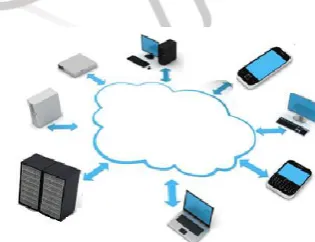
With numbers of devices projected to come by 2020, the cloud seems to be the only technology that can evaluate and store all the data effectively. It is the most important part of Internet of Things, which not only converges the servers but also processes on an improved processing power and analyzes the useful information obtained from the sensors and even provide good storage capacity [11]. But c loud computing is just a beginning of unleashing the true potential of this technology. It interfaced with smart objects using potentially numbers of sensors can be of massive benefits and can help internet of things for a very large scale develop ment so researches are being carried out since internet of things will be totally dependent on the Cloud Co mputing.
Figure 5 A typical Cloud Co mputing Scenario Networking Technologies
IJEDR1701098
International Journal of Engineering Development and Research (www.ijedr.org)636
ubiquitous computing, it will not be predictable anymore wh ich calls for a need of a super-fast, super-effic ient fifth generation wireless system which could offer a lot more bandwidth.Nano Technologies
Nano technology realizes improved and smaller version of the things that are interconnected. This technology can decrease the consumption of a system by enabling the development of devices in nano meters scale which can be used as a sensor and an actuator just similar to a normal device. Such a nano device is made fro m nano components and the consequential network defines a new networking standard, which is Internet of nano-Things [15].
Micr o-Electr o-Mechanical S ystems (MEMS)
Technologies of Micro electro mechanica l systems are a co mbination of e lectric and mechanical co mponents working together to present several applications including sensing and actuating which are already being commerc ially used in many fie ld in the form of acce lero meters and transducers etc. Micro e lectro mechanical systems combined with nano technologies are a comme rcia l solution for imp rovising the communication system of Internet of things and other advantages akin to size reduction of sensors and actuators, integrated ubiquitous computing devices and higher range of frequencies etc.
Optic al Tec hnologies
Recent year developments in the field of Optical technologies in the form of technologies like Cisco’s Bi-Direct ion and Li-Fi optical technology could be a major get through in the Internet of things development. Li-Fi, an epoch-making Visib le Light Co mmunicat ion technology, will afford a great connectivity on a higher bandwidth for the objects interrelated on the concept of IoT.
VI. Applicati on of IoTs
IoTs system is designed for a shopping comple x ma ll but it can be also used in numerous organizations like, Bus stand and Air-port to display the informat ion and notification, educational Notice board system or at Railway station. A few areas where Internet of things frequently used:
i. Smart Cities: -
To construct the city as a smart c ity to connect with the d ata exhaust produced from your city and neighbourhood. ii. Security & Emergencies: -
Perimeter Access Control is a detection and control of people in non-authorized and restricted.
Liquid Presence is liquid detection in data centres, sensitive building grounds and warehouses to prevent breakdowns and corrosion.
iii. Smart agriculture: -
Wine Quality Enhancing is a mon itoring soil mo isture and trunk dia meter in v ineyards to organize the amount of sugar in grapes and grapevine health.
Green Houses is control microc limate conditions to ma ximize the production of vegetables and fruits and its quality.
iv. Home & Domestic Automati on:- In home and domestic by using the internet of things system re motely manage and monitor our home appliances and reduce on your monthly bills and resource usage.
v. Me dic al fiel d:-
• All detections support for disabled or elderly people living independent.
• Medical fridges is control and monitoring of conditions inside freezers storing medicines, vaccines, and organic elements.
vi . Industrial Control:-
• Machine to Machine Applications: Machine is used auto-diagnosis the problem and control.
IJEDR1701098
International Journal of Engineering Development and Research (www.ijedr.org)637
With the continual growing of the emerging Internet of things technologies, the concept of Internet of things will soon be inevitably developing on a very large scale. This rising paradig m of networking will control every part of our lives ranging fro m the automated houses to smart environ ment monitoring and health by embedding intelligence into the objects around us. In this paper present the architecture of IoTs and also highlighted various enabling technologies and few of the relate d applications.IoTs is numerous usefulness of IoT applications into all the do mains in clud ing medica l, industrial, manufacturing, transportation, education, governance, mining, habitat etc. However, IoT has rich its benefits, there are some flaws in the IoT imple mentation level and governance. The key observations to IoTs are that (1) Worldwide there is no standard definition (2) in architectural level universal standardizations are required (3) For better global governance, we require to build standard protocols.
REFERENC ES
[1] L. Coetzee, J. Eksteen, “The Internet of Things Promise for the Future an Introduction" , IST Africa Conference Proceedings, pp. 1- 9, 2011.
[2] C. Perera , A. Zaslavsky, P. Christen, D. Georgakopoulos, “Context Aware Co mputing for The Internet of Things: A Survey”, IEEE Co mmunications Surveys & Tutorials, 2013, pp. 1-41
[3] S. Ra za, L.Wallgren, T. Vo igt, “SVELTE: Rea l-Time Intrusion Detection in the InternetofThings”, Ad Hoc Networks , Elsevier, pp 2661–2674, May 2013.
[4] Gig li, M., Koo S. “Internet of Things, Services and Applications Categorization Advances in Internet of Things”, 1, 27-31, 2011. http://d x.doi.org/10.4236/ait.2011.12004
[5] Xu Cheng, Minghui Zhang, Fuquan Sun, “Architecture of internet of things and its key technology integration based-on RFID”, in Fifth International Sy mposium on Co mputational
[6] Intelligence and Design, “RFID as an Enabler of the Internet of Things: Issues of Security and Privacy in Internet of Things (iTh ings/CPSCo m)”, pp. 294-297, 2012
[7] Ying Zhang, “Technology Framework of the Internet of things and Its Application,” in Electrical and Control Eng ineering (ICECE), pp. 4109-4112, 2011.
[8] Gu icheng Shen, Bingwu Liu, ”The visions, technologies, applications and security issues of Internet of Things”, in E-Business and E -Govern ment (ICEE), pp. 1-4, 2011.
[9] MiaoWu, Ting-lie Lu, Fei-Yang Ling, ling Sun, Hu i-Ying Du, “Research on the architecture of Internet of things”, in Advanced Computer Theory and Engineering (ICACTE), pp. 484-487, 2010
[10] Rafiullah Khan, Sarmad Ullah Khan, Rifaqat Zaheer and Shahid Khan, “Future Internet: The Internet of Things Architecture, Possible Applications and Key Challenges”, in Proceedings of Frontiers of In formation Technology (FIT), pp. 257-260, 2012
[11] Benja min Khoo, “RFID as an Enabler of the Internet of Things: Issues of Security and Privacy” Internet of Things (iTh ings/CPSCo m), pp. 709-712, 2011
[12] L.At zori, A.Iera , G. Morabito, “AN IBE BA SED SECURITY SCHEM E OF INTERNET OF THINGS”, The Internet of Things: A survey, in Computer Networks - Science Direct Wang Chen, in Cloud Computing and Intelligent Systems (CCIS), pp. 1046, 1049, 2012
[13] H. Zhang, L. Zhu, “Internet of Things: Key technology, architecture and challenging problems”, in Co mputer Science and Automation Engineering (CSA E), Vo lu me: 4, pp. 507-512, 2011.
[14] R. Ro man, C. A Lcara z, J.Lopez, N. Sklavos, “Key Management Systems for Sensor Networks in the Conte xt of the Internet of Things”, Co mputers & Electrica l Engineering, Vo lu me: 37, Issue: 2, pp. 147-159, 2011.
[15] I.Akyild iz, J.Jornet, ”THE INTERNET OF NANOTHINGS,” IEEE Wireless Communications, Vo lu me: 17 Issue: 6, pp. 58-63, 2010
[16] S. Sicari, A. Rizzardi, L.A Grieco, A. Coen-Porisini, “Security, privacy and trust in Internet of Things: The road ahead”, Co mput. Net w. 76, 146– 164, 2015.
![Figure 1 definition of IOT by [2]](https://thumb-us.123doks.com/thumbv2/123dok_us/8213841.1372658/1.596.241.355.565.648/figure-definition-of-iot-by.webp)