IJEDR1804099
International Journal of Engineering Development and Research (
www.ijedr.org
)
555
Social networking impact on the ERP
implementation in textile industries
1Raj Kumar Somani,
2Dr. Tanveer Ahmed Qazi,
3Dr. Shiv Lal
1Research scholar, 2 Professor& Dean, 3Professor & Principal 1Department of Mechanical Engineering,
1 PAHER University, Udaipur, India
_____________________________________________________________________________________________________
Abstract— This paper aims to analysis Social networking impact on the ERP implementation in industries also
comparing the social networking with critical success factors explain what are the, problems faced during ERP implementation. Social networking helps in training, proper communication, motivation and team work among the core team members at the time of ERP implementation. ERP system with cloud computing will change the world scenario by reducing cost, implementation time and reduction IT infrastructure.
IndexTerms—ERP system, Social networking, Critical success factor, cloud computing.
_____________________________________________________________________________________________________
I.INTRODUCTION
An ERP has been defined as “integrated information system software comprised of several modules that share a central database designed to automate business process across the enterprise”.
ERP systems are characterized by high level of costs and complexity. The high investment that is required and decision to purchase and implement an ERP are the most important decisions which management has to make [1].
Today ERP has become a basic business information-processing requirement for many organizations. ERP system is economically beneficial for company’s operational management. ERP users are better in performance rather than non user [2, 3]. Presently in cut throat business competition, real time information is very important for any organization.
Main benefits of ERP system are improved decision making, financial management, customer service and retention, inventory and asset management, ease of expansion/ growth and increased flexibility, reduction in cycle time, reduction in staff, enhanced logistics, more accurate transactions and better revenue [5].
Many organizations have realized that in today’s rapidly changing environment, it is not possible to create and maintain a custom designed software package that will cater to their entire requirement and also be fully up-to date. Realizing the requirement of user organizations several of top ERP software companies have developed ERP software which will offer industry specific vertical.
ERP system include Material Management, Production planning and Control, Sales and Distribution, Finance and Accounting, Personnel Management, Business forecasting, Planning and Control, SCM, and CRM etc.
The process of selecting a vendor and implementing the ERP is difficult and complex process. Textile industries replaced their legacy system which was FoxPro base system, replaced with SAP and TIN. Here ERP implementation used ASAP methodology which has mainly five phases project Preparation, Business Blueprint, Realization, Final Preparation, Go Live & Support and continuous improvement. ERP implementation has taken eight months to 24 months. AS IS and TO BE analysis prepared by one consultant and implementation of ERP performed by another consultant. Firstly analysis for Factors for ERP implementation has been performed. Than impact of ERP implementation on textile industries have been presented.
II.LITERATURE REVIEW
A brief development of ERP has as shown in Fig. 1.1.
Figure 1.1 the Evolution BOM to Internet based ERP [10, 13].
EXTENDED-ERP 2000’S BOM
1960’S 1970’S MRPI MRPII 1980’S 1990’S ERP
YEARS
IJEDR1804099
International Journal of Engineering Development and Research (
www.ijedr.org
)
556
Initially, bill of material (BOM) have been used from 1960 for streamlining industrial working and cost saving. Master schedule created for finished items into time phase net requirements for components, sub-assemblies and raw material planning and procurement by Material Requirement Planning (MRP) in1970. Manufacturing Resource Planning (MRP-II-1980) is extension of MRP. It includes shop floor and distribution management activities. ERP is extension of MRP-II. It includes finance, human resources, engineering, sales and project management etc. ERP name was given by Gartner group in 1990 which has enterprise wide scope. ERP replaced the legacy systems within organization by one, standardized software [12, 13]. ERP-Extended (2000) is extension of ERP. It includes E-Business solution, advanced planning and scheduling, customer relationship management, supply chain management. Collaborative ERP system(C-ERP) in which ERP crosses company boundary includes raw material suppliers, reseller, agents etc [14, 15]. Web based ERP systems (I-ERP) are internet based system (2006) now in demands [16-18]. Cloud Computing based ERP system are in developing phase, few of them in market and providing services two small and medium scale industries [8].DeLone and McLean (1992) has given framework for assessing IT systems impact and success at the micro level which included variable such as size, structure. It helped to understand the IS (Information System). Information Quality (IQ), System Quality (SQ), Individual Impact (II) and Organizational Impact (OI) having significant role for ERP success in organization. Gable et al (2003) presented the most comprehensive ERP systems impact and success measurement model that was good contribution to knowledge in this area of ERP research.
Critical Factor for ERP Implementation Success is discussed with their concerns researchers. Slevin and Pinto (1987), Sumner (1999), Holland et al. (1999), Bingi et al. (1999), Davenport (2000), Liang et al. (2007), Garg (2010) concluded that top management Support very important in ERP Implementation success. It provides the necessary resources, leadership, authority or the power for project success. [39].
User Training and Education required 15 to 20% total project investment for successful ERP implementation so Training is important factor given by Sumner et al. (1997), Bingi et al. (1999), Siriginidi (2000), Aladwani (2001), Esteves et al. (2003), Mandal and Gunasekaran (2003), Heikki et al. (2005), Jha et al. (2008). To make the user comfortable with the system & increase expertise & knowledge level of the employees. Concept features & hands on training are important to make user more comfortable with system [25].
Holland et al. (1999), Sumner (1999), Wee (2000), Rosario (2000), Soh et al. (2000), Shanks et al. (2000), Somers and Nelson (2001), Zhang et al. (2003) Akkermans and Helden (2002), Nah et al. (2007) has emphasis on Project management as It involves the use of skills & knowledge in coordinating the scheduling & monitoring of defined activities to ensure that stated objectives of implementation projects are achieved. Project implementation plan defines project activities, commits to those activities & promotes organizational support by organizing the implementation process.
Enterprise wide communication is important factor as per Holland et al. (1999), Sumner (1999), Rosario (2000), Wee (2000), Kumar et al. (2002), Mandal and Gunasekaran (2003), Grant (2003), Yusuf et al. (2004), Ngai et al. (2008). It is essential for creating an understanding, an approval for implementation & sharing information between the project team & communicating to the whole organization the results & the goals in each implementation stage.
Change management is also critical factor given by Bingi et al. (1999), Holland et al. (1999), Sumner (1999), Somers and Nelson (2001), Robert & Willcocks (2007). ERP systems introduce large-scale change that can cause resistance, confusion, redundancies, and errors. It is estimated that 50% of ERP implementations not successful to get expected benefits because industries “significantly underestimate the efforts required in change management”. Resistant to change is one of the main problems faced by the majority industries [45].
User Involvement has leading role for successful implementation of ERP system given by Esteves and Pastor (2001, 2003), Zhang et al. (2003), Roseman et al. (2001), Hong and Kim (2002), Al-Mashari et al. (2003). User participation is very important in the implementation of the ERP at the stage of defining company’s ERP system needs, ERP implementation & after going live.
Business Process Reengineering is important factor given by Hammer and Champy (1993), Holland et al. (1999), Somers and Nelson (2001), Al-Mashari et al. (2006), Robert & Willcocks (2007), Singh & Wesson (2009). For minimum degree of customization, organizations should be willing to modify their businesses to fit the ERP package. To achieve the greatest benefits provided by ERP system, it is imperative that the business processes are aligned with the ERP system [17][24].
Clear goals and objectives should be clearly defined & specific and operational, and to indicate the general directions of the project. It is vital to mark the goals of the project before even looking for top management support. The “triple constraint” of project management specifies three often competing and interrelated goals that need to be met: scope, time, and cost goals. Many ERP implementations face scope creep as a result of missing a clear plan.
Technological infrastructures adequate hardware & networking are crucial for an ERP success has given by Holland et al. (1999), Kumar et al. (2002), Al-Mashari (2002), Yasser (2000), Jafari et al. (2006), Yusuf et al. (2006).
Social Networking impact on ERP implementation has not seen in past research papers but their impacts are more positive than negative. Facebook, Whatsup, Hike, Twitter are working as adviser as or more than communication media. Many ERP users demanded inbuilt ERP system with social networking sites.
IJEDR1804099
International Journal of Engineering Development and Research (
www.ijedr.org
)
557
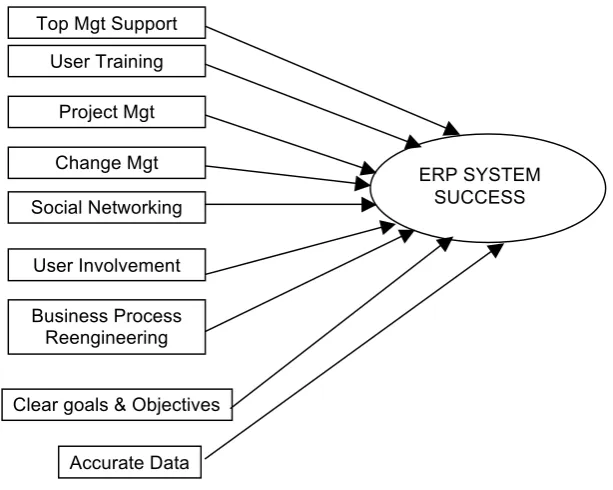
Figure 1.2 Research model (Factor Effecting ERP Implementation)Survey is one of the most prevalent research methodologies used in information system (IS) research (Vogel & Wetherbe, 1984; Pinsonneault & Kremer, 1993). The benefit of using surveys is that the researcher can easily cover large populations quickly at a relatively low cost especially with the availability of modern communication technologies. Survey, which is the most common research method used to measure dependent and independent variables of an environment without any controls on the environment.
By conducting a survey, this study acknowledges that gathering evidence that can support the validity of the hypothesis in other organizational settings can provide useful insights or suggest changes in behavior beneficial to an organization and its stakeholders. Additionally, methods associated with positivism lend credibility to an assertion that insights obtained in one context might be usefully generalized or transferred, thus increasing the relevancy of those research findings to the practitioner community.
The analysis procedures are based on the data collected from industries survey. Industry Experts, which are also ERP users by profession, were asked to recognize which characteristics of ERP systems are significant to them and their organization. The characteristics that were recognized as significant were then used to rate how the ERP users felt about their industries ERP package.
Likerta five point scales have been used for rating different CSF in the survey.
IV.DATA ANALYSIS AND RESULTS
Using relative importance factor for CSF have been calculated and sorted in the analysis software which have following order of importance Management support, Project management, Change management, Team work, Social networking, BPR, Training and infrastructure etc.
Table 1.1 Relative importance factor for social networking and CSF’s
Manage ment support
User trainin g
Team Work
Change Manage
ment
Projec t manag
ement
Technolo gical infrastru
cture
Business Process Reenginee
ring
Clear goals &
objecti ves
Gap Analy sis
Social Netwo
rking
Relative Importance
Factor
0.723 0.431 0.6 0.662 0.677 0.554 0.4154 0.539 0.431 0.615
Order 1 8 5 3 2 6 9 7 10 4
Further analysis have been performed using SPSS software and association of Social Networking * Management Support value for Eta was .595, Social Networking * User training was .701, Social Networking * Team Work was .677, Social Networking * Change Management was .530, Social Networking * Technological infrastructure was .530, Social Networking * Business Process Reengineering was .786, Social Networking * Clear goals and objectives was .614, Social Networking * Gap Analysis was .600 considerable.
Top Mgt Support
User Training
ERP SYSTEM SUCCESS Project Mgt
Social Networking
User Involvement
Business Process Reengineering
Clear goals & Objectives
IJEDR1804099
International Journal of Engineering Development and Research (
www.ijedr.org
)
558
V.CONCLUSION
Impact of social networking have been seen considerable for proper communication, motivation, training and team work among the staffs of industries in the whole cycle of ERP as come out with analysis of survey. Impacts of social networking for industries are considerable. It works like game changers technology for industries and any organization in coming future. CSF factors are very important for successful implementation of ERP in the industries. They are like Masala’s of fried vegetables of kitchen which require proper blending and right heating temperature and proper baking for good results.
REFERENCES
[1] Mary Summer, “Enterprise Resource Planning”, Pearson, 2009, pp 2-13.
[2] Ellen F. Monk, Bret J. Wagner, “Enterprise Resource Planning”, Cengage 2009, pp. 35-40. [3] Alexis Leon, “ERP Demystified”, Tata Mcgraw hill 2008, pp 529-544.
[4] R. K. Somani, Anukriti, “Management Information System”, C. B. C., 2010, pp. 2-40. [5] R. K. Somani, Neha, “Enterprises Resource planning System”, C. B. C., 2010, pp. 2-151.
[6] Ercan Oztemela, Seher Arslankayab, Tulay KorkusuzPolatba, “Enterprise knowledge management model in strategic enterprise resource management”, Procedia Social and Behavioral Sciences, Elsevier 2011, pp. 870–879.
[7] Mahmood Ali, Joanna, “A study to evaluate the effectiveness of simulation based decision support system in ERP implementation in SME”, CENTERIS, Elsevier 2014, pp 542-552.
[8] Raj Kumar Somani, Reena Dadhich, “Design of Cloud Computing based ERP model”, International Journal of IT, Engineering and Applied Sciences Research, Volume 2, No. 6, June 2013, pp. 39-43.
[9] Raj Kumar Somani, Reena Dadhich, “Design of Cloud Computing Based MIS Model for Textile Industries”, International Journal of Engineering and Innovative Technology, Volume 2, Issue 11, May 2013, pp. 70-75.
[10] Raj Kumar Somani, Reena Dadhich, “MIS and Cloud Computing for Textile Industries”, International conference on Sustainable Management Practices, at Faculty of Management Studies, Udaipur, ICSMP, 2012.
[11] Raj Kumar Somani, Reena Dadhich , “Research on ERP System Based on Cloud Architecture”, The International Conference on Recent Trends of Computer Technology in Academia, ICRTCTA, 2012.
[12] Al-Mashari, M., & Al-Mudimigh, A. 2003. ERP implementation: lessons from a case study. Information Technology & People, 16(1), 21-23.
[13] Al-Mashari, M., Al-Mudimigh, A., & Zairi, M. 2003. Enterprise resource planning: A taxonomy of critical factors. European Journal of Operational Research, 146, 352-364.
[14] Bingi, P., Sharma, M.K., & Golda, J.K. 2002. Enterprise Systems. 2 edn. Best practice series. Auerbach publications. Chap. 36, pages 425-438.
[15] Davenport, T., “Putting the Enterprise Into the Enterprise System”, Havard Business Review, 1998,76(4), 121-131. [16] Davenport, T., “Mission Critical”. Boston, MA: Harvard Business School Press, 2000.
[17] DeLone, W.H, & McLean, E.R. 1992. “Information systems success: the quest for the dependent variable. Information Systems Research”, 3(1), 60-95.
[18] Gable, G. G., Sedera, D., & Chan, T. 2003. “Enterprise systems success: a measurement model. Pages 576-591 of: International Conference on Information Systems”, Washington: ICIS Press.
[19] Laudon, K.C., & Laudon, J.P. 2000. Management Information Systems: Organizational and technology in a networked enterprise. 6 edn. New Jersey: Prentice Hall.
[20] Lee, J., & Myers, M. 2004. Enterprise Systems Implementation Failure: The Role of Organizational Defensive Routines. In: Pacific Conference on Information Systems 2004 Proceeding’s.
[21] Lee, Z., & Lee, J. 2002. An ERP implementation case study from a knowledge transfer perspective. Journal of Information Technology, 288.
[22] Monk, E.F., & Wagner, B.J. 2006. Concepts in Enterprise Resource Planning. 2nd edn. Boston: Thomson Course Technology.
[23] Somers, T., Nelson, K., & Ragowsky, A. 2000. Enterprise Resource Planning ERP for the Next Millenium: Development of an Integrative Framework and Implications for Research. In: Proceedings of Americas Conference on Information Systems AMCIS.
[24] Samwel Matende, Patrick Ogao, “Enterprise Resource Planning (ERP) System Implementation: A case for User participation”, Procedia Technology 9 ( 2013 ) 518 – 526, CENTERIS 2013
[25] ZHAN Xiaohui, XU Xin, LIU Hongzhi, “ERP Performance Evaluation of Power Supply Engineering Company Based on Gray Triangle Whiten Function”, Systems Engineering Procedia 4 (2012) 116 – 123, 2nd International Conference on Complexity Science & Information Engineering
IJEDR1804099
International Journal of Engineering Development and Research (
www.ijedr.org
)
559
[27] Samira Sadrzadehrafieia, Abdoulmohammad Gholamzadeh Chofrehb, Negin Karimi, Hosseinia, Riza Sulaimana, “TheBenefits of Enterprise Resource Planning (ERP) System Implementation in Dry Food Packaging Industry”, Procedia Technology 11 ( 2013 ) 220 – 226, ICEEI 2013
[28] Sunil Luthra, Dixit Garg, Abid Haleem, “The impacts of critical success factors for implementing green supply chain management towards sustainability: An empirical investigation of Indian automobile industry”, Journal of Cleaner Production, (2016).
[29] Muhmmad I. Nofal, Zawiyah M. Yusof, “Integration of Business Intelligence and Enterprise Resource Planning within Organizations”, Procedia Technology 11 ( 2013 ) 658 – 665, (ICEEI 2013)
[30] Ignatio Madanhirea, Charles Mbohwab, “Enterprise resource planning (ERP) in improving operational efficiency: Case study”, Procedia CIRP 40 ( 2016 ) 225 – 229, 13th Global Conference on Sustainable Manufacturing - Decoupling Growth from Resource Use.
[31] Carlos J. Costa, Edgar Ferreira, Fernando Bento, Manuela Aparicio, “Enterprise resource planning adoption and satisfaction determinants”, Computers in Human Behavior 63 (2016) 659e671
[32] Adil BAYKASOĞLU, İlker GÖLCÜK, “Development of a two-phase structural model for evaluating ERP critical success factors along with a case study”, Computers & Industrial Engineering (2015).
[33] Rajneesh Chauhan, Arun Mohan Sherry, Vinayak Bhat, “Critical Success Factors for Off shoring of Enterprise Resource Planning (ERP) Implementations – US Experience”, IEEE-International Conference on Recent Trends in Information Technology, ICRTIT 2011.
[34] Paula Serdeira Azevedoa, Mário Romãob, Efigénio Rebelo, “Advantages, Limitations and Solutions in the Use of ERP Systems (Enterprise Resource Planning) – A Case Study in the Hospitality Industry”, Procedia Technology 5 ( 2012 ) 264 – 272, CENTERIS 2012.
[35] Abiot Sinamo Boltenaa, Jorge Marx Gomeza, “A Successful ERP Implementation in an Ethiopian Company: A case Study of ERP Implementation in Mesfine Industrial Engineering Pvt. Ltd.”, Procedia Technology 5 ( 2012 ) 40 – 49, CENTERIS 2012.
[36] Vincent A. Mabert, Ashok Soni, M.A. Venkataramanan, “Model based interpretation of survey data: A case study of enterprise resource planning implementations”, Mathematical and Computer Modelling 44 (2006) 16–29.
[37] Singh and R. K. Somani, “Cost effective model for E-learning”, International Journal of Engineering and Innovative Technology (IJEIT), vol. 2, issue 6, December 2012.
[38] Pandey and R. K. Somani, “A cloud computing based sales forecasting system for small and medium scale textile industries”, International Journal of Engineering and Innovative Technology (IJEIT),vol. 3, issue 4, October 2013. [39] Singhal and R. K .Somani, “Algorithm for Cloud Based Integration of CRM, BPM & DM for SME’s”, International
Journal of Advanced Research in Computer Science and Software Engineering, vol. 4, issue 1, January 2014.
[40] R.K. Somani and N. Singhal, “Convergence of CRM, BPM, DM and Cloud computing for SME’s”, IJARCSSE, vol. 3, issue 11, November 2013.
![Figure 1.1 the Evolution BOM to Internet based ERP [10, 13].](https://thumb-us.123doks.com/thumbv2/123dok_us/8201226.1369895/1.595.133.461.618.764/figure-evolution-bom-internet-based-erp.webp)