1605
Zachman Framework Implementation At PT.
Global Intra Talenta Batam
Monata Sembiring, Ahmad Nurul Fajar, Susanti Margaretha Kuway.
Abstract: Enterprise Architecture (EA) plays an important role for companies in facing complexities and challenges in the future so that companies are more competitive. PT. Global Intra Talenta is one of the companies involved in the placement of young talents in the company as its partners. The company provides career services that can be selected according to the needs of the talent. The research method used is a case study with a qualitative approach where the data collection tool uses a questioner that will be distributed to 181 respondents. After the data is collected, it will be processed to produce an EA design using the Zachman framework, where each row in the Zachman framework represents the planner's perspective, owner, architect, designer, builder, subcontractor and perspective functional (user). While each column represents the focus, abstraction or topic of enterprise architecture, namely data, functions, networks, people, time, and motivation. This research aims to produce a Corporate Architecture design to create an alignment of IS / IT resources to support the business processes carried out by PT. Global Intra Talenta. The results of the plan will be a useful control tool and parameters in the implementation of information technology according to the company's needs.
Index Terms: Enterprise Architecture, Career Services, Zachman Framework
—————————— ——————————
1 I
NTRODUCTIONEnterprise architecture (EA) very helps organizations in
dealing with the level of complexity and uncertainty in the future through an adaptive and resilient company model (Lapalme et all, 2015). Information and architecture of the company need organizing logically, and describing the relationship between information in corporate architecture is essential and illustrated in the form of architectural models (Setiawan, 2009). Enterprise architecture (EA) has the potential to offer significant insights and technology can help organizations in the future for the Great Challenges (Lapalme). The company will face various challenges and changes, along with global business development. To become a competitive company today, strategic steps are needed. These strategic steps must be effective and utilize efficient resources. Surendro (2007), states that the application of information systems for enterprises provides the fulfillment of alignment in planning, implementation, and control in line with enterprise business strategies. Utilization of information systems and technology in business is a major component for supporting business processes. Through these resources, organizations will be able to face and respond to business competition through innovation, efficiency, and effectiveness to have an impact on organizational performance. Many perspectives are unique and valuable in every aspect of enterprise architecture. Increasingly effective and efficient use
of information systems (SI) and information technology (IT) can support business activities in achieving organizational goals and services for stakeholders. With the existence of an information system strategic planning, making the information system and information technology integrated following the company's business needs to achieve a synergy between the IS and IT strategy with the company's business strategy. Enterprise Architecture is used by the main tools to shorten the effect of assessment time, tradeoff analysis, changes in strategic plan direction, and tactical reaction. Besides, Enterprise Architecture is used to design an integrated information system in the entire business environment. Enterprise Architecture, which consists of documents such as pictures, diagrams, textual materials, standards or models that use various business methods that explain what kind of information and communication systems are needed by organizations and companies. In aligning business with Organizational Information Technology and managing complex systems, the Enterprise Architecture Framework can be used. Enterprise information system architecture itself can be reviewed from the standpoint of aspects and perspective, namely using the Zachman Framework.The development of the system by regulating the system in an organization through the integration of the company's business is a translation of the form of Corporate Architecture (Nasution et all, 2018). Enterprise Architecture is a coherent whole of the principles, methods, and models used in the design and realization of a company's organizational structure, business processes, information systems, and infrastructure (Lankhorst 2005). Thus, corporate architecture is a concept of system regulation through the integration of company business that is modeled in the organization, and alignment of IT / IS with company goals. Management of proper information technology will ensure efficiency and achievement of excellent service quality for organizational goals (Burdefira, 2013). Information and communication
————————————————
Monata Sembiring, information systems management department, BINUS Graduate Program – Master of Information Systems Management, Bina Nusantara University Jakarta, Indonesia, 11480. E-mail: [email protected]. Ahmad Nurul Fajar, information systems management department, BINUS
Graduate Program – Master of Information Systems Management, Bina Nusantara University Jakarta, Indonesia, 11480. E-mail: [email protected]. Susanti Margaretha Kuway, information systems management department,
BINUS Graduate Program – Master of Information Systems Management, Bina Nusantara University Jakarta, Indonesia, 11480. E-mail:
1606
technology is an inseparable part of the business (A. N. Asyikin, 2016). Understanding of the alignment (alignment) of the IS / IT strategy with an organization's business strategy is why a business is run, where the goals are, and the direction of the company, when those goals are achieved, how to achieve the goals and or are there any changes that must be made (Wedhasmara, 2009). According to (J. Gartlan., 2007, p. 34) The application of information systems aims to support the achievement of the organization to support the success of organizational goals through the support of information technology as enabling or enabling. Most conclude that the information system paradox occurs when specific organizations or industries are unable to establish harmonious relationships between business strategies and information systems. According to Chan and Reich (2007), business alignment and information technology (PBT), refers to the alignment of strategy, planning, and priorities in business with the arrangement of strategy, planning, and preferences in information technology. The purpose of this study is to produce an Enterprise Architecture design at PT. Global Intra Talenta that suits the company's needs so that the IS / IT resources are aligned with the company's business processes. This research is expected to provide benefits to the company to have an SI / IT design model or blueprint that will be the basis of planning for the company PT. Global Intra Talenta in the implementation and investment of information technology and the SI / IT design model or IT blueprint produced can be an effective control and parameter for the successful application of information technology in the company PT. Global Intra Talenta. The purpose of this study is to produce an Enterprise Architecture design at PT. Global Intra Talenta that suits the company's needs so that the IS / IT resources are aligned with the company's business processes. This research is expected to provide benefits to the company to have an SI / IT design model or blueprint that will be the basis of planning for the company PT. Global Intra Talenta in the implementation and investment of information technology and the SI / IT design model or IT blueprint produced can be an effective control and parameter for the successful application of information technology in the company PT. Global Intra Talenta.
2
R
ESEARCHM
ETHODThis research is qualitative method research. The form of research conducted is a case study to conclude learning from business reality. Research in the way of case study requires researchers to describe or photograph a business or management event at a particular time that is happening for subsequent analysis. Therefore, the data used in this study are data that is happening, so the recommendations given are also based on the context of the time of the incident. Data sources used for interviews or referred to as informants are those who understand the business processes of the company PT. Global Intra Talents. Not only understanding, information is those who are also involved in the scope of the business process
under study, have time to be asked for information so that they can convey information accurately. The number of informants used was 181 people. They consist of 5 people with the title of Head of the company, 151 people with the position of programmer, 30 people with the status of Recruiter. This study uses techniques for primary data collection, namely: Observation, In-depth interviews, and Document Analysis (Record Review).
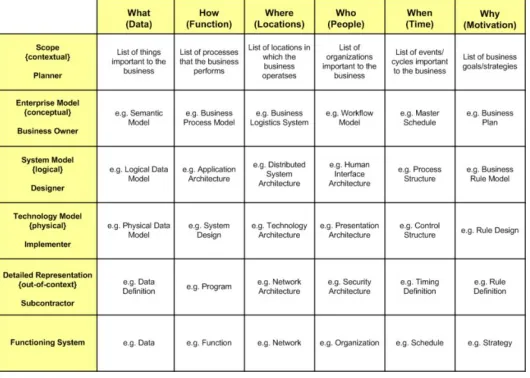
Gambar 4.1 EA Zachman Framework
3
A
RCHITECTUALD
ESIGNEnterprise architecture design at PT. Global Intra Talenta began by gathering data on the current conditions and business situation in the company. Data collected by interviewing the leaders and staff of the company who related to the business process of PT. Global Intra Talenta.
Each line in the Zachman framework represents the perspective of the planner, owner, designer (architect), builder, subcontractor and functional perspective (user). While each column represents the focus, abstraction, or topic of enterprise architecture including data, functions, networks, people, time and motivation.
3.1 Baris 1 – Scope (Contextual)
The Zachman Framework matrix consists of scope (Contextual), Business Model (Conceptual), System Model
(logical), Technology Model (physical), Detailed
Representation and Function System which are all needed for management and analysis.
Tabel 3.1. Line-1 Scope Review (Contextual)
Column Description Formulated Components
Data/What
Identifying the entity objects which related to PT. Global Intra
Talenta
The formulated components are: Talent, Id_Mitra, Id_Konsultan
Process/How
Identifying the processes
or functions
1607 that exist in
PT. Global Intra Talenta
Explain the recruitment process that will run Binding a contract between
the client and PT. Global Intra Talenta and listen to the talent’s request. Send some talent samples
that suitable or match with the Job description.
Scheduling interviews
between talent and client. Assist clients in making
contractual agreements between talent and client. Assisting clients in matters
of payroll and payment of BPJS Health, BPJS Employment and Tax. Assist clients in connecting
Talent and help them to relocate to Batam.
Network/Where
Identifying the business
locations at PT. Global Intra Talenta
to be integrated
PT. Global Intra Talenta developing its relationships network throughout Southeast
Asia so it would help young people in Indonesia have an experience working with
overseas companies
People/Who
Identifying the subjects or
people who involved in
the information system at PT.
Global Intra Talenta
The subjects or people who have a role and involved in the development of the company PT.
Global Intra Talenta are: - Business Partner / Client - Associate Consultant - Talent
Time/When
Identifying the type of service at PT.
Global Intra Talenta and when is the business architecture being used.
- Looking for clients who are in need of assistance in the recruitment process. - Explain the recruitment
process that will run - Binding a contract between
the client and PT. Global Intra Talenta and listen to the talent’s request. - Send some talent samples
that suitable or match with the Job description. - Scheduling interviews
between talent and client. - Assist clients in making
contractual agreements between talent and client. - Assisting clients in matters
of payroll and payment of BPJS Health, BPJS Employment and Tax. - Assist clients in connecting
Talent and help them to relocate to Batam.
Motivation/Why
Describing the management
Building a good relation with the Business Partners, Talents, and Associates who related with the
goals at PT. Global Intra Talenta.
business relationship of PT. Global Intra Talenta
3.1.1 Data Column (What)
Column 3.2 describes the data or entity that is related to the Information System of PT Global Intra Talenta.
Table 3.2 List of Entity of the Information System of PT Global Intra Talenta
Entity Description
User List of user/customer in the Information System of PT Global Intra Talenta.
Career Service List of career service which can be chosen by the talents.
Associate Consultant
List of associate consultant in the Information System of PT Global Intra Talenta who will guide and manage the talents.
Accounting List of receipt of transaction and operational and management expenses
Activity program List of activity programs and its schedules. Partner List of partners of PT Global Intra Talenta.
3.1.2 Process Column (How)
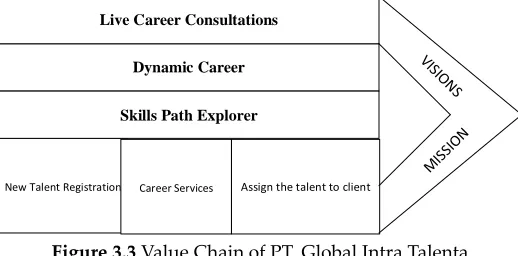
The business functions of top level management in PT Global Intra Talenta can be represented by a value chain.
Figure 3.3 Value Chain of PT. Global Intra Talenta
3.1.3. Network Column (Where)
PT. Global Intra Talenta is located in Nongsa Digital Park Tower 3 Level 2. Hang Lekiu Street KM 2, Nongsa – Batam 29465.with facility as follows:
a. Director office located in Tower 3 Level 2
b. 4 Associate Consultant offices located in Tower 3 Level 2
c. 1 HR office located in Tower 3 Level 1
d. 1 Accounting Office located in Tower 3 Level 1
e. Dedicated for Programmer Internal and External Team
f. 1 Office for External Programmer located in Tower 2
Level 1 and 2
g. 1 Activity room located in Tower 3 Level 1
3.1.4. People Column (Who)
The scope row of people column (who) is going to be described based on the responsibility of each role that is related to PT. Global Intra Talenta. Below is a notable list of PT. Global Intra Talenta.
a. Director
New Talent Registration Career Services Assign the talent to client
Dynamic Career Live Career Consultations
1608
b. Associate Consultant (Internal Employee)
c. HR
d. Accounting
e. External Employee
f. Internal Programmer
3.1.5. Time Column (When)
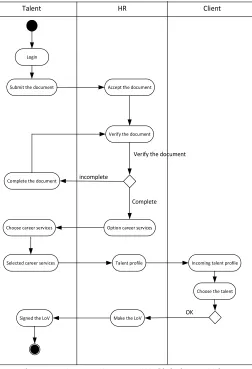
The business low of time column (time) is described by activity diagram of business process in PT Global Intra Talenta.
Figure 3.4 Activity Diagram PT. Global Intra Talenta
3.1.6 Motivation Column (Why)
In the scope row for the motivation (why) column, the motivation for building PT. Global Intra Talenta can be seen from the vision and mission of the organization. Vision: Preparing qualify Human Resources (HR) in agriculture and technology in order to produce productive and advanced people in the era of digital economy and industry 4.0, which is currently being promoted by the Indonesian government. Mission: To make the company ready to become a TalentHub for building a digital team in the top 3% of talent in Southeast Asian.
3.2 Line 2 – Business Model (Conceptual)
3.2.1 Data Column (What)
The business model row for the data column contains a description of the Entity Relationship Model and identifies and describes the management of the material and its relationships.
Figure 3.5 Data Model
3.2.2. Kolom Network (Where)
In the Business Model for network columns (network) will be discussed regarding network configuration in the company PT. Global Intra Talenta.
Figure 3.6 Konfigurasi Jaringan PT. Global Intra Talenta
3.2.3. Column People (Who)
In the business model line for the column people (who), we will discuss the actors in PT. Global Intra Talenta.
Aktor/pelaku keterangan
Associate Consultant who assists
in recruiting Talents and
connecting Talents with Partners
Talent who will work for Partners
Partners who will build up the relationships with Associate Consultants to recruit talent
Talent HR Client
Login
Submit the document
Verify the document
Verify the document
incomplete
Complete
Complete the document
Accept the document
Option career services Choose career services
Selected career services Talent profile Incoming talent profile
Choose the talent
OK
Make the LoV Signed the LoV
Talent Select Career Service Data
guide Assc. Consultant Login
HR Determine
Program Activities
Client Id_talent nama
jekel
alamat
no_kontak
Id_laca nm_laca deksripsi
Id_talent Id_laca
1 n
1
n
1 1
1 1
n
Id_ac nm_ac
keahlian jekel
alamat
no_kontak
masa_kerja
Id_ac Id_laca
Id_mitra
nm_mitra
alamat
no_kontak Informasi
Id_mitra
Penjelasan Id_program nm_program jadwal
Id_program
Tgl_daftar tujuan no_daftar no_daftar
Career Service Data Talent s Data
LogIn to Manajemen LogIn to Talent
Associate Consultant
1609
4. Conclusion
The result of the design is the architecture of PT. Global Intra Talenta based on the reconstruction requirements that exist today. The design results can be explained in the artifacts depicted in several of Zachman framework cells as follows: Overall data design from the planning and owner sides. There are 6 (six) defined entities which are Talent, Career Services, Associate Consultants, Partners, HR, Activity Programs. The design process in detail from the perspective of the planner and the owner. The 5 main business processes which are recommended by PT. The Global Intra Talenta are Recruitment of Associate Consultants, Talent Registration, Search for the intended Partner, Talent preparation activities, Talent Release to the intended Partner. Design in detail from the point of view of the planner and the owner. From the results of the design and analysis, the network architecture topology of PT. Global Intra Talenta which is divided into work units such as the Director's room, Talent room, Accounting room and Associate Consultant. Design in detail from the point of view of the planner and the owner. From the results of the design and analysis explained the main actors in PT. Global Intra Talents include: Associate Consultants, Talents and Partners. Design in detail from the point of view of the planner and the owner. From the results of the design and analysis explains the time of implementing PT. Global Intra Talenta with an activity diagram. Design in detail from the point of view of the planner and the owner. In general, it explains business motivation based on the vision and mission of PT. Global Intra Talenta and company strategy. Future research can be done by completing other Zachman framework columns, which are not discussed in this study in order to complete the entire architecture of PT. Global Intra Talenta as a whole. 2. For PT. Global Intra Talenta itself, namely the Director to create an enterprise architecture design, to map the current conditions as a whole, not only focused on the main business but all the supporting processes.
R
EFERENCES[1] A. N. Asyikin, R. F. (2016). Masterplan Teknologi
Informasi Dan Komunikasi (TIK) Kantor Pemerintah
Desa. Jurnal POROS TEKNIK, 8(2), 61-67. Retrieved from
http://ejurnal.poliban.ac.id/index.php/poros teknik/article/view/368/339%0A
[2] Burdefira. (2013). Evaluasi Terhadap Implementasi Tata
Kelola Teknologi Informasi Berdasarkan Framework Cobit Pada Pemerintah Kota Padang.
[3] Cakrayana, I. (2011). Perancangan Enterprise Architecture
Menggunakan TOGAF ADM Untuk Penerapan Standar Nasional Pendidikan Di Sekolah Menengah Atas (Studi Kasus: SMA Plus PGRI Cibinong) Sekolah Pascasarjana Institut Pertanian Bogor.
[4] David. (2011). 18-19.
[5] Dess, G. G., & Lumpkin., G. (2005). The Role of
Entrepreneurial Orientation in Stimulating Effective
Corporate Entrepreneurship. The Academy of Management
Executive, v. 19, n. 1, 147-156.
[6] Gronlund, A. (2009; 5(2): 61-75). "It's The Economy
Stupid" - Why the Swedish E-Government Action Plan Will Not Deliver Better Government, and How It Could.
International Journal of Public Information Systems.
[7] II, J. A. (2008). Management Strategis 10. 2.
[8] Indrajit, R. (2000). Manajemen Sistem Informasi dan
Teknologi Informasi. Pengantar Konsep Dasar.
[9] J. Gartlan., G. S. (2007). The Alignment of Business and
Information Technology Strategy in Australia. Australasian
Journal of Information Systems, 34.
[10]Jogiyanto. (2005). Analisis dan Disain Informasi:
Pendekatan Terstruktur Teori dan Praktek Aplikasi Bisnis. 11.
[11]Lipursari, A. (2013, Februari). Peran Sistem Informasi
Manajemen (SIM) Dalam Pengambilan Keputusan. Jurnal
STIE Semarang, Vol 5 No 1, Edisi Februari 2013 (ISSN: 2252-7826), 30.
[12]Mcleod, R. (2010). Sistem Informasi Manajemen. Jakarta:
Salemba Empat, 45.
[13]O'Rourke, C. (2003). "Enterprise Architecture Using The
Zachman Framework". Thomson.
[14]Rangkuti, F. (2013). Analisis SWOT: Teknik Membedah
Kasus Bisnis. PT. Gramedia Pustaka Utama, 183.
[15]Riman Irfanto, & Andry, J. F. (2017). Perancangan
Enterprise Architecture Menggunakan Zachman
Framework (Studi Kasus: PT. Vivamas Adipratama).
[16]Santoso, S. (2012). Panduan Lengkap SPSS Versi 20.
Jakarta: PT Elex Media Komputindo.
[17]Setiawan, E. B. (2009). Pemilihan EA Framework. Seminar
Nasional Aplikasi Teknologi Informasi 2009 (SNATI 2009), ISSN: 1907-5022.
[18]Sugiyono. (2009). Metode Penelitian Pendidikan,
Pendekatan Kuantitatif, Kualitatif, dan R&D.
[19]Sutabri, T. (2003). Analisis Sistem Informasi.
[20]Thompson, A. A. (2004). Strategic Management Case an
Consept. New York: Irwin MC, Grawhill.
[21]Ward. (2002).
http://thesis.binus.ac.id/doc/Bab2/2009-2-00820-SI%20bab%202.pdf. 69.
[22]Wedhasmara, A. (2009). Langkah-Langkah Perencanaan
Strategis Sistem Informasi dengan Metode Ward and
Peppard. Jurnal Sistem Informasi.
[23]Witarto. (2004). Memahami Sistem Informasi Pendekatan
Praktis Rekayasa Sistem Informasi Melalui Kasus-Kasus Sistem Informasi Disekitar kita, Bandung, Penerbit Informatika. 19.
[24]Zachman, J. (2000). Enteprise Architecture: Issues,
Inhibitors and Incentives. Data To Knowledge Newsletter. 27 (1): 11-17.
[25]https://www.academia.edu/5897550/JOB_DESCRIPTION_