115
Volume LVII 12 Number 3, 2009
CONSUMER PERCEPTION OF BREAD QUALITY
Ľ. Nagyová, P. Rovný, J. Stávková, M. Uličná, Ľ. Maďarová
Received: February 19, 2009
Abstract
NAGYOVŚ, Ľ., ROVNÝ, P., STÁVKOVÁ, J., ULIČNÁ, M., MAĎAROVÁ, Ľ.: Consumer perception of bread quality. Acta univ. agric. et silvic. Mendel. Brun., 2009, LVII, No. 3, pp. 115–122
The aim of this paper is to evaluate consumers’ perception of bread quality in Slovakia. Bread belongs to essential foodstuff s and we all have it served on our table every day.
Cereal products keep their importance in people’s nutrition mainly because of their preventive ef-fects on health. They saturate about 40 % of the daily energy need of an average European, who in ave-ra ge acquires from cereals about 30 % of proteins, vitamin B1, niatin and phosphorus, around 1/6 of fats (out of it 19 % of linol acid), almost 60 % of saccharides, ¼ iron and about 13 % of vitamin B2 and calcium. If we add some cereal fi ber which is an eff ective prevention factor of cardiovascular di sea-ses, metabolic and oncological diseases of colon and anus, we will get a complex picture about posi-tive eff ects of cereals in our nutrition. If we were to mark any foodstuff which has been accompany-ing the mankind in the course of history, it could be bread. Its consummation is spread in the whole world. Only the ones who once suff ered from its lack have recognized its value.
It results from our research that consumers in Slovakia prefer consuming the wheat-ray bread (38.5 %). The respondents – consumers prefer at choosing buying bread in terms of the external, subjective factors, the overall shape when choosing bread (45 %) and dark color of crust (25 %). They showed minimum interest in white color crust and packaging size. In terms of the internal, objective factors, the most important factor for respondents, for women as well as for men was freshness of foodstuff s followed by fi ber (with a big diff erence) (12.82 %).
Almost 60 % of bread consumers claimed that they did not have any possibility to obtain the required information regarding bread in supermarkets and hypermarkets because it is not possible to fi nd pro-fessional staff providing them with the required information. A diff erent situation is in the classical, small, self-service, and specialized stores, where personal contact of a shop-assistant and a cus to-mer is more o en. Results of the performed marketing research of consuto-mer behavior in the market with bakery products will become a sort of the initial basis for departments involved in the research. The team of co-authors have the task to defi ne bread quality on the basis of chemical analyses in ac-cordance with consumers needs.
consumer, bread, quality, external – subjective characteristics, internal – objective characteristics
Food consumption belongs to people’s joys and pleasures of life and is o en perceived by con su-mers as an activity which should be paid much more attention, especially in connection with health. The reason for the concern of the public is the news propagated by media about unhealthy and even harmful eff ects of foodstuff s. Some statistical fi gures point to an enormous increase of diseases caused by foodstuff s. For this reason it is necessary to evaluate consumers’ perception of bread quality in Slovakia. Bread belongs to essential foodstuff s and we all have it served on our table every day.
MATERIAL AND METHODS
Processing Plant Products, Faculty of Food Bio-technology and Foodstuff s of theSlovak Agricul-tural University in Nitra. To obtain the primary data, a method of enquiry was used with the purpose to obtain the necessary data of the qualitative as well as quantitative character. Knowing con su mers’ poten-tial is part of the analysis of the examined problem in order to obtain more information about the motives of consumers’ behavior in the market and their rela-tion to the quality of foodstuff s.
Primary data were obtained by direct question-ing {face to face. The written replies were recorded in the questionnaires prepared ahead of time in the whole country of Slovakia. Verifying the correct-ness of questions, understandability as well as their completion was realized through the piloting {pre-test} on the sample of 10 respondents. 664 respon-dents from the whole country of Slovakia were in-volved in this research.
The questionnaire consists of two parts:
Part I: Information about the products, where part B contains questions aimed at bakery pro ducts (5 questions).
Part II: Information about respondents (8 questions). Besides the numerous and percentual recordings, contingency tables were also used for questionnaire evaluation. A contingency or a cross-table is a combi-nation of two (or more) frequency tables so that each inner cell represents a clear combination of the spe-cifi c values (also called categories in this paper), which are cross tabulated variables. It makes it possi-ble to fi nd out the frequency, number of respondents involved in special categories for more than one vari-able. Observation of these frequencies enabled us to determine the relation between the cross tabulated variables. The contingency table is only suitable for nominal variables or the numeral variables achiev-ing a relatively small number of possible values.
The contingency table serves as the basis for inter-pretation of the two properties of the examined ob-jects. To form the contingency tables, the frequency distribution was taken into account.
Absolute and relative response multitudes to in-dividual questions of the questionnaire are stated at qualitative characters. Relative multitudes have ena-bled the comparison of various multitude divisions between the fi les, which diff er in their content and at the same time which make the interpretation of re-search results easier.
Absolute multitudes (n1, n2, … nk) indicate how
many times a mark will occur. Their total equals their fi le size n.
n1 + n2 + … + nk = ∑ni = n
Relative multitude will be achieved as part of the individual, absolute multitudes within the entire fi le extent. A percent formula is possible.
fi = ni/n, for which it is valid that f1 + f2 + … + fk = ∑fi =
1, respectively a cumulative multitude N1 = n1, N2 = n1 + n2, …, Nk = ∑ni = n
RESULTS
Modern production management systems guaran-tee the necessary security and quality of foodstuff s. A good production practice is a kind of guaran-tee that the necessary procedures will be kept fol-lowed by the quality and security of the products which should be on the standard level. The HACCP systems (presenting the analysis of danger in criti-cal control points) are aimed at those criticriti-cal sites of the production process where it could come to con-tamination and they have to secure ahead of time that it wouldn‘t come to such a situation. Foodstuff s producers are made to keep the standards of quality management defi ned by the International Organiza-tion for StandardizaOrganiza-tion (ISO).
The quality of foodstuff s depends on the quality of raw materials as well as on the quality of products distribution, their storage and sale conditions. Sup-pliers of raw materials, transporters, operators of storehouses and traders must be involved in the pro-cess of quality securing. It is highly important that foodstuff producers communicate with the prime producers and inform them about the demands concerning the quality of foodstuff s. They should also communicate with the buyers providing them with all necessary technical advice followed by fi nal control. It should be carried out in order to check if during foodstuff transportation, storage and sale, all instructions relating the temperature, humidity and other conditions connected with foodstuff manipu-lation were kept in such a way that the quality is well preserved. At the same time it should be monitored if the warranty period of foodstuff s is not expired.
Packaging is also very important for foodstuff qua-li ty. It can extend the durabiqua-lity of products because it keeps them from water evaporation and penetra-tion of microorganisms into them and helps to keep the freshness of products. It is also an important pro-vider of information, for example about the way of cooking a product, food preparation, about its nu-tritive components or about the term until which a producer is guaranteeing for the qua li ty and harm-lessness of a product. Such information can help consumers at storing food and food preparation without reducing its quality and safety.
Cereals have been the major foodstuff for man-kind for thousands of years. Grain contains almost all nutrients necessary for life. Here belong carbo-hydrates, 7–12 % of proteins, 2–7 % of fats with a high portion of acids essential to life, vitamins, fi rst of all B1 and E and minerals such as iron. We must not for-get about ballast substances which regulate our di-gestion process and are able to bind harmful pollut-ants. A supposal for a high nutritive value of cereal products is that the entire grain will be milled to-gether with sprits and cover.
ra-cte ris tics is as follows: The name of wheat bread can be used for bread which contains at least 70 weight per-cent of wheat mill products out of the total weight of mill products. The rye bread has to contain at least 70 weight percent of rye mill products out of the entire weight of mill products. The wheat-rye bread contains at least 50 weight percent of wheat mill products and 10 weight percent of rye mill products out of the to-tal weight of mill products.
The term wholemeal bread is used for bread that con-tains at least 70 weight percent of wholemeal mill products out of the total weight of mill products. At least 10 weight percent of at least two kinds of mill products other than wheat and rye was used for the production of wholemeal bread. There are also known many other kinds of bread. Here belong some kinds of special breads such as potato bread which be-longs to the most favourite kinds of bread. In this special kind of bread also potatoes can be found be-sides fl our. Here belong such kinds as soya-, corn-, rice-, graham-, sunfl ower and fi nish breads.
664 respondents got involved into the market-ing research of consumer behavior in the market of bakery products from the entire territory of Slova-kia. The primary data were obtained through casual choice of respondents.
Out of the total amount of the enquired respon-dents there were 63 % of women and 37 % of men
(Graph 1). Is was assumed that most women take care of buying foodstuff s in their households.
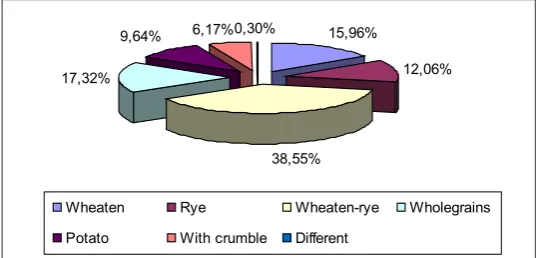
Consumers in Slovakia, as it results from the rea-li zed research, show their biggest interest in buy-ing wheat-rye breads (38.55 %). The least amount of respondents showed their interest in buying breads with pour spout, potato- and wholemeal breads (Graph 2).
Table I a,b point to respondents preferences relat-ing the kinds of bread accordrelat-ing to sex and age
Respondents prefer buying freely laid bread (57 %), which is in confl ict with the requirements of the EU policy. In case of bread packaging, more interest was shown in the packaged sliced breads than in wholly packaged breads. (Graph 3).
In our research we were interested in the external, subjective, followed by the internal, objective bread characteristics which infl uence the Slovak con su-mers’ behavior if they are buying this foodstuff .
It is clear from graph 4 that respondents pre-fer the overall shape when buying bread (45 %) and dark color of crust (25 %), they showed less interest in white color crust, respectively the size of packaging.
Table II shows the diff erences within the pre fe ren-ces of individual external – subjective characteristic features between women and men.
0% 10% 20% 30% 40% 50% 60% 70%
Men Women
Source: own research and processing
1: Percentage share of women and men participated on research
15,96%
12,06%
38,55% 17,32%
9,64% 6,17%0,30%
Wheaten Rye Wheaten-rye Wholegrains Potato With crumble Different
I: What kind of bread do you consume?
Kind of bread
Women by age
Women total do 25 years 26–35 years 36–45 years 46–55 years 56–65 years 66 and more years
Wheaten 3.16% 0.90% 3.16% 0.60% 1.65% 0.30% 9.79%
Rye 1.05% 1.20% 1.05% 0.60% 2.26% 0.90% 7.08%
Wheaten-rye 3.16% 3.01% 7.98% 2.56% 6.17% 0.45% 23.34%
Wholegrains 2.71% 1.96% 3.77% 1.66% 1.20% 0.75% 12.05%
Potato 0.30% 0.30% 2.26% 0.75% 1.96% 0.30% 5.87%
With crumble 1.05% 0.60% 2.26% 0.75% 0.00% 0.00% 4.67%
Diff erent 0.00% 0.00% 0.00% 0.00% 0.00% 0.00% 0.00%
Total 11.45% 7.98% 20.48% 6.93% 7.08% 2.71% 62.80%
Kind of bread
Men by age
Men total Total
do 25 years
26–35 years
36–45 years
46–55 years
56–65 years
66 and more years
Wheaten 1.81% 1.51% 1.36% 0.15% 0.90% 0.45% 6.17% 15.96%
Rye 0.61% 1.96% 0.90% 0.61% 0.45% 0.45% 4.98% 12.06%
Wheaten-rye 3.16% 2.56% 4.37% 1.51% 1.80% 1.81% 15.21% 38.55%
Wholegrains 1.66% 1.05% 1.36% 0.60% 0.15% 0.45% 5.27% 17.32%
Potato 0.45% 0.60% 1.05% 0.75% 0.60% 0.30% 3.77% 9.64%
With crumble 0.00% 0.30% 0.30% 0.60% 0.15% 0.15% 1.51% 6.17%
Diff erent 0.15% 0.15% 0.00% 0.00% 0.00% 0.00% 0.21% 0.30%
Total 7.83% 8.13% 9.34% 4.22% 2.41% 3.61% 37.20% 100.00%
Source: own research and processing
The most important factor in answering this ques-tion was freshness, in women (49.3 %) as well as in men (28.5 %), followed by fi ber(12.8%). Other character-istic features were not considered important in less than 4 % of the questioned respondents. The views regarding individual characteristic features were not too diff erent in men and women, nor from the point of age and education (Graph 5, Tab. III).
Almost 60 % of respondents said that they did not have any possibility to obtain the required infor-mation regarding bread. The reason is that it is not possible to fi nd professional staff in supermarkets and hypermarkets, which would be able to provide them with such information. A diff erent situation is in the classical, small, self-service, and specialized stores, where personal contact of a shop-assistant and a customer is more o en.
57% 14%
29%
Unpacked Complete packed Sliced packed
44,13%
13,25% 24,40%
7,53% 8,58% 2,11%
Overall shape Design Dark colour of skin Light colour of skin Size of packaging Don´t answer
Source: own research and processing
4:What is the most interesting thing for you if you are buying bread in terms of the “external – subjective” characteristic features?
II: What is the most interesting thing for you if you are buying bread in terms of the “external – subjective” characteristic features?
External characteristics Sex Total
Women Men
Overall shape 28.32% 15.81% 44.13%
Design 8.13% 5.12% 13.25%
Dark colour of skin 15.06% 9.34% 24.40%
Light colour of skin 4.52% 3.01% 7.53%
Size of packaging 5.87% 2.71% 8.58%
Don´t answer 0.90% 1.21% 2.11%
Total 62.80% 37.20% 100.00%
Age Overall shape Design Dark colour of skin Light colour of skin packagingSize of Other Total
to 25 years 8.28% 1.81% 4.67% 2.41% 1.51% 0.60% 19.28%
26–35 years 7.08% 3.46% 3.61% 0.60% 1.05% 0.30% 16.11%
36–45 years 13.86% 3.16% 7.98% 2.41% 1.66% 0.75% 29.82%
46–55 years 9.18% 2.32% 3.77% 1.05% 1.50% 0.15% 18.97%
56–65 years 3.31% 0.75% 2.41% 0.75% 2.11% 0.15% 9.49%
66 and more years 2.41% 0.75% 1.96% 0.30% 0.75% 0.15% 6.33%
Total 44.13% 13.25% 24.40% 7.53% 8.58% 2.11% 100.00%
Education Overall
shape Design
Dark colour of skin
Light colour of skin
Size of
packaging Other Total
Basic 0.90% 0.75% 0.90% 0.15% 0.30% 0.15% 3.16%
Secondary
professional 7.08% 2.86% 4.22% 1.51% 2.11% 0.45% 18.22%
Secondary with
graduation 13.10% 4.67% 8.89% 2.86% 2.71% 1.05% 33.28%
Undergraduate 23.04% 4.97% 10.39% 3.01% 3.46% 0.45% 45.33%
Total 44.13% 13.25% 24.40% 7.53% 8.58% 2.11% 100.00%
77,83% 3,77%
12,82% 1,51% 2,41% 1,66%
Freshment Volume Contenttassel Acidity Mineral matters Gluten
Source: own research and processing
5: Which initiated „internal – objective“ characteristics are you interested in bread purchasing in?
III: Which initiated „internal – objective“ characteristics are you interested in bread purchasing in?
Objective characteristics
Sex
Total
Women Men
Freshment 49.32% 28.51% 77.83%
Volume 2.26% 1.51% 3.77%
Contenttassel 7.39% 5.43% 12.82%
Acidity 1.36% 0.15% 1.51%
Mineral matters 1.66% 0.75% 2.41%
Gluten 0.75% 0.90% 1.66%
Total 62.75% 37.25% 100.00%
Age Freshment (humidity
Volume (porosity of breadcrumb)
Content
tassel Acidity
Mineral
matters Gluten Total
to 25 years 15.23% 0.15% 3.02% 0.00% 0.75% 0.15% 19.31%
26–35 years 13.12% 1.06% 1.36% 0.15% 0.15% 0.30% 16.14%
36–45 years 24.43% 0.60% 3.47% 0.15% 0.60% 0.45% 29.71%
46–55 years 13.48% 1.05% 2.42% 0.75% 0.75% 0.45% 19.00%
56–65 years 6.49% 0.45% 1.96% 0.30% 0.15% 0.15% 9.50%
66 and more years 4.98% 0.45% 0.60% 0.15% 0.00% 0.15% 6.33%
Total 77.83% 3.77% 12.82% 1.51% 2.41% 1.66% 100.00%
Education Freshment
(humidity
Volume (porosity of breadcrumb)
Content
tassel Acidity
Mineral
matters Gluten Total
Basic 2.26% 0.00% 0.60% 0.00% 0.15% 0.15% 3.16%
Secondary
professional 13.86% 0.60% 2.86% 0.30% 0.60% 0.00% 18.22%
Secondary with
graduation 25.30% 1.36% 4.22% 0.60% 0.90% 0.90% 33.28%
Undergraduate 36.30% 1.81% 5.12% 0.60% 0.75% 0.60% 45.33%
Total 77.71% 3.77% 12.80% 1.51% 2.41% 1.66% 100.00%
40%
60%
Yes No
Source: own research and processing
6: Do you have possibility to obtain demand information about free saved bread in store?
CONCLUSION
Cereal products keep their importance in peo-ple’s nutrition mainly because of their preventive ef-fects on health. They saturate about 40 % of the daily ener gy need of an average European, who in average acquires from cereals about 30 % of proteins, vitamin B1, niatin and phosphorus, around 1/6 of fats (out of it 19 % of linol acid), almost 60 % of saccharides, ¼ iron and about 13 % of vitamin B2 and calcium. If we add some cereal fi ber which is an eff ective pre-vention factor of cardiovascular diseases, metabolic and oncological diseases of colon and anus, we will get a complex picture about positive eff ects of ce-reals in our nutrition. If we were to mark any food-stuff which has been accompanying the mankind in the course of history, it could be bread. Its consum-mation is spread in the whole world. Only the ones who once suff ered from its lack have recognized its value.
It results from our research that consumers in Slo-vakia prefer consuming the wheat-ray bread (38.5 %). The respondents – consumers prefer at choosing buying bread in terms of the external, subjective
fac-tors, the overall shape when choosing bread (45 %) and dark color of crust (25 %). They showed mini-mum interest in white color crust and packaging size. In terms of the internal, objective factors, the most important factor for respondents, for women as well as for men was freshness of foodstuff s followed by fi -ber (with a big diff erence) (12.82 %).
Almost 60 % of bread consumers claimed that they did not have any possibility to obtain the required information regarding bread in supermarkets and hypermarkets because it is not possible to fi nd pro-fessional staff providing them with the required in-formation. A diff erent situation is in the classical, small, self-service, and specialized stores, where per-sonal contact of a shop-assistant and a customer is more o en. Results of the performed marketing re-search of consumer behavior in the market with ba-ke ry products will become a sort of the initial basis for departments involved in the research. The team of co-authors have the task to defi ne bread quality on the basis of chemical analyses in accordance with consumers needs.
SÚHRN
Vnímanie kvality chleba spotrebiteľom
Cieľom príspevku je zhodnotenie vnímania kvality chleba spotrebiteľmi na Slovensku. Chlieb je zá-kladnou potravinou, ktorá sa takmer denne vyskytuje na jedálnom lístku každej rodiny.
záu-jem prejavujú o bledú farbu kôrky a veľkosť balenia. Z hľadiska vnútorných objektívnych faktorov tak u žien (49,32%), ako aj mužov (28,51%) je za najdôležitejší faktor považujú respondenti čerstvosť potravín a s podstatným rozdielom nasleduje obsah vlákniny (12,82%). Takmer 60% konzumentov chleba uviedlo, že nemá možnosť získať požadované informácie o chlebe, nakoľko v supermarketoch a hypermarketoch nie je možné stretnúť personál, ktorý by takéto informácie poskytol. Iná je situ-ácia v klasických pultových, malých samoobslužných a špecializovaných predajniach, kde je častejší osobný kontakt predavača so zákazníkmi.
Výsledky realizovaného marketingového prieskumu spotrebiteľského správania na trhu pekáren-ských výrobkov sa stanú východiskovou základňou pre na projekte spolupracujúce pracoviská. Ko-lektív autorov má za úlohu defi novať kvalitu chleba na základe chemických rozborov a v súlade s po-žiadavkami spotrebiteľov.
spotrebiteľ, chlieb, kvalita, externé – subjektívne vlastnosti, interné – objektívne vlastnosti
REFERENCES
FORET, M., STÁVKOVÁ, J., 2003: Marketingový vý-zkum. 1. vyd. Praha: Grada Publishing, 160 s. ISBN 80-247-0385-8
HORSKÁ, E., 2007:Medzinárodný marketing (Inter-national Marketing). Nitra: SPU, 2007, 223 s. ISBN 978 8080 699383
GOLIAN, J., SOKOL, J., ZAJÁC, P., 2007: Food safe-ty and the emerging new food products and food technologies In: Acta Biochimica Polonica. –
War-szawa: Polish biochemical society, 1954. – Vol. 54, suppl. 1 (2007), s. 9. ISBN 0001-527X
KOTLER,P., 2007: Marketing manažment (Mar-keting Management). Praha: Grada 207 s., ISBN 8024700166
OBTULOVIČ, P., 2004: Bioštatistika. 3. vyd. Nitra: SPU, 2004, 132 s. ISBN 80-8069-432-X
PŘÍBOVÁ, M. a kol., 1996: Marketingový výzkum v praxi. 1. vyd. Praha: Grada Publishing, 1996. 248 s. ISBN 80-7169-299-9
Address