Themed Section: Science and Technology
Performance evaluation of Improvement in BER Performance using
DWT Based OFDM AND DFT Based OFDM for Different Modulation
Approaches
Navneet Ahuja1, Sandeep Somkuwar2
1Student M.TECH (Electronics &Telecom), GDR RUNGTA College of Engg. & Technology, Durg, Chattisgarh,
India
2Assistant Professor, GDR RUNGTA College of Engg. & Technology, Durg, Chattisgarh, India
ABSTRACT
Orthogonal frequency division multiplexing (OFDM) is a multicarrier modulation (MCM) technique which seems to be an attractive candidate for fourth generation wireless communication systems. OFDM offer high spectral efficiency, immune to the multipath delay, low inter-symbol interference (ISI), immunity to frequency selective fading and high power efficiency. Due to these merits OFDM is chosen as high data rate communication systems such as Digital Video Broadcasting (DVB) and based mobile worldwide interoperability for microwave access (mobile Wi-MAX). However OFDM system suffers from serious problem of high PAPR. In OFDM system output is superposition of multiple sub-carriers. In this case some instantaneous power output might increase greatly and become far higher than the mean power of system. To transmit signals with such high PAPR, it requires power amplifiers with very high power scope. These kinds of amplifiers are very expensive and have low efficiency-cost. If the peak power is too high, it could be out of the scope of the linear power amplifier. This gives rise to non-linear distortion which changes the superposition of the signal spectrum resulting in performancedegradation. If no measure is taken to reduce the high PAPR.
Keywords : OFDM, MCM, ISI, mobile Wi-MAX, PAPR, CCDF, BER, HPA, PTS, SLM
I.
INTRODUCTIONPAPR can be described by its complementary cumulative distribution function (CCDF). In this probabilistic approach certain schemes have been proposed by researchers. These include clipping, coding and signal scrambling techniques. Under the heading of signal scrambling techniques there are two schemes included. Which are Partial transmit sequence (PTS) and Selected Mapping (SLM). Although some techniques of PAPR reduction have been summarized in, it is still indeed needed to give a comprehensive review including some motivations of PAPR reductions, such as power saving, and to compare some typical methods of PAPR reduction
through theoretical analysis and simulation results directly. An effective PAPR reduction technique should be given the best trade-off between the capacity of PAPR reduction and transmission power, data rate loss, implementation complexity and Bit-Error-Ratio (BER) performance.The goal of precoding techniques is to obtain a signal with lower PAPR than in the case of OFDM without precoding techniques and to reduce the interference produced by multiple users. The PAPR reduction must compensate the nonlinearities of the HPA having as effect the reduction of the bit error rate (BER).
Traditional single carrier modulation
wireless channel and the receiver complexity. High data-rate is desirable in many recent wireless multimedia applications. However, as the data-rate in communication system increases, the symbol duration gets reduced. Therefore, the communication systems using single carrier modulation suffer from severe intersymbol interference (ISI) caused by dispersive channel impulse response, thereby needing a complex equalization mechanism. Orthogonal Frequency Division Multiplexing (OFDM) is a special form of multicarrier modulation scheme, which divides the entire frequency selective fading channel into many orthogonal narrow band flat fading sub channels. In OFDM system high-bit-rate data stream is transmitted in parallel over a number of lower data rate subcarriers and do not undergo ISI due to the long symbol duration.
Large envelope fluctuation in OFDM signal is one of the major drawbacks of OFDM. Such fluctuations create difficulties because practical communication systems are peak power limited. Thus, envelope peaks require a system to accommodate an instantaneous signal power that is larger than the signal average power, necessitating either low operating power efficiencies or power amplifier (PA) saturation. In order to amplify the OFDM signal with large envelope fluctuations, PAs with large linear range are required, which makes it very expensive. If PA has limited linear range then its operation in nonlinear mode introduces out of band radiation and in band distortion. It is also necessary to have D/A and A/D converters with large dynamic range to convert discrete time OFDM signal to analog signal and vice versa. PAPR is generally used to characterize the envelope fluctuation of the OFDM signal and it is defined as the ratio of the maximum instantaneous power to its average power. In addition to this, OFDM system requires tight frequency synchronization in comparison to single carrier systems, because in OFDM, the subcarriers are narrowband. Therefore, it is sensitive to a small frequency offset between the
transmitted and the received signal. The frequency offset may arise due to Doppler Effect or due to mismatch between transmitter and receiver local oscillator frequencies. The carrier frequency offset (CFO) disturbs the orthogonality between the subcarriers, and therefore the signal on any particular subcarrier will not remain independent of the remaining subcarriers. This phenomenon is known as inter-carrier interference (ICI), which is a big challenge for error-free demodulation and detection of OFDM symbols.
II.
REVIEW OF LITERATUREImran Baig and Varun Jeoti. 2010, “DCT Precoded SLM Technique for PAPR Reduction in OFDM”, have proposed a Discrete Cosine Transform (DCT) precoding based SLM technique for PAPR reduction in OFDM systems. This technique is based on precoding the constellation symbols with DCT precoder after the multiplication of phase rotation factor and before the Inverse Fast Fourier Transform (IFFT) in SLM-OFDM System. The scheme is faster and easier to deploy with lower operational costs for network maintenance but a null is placed in the direction of the interferers, so the antenna gain is not maximized at the direction of the desired user.
SeyranKhademi ,Alle-Jan Van der Veen , Thomas Svantesson. 2012,in “Precoding Technique For Peak-To-Average-Power-Ratio (Papr) Reduction In MIMO OFDM/A Systems”, This paper presents a new technique to reduce the peak to average power ratio (PAPR) in OFDM modulation for a MIMO system. This method exploits the Eigen-beamforming mode (EM) in MIMO systems which is a common feature in 4th generation standards. This scheme shows significant cost reduction and improved design flexibility due to the absence of the inter-connection between the MMIC and the antenna but suffers from low total efficiency.
Srishtansh Pathak and Himanshu Sharma, 2013 “Channel Estimation in OFDM Systems”, have focused on investigating the effect of fading in modern digital communication techniques such as orthogonal frequency division multiplexing (OFDM).
Although channel estimation can be avoided by using differential modulation techniques, these techniques will fail catastrophically in the fast fading channel, where the channel impulse response (CIR) varies significantly within the symbol duration. The major advantage of OFDM lies in processing frequency-selective channels as multiple flat-fading sub-channels but suffers from high peak-to-average-power ratio (PAPR), bit error rate (BER) and high sensitivity to carrier frequency offset (CFO).
Z. Wang and G. B. Giannakis, 2001“Linearly precoded or coded OFDM against wireless channel fades”, have integrated , LSE, MMSE, LMMSE, Low rank (Lr)-LMMSE channel estimators with the physical layer. The performance of estimation algorithms is analyzed in terms of BER, SNR, MSE and throughput. Simulation results proved that increment in modulation scheme size causes to improvement in throughput along with BER value. There is a trade-off among modulation size, BER value and throughput. It can accomplish a bandwidth efficiency but is not
suitable for applications with fast varying fading channels.
B. Muquet, Z. Wang, G. B. Giannakis, M. de Courville, and P. Duhamel, 2002,“Cyclic prefixing or zero padding for wireless multicarrier transmissions”, have presented evaluations and comparisons over the performance of these handover techniques. The effect of the mobile station speed on the handover techniques’ performance is also studied. The performance metric is the overall average downlink spectral efficiency which depends on the downlink carrier to interference and noise ratio (CINR).
The scheme is more stable and gives better performance and smoother transition, however there are some drawbacks with the use of two connections, system overhead will increase and the MS will use more network resources. MDHO is more complex than HHO
III.
PROBLEM IDENTIFICATION3.1
PROBLEM IDENTIFICATIONWireless communication, or sometimes simply wireless, is the transfer of information or power between two or more points that are not connected by an electrical conductor. The most common wireless technologies use radio waves. With radio waves distances can be short, such as a few meters for Bluetooth or as far as millions of kilometers for deep-space radio communications.Somewhat less common methods of achieving wireless communications include the use of other electromagnetic wireless technologies, such as light, magnetic, or electric fields or the use of sound.
3.2
EXISTING SYSTEMRandom data is generated and then the data is encoded by the encoder and the corresponding modulation is processed. The modulated signal is applied with the inverse Fourier transform is performed. After that the cyclic prefix data is added to the modulated signal and then the signal is passed into the channel with the noise. And the aforementioned process are performed on the transmitter side and then the reversal operations of the aforementioned processes are performed. In the receiver side the cyclic prefix is removed from the channel output data and then the pilot synchronization is performed after that the Fourier transform is applied on the synchronized data and then the demodulation is performed. And the demodulated data is decoded at the receiver. Finally the BER performance is estimated.
Disadvantage:
By adding cyclic prefix which occupies the 20%
bandwidth.
Spectral efficiency is less.
3.3
SOLUTION OF THE PROBLEMIn the proposed system we are using inverse discrete Fourier transform IDWT and discrete Fourier transform DWT at the place of IDFT and DFT. SUI - 2 channel is used for transmission and cyclic prefixing is not used. In the transmission side conventional encoding is performed and then interleaving is performed on the encoded data. Then the data is converted to decimal form and modulation is done. Here we are use the QPSK, QAM-16 and QAM-64 is performed. After modulation the pilot insertion and sub carrier mapping is performed on the data and then IDWT of the data, which provides the orthogonality to the subcarriers. IDWT will convert time domain signal to the frequency domain. After passing through the channel on the signal DWT will be performed and then pilot synchronization where the inserted pilots at the transmitter are removed then the demodulation is performed. Demodulated data is converted to binary
form and the de-interleaved and decoded to obtain the original data transmitted. Finally the performance of the system is evaluated by using the BER analysis.
Advantage:
Computational complexity is low.
Encoding signal at a low bit rate.
They have better Power spectral density.
Does not occupy much bandwidth.
IV.
METHODOLOGYbased OFDM, which is required in DFT based OFDM to maintain orthogonality so wavelet based system is more bandwidth efficient as compared with the DFT based OFDM. In discrete wavelet transform (DWT), input signal presented will pass through several different filters and will be decomposed into low pass and high pass bands through the filters. During decomposition the high pass filter will remove the frequencies below half of the highest frequency and low pass filter will remove frequencies that are above half of the highest frequency. The decomposition halves the time resolution because half of the samples are used to characterize the signal similarly frequency resolution will be doubled and this decomposition process will be repeated again for obtaining the wavelet coefficients of required level. Two types of coefficients are obtained through processing, first ones are called detailed coefficients obtained through high pass filter and second ones are called coarse approximations obtained through low pass filter related with scaling process. After passing the data through filters the decimation process will be performed. The whole procedure will continue until the required level is obtained.
4.1 METHODOLOGY
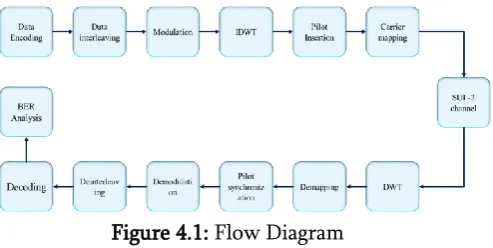
As shown in figure 4.1, in this proposed model we are using IDWT and DWT at the place of IDFT and DFT. AWGN channel is used for transmission and cyclic prefixing is not used. Here first of all conventional encoding is done followed by interleaving then data is converted to decimal form and modulation is done next. After modulation the pilot insertion and sub carrier mapping is done then comes the IDWT of the data, which provides the orthogonality to the subcarriers. IDWT will convert time domain signal to the frequency domain. After passing through the channel on the signal DWT will be performed and then pilot synchronization where the inserted pilots at the transmitter are removed then the demodulation is done. Demodulated data is converted to binary form and the de-interleaved and decoded to obtain the
original data transmitted. This system is implemented in following 4 stages.
1. OFDM Symbol Generation Model
2. Modulation Model
3. SUI – 2 Channel Model
4. Performance Analysis Model
The flow diagram of the methodology is shown in figure 4.1.
Figure 4.1: Flow Diagram
4.1.1 OFDM Symbol Generation Model
In an OFDM scheme, a large number of orthogonal, overlapping, narrow band sub-channels or subcarriers, transmitted in parallel, divide the available transmission bandwidth. The separation of the subcarriers is theoretically minimal such that there is a very compact spectral utilization. The attraction of OFDM is mainly due to how the system handles the multipath interference at the receiver. Multipath generates two effects: frequency selective fading and
intersymbol interference (ISI). The "flatness"
ISI even more. Thus, an equalizer in the receiver is not necessary.
4.1.2 Modulation Model:
QAM (quadrature amplitude modulation) is a method of combining two amplitude-modulated (AM) signals into a single channel, thereby doubling the effective bandwidth. QAM is used with pulse amplitude modulation (PAM) in digital systems, especially in wireless applications.This modulation technique is a combination of both Amplitude and phase modulation techniques. QAM is better than QPSK in terms of data carrying capacity. QAM takes benefit from the concept that two signal frequencies; one shifted by 90 degree with respect to the other can be transmitted on the same carrier. For QAM, each carrier is ASK/PSK modulated. Hence data symbols have different amplitudes and phases. QPSK: quadrature phase shift keying. Quadrature means the signal shifts among phase states that are separated by 90 degrees. The signal shifts in increments of 90 degrees from 45° to 135°, -45° (315°), or -135° (225°). Data into the modulator is separated into two channels called I and Q. Two bits are transmitted simultaneously, one per channel. Each channel modulates a carrier. The two carrier frequencies are the same, but their phase is offset by 90 degrees (that is, they are “in quadrature”). The two carriers are combined and transmitted • Four states because 2^2 = 4. Theoretical bandwidth efficiency is two bits/second/H.
4.1.3 SUI – 2 Channel Model:
Broadband Wireless Access working group proposed the standards for the frequency band below 11 GHz containing the channel model developed by Stanford University, namely the SUI models. The SUI model describes three types of terrain; they are terrain A, terrain B and terrain C. Terrain A can be used for hilly areas with moderate or very dense vegetation.OFDM has been incorporated into WiMAX technology to enable it to provide high speed data without the
selective fading and other issues of other forms of signal format.
4.1.4 Performance Analysis Model:
The bit error rate (BER) is the number of bit errors divided by the total number of transmitted bits over a channel. BER although unit-less also expressed in terms of percentage.The bit error rate (BER) is the number of bit errors per unit time. The bit error ratio (also BER) is the number of bit errors divided by the total number of transferred bits during a studied time interval. Bit error ratio is a unit less performance measure, often expressed as a percentage. The BER may be improved by choosing a strong signal strength, by choosing a slow and robust modulation scheme or line coding scheme, and by applying channel coding schemes such as redundant forward error correction codes.The BER may be evaluated using stochastic (Monte Carlo) computer simulations. If a simple transmission channel model and data source model is assumed, the BER may also be calculated analytically.
V.
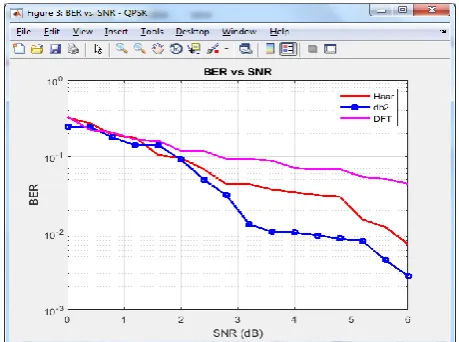
RESULTS AND DISCUSSIONSDifferent wavelet types daubechies2 and haar is used in wavelet based OFDM for QPSK, 16-QAM, 64-QAM. It is clear from the fig. 3, fig. 4 and fig. 5 that the BER performance of wavelet based OFDM is better than the DFT based OFDM. Fig. 3 indicates that db2 performs better when QPSK is used. Fig. 4 shows that when 16-QAM is used db2 and haar have similar performance but far better than DFT. Fig. 5, where 64-QAM is used haar and db2 performs better than DFT.
Figure 5.1. BER performance of wavelets and DFT based OFDM system using 16- QAM modulation.
Figure 5.2. BER performance of wavelets and DFT based OFDM system using 64- QAM modulation.
Figure 5.3. BER performance of wavelets and DFT based OFDM system using QPSK modulation.