800
Adaptive Sitting Plan Algorithm Based On Henon
Chaotic Map
Ashish Kumar, N S Raghava
Abstract: Examinations are an essential part of colleges, universities and academic institutes, where students go through many stages of evaluation scheme for better assessment. An organized structure of an exam hall with a proper sitting arrangement of students leads the implementation process of examination. A fraudulent behaviour such as cheating in examinations can hamper the efforts of many students; it is the Machiavellian behaviour of students which is being increased with technology and the rapid growth of the internet. In this paper, we have designed two algorithms, the first algorithm generates automatic sitting arrangement plan for examination halls to prevent mismanagement, prohibited material, and cheating during examinations and the second algorithm deals with Henon chaotic map to rescheduled the sitting plan. It is based on the sitting allocation methodology to generate random allocation in classrooms for every exam to prevent cheating from their surrounding locations. To preserve academic integrity, it is required to decrease the possibility of cheating in the examination hall. Maximum utilization of classrooms and less human resources are the main objectives of the proposed algorithms. Proposed work has been applied to university, and it gives a better environment during examination with the less human resource in a less executable time rather than a manual sitting plan allocation methods.
Index Terms: Allocation, cheating, classrooms, examination, Henon chaotic map, management, sitting arrangement.
————————————————————
1
I
NTRODUCTIONExams are the critical phase in every academic institute, and it also takes place in a competitive exam where many students enrolled themselves to get a job or admission [1] [2], and it is conducted at immense scale. In order to write exams in the given time frame, it is necessary to adjust the students in the classroom along with efficient management. To conduct an examination, the exam controller takes in charge of all the responsibilities which are related to exams [3]. Arrangements of desks in a classroom most often are fixed, and it cannot be transferred from the place, which leads to an administrator or exam controller for the students have to take concrete steps to the seating arrangement of seats in each classroom. Before the examination, the sitting plan of every classroom is generated and is also shared with students. When the student finds the right place for his sitting according to the sitting plan, then for each exam, the student has to sit in the same place that was already designated during the examination. Invigilators are sent by the authority in classrooms to monitor students and also for conducting exams successfully. In a classroom, during the examination, its corresponding attendance sheet is also essential to calculate a total number of present students and absentees to maintain records of student whether student has appeared or not in the examination. Exam sheets are collected in the end, and it also verified with the attendance sheet as shown in Fig. 1. Exam seating allocation algorithm is required to accommodate students in such a way that all the students of different discipline can write their exam efficiently without any interruptions [4] [5]. Many institutes do not use algorithms or techniques to generate seating allocation plan, it is based on some basic rules, number of students, size of classrooms, number of disciplines in the institute, time slots and types of examinations. A cooperative seating arrangement can trouble
the invigilators, and there are more chances for students to copy content from their neighbor’s exam sheet. Generally, in many institutes, Seats are allocated to students in a traditional approach with some facile rules, which increases the cost and time to get a feasible solution. There are possibilities of error in manual approach which are like, few seats are left empty, overlapping of seats between students, no seat is allocated to student, and there is also the fear that two adjacent students are writing the same paper. Having said that, question papers are distributed to students and increases the sore difficulties of invigilators and makes a complex system. Positive academic behaviour is developed with a proper sitting plan during the examination and even in classrooms during theory lectures to maintain discipline [6]. In this paper, we have designed two algorithms to preserve academic integrity; the first algorithm generates automatic sitting arrangement plan for examination halls to prevent prohibited material and cheating during examinations. The second algorithm deals with Henon chaotic map; It is associated with the sitting plan to generate random allocation in classrooms for every exam to prevent cheating from their surrounding locations. To conduct the examination in the institute, sitting plan along with its corresponding attendance for better monitoring is required. Cheating is common phenomena in human nature, which is also replicated in academic because of a few students. Cheating can be done in various ways which are mentioned below:
To answer the questions given in the exam, copying content from the adjacent student’s answer sheet from the same discipline in the examination hall. Cheating is also done through state-of-the-art
technology.
Once a student knows his sitting position in the examination hall, then there is a possibility that for the next upcoming exam, a student may write answers or text on the desk, and may hide exams related content.
————————————————
Ashish Kumar is currently pursuing Ph.D. degree program in Department of Information Technology, Delhi Technological university, Delhi, India 110042 E-mail: [email protected]
2
P
ROPOSEDA
LGORITHMIn many institutes, sitting allocation plan is designed by members of exam cell or by the exam controller, and it is required to have a large number of human resources to create an environment to generate a proper sitting plan. Many meetings of faculties with board members are placed before the examination to facilitate students for a proper atmosphere to write their exams. In order to reduce the enormous load, this paper introduces two algorithms. Student database is considered as input for the proposed algorithms. The first algorithm deals with the allocation of seats in classrooms with detailed attendance sheet of students of every classroom whereas the second algorithm is designed to generate a random sitting plan to prevent unethical things during the examination. Figure. 1.(a) Demonstrates the proposed algorithm, where different discipline participates in the examination process.
2.1 Adaptive Sitting Allocation Algorithm
The education system also has an essential contribution to the economic growth of any country and education system is assessed by the educational environment and knowledge of the student. To do this, an examination is required for better assessment, through this, the foundation of the students’ future is laid. Various disciplines of institute participate in examination process simultaneously. At the initial stage, a number of registered students who are going to appear in exam are identified and count number of students in each discipline. The second input for this algorithm is based on classrooms, where two parameters are taken: size of classroom and number of classrooms. The size of the examination hall defines how many students can be accommodated for the examination. Generally, examination halls consist of tables which are arranged in a row-column fashion. Maximum Utilization of examination halls is one of the primary objectives of the proposed algorithm.
the system administrator that in which column roll numbers of students are written in the file. The number of students in every discipline may be the same or may not be the same, so column size is taken maximum in the account for the driven approach.
Step (2): Roll numbers of each branch are stored in a separate list, and the number of students of different discipline is counted. For maximum utilization of classrooms or examination halls, student data lists are equally divided into four parts. An administrator finalizes four different lists with the manual and automatic approaches. Therefore, the creation of these four list entirely depends upon the examination controller. In two ways allotment can proceed further. A total number of students are counted by using the following equation.
( )
1 n
i
i
M
m
(1)
Where M represents a total number of students in the institute.
a) Automatically System Generated List
In this approach, the system works itself to divide the total number of students list into four equal parts, and processed lists are further used as input for step 3.
TABLE I.PSEUDO CODE OF STEP (1)
1. for i ← 1 to n do 2. filename ← file(i).xlsx
3. [num, text(i)] ← xlsread (filename, size)
4. extracted only roll numbers from the list by specified that column
802 b) Manual Approach to Generate a List
In this approach, lists are prepared by a member of the examination cell. Manually, we have taken four lists to allocate student in examination halls. Various disciplines enrolled and wrote their exams. So, it is considered that students of the same discipline can be found at a nearby location. For example, A, B, C, D, E, F, G are different discipline, and the lists are created in such a way that there is not much difference in size of the list or ideally the number of students in the list should be equal.
list1 = A + G list2 = B + H list3 = C + E list4 = D
Step (3): Classroom’s structure is constructed in a row, column fashion. In which, the position of desks is fixed, and it is assumed that table or desk will not be moved from one classroom to another classroom. The classroom is taken as a matrix, and it is also found that how many classes have the same number of columns, those classes are put together in which the number of columns are same and treated as a single classroom. Let us consider, the class1 dimension is M1 × N and class2 dimension is M2 × N, then these two classrooms can be merge and can be treated as a single classroom having the strength to accommodate student will be (M1 × M2) × N. same is followed with other classrooms.
Step (4): In this section, step3 is repeated until all the classrooms of the institute are covered. Sitting plan which is generated by step 3., divided into a separate and individual sitting plan for every classroom. Attendance lists of classrooms are also generated itself by the proposed algorithm on the basis of sitting plan.
TABLE II:PSEUDO CODE OF STEP 2.(A) total = 0
text = emptylist
for i = 1: n do
text ← text + text(i)
total ← total + m(i) end for
d ← total/4;
rem ← total%4
list1 = text(1 : d)
list2 = text(d + 1 : 2d)
list3 = text(2d + 1 : 3d)
list4 = text(3d + 1 : 4d + rem)
TABLE III.PSEUDO CODE FOR STEP (3)
Initialize: ptr1=1, ptr2=1, ptr3=1, ptr4=1 for i←1: total number of rows
for j ←1: N
if (i and j both variables are not divisible by 2) if (ptr1<= size of list1)
c (i, j) ← list1(ptr1,1) ptr1=ptr1+1; else
c (i, j) ← seat is empty end
else if (i is not divisible by 2 and j is divisible by 2) if (ptr2<= size of list2)
c (i, j) ← list2(ptr2,1) ptr2=ptr2+1; else
c (i, j) ← seat is empty end
else if (i is divisible by 2 and j is not divisible 2) if (ptr3<= size of list1)
c (i, j) ← list3(ptr3,1) ptr1=ptr3+1; else
c (i, j) ← seat is empty end
else (i and j are divisible by 2) if (ptr4<= size of list4) c (i, j) ← list4(ptr4,1) ptr4=ptr4+1; else
c (i, j) ← seat is empty end
(a)Content on Wall (b) Content on Desk
Figure 3. Prohibited text content on desk and wall
2.2 Random sitting allocation using Henon chaotic map Henon chaotic map is introduced in sitting allocation methodology to provide a random sitting allocation for every examination hall. Sometimes students write the relevant content of the next exam on a desk or table and enclosure walls as shown in Fig. 3., it helps them to copy content from the table or desk to their answer sheets. One more way that once a student knows his location as per sitting plan, a student may hide notes or book near to their surrounding location. Subsequently, for a legitimate reason, student come out from examination hall. Meanwhile, student receives answers from the hidden material. Chaotic maps are widely used in various field of science; therefore, different chaotic maps are also associated with chaos theory. Chaotic maps are mainly used to generate pseudo-random numbers and can be used as per the requirement of research [7].
Step (1): Henon chaotic map [8][9] was discovered in 1978, and mostly, it is used as a pseudo-random number generator in security systems. Two dimensional discrete-time nonlinear dynamical Henon chaotic map generates a pseudo-random binary sequence which has been described as below in (2).
Xn+1 = 1+Yn – aXn
Yn+1 = bXn n=0, 1, 2… (2)
Here, the parameters, a and b are of prime importance as the dynamic behaviour of the system depends on these values.
The system cannot be chaotic unless the value of a and b are 1.4 and 0.3 respectively.
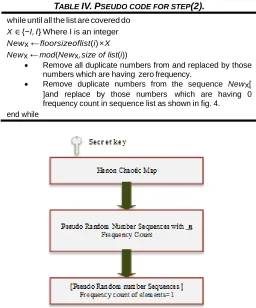
Step (2): In adaptive sitting allocation algorithm, four lists were generated in two ways. Here, the size of each list is taken for further approach. This sequence is converted into [1, size(list)] using modular arithmetic as shown in Fig. 4.
Figure 4. Pseudo-random numbers generation using Henon chaotic map
TABLE IV.PSEUDO CODE FOR STEP(2). while until all the list are covered do
X ∈ {−I, I} Where I is an integer
Newx ← floorsizeoflist(i) × X Newx ← mod(Newx, size of list(i))
Remove all duplicate numbers from and replaced by those numbers which are having zero frequency.
804 TABLE V. ATTENDANCE SHEET FOR THE CLASSROOM A
TABLE VI. SITTING PLAN FOR CLASSROOM A ATTENDANCE SHEET
ROOM NO: HALL-01
CO BOOKL
ET NO.
SIGNAT
URE ME
BOOK. NO.
SIGN ATUR E
EE BOOK.
NO.
SIGNATU
RE EC
BOOKLE T NO.
SIGNATUR E
CO/01 ME/01 EE/01 EC/01
CO/02 ME/02 EE/02 EC/02
CO/03 ME/03 EE/03 EC/03
C0/04 ME/04 EE/04 EC/04
CO/05 ME/05 EE/05 EC/05
CO/06 ME/06 EE/06 EC/06
CO/07 ME/07 EE/07 EC/07
CO/08 ME/08 EE/08 EC/08
CO/09 ME/09 EE/09 EC/09
CO/10 ME/10
CO/11 ME/11
CO/12 ME/12
ROOM NO. HALL -01
CO/01 EE/01 CO/02 EE/02 CO/03 EE/03 CO/04
ME/01 EC/01 ME/02 EC/02 ME/03 EC/03 ME/04
CO/05 EE/04 CO/06 EE/05 CO/07 EE/06 CO/08
ME/05 EC/04 ME/06 EC/05 ME/07 EC/06 ME/08
CO/09 EE/07 CO/10 EE/08 CO/11 EE/09 CO/12
ME/09 EC/07 ME/11 EC/08 ME/11 EC/09 ME/12
CO/01- CO/12 =12 ME/01-ME/12=12
EE/01 -EE/09= 09 EC/01- EC/09=09
Step (3): Now, the Random sequence is used to shuffle the roll numbers of a student’s list; pseudo-random sequence is used to rearrange the list by its indexing position with new index position using the Newx [ ] matrix. Later this shuffled list is utilized to regenerate the new sitting plan.
3
E
XPERIMENTALR
ESULTS ANDD
ISCUSSIONSitting plan is prepared by locating the number of students in the examination hall. Generally, when the individuals of the institutes do this work, it takes a lot of time and resources. In order to reduce the complexity of the system and prevent unethical practices, this paper helps in many ways. Proposed algorithm gives impressive results, and when the algorithm is implemented and tested, the drawbacks that were found in the traditional approaches seem to be moved away through this proposed algorithm. In this section, experimental results of the proposed algorithm are given to appreciate the efficiency of the proposed security system. MATLAB 7.9 software with 8 GB ram is used for implementation of proposed algorithm along with the use of Microsoft excel worksheet for reading and writing operations. The proposed algorithm generates table V and Table VI and it shows that the proposed algorithm works appropriately without any overlapping or underlapping problem and also reduce the cost of the prior implemented system. Henon chaotic map plays an important role to generate a new sitting plan for every exam, which helps institute to prevent cheating and misconduct of students.
4
C
ONCLUSION ANDF
UTUREW
ORKCheating is a common practice among students, and their human behaviour brings it. Academic Institute cannot stop the trend of imitating the students completely, but by creating an improved environment, the ideal education system can be prepared. Sitting plan gives proper management for conducting the examination process. A system with MATLAB and Microsoft excel worksheet is enough to generate a sitting plan; it takes a few seconds instead of taking several weeks. The education system is the backbone of any country, and many academic institutions are working to make it strong towards this direction. If a healthy examination process is governed by an institute, then by the results obtained, many steps can be taken to improve the education system, and this is only possible by the cooperation of teachers and students. Institute for upcoming exams can train those students who could not get a good result in an examination. The Henon chaotic map has been used to generate a random sittings plan to prevent cheating during the examination; it helps invigilators and also students for better assessment. It is possible in upcoming that how this input could be taken automatically by the system itself for the maximum utilization of examination halls.
R
EFERENCES[1] Clark, B.R.: The Higher Education System: Academic Organization in Cross-national Perspective. Univ of California Press, (1986).
[2] Mizruchi, M.S.: Who controls whom? an examination of the relation between management and boards of directors in large american corporations. Academy of Management review 8(3), 426–435 (1983).
[4] Burke, E.K., Elliman, D., Weare, R.: A genetic algorithm based university timetabling system. In: Proceedings of the 2nd East-west International Conference on Computer Technologies in Education, vol. 1, pp. 35–40 (1994)
[5] Hill, K.T., Wigfield, A.: Test anxiety: A major educational problem and what can be done about it. The Elementary School Journal 85(1), 105–126 (1984).
[6] Biggs, J.B.: Teaching for Quality Learning at University: What the Student Does. McGraw-Hill Education (UK), (2011).
[7] Petrisor, E.: Entry and exit sets in the dynamics of area preserving Henon map. Chaos, Solitons & Fractals 17(4), 651– 658 (2003).
[8] Guo-hui, L., Shi-ping, Z., De-ming, X., Jian-wen, L.: An intermittent linear feedback method for controlling he´ non-like attractor. Journal of Applied Sciences, 288–290 (2001).