DOI 10.1007/s13173-013-0108-8 O R I G I NA L PA P E R
Link prediction using a probabilistic description logic
José Eduardo Ochoa Luna · Kate Revoredo · Fabio Gagliardi Cozman
Received: 23 November 2012 / Accepted: 7 March 2013 / Published online: 25 April 2013 © The Brazilian Computer Society 2013
Abstract Due to the growing interest in social networks, link prediction has received significant attention. Link pre-diction is mostly based on graph-based features, with some recent approaches focusing on domain semantics. We pro-pose algorithms for link prediction that use a probabilis-tic ontology to enhance the analysis of the domain and the unavoidable uncertainty in the task (the ontology is specified in the probabilistic description logiccrALC). The scalabil-ity of the approach is investigated, through a combination of semantic assumptions and graph-based features. We evalu-ate empirically our proposal, and compare it with standard solutions in the literature.
Keywords Link prediction·Probabilistic logic· Description logics
1 Introduction
Many social, biological, and information systems can be well described as networks, where nodes represent objects (individuals), and links denote the relations or interactions between nodes. Predicting a possible link in a network is an interesting issue that has received significant attention. For
J. E. Ochoa Luna·F. G. Cozman
Escola Politécnica, Universidade de São Paulo, Av. Prof. Mello Morais 2231, São Paulo, SP, Brazil e-mail: [email protected]
F. G. Cozman
e-mail: [email protected] K. Revoredo (
B
)Departamento de Informática Aplicada, Unirio, Av. Pasteur, 458, Rio de Janeiro, RJ, Brazil e-mail: [email protected]
instance, one may be interested in finding potential friend-ships between two persons in a social network, or a potential collaboration between two researchers. In short,link predic-tion aims at predicting whether two nodes should be con-nected, given previous information about their relationships or interests.
Mohammad and Mohammed [18] survey representative link prediction methods, classifying them into three groups. In the first group, feature-based methods construct pairwise features to use in classification. The majority of the features are extracted from the graph topology by computing similar-ity based on the neighborhood of the pair of nodes, or based on ensembles of paths between the pair of nodes [15]. Seman-tic information has also been used as features [26,32]. The second group includes probabilistic approaches that model the joint probability for entities in a network by Bayesian graphical models [31]. The third group employs linear alge-braic approaches that compute the similarity between nodes in a network by rank-reduced similarity matrices [14].
The paper is organized as follows. Section2reviews basic concepts of probabilistic description logics and of link pre-diction. Our proposals for a scalable semantic link prediction approach appear in Sect.3. Section4describes experiments, and Sect.5concludes the paper and discusses some future work.
2 Background
This section briefly review probabilistic description logics and link prediction methods, with a focus on concepts and techniques that are later used.
2.1 Probabilistic description logics andcrALC
Description logics (DLs) form a family of representation lan-guages that are typically decidable fragments of first-order logic (FOL) [3]. Knowledge is expressed in terms of individ-uals,concepts, androles. The semantics of a description is given by adomainD(a set) and aninterpretation·I(a func-tor). Individuals represent objects through names from a set NI = {a,b, . . .}. Eachconceptin the setNC = {C,D, . . .}
is interpreted as a subset of a domainD. Eachrole in the setNR= {r,s, . . .}is interpreted as a binary relation on the
domain. An assertion states that an individual belongs to a concept of that a pair of individuals satisfies a role. AnABox is a set of assertions.
A popular description logic isALC[27]; given its impor-tance to our proposal, we briefly review it here. Constructors inALCareconjunction(CD),disjunction(CD), nega-tion(¬C),existential restriction (∃r.C), andvalue restric-tion (∀r.C). Conceptinclusionsanddefinitionsare denoted respectively byC D andC ≡ D, whereC and Dare concepts. ConceptC ¬C is denoted by , and concept C ¬Cis denoted by⊥. The semantics of these constructs is given by a domainDand aninterpretationIas follows: each individuala is mapped into an elementaI; each con-ceptCis mapped into a subsetCI of the domain; each role ris mapped into a binary relationrIin the domain; moreover,
– (CD)I=CI∩DI; – (CD)I=CI∪DI; – (¬C)I =D\CI;
– (∃r.C)I= {x∈D|∃y:(x,y)∈rI∧y∈CI}; – (∀r.C)I = {x∈D|∀y:(x,y)∈rI→ y∈CI}.
Finally,C Dis interpreted asCI ⊆ DI andC ≡ Dis interpreted asCI =DI.
An example may be useful. Consider the following con-cept definition:
Researcher≡Person ∃hasPublication.BibItem,
(1)
specifying that researchers are individuals who are persons and who have published a bibliographic item.
Severalprobabilisticdescription logics have appeared in the literature [13,17]; here we just indicate a few represen-tative proposals.
Heinsohn [11] and Sebastiani [28] consider probabilistic inclusion axioms such as
PD(Professor)=α,
meaning that a randomly selected object is aProfessorwith probabilityα. This characterizes adomain-basedsemantics: probabilities are assigned to subsets of the domainD. Sebas-tiani also allows inclusions such asP(Professor(John))=
α, specifying probabilities over the interpretations them-selves. For example, one interprets P(Professor(John))=
0.001 as assigning 0.001 to be the probability of the set of interpretations whereJohnis aProfessor. The latter seman-tics characterizes aninterpretation-basedsemantics.
The probabilistic description logiccrALCis a probabilis-tic extension of the description logic ALC that adopts an interpretation-based semantics. It keeps all constructors of ALC, but only allows concept names on the left hand side of inclusions/definitions. Additionally, incrALCone can have probabilistic inclusions such as P(C|D)=αor P(r)=β for conceptsC andD, and for roler(in this paper we only consider equality in probabilistic inclusions/definitions). If the interpretation of Dis the whole domain, then we sim-ply write P(C)= α. The semantics of these inclusions is roughly (a formal definition can be found in Ref. [5]) given by:
∀x∈D : P(C(x)|D(x))=α, ∀x∈D,y∈D : P(r(x,y))=β.
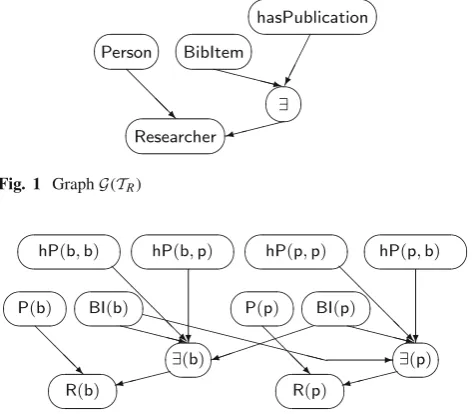
We assume that every terminology is acyclic: no concept uses itself (where “use” is the transitive closure of “directly use”; we say thatCdirectly usesDifDappears in the right hand side of an inclusion/definition, or in the conditioning side of a probabilistic inclusion). This assumption allows one to represent any terminology T through a directed acyclic graph. Such a graph, denoted by G(T), has each concept name and role name as a node, and if a conceptC directly uses concept D, that is ifC and D appear respectively in the left and right hand sides of an inclusion/definition, then D is a parent of C in G(T). Each existential restriction ∃r.C and each value restriction∀r.C is added to the graph G(T)as a node, with an edge fromr andCto each restric-tion directly using it. Each restricrestric-tion node is a determin-isticnode in that its value is completely determined by its parents.
Fig. 1 GraphG(TR)
Fig. 2 Bayesian network over indicator functions of assertions, produced by grounding the terminologyTR
0.2,P(BibItem)=0.6,P(hasPublication)=0.1; its graph is depicted in Fig.1.
The semantics ofcrALCis based on probability measures over the space of interpretations, for a fixed domain. To make sure a terminology specifies a single probability measure, a number of additional assumptions are adopted: the domain is assumed finite, fixed, and known; the unique-name assump-tion and the rigidity assumpassump-tion for individuals (as usual in first-order probabilistic logic [6]) are assumed; a single con-cept name appears in the left hand side of any inclusion or definition and in the conditioned side of any probabilistic inclusion; and finally a Markov condition imposes indepen-dence of any grounding of concept/role conditional on the groundings of its corresponding parents in the graphG(T) [5]. Given these assumptions, a set of sentencesT incrALC defines arelational Bayesian network[12] whose underlying graph is exactlyG(T).
Consider the following example. Suppose we have termi-nologyTRand domainD= {bob,paper}, There are several
possible sets of assertions that are obtained by grounding. For instance,
{Person(bob),Researcher(bob),
BibItem(paper),hasPublication(bob,paper)}.
The assumptions discussed in the previous paragraph induce a single probability measure over the set of all assertions (groundings), because they induce a Bayesian network over indicator variables of assertions.
For example, for domain D = {bob,paper}, Fig. 2 depicts the Bayesian network over indicator variables of assertions (for the sake of space, names are abbreviated; for
instance,hPdenoteshasPublication;bdenotesbob, and so on). To simplify notation, the indicator function of assertion C(a)is indicated simply byC(a), instead of the more usual conventionIC(a)=true.
Inferences, such asP(Ao(a0)|A)for an ABoxA, can be
computed by grounding, thus generating a Bayesian network where one “slice” is built for each individual. For instance, in the Bayesian network depicted in Fig.2two slices, one for individualboband another for individualpaper, are built. For large domains, exact probabilistic inference is in gen-eral quite hard. Variational algorithms that approximate such probabilities are available in the literature [5].
2.2 Link prediction
The task we are interested in can be defined as follows [15]. One is given a network (a graph) G consisting of a set of nodesV (represented by lettersa,b, etc) and a set of edges E, where an edge represents an interaction between nodes. Interactions may be tagged with times, and the link prediction problem may be one of predicting the existence of edges in a time interval, given the edges observed in another time interval. Here we are interested in a static problem where we are given nodes and edges, except for the edge between two nodesAandB, and we must then predict whether there is an edge betweenAandB.
Many different tools are used for link prediction, some of which, like matrix factorization, are related to the massive size of datasets; other tools are directly related to the exis-tence of links between nodes. One can use classifiers that, based on network features and measures, classify each ten-tative link as existing or not [18]; one may also resort to col-lective classification over the whole set of possible links [7]. Several such techniques are based on computing measures of proximity/similarity between nodes in a network [15,16]. One of them is the Katz measure [15], a weighted sum of the number of paths in the graph between two given nodes, with higher weights assigned to shorter paths:
Katzβ(A,B)=
∞
i=1 βi
pi,
wherepiis the number of paths of lengthiconnectingAand B, whileβ ∈ (0,1]weighs the paths—a small value ofβ favors shorter paths. Another notable proximity measure is the Adamic–Adar measure [1], given by:
Adamic−Adar(A,B)= C∈Γ (A)∩Γ (B)
1 log|Γ (C)|,
nodes, we should emphasize common neighbors that have less neighbors themselves.
Other approaches to link prediction consider semantic fea-tures. The degree of semantic similarity among entities can be useful to predict links that might be missed by simple topo-logical or frequency-based features [31]. One way of captur-ing semantic similarity is by considercaptur-ing documents related to nodes in the network. A simple example of semantic simi-larity is the keyword match count between two authors [10]. A more sophisticated method makes use of the well-known techniques such as TFIDF feature vector representation and the cosine measure to compute similarity [31]. The latter measure, for documentsd1 andd2, is obtained by creating
vector representations−→V(d1)and−→V(d2)that contain word
counts weighted by their TFIDF (Term Frequency−Inverse Document Frequency) measures. The similarity measure is then
cosine(d1,d2)=
− →
V(d1)·−→V(d2)
|−→V(d1)||−→V(d2)| ,
where the dot product is used in the numerator and the Euclid-ean distance is used in the denominator. To recall, the TFIDF weighting scheme assigns to termta weight in documentd given by TFIDFt,d=TFt,d×IDFt, where TFt,dis the term frequency ind, and IDFtis the inverse document frequency
oft, given by IDFt = logDFN
t, for N the total number of documents and DFtthe number of documents containing the
term.
Approaches to link prediction can be understood not only by considering the kinds of tools employed, but also by examining the model that is used to represent the network as a whole. Typically, one assumes some sort of probabilis-tic mechanism that at least partially explains the existence of edges, perhaps together with domain-specific knowledge (for instance, domain theories about human relationships) [9,19]. Thus the simplest network model is the Erdös–Rènyi random graph: each pair of nodes can be connected with identical probability. More sophisticated models resort to hierarchical specification of link probabilities, or to grouping of nodes within blocks of varying probability.
One way to capture the probabilistic structure of a net-work is through graph-based models such as Markov random fields or Bayesian networks [23]. However, these languages are well suited to express independence relations between a fixed set of random variables; when nodes and links are to be dealt within graphs, it is best to consider modeling lan-guages that can specify Markov random fields and Bayesian networks over relational structures. Indeed many proposals for link prediction resort to such languages, from seminal work by Getoor et al. [8] and Taskar et al. [29]. The pres-ence of relational structure lets one to represent properties of individuals nodes, of links, of communities; one can then
compute the probability of specific links, and estimate such probabilities from data. In this paper, we follow this model-ing strategy; the difference between our modelmodel-ing language and previous proposals is that we adopt a language based on description logics, as already indicated in the previous sec-tion. Our interest in models based on description logics is justified given recent results on the importance of ontologies in organizing information that can be used in link prediction [2,4,30].
3 Link prediction withcrALC
Given a networkG where many links are observed, one is interested in predicting whether a link between nodesaandb exists (presumably the linkage betweenaandbhas not been observed). We address this problem by considering, in addi-tion to topological informaaddi-tion about the network, knowl-edge about the domain concerning network entities. To do so, domain knowledge is represented through a probabilis-tic ontology usingcrALC. Among the concepts (NC) and roles (NR) in the ontology, there is a conceptCˆthat indicates which elements of the domain are nodes in G, and a role
ˆ
r that indicates which pairs of elements are linked—hence ˆ
C andrˆ describe the network itself, while other concepts and roles describe the remaining domain knowledge. In our experience, it is important to explicitly indicate which ele-ments of the domain are nodes, to make sure inference runs only with the required elements (in effect this is providing a type that separates network nodes from other elements of the domain).
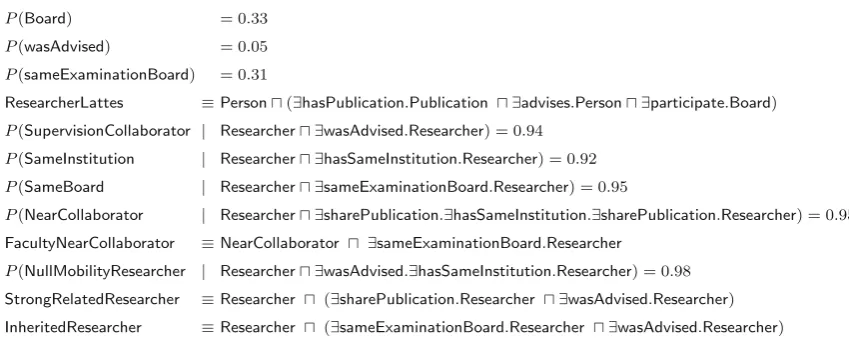
For example, in a coauthorship network, nodes repre-sent researchers and relationships may be “has a publi-cation with” or “is advised by”. An ontology for such a domain, represented by crALC, is shown in Fig. 3. The ontology describes publications, using concepts such as Researcher andPublication, and using roles such as
hasPublication,hasSameInstitution,sharePublication. Nodes in the network instantiate a concept (for instance
Researcher), while links in the network instantiate a role (for instancesharePublication).
Fig. 3 A probabilistic ontology for the co-authorship domain, and an ABox
Require:a networkG, an ontologyO, a rolerˆrepresenting links in the network, a conceptCˆspecifying the nodes in the network and a thresholdγ.
Ensure:a set of predicted linksL
1: initializeL= ∅;
2: initializeE=evidence (set of all assertions); 3:for allpair of instances(a,b)of nodes inGdo
4: ifthere is no link between nodesaandbinGthen
5: infer probabilityP(r(a,b)|E)using the relational Bayesian network created from the ontologyO; 6: ifP(r(a,b)|E) > γthen
7: add link betweenaandbtoL. 8: end if
9: end if
10:end for
Algorithm 1: Algorithm for link prediction: evidence is the complete set of assertions
the information about the domain. If this probability is higher than a suitable threshold, then a link is included.
Our first link prediction algorithm is described in Algorithm 1.1
The algorithm starts by going through all pairs of instances of the concept Cˆ (that is, all nodes). For each pair, it checks whether a link between the corresponding nodes exist in the network; if not, the probability of the link is computed using the relational Bayesian network extracted from the ontology O. If the probability is greater than a threshold, then the corresponding link is added to the set of suggested links. (Alternatively, when the threshold is not given, a list of links, ranked by their probability, can be produced.)
The evidence is the given set of assertions; the size of this set has great impact in inference effort. When infer-ences are computed, the ontology is turned into a relational Bayesian network, whose grounding is a Bayesian network— each assertion may generate a new slice of nodes in this grounded Bayesian network. Approximate algorithms are necessary for inference; in this work we employ the vari-ational inference method described in Ref. [5]. While one can suppose that more assertions lead to more accurate
pre-1This algorithm was first discussed in Ref. [25], and later refined,
together with Algorithm 2, in Refs. [22] and [21]; the presentation is here further refined. Some experiments and results reported here appeared in those preliminary publications; in this paper we also describe novel experiments with significantly larger datasets.
dictions, the computational effort involved in inference may be so large as to generate bad approximations. Hence it is important to filter out assertions and to focus on the most relevant ones.
We are interested in predicting a relationship between two specific nodes,aandb. Therefore, assertions directly related to these two objects and to other objects strongly related to them in the network are more relevant for link prediction than assertions on other objects in the network. We can make our link prediction algorithm scalable if we only consider assertions abouta,band about the objects strongly related to them in our inferences. To do so, we must specify the set A(a,b)of elements of the domain that are deemed strongly related toaandb.
Liben-Nowell and Kleinberg [15] compute similarities between two nodes using ensembles of paths between the two nodes (so as to decide whether to include a link between the nodes). It seems reasonable to adopt the same strategy, and defineA(a,b)to contain nodes in paths betweenaandb (although we could consider all possible paths between two nodes, compute this could be expensive. Hence, we restrict ourselves to a path size of five). Therefore, in Algorithm 1 the evidence must be specialized for each pair of nodes; givena andb, the setA(a,b)must be constructed and the relevant assertions are then collected intoE.
Require:a networkG, an ontologyO, a rolerˆrepresenting links in the network, a conceptCˆspecifying the nodes in the network and a thresholdγ.
Ensure:a set of predicted linksL
1: initializeL= ∅;
2:for allpair of instances(a,b)of nodes inGdo
3: ifthere is no link between nodesaandbinGthen
4: initializeE=evidence inA(a,b);
5: infer probabilityP(r(a,b)|E)using the relational Bayesian network created from the ontologyO; 6: ifP(r(a,b)|E) > γthen
7: add link betweenaandbtoL. 8: end if
9: end if
10:end for
Algorithm 2: Algorithm for link prediction: evidence on nodes and strongly related elements of the domain
4 Experiments
Experiments have been conducted to evaluate our approach to semantic link prediction. A real world data repository, the Lattes curriculum platform, was used. Our algorithm was combined with state-of-the-art classifiers for link prediction. This section reports the steps involved in this process.
4.1 Scenario description
The Lattes platform is the public repository of Brazilian sci-entific curricula that consists of approximately a million reg-istered documents. Information is encoded in HTML format, ranging from personal information such as name and pro-fessional address to publication lists, administrative tasks, research areas, research projects and advising/advisor infor-mation. There is implicit relational information in these web pages; for instance, collaboration networks are built by advis-ing/adviser links, shared publications, and so on.
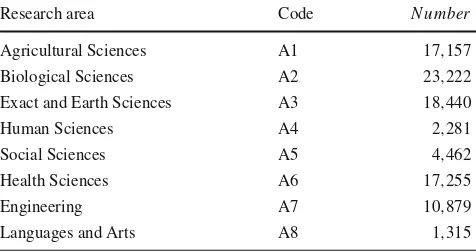
To perform experiments we have randomly selected eight thousand researchers that are associated with eight research areas. Table1depicts these research areas.
Assertions were extracted from the Lattes platform con-cerning these researchers. For instance, if a parser finds that a researcher John has four publications (p1,p2,p3,p4) and
a researcher Mary has two (p2,p5), where p2was done in
collaboration with John, then assertions, as the following, are extracted:
Researcher(john),Researcher(ann),
Publication(p1),Publication(p2),Publication(p3),
Publication(p4),Publication(p5)
sharePublication(john,ann).
A probabilistic ontology was then learned using algo-rithms in the literature [20,24]. This ontology is comprised by 24 probabilistic inclusions and 17 concept definitions. Because learning is mainly concerned with deterministic and probabilistic inclusions, the learned ontology was enlarged
Table 1 Research areas and number of co-authored collaboration
Research area Code N umber
Agricultural Sciences A1 17,157
Biological Sciences A2 23,222
Exact and Earth Sciences A3 18,440
Human Sciences A4 2,281
Social Sciences A5 4,462
Health Sciences A6 17,255
Engineering A7 10,879
Languages and Arts A8 1,315
with 4 relevant roles. Parts of the final ontology can be seen in Figs.3and4.
In this probabilistic ontology, concepts and probabilis-tic inclusions typically denote mutual research interests. In short, in this ontology a ResearcherLattes is a per-son that has publications, advises other people and par-ticipates on examination boards. On the other hand, a
SupervisionCollaboratoris a probabilistic inclusion which denotes a kind of researcher that was advised for another researcher. The SameInstitution concept denotes researchers that work at the same institution. Seemingly, the
SameBoardconcept denotes researchers that have partici-pated on same examination boards. TheNearCollaborator
is a probabilistic inclusion that denotes researchers work-ing at the same institution that have shared publications. The
FacultyNearCollaborator is a near collaborator that also participates of same examination boards. TheNullMobility Researcher concept denotes researchers which have low mobility, i.e., they remain at the same institution where they were advised. TheStrongRelatedResearcherdenotes strong relationship between two researchers (advisor and advisee) which also share publications.
The conceptResearcher indicates whether an element of the domain is a node in the network (henceResearcher
isC) and the roleˆ sharePublicationindicates whether a pair of elements of the domain is linked in the network (hence
Fig. 4 A probabilistic ontologycrALCfor the Lattes domain
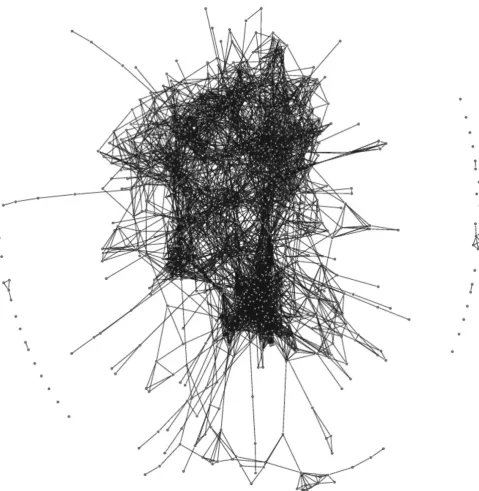
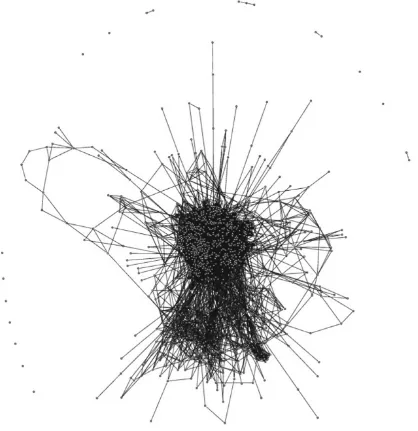
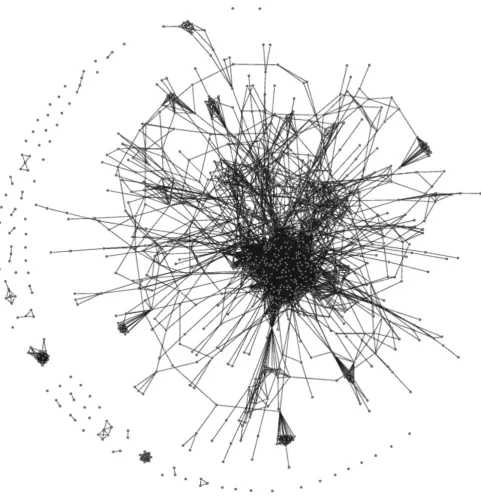
Topological graph information was computed using the assertions for Researcher and sharePublication. Figures 5, 6 and 7 depict collaboration networks within research areas in our dataset.
Using this data, link probabilities were computed through inference in the crALC ontology. To illustrate inference, consider Fig. 8 which depicts a subset of collaborations among researchers. If we inspect this collaboration graph we could be interested, for instance, in checking links among researchers from different groups. Since filling forms in the Lattes platform is prone to errors, there is uncertainty regard-ing real collaborations. Thus, in Fig.8 one could further investigate whether a link between researcher R (rectan-gle node) and the researcher B (triangle node) is suitable. The probability of a possible link between R and B was computed, P(sharePublication(R,B)|E), where E con-tains evidence about researchers such as publications, insti-tution, examination board participations and so on. Using evidence
Researcher(R) ∃hasSameInstitution.Researcher(B),
one obtains
P(sharePublication(R,B)|Researcher(R)
∃hasSameInstitution.Researcher(B))=0.57.
One could obtain more evidence, such as information about nodes that indirectly connect these two groups (Fig.8), denoted byI1,I2. Consider:
P(sharePublication(R,B)|Researcher(R)
∃sharePublication(I1).∃sharePublication(B)
∃sharePublication(I2).∃sharePublication(B))
=0.65.
In order to compare our approach with existing algorithms, topological and semantic features have also been defined, as discussed in the following sections.
4.2 Methodology
In this section, we describe our main design choices to run experiments.
Given the 8,000 selected researchers, there exist 31,996,000 possible link relationships. To perform link pre-diction we have considered collaborations based on coauthor-ship on publications (there are 2,837,206 publications). After analysing these publications we identified 95,100 true posi-tive links among researchers based on co-authorship. Table1 details true coauthorship collaborations for every research area.
Given these true relationships, we have defined three datasets. The first one, Lattes I, where true links for all eight research areas were considered, provides some general analy-sis. In the second and third datasets, Lattes II and Lattes III, only true links for one of the eight researcher areas were con-sidered, allowing some specific analysis. Biological Sciences and Exact and Earth Sciences research areas were chosen, since they are the ones with more collaborations. According to cross validation principles, every dataset must be divided in training and validation sets. To avoid skewness (due to unbalanced classes), all dataset were balanced,2 thus they have the same quantity of positive and negative examples. The positive examples were randomly chosen from the true links and the same number of negative examples were ran-domly collected, where negative examples means that there
2 The problem of class skewness, imbalance in the class distribution,
Fig. 5 Collaborations patterns in research areas (1,000 researchers): Social Sciences is not a link between the nodes. Table 2 details the three
datasets.
Although we can use probabilistic inference to decide whether there is a link between two nodes, to perform com-parisons with previous approaches we resort to a classifica-tion algorithm approach. This paradigm allow us to combine several metrics (topological, semantic and probabilistic) as features of a classification algorithm. In this sense, we can compare which feature is more relevant by adding, delet-ing and combindelet-ing features and observdelet-ing the classification results.
To perform classification we resort to the Logistic regres-sion algorithm. Which outputs values between 0 and 1 (due the logistic function) and prevent us from doing feature normalization. A threshold of 0.5 was used to decide a classification.
Fig. 6 Collaborations patterns in research areas (1,000 researchers): Human Sciences
The two baseline graph-based numerical feature, Katz and Adamic-Adar measures, have been used in our exper-iments. For the first one, since computing all paths (∞) is expensive we only consider paths of length at most four (i ≤4).
We have also considered semantic features. In this work, for each researcher a document with the words appearing in the title of his publications (removing stop words) is con-sidered. Thus, a researcher is represented as a set of words, which allow us to compute two features based on semantic similarity:
(i) The keywordmatchcount between two researchers [10]. (ii) Thecosinebetween the TFIDF features vectors of two
researchers [31].
Finally, the probabilityP(r(x,y)|E), given by our prob-abilistic description logic model, is also used as a numerical feature in the classification model, in order to investigate whether it can improve the classification approach for link prediction.
4.3 Results
In order to evaluate suitability of our approach in predicting coauthorships in the Lattes dataset, several experiments were run. The experiments were performed in three stages, consid-ering incrementally, topological, semantic and probabilistic-logic scores.
fea-Fig. 7 Collaborations patterns in research areas (1,000 researchers): Languages and Arts tures in the logistic regression algorithm. After a ten-fold
cross validation process, the classification algorithm yielded results on accuracy which are depicted in Table3(stage 1).
For all three Lattes dataset, the Katz feature yields the best accuracy when the two topological features are used in iso-lation. Katz has been shown to be among the most effective topological measures for the link prediction task [15]. Fur-thermore, when we combine the two features, we improve all three accuracy.
In the second stage, we evaluate two features based on semantic similarity and their combination with topological
features. Results on accuracy for these semantic features are depicted in Table3(stage 2). The cosine similarity feature performs better than matching keyword feature and outper-forms the two former topological features. When we combine all four features together, there is an improvement in accuracy considering datasets Lattes I and Lattes II. Dataset Lattes III was indifferent to the combination of all four features.
Fig. 8 Lattes collaboration network: subset of collaborations among researchers
Amilton Sinatora Linilson Rodrigues Padovese 1
Deniol Katsuki Tanaka 1 G ius e p p e Pi n t a ú d e
1
W ilson Luiz Guesser 1 Marcio Gustavo Di Vernieri Cuppari
1
Ricardo Fuoco 1
Andre Paulo Tschiptschin 1
Miguel Angelo de Carvalho 1
Ivan Gilberto Sandoval Falleiros 1 Celso Pupo Pesce
1 Marcelo Nelson Páez Carreño
1
Renato Rufino Xavier 1 Cristian Camilo Viáfara Arango 1 Célia Aparecida Lino dos Santos
1
Ro b e r t o M a r t i n s d e S ouz a 1
I n é s Pe r e y r a 1 D aniel Rodrigues
1 Julio Cesar Klein das Neves
1 Newton Kiyoshi Fukumasu
1 Helio Goldenstein 1
Paulo Roberto Mei 1
F e r n a n d o J o s e p e t t i F o n s e c a 1 G e r s o n d o s S a n t o s
Maria Aparecida Godoy Soler Pajanian 1 Joao Paulo Sinnecker
1 Leni Campos Akcelrud 1
Paul o S e rgi o S a n t o s 1
Rodrigo Fernando Bianchi 1
M a r y s t e l a F e r r e i r a 1 Adnei Melges de Andrade
1
Rodrigo Andrade Martine z 1
Paulo Cesar de Morais 1 Antônio Otávio de Toledo Patrocínio
1
Ely Antonio Tadeu Dirani 1
Rinaldo Gregorio Filho 1 Antonio Riul Júnior 1
V itor Angelo Fonseca Deichmann 1
Miguel Alexandre Novak 1
Patricia Alexandra Antunes 1 Everaldo Carlos Venancio
1 John Paul Hempel Lima 1 Francisco Ferreira Cardos o
Erika Paiva Tenório de Holanda 1 Fred Borges da Silva
1
Marco Antônio Penido de Rezende 1 Heliana Comin Vargas
1
Ubiraci Espinelli Lemes de Souza
1
Eliana Kimie Taniguti 1
Adriano Gameiro Vivancos 1
M e r c i a M a r i a S e m e n s a t o B o t tur a d e B a r r os 1
Leonardo Tolaine Massetto 1 F e r n a n d o H e n r i que S a b b a t i n i
1
T a t h y a n a M o r a t t i 1 Adriana Gouveia Rodrigo 1 Márcia Terra da Silva
1
Anna Helena Reali COSTA 1
Cláudio Vicente Mitidieri Filho 1 Viviane Miranda Araujo
1 H e n r i que L i n d e n b e rg N e t o
1 Marcela Paula Maria Zanin Meneguetti
1
Mauro Zilbovicius 1
Cláudia Nascimento de Jesus 1
Carlos Torres Formoso
1 F e r n a n d o R e s e n d e
1 Silvio Burrattino Melhado
1
José Roberto Cardoso
R e n a t o C a r l s o n 1
Maurício Caldora Costa 1 José Augusto Pereira da Silva
1
Jose Jaime da Cruz 1 Wanderlei Marinho da Silv a
1
Marcos Antonio Ruggieri Franco 1
Carlos Shiniti Muranaka 1
Emilio Del Moral Hernandez 1
Lui z L e b e n s z t a j n 1
Mario Leite Pereira Filho 1
Pe d r o Pe r e i r a d e Paul a 1
Sérgio Luís Lopes Verardi 1
Yasmara Conceicao De Polli Migliano
1 Viviane Cristine Silva
1
Antonio Carlos de Jesus Paes 1
Djonny Weinzier l 1 Fabio Henrique Pereira
1 Mauricio Barbosa de Camargo Salles
1 B e r n a r d o Pi n h e i r o d e A l v a r e nga
1 Roberto Moura Sales 1
Silvio Ikuyo Nabeta 1
I v a n E dua r d o C h a bu
1
Vanderley Moacyr John 1
1
Heloísa Cristina Fernandes 1
H e n r i que K a h n
1 Racine Tadeu Araujo Prado
1
Arnaldo Manoel Pereira Carneiro 1
Antonio Carlos Vieira Coelho 1 Thiago Melanda Mendes
1
N e i d e M a t i k o N a k a t a S a t o 1
Bruno Luís Damineli 1 A r t e m á r i a C o ê l h o d e A n d r a d e
1
Orestes Marraccini Goncalves
1
Miguel Aloysio Sattler 1
Brunoro Leite Giordano
1 V a n e s s a G o m e s d a S i l va
1 V a h a n Ago p y a n
1 An n e K o m a t su Ago p y a n
1 Andrea Murillo Betioli
1 Antonio Domingues de Figueiredo
1 Cleber Marcos Ribeiro Dias
1
Sérgio Cirelli Angulo 1
Roberto Cesar de Oliveira Romano 1
Maristela Gomes da Silv a 1
Rafael Giuliano Pileggi 1
Alex Kenya Abiko 1
Mário Sousa Takeashi 1
Silvia Maria de Souza Selm o 1
Carina Ulsen 1
M a r i a E l e n a S a n t o s T a que d a 1
Table 2 Lattes datasets: number of positive (+) and negative (−) exam-ples
Name # Examples
(+/−)
Lattes I (General) 90,000
Lattes II (Biological Sciences) 20,000 Lattes III (Exact and Earth Sciences) 18,000
is significant improvement in accuracy considering datasets Lattes 1 and Lattes 2, when all five features are combined.
It is worth noting that the probabilistic logic feature used in isolation outperforms all other features and allows us to improve the classification model for link prediction on accu-racy. It could be argued that such performance stems from evidence used on probabilistic inferences, but a similar analy-sis could be done for topological and semantic features. They use information that is missing on a probabilistic description logic setting. In conclusion, despite the fact that all features have different approaches, experimental results showed that they can be successfully used together.
Nothing prevents us from defining ad-hoc probabilistic networks to estimate link probabilities. However, by doing
Table 3 Classification results for datasets Lattes I, Lattes II and Lattes III on accuracy (%) for baseline features: Adamic-Adar (Adamic), Katz, Word matching (Match), Cosine, CrALC and a combination of them
Stage Feature Lattes I (acc.) Lattes II (acc.) Lattes III (acc.)
l Adamic 83.34±1.87 82.5±1.35 81.23±1.46
Katz 85.4±1.07 87.7±0.91 84.43±0.84
Adamic + Katz 85.9±1.12 87.75±1.03 85.44±0.78
2 Match 75.42±1.66 73.42±2.66 72.8±0.47
Cosine 89.35±1.28 90.4±1.37 86.7±0.85
Adamic + Katz + Match + Cosine 91.63±1.23 90.69±1.23 86.3±0.12
3 Cralc 93.3±0.79 94.2±1.48 89.72±1.67
Table 4 Average runtime for inference incrALCconsidering the num-ber of nodes in the network
# Nodes Runtime (ms)
10,000 168
100,000 175
10,000,000 185
so we are expected to define a large propositionalized net-work (a relational Bayesian netnet-work) [25] or estimate local probabilistic networks [31]. These approaches do not scale well, since computing probabilistic inference for large net-works is expensive.
To overcome these performance and scalability issues, we resort to lifted inference incrALCwhich is based on varia-tional methods—tuned by evidence defined according to the nodes’s neighborhood. Thus, for a 10,000 possible nodes, if evidence is given for 5 nodes (this is the neighborhood for a given link candidate), then there are only 6 slices which have messages interchanged. To instantiate the overall net-work, we use local evidence to perform inference for every link candidate, i.e., neighborhood evidence is instantiated accordingly.
In our experiments, the average runtime for inference in crALC(10,000 nodes network) was 168 ms. Table4depicts some runtime results for larger networks, which demon-strates the scalability of our approach. A direct grounding of the ontology into a propositional Bayesian network would generate an unmanageably large model.
5 Conclusion
In this paper, we have introduced a link prediction method that combines graph-based and ontological information through the use of a probabilistic description logic. Given a collaborative network, we encode interests and graph fea-tures through acrALC probabilistic ontology. To predict links, we resort to probabilistic inference—thus we combine and extend previous work on relational probabilistic mod-els of link prediction, and on ontology-based link prediction. To make the proposal scalable we propose a novel strategy for approximating link probabilities: for each pair of nodes, we focus only on evidence collected along paths between them. Our proposal was evaluated on an academic domain, where links among researchers were predicted. Moreover, the approach was successfully compared with graph-based and semantic-based features.
Compared to previous work, our approach employs a rich ontology (as opposed to simple is-a terminologies) that can encode substantial information about the domain.
Hierar-chical structure can be encoded together with knowledge about specific nodes in a network—we plan to explore richer ontologies in the future. Moreover, our proposal attains better scalability than previous proposals that have tried to explore probabilistic relational models for similar purposes.
Acknowledgments The third author is partially supported by CNPq. The work reported here has received substantial support by FAPESP Grant 2008/03995-5 and FAPERJ Grant E-26/111484/2010. Thanks to Jesus Pascual Mena Chalco for providing us datasets and figures of the Lattes research areas.
References
1. Adamic L, Adar E (2001) Friends and neighbors on the web. Soc Netw 25:211–230
2. Aljandal W, Bahirwani V, Caragea D, Hsu H (2009) Ontology-aware classification and association rule mining for interest and link prediction in social networks. In: AAAI 2009 Spring symposium on social semantic web: where web 2.0 meets web 3.0. Standford, CA
3. Baader F, Nutt W (2007) Basic description logics. In: Descrip-tion logic handbook. Cambridge University Press, Cambridge, pp 47–100
4. Caragea D, Bahirwani V, Aljandal W, Hsu W (2009) Ontology-based link prediction in the livejournal social network. In: SARA’09, p 1
5. Cozman FG, Polastro RB (2009) Complexity analysis and varia-tional inference for interpretation-based probabilistic description logics. In: Proceedings of the twenty-fifth conference annual con-ference on uncertainty in artificial intelligence (UAI-09). AUAI Press, Corvallis, Oregon, pp 117–125
6. Fagin R, Halpern JY, Megiddo N (1990) A logic for reasoning about probabilities. Inf Comput 87:78–128
7. Getoor L, Diehl CP (2005) Link mining: a survey. ACM SIGKDD Explor Newsl 7(2):3–12
8. Getoor L, Friedman N, Koller D, Taskar B (2002) Learning prob-abilistic models of link structure. J Mach Learn Res 3:679–707 9. Goldenberg A, Zheng AX, Fienberg SE, Airoldi EM (2010)
A survey of statistical network models. Found Trends Mach Learn 2(2):129–233
10. Hasan MA, Chaoji V, Salem S, Zaki M (2006) Link prediction using supervised learning. In: Proceedings of SDM 06 workshop on link analysis, counterterrorism and security
11. Heinsohn J (1994) Probabilistic description logics. In: International conference on uncertainty in artificial intelligence, pp 311–318 12. Jaeger M (2002) Relational Bayesian networks: a survey.
Linkop-ing Electr Artic Comput Inf Sci 6
13. Klinov P (2008) Pronto: A non-monotonic probabilistic description logic reasoner. In: The semantic web research and applications, pp 822–826
14. Kunegis J, Lommatzsch A (2009) Learning spectral graph trans-formations for link prediction. In: Proceedings of the ICML, pp 561–568
15. Liben-Nowell D, Kleinberg J (2007) The link prediction problem for social networks. J Am Soc Inf Sci Technol 7(58):1019–1031 16. Lu L, Zhou T (2011) Link prediction in complex networks: a survey.
Physica A 390:1150–1170
18. Mohammad A, Mohammed J (2011) A survey of link pre-diction in social networks. In: Social network data analytics, pp 243–275
19. Newman MEJ (2003) The structure and function of complex net-works. SIAM Rev 45:167–256
20. Ochoa-Luna J, Revoredo K, Cozman F (2011) Learning probabilis-tic description logics: a framework and algorithms. In: Proceedings of the MICAI, LNCS, vol 7094. Springer, Berlin, pp 28–39 21. Ochoa-Luna J, Revoredo K, Cozman F (2012) An experimental
evaluation of a scalable probabilistic description logics approach for semantic link prediction. In: Bobillo F et al (eds) Proceedings of the 8th international workshop on uncertainty reasoning for the semantic web, vol 900. CEUR-WS.org, Shangai, China,analytics, pp 63–74
22. Ochoa-Luna J, Revoredo K, Cozman F (2012) A scalable seman-tic link prediction approach through probabilisseman-tic description log-ics. In: Proceedings of 9th artificial intelligence national meeting (ENIA)
23. Pearl J (1988) Probabilistic reasoning in intelligent systems: net-works of plausible inference. Morgan Kaufmann, Sananalytics, Francisco
24. Revoredo K, Ochoa-Luna J, Cozman F (2010) Learning termi-nologies in probabilistic description logics. In: da Rocha Costa A, Vicari R, Tonidandel F (eds) Advances in artificial intelli-gence SBIA, (2010) Lecture Notes in Computer Science, vol 6404. Springer/Heidelberg, Berlin, pp 41–50
25. Revoredo K, Ochoa-Luna J, Cozman F (2011) International work-shop on URSW, semantic link prediction through probabilistic description logics. In: Bobillo F et al (eds) Proceedings of the 7th international workshop on URSW, vol 778, pp 87–97
26. Sachan M, Ichise R (2011) Using semantic information to improve link prediction results in network datasets. Int J Comput Theory Eng 3:71–76
27. Schmidt-Schauss M, Smolka G (1991) Attributive concept descrip-tions with complements. Artif Intel 48:1–26
28. Sebastiani F (1994) A probabilistic terminological logic for mod-elling information retrieval.In: ACM conference on research and development in information retrieval (SIGIR), pp 122–130 29. Taskar B, Wong MF, Abbeel P, Koller D (2003) Link prediction in
relational data. In: Proceedings of neural information processing systems
30. Thor A, Anderson P, Raschid L, Navlakha S, Saha B, Khuller S, Zhang XN (2011) Link prediction for annotation graphs using graph summarization. In: The semantic web-ISWC, pp 714–729
31. Wang C, Satuluri V, Parthasarathy S (2007) Local probabilistic models for link prediction. In: Proceedings of the 2007 seventh IEEE ICDM. IEEE Computer Society, Washington, DC, USA, pp 322–331. doi:10.1109/ICDM.2007.108