EFFECT OF COMPOST FROM BY-PRODUCT OF THE FISHING INDUSTRY
ON CROP YIELD AND MICROELEMENT CONTENT IN MAIZE
Maja Radziemska1, Zbigniew Mazur2
1 Warsaw University of Life Sciences-SGGW, Faculty of Civil and Environmental Engineering, Nowoursynowska
159, 02-776 Warsaw, Poland, e-mail: [email protected]
2 University of Warmia and Mazury in Olsztyn, Faculty of Environmental Management and Agriculture, Pl.
Łódzki 4, 10-727 Olsztyn, Poland, e-mail: [email protected]
INTRODUCTION
Composting is one of the most effective methods of recycling organic waste with pos-sible use in agriculture. The application of all sorts of organic waste products by turning them into composts has, above all, an economic-eco-logical value and is regarded to be environmen-tally friendly [Castaldi et al. 2004, Deguchi et al. 2009]. It enables obtaining a valuable organic fertilizer, which is a substrate of humus, and ap-plying it, among others, in crop production for consumption purposes [Ranalli et al. 2001]. Com-post application may enhance the role of physical properties such as total porosity, available water content and saturated hydraulic conductivity, and Volume 16, Issue 4, Oct. 2015, pages 168–175
DOI: 10.12911/22998993/59378 Research Article
ABSTRACT
A pot experiment was conducted to compare the effects of compost from fish waste with mineral and manure fertilization on the yield and chemical composition of the overground parts of maize (Zea mays L.). The experiment comprised two series: I – composts at a dose of 1 g of compost per pot, and II – composts with 0.5 g of urea. The treatments were conducted on the following types of composts: compost 1: fish waste (80% d.m.), sawdust (20% d.m.); compost 2: fish waste (80% d.m.), straw (20% d.m.); compost 3: fish waste (80% d.m.), bark (20% d.m.); compost 4: fish waste (79.3% d.m.), sawdust (19.7% d.m.), lignite (1% d.m.); compost 5: fish waste (79.3% d.m.), straw (19.7% d.m.); lignite (1% d.m.); compost 6: fish waste (79.3% d.m.), bark (19.7% d.m), lignite (1% d.m). The contents of Ni, Zn, Cr, Cu and Cd were deter-mined in an air-acetylene flame using the flame atomic absorption spectrophotometric method. The average crop yield of the overground parts of maize in the series without additional mineral fertilization and with mineral N-fertilization was higher compared to objects without mineral N-fertilization. The highest crop yield was noted in the case of compost containing fish waste and straw with addition of lignite and with bark and lignite. The addition of lignite to the compost mass in the series with mineral N-fertilization had stronger influence on the content of cadmium, chromium, nickel and zinc in the overground parts of maize.
Keywords: compost, fish waste, maize (Zea mays L.), microelements, yield. Received: 2015.06.06
Accepted: 2015.08.31 Published: 2015.10.01
may increase soil organic matter content [Celik et
al. 2004].Compost input into contaminated soils containing microelements reduces the overall bioavailability of metals due to sorption process-es and thus providprocess-es an effective soil remediation technique [Brown et al. 2004]. Inorganic
fertiliz-ers are costly and unable to sustain soil fertility;
they also pose environmental risk of nitrate pollu
-tion of groundwater [Camargo and Alonso 2006]. The Regulation (EC) of the European Parlia-ment and the Council on health rules concern-ing animal by-products not intended for human consumption describes products derived from
aquatic animals, including fish, as removed e.g.
Animal waste, which includes the by-products of
fishing industry, i.e. half-dead fish or products left over after processing fish for consumption pur -poses, may be an excellent component for com-post production [Laos et al. 1998, López-Mos-quera et al. 2011]. Compost should be sanitarily safe and rich in humic and biogenic substances, without destructive effect on the environment and be possible to apply to soil[Seki et al. 2008]. The
rate of compost application to ensure maximum crop yield with minimal environmental degrada-tion varies depending on the crop species, as well as on the types of the compost used. There is a published report on the composting of offal from
chicken slaughter [Pisa and Wuta 2013]; it shows
that composting can be used successfully to
man-age chicken offal, although the compost quality
was not determined in the report.
The aim of the presented research is to
deter-mine the influence of composts produced from by-products of the fishing industry added to the soil on
the crop yield and selected microelements content in the overground parts of maize (Zea mays L.).
MATERIAL AND METHODS
Composting trials
Composts used in the experiment came from an outdoor experiment set up in 2010, conducted
in specially constructed wooden crates
measur-ing 50×60×60 cm (W×L×H). The basic substrate
for obtaining the compost were small cyprinid
fish from Lake Kortowskie (Olsztyn, Poland): common bleak (Alburnus alburnus), common roach (Rutilus rutilus), common bream ( Abra-mis brama) and white bream (Blicca bjoerkna). The effect of composting depends largely on
the quantity and proportions of the components;
wheat straw, which is a basic component, was
applied as a structural additive. Other substrates
included waste products of the foresting industry, i.e. sawdust, due to its ability to absorb moisture and a structure ensuring adequate compost
poros-ity, as well as pine bark. A variant with the ad -dition of lignite was also tested. After grinding, all substrates were placed in layers. The top layer always consisted of organic substances, which were applied to protect the compost from exces-sive drying up and from the unfavourable effect of atmospheric conditions.
In order to achieve the assumed study aims, an experiment was carried out using the
follow-ing types of compost: Compost 1: fish waste (80% d.m.), sawdust (20% d.m.); Compost 2: fish waste (80% d.m.), straw (20% d.m.); Com
-post 3: fish waste (80% d.m.), bark (20% d.m.); Compost 4: fish waste (79.3% d.m.), sawdust (19.7% d.m.), lignite (1% d.m.); Compost 5: fish waste (79.3% d.m.), straw (19.7% d.m.), lignite (1% d.m.); Compost 6: fish waste (79.3% d.m.),
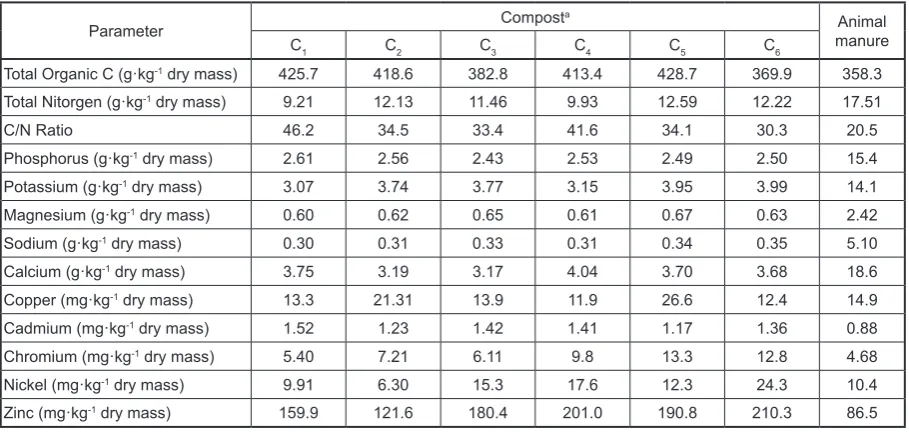
Table 1. Chemical characteristics of the applied composts and manure
Parameter Composta manureAnimal
C1 C2 C3 C4 C5 C6
Total Organic C (g·kg-1 dry mass) 425.7 418.6 382.8 413.4 428.7 369.9 358.3
Total Nitorgen (g·kg-1 dry mass) 9.21 12.13 11.46 9.93 12.59 12.22 17.51
C/N Ratio 46.2 34.5 33.4 41.6 34.1 30.3 20.5
Phosphorus (g·kg-1 dry mass) 2.61 2.56 2.43 2.53 2.49 2.50 15.4
Potassium (g·kg-1 dry mass) 3.07 3.74 3.77 3.15 3.95 3.99 14.1
Magnesium (g·kg-1 dry mass) 0.60 0.62 0.65 0.61 0.67 0.63 2.42
Sodium (g·kg-1 dry mass) 0.30 0.31 0.33 0.31 0.34 0.35 5.10
Calcium (g·kg-1 dry mass) 3.75 3.19 3.17 4.04 3.70 3.68 18.6
Copper (mg·kg-1 dry mass) 13.3 21.31 13.9 11.9 26.6 12.4 14.9
Cadmium (mg·kg-1 dry mass) 1.52 1.23 1.42 1.41 1.17 1.36 0.88
Chromium (mg·kg-1 dry mass) 5.40 7.21 6.11 9.8 13.3 12.8 4.68
Nickel (mg·kg-1 dry mass) 9.91 6.30 15.3 17.6 12.3 24.3 10.4
Zinc (mg·kg-1 dry mass) 159.9 121.6 180.4 201.0 190.8 210.3 86.5
a C
1: fish waste (80% d.m.), sawdust (20% d.m.); C2: fish waste (80% d.m.), straw (20% d.m.); C3: fish waste
(80% d.m.), bark (20% d.m.); C4: fish waste (79.3% d.m.), sawdust (19.7% d.m.), lignite (1% d.m.); C5: fish
waste (79.3% d.m.), straw (19.7% d.m.), lignite (1% d.m.); C6: fish waste (79.3% d.m.), bark (19.7% d.m),
bark (19.7% d.m), lignite (1% d.m). During the composting process, the humidity of the materi-als was maintained at a constant level of 60–70% and the compost mass was mixed once a week for aeration. Characteristics of the composts are presented in Table 1.
Pot experiment
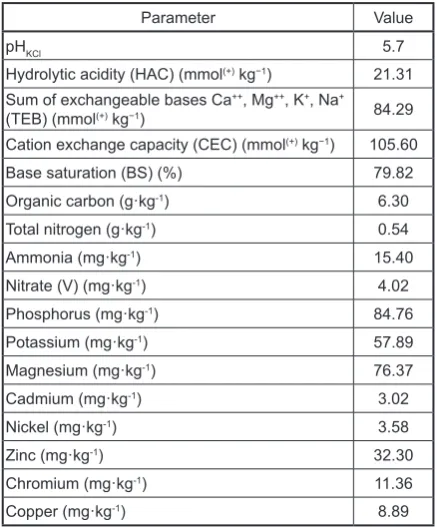
The experiment was established in the glass-house of the University of Warmia and Mazury in Olsztyn (Poland) at a natural day/night con-ditions; during the day, the air temperature was 26±3°C and approximately ten degrees lower (16±2°C) at night, relative humidity 75±5%. PCV pots filled with 9.5 kg of soil mixed with com-posts in accordance to the study procedure were used for this purpose. Soil used in the experiment was characterized by a granulometric composi-tion with 86% of sand (2.0–0.05 mm), 11.2% of silt (0.05–0.002 mm) and 2.2% of the suspended fraction (< 0.002 mm); the soil was collected from the arable layer of a farm field. The soil samples were air-dried and passed through a 5-mm sieve prior to the greenhouse pot experiment. Agro-chemical parameters of the used soil are shown in Table 2.
The experiment consisted of two series, each conducted in four replicates. In the first one, the composts were applied in the amount of 1 g N of compost per pot. In the second series, 0.5 g of
mineral N in the form of urea [(NH2)2CO] was additionally applied to the compost. The control objects did not contain compost additives. The effect of fertilization was tested on maize (Zea mays L. cv. San). The density was 6 plants per pot. Maize was picked after 66 days of vegetation during the phase of intense stalk growth.
Measurements and statistical analysis
The collected plant samples were analyzed in order to determine the yield of the overground parts from each pot. The harvested plants were washed with tap water and rinsed with double deionized water, fragmented and oven-dried at 60 °C for 48 h. The contents of trace elements: cadmium – Cd, nickel – Ni, zinc – Zn, chro-mium – Cr, manganese – Mn, copper – Cu and cobalt – Co were determined in an air-acetylene flame, following the flame atomic absorption spectrophotometric method (FAAS) on a Specr-tAA 240FS atomic absorption spectrophotometer (VARIAN, Australia) using a Sample Introduc-tion Pump System (SIPS) in extracts obtained af-ter microwave digestion of plant samples in nitric acid hydrogen (analytically pure HNO3) at a con-centration of 1.40·g.cm-3, poured into HP500 Tef-lon vessels and placed in a MARS-5 microwave oven (CEM Corporation, USA). The mineraliza-tion condimineraliza-tions, i.e. volume of nitrogen acid and mineralization temperature, were set as described in the methodology given in the Mars 5 Operation Manual (2001). Soil samples were digested and analyzed using the same reagents. Double deion-ized water (Milli-Q Millipore 0.055 µS.cm-1 resis-tivity) was used for all dilutions.
Before establishing the experiment, the fol-lowing parameters were determined in the col-lected soil samples: pHKCl by potentiometry in a 1 mol.dm-3 potassium chloride solution (ISO 10390 2005), HAC using Kappen’s method [Klute 1996], total exchangeable bases (TEB - K+, Na+, Ca2+, and Mg2+) using Kappen’s method [Klute 1996], cation exchange capacity (CEC) from the formula: CEC=HAC+TEB, and percentage base saturation (V) from the formula: BS=100.TEB CEC-1. The organic carbon (Corg.) content was measured using Triuin’s method in potassium di-chromate with diluted sulfuric (VI) acid [Kawada 1957], phosphorus (P) and potassium (K) con-tents – using Egner-Riehm’s method [Egner et al. 1960], and the magnesium (Mg) content – using atomic absorption spectroscopy (AAS) through Table 2. Agrochemical parameters of the soil
Parameter Value
pHKCl 5.7
Hydrolytic acidity (HAC) (mmol(+) kg−1) 21.31
Sum of exchangeable bases Ca++, Mg++, K+, Na+
(TEB) (mmol(+) kg−1) 84.29 Cation exchange capacity (CEC) (mmol(+) kg−1) 105.60
Base saturation (BS) (%) 79.82 Organic carbon (g·kg-1) 6.30
Total nitrogen (g·kg-1) 0.54
Ammonia (mg·kg-1) 15.40
Nitrate (V) (mg·kg-1) 4.02
Phosphorus (mg·kg-1) 84.76
Potassium (mg·kg-1) 57.89
Magnesium (mg·kg-1) 76.37
Cadmium (mg·kg-1) 3.02
Nickel (mg·kg-1) 3.58
Zinc (mg·kg-1) 32.30
Chromium (mg·kg-1) 11.36
extraction with Schachtschabel’s method [Schli-chting et al. 1995]. Total nitrogen (N-total) was determined using Kjedahl’s method after miner-alization in concentrated sulfuric (VI) acid using hydrogen peroxide as a catalyst [Bremner 1965], N-NH4+ was determined using Nessler’s reagent [Ostrowska et al. 1991], and N-NO3− using phe-noldisulfonic acid [Ostrowska et al. 1991].
The results were subjected to statistical cal-culations using the Statistica 10 software package (StatSoft Inc. 2010), with results of each series subjected to statistical analysis using Tukey’s analysis of variance. The series were compared with the t-test for dependent variables, assessing differences between the average results. The cor-relation coefficients (r) between the contents of particular heavy metals in the plants were also calculated.
RESULTS AND DISCUSSION
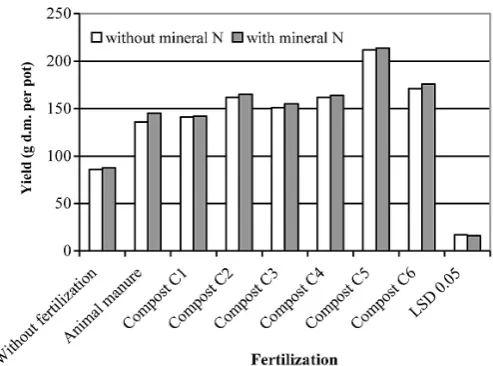
The crop yield of maize (Zea mays L.) indi-cated a clear differentiation and was influenced by the type of compost (C1–C6) as well as mineral fertilization (Figure 1). The average crop yield of the overground parts of maize in the series with-out additional mineral N fertilization was 51.77% higher, and in the mineral N series – 51.42% high-er when compared to the control objects. These observations are in accordance with the results reported by Sikora [1998] and Sikora and Enkiri [2000]. These authors have noted that when an N fertilizer was present in a blend with the com-post, the compost provided a higher crop yield. N-availability of the compost is generally low and the uptake efficiency of the N fertilizer is also
limited due to nitrogen (N) loss and the minerali-zation-immobilization turnover [Wen et al. 1995]. The influence of variable organic fertilization on the crop yield of maize has been confirmed by the studies of Leroy et al. [2007], Basso and Ritch-ie [2005] and Doan et al. [2013]. By improving the physical, chemical, and biological properties of the soil, composts may stimulate crop yields [Wyszkowski and Radziemska 2010]. For exam-ple, a tomato yield increase of more than 50% was noted in the case when the soil was covered by a layer of solid waste compost [Manios and Kapetanios 1992]. Composts applied in the ex-periment have resulted in different crop yields of the overground parts of maize. In the control treat-ments (without and with manure fertilization), the yield of the tested plant was lower than in the treat-ments in pots with compost (C1–C6). The highest crop yield of maize (Zea mays L.) was noted in the case of compost containing straw with the addition of lignite. Compost (C6) with bark and lignite also produced a positive although weaker effect. The addition of lignite (composts C4–C6) significantly influenced the crop yield of the overground parts of maize as compared to composts without lignite (C1–C3). This yield increase seems to be caused mainly by improved soil structure and enhanced nutritional status of the plants. Mineral fertiliza-tion generally increased the crop yield of maize in the control objects.
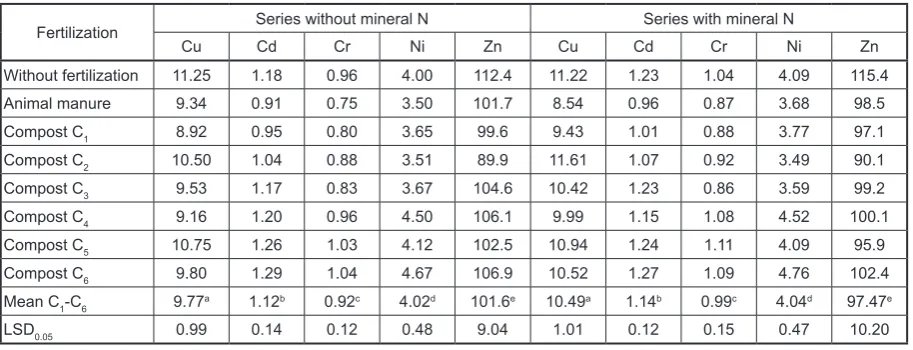
The applied fertilization resulted in various contents of the microelements in the dry mass of the overground parts of maize (Zea mays L.) (Table 3). These factors variably influenced the quantitative changes of the individual elements. Copper is very strongly bound to organic matter. Most probably, more available copper was
sent in the soil during the mineralization process. The average content of copper in the overground parts of maize in the series without additional mineral fertilization was 12.89% lower, and in the mineral N series – 6.51% lower in compari-son to the control objects. Mineral fertilization with nitrogen and NPK modified the content of microelements in the plants [Wołoszyk et al. 2009]. The overground parts of maize grown on compost comprising a mixture of fish waste and sawdust (compost C1) without additional min-eral fertilization were characterized by the low-est content of copper at 8.92 mg·kg-1 dry mass. Zhang et al. [2000] reported that MSW compost application increased the concentrations of cop-per and zinc in the crop. The highest value of Cu (10.75 mg×kg-1 dry mass) occurred in series with compost produced from fish waste and straw with the addition of lignite.
The obtained results indicate that the content of cadmium in maize (Zea mays L.) was variable and affected by the type of the used compost (C1 -C6) (Table 3). The application of organic material such as compost has been reported to reduce cad-mium extractability from soil [Pinto et al. 2004, Li et al. 2006]. In the series without mineral N fer-tilizer, cadmium content (1.29 mg·kg-1 dry mass) in the overground parts of the analyzed plants was most affected by the addition of compost contain-ing fish waste, bark and lignite. In the same series, the lowest content of cadmium at 0.95 mg·kg-1 dry mass was observed in plants grown on soil con-taining compost with sawdust (C1). Urea fertiliza-tion increased the accumulafertiliza-tion of cadmium in the overground parts of the tested plants. In the series with mineral fertilization, the cadmium content in
maize ranged from 1.01 mg×kg-1 in pots contain-ing compost with sawdust up to 1.27 mg×kg-1 dry mass in pots containing compost with fish waste, bark and lignite (C6). Complexation of Cd with soil organic matter may not be the main reason for the reduction of Cd toxicity in plants because the complexing abilities of soil organic matter with cadmium are lower than those revealed by other heavy metal ions, such as Zn2+, Cu2+ and Pb2+ [Plavšic et al. 1991].
Compost and urea fertilization used in the ex-periments had a significant effect on the content of chromium in maize versus the treatments with-out mineral N fertilization (Table 3). The aver-age content of chromium in maize (Zea mays L.) in the series with additional mineral fertilization was higher than in the series with pure composts. The lowest content of chromium at 0.86 mg·kg-1 dry mass in the series with mineral N fertilization was observed in plants grown on soil containing compost with bark (compost C3). However, in the series without the mineral N fertilizer, the lowest content (0.80 mg·kg-1 dry mass) was noted in the case of compost containing fish waste and straw. The highest chromium content in the overground parts of maize (1.09 mg·kg-1 dry mass) was noted in the second series of the experiment, in which compost produced from fish waste and bark with the addition of lignite was used (compost C6).
The type of compost as well as the application of a mineral fertilizer significantly modified the content of nickel in the overground parts of maize (Zea mays L.) (Table 3). Organic matter strongly inhibits the uptake of trace elements by plants because composts improve the base saturation of the sorption complex, which limits the uptake
Table 3. Effect of composts on the microelements content in maize (Zea mays L.), mg·kg-1 dry mass
Fertilization Series without mineral N Series with mineral N
Cu Cd Cr Ni Zn Cu Cd Cr Ni Zn
Without fertilization 11.25 1.18 0.96 4.00 112.4 11.22 1.23 1.04 4.09 115.4 Animal manure 9.34 0.91 0.75 3.50 101.7 8.54 0.96 0.87 3.68 98.5
Compost C1 8.92 0.95 0.80 3.65 99.6 9.43 1.01 0.88 3.77 97.1
Compost C2 10.50 1.04 0.88 3.51 89.9 11.61 1.07 0.92 3.49 90.1
Compost C3 9.53 1.17 0.83 3.67 104.6 10.42 1.23 0.86 3.59 99.2
Compost C4 9.16 1.20 0.96 4.50 106.1 9.99 1.15 1.08 4.52 100.1
Compost C5 10.75 1.26 1.03 4.12 102.5 10.94 1.24 1.11 4.09 95.9
Compost C6 9.80 1.29 1.04 4.67 106.9 10.52 1.27 1.09 4.76 102.4
Mean C1-C6 9.77a 1.12b 0.92c 4.02d 101.6e 10.49a 1.14b 0.99c 4.04d 97.47e
LSD0.05 0.99 0.14 0.12 0.48 9.04 1.01 0.12 0.15 0.47 10.20
of trace metals [Weber et al. 2003]. The average nickel content in maize (Zea mays L.) was the lowest in the series without mineral N fertiliza-tion. The overground parts of maize grown on compost comprising fish waste and straw with additional mineral N fertilization were charac-terized by the lowest content of nickel at 3.49 mg·kg-1 dry mass. The group of plants grown on compost made of fish waste and bark with the ad-dition of lignite was characterized by the highest concentration of nickel (4.76 mg·kg-1 dry mass) in maize planted in pots with additional mineral N fertilization. Addition of lignite (composts C4– C6) significantly influenced the nickel content of the overground parts of maize when compared to composts without lignite (C1–C3).
In the presented study, the zinc content in the overground parts of maize (Zea mays L.) de-pended on the type of fertilization as well as the applied composts (C1–C6) (Table 3). Fertilization with municipal waste compost leads to a higher concentration of zinc in plants [Shuman et al. 2001]. Mazur and Sienkiewicz [2009] claimed that urea used in combination with composts had very strongly increased the concentration of zinc and copper in the vegetative parts of maize (stems and leaves). Copper availability was higher than Zn, although plants uptake zinc rather than cop-per because of antagonisms between these ele-ments [Kabata-Pendias and Pendias 1992]. In the presented experiment, zinc content was higher in the control object (without fertilization). The low-est content of zinc (3.49 mg·kg-1 dry mass) in the overground parts of maize in the series with min-eral N fertilization was obtained after application of compost comprising fish waste and straw. The addition of the latter component was also shown to have some effect in the variants without min-eral N fertilization.
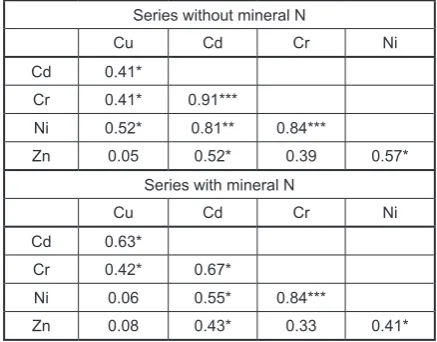
The correlation coefficients between the con-tent of heavy metals in the overground parts of maize (Zea mays L.) in series without mineral N and those with mineral N fertilization have been presented in Table 4. Statistical analysis revealed a significant correlation between the content of the individual microelements in the test plants and the type of compost (C1–C6) incorporated into the soil. In the series without mineral N fertilization, a positive high correlation was confirmed be-tween cadmium and chromium (r=0.91) and be-tween nickel and chromium (r=0.84). Moreover, significant correlation was also noted between the contents of chromium and nickel (r=0.84) in the
overground parts of the tested plants in the series with mineral N fertilization.
CONCLUSIONS
The yield of maize (Zea mays L.) depended on mineral N fertilization as well as the type of composts incorporated into the soil.In the series without mineral N fertilization, composts C1–C6 had a negative effect on the growth and develop-ment of the overground parts of maize. The aver-age crop yield of the overground parts of maize in the series without mineral fertilization and se-ries with mineral N fertilization was higher com-pared to the control objects. The highest crop yield of maize (Zea mays L.) was noted in the case of applying compost containing fish waste and straw with the addition of lignite and with bark and lignite. The content of microelements in maize (Zea mays L.) depended on the type of compost as well as mineral fertilization. The most distinct changes were confirmed in the case of copper and zinc, for which mineral N fertili-zation resulted in the decrease of their content in the analyzed plants. The average accumulation of microelements in maize (Zea mays L.) grown in composts C1–C6 applied into the soil followed the decreasing order Zn>Cu>Cd>Ni>Cr, respec-tively. Addition of lignite to the compost mass in the series with mineral N fertilization had a stronger influence on the content of cadmium, chromium, nickel, and zinc in the overground parts of maize.
Table 4. Linear correlation coefficients between the heavy metal content in maize (Zea mays L.) in series without mineral N-fertilization and series with mineral N-fertilization
Series without mineral N
Cu Cd Cr Ni
Cd 0.41*
Cr 0.41* 0.91***
Ni 0.52* 0.81** 0.84***
Zn 0.05 0.52* 0.39 0.57*
Series with mineral N
Cu Cd Cr Ni
Cd 0.63*
Cr 0.42* 0.67*
Ni 0.06 0.55* 0.84***
Zn 0.08 0.43* 0.33 0.41*
REFERENCES
1. Basso B, .Ritchie J.T. 2005. Impact of compost, manure and inorganic fertilizer on nitrate leach-ing and yield for a 6-year maize–alfalfa rotation in Michigan. Agriculture, Ecosystems and Environ-ment, 108, 329–341.
2. Bremner J.M. 1965. Total nitrogen. In: Black C.A. et al. (Eds). Methods of soil analysis, Part 2. Chem-ical and microbiologChem-ical properties. American So-ciety of Agronomy, Madison, WI. Agronomy, 9, 1149–1178.
3. Brown S., Chaney R., Hallfrisch J., Ryan J.A., Berti W.R. 2004. In situ soil treatments to reduce the phy-to- and bioavailability of lead, zinc, and cadmium. Journal of Environmental Quality, 33, 522–531. 4. Castaldi P., Garau G., Melis P. 2004. Influence of
compost from sea weeds on heavy metal dynamics in the soil-plant system. Fresenius Environmental Bulletin, 13(11b), 1322–1328.
5. Celik I., Ortas I., Kilic S. 2004. Effects of compost, mycorrhiza, manure and fertilizer on some physi-cal properties of a Chromoxerert soil, Soil Tillage Resources, 78, 59–67.
6. Camargo J.A., Alonso A. 2006. Ecological and tox-icological effects of inorganic nitrogen pollution in aquatic ecosystems: A global assessment. Environ-ment International, 32, 831–849.
7. Doan T.T., Ngo P.T., Rumpel C., Van Nguyen B., Jouquet P. 2013. Interactions between compost, vermicompost and earthworms influence plant growth and yield: A one-year greenhouse experi-ment. Scientia Horticulturae, 160, 148–154.
8. Egner H., Riehm H., Domingo W.R. 1960.
Untersuc-hun-genüber die chemische Bodenanalyse als Grun-dlage für die Beurteilung des Nährstoffzustandes der Böden. II. Chemische Extractionsmethoden zur Phospor- und Kaliumbestimmung. Ann. Royal Ag-ricult. College Sweden, 26, 199–215.
9. Kabata-Pendias A., Pendias H. 1992. Trace ele-ments in soil and plants. CRC Pres. Boca Raton, Florida, pp. 365.
10. Kawada H. 1957. An examination of the Tiurin’s method for determination of soil organic carbon and a proposed modification of the chromic acid titration method. Forest Soils Japan Report, 8, 67–80. 11. Klute A. 1996. Methods of soil analysis. Madison:
American Society of Agronomy. Agronomy Mono-graph 9.
12. Laos F., Mazzarino M.J., Walter I., Roselli L. 1998. Composting of Fish Waste with Wood By-Products and Testing Compost Quality as a Soil Amendment: Experiences in the Patagonia Region of Argentina. Compost Science & Utilization, 6(1), 59–66. 13. Leroy B.L., Bommele L., Reheul D., Moens M.,
De Neve S. 2007. The application of vegetable,
fruit and garden waste (VFG) compost in addition to cattle slurry in a silage maize monoculture: Ef-fects on soil fauna and yield. European Journal of Soil Biology, 43, 91–100.
14. Li S., Liu R., Wang M., Wang X., Shan H., Wang H. 2006: Phytoavailability of cadmium to cherry-red radish in soils applied composted chicken or pig manure, Geoderma, 136, 260–271.
15. López-Mosquera M.E., Fernández-Lema E., Vil-lares R., Corral R., Alonso B. 2011. Composting fish waste and seaweed to produce a fertilizer for use in organic agriculture. Procedia Environmental Sciences, 9(113), 117.
16. Manios V.I., Kapetanios A. 1992. Effect of town refuse compost as soil amendment on greenhouse tomato crop. Acta Horticulturae, 302, 193–201. 17. Mazur Z., Sienkiewicz S. 2009. Effect of urea
ap-plied with composts on concentration of Cu, Zn and Mn in corn fresh matter. Journal of Elementol-ogy, 14, 2, 323–330.
18. Ostrowska A., Gawliński S., Szczubiałka Z. 1991. Methods for analysis and evaluation of soil and plant properties. IOŚ Warsaw, pp. 334 [In Polish]. 19. Pinto A.P., Mota A. M., de Varennesc A., Pinto F. C.
2004. Influence of organic matter on the uptake of cadmium, zinc, copper and iron by sorghum plants, Science of the Total Environment, 326, 239–247. 20. Pisa C., Wuta M. 2013. Evaluation of
compost-ing performance of mixtures of chicken blood and maize stover in Harare, Zimbabwe. International Journal of Recycling of Organic Waste in Agricul-ture, 2(5).
21. Plavšic M., Cosovic B., Muletic S. 1991. Compari-son of the behaviours of copper, cadmium and lead in the presence of humic acid in sodium chloride solutions. Analytica Chimica Acta, 255, 15–21. 22. Ranalli G., Botturea G., Taddei P., Garavni M.,
Marchetti R., Sorlini G 2001. Composting of solid and sludge residues from agricultural and food industries. Bioindicators of monitoring and com-post maturity. Journal of Environmental Science Health, 36, 415–436.
23. Schlichting E., Blume H.P., Stahr K. 1995. Boden-kundliches Praktikum, Pareys Studientexte 81. Berlin: Blackwell.
24. Seki K., Saito N., Kishino M., Sato M., Takeda T., Akino M. 2008. Composting fishery wastes with wood meal (II) – Chemical changes in the disposal product in the early stage of the biodegradation process and its characterization as a green mate-rial. Rinsan Shikenj Oha, Journal of the Hokkaido Forest Products Research Institute, 22(2), 7–12. 25. Sikora L.J., Enkiri N.K. 2000. Efficiency of
26. Sikora L.J. 1998. Nitrogen availability from com-posts and blends of comcom-posts and fertilizers. Acta Horticulturae, 469, 343–351.
27. Deguchi S., Kawamoto H., Tanaka O., Fushimi S.,
Uozumi S. 2009. Compost application increases
the soil temperature on bare Andosol in a cool climate region, Soil Science and Plant Nutrition, 55(6), 778–782.
28. Shuman L.M., Dudka S., Das K. 2001. Zinc forms and plant availability in a compost amended soil. Water, Air Soil Pollution, 128, 1–11.
29. StatSoft Inc. 2010. Statistica (data analysis soft-ware system), version 10, www.statsoft.com. 30. Weber J., Licznar M., Drozd. J. 2003. Changes of
physicochemical properties of sandy soil amended with composted municipal solid wastes. In: Inno-vate Soil-Plant Systems for Sustainable Agricul-tural Practices. Lynch J M, Schepers J S, Unver I, OECD Paris, 227–242.
31. Wen G., Bates T.E., Voroney R.P. 1995. Evaluation of nitrogen availability in irradiated sewage sludge, sludge compost, and manure compost. Journal of Environmental Quality, 24, 527–534.
32. Wołoszyk C., Iżewska A., Krzywy-Gawrońska E. 2009. Content, uptake and utilization by plants of copper, manganese and zinc from municipal sew-age sludge and wheat straw. Journal of Elementol-ogy, 14(3), 593–604.
33. Wyszkowski M., Radziemska M. 2010. Effects of chromium (III and VI) on spring barley and maize biomass yield and content of nitrogen compounds. Journal of Toxicology and Environment Health, Part A, 73(17), 1274–1282.