The Influence of Peer Assessment and the Use of
Corpus for the Development of Speaking Skills in
In-Service Teachers
La influencia de la co-evaluación y un corpus en el desarrollo
de la habilidad oral de docentes en ejercicio*
Mary Mily Gómez Sará
[email protected]Universidad de La Sabana, Bogotá, Colombia
This article reports on how the use of peer-assessment and a corpus influence the development of the spontaneous interactive speaking of 14 adults with an A1 English level. The data, that were collected through video recordings, two peer-assessment forms, and a teacher’s journal, evidenced the development of three enhancement strategies (willingness to improve, use of compensatory strategies, and construction of a personalized version of the corpus) and two detrimental traits (underassessment and dependency on the corpus).The results of the inquiry evinced some limitations in the pedagogical intervention.
Key words:Corpus, in-service teachers, peer assessment, spontaneous interactive speaking.
Este artículo informa sobre cómo el uso de la evaluación por pares y un corpus influyen en el desa-rrollo del habla espontánea interactiva de 14 adultos con nivel A1 de inglés. Los datos, que fueron reco-gidos a través de videograbaciones, dos formatos de evaluación por pares y un diario del docente, evidenciaron el desarrollo de tres estrategias de mejoramiento (voluntad de mejorar, uso de estrategias compensatorias y construcción de una versión personalizada del corpus) y dos rasgos perjudiciales
(in-* Received: July 17, 2015. Accepted: February 22, 2016. How to cite this article (APA 6th ed.):
fravaloración y dependencia al corpus). Los resultados de la investigación evidenciaron algunas limita-ciones en la intervención pedagógica.
Palabras clave:corpus, docentes en ejercicio, evaluación por pares, habla espontánea interactiva.
Introduction
This paper describes a research study conducted with a group of in-service school teachers in different content areas who were studying English to enrich their professional performance. The research question that guided the development of the study was: “How might the use of two peer assessment strategies and a corpus influence the development of the spontaneous interactive speaking of a group of 14 adults with an A1 English level?” In the subsequent pages, the reader will find the process that the teacher-researcher went through when undertaking and conducting the study.
Identification of Participants’Learning Needs
Identifying the learning needs of participants was relevant in order to set their learning objectives and decide on an action plan. Two questionnaires and a focus group were used to explore participants’ linguistics, affective, and cognitive needs as follows:
•
Through Questionnaire 1 (Appendix 1) and focus group (Appendix 2), participants reported that they had difficulties producing oral language, especially in spontaneous situations that entail interacting with others. This was interpreted as their linguistic need.•
Throughthe Questionnaire 2 (Appendix 3), participants reported that comforting students who were having problems or were going through difficult circumstances, was the most common communicative situation that they faced in their work as schoolteachers when interacting with their students outside the classroom context. This suggested that their affective need had to do with establishing rapport with their students by supporting them.•
Through Questionnaire 1, participants also reported that the class time was not enough for practicing and improving their English. This suggested that their cognitive need had to do with developing autonomous learning skills that would allow them to extend their language practice beyond the face-to-face classes.Strategies Proposed to Address Participants’ Needs
Peer assessment checklist.The peer assessment (PA) checklist was used to encourage participants to reflect on their strengths and weaknesses in speaking by contrasting their productions with criteria of satisfactory performance. Thus, the strategy was intended to help participants raise awareness of their English language learning process, which is necessary to foster autonomous learning. The PA checklist was also used as a data collection instrument.
Plus, minus, and what’s next?The “Plus, minus, and what’s next?” (PMWN) was used to encourage participants to reflect on their strengths, weaknesses, and improvement opportunities using their own words instead of pre-established criteria as in the checklist. The strategy was intended for participants to become more critical when reflecting on their oral performance, which is also necessary to foster autonomous learning. According to Glasson (2009), thePMWNis a strategy in which learners reflect on what was done well (plus) and wrong (minus) in regard to the development of a particular task. Then, they generate a personal learning target (what’s next?). For the purpose of the present study, participants had to write their perceptions about their peers’ spoken strengths and weaknesses when developing speaking tasks. Furthermore, instead of producing a personal learning target, they had to write improvement pieces of advice to their classmates. ThePMWNwas also used as a data collection instrument.
Corpus.To attend to participants’ linguistic and affective needs the teacher-researcher selected to teach participants a corpus (Appendix 6) with the most common expressions used to comfort someone. According to Bennett (2010) and Suzuki (2008, 2009a, 2009b, 2010, 2011), a “corpus” is a tool that informs the frequency of use of words and/or combination of words. Thornbury (2008), Moudraia (2001), and Suzuki (2008, 2009a, 2009b, 2010, 2011) believe that learning prefabricated multi-word units (also known as chunks) help learners produce more fluent and accurate language because they do not have to think about sentences word by word, but in longer meaningful units. According to Moudraia (2001), “the lexical approach to second language teaching [which consists of teaching prefabricated multi-word units to L2 learners] has received interest in recent years” (p. 1), so it deserves to be studied in order to explore its influence and features. Moreover, teaching participants to comfort their students in English would enrich their professional performance.
Literature Review
Peer Assessment for Developing Oral Skills
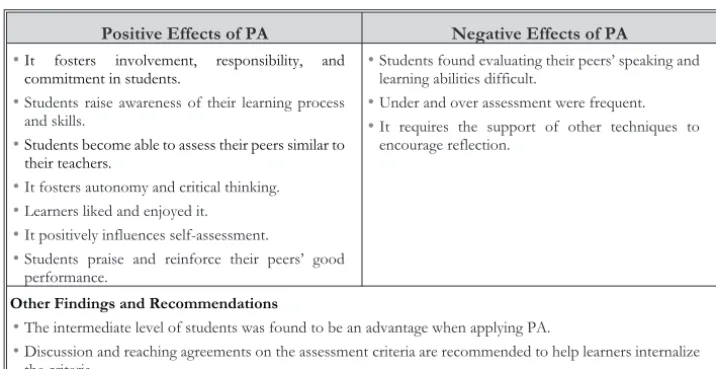
a result of contrasting the studies, the teacher researcher could have an idea of what have been done around the globe in regard to the use ofPAto foster speaking development. Table 1 summarizes the findings of the three studies in terms of positive effects, negative effects, and other findings and recommendations.
Table 1.Peer Assessment for Developing Oral Skills
Positive Effects of PA Negative Effects of PA •It fosters involvement, responsibility, and
commitment in students.
•Students raise awareness of their learning process and skills.
•Students become able to assess their peers similar to their teachers.
•It fosters autonomy and critical thinking. •Learners liked and enjoyed it.
•It positively influences self-assessment.
•Students praise and reinforce their peers’ good performance.
•Students found evaluating their peers’ speaking and learning abilities difficult.
•Under and over assessment were frequent. •It requires the support of other techniques to
encourage reflection.
Other Findings and Recommendations
•The intermediate level of students was found to be an advantage when applying PA.
•Discussion and reaching agreements on the assessment criteria are recommended to help learners internalize the criteria.
Teaching Through Prefabricated Chunks
Chu and Wang (2011) review the role that the lexical chunk method, which consists of teaching learners prefabricated lexical chunks, has had on the development of the oral and written competences of Chinese students who learn English as a foreign language. Their review reveals that the method contributes to the enhancement of learners’ pragmatic competence, helps students understand the discourse structures and speech rules, and promotes fluency and accuracy in oral and written English. However, Chu and Wang (2011) pointed out that a disadvantage is that chunks are learned as unanalyzed units that are not available to be combined with other structures or parts and this limits their use.
Research Design
according to Koshy (2005), Lim (2007), Sagor (2000), and Valcarcel (2009), consists of in-service teachers studying class situations in order to improve their pedagogical practice. Hence, teachers assume a double role as teachers and researchers.
Participants and Context
This study was conducted with 14 adults, from 26 to 50 years old, who worked as schoolteachers in different content areas (Christian education, mathematics, music, physics, Spanish, social science, accounting, biology, and pre-school education) at a private nonprofit school located in the northeast of Bogota, Colombia. Participants’ English level was A1 according to the Common European Framework of Reference (CEFR) (Council of Europe, 2014). In order to become a bilingual institution, the school provided two hours of English training per week for the teaching staff. The 14 teacher-students signed a consent form through which they authorized their participation in the research study.
Data Collection Instruments
Data were collected through four instruments, namely, video recordings(Appendix 7),PA checklist(Appendix 4),PMWN(Appendix 5), and a teacher-researcher’s journal(Appendix 8). The video recordings were used to gather data on participants’ speaking behaviors, thePA checklist andPMWNwere used to collect data on participants’ perceptions towards their peers’ spoken productions, and the journal was used to collect data on the teacher-researcher’s perceptions on the participants’ responses to the pedagogical implementation. Immediately after each session, the teacher-researcher wrote an entry in the journal in order to guarantee that the memories were still fresh.
Pedagogical Intervention
The pedagogical intervention was carried out in 11 lessons of two hours each (22 hours). It was developed in two stages, namely,training(six hours divided into three sessions) andmain implementation (16 hours divided into eight sessions). In the training stage, participants got acquainted with the features, scope, aims, and methodology of the research study. Also, the PA forms and the corpus were introduced and some practice on how to use them was carried out. Then, the main implementation stage was undertaken using task-based instruction (Willis & Willis, 2012) which consists of learners using authentic language to do meaningful situational tasks.
unfavorable events, sickness or injury, failureon a test, accident, or death of a loved one, which Suzuki (2008, 2010) recognized as the most common comforting situations occurring in the educational environment.
Data Analysis and Results
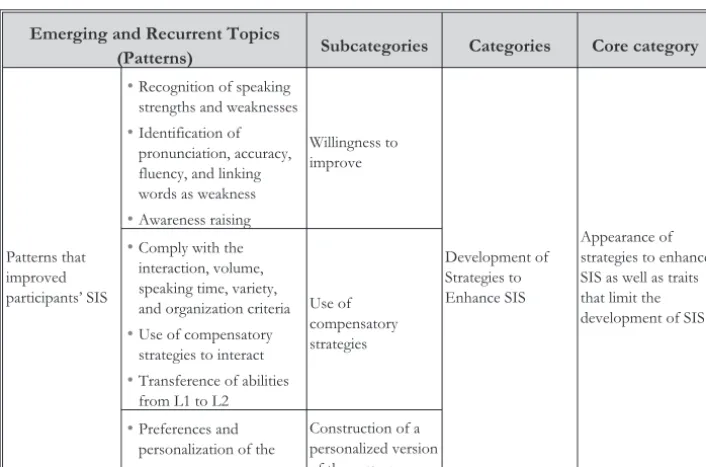
Data were analyzed using the grounded theory approach, which consists of coding data in three consecutive steps, namely,open,axial, andselective(Corbin & Strauss, 2008). In open coding, data were extracted from the instruments, contrasted, and triangulated. From this procedure, the teacher-researcher obtained a list of recurrent topics (patterns). Then, in the axial coding the patterns were grouped obtaining categories and subcategories. Finally, in the selective coding, the categories were grouped and refined in order to obtain a core category that answered directly the research question and predicted how PA and corpus would operate in diverse contexts. Table 2 shows the steps carried out in the data analysis process.
Table 2.Emerging Patterns, Subcategories and Categories
Emerging and Recurrent Topics
(Patterns) Subcategories Categories Core category
Patterns that improved participants’ SIS
•Recognition of speaking strengths and weaknesses •Identification of
pronunciation, accuracy, fluency, and linking words as weakness •Awareness raising
Willingness to improve Development of Strategies to Enhance SIS Appearance of strategies to enhance SIS as well as traits that limit the development of SIS •Comply with the
interaction, volume, speaking time, variety, and organization criteria •Use of compensatory
strategies to interact •Transference of abilities
from L1 to L2
Use of compensatory strategies
•Preferences and personalization of the corpus
Emerging and Recurrent Topics
(Patterns) Subcategories Categories Core category
Patterns that limited participants’ SIS
•Underassessment •Reluctance and
difficulties to give pieces of advice
•Fear to threaten peers •Lack of critical thinking
skills and awareness of the learning process
Underassessment
Emergence of Detrimental Traits
Appearance of strategies to enhance SIS as well as traits that limit the development of SIS •Dependency on the
corpus
Dependency on the corpus
Through the open and axial coding, the teacher-researcher discovered that the use of PA and a corpus produced two main effects on participants’ SIS. On the one hand, it encouraged participants to develop strategies to enhance their SIS productions (Category 1). These strategies were called willingness to improve(Subcategory 1.1), use of compensatory strategies(Subcategory 1.2), andconstruction of a personalized version of the corpus(Subcategory 1.3). On the other hand, it provoked the emergence of two detrimental traits (Category 2) that were namedunderassessment(Subcategory 2.1) anddependency on the corpus(Subcategory 2.2). Subsequently, the categories and subcategories are explained in detail and supported through excerpts taken from the instruments.
Category 1: Development of Strategies to Enhance SIS
The use ofPAand corpus encouraged participants to develop three strategies to improve theirSISperformance.
Subcategory 1.1: Improvement willingness. The teacher-researcher observed a change in participants’ assessment patterns by the end of the implementation process. This change had to do with the emergence of willingness to improve the peer assessment practice. By the end of the implementation, participants showed an emergent motivation to express their ideas, produce more objective and less emotional assessment, identify their peers’ mistakes and difficulties, and provide specific reasons to support their assessment.
their opinions. Therefore, they moved from no comment in the checklists to at least two comments, which are shown in Excerpt 1 below:1
Excerpt 1.Emergence of Participants’ Comments
S10 and S9: very good! S4: can be better. (Checklist)
Although these comments do not evidence deep reflection, they show participants’ willingness to reflect on their peers’ performances. In thePMWN, the teacher-researcher also observed a change in participants’ production of comments, which evidenced that they were able to recognize their peers’ mistakes and difficulties. Excerpt 2 shows examples of participants identifying specific problems in their peers’ performance:2
Excerpt 2.Identification of Peers’ Mistakes and Difficulties
Don’t clear the situation.
In my opinion he should calm when has a conversation. The conversation breakdown. (PMWN)
There were also positive comments that showed that participants identified good performances, too. Excerpt 3 evidences this:
Excerpt 3.Identification of Peers’ Good Performances
The time was apropiate.
Talk with good volume.
She have a good pronunciation. (PMWN)
In the PMWN, there were even some comments in which participants did not only establish if the performance was good or bad, but they went beyond by providing reasons that explain their judgment. Excerpt 4 shows examples of this:
Excerpt 4.Emergent Argumentation
Relevance: Is necessary that the situation is punctual.
Organization: The sentences she used has clear and logical.
Variety: He use a variety of vocabulary. He used pre-fabricated sentences in the performance. (PMWN)
In the first one, the participant did not consider his peers’ utterances relevant because the situation that framed the conversation was not well established. In the second one, the
1 The names of the participants were replaced by S and a number.
participant explained that the speech of the classmate approved the organization criterion
because it was clear and ordered in a logical way. In the last one, the participant argued that the criterion of variety was accomplished because the speaker incorporated various pre-fabricated sentences to enrich his speech, the use of the pre-fabricated sentences was confirmed in the video recording.
Subcategory 1.2: Use of compensatory strategies.The teacher-researcher noticed that participants could communicate despite the language limitations associated with their current language level. The teacher-researcher reflected on this phenomenon in the journal as can be seen in Excerpt 5:
Excerpt 5.Use of Strategies to Ensure Interaction
An important aspect of their spoken productions was that participants were able to interact in the conversation. Most of them were able to adapt their speech to the emerging unexpected situations such as when the partner did not produce the exact sentence that was planned or when a classmate from the audience made a joke. (Teacher-researcher’s journal)
The teacher-researcher found that to overcome emerging challenges in communication, participants used what Thornbury (2008) called compensatory strategies. According to this author, compensatory strategies are actions that speakers undertake in order to ensure the transmission of a message and maintain the interaction when they do not know or do not remember the exact grammar that they need. In this inquiry, participants used some of the compensatory strategies described by Thornbury. Furthermore, the teacher-researcher observed that participants used other strategies to avoid communication breakdown, so she included them in the list of compensatory strategies. Table 3 shows the number of times in which each compensatory strategy was used during the intervention. The ones with white background are those described by Thornbury while the ones with grey background correspond to other compensatory strategies that participants used in response to the implementation.
The use of the compensatory strategies allowed participants to achieve communication in L2 by overcoming their limitations in the use of the language. This can be seen in Excerpts6 and 7:
Excerpt 6.Use of Approximation in L2
S14: Oh, dear God! I lost five subjects. I lost math, I lost English, I lost chemistry, I lost biology and religion. (Video-recording transcription)
Excerpt 7.Use of Omission, Avoidance and Approximation in L2
S7: He was . . . since a long time…I have 10 years…I remember when I was a child I have a dog and now he. . . death. (Video-recording transcription)
Table 3.Use of Compensatory Strategies
Approximation in L2 12
Translation 4
Omission 3
Appealing for help 3
Approximation to an L1 expression 2
Word coinage 1
Avoidance 1
Paralinguistics 1
Foreignizing 0
All-purpose words 0
Circumlocution 0
Total 27
Note:Taken from the analysis of the video recordings.
In Excerpt 7, S7 started conveying a message omitting the unknown words. Later, he decided to reword the message which entailed the use of the avoidance strategy. Next, S7 approximated the verbhavethat should have been conjugated in past. Finally, S7 produced the worddeathto approximate the appropriate wording that should have beenis dead.
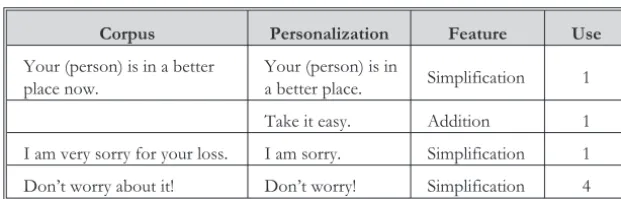
Table 4.New and Adapted Expressions of the Corpus
Corpus Personalization Feature Use
Your (person) is in a better place now.
Your (person) is in
a better place. Simplification 1 Take it easy. Addition 1 I am very sorry for your loss. I am sorry. Simplification 1 Don’t worry about it! Don’t worry! Simplification 4
Note:Taken from the analysis of video recordings
These modifications and additions suggest that participants personalized the corpus, which evince that they did not use it in an unreflected way. Besides, participants’ comments in thePMWNevidenced that the corpus fostered language variety as can be seen in Excerpt 8:
Excerpt 8.Expansion of Participants’ Vocabulary Range
She know the diferents words.
He has much vocabulary and your conversation is very expensive. He used many words for the conversation. (PMWN)
Category 2: Emergence of Detrimental Traits
PAand corpus also resulted in two traits that limited the development ofSIS.
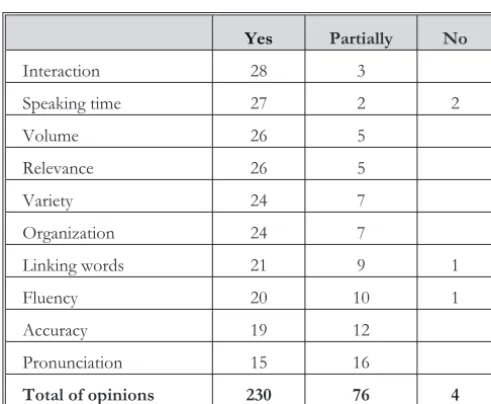
Subcategory 2.1: Underassessment.Serrano and Cebrián de la Serna (2011) defined underassessment as a phenomenon in which learners assess their peers under the assessment that the teacher would produce. This situation was evidenced especially at the beginning of the implementation of the project. Only four “no” marks throughout the complete pedagogical implementation evinced participants’ resistance to provide low scores. When their peers do not perform well, participants preferred to mark “partially” rather than “no,” as can be seen in Table 5.
The “no” marks appeared in the last checklists, by the end of the pedagogical intervention.
Excerpt 9.Assessment of “Fluency” in the Journal
Participants need to practice the corpus because they have not acquired the expressions yet. They still require support to use the expressions. (Teacher-researcher’s journal)
Table 5.Participants’ Assessment Patterns
Yes Partially No
Interaction 28 3
Speaking time 27 2 2
Volume 26 5
Relevance 26 5
Variety 24 7
Organization 24 7
Linking words 21 9 1
Fluency 20 10 1
Accuracy 19 12
Pronunciation 15 16
Total of opinions 230 76 4
Note:Taken from the analysis of checklists
Although the corpus helped participants expand their vocabulary range, it limited their spontaneity and fluency.
Limitations
Secondly, when using checklists, there should not be room for partial judgments, the person achieved the criteria or not; if there is a “partially” option, learners will tend to select this in order to avoid being rude with their peers, as occurred in this study. As a result, a lack of critical thinking will be perpetuated. Finally, when using thePMWN, as it was applied in this study, learners need to be trained in how to produce pieces of advice since they may lack the required language (vocabulary and structures), or they may not know how to do it politely, avoiding sounding rude and/or threatening (lack of knowledge of the register and language function). The lack of this knowledge may cause learners to limit their comments to avoid being rude with their classmates, as also occurred in this study.
Conclusions
As a result of the data analysis process, the teacher-researcher could answer the research question that guided the development of the study. In this sense, the teacher-researcher found that thePAand corpus influenced the development of participants’SISin the following two ways:
On the one hand,PAand corpus encouraged participants to develop three strategies to enhance their SIS productions, namely, willingness to improve, use of compensatory strategies, and construction of a personalized version of the corpus. These strategies provoked participants to reflect on the strengths and weaknesses of their spoken productions, overcome language barriers to achieve communication, and expand the range of vocabulary and structures that they were able to use in their spoken productions.
On the other hand, PAand corpus produced the emergence of two detrimental traits, namely, underassessment and dependency on the corpus. These traits impeded participants from delving further into the analysis of their spoken production and affected their fluency and spontaneity when speaking. However, more practice might be a solution to prevent these difficulties from appearing.
References
Ahangari, S., Rassekh-Alqol, B., & Akbari, L. A. (2013). The effect of peer assessment on oral presentation in an EFL context.International Journal of Applied Linguistics & English Literature, 2(3), 45-53. http://dx.doi.org/10.7575/aiac.ijalel.v.2n.3p.45.
Bennett, G. R. (2010). Using corpora in the language learning classroom: Corpus linguistics for participants.Michigan ELT, 1-22. Retrieved from http://www.international.ucla.edu/media/ files/Using-corpora-in-the-language-learning-classroom—Corpus-linguistics-for-teachers-m y-atc.pdf?AspxAutoDetectCookieSupport=1.
Corbin, J.,& Strauss, A. (2008).Basics of qualitative research: Grounded theory procedures and techniques(3rd ed.). Thousand Oaks, CA: Sage Publications.
Council of Europe. (2014).Common European Framework of Reference for Languages: Learning, teaching, assessment.Retrieved from http://www.coe.int/t/dg4/linguistic/source/framework_en.pdf. Creswell, J. W. (2009).Research design: Qualitative, quantitative, and mixed methods approaches(3rd ed.).
Thousand Oaks, CA: Sage Publications.
Ericsson, K. A., Krampe, R. T., & Tesch-Römer, C. (1993). The role of deliberate practice in the acquisition of expert performance. Psychological Review, 100(3), 363-406. http://dx.doi.org/10.1037/0033-295X.100.3.363.
Glasson, T. (2009).Improving student achievement: A practical guide to assessment for learning.Carlton, AU: Curriculum Corporation.
Gómez, D. (2014).The impact of peer and self-assessment on teenage B2 students’use of present perfect simple, present perfect continuous and past perfect simple in their spontaneous spoken productions(Master’s thesis). Universidad de La Sabana, Bogotá, Colombia.
Koshy, V. (2005).Action research for improving practice: A practical guide. London, UK: Paul Chapman Publishing.
Lim, P. T. H. (2007, May). Action research for teachers: A balanced model.Proceeding of the Redesigning Pedagogy: Culture, Knowledge and Understanding Conference 2007, Singapore. Retrieved from http://citeseerx.ist.psu.edu/viewdoc/download?doi=10.1.1.570.1170&rep=rep1&type=pdf. McMillan, J. H., & Schumacher, S. (2009).Research in education: Evidence-based inquiry (7th ed.).
London, UK: Pearson Education.
Moudraia, O. (2001). Lexical approach to second language teaching.ERIC Digest. Retrieved from http://www.cal.org/index.php/content/download/1546/16373/file/LexicalApproachtoSe condLanguageTeaching.pdf.
Sagor, R. (2000).Guiding school improvement with action research. Alexandria, VA: Association for Supervision and Curriculum Development.
Serrano, J., & Cebrián de la Serna, M. (2011). Study of the impact on student learning using the eRubric tool and peer assessment. In A. Méndez-Vilas (Ed.),Education in a technological world: Communicating current and emerging research and technological efforts(pp. 421-427). Badajoz, ES: Formatex Research Center.
Suzuki, T. (2008, August). A corpus-based study of the speech act of “comforting”: Naturalness and appropriateness for English language teaching.Paper presented at the 13th PAAL Conference, University of Hawaii, Manoa, USA. Retrieved from http://www.f.waseda.jp/toshisuz/ paal2008handout.pdf.
Suzuki, T. (2009a). A study of lexicogrammatical and discourse strategies for ‘suggestion’ with the use of the English speech act corpus. Retrieved from http://dspace.wul.waseda.ac.jp/ dspace/bitstream/2065/29661/1/BunkaRonshu_34_Suzuki.pdf.
Suzuki, T. (2010). A corpus-linguistic approach to the verbal realization of “comforting”.The Cultural Review, 4(36), 81-103. Retrieved from http://www.waseda.jp/w-com/quotient/ publications/pdf/bun36_04.pdf.
Suzuki, T. (2011). Children’s pragmatic competence: A case study of English speech acts performed by American children. The Cultural Review, 3(38), 55-73. Retrieved from http://www.waseda.jp/w-com/quotient/publications/pdf/bun38_03.pdf.
Thornbury, S. (2008).How to teach speaking. Harlow, UK: Pearson Education. Valcarcel, D. (2009).Action research essentials. San Francisco, CA: Jossey-Bass.
Willis, D., & Willis, J. (2012).Doing task-based teaching. Oxford, UK: Oxford University Press.
The Author
Appendix 1: Questionnaire 1
3Dear participants,
I invite you to answer this questionnairewhose aim is to explore your learning interests and needs. Your answers will help me improve the development and content of my classes. Feel free to write your opinions and experiences in detail. It is important to note that your responses will be treated anonymously.
Estimated time of development:5 min.
1. Which skill have you developed the most in your process of learning English?
Listening __ Speaking __ Reading __ Writing __
2. Why do you think that you have developed this skill more?
3. Which skill have you developed the least in your process of learning English?
Listening __ Speaking __ Reading __ Writing __
4. Why do you think that you have developed this skill less?
5. Which skill would you like to emphasize during the English classes?
Listening __ Speaking __ Reading __ Writing __
Appendix 2: Focus Group
Dear participants.
This is the guideline to participate in a group interview that aims to explore the difficulties that you find when doing oral productions. This interview was designed based on your responses to a questionnaire developed in a previous session. I invite you to complete the self-assessment format below and then participate in the discussion. Your contributions will help me better understand your learning interests and needs. The interview will be recorded, transcribed, and then analyzed, but your personal information will be always treated anonymously.
Please evaluate your speaking skills from 1 to 5, where 1 represents low mastery of skill and 5 total dominance.
Estimated time of development:15 min.
1 2 3 4 5
1 Have a clear understandable pronunciation.
2 Use appropriate patterns of stress, rhythm, and
intonation.
3 Use appropriate word variation such as verb
conjugation, adjective, nouns, etc.
4 Produce language following the grammatical structure.
5 Have a wide range of vocabulary that allows participating in conversations of diverse topics.
6 Use formal or informal language according to the
context and situation.
7 Provide arguments that supportmy ideas.
8 Organizemy speech in a logical way.
9 Say a same idea in a different way (rephrase,
reformulate).
10 Follow the topic of a conversation and participate
Appendix 3: Questionnaire 2
Dear participants,
This is a one-questionquestionnaire that aims to identify the language function that you use the most when interacting with your students in situations different from the class.
What are language functions?
Speakers produce language with a communicative intention. That intention or purpose is called function. There are many language functions such as greeting, thanking, suggesting, comforting, apologizing, etc. A function can be expressed through different utterances. For instance, the expressions “You are very kind”, “I am very thankful”, “Thank you for…” have as their function to offer thanks.
Instructions:
1. Highlight the five functions that you use the most when talking to your students in situations different from the class.
2. Then, number the functions that you selected considering that 1 is the most used
and 5 the least used.
___ Clarify something (I mean...)
___ Thank (You’re very kind...)
___ Assume responsibilities (I will do it) ___ Conclude (Finally…)
___ Blame someone (It was you…)
___ Giving advice (I suggest you...)
___ Giving instructions (Sit down, please)
___ Giving opinions (I think...)
___ Deduct information (This means that...)
___ Apologize (I am very sorry…)
___ Praise someone (You are so beautiful…)
___ Agree (Of course…)
___ Disapprove of something (I do not like that...)
___ Express displeasure (I dislike...)
___ Express obligation (I have to...)
___ Express preference (I like... more than…)
___ Express probability (Maybe...)
___ Express surprise (Really?)
___ Congratulate someone (Nice work)
___ Insinuate something (It would be good if...) ___ Invite someone (Do you want to go to...?) ___ Offer something (How about ...?) ___ Forbid something (Do not do that) ___ Complain (This is very complicated) ___ Comfort someone (Do not worry)
Appendix 4: Peer Assessment Checklist
1. Observe the conversation of your classmates.
2. Answerthe questions by marking a tick (T) in the column that corresponds.
Assessment Criteria Yes Partially No Comments
Content
1. Relevance of the message: Was the message of the speaker relevant to the listener?
Delivery
2. Speaking time: Did the speakers talk for at least 5 minutes?
3. Volume: Did the speakers talk in an audible volume?
4. Fluency, pauses, and rhythm: Did the speakers talk with an appropriate balance between fluency and pauses?
5. Pronunciation: Was the pronunciation understandable?
Organization
6. Organization: Was the message organized in a logical way?
7. Linking words: Did the speakers use linking words to connect their ideas?
Language
8. Accuracy: Were the sentences grammatically correct?
Assessment Criteria Yes Partially No Comments
Interaction 10. Interaction: Were theinterventions of the speakers
Appendix 5: “Plus, minus, and what’s next?” Form
1. Observe the conversation of your classmates.
2. Fill the table considering the assessment criteria.
Assessment Criteria
Plus (+) Minus (-) What’s next?
Good aspects Bad aspects What to practice
(advice)
Relevance of the message Speaking time
Volume
Fluency, pauses, and rhythm
Appendix 6: Sample of the Corpus About Comforting
#
Sub-Function Corpus Death Break Up Difficult Situation Unfavo-rable Event Sickness/ Injury Failure In Test Acci-dent
1 Soother (Person) is
okay. X
2 Advice
(Verb) will make you feel better.
X
3 Sympathy Are youokay? X X X
4 Offer of support
Can I do anything to help you feel better?
X X
5 Advice Cheer up. X X X X
6 Advice Don’t cry. X X X X
7 Advice Don’t be so
nervous. X
8 Advice
Don’t forget school break is coming up.
X X X
9 Advice Don’t worry
about it! X X X
10 Encourage-ment
Everything is going to be fine.
X X X X X
11 Encourage-ment
Everything will
beall right. X X X X X
12 Encourage-ment
Everything will
beokay. X X X X X
13 Encourage-ment
Everything works out in the long run, I promise.
X X X
14 Offer of support
I am here for
#
Sub-Function Corpus Death Break
Up
Difficult Situation
Unfavo-rable Event
Sickness/ Injury
Failure In Test
Acci-dent
15 Sympathy
I am reallysorry about the loss in your family.
X
16 Sympathy
I am so sorry things didn’t work out between you two.
X
17 Sympathy
I am sosorryto hear about your (mom, etc.) dying.
X
18 Sympathy
I amsorryto hear about your (person).
X
19 Sympathy I amsorryto
hear that. X X X
20 Advice
I am telling you to break up with her.
Appendix 7: Sample of a Video Recording Transcription
Date:Thursday, November 7th, 2013 (Session 3)
Role Play 1
S10: Hello, teacher. How are you?
S9:Bien[fine] or what.
S10: (Laughs). S9: What’s happen?
S10: Teacher, please me with my son. My son is very…lazy. S9: Very lazy? Yes.
(Participants joke a little) S9: What’s happen?Fabiancito.
S4: I am very lazy because I do not understand… S9: In what mat..?
S4: In math. S9: In mathematics?
S4: Yes. I always…I always…I always…fail. S9: You know because?
S4: I…I like…now, the mathematics, but I do not understand. S9: You do not understand mathematics.
S10: Teacher, please help us.
S9: OK. Don’t forget school break is coming up.Take it easy. Ok?
Appendix 8:Teacher-Researcher’s Journal
Session: Date: Time: Implementation
Stage: # participants:
Summary of the Class Activities:
Description of the activity with the corpus Analyzing participants’ response to the activity with the corpus
Description of the SIS activity Analyzing participants’ response to the SIS task