Author for correspondence:
Volume-5 Issue-2
International Journal of Intellectual Advancements
and Research in Engineering Computations
A comparative study of biosorption potential of different indigenous
waste materials for adsorption of nickel (ii) heavy metal - experiment and
kinetics
R. Ramesh Kumar, Dr. Pappayee Nagappan
ABSTRACT
The ability of adsorbents to adsorb nickel, Ni2+, from aqueous solutions has been inves tigated through batch experiments. The Ni2+ adsorption was found to be depends on pH, adsorbent dosage, contact time, initial concentration and agitation speed. All batch experiments carried out at temperature of 30oC using rotary shaker that operated at 150 rpm. Eco friendly, cost effective, easily available indigenous wastes were activated using sodium hydroxide, ultra sound irradiation (US) and sodium hydroxide followed by US was used as an adsorbent. Better activation was obtained with sodium hydroxide followed by US treatment. The experimental isotherm data were analyzed using Langmuir, Freundlich and Temkin equations. The experimental showed that highest Ni2+ removal rate was 79% for teakwood leaves under optimal conditions. The kinetic processes of Ni2+ adsorption onto various adsorbents were described by applying pseudo - first-order and pseudo-second-order rate equations. The kinetic data for the adsorption process obeyed pseudo -second-pseudo-second-order rate equations.
INTRODUCTION
Earth's surface comprises of 70% water is the most valuable natural resource existing on our planet. Without this invaluable compound, the life on the Earth would not exist. Although this fact is widely recognized, pollution of water resources is a common problem being faced today [1-5]. Heavy metal pollution occurs directly by effluent outfalls from industries, refineries and waste treatment plants and indirectly by the contaminants that enter the water supply from soils/ground water systems and from the atmosphere via rain water [6-10].
Heavy metals contamination of water and wastewater is a common phenomenon. Industrial wastewaters are usually the cause of heavy metals pollution of the environment. Heavy metals can bring about serious water pollution problems and threaten ecosystems. The presence of heavy metals in the environment has led to a number of environmental problems. Thus, it is essential to limit their discharge into the environment. Efforts are, therefore, constantly being made to develop new or modify existing technologies for their
removal from effluents before their discharge into receiving water bodies. Excessive levels of heavy metals have been linked with a wide range of health conditions, including skin disease, birth defects and cancer. The present study focuses on the removal of nickel (Ni) from aqueous solution [11-15].
An adsorption is one of the most efficient methods for the removal of heavy metals from wastewater and also it is easier and cheaper technique onto solid materials, whereby the adsorbate is accumulated on the surface of or inside an adsorbent. The efficiency of adsorption depends on many factors, including the surface area, pore size distribution, polarity, and functional groups of the adsorbent. Adsorption is a commonly used method for the removal of heavy metals from aqueous solutions. However, for the process to be economical the adsorbent should be easily and cheaply available in abundance and it should require minimal pretreatment for expensive pre-treatment procedures would add to the overall treatment cost [16-20].
Copyrights © International Journal of Intellectual Advancements and Research in Engineering Computations,
Traditional technologies for heavy metals removal include ion exchange, chemical precipitation and reverse osmosis. These methods are often ineffective or expensive, particularly for the removal of heavy metal ions at low concentrations. Hence there is a need for the development of efficient and environmental friendly waste treatment technologies to reduce the heavy metals content in wastewaters to acceptable levels at inexpensive costs.
Biosorption is an innovative technology that employs biomass for the recovery of heavy metals from waste water. Biosorption is a process that utilizes biological materials as adsorbents, and this method has been studied by several researchers as an alternative technique to conventional methods for heavy metal removal from wastewater. Biosorbent materials are available in abundance, low in cost but many of which potential not yet exploded. That can be used as a adsorbent to remove nickel (II) heavy metal. We are going to test the suitable adsorbent from the indigenous available waste materials for the adsorption of nickel.
EXPERIMENTAL
Preparation of Adsorbate
Stock solution of nickel was prepared by dissolving 100 mg of NiSO4. 7H2O in one litre (100
mg/L). The concentration range of nickel prepared from stock solution varied from 20 to 100 mg/L.
Preparation of Adsorbents
The adsorbents such as orange peel and teak wood leaves etc, was collected and washed with water to remove dirt particles. It was then boiled in distilled water to remove the mineral substances, lipids, amino acids, color agents and volatile compounds. Then it was washed with distilled water till the wash liquor free from color. The washed adsorbents were then dried in an oven at 105oc for 16 hour. The following is a chronological order of the process needed to produce adsorbents from their sources.
Collect waste → wash with distilled water → drying it in oven → size reduction → sieving → boiling and decolourisation → washing with water → drying → adsorbent.
Activation methods
In order to improve the surface activity, these adsorbents were activated using sodium hydroxide, ultra sound and two different sequential treatments such as NaOH followed by ultra sound.
Chemical activation
A known amount of adsorbent was mixed with 10% NaOH solution and the mixture was stirred at atmospheric conditions for 24 hours. Then, it was filtered and the sorbent was washed with excess amount of distilled water till the pH of wash liquor reaches the neutral conditions. The washed materials were dried in an oven in order to remove all the surface and entrapped moisture.
Ultra sonication
About 10g of adsorbents were added into 500 ml of distilled water and these contents were exposed to ultrasound irradiation for 30 min. An ultrasonic reactor with an operating frequency of 24 kHz was used for activation. The treated adsorbent solution was filtered, the contents were dried and used for further studies.
Sequential treatments
The sequential experiments by treating the adsorbents with NaOH followed by Ultrasound. A known amount of adsorbent was mixed with 10% NaOH solution and the mixture was stirred at atmospheric conditions for 24 hours. Then, it was filtered and the sorbent was washed with excess amount of distilled water till the pH of wash liquor reaches the neutral conditions. 100 ml of distilled water was added and these contents were exposed to ultrasound irradiation for 30 min. An ultrasonic reactor with an operating frequency of 24 kHz was used for activation. The treated adsorbent solution was filtered; the contents were dried and used for further studies.
Adsorption
RESULTS AND DISCUSSION
Activation of Adsorbent
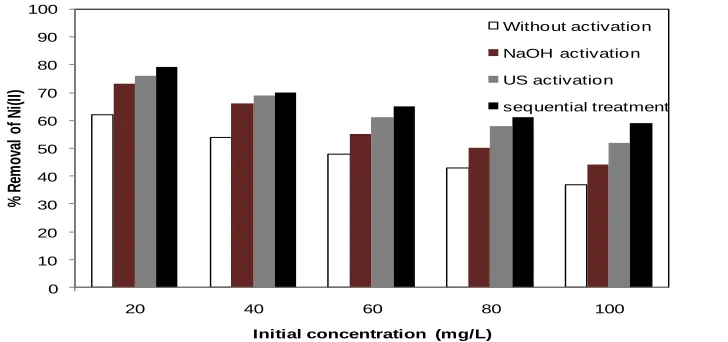
The influence of activation of adsorbent on the removal of Ni (II) was studied and the results are shown in Fig 4.1. Without pretreatment, the % Removal obtained was lower in all the cases whereas it was higher for the adsorbent which was activated by sequential treatment method. Based on the results obtained, the sequential treatment,
method was considered as the best method for activation. So the activation method was followed for the other two adsorbents also. Though the alkali and ultrasound treatments are effective in their own respective, the combined effect is even more effective due to double action on the surface of the adsorbent.
Fig 1: Activation of Adsorbent
Effect of ph
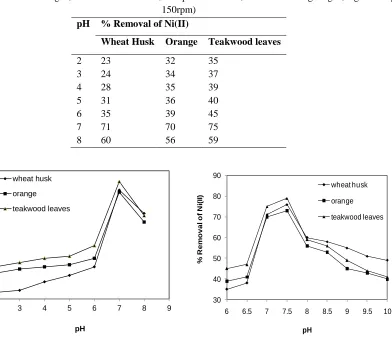
It is well known that adsorption depends on pH of the aqueous solution. The pH of the solution was controlled by the addition of 0.1N HCl and 0.1N NaOH. Fig.4.2 indicates the effect of pH on % Removal of Ni(II) for various adsorbents. The pH
level of the solution varies from 2.0 to 7.0. It is seen that the maximum adsorption was found between 6 to 8. So the nickel solution was again altered from 6 to 8. The maximum adsorption was found at the pH of 7.5 as shown in the Fig.4.2. So the optimum pH had been selected as 7.5.
Table 1 Effect of pH (2 – 8) on % removal of Ni (II) for various adsorbents
(Initial concentration: 20 mg/L; Contact time: 30 min; Temperature: 30oC; Adsorbent dosage:4 g/L; Agitation speed: 150rpm)
pH % Removal of Ni(II)
Wheat Husk Orange Teakwood leaves
2 23 32 35
3 24 34 37
4 28 35 39
5 31 36 40
6 35 39 45
7 71 70 75
8 60 56 59
0 10 20 30 40 50 60 70 80 90 100
20 40 60 80 100
%
R
em
ov
al
o
f N
i(I
I)
Initial concentration (mg/L)
Copyrights © International Journal of Intellectual Advancements and Research in Engineering Computations,
Table 2. Effect of pH (6 – 8) on % removal of Ni(II) for various adsorbents
(Initial concentration: 20 mg/L; Contact time: 30 min; Temperature: 30oC; Adsorbent dosage:4 g/L; Agitation speed: 150rpm)
pH % Removal of Ni(II)
Wheat Husk Orange Teakwood leaves
2 23 32 35
3 24 34 37
4 28 35 39
5 31 36 40
6 35 39 45
7 71 70 75
8 60 56 59
Fig 2: Effect of pH (2 – 8) on % removal Fig 3: Effect of pH (6 – 8) on % removal of Ni(II) for various adsorbents of Ni(II) for various adsorbents
Equilibrium study
Absorption isotherm are mathematical models that describe the distribution of the adsorbate species among liquid and adsorbent, based on a set of assumptions that are mainly related to the heterogeneity / homogeneity of adsorbents, the type of coverage and possibility of interaction between the absorbate species. Adsorption data are usually by adsorption isotherm, such as Langmuir, Freundlich and Temkin isotherms. These isotherms relate metal uptake per unit mass of adsorbent, qe, to the equilibrium adsorbate concentration in the bulk fluid phase Ce.
The Langmuir isotherm
The Langmuir model based on the assumption that the maximum adsorption occurs when a
saturated monolayer of solute molecules is present on the adsorbent surface, the energy of adsorption is constant and there is no migration of adsorbate molecules in the surface plan. The Langmuir isotherm is given by:
qe =
The constants in the Langmuir isotherm can be determined by plotting (1/qe) versus (1/Ce) and
making use of above equation rewritten as:
Where, qm and KL are the Langmuir constants,
representing the maximum adsorption capacity of the solid phase loading and the energy constant related to the heat of adsorption respectively. 20
30 40 50 60 70 80
2 3 4 5 6 7 8 9
%
Rem
ov
a
l
of
Ni(II)
pH
wheat husk
orange
teakwood leaves
30 40 50 60 70 80 90
6 6.5 7 7.5 8 8.5 9 9.5 10
%
R
e
m
o
v
a
l
o
f
N
i(
II
)
pH
wheat husk
orange
Table 3: Langmuir isotherm for various adsorbents
(Contact time: 30 min; Temperature: 30oC; Agitation speed: 150 rpm; Adsorbent dosage: 4 g/L; pH: 7.5; Initial concentration: 20 mg/L)
S.No Wheat husk Orange Teakwood leaves
1/Ce 1/qe 1/Ce 1/qe 1/Ce 1/qe
1. 0.056361 0.499924 0.056361 0.499924 0.070561 1.060538 2. 0.026338 0.267591 0.026338 0.267591 0.028544 0.367358 3. 0.017269 0.175109 0.017269 0.175109 0.017904 0.280012 4. 0.012692 0.129332 0.012692 0.129332 0.013063 0.204696 5. 0.010058 0.104299 0.010058 0.104299 0.010307 0.156558
Figure 4: Langmuir isotherm for various adsorbents
(Contact time: 30 min; Temperature: 30oC; Agitation speed: 150 rpm; Adsorbent dosage: 4 g/L; pH: 7.5; Initial concentration: 20 mg/L)
The freundlich isotherm
The Freundlich isotherm model is an empirical relationship describing the adsorption of solution from a liquid to a solid surface and assumes that different sites with several adsorption energies are involved. Freundlich adsorption isotherm is the relationship between the amounts of nickel adsorbed per unit mass of adsorbent, qe, and the
concentration of nickel at equilibrium, Ce and it is
given by,
The logarithmic from of the equation becomes, log qe = log Kf + log Ce
Where Kf and n and the Freundlich constants,
the characteristics of the system, Respectively. The ability of Freundlich model to fit experimental data was examined. For this case, the plot of log Ce vs
log qe was employed to generate the intercept value
of Kf and the slope of n from Fig4.9.
Table: 4 Freundlich isotherm for various adsorbents
(Contact time: 30 min; Temperature: 30oC; Agitation speed: 150 rpm; Adsorbent dosage: 4 g/L; pH: 7.5; Initial concentration: 20mg/L)
S.No Wheat husk Orange Teakwood leaves
log Ce log qe log Ce log qe log Ce log qe
1. 1.24902 0.401 1.24902 0.301096 1.151433 -0.02553 2. 1.579423 0.6725 1.579423 0.572529 1.544489 0.43491 3. 1.76273 0.7566 1.76273 0.756692 1.74706 0.552823 4. 1.896467 0.982 1.896467 0.888293 1.883959 0.68889 5. 1.997497 0.999 1.997497 0.981719 1.986881 0.805323
y = 14.91x - 0.004 R² = 0.993
y = 8.506x + 0.026 R² = 0.996
y = 6.965x + 0.150 R² = 0.976
0 0.2 0.4 0.6 0.8 1 1.2
0.01 0.02 0.03 0.04 0.05 0.06 0.07 0.08
1/
qe
1/Ce
Copyrights © International Journal of Intellectual Advancements and Research in Engineering Computations,
Figur 5: Freundlich isotherm for various adsorbents
(Contact time: 30 min; Temperature: 30oC; Agitation speed: 150 rpm; Adsorbent dosage: 4 g/L; pH: 7.5; Initial concentration: 20 mg/L)
Kinetic study
In order to investigate the controlling mechanism of adsorption processes such as mass transfer and chemical reaction, the pseudo first order and pseudo second order equations are applied to model the kinetics of nickel adsorption onto various adsorbents. The pseudo first order rate equation is given as
log (qe- qt) = log qe - t
Where qt and qe are the amount adsorbed (mg/g)
at time, t and at equilibrium respectively and kad is
the rate constant of the pseudo-first-order adsorption process (min-1). Straight line plots of log (qe - qt) against were used to determine the rate
constant, kad, and correlation coefficients, R2, for
different nickel concentrations,
Figure: 6: Pseudo first order Reactions for Ni2+ Ions Adsorbed onto various adsorbents
y = 0.916x - 0.854 R² = 0.997
y = 0.965x - 1.114 R² = 0.989 y = 0.822x - 0.633
R² = 0.971
0 0.2 0.4 0.6 0.8 1 1.2
1.2 1.4 1.6 1.8 2 2.2
lo
g
q
e
log Ce
teakwood leaves
orange
wheat husk
y = -0.069x + 0.051
R² = 0.999
y = -0.058x - 0.047
R² = 0.999
y = -0.097x + 0.749
R² = 0.807
-4.5
-4
-3.5
-3
-2.5
-2
-1.5
-1
-0.5
0
0
10
20
30
40
50
60
lo
g
(
q
e
-q
t)
Time (min)
teakwood leaves
orange
The pseudo second order equation is expressed as
Where h = kqe 2
(mg g-1min-1) can be regarded as the initial adsorption rate as t→0 and k is the rate constant of pseudo-second-order adsorption (g mg
-1min-1). The plot t/q
t versus t should give a straight
line if pseudo-second-order kinetics is applicable and qe, k and h can be determined from the slope
and intercept of the plot, respectively. The plots of the linearized form of the pseudo second- order reaction at different Ni2+ concentrations by various adsorbents are shown in Fig. 4.12. The pseudo-first-order and pseudo-second-order rate constants determined from Figs. 4.11.and 4.12.are presented in Table 4.13. along with the corresponding correlation coefficients.
Fig: 7: Pseudo second order Reactions for Ni2+ Ions Adsorbed onto various adsorbents
CONCLUSION
The adsorption of Nickel (II) onto various adsorbents has been studied. The following conclusions are drawn based on the above study; On comparing the biosorption potential of
adsorbents such as Teak wood leaves, Wheat husk and Orange peel, it is found that the biosorption potential of teakwood leaves is higher than wheat husk and orange peel.
From the results, the sequentially pretreated adsorbents are found to have more adsorption potential than other pretreated adsorbents.
Langmuir isotherm is well fitted for adsorption of Nickel (II) onto various adsorbents.
Adsorption of Nickel has been best described by pseudo- second- order kinetic model. The pseudo second order rate constant is found to be 0.1140 g/mg min.
The % removal of Nickel increases with increase in pH of the nickel solution.
The % removal of Nickel increases with increase with increase contact time.
The % removal of Nickel increases with increase in adsorbent dosage.
The % removal of Nickel decreases with initial concentration of the nickel solution.
REFERENCES
[1]. Abbas Afkhami , Tayyebeh Madrakian, Ziba Karimi, Azadeh Amini, ‘Effect of treatment of carbon cloth with sodium hydroxide solution on its adsorption capacity for the adsorption of some cations’, Colloids and Surfaces A: Physicochem. Eng, 304, 2007, 36–40.
y = 1.231x + 13.28 R² = 0.999
y = 0.938x + 5.987 R² = 0.999
y = 0.935x + 16.12 R² = 0.999
0 10 20 30 40 50 60 70 80 90
10 20 30 40 50 60 70 80
1
/q
t
Time (min)
teakwood leaves
orange
Copyrights © International Journal of Intellectual Advancements and Research in Engineering Computations,
[2]. Akbar Eskandarpour , Maurice S. Onyango , Aoyi Ochieng , Shigeo Asai, ‘Removal of fluoride ions from aqueous solution at low ph using schwertmannite’, Journal of Hazardous Materials, 152, 2008, 571–579. [3]. Benhammou, A.Yaacoubi, L.Nibou, B.Tanouti, ‘Adsorption of metal ions onto moroccan stevensite and kinetic
and isotherm studies’, Journal of Colloid and Interface Science, 282, 2005, 320–326.
[4]. Bin Yu , Y. Zhang , Alka Shukla , Shyam S. Shukla ,Kenneth L. Dorris, ‘The removal of heavy metals from aqueous solutions by sawdust adsorption— removal of lead and comparison of its adsorption with copper’, Journal of Hazardous Materials, B84, 2001, 83–94.
[5]. B.M.W.P.K. Amarasinghe, R.A. Williams, ‘Tea waste as a low cost adsorbent for the removal of cu and pb from wastewater’, Chemical Engineering Journal, 132, 2007, 299–309.
[6]. Carlos Escudero, Carmen Gabald on , Paula Marzal, Isabel Villaescusa, ‘Effect of EDTA on Divalent Metal Adsorption onto Grape Stalk and Exhausted Coffee Wastes’, Journal of Hazardous Materials, 152 2008, 476– 485.
[7]. Chuh-Yean Chen, Mao-Syong Lin, Kun-Rong Hsu, ‘Recovery of Cu(II) and Cd(II) by a chelating resin containing aspartate groups’, Journal of Hazardous Materials, 152, 2008, 986–993.
[8]. David William O’Connell, Colin Birkinshaw, Thomas Francis O’Dwyer, ‘Heavy metal adsorbents prepared from the modification of cellulose’, Bioresource Technology, 99, 2008, 6709–6724.
[9]. E. Nehrenheim, J.P. Gustafsson, ‘Kinetic sorption modelling of Cu, Ni, Zn, Pb and Cr ions to pine bark and blast furnace slag by using batch experiments’, Bioresource Technology, 99, 2008, 1571–1577.
[10]. Erdal Eren, ‘Removal of lead ions by unye (turkey) bentonite in iron and magnesium oxide-coated forms’, Journal of Hazardous Materials, 100, 2008, 396- 398.
[11].Elias B. Tambourgi, ‘Capacity of adsorption of pb2+ and ni2+ from aqueous solutions by chitosan produced from silkworm chrysalides in different degrees of deacetylation’, Journal of Hazardous Materials, 147, 2007, 139– 147.
[12]. F.Gode, E.Pehlivan, ‘A comparative study of two chelating ion-exchange resins for the removal of chromium (iii) from aqueous solution’, Journal of Hazardous Materials, 100, 2003, 231–243.
[13]. F. Rozada, M. Otero, A. Mora , A.I. Garcı´a, ‘Adsorption of heavy metals onto sewage sludge-derived materials’, Bioresource Technology, 99, 2008, 6332–6338.
[14]. Gulay Bayramo glu, M. Yakup Arica, ‘Adsorption of Cr(VI) onto PEI immobilized acrylate-based magnetic beads isotherms, kinetics and thermodynamics study’, Chemical Engineering Journal, 139, 2008, 20–28. [15]. Heechan cho, Dalyoung oh, kwanho kim, ‘A study on removal characteristics of heavy metals from aqueous
solution by fly ash’, Journal of Hazardous Materials, b127, 2005, 187–195.
[16]. H.J. Wang, A.L. Zhou, F. Peng , H. Yu, L.F. Chen, ‘Adsorption characteristic of acidified carbon nanotubes for heavy metal pb(ii) in aqueous solution’, Materials Science and Engineering, 466, 2007, 201–206.
[17]. Jaeyoung Choi, Ju Young Lee, Jung-Seok Yang, ‘Biosorption of heavy metals and uranium by starfish and pseudomonas putida’, Journal of Hazardous Materials, 161, 2009, 157–162.
[18]. Joanna Rutkowska, Krzysztof Kilian, Krystyna Pyrzynska, ‘Removal and enrichment of copper ions from aqueous solution by 1,8-diaminonapthalene polymer’, European Polymer Journal, 44, 2008, 2108–2114. [19]. Julien Laurent, Magali Casellas, Christophe Dagot, ‘Heavy metals uptake by sonicated activated sludge’,
Journal of Hazardous Materials. 2008