ISSN: 2334-2366 (Print), 2334-2374 (Online) Copyright © The Author(s). 2014. All Rights Reserved. Published by American Research Institute for Policy Development
Virtualization benefits in High Performance Computing
Applications
Zartasha Gul1, Irfan Ahmed2, Yasir Hafeez3 and Saiqa Bibi4
Abstract
Virtualization is not a new computer technology in this age. It was developed by IBM in 1960’s. Virtualization was used to access the pricey resources of mainframe computers. Furthermore it conceals the computer resources from the operating system. Since computer resources are growing day by day, there is an emergent need to utilize them efficiently and effectively. It proffers a lot of benefits to different applications including High Performing Computing (HPC) applications. We have highlighted a review of some benefits aided by This paper provides a review of some benefits that are aided by employing virtualization in HPC environments and analysis of some of the technologies that are designed to support virtualization.
Keywords: virtualization, HPC, hypervisor
Introduction
Virtualization is a method to divide computing resources logically. Virtualized resources can be computer hardware, computer software, storage, memory, data, operating system, and network resources. Virtualization technology is one of the technologies in computer science field which is not a new technology [1].
1 University Institute of Information Technology (UIIT), PMAS - Arid Agriculture University,
Rawalpindi, Pakistan. Email: [email protected]
2 University Institute of Information Technology (UIIT), PMAS - Arid Agriculture University,
Rawalpindi, Pakistan. Email: [email protected]
3 University Institute of Information Technology (UIIT), PMAS - Arid Agriculture University,
Rawalpindi, Pakistan. Email: [email protected]
4 University Institute of Information Technology (UIIT), PMAS - Arid Agriculture University,
Virtualization is an implementation that hides the computer hardware and software resources from the operating system [2]. Virtualization is as old as the 1960, at that time, virtualization was recommended by the IBM [3]. In old days, virtualization was a way to access the costly resources of mainframe computers. Now, computing system resources are growing day by day at a very large scale. It is required that these resources should be used efficiently over and above cost incurred using these resources should be negligible. Virtualization is only the way to achieve these objectives. Virtualization started supporting different applications’ requirement demand; some of them are server consolidation, application performance isolation, dynamic migration of workloads, and research on security areas [3] .
Special virtualization techniques are available to fulfill these demands. “Xen” is a technique of virtualization that meets the demand of performance isolation with the help of high performance Virtual Machine Monitor (VMM) [4]. Other virtualization technologies are VMWare ESX, Oracle VirtualBox and Kernalbased Virtual Machine (KVM) are more common[3], [4]. Virtualization technologies provide number of benefits i-e simplified management, security, lowest performance cost and shifting the virtual machine from one place to another without disconnecting the application [5] . Virtualization is a source of easy division of computer hardware and software resources while maintaining the security and quality of service provided to the customer, so interest is increasing in designing the microprocessors that fits the virtualization support [6]. Virtualization is increasing rapidly in research communities and IT industry [5], [7] .
Fig 1: A virtual machine monitor provides a virtual machine abstraction in which standard operating systems and applications may run. Each virtual
machine is fully isolated from the rest of the virtual machines
HPC applications need to be accelerated. They are used in data mining, medical industry, financial trading, data ware housing, to bioscience, data security and many more. In IT industry acceleration in data processing increasing extensively and industry started to develop and deploy HPC applications every day.
Although virtualization provide a wide range of benefits but it has not been extensively accepted to the HPC environment because of some disputes; virtualization overhear: in HPC application efficient communication is critical, but in virtualizing systems hypervisor takes some tasks from the virtual machines to perform. This is not suitable in HPC environment. Ease of management: virtualization in HPC environment need a framework to provide the management ease for the virtual machines. HPC applications cannot have benefit from the virtualization until the management framework is applied [5].
In spite of these challenges, virtualization can provide extensive benefits to the HPC applications. In this paper we will review some potential benefits that the virtualization can bring to the HPC environment when HPC applications are multiplexed.
Related Work
There are several uses of virtualization in HPC environment [7]. As well as virtualization offers many benefits to the HPC applications, although the use of virtualized HPC applications is lagging but it is becoming the thrust of enterprise industry. Virtualization provides many benefits to the HPC applications in terms of performance, scalability, availability, and security.
It can provide HPC applications and systems with increased development and testing. As virtualization offers a bunch of virtual machines and each of them can be configured for specific task. With the use of virtualization testing and development can be performed on the same machine. Another aspect of productivity of the HPC applications with the use of virtualization is that the productivity can be increased by running various copies of OS and applications on the same machine [8].
Regarding virtualization, performance is the major question to answer as the performance of virtualized HPC applications is as good as they are in physical machines [10]. Performance isolation is one of the issues of virtualization that is being given great importance while designing the virtualization technologies like xen and IBM Hypervisor. HPC applications can benefit from virtualized environment in terms of performance in many ways. In virtualization optimized operating systems are used for HPC applications. It is the responsibility of hypervisor to allocate resources to different applications in HPC environment so the performance of different HPC applications is isolated and they can perform their tasks as efficiently as they were in physical machines[8].
As discussed above that the virtualization multiplexes the resources of a single machine to be used as multiple machines. These multiple machines are virtual faces of different machines. In HPC environment several applications run on these VM’s. Along with the performance and productivity, availability can also be discussed as the advantage of virtualization in HPC environment. Availability can be defined in terms of isolation. As applications in virtualized HPC environment run on different virtual machines and the hypervisor is responsible for the allocation of resources [10] so availability is not an issue. If one VM is busy in development than another VM is always available to perform testing or other tasks, it is intended to serve [8].
Virtualization also offers other resource related benefits in terms of resource management, fault tolerance and other functionality. In virtualization HPC applications are greatly dependent on the availability of the resources and related to the breakdown of the virtualized resources [12]. Two methods are used to avoid such problems a) fault tolerance migration and b) fault tolerance monitoring. In HPC environment application break down and restart is an important issue [10]. Fault tolerance migration is also called reactive approach and it is valuable way to restart HPC application after a breakdown [12]. This approach has the aptitude to save the current state of the application and again start the application from this point [7]. Fault tolerance monitoring is the proactive approach it includes continues monitoring of the HPC applications environment [10]. It monitors whether any interruption to the system occurs [12]. Virtualization provides the solutions for these two types of tolerances without having separate hardware and software manageability[10].
Various Virtualization technologies used in HPC environment:
Virtualization is preferred cost saving plan in software industry. HPC applications can also get benefit from the other virtualization benefits such as saving costs used in purchase of several servers, scalability, load balancing, lower power consumption and efficiency etc [11].
Performance Evaluation
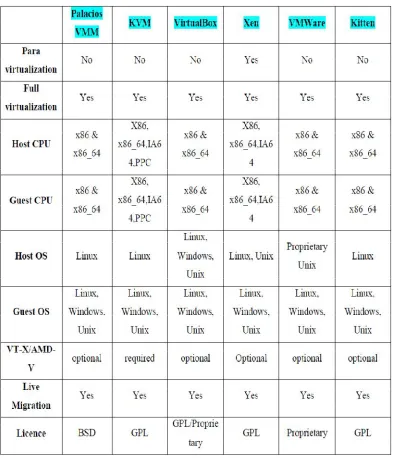
Table 1 shows the analysis of various virtualization technologies that can be used for HPC environments. Among them Palacios and kitten are specially designed for HPC applications to gain high productivity, scalability and improved performance of HPC applications. Both are embedded to achieve scalability and improved performance, kitten is a light weight OS in which Palacios is embedded as a kernel code [9].
Conclusion
References
N. Regola and J.-C. Ducom, “Recommendations for Virtualization Technologies in High Performance Computing,” 2010 IEEE Second International Conference on Cloud Computing Technology and Science, pp. 409–416, Nov. 2010.
A. J. Younge, R. Henschel, J. T. Brown, G. von Laszewski, J. Qiu, and G. C. Fox, “Analysis of Virtualization Technologies for High Performance Computing Environments,” 2011 IEEE 4th International Conference on Cloud Computing, pp. 9–16, Jul. 2011. X. Zhang and Y. Dong, “Optimizing Xen VMM Based on Intel® Virtualization
Technology,” 2008 International Conference on Internet Computing in Science and Engineering, no. Vmm, pp. 367–374, Jan. 2008.
P. T. Barham, B. Dragovic, K. Fraser, S. Hand, T. L. Harris, A. Ho, R. Neugebauer, and M. Harringer, “Xen - The Art of Virtualization,” pp. 1–15, 2004.
W. Huang, J. Liu, B. Abali, D. K. Panda, and C. Science, “A Case for High Performance Computing with Virtual Machines,” 2006.
E. Van Hensbergen, “The Effect of Virtualization on OS Interference,” pp. 2–7. J. E. Simons and J. Buell, “Virtuali z ing High Performance Computing,” pp. 136–145. M. F. Mergen, V. Uhlig, O. Krieger, and J. Xenidis, “Virtualization for High-Performance
Computing Categories and Subject Descriptors,” pp. 8–11.
J. R. Lange, K. Pedretti, P. Dinda, P. G. Bridges, C. Bae, P. Soltero, and A. Merritt, “Minimal-overhead virtualization of a large scale supercomputer,” ACM SIGPLAN Notices, vol. 46, no. 7, p. 169, Jul. 2011.
A. Gavrilovska, “High-Performance Hypervisor Architectures : Virtualization in HPC Systems,” no. 1.
E. Ray, N. Red, R. Street, E. Schultz, and D. Ph, “Virtualization Security,” 1906.