ABEPRO
DOI: 10.14488/BJOPM.2017.v14.n4.a9
IDENTIFYING CRITICAL SUCCESS FACTORS FOR THE IMPLEMENTATION OF ENTERPRISE
RESOURCE PLANNING SYSTEMS IN PUBLIC EDUCATIONAL INSTITUTIONS
Flávia Campos Fernandes Leandro1, Mirian Picinini Méxas2, Geisa Meirelles Drumond2
1 Pedro II School; 2 Fluminense Federal University
ABSTRACT
The implementation of Enterprise Resource Planning (ERP) systems in Brazilian public educational institutions is considered critical and a time consuming process. Then this study aims to identify the Critical Success Factors (CSF) for the implementation of ERP systems in these organizations. A literature review, where 30 CSF used in scientific articles were identified, has been prepared. Based on found CSF, 20 were selected to compose a questionnaire constructed with the Likert scale and applied to 70 ERP systems specialists in educational institutions, in order to get the perception of the most CFS relevant during the pre-implementation, implementation and post-implementation phases. As a result of this field survey, a ranking of the degree classification “very important” for 20 CFS was drafted by percentage in the ERP lifecycle. This work intends to contribute with a comprehension in terms of what CFS needs to be observed during each phase of the ERP systems implementation in educational institutions.
1. INTRODUCTION
As well as businesses and industries, educational insti-tutions have been searching for IT (Information Technol-ogy) resources, and the ERP systems (Enterprise Resource Planning) have been increasingly used by these institutions (Alqashami et Mohammad, 2015).
As an IT application, the ERP system is considered one of the most important, as it enables organizations to connect and interact with their administrative units, allowing data management and internal procedures coordination. Edu-cational institutions have sought the capabilities of the ERP system; however, many projects fail, go beyond the schedule or face budget constraints. The failure rate of ERP systems implementation in educational institutions is higher than in other sectors (Alqashami et Mohammad, 2015).
In addition, the ERP system implementation is a complex process and usually produces changes within the organiza-tion, whether involving changes in the roles and responsi-bilities of the people, or changes in relations between the company departments (Sun et al., 2015).
Ram et al. (2014) declare that both the academic litera-ture as the commercial show that ERP systems implemen-tation involves complexities, often resulting in failures and difficulties; however, the implementation of these systems has produced improvements as well as tangible and intangi-ble benefits in organizations performance.
Several researchers, including Umble et al. (2003), Ehie et
Madsen (2005), Finney et Corbett (2007) and Hart et Snad-don (2014), highlight the challenges and gaps in the success-ful implementation of ERP systems. The critical success fac-tors (CSF), a management tool released by Bullen et Rockart (1981), emphasize the importance of knowing the key areas of the organization for the success of projects at the company.
This tool has been widely used and studied by research-ers for implementating ERP systems, as presented by Bansal
et Agarwal (2015), Kapur et al. (2014), Ram et al. (2014) and Beheshti et al. (2014), among others. Considering that the Critical Success Factors are regarded as key areas in the or-ganization, when they are put into practice properly, these factors provide successful implementation of the ERP sys-tem and, in addition, considering the studies of Ashja et al.
(2015) on the lifecycle of ERP, sorting it into three stages - pre-implementation, implementation and post-implementa-tion, this research aims to identify the CSF that more affect success in these three phases of ERP systems in Brazilian public education institutions.
To achieve this goal, a questionnaire was prepared based on the literature review, where 20 CSF were evaluated by
experts, in a Likert scale, focusing on the answers concern-ing the degree of importance “too high”, in the perception of these respondents. As a result of this survey, a ranking of the 20 CSF was developed, showing the percentages for each CSF. The purpose of this ranking is to observe the CSF position as its relevance in the three phases of ERP imple-mentation.
Finally, we highlight that this paper will refer to the term “implementation”, both in generic form, thus covering all the complexity of ERP system within the organization, as de-fined by Sun et al. (2015), and specifically with respect to the second stage of the ERP life cycle, as proposed by Ashja et al. (2015): first phase, pre-implementation; second phase, implementation; and the third stage, post-implementation.
In addition to this introduction, this article is composed of the following sections: Section 2, which describes the concepts of ERP systems and their three stages of imple-mentation; Section 3, which features the description on Critical Success Factors; Section 4, where the methodology applied in this study is presented; Section 5, which describes the literature review, presenting the 20 CSF grouped and employed for this research; Section 6, which presents the ranking of CSF in the experts perception within the pre-im-plementation, implementation and post implementation phases and the considerations of the results; and, finally, Section 7, which features the conclusion of the study.
2. ERP SYSTEMS
ERP systems became one of the most important tools used in the organizations’ management. These systems con-tribute to the companies’ efficiency, by means of integrated resource management, automation processes and optimi-zation of the information flow. When successfully imple-mented, the ERP can facilitate management under various aspects; however, its implementation is not a simple task (Morton et Hu, 2008).
These systems are composed of a set of modules that are linked. The functional areas of an organization, such as: fi-nance, accounting, production, procurement and customer service, are interconnected in a single system, with a com-mon platform for the information flow across the enterprise (Beheshti et al., 2014).
infor-mation communication within the company. To the authors, the ERP systems must be well understood, since they are at the heart of the company’s business and, therefore, meet the three main objectives within the organization, namely, the operational, tactical and strategic.
The ERP system implementation should not only be viewed as a technology exchange within the organization, because this migration involves changes where the organi-zational structure will be anchored in the company’s internal processes. In addition, its implementation is complex, due to the fact that clients can make adjustments in the system to contemplate their need, increasing not only the complexity, but also the time for this implementation (Mendes et Escriv-ão Filho, 2002).
Bernroider et al. (2014) claim that implementation of the ERP system is difficult and not always successful. Many orga-nizations do not seem to be prepared for proper planning for this project, producing as a result, a partial implementation success or abandonment of the project before its comple-tion.
Tasevska et al. (2014) declare that the ERP systems have been developed to allow the organization global integration of business processes, producing as a final result, the effec-tive management of the entire company; however, its imple-mentation is not an easy task.
Considering that the ERP systems management involves various difficulties, due to its complexity, Corrêa (2015) sug-gests the training of technicians and users, in order to con-tribute to ERP implementation-related issues reduction.
Esteves-Souza et Pastor-Collado (2000) claim that ERP implementation has been one of the major themes for ERP system researchers and scholars. The authors comment that it is quite common for project managers to focus only the technical and financial aspects of the project implementa-tion, forgetting to observe aspects related to cultural change, user activity and involvement of senior management.
An ERP system can be a powerful weapon in terms of competition and competitiveness for an enterprise; howev-er, its implementation can be very risky if there is no appro-priate planning and management (Sun et al., 2015).
2.1. Stages of ERP implementation
Ashja et al. (2015) developed a work whose aim was to identify the ERP system life cycle and find the CSF that stood out at every point in its lifecycle. The authors state that sev-eral researchers presented models of ERP system lifecycle, watching the special features of the system; however, Ashja
et al. (2015) proposed the classification of the ERP system life cycle in three essential stages in that all information sys-tem goes through pre-implementation, implementation and post-implementation processes.
According to Ashja et al. (2015), the pre-implementation stage begins when the organization understands that the ERP system is the best solution to enhance and develop its business. This phase involves the financial question and se-lecting the appropriate ERP system package.
On the implementation stage, these authors assert that this phase includes providing an action plan for implement-ing the ERP system, the application of the software package, users training and the execution system.
Ashja et al. (2015) claim that the last stage, post-imple-mentation, includes two main stages: first, stabilization and, secondly, improving and updating. The authors state that, in this step, users’ problems and difficulties stand out and, in addition, the project team must be ready for the correction of possible bugs and system settings for better performance, until all organization operations happen within normality.
For these authors, the system improvement and upgrade are crucial. They are related to the software update or the new modules addition to be integrated into the implement-ed system.
This stage ends when the organization notes that the ERP system in use needs to be replaced by another or when there is the need for exchanging the system’s principal com-ponents.
Therefore, based on the study of Ashja et al. (2015), this work will structure the CSF in the three stages of the pro-posed ERP life cycle, so that the CSF may be evaluated by ERP system experts from educational institutions, within these three phases.
3. CRITICAL SUCCESS FACTORS
The concept of Critical Success Factors (CSF) was devel-oped in early 1960s. Ronald Daniel was the first scholar who discussed, in the literature devoted to management, the idea of CSF. He stated that the information analysis should have the focus on success factors to help organizations achieve their targets (Alqashami et Mohammad, 2015).
Rockart, 1981).
According to the Bullen et Rockart’s (1981) definition, the CSF are the key areas in a company in which favorable re-sults are absolutely necessary, in order to ensure the organi-zation productive performance.
Rockart (1979) noted that the CSF could lead the compa-ny to achieve satisfactory results, ensuring productive per-formance in the organization.
This methodology is still being applied, even today, by scholars in the organizational management area; thus, some aspects of the company are actually crucial to its success. Researchers, both in the past and present, have been de-voted to studying and list multiple CSF that are essential for the successful implementation of ERP systems (Ciubotaru, 2012).
Ram et al. (2014) highlight that the implementation of the CSF tool, when properly managed, can have a significant impact on the success, contributing directly or indirectly to the positive outcome of the organization’s performance.
Bullen et Rockart (1981) state that the set of CSF is rela-tively small, however, of great importance; therefore, it is a truly relevant affair, to which the manager must, in fact, focus his attention. For this reason, the term “critical success factors” is aptly chosen, because it represents the “factors” that are “critical” to the “success” of the implementation of any management project, within the organization. The key to success, for most managers of coordinated projects, is concentrating their focus on what really makes the differ-ence between success and failure.
Bullen et Rockart (1981) state that it is quite important that the CSF characterize the key areas of activities, which should receive constant attention from management. In addition, the status of the project performance in each key area should be continuously measured and the status infor-mation must be accessible for managers’ use.
Organizations must understand that the CSF are indica-tors and their performance should be regularly monitored in order to achieve the success in the expected results (Morei-ra, 2013).
Hoorn (2016) points out that there is a CSF set specific to each type of organization, varying the CSF importance in each project lifecycle phase; thus, the set of CSF is dynamic. For this reason, scholars investigating the success of factors in different projects, concluded that the factors are not uni-versal and that they are subject to the specific project type. Vezzoni et al. (2013), however, point out that there is
agree-ment on the fact that it is always best to focus attention on a few critical features that may interfere with the project, thus ensuring success.
4. RESEARCH METHOD
The present study was carried out through the develop-ment of the following steps:
• Step 1: Initially, aiming to provide theoretical sup-port to the study, a literature review, through articles available on Scopus and Web of Science.
• Step 2: While reading the articles, the CSF cited by the authors were registered, and those that fit the reality of ERP system implementation in educational institutions were selected for this study. In this pro-cess, 30 CSF were observed, and among these, 20 CSF were selected for the survey.
• Step 3: The 20 CSF selected were then grouped into five categories, which are presented in section 5 in this article.
• Step 4: Based on the literature review, an online questionnaire was developed using the “encuesta-facil.com” tool, which has been submitted to ERP systems in educational institutions experts, with the purpose of obtaining of these respondents, the perception on the CSF that most influence the im-plementation of ERP systems in educational institu-tions. Before the questionnaire was sent, a pre-test with five experts in ERP systems was conducted.
• Step 5: 70 experts in the implementation of the ERP systems in Brazilian public education institutions re-sponded to the questionnaire. The responses were collected and tabulated in order to obtain the re-spondents’ profile, as well as their perception of the degree of importance “too high” to the CSF in each phase of the ERP implementation.
• Step 6: A ranking of the 20 CSF was prepared and its position concerning the degree “too high”, was per-ceived by the questionnaire respondents for each phase of the lifecycle of ERP.
5. LITERATURE REVIEW: GROUPING OF THE 20 CSF APPLIED TO THE RESEARCH
selec-tion was held through the Comissão de Aperfeiçoamento de Pessoal do Nível Superior Journal Portal (CAPES - Commis-sion for the Improvement of Higher Education Personnel), searching on Scopus and Web of Science, without restriction of publication year, using the keywords “ERP” AND “CRITI-CAL SUCCESS FACTORS”.
The selection process of these articles was based on observation of the research objectives, the methodology and techniques used in the areas of knowledge, the results achieved with the use of the methods and the encountered problems in the process of implementation of the tooling used in the research. As a result of this search, 33 articles were selected for this job and 30 CSF were observed. Among these, 20 CSF were selected for this survey, because they fit the reality of ERP systems implementation in educational institutions.
Dezdar et Sulaiman (2009) conducted a study on the CSF taxonomy for ERP implementation projects and they were categorized in five main groups: ERP software, ERP exper-tise, ERP user, ERP project and ERP organization. According the authors, this classification type gives the chance to the responsible for the ERP system implementation project to have clarity in terms of what area may be presenting prob-lems, allowing evaluation of the ERP implementation from five points of view.
Under this perspective, the 20 selected CSF for the search were then grouped in five categories proposed by Dezdar
et Sulaiman (2009). It is noteworthy that these 20 CSF were chosen in order to contemplate a better implementation of ERP systems in Brazilian public education institutions.
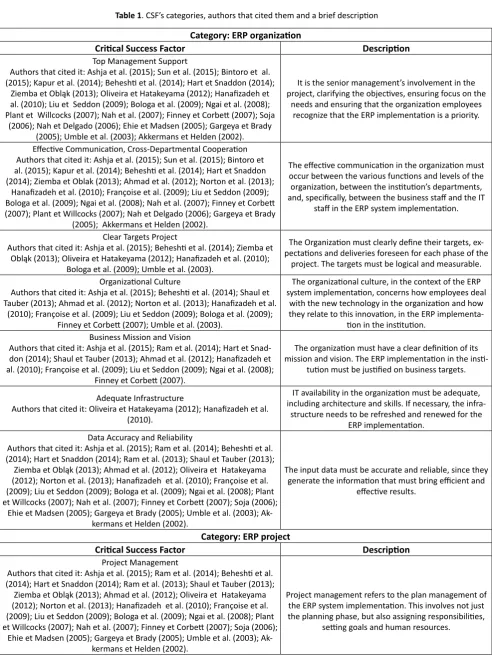
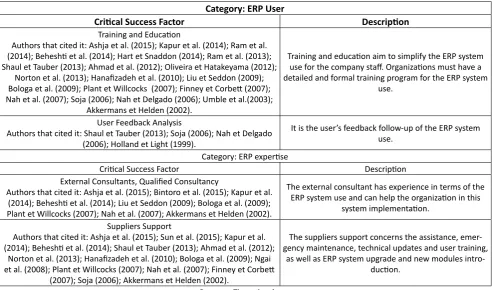
Next, in table 1, the 20 selected CSF are arranged within the respective grouping, according to the Dezdar et Sulaim-an’s proposal (2009). The table is composed by two columns – on the left several authors who have cited the CSF and on the right column a brief description of what the CSF means.
6. RESULTS ANALYSIS
From the 20 CSF presented in the previous section, a questionnaire was prepared. It consisted of two types of issues: the introductory, in order to obtain the respon-dents’ profiles; and the following, which asks the percep-tion about the 20 selected CSF importance levels, within each ERP lifecycle phase. The responses were received by assigning values from 1 to 5, in a Likert scale, proposed as follows: level of importance 5-very high, 4-high, 3-average 2- low and 1- very low.
The Likert scale application aimed to get these specialists insight about the value 5-”very high importance”, for each
of the CSF presented, in each of the phases - pre-implemen-tation, implementation and post-implemenpre-implemen-tation, with the purpose of registering the CSF position as for the impor-tance “too high”, in the ERP system implementation project in its three phases.
The questionnaire, during the period from March 29 to June 29, 2016, was forwarded to 356 e-mails, belonging to public education institutions specialists of all Brazil 70 ques-tionnaires returned filled in correctly, and the following is the description of the profile of these respondents and the result of the ranking of the CSF.
6.1 Respondents Profile
Follow up of the result of the introductory questions about the respondents’ profile.
About the experience time in ERP implementations in Brazilian public education institutions, 19% had between 0 and 3 years, 28% had between 3 and 6 years, 22% had between 6 and 9 years and 31% had 10 years or more. It is observed that most of the participants in the survey had 10 years or more of experience in ERP system implemen-tation.
As for participation in ERP system implementation, the vast majority has already participated in such implemen-tation, as 93% of the respondents said “yes” and 7% said “no”.
As regards to participation in the ERP implementation phases, 90% of respondents participated in the pre-imple-mentation phase, 94% were active in the implepre-imple-mentation phase and 84% attended the post-implementation phase.
The questionnaire also sought the percentage of the re-spondents’ who participated in all 3 stages of ERP implemen-tation – pre-implemenimplemen-tation, implemenimplemen-tation and post-im-plementation. More than half of the respondents (57.1%) participated in the 3 stages of the ERP implementation.
On the distribution by Brazilian regions, the answered questionnaires came from experts from all regions of Bra-zil: 8% were from the North; 27% from the Northeastern region; 35% from the Southeast region; 16% from the South; and 14% from the Midwest region.
Table 1. CSF’s categories, authors that cited them and a brief description Category: ERP organization
Critical Success Factor Description
Top Management Support
Authors that cited it: Ashja et al. (2015); Sun et al. (2015); Bintoro et al. (2015); Kapur et al. (2014); Beheshti et al. (2014); Hart et Snaddon (2014);
Ziemba et Obląk (2013); Oliveira et Hatakeyama (2012); Hanafizadeh et al. (2010); Liu et Seddon (2009); Bologa et al. (2009); Ngai et al. (2008); Plant et Willcocks (2007); Nah et al. (2007); Finney et Corbett (2007); Soja
(2006); Nah et Delgado (2006); Ehie et Madsen (2005); Gargeya et Brady (2005); Umble et al. (2003); Akkermans et Helden (2002).
It is the senior management’s involvement in the project, clarifying the objectives, ensuring focus on the
needs and ensuring that the organization employees recognize that the ERP implementation is a priority.
Effective Communication, Cross-Departmental Cooperation Authors that cited it: Ashja et al. (2015); Sun et al. (2015); Bintoro et al. (2015); Kapur et al. (2014); Beheshti et al. (2014); Hart et Snaddon (2014); Ziemba et Oblak (2013); Ahmad et al. (2012); Norton et al. (2013);
Hanafizadeh et al. (2010); Françoise et al. (2009); Liu et Seddon (2009); Bologa et al. (2009); Ngai et al. (2008); Nah et al. (2007); Finney et Corbett (2007); Plant et Willcocks (2007); Nah et Delgado (2006); Gargeya et Brady
(2005); Akkermans et Helden (2002).
The effective communication in the organization must occur between the various functions and levels of the organization, between the institution’s departments, and, specifically, between the business staff and the IT
staff in the ERP system implementation.
Clear Targets Project
Authors that cited it: Ashja et al. (2015); Beheshti et al. (2014); Ziemba et Obląk (2013); Oliveira et Hatakeyama (2012); Hanafizadeh et al. (2010);
Bologa et al. (2009); Umble et al. (2003).
The Organization must clearly define their targets, ex-pectations and deliveries foreseen for each phase of the
project. The targets must be logical and measurable. Organizational Culture
Authors that cited it: Ashja et al. (2015); Beheshti et al. (2014); Shaul et Tauber (2013); Ahmad et al. (2012); Norton et al. (2013); Hanafizadeh et al.
(2010); Françoise et al. (2009); Liu et Seddon (2009); Bologa et al. (2009); Finney et Corbett (2007); Umble et al. (2003).
The organizational culture, in the context of the ERP system implementation, concerns how employees deal
with the new technology in the organization and how they relate to this innovation, in the ERP
implementa-tion in the instituimplementa-tion. Business Mission and Vision
Authors that cited it: Ashja et al. (2015); Ram et al. (2014); Hart et Snad-don (2014); Shaul et Tauber (2013); Ahmad et al. (2012); Hanafizadeh et al. (2010); Françoise et al. (2009); Liu et Seddon (2009); Ngai et al. (2008);
Finney et Corbett (2007).
The organization must have a clear definition of its mission and vision. The ERP implementation in the
insti-tution must be justified on business targets.
Adequate Infrastructure
Authors that cited it: Oliveira et Hatakeyama (2012); Hanafizadeh et al. (2010).
IT availability in the organization must be adequate, including architecture and skills. If necessary, the
infra-structure needs to be refreshed and renewed for the ERP implementation.
Data Accuracy and Reliability
Authors that cited it: Ashja et al. (2015); Ram et al. (2014); Beheshti et al. (2014); Hart et Snaddon (2014); Ram et al. (2013); Shaul et Tauber (2013); Ziemba et Obląk (2013); Ahmad et al. (2012); Oliveira et Hatakeyama (2012); Norton et al. (2013); Hanafizadeh et al. (2010); Françoise et al. (2009); Liu et Seddon (2009); Bologa et al. (2009); Ngai et al. (2008); Plant et Willcocks (2007); Nah et al. (2007); Finney et Corbett (2007); Soja (2006);
Ehie et Madsen (2005); Gargeya et Brady (2005); Umble et al. (2003); Ak-kermans et Helden (2002).
The input data must be accurate and reliable, since they generate the information that must bring efficient and
effective results.
Category: ERP project
Critical Success Factor Description
Project Management
Authors that cited it: Ashja et al. (2015); Ram et al. (2014); Beheshti et al. (2014); Hart et Snaddon (2014); Ram et al. (2013); Shaul et Tauber (2013); Ziemba et Obląk (2013); Ahmad et al. (2012); Oliveira et Hatakeyama (2012); Norton et al. (2013); Hanafizadeh et al. (2010); Françoise et al. (2009); Liu et Seddon (2009); Bologa et al. (2009); Ngai et al. (2008); Plant et Willcocks (2007); Nah et al. (2007); Finney et Corbett (2007); Soja (2006);
Ehie et Madsen (2005); Gargeya et Brady (2005); Umble et al. (2003); Ak-kermans et Helden (2002).
Project management refers to the plan management of the ERP system implementation. This involves not just the planning phase, but also assigning responsibilities,
Change Management
Authors that cited it: Ashja et al. (2015); Sun et al. (2015); Bintoro et al. (2015); Kapur et al. (2014); Beheshti et al. (2014); Hart et Snaddon (2014);
Shaul et Tauber (2013); Ziemba et Obląk (2013); Ahmad et al. (2012); Oliveira et Hatakeyama (2012); Norton et al. (2013); Hanafizadeh et al. (2010); Françoise et al. (2009); Liu et Seddon (2009); Bologa et al. (2009);
Ngai et al. (2008); Plant et Willcocks (2007); Nah et al. (2007); Finney et Corbett (2007); Soja (2006); Nah et Delgado (2006); Gargeya et Brady
(2005); Akkermans et Helden (2002).
With the ERP implementation, changes occur in the or-ganization. If these changes are not managed effectively,
they can cause resistance, confusion and redundancies. Change management is related to the company’s
trans-formation guidance, aligning it to the strategy and the implementation of the ERP plan.
BPR (Business Process Reengineering)
Authors that cited it: Ashja et al.(2015); Bintoro et al.(2015); Ram et al. (2014); Beheshti et al.(2014); Hart et Snaddon (2014); Ram et al. (2013);
Ahmad et al. (2012); Norton et al. (2013); Hanafizadeh et al. (2010); Françoise et al. (2009); Liu et Seddon (2009); Ngai et al. (2008); Nah et al. (2007); Finney et Corbett (2007); Nah et Delgado (2006); Ehie et Madsen
(2005); Gargeya et Brady (2005); Akkermans et Helden (2002).
When the software is incompatible with the institutions, the researchers suggest that the organization needs to be redrawn. The BPR makes a deep analysis of the organization and its goals, proposing the redesign of its
processes, making the organization lighter, more agile and more competitive.
The Champion Role
Authors that cited it: Ashja et al. (2015); Kapur et al. (2014); Shaul et Tauber (2013); Ahmad et al. (2012); Norton et al. (2013); Françoise et al. (2009); Liu et Seddon (2009); Bologa et al. (2009); Ngai et al. (2008); Plant et Will-cocks (2007); Nah et al. (2007); Finney et Corbett (2007); Nah et Delgado (2006); Gargeya et Brady (2005); Umble et al. (2003); Akkermans et Helden
(2002).
At least one person within the organization should be recognized as the champion, defending the ERP plan im-plementation in the organization. The champion, can be male or female and must be respected in the institution, and may interfere in favor of the ERP implementation
project, in the decisions of the organization.
Competent Project Team
Authors that cited it: Kapur et al. (2014); Hart et Snaddon (2014); Shaul et Tauber (2013); Bologa et al.(2009).
It is a team formed by different groups, from different sectors and departments, where partnerships and synergies occur, involving the organization as a whole, in
the acceptance of ERP implementation project.
Performance’s Monitoring and Evaluation Authors that cited it: Hatakeyama (2012); Ngai et al. (2008).
This monitoring concerns the measurement of ERP sys-tem performance, since the implementation beginning,
including the schedule, employees’ performance and users’ satisfaction. This is a regular measurement on the implementation progress, to control the ERP system
effectiveness and efficiency.
Crisis Management and Problem Solving
Authors that cited it: Finney et Corbett (2007); Ngai et al. (2008).
The crises and problems management monitoring, working together with consultants, in order to solve the
problems, ensuring that the ERP system performance takes place according to the schedule. Category: ERP software
Critical Success Factor Description
IT Used Before the ERP System
Authors that cited it: Ashja et al. (2015); Hart et Snaddon (2014); Norton et al. (2013); Ahmad et al. (2012); Bologa et al. (2009); Dezdar et
Sulaim-an (2009); Ngai et al. (2008); Bradley (2008); Nah et al. (2007); Finney et Corbett (2007); Soja (2006); Nah et Delgado (2006); Ehie et Madsen (2005);
Gargeya et Brady (2005); Holland et Light (1999).
This is about the transition and adaptation of the exist-ing system to the ERP system management.
Minimal Customization
Authors that cited it: Ashja et al. (2015); Bintoro et al. (2015); Kapur et al. (2014); Beheshti et al. (2014); Hart et Snaddon (2014); Shaul et Tauber (2013); Momoh et al. (2010); Bologa et al. (2009); Françoise et al. (2009);
Ngai et al. (2008); Nah et al. (2007); Nah et Delgado (2006); Umble et al. (2003); Akkermans et Helden (2002).
The researchers claim that the ERP system to be imple-mented should be minimally customized and coded. Changes in the ERP system generate complexities, inter-fere with the implementation schedule and increase the
6.2. Ranking of Very High Importance CSF
From the result of the values assigned to the CSF in each phase of the ERP life cycle, the values for the degree 5 - high importance, to the CSF in the stages of implementation of ERP were tabulated so that a ranking was prepared.
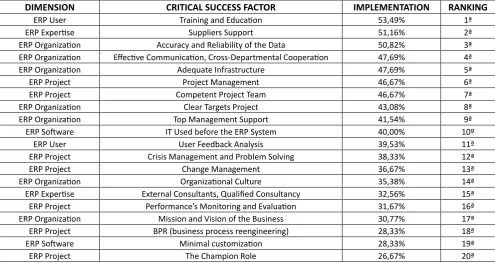
The result was the production of 3 rankings correspond-ing to the 20 CSF, each rankcorrespond-ing referrcorrespond-ing to a phase of the ERP lifecycle. The 10 highest percentages were highlight-ed in bold, in cells differentiathighlight-ed by color and presenthighlight-ed in tables 2, 3 and 4. These tables were constructed from the works of Paixão (2014) and Oliveira (2016), and consist of four columns: CSF dimension according to Dezdar et Sulaim-an (2009); the CSF name; the responses percentage with degree of importance “too high”; and its ranking position.
Table 2, below, shows the CSF’s ranking established from the percentage of the importance “too high” degree in the pre-implementation phase.
It is observed that, in table 2, the “Top Management Sup-port” has a very high percentage in relation to the second position. Note that the factors IT Used before the ERP Sys-tem and Competent Project Team, corresponding to the 3rd
and 4th positions have the same percentage in the ranking.
As to the dimensions of the CSF, note that ERP User and ERP Expertise dimensions are not among the 10 top positions in
the ranking, which shows that, for this stage, these dimen-sions are not so relevant in the respondents’ perception.
Table 3, below, shows the CSF’s ranking established from the percentage of the degree of importance “too high” in the implementation phase.
It is observed that the CSF in the first position, Training and Education, is quite close to the CSF in the second posi-tion, Suppliers Support. Note that the CSF in the 4th position,
Effective Communication, Cross-Departmental Cooperation and the 5th position, Adequate Infrastructure, have the same
percentage. Moreover, the same occurs to the CSF in the 6th
and 7th positions, Project Management and Competent
Proj-ect Team. As regards to CSF dimensions, all of them are pres-ent in the top 10 ranking, which highlights the importance of all these dimensions in this phase.
Table 4, below, shows the CSF’s ranking established from the percentage of the degree of importance “too high” in the post-implementation phase.
In Table 4, it is observed that the CSF of the 2nd and 3rd
positions, Accuracy and Reliability of the Data and Suppliers Support, are present in the top 3 of table 3 ranking. Note that the monitoring and evaluation of Performance’s Moni-toring and Evaluation and Crisis Management and Problem Solving, corresponding to the 8th and 9th positions have the
Category: ERP User
Critical Success Factor Description
Training and Education
Authors that cited it: Ashja et al. (2015); Kapur et al. (2014); Ram et al. (2014); Beheshti et al. (2014); Hart et Snaddon (2014); Ram et al. (2013); Shaul et Tauber (2013); Ahmad et al. (2012); Oliveira et Hatakeyama (2012);
Norton et al. (2013); Hanafizadeh et al. (2010); Liu et Seddon (2009); Bologa et al. (2009); Plant et Willcocks (2007); Finney et Corbett (2007); Nah et al. (2007); Soja (2006); Nah et Delgado (2006); Umble et al.(2003);
Akkermans et Helden (2002).
Training and education aim to simplify the ERP system use for the company staff. Organizations must have a detailed and formal training program for the ERP system
use.
User Feedback Analysis
Authors that cited it: Shaul et Tauber (2013); Soja (2006); Nah et Delgado (2006); Holland et Light (1999).
It is the user’s feedback follow-up of the ERP system use.
Category: ERP expertise
Critical Success Factor Description
External Consultants, Qualified Consultancy
Authors that cited it: Ashja et al. (2015); Bintoro et al. (2015); Kapur et al. (2014); Beheshti et al. (2014); Liu et Seddon (2009); Bologa et al. (2009); Plant et Willcocks (2007); Nah et al. (2007); Akkermans et Helden (2002).
The external consultant has experience in terms of the ERP system use and can help the organization in this
system implementation. Suppliers Support
Authors that cited it: Ashja et al. (2015); Sun et al. (2015); Kapur et al. (2014); Beheshti et al. (2014); Shaul et Tauber (2013); Ahmad et al. (2012);
Norton et al. (2013); Hanafizadeh et al. (2010); Bologa et al. (2009); Ngai et al. (2008); Plant et Willcocks (2007); Nah et al. (2007); Finney et Corbett
(2007); Soja (2006); Akkermans et Helden (2002).
The suppliers support concerns the assistance, emer-gency maintenance, technical updates and user training,
as well as ERP system upgrade and new modules intro-duction.
Table 2. CSF’s ranking valued with “high importance” degree in the pre-implementation phase
DIMENSION CRITICAL SUCCESS FACTOR
PRE-IMPLEMENTA-TION RANKING
ERP Organization Top Management Support 66,15% 1ª
ERP Organization Clear Targets Project 53,85% 2ª
ERP Software IT Used before the ERP System 48,33% 3ª
ERP Project Competent Project Team 48,33% 4ª
ERP Organization Mission and Vision of the Business 47,69% 5ª
ERP Project Project Management 46,67% 6ª
ERP Project BPR (business process reengineering) 45,00% 7ª
ERP Organization Adequate Infrastructure 43,08% 8ª
ERP Project Change Management 41,67% 9ª
ERP Organization Effective Communication, Cross-Departmental Cooperation 40,00% 10º
ERP User Training and education 37,21% 11ª
ERP Expertise External Consultants, Qualified Consultancy 37,21% 12ª
ERP Project The Champion Role 36,67% 13ª
ERP Software Minimal customization 33,33% 14ª
ERP Organization Accuracy and Reliability of the Data 32,79% 15ª
ERP Organization Organizational Culture 32,31% 16ª
ERP Expertise Suppliers Support 30,23% 17ª
ERP Project Performance’s Monitoring and Evaluation 28,33% 18ª
ERP Project Crisis Management and Problem Solving 28,33% 19ª
ERP User User Feedback Analysis 25,58% 20ª
Resource: The authors’ own.
Table 3. CFS’s ranking valued with “high importance” degree in the phase of implementation
DIMENSION CRITICAL SUCCESS FACTOR IMPLEMENTATION RANKING
ERP User Training and Education 53,49% 1ª
ERP Expertise Suppliers Support 51,16% 2ª
ERP Organization Accuracy and Reliability of the Data 50,82% 3ª
ERP Organization Effective Communication, Cross-Departmental Cooperation 47,69% 4ª
ERP Organization Adequate Infrastructure 47,69% 5ª
ERP Project Project Management 46,67% 6ª
ERP Project Competent Project Team 46,67% 7ª
ERP Organization Clear Targets Project 43,08% 8ª
ERP Organization Top Management Support 41,54% 9ª
ERP Software IT Used before the ERP System 40,00% 10º
ERP User User Feedback Analysis 39,53% 11ª
ERP Project Crisis Management and Problem Solving 38,33% 12ª
ERP Project Change Management 36,67% 13ª
ERP Organization Organizational Culture 35,38% 14ª
ERP Expertise External Consultants, Qualified Consultancy 32,56% 15ª
ERP Project Performance’s Monitoring and Evaluation 31,67% 16ª
ERP Organization Mission and Vision of the Business 30,77% 17ª
ERP Project BPR (business process reengineering) 28,33% 18ª
ERP Software Minimal customization 28,33% 19ª
ERP Project The Champion Role 26,67% 20ª
Table 4. CSF’s ranking valued with “high importance” degree in the post-implementation phase
DIMENSION CRITICAL SUCCESS FACTOR POST-IMPLEMENTA-TION RANKING
ERP User User Feedback Analysis 67,44% 1ª
ERP Organization Accuracy and Reliability of the Data 60,66% 2ª
ERP Expertise Suppliers Support 58,14% 3ª
ERP Organization Adequate Infrastructure 53,85% 4ª
ERP User Training and education 51,16% 5ª
ERP Project Change Management 43,33% 6ª
ERP Organization Effective Communication, Cross-Departmental Cooperation 43,08% 7ª
ERP Project Performance’s Monitoring and Evaluation 41,67% 8ª
ERP Project Crisis Management and Problem Solving 41,67% 9ª
ERP Project Competent Project Team 40,00% 10º
ERP Organization Clear Targets Project 33,85% 11ª
ERP Project BPR (business process reengineering) 33,33% 12ª
ERP Organization Top Management Support 32,31% 13ª
ERP Organization Organizational Culture 32,31% 14ª
ERP Project Project Management 31,67% 15ª
ERP Software IT Used before the ERP System 26,67% 16ª
ERP Software Minimal customization 26,67% 17ª
ERP Organization Mission and Vision of the Business 26,15% 18ª
ERP Expertise External Consultants, Qualified Consultancy 25,58% 19ª
ERP Project The Champion Role 15,00% 20ª
Resource: The authors’ own.
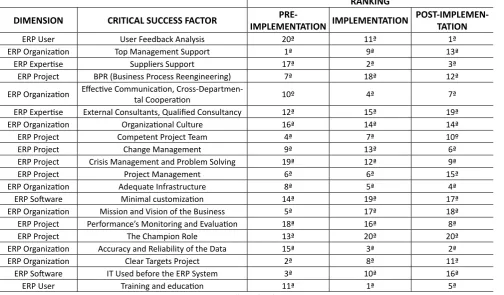
Table 5. CSF’s ranking with “high importance” degree in 3 phases RANKING
DIMENSION CRITICAL SUCCESS FACTOR IMPLEMENTATION IMPLEMENTATIONPRE- POST-IMPLEMEN-TATION
ERP User User Feedback Analysis 20ª 11ª 1ª
ERP Organization Top Management Support 1ª 9ª 13ª
ERP Expertise Suppliers Support 17ª 2ª 3ª
ERP Project BPR (Business Process Reengineering) 7ª 18ª 12ª
ERP Organization Effective Communication, Cross-Departmen-tal Cooperation 10º 4ª 7ª
ERP Expertise External Consultants, Qualified Consultancy 12ª 15ª 19ª
ERP Organization Organizational Culture 16ª 14ª 14ª
ERP Project Competent Project Team 4ª 7ª 10º
ERP Project Change Management 9ª 13ª 6ª
ERP Project Crisis Management and Problem Solving 19ª 12ª 9ª
ERP Project Project Management 6ª 6ª 15ª
ERP Organization Adequate Infrastructure 8ª 5ª 4ª
ERP Software Minimal customization 14ª 19ª 17ª
ERP Organization Mission and Vision of the Business 5ª 17ª 18ª
ERP Project Performance’s Monitoring and Evaluation 18ª 16ª 8ª
ERP Project The Champion Role 13ª 20ª 20ª
ERP Organization Accuracy and Reliability of the Data 15ª 3ª 2ª
ERP Organization Clear Targets Project 2ª 8ª 11ª
ERP Software IT Used before the ERP System 3ª 10ª 16ª
ERP User Training and education 11ª 1ª 5ª
same percentage in the ranking. As for the dimensions of the CSF, note that the ERP Software dimensions is not among the top 10 in the ranking; therefore, this dimension was not considered very important for this stage.
Table 5, below, is a summary of previous three tables. It was built with the purpose of observing each factor place-ment, comparatively within each phase of the ERP life cycle, enabling a vision of the factor importance for each step of the ERP implementation. The table highlights, with shaded cells, ranking positions from the 1st to the 10th place in the
pre-implementation, implementation and post-implementa-tion phases.
It is observed that the CSF – Effective Communication, Cross-Departmental Cooperation; Competent Project Team and Adequate Infrastructure are within the top 10 ranking in the three phases of the ERP life cycle.
7. CONCLUSION
The objective of this work was to map specialists in Brazil-ian public education institutions regarding their perception of ERP systems, about the CSF considered of high impor-tance for these systems’ implementation, however, from the perspective of the 3 stages of implementation: pre-imple-mentation, implementation and post-implementation.
Initially, a literature review was made, in order to obtain the CSF cited by the authors, for ERP system implementa-tions. In this literature review 30 FCS were identified and, among these, 20 were selected for the survey and grouped into five categories: ERP Organization, ERP Project, ERP Soft-ware, ERP User and ERP Expertise. This grouping allows the responsible ERP system implementation project to have ease of perception in terms of what area can be occurring prob-lems in the ERP system implementation within the company.
Based on the literature review the field research was pre-pared, via electronic questionnaire, requesting specialists in ERP systems in the Brazilian public education institutions about their perception in terms of the importance of 20 CSF in pre-implementation, implementation and post imple-mentation stages, within a Likert scale, with the purpose of observing the very high importance CSF.
The questionnaire was forwarded to 356 e-mails, of which, 70 have been filled. Through the results tab, it could be observed that the respondents belong to Brazilian public education institutions; most of them have over 10 years of experience, have participated in the 3 phases of the ERP sys-tem implementation and belong to the Brazilian Southeast region.
As regards to the CSF evaluation, we conducted a rank-ing of CSF considered with “too high” degree of importance in each of those phases, in order to propose a set of the most influential CSF for the success, in the pre-implemen-tation, implementation and post-implementation phases of ERP systems. It was found that the 3 CSF more cited as “very important” in the pre-implementation phase were: Top Management Support, Clear Targets Project and IT Used be-fore the ERP System. In the phase of implementation were: Training and Education, Suppliers Support and Accuracy and Reliability of the Data. Finally, in the post-implementation stage, the 3 CSF more cited as “very important” were: User Feedback Analysis, Accuracy and Reliability of the Data and Suppliers Support.
It is worth noting that the prospect of the three phases of the ERP system life cycle: pre-implementation, implementa-tion and post-implementaimplementa-tion, allows a more rigorous con-trol of the organization activity areas, where the results of monitoring can ensure the productive performance in the implementation of the ERP system.
It is expected that this research may help researchers and managers to apply, with greater precision, studies on CSF for success in ERP system implementations in education orga-nizations.
It is expected, as well, that this research may help the de-bate on the success of ERP systems implementations among re-searchers, offering other theme views aimed to development.
As a suggestion for future work, it is suggested the ob-servation and monitoring of critical success Factors in loco, demonstrating the need for adjustments to the initial pro-posal of CSF presented in this work, in ERP systems imple-mentations in the context of educational organizations, from the grouping proposed in this research and within the 3 stages of implementation, also suggested in this study.
REFERENCES
Ahmad, N., Haleem, A., Syed, A.A. (2012), “Compilation of Critical Success Factors in Implementation of Enterprise Systems: A Study on Indian Organisations”, Global Journal of Flexible Systems Management, Vol.13 No.4, pp. 217–232. doi:10.1007/s40171-013-0019-8
Akkermans, H., Van Helden, K. (2002), Vicious and virtuo-us cycles in ERP implementation: a case of interrelations bet-ween critical success factors, European Journal of Informa-tion Systems, Vol.11 No.1, pp. 35-46. doi:10.1057/palgrave/ ejis/3000418
of Managing Information Technology, Vol.7 No.4, pp. 01–19. doi:10.5121/ijmit.2015.7401
Ashja, M., Moghadam, A.H., Bidram, H. (2015), “Comparati-ve study of large information systems’ CSFs during their life cy-cle”, Information Systems Frontiers, Vol.17 No.3, pp. 619–628. doi:10.1007/s10796-013-9445-6
Bansal, V., Agarwal, A. (2015), “Enterprise resource plan-ning: identifying relationships among critical success factors”, Business Process Management Journal, Vol.21 No.6, pp. 1337– 1352. doi:10.1108/BPMJ-12-2014-0128
Beheshti, H. M., Blaylock, B. K., Henderson, D. A., Lollar, J.G. (2014), “Selection and critical success factors in successful ERP implementation”, Competitiveness Review, Vol. 24 No.4, pp. 357–375. doi:10.1108/CR-10-2013-0082
Bernroider, E. W. N.; Wong, C. W.Y.; Lai, K.H. (2014), “From dynamic capabilities to ERP enabled business improvements: The mediating effect of the implementation project”, Interna-tional Journal of Project Management, Vol.32 No.2, pp. 350– 362. doi:http://dx.doi.org/10.1016/j.ijproman.2013.05.006
Bintoro, B., P., K., Simatupang, T. M., Putro, U. S., Herma-wan, P. (2015), “Actors’ interaction in the ERP implementation literature”, Business Process Management Journal, Vol.21 No.2, pp. 222–249. doi:10.1108/BPMJ-11-2013-0142
Bologa, A.R., Muntean, M., Sabau, G., Scorta, I. (2009), “Higher education ERPs: Implementation factors and their in-terdependencies”, WSEAS Transactions on Computers, Vol. 8 No.4, pp. 651–660.
Bradley, J. (2008), “Management based critical success fac-tors in the implementation of Enterprise Resource Planning sys-tems”, International Journal Accounting Information Systems, Vol.9 No.3, pp. 175–200. doi:10.1016/j.accinf.2008.04.001
Bullen, C. V., Rockart, J.F. (1981), “A primer on critical suc-cess factors”, Work Paper No. 1220-81, pp. 1–64.
Ciubotaru, G.M. (2012), “An analysis of the processes that ensure success in ERP implementations - A Case Study in a Pu-blic Sector Organisation”, A Case Study presented to the School of Information Management, Victoria University of Wellington.
Corrêa, S.L.L. (2015), Análise de relevância de elementos de custo em manutenção e suporte de sistemas ERP nas IFES: uma abordagem baseada em TCO e ITIL, Dissertação de Mes-trado em Sistemas de Gestão, Universidade Federal Fluminen-se, Niterói, RJ.
Dezdar, S., Sulaiman, A. (2009), “Successful enterprise re-source planning implementation: Taxonomy of critical factors”, Industrial Management & Data Systems, Vol. 109 No. 8, pp. 1037–1052. doi:10.1108/02635570910991283
Ehie, I.C., Madsen, M. (2005), “Identifying critical issues in enterprise resource planning (ERP) implementation”, Compu-ters in Industry, Vol.56 No.6, pp.545–557. doi:10.1016/j.com-pind.2005.02.006
Esteves-Souza, J., Pastor-Collado, J. A. (2000), “Towards the unification of critical success factors for ERP implementations”, published in 10th Annual Business Information Technology (BIT) Conference, Manchester.
Finney, S., Corbett, M. (2007), “ERP implementation: a compilation and analysis of critical success factors”, Business Process Management Journal, Vol. 13 No.3, pp. 329–347. doi:10.1108/14637150710752272
Francoise, O., Bourgalult, M., Pellerin, P. (2009), “ERP im-plementation through critical success factors’ management”, Business Process Management Journal, Vol.15 No.3, pp.371– 394. doi:10.1108/14637150910960620
Gargeya, V.B., Brady, C. (2005), “Success and failure factors of adopting SAP in ERP system implementation”, Business Process Management Journal, Vol.11 No.5, pp. 501–516. doi:10.1108/14637150510619858
Hanafizadeh, P., Tabataba’i, A., Gholami, R., Dadbin, S., Standage, N. (2010), “The Core Critical Success Factors in Im-plementation of Enterprise Resource Planning Systems”, Inter-national Journal of Enterprise Information Systems, Vol.6 No.2, pp. 82–111. doi:10.4018/jeis.2010040105
Hart, C.A., Snaddon, D.R. (2014), “The organisational per-formance impact of erp systems on selected companies”, South African Journal of Industrial Engineering, Vol.25 No.1, pp. 14–28. doi:http://dx.doi.org/10.7166/25-1-615
Holland, C. P., Light, B. (1999), “A Critical Success Factors Model For ERP Implementation”, IEEE Software, Vol.16 No.3, pp 30–36. doi:10.1109/52.765784
Hoorn, B. (2016), “The Project-space Model: Visualising the enablers and constraints for a given project”, Internatio-nal JourInternatio-nal of Project Management, Vol.34 No.2, pp. 173–186. doi:http://dx.doi.org/10.1016/j.ijproman.2015.10.006
Kapur, P.K., Nagpal, S., Khatri, S.K., Yadavalli, V.S.S. (2014), “Critical success factor utility based tool for ERP health asses-sment: a general framework”, International Journal System Assurance Engineering and Management, Vol.5 No.2, pp.133– 148. doi:10.1007/s13198-014-0223-8
Liu, A.Z., Seddon, P.B. (2009), “Understanding how project critical success factors affect organizational benefits from en-terprise systems”, Business Process Management Journal, Vol.15 No.5, pp.716–743. doi:10.1108/14637150910987928
Mendes, J.V., Escrivão Filho, E. (2002), “Sistemas integrados de gestão ERP em pequenas empresas: um confronto entre o referencial teórico e a prática empresarial”, Gestão & Produção, Vol.9 No.3, pp. 1–20. doi:10.1590/S0104-530X2002000300006
Momoh, A., Roy, R., Shehab, E. (2010), “Challenges in en-terprise resource planning implementation: State-of-the-art”, Business Process Management Journal, Vol.16, No.4, pp. 537-565. doi:10.1108/14637151011065919
Moreira, A.W. (2013), Proposta de Fatores Críticos de Suces-so para a implantação de um modelo de gestão da Tecnologia da Informação: um estudo de caso numa instituição de ensino federal, Dissertação de Mestrado em Sistemas de Gestão, Uni-versidade Federal Fluminense, Niterói, RJ.
Morton, N. A., Hu, Q. (2008), “Implications of the fit bet-ween organizational structure and ERP: A structural contin-gency theory perspective”, International Journal of Infor-mation Management, Vol.28 No.5, pp. 391–402. doi:http:// dx.doi.org/10.1016/j.ijinfomgt.2008.01.008
Nah, F. F-H, Islam, Z., Tan, M. (2007), “Empirical Assessment of Factors Influencing Success of Enterprise Resource Planning Implementations”, Journal of Database Management, Vol.18 No.4, pp.26–50. doi:10.4018/jdm.2007100102
Nah, F., Delgado, S. (2006), “Critical Success Factors for En-terprise Resource Planning Implementation and Upgrade”, Journal of Computer Information Systems, Vol.46 No.5, pp. 99–113. doi:10.1080/08874417.2006.11645928
Ngai, E.W.T., Law, C.C.H., Wat, F.K.T. (2008), “Examining the critical success factors in the adoption of enterprise resource planning”, Computers in Industry, Vol.59 No.6, pp. 548–564. doi:10.1016/j.compind.2007.12.001
Norton, A. L., Coulson-Thomas, Y.M., Coulson-Tho-mas, C. J., Ashurst, C. (2013), “Ensuring benefits realisa-tion from ERP II: the CSF phasing model”, Journal Enterpri-se Information Management, Vol.26 No.3, pp. 218–234. doi:10.1108/17410391311325207
Oliveira, K.W.N. (2016), Fatores Críticos de Sucesso Asso-ciados à Implementação do Enterprise Risk Management: O Caso de uma Empresa Corretora De Seguros. Dissertação de Mestrado em Sistemas de Gestão, Universidade Federal Flumi-nense, Niterói, RJ.
Oliveira, L.S. De, Hatakeyama, K. (2012), “Um estudo sobre a implantação de sistemas ERP: pesquisa realizada em grandes empresas industriais”, Produção, Vol.22 No.3, pp. 596–611. doi:10.1590/S0103-65132012005000052
Paixão, T.R. (2014), A Influência dos Fatores Críticos de Su-cesso na Gestão por ProSu-cessos de Negócios – BPM, Disserta-ção de Mestrado em Sistemas de Gestão, Universidade Fede-ral Fluminense, Niterói, RJ.
Plant, R., Willcocks, L. (2007), “Critical success factors in In-ternational ERP implementations: a case research approach”, Journal of Computer Information Systems, Vol. 47 No.3, pp. 60–70. doi:10.1016/j.ijpe.2010.05.008
Ram, J., Corkindale, D., Wu, M.L. (2013), “Implementation critical success factors (CSFs) for ERP: Do they contribute to
implementation success and post-implementation performan-ce?”, International Journal of Production Economics, Vol.144 No.1, pp. 157–174. doi:10.1016/j.ijpe.2013.01.032
Ram, J., Wu, M.L., Tagg, R. (2014), “Competitive advantage from ERP projects: Examining the role of key implementation drivers”, International Journal of Project Management, Vol.32 No.4, pp. 663–675. doi:10.1016/j.ijproman.2013.08.004
Rockart, J.F. (1979), “Chief executives define their own data needs”, Harvard Business Review, Vol.57 No.2, pp. 81–93.
Sammon, D., Adam, F. (2010), “Project preparedness and the emergence of implementation problems in ERP pro-jects”, Information & Management, Vol.47 No.1, pp. 1–8. doi:10.1016/j.im.2009.09.002
Shaul, L., Tauber, D. (2013), “Critical success factors in enterprise resource planning systems: Review of the last decade”, ACM Computing Surveys, Vol.45, No.4, pp. 1–39. doi:10.1145/2501654.2501669
Soja, P. (2006), “Success factors in ERP systems imple-mentations: Lessons from practice”, Journal of Enterpri-se Information Management, Vol.19 No.4, pp. 418–433. doi:10.1108/17410390610708517
Sun, A.Y.T., Yazdani, A., Overend, J.D. (2005), “Achievement assessment for enterprise resource planning (ERP) system implementations based on critical success factors (CSFs)”, In-ternational Journal of Production Economics, Vol.98 No.2, pp.189–203. doi:10.1016/j.ijpe.2004.05.013
Sun, H., Ni, W., Lam, R. (2015), “A step-by-step performance assessment and improvement method for ERP implementation: Action case studies in Chinese companies”, Computers in In-dustry, Vol.68, pp. 40–52. doi:10.1016/j.compind.2014.12.005
Tasevska, F., Damij, T., Damij, N. (2014), “Project plan-ning practices based on enterprise resource planplan-ning sys-tems in small and medium enterprises — A case study from the Republic of Macedonia”, International Journal of Project Management, Vol.32 No.3, pp. 529–539. doi:http://dx.doi. org/10.1016/j.ijproman.2013.08.001
Umble, E.J., Haft, R.R., Umble, M.M. (2003), “Enterprise re-source planning: Implementation procedures and critical suc-cess factors”, European Journal Operation Research, Vol.146 No.2, pp. 241–257. doi:10.1016/S0377-2217(02)00547-7
Vezzoni, G., Pacagnella, A.C.J., Banzi, A.L.J., Silva, S.L. da (2013), “Identificação e Análise de Fatores Críticos de Sucesso em Projetos”, Revista de Gestão de Projetos - GeP 4, Vol. No.1, pp. 116–137. doi:10.5585/gep.v4i1.83