Background:
Chronic kidney disease (CKD) is a global burden and now recognized as a major public health
problem worldwide. Patients with CKD have alteration in thyroid hormone metabolism. This study aims to evaluate
the status of thyroid hormone profile in different stages of CKD.
Methods:
The cross-sectional study included 103 CKD patients attending Nephrology and Dialysis unit of KIST
Medical College Teaching Hospital, Lalitpur, Nepal. Serum creatinine, free triiodothyronine (fT3), free thyroxine
(fT4), and thyroid stimulating hormone (TSH) were measured. Risk factors, duration of illness and physical
examination of patients were recorded along with their written informed consent. Patients with history of any
thyroid function abnormalities, on medication for hypothyroidism and pregnancy were excluded.
Results:
Out of 103 CKD patients, 59 (57.28%) were males and 44 (42.71%) were females. Thirty five (33.98%)
CKD patients had low fT3 and 19 (18.44%) had low fT4 with normal TSH. Six (5.82%) CKD patients had increased
TSH concentrations with normal fT3 and fT4. The median value of creatinine, fT3 and fT4 were significantly altered
at different stages of CKD. Among the risk factors for CKD, diabetic nephropathy (44.66%) was found to be the
lead primary cause followed by chronic glomerulonephritis (26.21%) and hypertension (23.30%).
Conclusions:
In our study thyroid hormone profile was altered in CKD patients, mainly in the stage 5 CKD. Most
common thyroid dysfunction was low fT3 and low fT4 with normal TSH levels.
Keywords:
Chronic kidney disease; Thyroid dysfunction; Thyroid hormone profile
Thyroid hormone profile in patients with chronic
kidney disease: a single centre study
Samir Singh,1,2 Aman Verma,3 Gopi Aryal,4 Santosh Thapa,5 Sudha Khakurel,5 Kalpana Shrestha5
1Jaipur National University, Jaipur, Rajasthan, India, 2Department of Clinical Biochemistry, KIST Medical College, Lalitpur, Nepal, 3School of Life and Basic Sciences, Jaipur National University, Jaipur, Rajasthan, India, 4Department Pathology, 5Department of Nephrology, KIST Medical College, Lalitpur, Nepal.
Correspondence:
Samir Singh, Department of Clinical Biochemistry, KIST Medical College,
Lalitpur, Nepal. Email: [email protected]
,
Phone: +977 9851106888.
ABSTRACT
J Nepal Health Res Counc 2016 Sep- Dec;14(34): 197-201
Original
Article
INTRODUCTION
Chronic kidney disease (CKD) is a global burden and its prevalence is rising exponentially.1,2 Chronic kidney disease is associated with increased morbidity and mortality and also with increased threat of cardiovascular disease, heart failure and increase healthcare expenditures.3,4 The prevalence of CKD in Nepal is 10.6%.5
National Kidney Foundation- Kidney Disease Outcomes Quality Initiative (NKF-K/DOQI) in 2002 define and classify CKD into 5 stages based on GFR.6,7 Diabetes mellitus, chronic glomerulonephritis, hypertension, and smoking are the common risk factors for CKD.8
End-stage renal disease (ESRD) is the advance form of Stage 5 CKD that can be treated with renal replacement therapy.9,10 Endocrine abnormalities are common in CKD. The kidney plays an important role in the degradation
and excretion of thyroid hormones. CKD upsets thyroid function in many ways, including low circulating thyroid hormone concentration, insufficient binding to carrier proteins and altered iodine storage in the thyroid gland.11,12 Low fT3 is the hallmark of main disturbance.13
The data related thyroid dysfunction in CKD with different stages in Nepal is scarce. The objective of the present study was therefore to evaluate the thyroid hormone profile in patients with CKD.
METHODS
about the purpose of the research work provided with free thyroid hormone profile test and assurance about the confidentiality of the information obtained through the written consent. The patients who refuse to give the consent as well as with visible goiter, receiving treatment with drugs for thyroid hormone abnormalities and pregnancy were excluded from the study. Patients had different duration of chronic illness ranging from 5 months to 10 years. Ethical approval was taken from Institutional Review Committee of the KIST Medical College Teaching Hospital.
Chronic kidney disease stages were categorized in five groups depending upon glomerular filtration rate (GFR) estimated by Cockcroft-Gault equation14 according to the guidelines formulated by NKF-K/DOQI.6 Risk factors such as diabetes mellitus, hypertension, chronic glomerulonephritis, family history of CKD and others were recorded.
Five ml of blood samples were collected from cubital vein in a plain vacutainer tube. The sample was obtained from the CKD patients attending both inpatient department (IPD) and outpatient department (OPD) of Nephrology and Dialysis unit. Samples from CKD patients on haemodialysis (HD) were also taken. There was no any specific time allotted for sample collection. For OPD patients, blood was collected by technicians of OPD blood collection centre whereas nurses were involved in the blood collection from IPD and HD patients. The collected blood were allowed to clot and centrifuged to separate serum. Serum creatinine, fT3, fT4, and TSH were performed by qualified laboratory personnel using Standard Operating Procedures (SOPs). Commercial control materials from Bio-Rad (Bio-Rad laboratories, California, USA) were included in each batch and results were only accepted if this Internal Quality Control (IQC) were within the acceptable limit. Serum fT3, fT4 and TSH were measured by using ADVIA Centaur CP automatic analyser system which was a Chemiluminiscence Immunoassay (CLIA) technique from Siemens Healthcare Diagnostics, USA. Serum level of creatinine was measured by using semi-automatic Biochemistry analyser ERBA chem-7, Germany. The normal range of fT3, fT4 and TSH were 2.30-4.2 pg/ml, 0.89-1.76 ng/dl and 0.35-5.5 µIU/ ml respectively.
All variables were presented as number and frequency and were arranged in tables. The Kruskal-Wallis test was used to find out the variation among different stages of CKD. Statistical analysis was done by SPSS (Statistical Package for the Social Sciences, version 21.0, SPSS Inc, Chicago, USA). The level of significance (P value) was set at 0.05.
RESULTS
Out of 103 CKD patients, 59 (57.28%) were males and 44 (42.71%) were females. Age range was 21 years to 83 years. They were divided into 3 age groups. In first age group (below 41 years), 14.56% were male and 5.82% were female. In second age group (41-60 years), 21.35% were male and 26.21% were female and finally in third age group (above 60 years), 21.35% were male and 10.67% were female respectively (Table 1).
Table 1. Distribution of chronic kidney disease patients according to gender and age.
Age
(years)
Male Female Total
n % n % n %
< 41 15 14.56 6 5.82 21 20.38 41-60 22 21.35 27 26.21 49 47.57 > 60 22 21.35 11 10.67 33 32.03 Total 59 57.28 44 42.71 103 100.0 Diabetic nephropathy was the leading cause found in 46 (44.66%) CKD patients followed by chronic glomerulonephritis 27 (26.21%) and hypertension 24 (23.30%). Other causes (5.82%) of CKD were polycystic kidney disease 3 (2.91%), obstructive uropathy 2 (1.94%), and 1 (0.97%) Nephrotic syndrome (Table 2).
Table 2. Factors causing chronic renal failure.
Causes Frequency
(n)
Percentage (%)
Diabetic nephropathy 46 44.66 Chronic
glomerulonephritis 27 26.21
Hypertension 24 23.30
Polycystic kidney
disease 3 2.91
Obstructive uropathy 2 1.94
Nephrotic syndrome 1 0.97
Seventy four 74 (71.84%) CKD patients were from stage 5 followed by 15 (14.56%) from stage 3, 8 (7.76%) from stage 4, 4 (3.88%) from stage 2 and 2 (1.94%) from stage 1 (Table 3).
Table 3. Frequency and percentage of chronic
kidney disease patients in different CKD stages6
CKD stages Frequency (n) Percentage (%)
1 2 1.94
2 4 3.88
3 15 14.56
4 8 7.76
5 74 71.84
Total 103 100
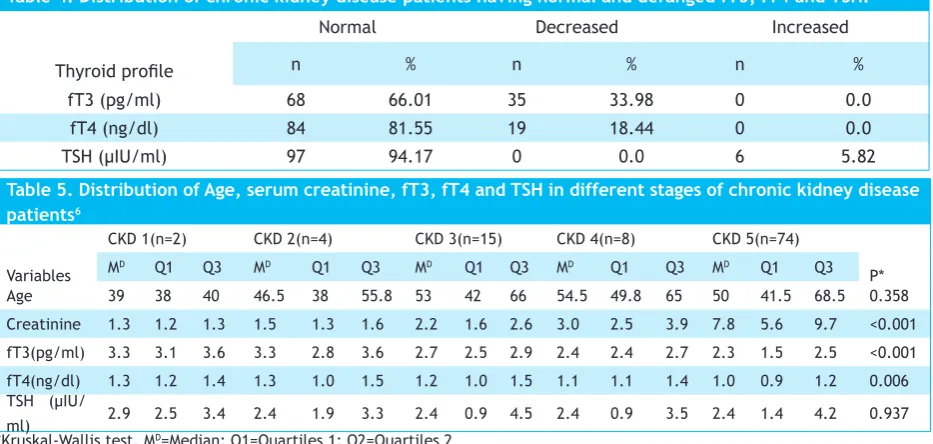
from stage 3 and 34 from stage 5) and 19 (18.44%) had low fT4 (all 19 from stage 5). Ninety seven (94.17%) CKD patients had normal TSH values. Six (5.82%) CKD patients had increased TSH (2 from stage 4 and 4 from stage 5) with normal fT3 and fT4 seen in CKD patients (Table 4).
The median age of patients with CKD stage 1 was 39, stage 2 was 46.5, stage 3 was 53, stage 4 was 54.5 and stage 5 was 50. The median creatinine values of patients
with CKD stages 1-5 were 1.3, 1.3, 2.2, 3.0 and 7.8 respectively. The median fT3 values of patients with CKD stage 1 was 3.3, stage 2 was 3.3, stage 3 was 2.7, stage 4 was 2.4 and stage 5 was 2.3. The median fT4 values of patients with CKD stage 1-5 were 1.3, 1.3, 1.2, 1.1 and 1.0 respectively. Finally, the median TSH values of patients with CKD stage 1 was 2.9. Stage 2-5 CKD patients had same median values i.e. 2.4 (Table 5).
Table 4. Distribution of chronic kidney disease patients having normal and deranged fT3, fT4 and TSH.
Thyroid profile
Normal Decreased Increased
n % n % n %
fT3 (pg/ml) 68 66.01 35 33.98 0 0.0
fT4 (ng/dl) 84 81.55 19 18.44 0 0.0
TSH (µIU/ml) 97 94.17 0 0.0 6 5.82
Table 5. Distribution of Age, serum creatinine, fT3, fT4 and TSH in different stages of chronic kidney disease
patients6
Variables
CKD 1(n=2) CKD 2(n=4) CKD 3(n=15) CKD 4(n=8) CKD 5(n=74)
P*
MD Q1 Q3 MD Q1 Q3 MD Q1 Q3 MD Q1 Q3 MD Q1 Q3
Age 39 38 40 46.5 38 55.8 53 42 66 54.5 49.8 65 50 41.5 68.5 0.358 Creatinine 1.3 1.2 1.3 1.5 1.3 1.6 2.2 1.6 2.6 3.0 2.5 3.9 7.8 5.6 9.7 <0.001 fT3(pg/ml) 3.3 3.1 3.6 3.3 2.8 3.6 2.7 2.5 2.9 2.4 2.4 2.7 2.3 1.5 2.5 <0.001 fT4(ng/dl) 1.3 1.2 1.4 1.3 1.0 1.5 1.2 1.0 1.5 1.1 1.1 1.4 1.0 0.9 1.2 0.006 TSH (µIU/
ml) 2.9 2.5 3.4 2.4 1.9 3.3 2.4 0.9 4.5 2.4 0.9 3.5 2.4 1.4 4.2 0.937 *Kruskal-Wallis test, MD=Median; Q1=Quartiles 1; Q2=Quartiles 2
DISCUSSION
In the present study, we found that the serum fT3 concentration were lower than the normal value in 35 (33.98%), out of 103 CKD patients. The low fT3 was predominantly found in stage 5 CKD patients. In our study we have 74 stage 5 CKD subjects, out of which 34 (45.94%) had reduced fT3 concentration indicating that the prevalence of low T3 syndrome was very higher in stage 5 CKD patients. In our study, the median values of fT3 were significantly different among different stages of CKD. Decreasing pattern of median values was observed with the progression of CKD. These findings justified the earlier studies done by several authors in which they reported that one third to one half of ESRD cases had low T3 values.10,15-19
The major cause of reduction in fT3 levels had been linked to impaired conversion of T4 to T3 despite the production of T3 by thyroid gland being normal. According to Singh PA et al., the underlying mechanism behind the impaired conversion of T4 to T3 may be mediated by malnutrition and humoral factors including cytokines that are generally associated with chronic renal failure (CRF), which is an irreversible deterioration in renal function as seen in stage 5 CKD
with requirements of some form of renal replacement therapy. Moreover, other factors like chronic metabolic acidosis and increased excretion of bound and free T4 in urine of CRF patients were also among the contributors of low T3 concentrations.10,17 In this study we found that thyroid functions were normal in earlier stages of CKD indicating that the low fT3 was commonly seen in advanced stage (stage 5 CKD). This is similar to the study done by Song et al. in which they reported that the prevalence of low T3 level were increased according to the increase in CKD stage.20 Thyroid hormone metabolism is disturbed at multiple critical steps in CKD patients including iodine accumulation in the thyroid gland and altered de-iodination. It was also hypothesized that the sub-normal fT3 in ESRD may be due to the accumulation of substances that inhibits binding of T3 to the solid-phase matrices.13
diseases was progressed. Thus, the decreasing trends of median fT4 values showed the statistically significant correlation between thyroid profile and different stages of CKD. This reduction in fT4 value may be linked to impaired T4 binding to serum carrier protein like thyroid hormone binding globulin (TBG) and to less extent prealbumin and albumin. In the previous studies, it has been reported that many inhibitors of T4 binding to TBG are present in CRF patients which result in decrease level of T3.10,17-19,21
Interestingly, the median value of serum TSH concentration were almost similar in all CKD stage sindicating that there was no statistically significant differences between thyroid hormone profile and severity of renal failure. The underlying mechanism may be mediated by inhibited response to the thyrotropin releasing hormone (TRH) as a result of TSH glycosylation and altered TSH circadian rhythm. This suggests that thyroid is able to compensate for humoral urinary losses keeping the patient euthyroid. Reduced level of serum TSH have not been reported in euthyroid CRF patients.10,17,19,21-23
In the present study, only 6 (5.82%) CKD patients had increased TSH concentration without altering the median normal value. The fT3 and fT4 levels were within the normal range in these patients indicating that the subclinical primary hypothyroidism is also among the thyroid function abnormalities commonly persists in CKD patients. These findings are similar to the previous studies which reported that subclinical primary hypothyroidism is independently associated with progression of CKD with decreased estimated GFR.24-26
Our data showed diabetic nephropathy in the main lead among the risk factors of CKD followed by chronic glomerulonephritis, hypertension, polycystic kidney disease, obstructive uropathy and others which is concordant with data from a study conducted by Foley RN and Marshall SM reporting that diabetic nephropathy is the leading cause of ESRD worldwide.27,28 In our study, chronic glomerulonephritis was in the second lead which differs from the study done to find out Low T3 syndrome and long-term mortality in chronic hemodialysis patients which reported that chronic glomerulonephritis was the leading cause of ESRD followed by diabetic nephropathy and hypertension.29
In our study, majority of the subjects belong to stage 5 CKD had low free T3. In chronic haemodialysis patients, the reduced fT3 levels had emerged as a potent predictor of morbidity and mortality independently of traditional
and some uremia-related risk factors including age, diabetes mellitus, hypertension etc.30 The prevalence of CKD in Nepal is increasing, so this study will generate awareness among CKD patients with thyroid function disorders. More studies are needed to recognize the underlying mechanisms behind this association.
CONCLUSIONS
Present study demonstrates that thyroid hormone profile alters with the progression of CKD. The most common thyroid dysfunctions found in CKD was low fT3 and fT4 levels. TSH levels were almost similar in different stages of CKD.
Funding: Reagent kits for fT3, fT4 and TSH test were funded by East-West Trading Private Limited, Kathmanduas per request done by Principal Investigator for research work.