Comparing the Effects of Conventional and Pastured Poultry Production
Systems on Broiler Performance and Meat Quality
Jannette R. Bartlett
Department of Agricultural and Environmental Sciences
200 Mary Starke Harper Hall
Tuskegee University, Tuskegee
Alabama 36088
USA
Kristina M. Liles
Department of Agricultural and Environmental Sciences
Tuskegee University
Tuskegee, AL 26088
USA
Ronique C. Beckford
Department of Agricultural and Environmental Sciences
Tuskegee University
Tuskegee, AL 36088
USA
Abstract
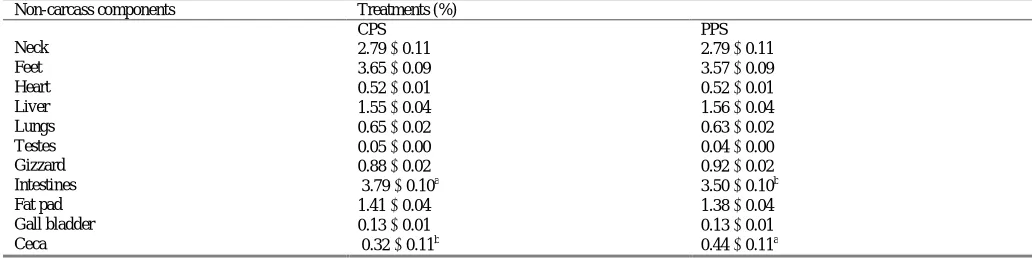
Pasture-raised poultry products are growing in popularity among many American consumers. They are of the perception that poultry reared in a more natural environment can yield products of better quality. Thus, the objective of this study was to determine the effects of conventional production system (CPS) and pasture production system (PPS) on broiler performance (feed intake, weight gain, feed conversion, and organ weights) and meat nutritional quality (moisture, fat, protein, and ash). Three hundred and sixty Cornish Rock male broiler chickens were randomly assigned to one of two treatments, CPS or PPS, for 49 days. After brooding indoors for 3 weeks, the PPS treatment was moved into pens on pasture and the CPS birds remained indoors for the remainder of the study. Dark (leg and thigh) and white (breast) meat samples were evaluated separately for nutrient composition. Results showed no significant differences between treatments for most performance characteristics and nutrient content. No differences were detected for non-carcass components except the intestines, which were higher (P< 0.05) in CPS birds (3.79%) than PPS birds (3.50%). Ceca weights were higher (P< 0.05) in PPS birds compared to CPS birds with 0.44% and 0.32%, respectively. Based on these results, broilers raised on pasture performed similarly to those raised conventionally.
Keywords:
pasture poultry, performance, nutrient content, organ weight, broiler1. Introduction
This has resulted in some consumers moving away from consuming products from conventionally raised broilers to consuming products from birds raised alternatively (pasture, free range, and organic). Consumers’ interest in these natural (specialty) products is related to the greater quality and security of meat derived from such systems along with high standards of animal welfare (Fanatico et al., 2005a). In recent years, the demand for birds raised using alternative methods of production has increased. This increase in demand is because consumers are of the perception that these alternative production systems may provide healthier, more environmentally friendly food with superior sensory characteristics (Lewis et al., 1997). One such alternative production system is pastured poultry. In this method of production, birds are raised outdoors in a more natural environment (Fanatico et al., 2005b; Smith et al., 2012; Chen et al., 2013). The broilers are placed in pens on pasture allowing them access to grass, grass seeds, and small insects (Fanatico et al., 2007). Because these birds are being produced in a less intensive setting, there is a decrease in stress conditions, and increase in bird comfort (Blokhuis et al., 2000) resulting in stronger leg bones and walking ability (Fanatico et al., 2005b; Fanatico et al., 2008). Consumers perceive that birds reared with outdoor access are not only happier, but produce eggs and meat that are also healthier (Husak et al., 2008) and tastier (Latter-Dubois, 2001; Fanatico et al., 2005b; Wang et al., 2009) than those reared in the conventional system. Furthermore, consumers are willing to pay more for these products, thus supporting a specialty market. They believe that despite the increase in price, the production method improves animal welfare, and the products have a distinct flavor and quality (Latter-Dubois, 2001; Chen et al., 2013).
There are conflicting results available comparing the performance of conventionally raised broilers with those raised on pasture. Lower feed conversion and higher final body weights (Castellini et al., 2002; Lima and Nass, 2005; Wang et al., 2009) have been reported in birds produced conventionally compared to those produced with outdoor access. In contrast, the same results have also been reported from broilers with access to pasture (Chisholm et al., 2003; Ponte et al., 2008a). Free-range broilers had been shown to have higher feed intake than conventional broilers (Lima and Nass, 2005). Moreover, free-range broilers have had heavier stomachs than conventional broilers, but intimated that this could be the result of sand particles ingested with the forage in the pasture (Dou et al., 2009). Still, performance was positively influenced by forage consumption when comparing broilers reared on pasture with and without forage access (Ponte et al., 2008b). Results indicated significantly higher feed consumption in the birds having access to pasture than those with no access, resulting in higher final body weights in birds with pasture access. However, there was no difference in feed conversion ratio between the two groups (Ponte et al., 2008b). Conversely, other reports have shown outdoor access to have no effect on growth performance (Fanatico et al., 2005b; Chen et al., 2013).
2. Materials and Methods
2.1. Experimental Birds, Diet and Housing
This research was approved by the Tuskegee University Animal Care and Use Committee and conducted at the Poultry Unit of the George Washington Carver Agricultural Experimental Station at Tuskegee University, Tuskegee, Alabama. It is part of a larger study looking at the effect of pasture production on the overall performance of broilers compared to those raised in a conventional production system.
Three hundred and sixty 1-day-old male Cornish Rock broiler chickens were purchased from Murray McMurray Hatcheries (P.O Box 458, 191 Closz Dr., Webster City, Iowa 50595). Upon arrival, chicks were wing-banded for identification, weighed, and randomly assigned to one of six pens prepared for brooding. Brooding pens were approximately 12 ft x 14 ft (3.66 m x 4.27 m). Each pen contained a 250-Watt infrared fluorescent brooding lamp to provide the chicks with adequate heat. Pens also contained bedding material (wood shavings). In addition, three chick feeders and drinkers were placed in each pen. A commercial broiler ration, Nutrena Nature Wise Meatbird crumbles feed (P.O. Box 5614, Minneapolis MN, 55440), was purchased from H. A. Vaughan Feed Store (106 West Lee Street, Tuskegee, Alabama 36083), and fed to the birds through the duration of the study. Feed and water were provided ad libitum to the birds. Table 1 shows the chemical composition of the feed offered as reported on feed bag label.
2.2. Experimental Procedure
This study utilized two treatments, the pastured poultry production system (PPS) and the conventional production system (CPS). Each treatment was replicated three times (60 birds per replication = 180 birds per treatment = 360 total). The birds were randomly assigned to treatment groups and brooded indoors for three weeks. After brooding, one treatment was moved into three polyvinyl chloride (PVC) pens on pasture while the other treatment remained in three indoor pens. The indoor pens were modified to be similar in size to the PVC pens measuring 10 ft x 12 ft (3.05 m x 3.66 m). The PVC pens were approximately 3 ft high (0.9 m) with wire fencing around all sides. A tarp covered approximately two-thirds of the top of the pen providing shade and shelter for the birds. Access into the PVC pens was available via a top, swinging door. All pens were equipped with hanging feeders and automatic drinkers. Weights and feed intake were recorded on a weekly basis. The study was conducted for a total of 49 days.
2.3. Slaughtering and Processing of Birds
After final weights were recorded on day 49, feed was removed from all pens in preparation for slaughter and processing on day 50. On the day of slaughter, birds were weighed to obtain pre-slaughter weights. Birds were placed in killing cones, manually decapitated, and exsanguinated. The birds were dipped in hot water (62C) for 30 seconds to loosen feathers. Feathers were then removed using a batch de-feathering machine. The birds were eviscerated and internal organs (liver, heart, testicles, spleen, gizzard, intestines, lungs, gall bladder, ceca, and fat pad) and other non-carcass components (feet and neck) were removed, weighed, and discarded. The carcasses were then weighed to obtain dressing percentage after which they were thoroughly washed and excess water drained. They were then placed in an ice bath to reduce the temperature to approximately 4.44C before packaging. The carcasses were quartered, vacuum-sealed, and placed in the freezer for further lab analyses.
2.4. Nutrient Analysis of Meat Samples
2.5. Statistical Analysis
The experimental design was a completely randomized design (CRD) with two treatments and three replications. Statistical analyses were performed using the General Linear Model procedure of SAS software (SAS, 2008), SAS Inst. Inc. Cary, NC 27513. Analysis of variance (ANOVA) tables were used for determining significant differences. When F-test showed significance, means were separated using Tukey’s test.
3. Results and Discussion
3.1. Effect of production System of Broiler Performance
To evaluate the effects of the two different production systems on broiler performance and meat nutrient quality, a comparative study was conducted. Reported in Table 2 are initial body weight, final body weight, total weight gain, and average daily gain.
No significant differences were found between the two treatments for these parameters. Over the study period, birds reared on pasture gained equally as much as those reared indoors. Similar results were found by Fanatico et al. (2005b), Chen et al. (2013), and Mikulski et al. (2011), who also reported that access to pasture had no effect on performance. In contrast, Ponte et al. (2008a) found that birds raised outdoors with access to pasture had higher body weights when compared to birds raised in the same setting but without access to pasture. Differences in these studies could be due to seasonal effects, forage type, and/or breed of bird. Suggestions have been made that birds can compensate growth at inappropriate temperatures, humidity, and light intensity (during different seasons) by increasing or decreasing feed intake (Ponte et al., 2008a). Broilers may also favor a specific forage type, thus possibly decreasing consumption of supplemental feed when that forage type is provided. In addition, several studies have been done where, not only different breeds, but also different genotypes have been used allowing for multiple result variations (Castellini et al., 2002; Fanatico et al., 2005a; Fanatico et al., 2005b; Ponte et al., 2008a; Husak et al., 2008; Chen et al., 2013). Despite these differences, none of the studies showed that access to pasture had any negative impact on broiler performance.
Table 3 shows the total intake (TI), average daily intake (ADI), and feed conversion ratio (FCR) of broilers reared under the two production systems. Results showed that ADI, TI, and FCR were not different in birds from either production system. These results were unexpected because reports in the literature suggested that birds raised in a conventional system tended to have higher levels of intake than those raised on pasture (Castellini et al., 2002; Wang et al., 2009). The results of the current study suggest that birds reared on pasture were as efficient in converting feed to meat as those reared in the conventional production system. Moreover, these results are in contrast to Chisholm et al. (2003) who observed that birds raised on pasture were more efficient than birds reared conventionally. Because Chisholm et al. (2003) conducted their study during the spring instead of the summer (as in the current study); variations may exist because of seasonal differences, for example, in the spring, weather conditions are milder, they are exposed to more pasture inhabitants (insects, worms, etc.), and fresher forage growth.
The pre-slaughter weight, carcass weight, and dressing percent of conventionally raised broilers and pasture raised broilers are shown in Table 4. No significant differences were found between treatments for these parameters. This indicates that pasture raised broilers consumed similar amounts of feed as conventionally raised broilers and had the same efficiency of converting feed to meat. In contrast, Castellini et al. (2002) showed that conventional broilers had higher live weights (3,219 g) compared to organically raised broilers (2,861g), and carcass weight of (2,263 g) for conventional and (2,011 g) for organic. Differences in the results of the current study compared to Castellini et al. (2002) could be due to a different breed used, as well as longer growth periods, because those authors raised conventional and pasture birds for 56 days compared to the 49 days in this study. In the same study by Castellini et al. (2002) one group of broilers was raised for 81 days and a similar trend was observed as in the group raised for 56 days.
Moreover, because birds on pasture had unrestricted access to supplemental feed, it is possible that consumption of forage was held to a minimum. In addition, because the study was conducted in the summer, forage material in the pasture may not have been of adequate quantity or quality. This could explain the limited differences observed. As expected, the ceca were found to be larger (P<0.05) in birds raised on pasture compared to those raised indoors with 0.44% versus 0.32%, respectively. This was likely the result of forage consumption. At slaughter, the ceca contained large portions of undigested forages. Microbes are required for the metabolism of cellulose and hemi-cellulose present in plants, however, only a miniscule amount of these microorganisms are found in the ceca of birds. Hence, the ceca became enlarged to accommodate the increase in forage fiber intake. Although there was not an overall increase in the digestive organs, birds with access to forage had larger ceca and smaller intestines than those reared indoors. This difference could be because birds indoors had residual concentrate feed left in the intestines which was heavier than residual forage material that would be present in the digestive tract of those raised outdoors.
3.2. Effect of Production System on Nutrient Composition of Broiler Meat
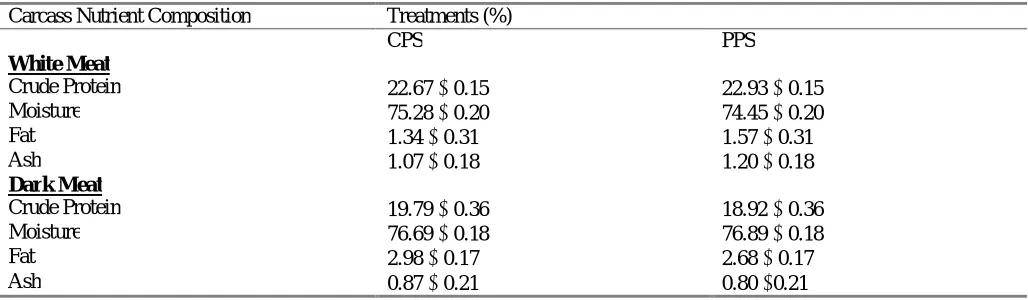
Nutrient composition of dark and white meat is shown in Table 6. Results show that there were no significant differences between treatment groups for protein, moisture, fat, and ash. This shows that the nutrient quality of the meat from birds reared in the alternative production system was similar to that of birds reared in the conventional system. This was similar to results obtained by Dou et al. (2009) who reported that rearing birds indoors and outdoors had no impact on meat nutrient content. Castellini et al. (2002) compared organically and conventionally reared broilers and also found moisture, protein, and ash to be unaffected by production system. However, conventional broilers had a higher fat content than organic broilers. In contrast, Husak et al. (2008) conducted a study on conventional, organic, and free-range broilers and observations indicated that organic and free-range breast meat were significantly lower in moisture but higher in protein when compared to conventional broilers.
4. Summary and Conclusion
There were no significant differences for FI, BW gain, FCR, carcass weight, dressing percentage, and meat nutrient composition (protein, moisture, fat, ash) of broilers reared in both production systems. Small intestines for birds raised conventionally were larger than those raised on pasture. Ceca from birds reared outdoors were larger than those from birds reared indoors. Future studies in this area would evaluate longer periods of the birds on pasture, and the implications on meat quality factors, as well as consumers’ acceptability of the product.
Acknowledgements
The authors would like to thank the George Washington Carver Agricultural Experiment Station, Tuskegee University, Tuskegee, AL for providing the resources for the implementation of this research project. This work was also supported by the USDA National Institute of Food and Agriculture, (Evans-Allen) project (Accession # 211872).
References
Awad, W. A., K. Ghareeb, S. Abdel-Raheem, and J. Böhm. (2009). Effects of Dietary Inclusion of Probiotic and Synbiotic on Growth Performance, Organ Weights, and Intestinal Histomorphology of Broiler Chickens. Poultry Science, 88(1), 49-55.
Blokhuis, H., E. Ekkel, S. Korte, H. Hopster, and C. Van Reenen. (2000). Farm Animal Welfare Research in Interaction with Society. Veterinary Quarterly, (22), 217-222.
Castellini, C., C. Mugnai, A. Dal Bosco. (2002). Effect of Organic Production System on Broiler Carcass and Meat Quality. Meat Science, (60), 219-225.
Chisholm, J., D. Trott, C. Zivnuska, J. Cox, and M. Seipel. 2003. Pasture Poultry Reseach: Pasture Poultry and Student Research at Truman.
Chen, X., W. Jiang, H. Z. Tan, G. F. Xu, X. B. Zhang, S. Wei, and X. Q. Wang. (2013). Effects of Outdoor Access on Growth Performance, Carcass Composition, and Meat Characteristics of Broiler Chickens. Poultry Science, 92(2), 435-443.
Dozier, W. A., III, B. D. Lott, and S. L. Branton. (2005). Growth Responses of Male Broilers Subjected to Increasing Air Velocities at High Ambient Temperatures and a High Dewpoint. Poultry Science, 84(6), 962-966.
Fanatico, A. C., L. C. Cavitt, P. B. Pillai, J. L. Emmert, and C. M. Owens. (2005a). Evaluation of Slower-Growing Broiler Genotypes Grown with and without Outdoor Access: Meat Quality. Poultry Science, 84(11), 1785-1790.
Fanatico, A. C., P. B. Pillai, L. C. Cavitt, C. M. Owens, J. L. Emmert. (2005b). Evaluation of Slow-Growing Broiler Genotypes Grown with and without Outdoor Access: Growth Performance and Carcass Yield. Poultry Science, 84(8), 1321-1327.
Fanatico, A. C., P. B. Pillai, J. L. Emmert, E. E. Gbur, J. F. Meullenet, and C. M. Owens. (2007). Sensory Attributes of Slow- and Fast-Growing Chicken Genotypes raised Indoors or with Outdoor Access. Poultry Science, 86(11), 2441-2449.
Fanatico, A. C., P. B. Pillai, P. Y. Hester, C. Falcone, J. A. Mench, C. M. Owens, and J. L. Emmert. (2008). Performance, Livability, and Carcass Yield of Slow-and Fast-growing Chicken Genotypes fed Low-nutrient or Standard Diets and raised Indoors or with Outdoor Access. Poultry Science, 87(6), 1012-1021. Husak, R. L., J. G. Sebranek, and K. Bregendahl. (2008). A Survey of Commercially Available Broilers Marketed
as Organic, Free-Range, and Conventional Broilers for Cooked Meat Yields, Meat Composition, and Relative Value. Poultry Science, 87(11), 2367-2376
Latter-Dubois, J. (2001). Poulets Fermiers:Leurs Qualite’s Nutritionnelle et Organoleptiques et la Perception du Consommateur. MSc Faculte’ des Sciences de l’Agriculture et de L’Alimentation. Univ. Laval, Quebec, Canada.
Lewis, P. D., G. C. Perry, L. J. Farmer, and R. L. S. Patterson. (1997). Responses of Two Genotypes of Chicken to the Diets and Stocking Densities Typical of UK and ‘Label Rouge’Production Systems: I. Performance, behavior and carcass composition. Meat Science, 45(4), 501-516.
Lima, A. M. C and I. A. Naas. (2005). Evaluating Two Systems of Poultry Production: Conventional and Free-Range. Brazilian Journal of Poultry Science, 7(4), 215-220.
Mikulski, D., J. Celej, J. Jankowski, T. Majewska, and M. Mikulska. (2011). Growth Performance, Carcass Traits and Meat Quality of Slower-growing and Fast-growing Chickens raised with and without Outdoor Access. Asian Australian Journal of Animal Science, (24), 1407-1416.
Ponte, P. I. P., J. A. M. Prates, J. P. Crespo, D. G. Crespo, J. L. Mourao, S. P. Alves, R. J. B. Bessa, M. A. Chaveiro-Soares, L. T. Gama, L. M. A. Ferreira, and C. M. G. A. Fontes. (2008a). Pasture Intake Improves the Performance and Meat Sensory Attributes of Free-Range Broilers. Poultry Science, 87(1), 71-79.
Ponte, P. I. P., J. A. M. Prates, J. P. Crespo, D. G. Crespo, J. L. Mourao, S. P. Alves, R. J. B. Bessa, M. A. Chaveiro-Soares, L. T. Gama, L. M. A. Ferreira, and C. M. G. A. Fontes. (2008b). Restricting the Intake of a Cereal-Based Feed in Free-Range Pasture Poultry: Effects on Performance and Meat Quality. Poultry Science, 87(10), 2032-2042.
SAS Institute. (2008). Statistical Analysis System Software Version 9.2. SAS Inst. Inc., Cary, NC 27513
Smith, D. P., J. K. Northcutt, E. L. Steinberg. (2012). Meat Quality and Sensory Attributes of a Conventional and a Label Rouge-type Broiler Strain Obtained at Retail. Poultry Science, 91(6), 1489-1495.
Table 1: Chemical Composition of Diet
Macronutrients
Crude Protein (%) 22.0
Lysine (%) 1.0
Methionine (%) 0.37
Crude Fat (%) 2.5
Crude Fiber (%) 6.0
Calcium (%) 0.9 - 1.4
Phosphorus (%) 0.6
Salt (%) 0.25 - 0.65
Sodium (%) 0.15 - 0.22
*Chemical composition as listed on label of feed bag
Table 2: Initial Weight, Final Weight, Total Weight Gain, and Average Daily gain of Broilers Raised on Pasture versus a Conventional Production System
Performance Parameters Treatments
CPS PPS
Initial body weight (g) 34.08 0.26 34.08 0.26
Final body weight (g) 3169 30 3192 30
Total weight gain (g) 2870 36 2769 36
Average Daily Gain (g) 58.56 ± 0.73 56.52 ± 0.73
Treatments: CPS=conventional production system, PPS=pasture production system
Table 3: Total Intake, Average Daily Intake, and Feed Conversion Ratio of Broilers Raised on Pasture versus a Conventional Production System
Performance Parameters Treatments
CPS PPS
Total intake (g) 5,754 50 5,634 50
Average daily intake (g) 117 1.03 115 1.03
Feed conversion ratio 2.01 0.02 2.04 0.02
Treatments: CPS=conventional production system, PPS=pasture production system
Table 4: Pre-Slaughter Weight, Carcass Weight, and Dressing Percent of Broilers Raised on Pasture versus a Conventional Production System
Performance Parameters Treatments
CPS PPS
Pre-slaughter weight (g) 3,177 48 3,161 48
Carcass weight (g) 2,261 40 2,260 40
Dressing percent (%) 71.2 0.44 71.5 0.44
Treatments: CPS=conventional production system, PPS=pasture production system
Table 5: Non-Carcass Components of Broilers Raised on Pasture versus a Conventional Production System
Non-carcass components Treatments (%)
CPS PPS
Neck 2.79 0.11 2.79 0.11
Feet 3.65 0.09 3.57 0.09
Heart 0.52 0.01 0.52 0.01
Liver 1.55 0.04 1.56 0.04
Lungs 0.65 0.02 0.63 0.02
Testes 0.05 0.00 0.04 0.00
Gizzard 0.88 0.02 0.92 0.02
Intestines 3.79 0.10a 3.50 0.10b
Fat pad 1.41 0.04 1.38 0.04
Gall bladder 0.13 0.01 0.13 0.01
Ceca 0.32 0.11b 0.44 0.11a
Table 6: Proximate Analysis of white and Dark Meat of Broilers Raised on Pasture versus a Conventional Production System
Carcass Nutrient Composition Treatments (%)
CPS PPS
White Meat
Crude Protein 22.67 0.15 22.93 0.15
Moisture 75.28 0.20 74.45 0.20
Fat 1.34 0.31 1.57 0.31
Ash 1.07 0.18 1.20 0.18
Dark Meat
Crude Protein 19.79 0.36 18.92 0.36
Moisture 76.69 0.18 76.89 0.18
Fat 2.98 0.17 2.68 0.17
Ash 0.87 0.21 0.80 0.21