Vol. 2 Issue 5, May - 2016
Molecular structure, vibrational
spectra and electronic properties
of cis-[Pt(2-aminothiazole)
2
Cl
2
]
Rumyana Yankova
Department of Inorganic and Analytical Chemistry, Assen Zlatarov University, 8010 Burgas, Bulgaria,
Abstract—Cis-[Pt(2-aminothiazole)2Cl2] was obtained. The geometry optimization of this molecule was done by Density Functional Theory (DFT/B3LYP) method with 6-31G(d) basis set and LANL2DZ for Pt. The experimental infrared spectrum was compared with calculated and complete vibrational assignment was provided. The bond orders and the electronic properties of the molecule were calculated. The natural bond orbital analysis (NBO) was performed in order to study the intramolecular bonding interactions among bonds and delocalization of unpaired electrons. The calculated highest occupied molecular orbital (HOMO) and lowest unoccupied molecular orbital (LUMO) with frontier orbital gap were presented.
Keywords—cis-[Pt(2-aminothiazole)2Cl2], quantum chemical calculations, geometry optimization, electronic properties
I. INTRODUCTION
The thiazoles compounds have a number of characteristic pharmacological features, such as relative stability and ease of starting materials. 2-Aminothiazoles are known mainly as biologically active compounds with a broad range of activity and as intermediates in the synthesis of antibiotics and dyes [1]. The biological activity of these compounds may be connected to their ability [2, 3] to form complexes with metal ions. Metal complexes with these ligands are becoming important as biochemical and antimicrobial reagents [4, 5]. Cis-platin has a significant activity against a variety of tumors. There is a continuing interest in the development of new platinum complexes, which are less toxic and noncross-resistance to cisplatin. Large part of the platinum complexes exhibiting antitumor activity have two cis ligands, such as chlorides and two strongly bonded amine type groups [6, 7].
The aims of the present work are using quantum chemical calculations to determine the geometry and electronic structure of cis-[Pt(2-aminothiazole)2Cl2], to
provide vibrational assignment for the IR spectra and investigate quantum chemical parameters, such as highest occupied, lowest unoccupied molecular orbital energy levels, energy gap, atomic charges.
II. EXPERIMENTAL
The cis-[Pt(2-aminothiazole)2Cl2] was obtained by
mixing water solutions of (NH4)2PtCl4 and of
2-Aminothiazole in mol ratio 1:2. The crystalline product which precipitated slowly (after one week) was filtered off and washed with water and dried under vacuum. The infrared spectra were recorded on a Bruker Tensor 27 FT-IR spectrometer in the 4000 – 400 cm–1 range, with the samples embedded in KBr matrixes.
III. COMPUTATIONALS METHODS
The full optimization of cis-[Pt(2-aminothia-zole)2Cl2] was carried out by Density Functional
Theories (DFT) method using Gaussian 03 software [8]. It was used Becke’s three parameter hybrid exchange functional with Lee–Yang–Parr correlation functional (B3LYP) [9-11] with added polarization functions for H, S, C, N и Cl – 6-31G(d) and LANL2DZ [12-14] for Pt. All calculations were converged to 10–8 a.u. Vibrational analysis was performed at each stationary point found, that confirm its identity as an energy minimum.
The population analysis was performed by the natural bond orbital method [15] at B3LYP/6-31G(d) level of theory using NBO program [16] under Gaussian 2003 program package. Natural bond orbital analysis stresses the role of intermolecular orbital interaction in the complex, particularly charge transfer. This is carried out by considering all possible interactions between filled donor and empty acceptor orbitals and estimating their energetic importance by second-order perturbation theory. For each filled orbital of the donor (Φi) and the empty orbital of the acceptor (Φj), the stabilization energy (∆Eij
(2)
) associated with electron delocalization between donor and acceptor and it is calculated by equation (1) [17].
i j
j ij i i iJ
F
q
E
2
) 2 (
, (1)
Vol. 2 Issue 5, May - 2016 IV. RESULTS AND DISCUSSION
A. Geometry Optimization
The equilibrium geometry was determined by the energy minimization. The ground state optimized geometrical structure and atomic labeling of cis-[Pt(2-aminothiazole)2Cl2] are shown in Figure 1.
Figure 1. Optimized geometrical structure and atomic labeling of cis-[Pt(2-aminothiazole)2Cl2]
(C-atoms are in grey, Cl-atoms are in green, S-atoms are in yellow, N-atoms are in blue, Pt-atom is in dark blue,
H-atoms are in white)
Table 1. Some optimized geometrical parameters of cis-[Pt(2-aminothiazole)2Cl2
Table 2. Mulliken atomic charges and bond orders of cis-[Pt(2-aminothiazole)2Cl2
Atom Mulliken atomic
charges
Bond Bond
order
Pt 0.027 Pt–Cl11(23)
1.249
Cl11(23) –0.249 Pt–N1(13) 0.746
N1(13) –0.493 S4(16)–C2(14)
1.252
N5(17) –0.724 S4(16)–C6(18) 1.230
S4(16) 0.269 C2(14)–N5(17) 1.416
C2(14) 0.311 N1(13)–C2(14)
1.530
C3(15) 0.110 N1(13)–C3(15) 1.259
C6(18) –0.369 C3(15)–C6(18) 1.782
The results obtained from the geometry optimization of cis-[Pt(2-aminothiazole)2Cl2] in
gas-phase cannot be verified experimentally. The optimized structural parameters (bond lengths, bond
angles, dihedral angles) of cis-[Pt(2-aminothia-zole)2Cl2] are listed in Table 1.
Quantum chemical calculations provide the ability to calculate the net atomic charges (q), which are localized at the corresponding atoms as a result of the redistribution of the electrons in the molecule. They allow the understanding of the distribution of the electronic density in a system of connected atoms and predict some chemical properties of the molecules. The atomic charge values were obtained by the Mulliken population analysis [18]. The net atomic charges and the order of the bonds in the investigated compound are presented in Table 2.
B. Natural Bond Orbital Analysis
NBO analysis is an efficient method for study of the intra-molecular and inter-molecular bonding and interactions among bonds, and also provides a convenient basis for investigation charge transfer or conjugative interactions in molecular systems.
Calculations were performed using the Gaussian 03 package at the DFT/B3LYP/6-31G(d) level of the theory with LANL2DZ for Pt. Table 3 lists the calculated occupancies of natural orbitals. The calculated natural hybrids on atoms are also given in this table. As seen from Table 3, the σ(N1(13)–Pt) bond
is resulting from the overlap of an sp2.45 hybrid on nitrogen with an sp2.04d1.24 hybrid on platinum. The higher electronegativity of the nitrogen atom is reflected in the larger percentage (85.46) for the nitrogen hybrid. On the other hand, ϭ(Cl11(23)–Pt) bond is formed from an sp4.95 hybrid on chlorine atom and sp2.23d1.11 hybrid on platinum – 79.04% of the bond is contributed from the Cl orbital, while 20.96% of the bond comes from the platinum orbital.
In the NBO method, delocalization of electron density (ED) between occupied Lewis-type orbitals and formally unoccupied (antibonding or Rydberg) non-Lewis NBOs corresponds to a stabilizing donor– acceptor interaction. The strength of this interaction can be estimated by the second order perturbation theory. Thus, the results obtained from NBO analysis provide convenient basis for investigating conjugative interactions in molecular systems. The larger stabilization energy E(2) value, the more intensive is the interaction between electron donors and acceptors, i.e. the more electron donating tendency from electron donors to acceptors and the greater the extent of conjugation of the whole system. This interaction results a loss of occupancy from the concentration of electron NBO of the idealized Lewis (bond or lone pair) structure into an empty (anti-bond or Rydberg) non-Lewis orbital. The second-order perturbation theory analysis of Fock matrix in NBO basis of cis-[Pt(2-aminothiazole)2Cl2 display strong
intra-molecular conjugative and hyperconjugative interactions and delocalization of electron density within the molecule.
In NBO analysis large E(2) value shows the intensive interaction between electron-donors and electron-acceptors, and greater the extent of conjugation of the whole system. Some important
Parameters
Bond length (Ǻ) Bond angle (degree)
Pt–Cl11(23)
2.363 N1–Pt–N13
92.3 Pt–N1(13)
2.084 C2(14)–S4(16)–C6(18) 89.6
S4(16)–C2(14) 1.752 Pt–N1(13)–C2(14) 122.9
S4(16)–C6(18)
1.750 Pt–N1(13)–C3(15) 125.1
C2(14)–N5(17) 1.357 C2(14)–N1(13)–C3(15) 112.0 N1(13)–C2(14)
1.326 S4(16)–C2(14)–N5(17)
122.7 N1(13)–C3(15)
1.388 S4(16)–C2(14)–N1(13)
112.9 C3(15)–C6(18) 1.352 N5(17)–C2(14)–N1(13) 124.3
Bond angle (degree) N1(13)–C3(15)–C6(18)
115.6 Cl11–Pt–Cl23 91.8 S4(16)–C6(18)–C3(15) 109.9 N1(13)–Pt–Cl11(23) 87.9 C3(15)– N1(13)–Pt–Cl23(11) 162.2 N1(13)–Pt–Cl23(11)
178.0 N5(17)– C2(14)–N1(13)–Pt
Vol. 2 Issue 5, May - 2016 interactions between Lewis and non-Lewis orbitals
along with their interacting stabilization energies are shown in Table 4.
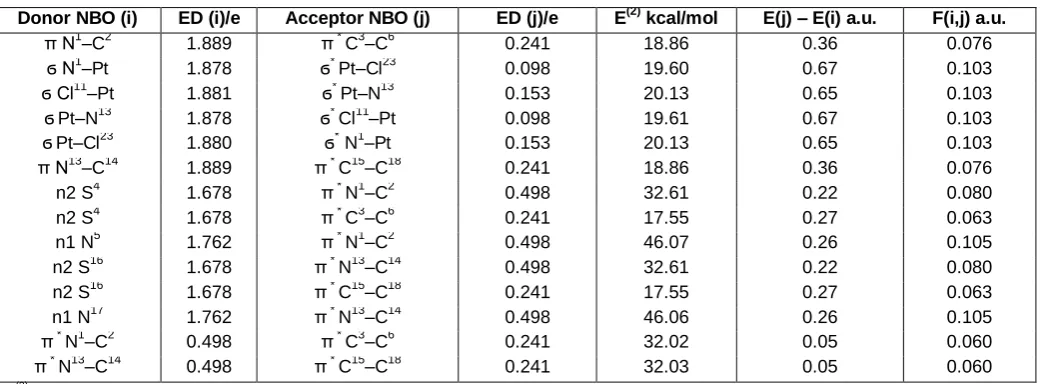
The second-order perturbation theory analysis of Fock-matrix in NBO basis shows that strong intramolecular conjugative interactions are formed by orbital overlap between n(N5(17)) and π*(N1(13)–C2(14)), and that between n(S4(16)) and π*(N1(13)–C2(14)), bond orbital which result in stabilization of the system. There occurs a strong intramolecular conjugative interaction of N1(13)–C2(14) from N5(17) and from S4(16) of n1(N5(17)) → π*
(N1(13)–C2(14)) and of n2(S4(16)) → π*(N1(13)–C2(14)),
which increases ED(0.498e) leading to stabilization of 46.06 and 32.61 kcal/mol. Also there occurs a strong intramolecular hyper conjugative interaction of Pt– N1(13) from Pt–Cl11(23) of ϭ(Pt–Cl11(23)) → ϭ*(Pt–N1(13)) which increases ED(0.153e) that weakens the respective bonds Pt–Cl11(23)
(1.880e) leading to stabilization of 20.13 kcal/mol and also the hyper conjugative interaction of ϭ(Pt–N1(13)) → ϭ*(Pt–Cl11(23)) leading to stabilization of 19.60 kcal/mol. The conjugative interaction of π(N1(13)–C2(14)) → π*
(C3(15)– C6(18)); π*(N1(13)–C2(14)) → π*(C3(15)–C6(18)) leading to stabilization of 18.86 and 32.03 kcal/mol respectively.
Table 3. Occupancy of natural orbitals (NBOs) and hybrids of cis-[Pt(2-aminothiazole)2Cl2 by the B3LYP method
with 6-31G(d) basis set and Lanl2dz for Pt atom
Bond orbital Occupancy Hybridsa AO (%)b
ϭN1(13)–C2(14) 1.985 sp1.79(N1(13)) + sp1.83(C2(14)) 60.63%(N1(13)) + 39.37%(C2(14)) πN1(13)–C2(14)
1.889 p(N1(13)) + p(C2(14)) 66.67%(N1(13)) + 33.33%(C2(14))
ϭN1(13)–C3(15) 1.980 sp1.84(N1(13)) + sp2.59(C3(15)) 61.90%(N1(13)) + 38.10%(C3(15))
ϭN1(13)–Pt 1.878 sp2.45(N1(13)) + sp2.04d1.24(Pt) 85.46%(N1(13)) + 14.54%(Pt)
ϭC2(14)–S4(16) 1.975 sp2.42(C2(14)) + sp4.88(S4(16)) 54.15%(C2(14)) + 45.85%(S4(16)) ϭC2(14)–N5(17)
1.993 sp1.83(C2(14)) + sp1.80(N5(17)) 41.04%(C2(14)) + 58.96%(N5(17)) ϭC3(15)–C6(18) 1.985 sp1.60(C3(15)) + sp1.53(C6(18)) 49.66%(C3(15)) + 50.34%(C6(18))
πC3(15)–C6(18) 1.933 p(C3(15)) + p(C6(18)) 45.27%(C3(15)) + 54.73%(C6(18))
ϭS4(16)–C6(18)
1.976 sp4.54(S4(16)) + sp3.06(C6(18)) 48.69%(S4(16)) + 51.31%(C6(18))
ϭCl11(23)–Pt 1.881 sp4.95(Cl11(23)) + sp2.23d1.11(Pt) 79.04%(Cl11(23)) + 20.96%(Pt)
a Hybrids on atoms.
b Percentage contribution of atomic orbitals in NBO hybrid.
Table 4. Second-order perturbation theory analysis of Fock matrix in NBO basis
Donor NBO (i) ED (i)/e Acceptor NBO (j) ED (j)/e E(2) kcal/mol E(j) – E(i) a.u. F(i,j) a.u.
π N1–C2
1.889 π *
C3–C6
0.241 18.86 0.36 0.076
ϭ N1–Pt
1.878 ϭ* Pt–Cl23 0.098 19.60 0.67 0.103
ϭ Cl11–Pt
1.881 ϭ* Pt–N13 0.153 20.13 0.65 0.103
ϭPt–N13
1.878 ϭ*
Cl11–Pt 0.098 19.61 0.67 0.103
ϭPt–Cl23
1.880 ϭ* N1–Pt 0.153 20.13 0.65 0.103
π N13–C14
1.889 π *
C15–C18
0.241 18.86 0.36 0.076
n2 S4 1.678 π *
N1–C2
0.498 32.61 0.22 0.080
n2 S4 1.678 π * C3–C6 0.241 17.55 0.27 0.063
n1 N5 1.762 π *
N1–C2
0.498 46.07 0.26 0.105
n2 S16 1.678 π * N13–C14 0.498 32.61 0.22 0.080
n2 S16 1.678 π * C15–C18 0.241 17.55 0.27 0.063
n1 N17 1.762 π *
N13–C14
0.498 46.06 0.26 0.105
π *
N1–C2 0.498 π * C3–C6 0.241 32.02 0.05 0.060
π *
N13–C14 0.498 π * C15–C18 0.241 32.03 0.05 0.060
E(2) – means energy of hyper-conjugative interactions (stabilization energy) in kcal/mol. E(j) – E (i) – Energy difference between donor and acceptor i and j NBO orbitals in a.u. F(i, j) – is the Fock matrix elements between i and j NBO orbitals in a.u.
C. Homo-Lumo Analysis
The frontier orbitals (highest occupied molecular orbital – HOMO and lowest unoccupied molecular orbital – LUMO) are very important in defining reactivity. The HOMO exhibits the ability to donate an electron and LUMO as an electron acceptor serves the ability to obtain an electron. The frontier orbitals (HOMO, LUMO) of cis-[Pt(2-aminothiazole)2Cl2]
calculated by B3LYP/6-31G(d) and LANL2DZ for Hf are plotted in Figure 2.
Energy of frontier orbitals and energy of the gap are:
EHOMO = –581.680 kJ/mol
ELUMO = –147.107 kJ/mol
ΔELUMO–HOMO = 434.573 kJ/mol
High values of EHOMO have a tendency of the molecule
to donate electrons to appropriate acceptor molecules with low energy, empty molecular orbitals. The energy of the lowest unoccupied molecular orbital indicates the ability of the molecule to accept electrons. The lower value of ELUMO, the more probable it is that the
molecule would accept electrons. Consequently, concerning the value of the energy of the gap ΔELUMO– HOMO, larger values of the energy difference will
Vol. 2 Issue 5, May - 2016 inhibition efficiency, because the energy to remove an
electron from the last occupied orbital will be low. The results for the calculations of the ionization potential (I) and the electron affinity (A) by application of the Koopman’s theorem [19] are shown. According to the Hartree–Fock theorem, the frontier orbital energies are given by: I = – EHOMO = 581.680 kJ/mol; A = –
ELUMO = 147.107 kJ/mol. This theorem establishes a
relation between the energies of the HOMO and the LUMO and the ionization potential and the electron affinity, respectively. Although no formal proof of this theorem exists within DFT, its validity is generally accepted. Electronegativity (χ), chemical potential (µ) and global hardness (η), their operational and approximate definitions for cis-[Pt(2-aminothia-zole)2Cl2]are: χ = – µ= (I + A)/2 = 364.394 kJ/mol ; η
= (I – A)/2 = 217.287 kJ/mol.
1
2
Figure 2. Electron distribution of HOMO – 1 and LUMO – 2 for cis-[Pt(2-aminothiazole)2Cl2]
D. Vibrational Spectral Analysis
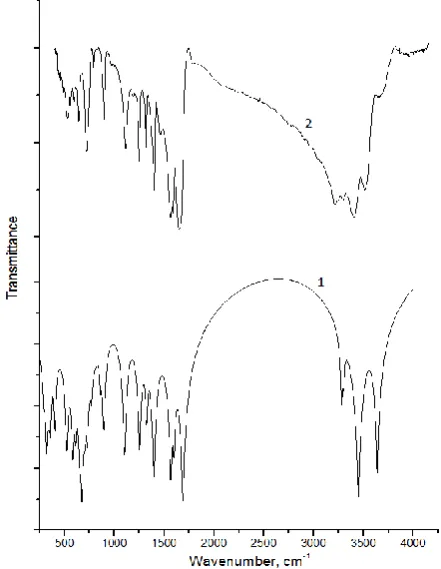
The vibrational spectra of cis-[Pt(2-Aminothia-zole)2Cl2] was calculated by DFT with B3LYP functional having extended basis sets 6-31G(d) and LANL2DZ for Pt. Frequencies recorded experimentally for cis-[Pt(2-Aminothiazole)2Cl2] are compared with the calculated obtained by DFT (Figure 3).
It is well known that the harmonic frequencies by DFT calculations are usually higher than the corresponding experimental quantities due to the facts
of the electron correlation approximate treatment, the anharmonicity effect and basis set deficiency, etc. [20]. In order to improve the calculated values in agreement with the experimental values, it is necessary to scale down the calculated harmonic frequencies. After scaling, the theoretical frequencies
match well with the experimental ones. The experimental assignments of IR for vibrations, IR theoretical and relative intensities were reported in Table 5.
These assignments are important to understand the molecular structure of the title molecule. Any discrepancies noted between the observed and the calculated wavenumbers due to the fact that the calculations were actually performed on single (isolated) molecules in the gaseous state. Thus some reasonable deviations from the experimental values seem to be justified.
Figure 3. IR spectrum of cis-[Pt(2-Aminothiazole)2Cl2], 1 –
calculated, 2 – experimental
Table 5. Experimental and calculated characteristic frequencies (cm-1), IR intensity and probable assignments of 2-Aminothiazole and cis-[Pt(2-2-Aminothiazole)2Cl2]
2-Aminothiazole [Pt(2-Aminothiazole)2Cl2] Assigmentsb
Experimental
frequencies[21]a
Calculated Experimental
frequencies
Calculated
Scaled IAbs Scaled IAbs
– 3686 29 3808 s 3638 72 νassym(NH);(NH2)
3413 w 3569 37 3385 s 3449 273 νsym(NH); (NH2)
3293 w 3224 10 3283; 3100 3283 8 ν(C-H)
1764 s 1653 186 – 1689 278 δb(NH2); ν(C=N)
1629 m 1588 73 1594 1597 35 δb(NH2); ν(C=N); ν(C=C)
Vol. 2 Issue 5, May - 2016
1361 s 1359 44 – 1399 93 Rband; ν(C-H)
1327 s 1305 54 1355 1394 57 Rband; ν(C-H)
1277 ms 1243 24 1273 1255 47 δt(NH2); ν(C-N); ν(C-H)
1070 s 1054 47 1206 1247 14 δt(NH2); Rband
– – – 1072 1100 40 δt(NH2); Rband
– – – 876 862 4 ν(C-H)
769 s 754 12 770 768 4 Rband; ν(C-S)
709 s 700 13 – 729 37 Rband; δr(NH2)
695 ms 650 46 699 705 22 Rband; ν(C-S)
661 vs 644 158 623 674; 653 352 Rband; δw(NH2)
542 s 556 61 583 583 68 Rband; δw(NH2)
517 ms 510 103 527 525 48 Rband
– 292 36 400[18]c 404 15 δr(NH2)
– – – – 356; 342 28 δt(NH2)
– – – 300[22]c 324 42 νsym( (Pt-Cl)
– – – 290[22]c 317 28 νassym( (Pt-Cl)
– – – 225[22]c 293 6 ν(Pt-N)
– – – 185[22]c 187 5 ν(Pt-N)
– – – 168[22]c 170 2 ν(Pt-N)
Scale factors of 0.9613 for calculated frequencies with B3LYP/6-31G(d,p) (a) s - strong; m - medium; w - weak; vw - very weak
(b) ν - stretching; ss - symmetric; ass – asymmetric; δb – bending; δr – rocking; δw – wagging; δt – twisting; Rband – ring deformation
(c) These experimental frequencies are of [Zn(2-Aminothiazole)2Cl2] – δr(NH2); νsym( (Zn-Cl); νassym( (Zn-Cl); ν(Zn-N)respectively
IAbs-Theoretical infrared intensities
V. CONCLUSION
The geometry of cis-[Pt(2-Aminothiazole)2Cl2] was optimized with DFT/B3LYP methods using 6-31G(d) basis set and LANL2DZ for Pt. The complete molecular structural parameters of the compound were obtained. The vibrational frequencies of the fundamental modes of the compound were precisely assigned, analyzed and the theoretical results were compared with the experimental vibrations. The close agreement was observed between the experimental and scaled frequencies obtained using the basis set 6-31G(d). HOMO–LUMO studies reveal the intramolecular charge transfer through conjugated system. The Mulliken charges calculated by B3LYP/6-31G(d) method were presented. The transactions give stabilization to the structure were identified by second order perturbation energy calculations. Using NBO analysis the stability of the molecule arising from hyper-conjugative interaction and charge delocalization was analyzed. The present quantum chemical study may lead to the understanding of properties and activity of cis-[Pt(2-Aminothiazole)2Cl2].
REFERENCES
[1] Manju, D. Kishore, D. Kumar, Cadmium and tin complexes of Schiff-base ligands, Journal of Coordination Chemistry, 64, 2011, 2130–2156.
[2] H. Sigel, D.B. McCormick, Discriminating behavior of metal ions and ligands with regard to their biological significance, Accounts of Chemical Research, 3, 1970, 201–208.
[3] M. Dixon, E.C. Webb, Enzyme inhibitors. In Enzymes, Academic Press New York, 1964.
[4] N. Raman, S.J. Raja, J. Joseph, J.D. Raja, Synthesis, spectral characterization and DNA cleavage study of heterocyclic Schiff base metal complexes, Journal of the Chilean Chemical Society, 52, 2007, 1138–1141.
[5] M.A. Neelakantan, S.S. Marriappan, J. Dha-rmaraja, T. Jeyakumar, K. Muthukumaran, Spectral, XRD, SEM and biological activities of transition metal complexes of polydentate ligands containing thiazole moiety, Spectrochimica Acta Part A: Molecular and Biomolecular Spectroscopy, 71, 2008, 628–635.
[6] J. Reedijk, The relevance of hydrogen bonding in the mechanism of action of platinum antitumor compounds, Inorganica chimica acta, 198, 1992, 873– 881.
[7] N.P. Johnson, J.L. Butour, G. Villani, F.L. Wimmer, M. Defais, V. Pierson, V. Brabec, Metal antitumor compounds: the mechanism of action of platinum complexes. In Ruthenium and Other Non-Platinum Metal Complexes in Cancer Chemotherapy, Springer Berlin Heidelberg, 1989.
Vol. 2 Issue 5, May - 2016 [9] C.T. Lee, W.T. Yang, R.G. Parr, Development
of the Colle-Salvetti correlation-energy formula into a functional of the electron density, Phys. Rev., B 37, 1988, 785–789.
[10] A.D. Becke, Densityfunctional thermoche-mistry. III. The role of exact exchange, J. Chem. Phys., 98,1993, 5648–5652.
[11] R.G. Parr, W. Yang, Density-functional theory of atoms and molecules (Vol. 16), Oxford university press, 1989.
[12] P. J. Hay, W.R. Wadt, Ab initio effective core potentials for molecular calculations. Potentials for the transition metal atoms Sc to Hg, J. Chem. Phys., 82, 1985, 270–283.
[13] W.R. Wadt, P.J. Hay, Ab initio effective core potentials for molecular calculations. Potentials for main group elements Na to Bi, J. Chem. Phys., 82, 1985, 284–298.
[14] P.J. Hay, W.R. Wadt, Ab initio effective core potentials for molecular calculations. Potentials for K to Au including the outermost core orbitals, J. Chem. Phys., 82, 1985, 299–310.
[15] A.E. Reed, L.A. Curtiss, F. Weinhold, Intermolecular interactions from a natural bond orbital,
donor-acceptor viewpoint, Chemical Reviews, 88, 1988, 899–926.
[16] E.D. Glendening, A.E. Reed, J. E. Carpenter, F. Weinhold, NBO, version 3.1.
[17] F.Weinhold, C.R. Landis, Natural bond orbitals and extensions of localized bonding concepts, Chem. Educ. Res. Pract., 2, 2001, 91–104.
[18] R.S. Mulliken, Electronic Population Analysis on LCAO-MO Molecular Wave Functions. I, J. Chem. Phys., 23, 1955, 1833–1840.
[19] V.S. Sastri, J.R. Perumareddi, Molecular orbital theoretical studies of some organic corro-sion inhibitors, Corros. Sci., 53, 1997, 617–622.
[20] M. Karabacak, M. Çınar, M. Kurt, An experimental and theoretical study of molecular structure and vibrational spectra of 2-chloronicotinic acid by density functional theory and ab initio Hartree– Fock calculations, J. Molec. Str., 885, 2008, 28–35.
[21] http://www.hanhonggroup.com/ir/ir_en/B4102 8.html.
![Figure 1. Optimized geometrical structure and atomic labeling of cis-[Pt(2-aminothiazole)Cl]](https://thumb-us.123doks.com/thumbv2/123dok_us/8358279.1669986/2.595.42.293.581.709/figure-optimized-geometrical-structure-atomic-labeling-cis-aminothiazole.webp)