Introducing Performance of Reservoirs (Ab Anbar)
in the Management of Flood and Surface Runoff
Hussein Hassanzadeh and Reza Razani
Department of Civil Engineering, Islamic Azad University of Shiraz Sadra Pardis, Shiraz, Iran
ABSTRACT: In order to achieve enormous resources and utilization of water in agriculture, livestock, drinking, irrigation of urban green spaces, cleaning streets and collecting flood and runoff from cities, especially in the low rainfall areas, rehabilitation and construction of reservoirs (pond) in the way of directing flood paths are required.
It is possible to save more water for consumption in low rainfall seasons by directing floods away through rivers and multiple reservoirs with sliding doors exactly like dams around cities and mountains which we are able to control not only floods and runoffs but also financial losses and urban traffic.
Keywords: component; Reservoir (Berke); multiple reservoirs; surface water storage; directed Flood Rivers; directed runoff streams.
I. INTRODUCTION
Reservoirs (Berke or Ab Anbar in Persian) in order to achieve a useful resource, utility and large, are constructed to store water which by sanitizing it can be considered as a source of drinking water supply with minimal salts and minerals.
Until the sixth century of Hijri year, due to the popularity and prosperity of aqueducts and wells in and around the city, the source of drinking water supply and water storage was there and the form of today’s reservoirs didn’t exist [1].
Based on founded petroglyph, after 600 Hijri reservoirs were built. Over time, more people need water so their numbers have been added [1].
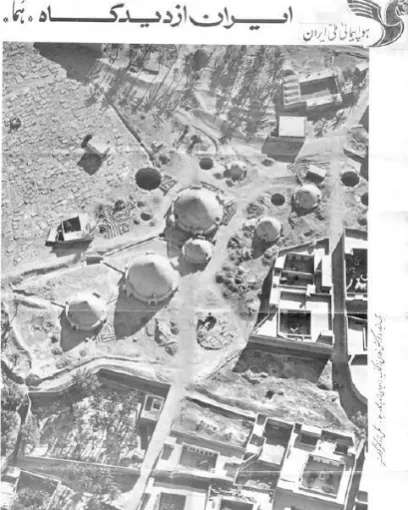
By directing rainfall floods to the multiple reservoirs located on a river path, in addition to preventing potential losses it can be a huge source of water as well (Figure 1).
Figure 1. Salafi-Berke Evaz, Fars, Iran [2].
However, several thousand years of human thought and effort has been led to not only live in low rainfall and dry areas but also do agricultural activities and livestock (not ridiculing our ancestor’s efforts).
II. THE GENERAL OVERVIEW OF THE COMPONENTS OF A RESERVOIRS
11
Figure 2. Elevation of HajAbolHassan reservoirs, Grash,Fars, Iran [2].
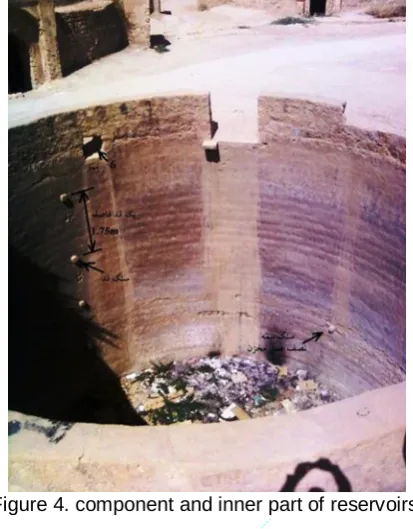
As you saw the components of a reservoirs in Figure 3 and Figure 4, they are consist of:
12
1) Foretop on the roof 2) Conical or domed roof 3) Annular wall below the roof
4) Entrance outfall and its protective cap and inscription 5) Arch over the entrance outfall
6) Water inlet and outlet
7) Directed streams of surface water into the reservoirs 8) Sedimentary basins and dams
9) Door controller of the amount of water entering the reservoirs tank 10) reservoirs tank
11) Stairs entering the tank
12) The streams of irrigating farmland 13) Dredging valve and pumping water 14) Details of the amount of available water
15) Details of utilization such as tether location of horses, location for lantern, location for fastening bucket rope and the valves for air ventilation and light.
Figure 4. component and inner part of reservoirs.
13
III. TYPES OF RESERVOIR
Due to factors such as the economy, dewatering, operation and construction of reservoirs where one of the following forms has been constructed:
1) Circular reservoirs 2) Roofless reservoirs 3) Rectangular reservoirs Circular reservoirs
The average reservoirs size (diameter of 4 to 6 m) and large (more than 6 m in diameter) in order to collect and store flood water and runoff from the city for cleaning streets and urban roads, irrigation of agricultural lands and urban green spaces, as well as providing water for drinking, agriculture or livestock are constructed (Figure 6).
Figure 6. HajAsadAllh Khani Berke Gerash, Fars, Iran [2].
Advantages of circular reservoirs: 1) The speed and ease of construction.
2) Beauty, durability and reliability of the structure of the reservoir 3) Ease of operation and maintenance.
4) High resistance to gravity and lateral loads. Disadvantages of circular reservoirs: 1) The need for skilled manpower
2) The economic cost more than other types of reservoir Roofless reservoirs
Due to cost savings in the construction of this type of reservoir with small size (less than 4 m in diameter) is used (Figure 7).
These types of reservoirs, making more in the middle of farmland, are used to collect additional runoff water to the area of land.
14
1) Low cost and ease of implementation 2) Ease of construction
Disadvantages of roofless reservoirs: 1) The risk to humans or animals to fall into it 2) Pollution and odor of the water in it Rectangular reservoirs
This type of reservoirs, due to savings in time, cost and ease of excavation (by truck) are constructed (Figure 8).
Figure 8. Rectangular reservoirs.
Advantages of rectangular reservoirs: 1) Ease of excavation
2) Occupy less space
Disadvantages of rectangular reservoirs:
1) It requires scaffolding for construction of the arch 2) It resists less than circular reservoirs
To avoid opening the vault ceiling and the roof siding, the tensile strength (usually wooden rods used) is required. These types of reservoirs are constructed further along the path of Caravansary (Figure 9).
15
IV. PERFORMANCE OF RESERVOIRS
Several thousand years of human thought and effort has been led to live and do agriculture and livestock in low rainfall and drought seasons.
Both directing flood out of the city and distributing it among farmland and reservoirs in the rainy season, as well as clearing and dredging rivers in the low rainfall seasons, we can manage surface water to achieve huge resources of water found in low rainfall seasons (Figure 10).
Figure 10. Flood distribution.
V. MULTIPLE RESERVOIRS
After a heavy rainfall, large volumes of surface water flooding from mountains and hills, can be sent to the city by specific rivers and multiple reservoirs which we are able not only to prevent further damage and financial loss and compensation but also to achieve a huge source of water (Figure 11).
16
Surface runoff and floods in the rivers lead into one reservoir through the inlet gate. Finally, after filling the reservoir, excess water runs out of the front water outlet and goes into the next reservoir or directed river (Figure 12).
Figure 12. Multipe reservoirs Evaz, Fars.
VI. MULTIPLE RESERVOIRS IN COMPARISON WITH DAMS
Although the dam construction and management of flood, water can be stored more than reservoirs, in the following cases, the use of reservoirs, especially multiple one as compared to the dam is preferable.
1) Dams are limited only in the straits and topographies based on land types, while reservoirs can be constructed in the plains, foothill and where runoff is formed after raining.
2) Dredging dam tanks are expensive and almost impossible so that the tank will be filled after several years. But for reservoirs due to limited storage and disposal of structures and dredging equipment during construction, tanks and directed streams of water cab be dredged at a specific time schedule.
3) Massive dam tank holds water in a concentration so this big construction can change the ecosystem of those regions and surrounding areas. While, scattered reservoirs (according to the topography of the area) are constructed based on the needs of each region.
4) The volume of water stored in a dam tank, trigger earthquakes and aftershocks or create artificial earthquakes. But the volume of each reservoir is designed to be avoided keeping more than the concentration of water in an area. 5) Although a large body of water stored in a dam can be used as a source of energy and electricity production. But
in a country where water scarcity and easily generation of electricity from power plants such as solar, wind (in the desert zone) and combined cycle, there is no sense of Hydroelectric power plant.
6) In contrast to dams, reservoirs are scattered in required areas and easily available for different purposes.
VII. CONCLUSIONS
By studying the natural topography maps and determined directions or drainage systems and runoff, we can spend the cost of construction, maintenance and dredging reservoirs, directed flooding rivers and streams to collect runoff water to achieve a massive utilizable source during drought years, especially in low rainfall areas (Figure 13).
For this purpose, we had better pay special attention to the development of rural and urban drainage maps.
17
Also in this new type of vessels, consisting of a circular plan with a reinforced concrete wall, which consists of some circular arcs at the intersection of the vertical steel and concrete columns, beams tank kept on height are studied and the results indicate that half of the cost of construction of this type of circular tanks against usual tanks are common. In this type of circular tanks drift component from the fluid pressure at the end congress, by herbicide steel screws or round cable harness is placed at appropriate intervals around the tank [5].
Therefore, the construction of reservoirs as well as protect them on the road to prevent flooding in addition to financial losses and stop urban traffic, can be a huge source of water to be used in the following [2]:
1) Drinking water supply. 2) Provide water for livestock. 3) Irrigation of agricultural lands. 4) Irrigation of urban green space.
5) Cleaning of streets and roads, urban and rural water supply. 6) Collect runoff from the city.
7) Modulates the rainy season and the season of low rainfall.
REFERENCES
[1] Shafahi, A., & Rahpeama, H. (1998). Antiquities of Evaz. Evaz, Fars, Iran: (In Persian).
[2] Hassanzadeh, H., Fotoohi, M., & Moradi, H. (2009). Introduction and how to build a reservoir (berke). B.S. Dissertation Advis or: H. Nami, Department of Civil Engineering. Larestan, Fars, Iran: Islamic Azad University of Larestan (In Persian).
[3] Wikipedia. (2014). Haft-Berke. Retrieved Dec 25, 2014, from
http://fa.wikipedia.org/wiki/%D9%87%D9%81%D8%AA%E2%80%8C%D8%A8%D8%B1%DA%A9%D9%87?oldid=9924612 [4] Wikipedia. (2014). Gerash. Retrieved Dec 12, 2014, from Wikipedia the Free Encyclopedia:
http://fa.wikipedia.org/wiki/%DA%AF%D8%B1%D8%A7%D8%B4?oldid=14367581
![Figure 1. Salafi-Berke Evaz, Fars, Iran [2].](https://thumb-us.123doks.com/thumbv2/123dok_us/8357520.1669612/1.595.177.419.462.659/figure-salafi-berke-evaz-fars-iran.webp)
![Figure 2. Elevation of HajAbolHassan reservoirs, Grash,Fars, Iran [2].](https://thumb-us.123doks.com/thumbv2/123dok_us/8357520.1669612/2.595.169.430.322.525/figure-elevation-of-hajabolhassan-reservoirs-grash-fars-iran.webp)
![Figure 7. Roofless reservoirs [2].](https://thumb-us.123doks.com/thumbv2/123dok_us/8357520.1669612/4.595.176.424.209.355/figure-roofless-reservoirs.webp)