Issue 1
Northwest Passage: Journal of Educational
Practices
Article 4
September 2002
Oh, What A Tangled Web-Site We Weave When First We Practice
Elizabeth Reynolds
University of IdahoJames Reynolds
Washington State UniversityLet us know how access to this document benefits you.
Follow this and additional works at:
https://pdxscholar.library.pdx.edu/nwjte
Part of the
Education Commons
This Article is brought to you for free and open access. It has been accepted for inclusion in Northwest Journal of Teacher Education by an authorized administrator of PDXScholar. For more information, please [email protected].
Recommended Citation
Reynolds, Elizabeth and Reynolds, James (2002) "Oh, What A Tangled Web-Site We Weave When First We Practice,"Northwest
Journal of Teacher Education: Vol. 2 : Iss. 1 , Article 4.
DOI: 10.15760/nwjte.2002.2.1.4
Oh, What A Tangled Web-Site We Weave When
First We Practice
Elizabeth Reynolds, Ed.D.
College of Education University of Idaho
.James Reynolds, Ed.M.
U.S. Department of Agriculture Washington State University
ABSTRACT
Current en1phases on con1JJUter technology have promjJted a naive desire to use lvhatever is nevv regardless c~{its approJJriateness to educational outcon1es. U<i'C qf College level Web-based instrucUon has unearthed a variety of problems: misap-plication of software, misplaced attempts to adapt traditional instruction to the
Web, lack of teacher support, access and time difficulties, financial barriers, spa-tial/gender tl~ff'erences, and counterproductive G[Jproaches to learning that are
un-s,vsten1atic and inde11ende111 vet:5us organized, social, and cultural. The present stut~}'
excunined technological barriers to college student :5 achieve111ent as well as stu-dent ]JrefCrences regartling an 011tional Web-based ancillary designed to [Jron1ote student achievenzent in an Educational F'sychology course.
INTRODUCTION
Attitude
Recent research addresses achicvcn1cnts gained through the use of computerized study plans in a variety of fields (Cauble & Thurston, 2000; Inglis, 1996; Ritter & Lemke, 2000; Montclpare & Williams, 2000; Ruth, 1997). Al-beit, several studies describe shortcomings and poor results using the san1e con1putcrizcd tech-niques (Faux & Black-Hughes, 2000; Healy, 2000; Menon & Coe, 2000; Raths, 2000). De-scribed difficulties arc many and varied. Some researchers believe that the problem lies in the attitudes of the people within the culture. "The technical part is easy; it's the attitudes and cul-ture that arc hard". "You can write a beautiful program, but it docsn 't count if nobody uses it" (Raths, 2000, p. 8 l ). Furthermore, critics have suggested that current interest in technology re-flects a rather unschooled urge to use whatever
technology is "state of the art" with little regard for the appropriateness relative to the educational objective in question.
Educational Criticisms of Ways Computers arc Used
Others posit that it is the way software is used that is problematic.
"Web-based training material is otlen pulled from traditional teaching tools, such as slide pre-sentations or videos, that were n1cant to accon1-pany a lecture. Taking those teaching tools out of context and sticking them on the Web docs not n1akc for engaging, interactive content" (Faux & Black-Hughes, 2000, p. 458). Abbcduto (2000) summarizes several complaints by edu-cators regarding the computer explosion. He suggests that critics posit that computers may be antithetical to the goals that most educators hope to achieve and cites the Internet as an ex-ample of a superficial, unsystematic approach
to studying rather than one that is focused, goal-directed and self-reflective. Others argue that technology tends to isolate learning as something individual versus social and cultural. Another criticism involves computer mediated instruc-tion which depends critically on a student's abil-ity to monitor his or her own progress, thereby increasing the gap between more capable and less capable students; independent learners will benefit, while those students requiring teacher support will flounder. Burniskc ( 1998) further suggests that the greatest threat facing educa-tion today is the death of dialectical discourse and that today's adolescents me gravely lacking this ability and there is little in popular culture that encourages them to think but ra thcr to 'just consun1c". I-le states that con1putcrs arc "persua-sive" and discourage public debate and says that
if there arc no opposing views, then where's the dialectical tension necessary to discover the truth? Samuel Sava (head of the National Asso-ciation of Elementary School Principals) ob-served before the start of the 1997-98 school year, "Ifcon1putcrs n1akc a diffCrcncc, it has yet to show up in achievement. We must have the courage to resist sexy hardware and argue for the funds necessary to train our teachers." (In Abbcduto, p. 271)
Time/ Access
On-de1nand access to con1putcrs has been dccn1cd a n1ajor obstacle in so1nc instances. High demand for computer time in computer labs and limitations in off-site connections both contrib-ute to limiting access (Faux & Black-Hughes, 2000; Menon & Coe, 2000). Off-campus stu-dents face barriers of time. They may have young children or employment that prevents them from using co1nn1unity resources, including univer-sity or community library resources (Faux &
Black-Hughes, 2000).
Financial Barrier
Financial li111itations n1ay be another barrier that students face using Internet course mate-rial. The increasing amount of computer tech-nology required to access Internet courses may present a financial barrier to learners who do not otherwise have access to a con1putcr. The initial
22 NORTHWEST PASSAGE
expense of the hardware and the continual ex-pense of Internet access and software can be prohibitive to off-campus students (Brent, 1999). The cost ofteclmology is not important only to the students, but also impacts professors and instructors (Healy, 2000).
Lack of Knowledge/Discomfort With Computers
Another area for exmnination is student lack of knowledge and general discomfort with com-puters and the Internet. Primary and secondary students have increasing access to computers in elementary schools and high schools. This does not mean that all college students arc entering post secondary education with a competence or comfort level with computers that suppo1t their use of the Internet as a learning tool (Mowrer-Popiel, Pollard, & Pollard, 1994). Many students from the study indicated that they were not able to learn well using the computer and/or the Internet. Students felt that they did not receive any feedback to reinforce learning and that dis-comfort with the computer led to getting lost on the Internet while engaged in studies. Students were very direct about not enjoying learning from the Internet or from the computer. Re-searchers have found that learning takes place in both traditional classroom and on-line fonnats, but performance on a posttest of knowledge gained was best in the lecture section (Faux &
Black-Hughes, 2000). Students also stated a preference for teacher contact over Internet in-struction. "The typical things we do to infuse enthusiasm and life into our lectures cannot be done as readily via distance learning. Simple examples such as adding a point to our overheads with a marker, gesturing and moving around, and walking to the blackboard all serve to keep stu-dents oriented in live classrooms and, as much as we prefer not to admit it, sometimes keep them awake" (Menon & Coe, 2000, p. 499).
Gender/Spatial Ability
A final area for examination deals with the widening gap between males and females with respect to access and the use of technology (Linn, 1998). "This is becoming the new boys club -this is where the gender gap is going to be."
2 https://pdxscholar.library.pdx.edu/nwjte/vol2/iss1/4
(Janice Weiman, executive director of AAUW Edncational Foundation, 1998). A study at MIT in 1995 examined the disparity in the ratio of male and female engineering and computer sci-ence majors. According to that report, women were half as likely as men to major in computer science at MIT. Surveys found that both women and men characterized the environment as more competitive than other majors and women gen-erally felt less prepared for the major. Cornelia Brunner (associate director and media designer for the Center for Children and Technology, Education Development Center in New York) says that girls and boys have different percep-tions of computers with girls focussing more on the function of computers and boys more likely to concentrate on computers as machines. For
cxan1plc, she says in con1putcr progran1111ing
classes, girls are inclined to be less interested in the material than the boys.""lfthc technology is
introduced as a n1cans to an end, as a tool for research or making a n1ulti1ncdia presentation,
young women arc as likely to take to it as young men." Part of the problem may also stem from long established gender differences in spatial performance (Casey & Brabeck, 1990; Greenfield, Brannon, & Lohr, 1994; Subrahmanyam & Greenfield, 1994). Skills in
utilizing two-din1cnsional representations of
hypothetical space arc important in a variety of computer applications, including word
process-ing, programn1process-ing, and computerized video
games (Subrahmanyam & Greenfield, 1994). As determined by these researchers, those with su-perior spatial skills (significantly more males)
dcn1onstratc superior cotnputcrizcd video gan1c
performance and those who experience greater video game practice (significantly more males) also demonstrate improved spatial performance.
Training through video gan1c pcrfor111ancc was
significant for improving spatial performance and most effective for those who started out with relatively poor spatial skills (significantly more females). Greenfield, Brannon, & Lohr (1994) tested whether video games would contribute to the development of spatial representational skills necessary for people to effectively utilize com-puter technology and found that long-term de-velopment of video game expertise yielded
ad-vanced spatial skills as measured by a mental paper- folding task. They further suggest that the anthropological study of games has shown that a culture's games socialize children relative to the needs and adaptational requirements of their own society. Vygotsky ( 1962) and Bruner (l 965) posited that the internalization of cultural tools or symbol systems stimulate cognitive develop-ment. This notion as applied to media, was ex-panded by Bruner and Olson (l 973) as they were
the first to recognize con1n1unication 1ncdia as a
distinct symbol system. People engage with these cultural symbol systems everyday of their lives and the cognitive activity that ensues leads to representational competence. For most chil-dren, video games arc one of the first opportu-nities to interact with computer technology. As demonstrated by Greenfield, Brannon, & Lohr, (1994) this form of cognitive socialization is predominately male.
Relationship to Study
There arc n1any stakeholders concerning escalating use of co1npulcr technologies in the
college classroom (Chung & McLarney, 2000).
"Just because everyone's going there, docsn)t
mean it will be easy to get to or worth the trip" (March, 2000, p. 55). In light of the aforemen-tioned variables, the present study sought to in-vestigate use of an optional on-line ancillary for a course in Educational Psychology and to
ex-plore student preferences for such a site relative to gender and spatial ability. By generating sur-veys to determine student preferences for what they consider to be most beneficial to their learn-ing and then uslearn-ing that information to construct an onlinc site for optional student use, we hoped to gain insights into what students consider to be the greatest technological barriers to effec-tive achievement as well as what they
consid-ered to be most advantageous.
METHOD
Subjects (pilot study)
The subjects for the pilot study conducted during the Fall semester of 2000 consisted of 130 pre-service educators from a 300 level Edu-cational Psychology course at the University of
Idaho. Surveys were administered to gather stu-dent preference information that was then uti-lized to construct an onlinc-ancillary for use in the next semester's Educational Psychology course.
Subjects
The 86 subjects were 59 females and 27 males enrolled in an Educational Psychology course at the University ofldaho. The study took place during the Spring Semester of200 l. Forty-eight percent of the students lived in a campus residence. Eighty-three percent of the students had Internet available in their homes. Nincty-three percent reported that they had adequate access to a con1putcr while on ca1npus. One hun-dred percent reported that they used e-mail. Sixty-five percent of the students reported they have a NOVELL account. Sixty-five percent of the students reported that they had on-line an·· cillarics associated with other classes. Subjects participated on a voluntary basis.
Test Materials
A pre-class co1nputcr survey and a Group Embedded Figures Test (GEFT) (permission secured for use) were administered to the sub-jects. The computer survey was used to assess subject demographics and student likes/dislikes regarding feature of online ancillaries. The GEFT was administered to examine gender di f-ferences in spatial performance and possible re-lationships between spatial performance and preferences on the computer survey. Scores ranged from 0-18 with 18 as the highest pos-sible score.
Procedure
During the Fall semester of 2000, 130 stu-dents from a 300 level Educational Psychology course at the University of Idaho were adminis-tered a pre-class computer survey to determine preferences regarding an on line ancillary for the course. Results were used to generate an online site for optional student use. Spring semester 200 I, a modified survey was administered to that semester's Educational Psychology class which was used to verify student preferences for online ancillary components, increase the demographic
24 NORI'HWEST PASSAGE
information, and also to assess student attitudes toward computers and online ancillaries. Addi-tionally, students were administered a Group Embedded Figures Test (GEFT) to determine levels of spatial performance. Anecdotal infor-mation was gathered.
RESULTS
Table 1 reports means, standard deviations, and percentages by sex relative to norm quartiles for the GEFJ; standardized by the number cor-rect for women.
Table I
JY1££1ns Stal)dard Deviations and Percentages by Gc;;n-dcr per 01iartilc O!J the GEFT
Males n=21 M~l l.71 Nun1bcr Correct Test Norms Sl)=5.24
1-8 . 23%
9-11 12 .. 14
15-18
29o/t1
IO'X) 38°/i
Fcn1alcs n=62 M~l0.55 SD~5.J3
39o/o 1 Jo/o 2!o/t1 27o/o
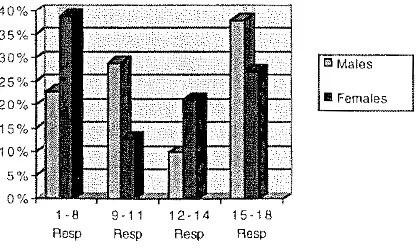
A one-way analysis of variance for total group showed no significant effects for gender on the GEFT. Figure 1, however, shows that when categorized by number of correct items, an inverse relationship exists for percentages of n1ales and fe1nalcs obtaining correct nu1nbcr of responses. The greatest percentage of males (38%) scored in the top category (l 5-18 correct) and the greatest percentage of females (39%) scored in the lowest catego1y (0-8 correct).
40%
35%
30% El Males
25%
20°1,, B Females
15%
1 O"/.,
5%
0%
1-8 9-11 12-14 15-18
Resp Resp Resp Resp
Figure I Percentage of females (n_0062) and
males (IL ~21) falling within the ranges of 1-8,
4 https://pdxscholar.library.pdx.edu/nwjte/vol2/iss1/4
9-11, 12-14, or 15-18 correct responses on the GEFT.
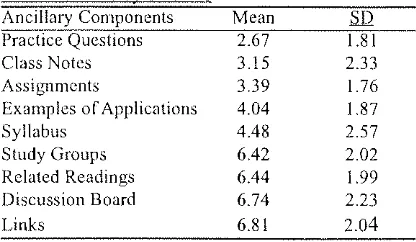
Table 2 reports results from the computer survey ranking the ancillary components from most preferred to least preferred and their
asso-ciated 111can scores.
Table 2
Ancillary Co1nponents Ranked fron1 Most Preferred to Least Preferred by Students.
Ancillary Con1poncnts Mean fil2
PractTCCQUcstions 2.6 7 1.81
Class Notes 3.15 2.33
Assignn1cnts 339 1.76
Exa111p!cs of Applications 4.04 1.87
Syllabus 4.48 2.57
Study C3roups 6.42 2.02
Related Readings 6.44 1.99
J)iscussion Board 6.74 2.23
Links 6.81 2.04
Anecdotal reports from the survey revealed the majority of comments about computer us-age were negative (!1'=94) versus positive (!1
~70). Eighty percent of the positive replies ad-dressed the benefits of having access to mate-rial for review and course notes from missed lectures. The negative responses addressed (1)
the amount of' time needed to interact with the computer when using online ancillaries (40%),
(2) technical problems with software or hard-ware (26%), and (3) feelings of confusion, in-ability, frustration and discouragement (24%).
DISCUSSION
Reviewing the anecdotal con1rncnts, one
stu-dent said, "Computers can have problems. I feel safer without them." Three people found pro-fessors to be more accessible than computers. Thirteen said that optional ancillaries arc good but mandatory ancillaries arc bad. Another stated that readings and lectures always seemed ad-equate to him. Views regarding computer usage arc as varied as their applications. Generally, students feel that computers arc worthwhile tools, however they don't always agree with how they arc used within the educational arena. Their sentiments echoed many of those found within the literature in that there docs not appear to be
adequate support nor should they supplant the live classroom teacher. They appreciate ancil-laries in as much as they support and extend learning and if they are not thrust upon students as yet another task to be accomplished. Some of our colleagues suggest that students need to be placed into "zones of discomfort" in order to progress to higher levels of intellectual under-standing and familiarity with computers. Based upon the results of this present study, it is sug-gested that we attempt to reach common ground. Realizing that some students encounter difficul-ties that other students may not, we need to pro-vide equalizing support for all areas of difficulty experienced by users. In order to empower stu-dents we need to involve them when constrnct-ing onlinc ancillaries and perhaps Web-based instruction, in spite of the arguments by our col-leagues that students don't know what is best for them. We must .also remain cognizant that gender differences have emerged within this realm as well as spatial differences. Both have been shown to relate to varying levels of com-puter expertise. Individual differences in learn-ing styles extend into the technological environ-ment. Educators must pay attention to the needs of the students and learn from them how best to accommodate technology ifwc wish for all stu-dents to embrace this mode of instrnction and meet the expectations of our rapidly changing culture.
REFERENCES
Abbeduto, L.,(2000). Taking sides:
Clash-ing views on controversial issues in educational
psychology.
Brent, E. (1999) Computers in the under-graduate classroom: Lessons from the first 2,000
students. Social Science Computer Review. l 7 (2), 162-175.
Bruner, J.S. (1965) The growth of mind" American Psychologist, 20, 1007-1017.
Bruner, J.S. & Olson, D.R., (1973). Learn-ing through experience and learnLearn-ing through media. In G. Gcrbner, L.P. Gross & W.H. Melody (Eds.), Communications technology and social policy. New York: Wiley.
Brunner, C. (1998, August 1 ). Internet gen-der gap. Scripps Howard News Service-Mos: cow-Pullman Daily News, p. B2
Burniske, R. W. (1998). The shadow play: How the integration of technology annihilates dehate in our schools. Phi Delta Kappan, Octo-ber, 1998.
Casey, M. Beth & Brabeck, Mary M. (1990). Women who exec! on a spatial task: Proposed
genetic and environ1nental factors. Brain_<)nd
\:;.Qgnition 12 73-84.
Cauble, A. E.; Thurston, L.P. (2000). Effects
of interactive multimedia on knowledge, atti-tuclc, and self-efficacy of social work students. Research on Social Work Practice. 1 Q ( 4), 428-438.
Chung, E.; Mclarney, C. (2000). The
class-roon1 as a service encounter: Suggestions for
value creation. Journal of l'y!anagemcnt Educa-Jjon 24 (4), 484-501.
Faux, TL.; Black-Hughes, C.A. (2000). Comparison of Using the Internet Versus Lec-tures to Teach. Research on Social Work Prac-tice 10 (4), 454-467.
Greenfield, P.M., Brannon, C., & Lohr, D. ( 1994). Two-dimensional representation of movement through three -dimensional space: the role of video game expertise. Journal of Applied Developmental Psychology...12, 87-103.
Healy, J.M. (2000). How Do Computers Affect Our Children's Minds?'Education Digest, 65 (9), 37-45.
Inglis, T.J.J. ( 1996). Teaching problem-solv-ing skills by analogy. Medical Teacher. 18 (1), 73-75.
Linn, M. (1998, August 1). Internet gender gap. Scripps Howard News Service-Moscow-Pullman Daily News. p. B2
Menon, G.M.; Coe, J.R. (2000). Technol-ogy and Social Work Education: Recent Empiri-cal Studies. Research on Social Work Practice
lQ (4), 397-400.
Montclpare, W.J.; Williams A. (2000). Wcb-based learning: Challenges in using the Internet in the undergraduate curriculum. Education and Infonnation Technologies. 5 (2), 85-101.
Mowrer-Popiel, E.; Pollard, C. And Pollard, R. (1994) An analysis of the perceptions of preservice teachers toward technology and its use in the classroom. Journ.al of Instructional Psychology. 21(2),131-138.
Raths, D. (2000). Will the Web deliver? Info World 22 (23), 81-82.
Ritter, M.E.; Lemke, K.A. (2000). Address-ing the 'Seven Principles for Good Practice in Undergraduate Education' with Internet-en-hanced Education. Journal of Geography in Higher Education. 24 (1), 100-109.
Ruth, S. (1997). Getting real about technol-ogy-based learning: The medium is not the mes-sage. Educom Review. 32(5), 32-37.
Subrahmauyam, K. & Greenfield, P. ( 1994). Effect of video game practice on spatial skills in girls and boys. Journal of Applied Developmen-tal Psychology, 15, l 3-32.
Weinman, J. (1998, August 1 ). Internet gen-der gap. Scripps Howard News Service-Mos-cow-Pullman Daily News, p. B2
Vygotsky, L.S. (1962). Thought and lan-guage. New York: Wiley.
Dr. Elizabeth Reynolds is an associate professor of teacher education in the Department of
Teaching, Learning and Leadership at the University of Idaho, Moscow, Idaho 83843. Email: [email protected]
Professor James Reynolds is a microbiologist for the U.S. Department of Agriculture on the
campus of Washington State University, Pullman, Washington. 99164 Email: [email protected]
26 NORTHWEST PASSAGE
6 https://pdxscholar.library.pdx.edu/nwjte/vol2/iss1/4