R E S E A R C H
Open Access
Development of a pan-Simbu real-time reverse
transcriptase PCR for the detection of Simbu
serogroup viruses and comparison with SBV
diagnostic PCR systems
Melina Fischer, Horst Schirrmeier, Kerstin Wernike, Anne Wegelt, Martin Beer and Bernd Hoffmann
*Abstract
Background:Schmallenberg virus (SBV), a novel orthobunyavirus of the Simbu serogroup, was first identified in October 2011 in dairy cattle in Germany, where it caused fever, diarrhea and a drop in milk yield. Since then, SBV additionally has been detected in adult sheep and goats. Although symptoms of acute infection were not
observed, infection during a vulnerable phase of pregnancy caused congenital malformations and stillbirths. In view of the current situation and the possible emergence of further Simbu serogroup members, a pan-Simbu real-time reverse transcriptase (RT) PCR system for the reliable detection of Simbu serogroup viruses should be developed. Methods:In this study a pan-Simbu real-time RT-PCR system was established and compared to several SBV real-time RT-PCR assays. All PCR-systems were tested using a panel of different Simbu serogroup viruses as well as several field samples from diseased cattle, sheep and goats originating from all over Germany. Several pan-Simbu real-time RT-PCR products were sequenced via Sanger sequencing. Furthermore,in silicoanalyses were performed to investigate suitability for the detection of further orthobunyaviruses.
Results:All tested members of the Simbu serogroup (n = 14) as well as most of the field samples were successfully detected by the pan-Simbu real-time RT-PCR system. The comparison of this intercalating dye assay with different TaqMan probe-based assays developed for SBV diagnostics confirmed the functionality of the pan-Simbu assay for screening purposes. However, the SBV-TaqMan-assay SBV-S3 delivered the highest analytical sensitivity of less than ten copies per reaction for duplex systems including an internal control. In addition, for confirmation of SBV-genome detection the highly specific SBV-M1 assay was established.
Conclusion:The pan-Simbu real-time RT-PCR system was able to detect all tested members of the Simbu serogroup, most of the SBV field samples as well as three tested Bunyamwera serogroup viruses with a suitable sensitivity. According to in silico analyses, this system seems to be able to detect a broad orthobunyavirus spectrum. As an additional feature of the pan-Simbu real-time RT-PCR system, subsequent species classification via sequencing is feasible. Regarding SBV diagnostics, the performance of the S-segment targeting SBV-S3 assay was superior with respect to the analytical sensitivity.
Keywords:Orthobunyavirus, Simbu serogroup, Schmallenberg virus, Real-time RT-PCR
* Correspondence:[email protected]
Institute of Diagnostic Virology, Friedrich-Loeffler-Institut, Südufer 10, D-17493, Greifswald-Insel Riems, Germany
Background
In October 2011, a novel orthobunyavirus (family:
Bunyaviridae) related to the Simbu serogroup viruses af-fected dairy cattle on a farm near the city of Schmallenberg (North Rhine-Westphalia, Germany). The virus caused clinical signs such as fever, diarrhea and decreased milk yield in dairy cattle. It was finally identified via full-genome sequencing combined with metafull-genome analysis and named Schmallenberg virus (SBV) after its geograph-ical origin [1]. Subsequently, SBV was detected in samples from diseased cattle in the Netherlands and in malformed sheep and goat lambs as well as in calves from several European countries [2].
Orthobunyaviruses are characterized by a tripartite, single-stranded, negative-sense RNA genome [3,4]. The three segments are termed according to their size as small (S), medium (M) and large (L) [5]. The genus is divided into 18 serogroups defined by serological relationships. One of the largest serogroups, the Simbu ser-ogroup, comprises at least 25 members [6]. Full-genome sequencing as well as Sanger sequencing and subsequent phylogenetic analyses revealed that SBV is a Simbu serogroup virus, closely related to viruses of the species
Sathuperi virus [7]. Sequencing also revealed a comple-mentarity of the 3 prime and the 5 prime end of each seg-ment, a typical feature of the members of the family
Bunyaviridae,which leads to the formation of panhandle structures [8].
In this study a pan-Simbu real-time reverse transcript-ase (RT) PCR system was developed btranscript-ased on two con-served sequence regions of the L-segment facilitating the amplification of a 279 base pair (bp) fragment for the reli-able detection of viruses predominantly from the Simbu serogroup. Furthermore, several diagnostic real-time RT-PCR assays for the sensitive and specific detection of the SBV genome were developed and validated. Within the SBV L-segment the SBV-L1 and the SBV-L1.4 assays de-tected an amplification fragment of 144 bp and 107 bp in length, respectively. The SBV-M1 assay produced a 137 bp PCR product from the M-segment, whereas the published SBV-S3 assay detected an 88 bp region of the S-segment [9]. All of these PCR-systems were tested with a panel of different Simbu serogroup viruses as well as several SBV field samples from diseased cattle, sheep and goats origin-ating from all over Germany.
Results and discussion
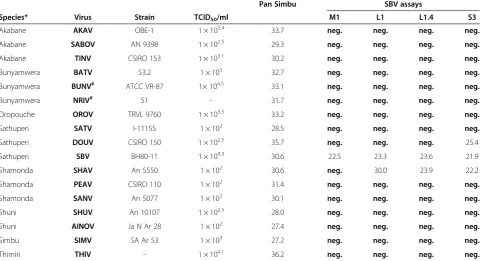
As a first step, from our perspective pivotal members of the Simbu serogroup (Aino virus AINOV, Akabane virus AKAV, Douglas virus DOUV, Oropouche virus OROV, Peaton virus PEAV, Sabo virus SABOV, Sango virus SANV, Sathuperi virus SATV, Shamonda virus SHAV, Shuni virus SHUV, Simbu virus SIMV, Thimiri virus THIV, Tinaroo virus TINV; see Table 1 for species classification) including
SBV and three members of the Bunyamwera serogroup (Batai virus BATV, Bunyamwera virus BUNV, Ngari virus NRIV) were tested to define the detection spectrum of the intercalating dye based pan-Simbu real-time RT-PCR sys-tem and the TaqMan probe-based SBV real-time RT-PCR assays (Table 1). Although the applied virus titers were par-tially low (1 × 10², 1 × 102.5or 1 × 10350% tissue culture in-fectious doses (TCID50) per ml), the pan-Simbu real-time
RT-PCR system detected all tested isolates of the Simbu serogroup. DOUV however was recognized with a high quantification cycle (Cq) value of 35.7 presumably caused
by mismatches in the binding region of the forward primer (Figure 1). Also the detection of THIV seems problematic, yielding the highest Cq-value (36.2) in this investigation.
To further characterize the pan-Simbu real-time RT-PCR system the limit of detection and the PCR efficiency were determined using an SBV L-segment standard. The assay reliably detected 100 copies per reaction and displayed an efficiency of 91.6%.
The potential of a subsequent species classification via sequencing was investigated for AINOV, DOUV, PEAV, SABOV, SANV, SATV, SHAV, SHUV and SIMV. Each sequence fragment displayed 100% sequence identity with the respective Simbu serogroup virus in GenBank, whereas 60-88% sequence identity was determined among the amp-lified products, facilitating a reliable differentiation.In silico
analyses indicated that this pan-Simbu system is probably able to detect also members from other serogroups, e.g. several members of the California serogroup: Tahyna-, Chatanga-, La Crosse-, Jamestown Canyon-, Snowshoe hare- and Inkoo virus [11] (Figure 1). This assumption was supported by detection of the Bunyamwera serogroup vi-ruses BATV, BUNV and NRIV (Table 1). However, it can-not be excluded that some untested members could be only poorly or not detected at all. Previously published real-time RT-PCR systems are available e.g. for the specific detection of OROV [12] as well as for the simultaneous de-tection of AKAV and AINOV [13], but to our knowledge this pan-Simbu PCR is the first generic real-time PCR ap-proach for the detection of orthobunyaviruses, predomin-antly members of the Simbu serogroup.
The different Simbu serogroup viruses and the three Bunyamwera serogroup viruses were also analyzed with SBV-specific real-time RT-PCR assays. With this approach, only the SBV-M1 assay scored negative for the Bunyam-wera serogroup viruses and for all Simbu serogroup vi-ruses, with the exception of SBV (Table 1). This assay seemed to be highly specific for SBV. In addition to SBV, the SBV-L1 and the SBV-L1.4 assays also recognized RNA from a SHAV (species Shamonda virus, reassortant com-prising the SBV S- and L-segments and the M-segment from an unclassified virus [7]) sample. Compared to each other, these assays displayed markedly different Cq-values
in the primer binding capability caused by a slight adjust-ment of the detection region for the SBV-L1.4 assay. The SBV-S3 assay was able to detect RNA from SBV, SHAV and DOUV (species Sathuperi virus; see Table 1 for spe-cies classification). In this case, the detection region of the
SBV-S3 assay on the S-segment is highly similar between SBV and the reassortant SHAV and further seems to be ra-ther similar between the two members of the Sathuperi virusspecies SBV and DOUV which consequently enables their recognition.
Table 1 PCR analysis of Simbu serogroup viruses and Bunyamwera serogroup viruses
Pan Simbu SBV assays
Species* Virus Strain TCID50/ml M1 L1 L1.4 S3
Akabane AKAV OBE-1 1 × 105.4 33.7 neg. neg. neg. neg.
Akabane SABOV AN 9398 1 × 102.5 29.3 neg. neg. neg. neg.
Akabane TINV CSIRO 153 1 × 103.1 30.2 neg. neg. neg. neg.
Bunyamwera BATV 53.2 1 × 10⁵ 32.7 neg. neg. neg. neg.
Bunyamwera BUNV# ATCC VR-87 1× 104.5 33.1 neg. neg. neg. neg.
Bunyamwera NRIV# 51 - 31.7 neg. neg. neg. neg.
Oropouche OROV TRVL 9760 1 × 103.5 33.2 neg. neg. neg. neg.
Sathuperi SATV l-11155 1 × 10² 28.5 neg. neg. neg. neg.
Sathuperi DOUV CSIRO 150 1 × 102.5 35.7 neg. neg. neg. 25.4
Sathuperi SBV BH80-11 1 × 104.3 30.6 22.5 23.3 23.6 21.9
Shamonda SHAV An 5550 1 × 10² 30.6 neg. 30.0 23.9 22.2
Shamonda PEAV CSIRO 110 1 × 10² 31.4 neg. neg. neg. neg.
Shamonda SANV An 5077 1 × 10³ 30.1 neg. neg. neg. neg.
Shuni SHUV An 10107 1 × 102.5 28.0 neg. neg. neg. neg.
Shuni AINOV Ja N Ar 28 1 × 10² 27.4 neg. neg. neg. neg.
Simbu SIMV SA Ar 53 1 × 10³ 27.2 neg. neg. neg. neg.
Thimiri THIV - 1 × 104.1 36.2 neg. neg. neg. neg.
neg.:negative result; -: not available; pan Simbu: pan-Simbu real-time RT-PCR system; TCID50: 50% tissue culture infectious doses; M1: highly specific SBV-M1 assay; L1:
SBV-L1 assay, L1.4: SBV-L1.4 assay; S3: SBV-S3 assay; *species classification according to [10], SBV [7];#
1:100 dilution of original RNA; columns 5–9 represent mean Cq-values from duplicates.
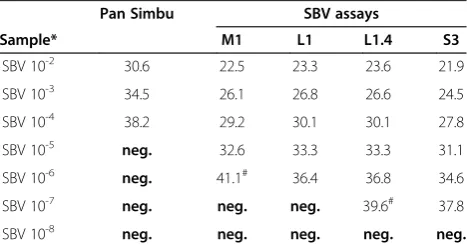
To evaluate the sensitivity of the different assays a log10 dilution series (10-2to 10-8dilution) of SBV-RNA
extracted from a cell culture sample (BH80/11-4, initial titer 1 × 106.3TCID50/ml) was tested (Table 2). The
max-imum detection rate of the pan-Simbu real-time RT-PCR system was seen at the 10-4dilution; due to recognition up to this dilution step, the system seems sufficient for a pre-liminary screening of undiluted field samples of good qual-ity. The SBV-S3 assay provided the best performance with a reliable recognition (detection of duplicate samples) of every dilution step up to the 10-7 dilution in combination with the lowest Cq-values compared to the other assays.
Furthermore, the SBV-L1 and SBV-L1.4 assays displayed comparable Cq-values for the dilution series with a reliable
detection up to a dilution of 10-6. The specific SBV-M1 assay allowed a positive detection up to the dilution step 10-5. Despite its lower sensitivity, the SBV-M1 assay is a valuable tool for distinguishing SBV from other orthobu-nyaviruses to yield a precise diagnosis in regions where multiple orthobunyaviruses occur.
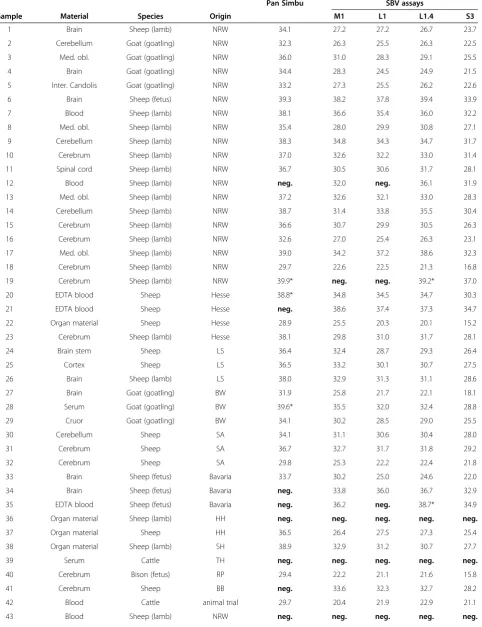
In addition to the sensitivity analysis, the pan-Simbu real-time RT-PCR system, the SBV-M1, the SBV-L1, the SBV-L1.4 and the SBV-S3 assays were tested using 47 RNA samples from SBV-suspicious field material as well as a defined sample from an SBV challenge experiment [1] (Table 3). In this approach, the SBV-S3 assay showed the lowest Cq-values among the tested assays and
recog-nized 40 positive samples, while eight isolates scored negative (pre-tested as negative by SBV-L1 assay).
The pan-Simbu real-time RT-PCR system detected 32 positive samples out of the 40 SBV-S3-positive samples. Three samples which had Cq-values above 28 using the
SBV-S3 assay scored doubtful with only one positive du-plicate using the pan-Simbu real-time RT-PCR system. Eight samples defined as SBV-negative with the SBV-S3 assay, and additional five samples with a genome load of
Cq-values >28 using the SBV-S3 assay, scored negative
in the pan-Simbu real-time RT-PCR system. In general, the pan-Simbu real-time RT-PCR system produced higher Cq-values than the SBV-specific assays (Table 3).
Therefore, the sensitivity of the pan-Simbu system pre-sumably was not sufficient for samples containing a low viral genome load. Nevertheless, the pan-Simbu real-time RT-PCR system was able to detect field samples with Cq
-values below 28 reliably measured by the SBV-S3 assay as well as the animal trial sample (Table 3).
Furthermore, the SBV-M1 assay revealed 39 positive and nine negative samples (Table 3). One SBV-S3 positive sample (Cq37) scored negative, presumably due to the
re-duced sensitivity of the SBV-M1 assay. The SBV-L1 assay detected 37 positive and eleven negative samples. Three samples tested positive with Cq-values >31 in the SBV-S3
assay scored negative. The SBV-L1.4 assay yielded com-parable Cq-values to the SBV-L1 assay, but recognized 38
positive samples, and two doubtful results (SBV-S3 Cq
-values >34) with only one positive duplicate displaying a Cq-value higher than 38. Eight isolates scored negative (in concordance with SBV-S3) with both SBV-L assays.
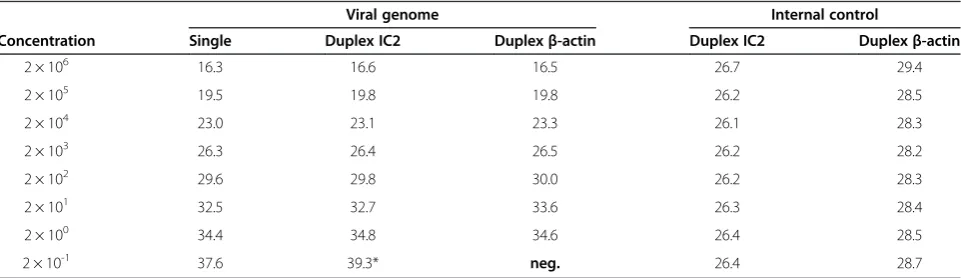
Finally, the analytical sensitivity of the SBV-S3 single-target assay in comparison to two different SBV-S3 du-plex assays including internal amplification controls was evaluated (Table 4). The single-target assay detected a dilution of 2 × 10⁻¹copies/μl, which corresponded to one RNA copy per reaction. Both duplex assays were able to detect at most 2 × 100copies/μl (10 copies per reaction), while simultaneous co-amplification of either IC2-RNA (~Cq 26) or the housekeeping gene beta-actin (~Cq29)
was performed reliably.
Conclusion
In conclusion, the pan-Simbu real-time RT-PCR system was able to detect all tested members of the Simbu ser-ogroup as well as most of the SBV field samples and three Bunyamwera serogroup viruses with an acceptable sensitivity for screening diagnostics. Although we were not able to test all 25 members of the Simbu serogroup, we investigated key-members with clinical or economic importance like OROV and AKAV [6]. According to in silico analyses the system seems to be able to detect a broad spectrum of orthobunyaviruses (Figure 1) as sup-ported by detection of members from the Bunyamwera serogroup (Table 1). The pan-Simbu real-time RT-PCR system is based on two highly conserved sequence re-gions of the L-segment which were selected as primer binding sites. As an additional feature of the novel sys-tem, these primers enclosed a variable sequence region, which is suitable for subsequent species classification via sequencing, avoiding misdiagnosis. This opportunity was confirmed exemplarily for AINOV, DOUV, PEAV, SABOV, SANV, SATV, SHAV, SHUV and SIMV. The here Table 2 Evaluation of the sensitivity of the individual
assays using an SBV-RNA dilution series
Pan Simbu SBV assays
Sample* M1 L1 L1.4 S3
SBV 10-2 30.6 22.5 23.3 23.6 21.9
*log10 dilution series of SBV RNA extracted from cell culture sample BH80/11-4 (KC/BHK), initial titer 1× 106.3
TCID50/ml;#
Table 3 Comparison of pan-Simbu real-time RT-PCR and SBV diagnostic PCRs using field samples
Pan Simbu SBV assays
Sample Material Species Origin M1 L1 L1.4 S3
1 Brain Sheep (lamb) NRW 34.1 27.2 27.2 26.7 23.7
2 Cerebellum Goat (goatling) NRW 32.3 26.3 25.5 26.3 22.5
3 Med. obl. Goat (goatling) NRW 36.0 31.0 28.3 29.1 25.5
4 Brain Goat (goatling) NRW 34.4 28.3 24.5 24.9 21.5
5 Inter. Candolis Goat (goatling) NRW 33.2 27.3 25.5 26.2 22.6
6 Brain Sheep (fetus) NRW 39.3 38.2 37.8 39.4 33.9
7 Blood Sheep (lamb) NRW 38.1 36.6 35.4 36.0 32.2
8 Med. obl. Sheep (lamb) NRW 35.4 28.0 29.9 30.8 27.1
9 Cerebellum Sheep (lamb) NRW 38.3 34.8 34.3 34.7 31.7
10 Cerebrum Sheep (lamb) NRW 37.0 32.6 32.2 33.0 31.4
11 Spinal cord Sheep (lamb) NRW 36.7 30.5 30.6 31.7 28.1
12 Blood Sheep (lamb) NRW neg. 32.0 neg. 36.1 31.9
13 Med. obl. Sheep (lamb) NRW 37.2 32.6 32.1 33.0 28.3
14 Cerebellum Sheep (lamb) NRW 38.7 31.4 33.8 35.5 30.4
15 Cerebrum Sheep (lamb) NRW 36.6 30.7 29.9 30.5 26.3
16 Cerebrum Sheep (lamb) NRW 32.6 27.0 25.4 26.3 23.1
17 Med. obl. Sheep (lamb) NRW 39.0 34.2 37.2 38.6 32.3
18 Cerebrum Sheep (lamb) NRW 29.7 22.6 22.5 21.3 16.8
19 Cerebrum Sheep (lamb) NRW 39.9* neg. neg. 39.2* 37.0
20 EDTA blood Sheep Hesse 38.8* 34.8 34.5 34.7 30.3
21 EDTA blood Sheep Hesse neg. 38.6 37.4 37.3 34.7
22 Organ material Sheep Hesse 28.9 25.5 20.3 20.1 15.2
23 Cerebrum Sheep (lamb) Hesse 38.1 29.8 31.0 31.7 28.1
24 Brain stem Sheep LS 36.4 32.4 28.7 29.3 26.4
25 Cortex Sheep LS 36.5 33.2 30.1 30.7 27.5
26 Brain Sheep (lamb) LS 38.0 32.9 31.3 31.1 28.6
27 Brain Goat (goatling) BW 31.9 25.8 21.7 22.1 18.1
28 Serum Goat (goatling) BW 39.6* 35.5 32.0 32.4 28.8
29 Cruor Goat (goatling) BW 34.1 30.2 28.5 29.0 25.5
30 Cerebellum Sheep SA 34.1 31.1 30.6 30.4 28.0
31 Cerebrum Sheep SA 36.7 32.7 31.7 31.8 29.2
32 Cerebrum Sheep SA 29.8 25.3 22.2 22.4 21.8
33 Brain Sheep (fetus) Bavaria 33.7 30.2 25.0 24.6 22.0
34 Brain Sheep (fetus) Bavaria neg. 33.8 36.0 36.7 32.9
35 EDTA blood Sheep (fetus) Bavaria neg. 36.2 neg. 38.7* 34.9
36 Organ material Sheep (lamb) HH neg. neg. neg. neg. neg.
37 Organ material Sheep HH 36.5 26.4 27.5 27.3 25.4
38 Organ material Sheep (lamb) SH 38.9 32.9 31.2 30.7 27.7
39 Serum Cattle TH neg. neg. neg. neg. neg.
40 Cerebrum Bison (fetus) RP 29.4 22.2 21.1 21.6 15.8
41 Cerebrum Sheep BB neg. 33.6 32.3 32.7 28.2
42 Blood Cattle animal trial 29.7 20.4 21.9 22.9 21.1
described pan-Simbu PCR system is therefore the first available tool for a broad screening of samples predomin-antly for Simbu serogroup virus genomes and could also allow the identification of related orthobunyaviruses in mammalian but also insect vector samples.
For the specific detection of SBV-genome, the SBV-S3 assay turned out to be the most suitable system with the highest sensitivity and reliability. The analytical sensitiv-ity of the SBV-S3 single-target assay as well as the two duplex assays including an internal amplification control (IC2-RNA, beta-actin respectively) were determined as one copy per reaction performing the single-target assay and ten copies per reaction using both duplex systems. Furthermore, the SBV-S3 assay was also able to detect the highly related Sathuperi virusspecies member DOUV as well as the reassortant SHAV apart from SBV.
Methods
Samples and RNA isolation
Viral RNA from field samples, from blood of an experi-mentally infected calf [1] (Table 3) as well as from cell culture material of the Simbu serogroup viruses namely AINOV, AKAV, DOUV, OROV, PEAV, SABOV, SANV, SATV, SHAV, SHUV, SIMV, THIV, TINV [6] and from the Bunyamwera serogroup viruses BATV [14], BUNV, NRIV was extracted manually using the QIAmp Viral RNA Mini
Kit (Qiagen, Hilden, Germany) according to the manufac-turer’s instructions or using the MagNA Pure LC 2.0 in combination with the MagNA Pure LC Total Nucleic Acid Isolation Kit (Roche Diagnostics, Mannheim, Germany) ac-cording to the manufacturer’s recommendations. All sam-ples were stored at−20°C until use.
Oligonucleotides and primer design
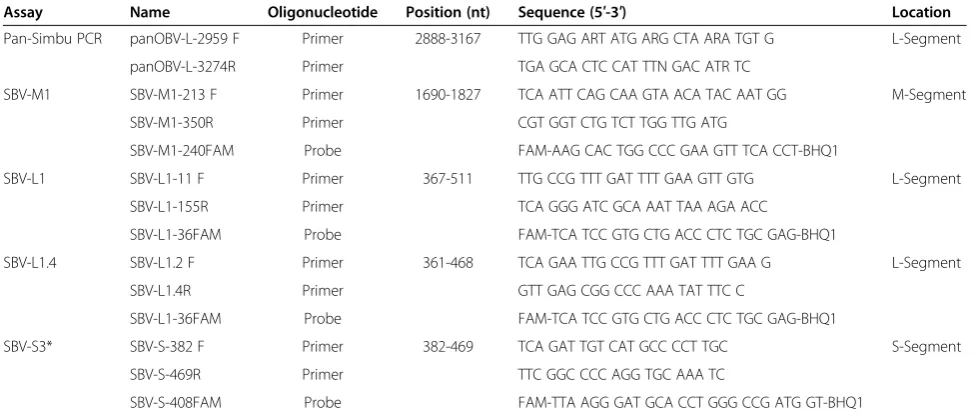
The sequences of primers and probes are listed in Table 5. For the pan-Simbu assay, primers were selected by analyzing the consensus sequence of the L-segment of 70 orthobunyaviruses available in GenBank. The locations of the primers and potential mismatches with the L-segment of different orthobunyaviruses are depicted in Figure 1.
The selection of primers and probes of the SBV real-time RT-PCR assays was based on the first available se-quence data of the SBV isolate BH80/11-4 [1] and was supported by the software package Beacon Designer 7.0 (PremierBiosoft, Palo Alto, USA).
All oligonucleotides were synthesized by metabion (metabion international AG, Martinsried, Germany) and stored at−20°C until use.
Pan-Simbu real-time RT-PCR
In order to allow a broad detection of members of the Simbu serogroup a pan-Simbu real-time RT-PCR was
Table 3 Comparison of pan-Simbu real-time RT-PCR and SBV diagnostic PCRs using field samples(Continued)
44 Med. obl. Sheep (lamb) NRW neg. neg. neg. neg. neg.
45 Cerebellum Sheep (lamb) NRW neg. neg. neg. neg. neg.
46 Cerebrum Sheep (lamb) NRW neg. neg. neg. neg. neg.
47 Spleen Sheep (lamb) NRW neg. neg. neg. neg. neg.
48 Muscle Sheep (lamb) NRW neg. neg. neg. neg. neg.
med. obl.: medulla oblongata; organ material consists of cerebrum, cerebellum, spleen; LS: Lower Saxony; NRW: North Rhine-Westphalia; SH: Schleswig-Holstein; TH: Thuringia; RP: Rhineland-Palatinate; BW: Baden-Württemberg; HH: Hamburg; BB: Brandenburg; SA: Saxony-Anhalt; * only one of the duplicates positive;neg.: negative result; pan Simbu: pan-Simbu real-time RT-PCR system; M1: SBV-M1 assay; L1: SBV-L1 assay, L1.4: SBV-L1.4 assay; S3: SBV-S3 assay; columns 5–9 represent mean Cq-values from duplicates.
Table 4 Evaluation of the analytical sensitivity of the SBV-S3 assay using an SBV-S3 standard
Viral genome Internal control
Concentration Single Duplex IC2 Duplexβ-actin Duplex IC2 Duplexβ-actin
2 × 10⁶ 16.3 16.6 16.5 26.7 29.4
2 × 10⁵ 19.5 19.8 19.8 26.2 28.5
2 × 10⁴ 23.0 23.1 23.3 26.1 28.3
2 × 10³ 26.3 26.4 26.5 26.2 28.2
2 × 10² 29.6 29.8 30.0 26.2 28.3
2 × 101 32.5 32.7 33.6 26.3 28.4
2 × 100 34.4 34.8 34.6 26.4 28.5
2 × 10⁻¹ 37.6 39.3* neg. 26.4 28.7
developed using the OneStep RT-PCR Kit (Qiagen, Hilden, Germany). The assay was optimized using a total reaction volume of 25 μl. For one reaction 8 μl RNase-free water, 5μl 5x OneStep RT-PCR Buffer, 1μl OneStep RT-PCR En-zyme Mix, 1μl dNTP Mix (10 mM each), 1μl ResoLight Dye (Roche, Mannheim, Germany), 2 μl of each primer
(panOBV-L-2959 F, panOBV-L-3274R; 10 μM each;
Table 5) and 5 μl RNA template or RNase free water for the no template control (NTC) was used. The following thermal program was applied 1 cycle of 50°C for 30 min and 95°C for 15 min, followed by 40 cycles of 95°C for 30 s, 55°C for 30 s, 72°C for 30 s and 78°C for 15 s. The collection of the fluorescence data was performed during the 78°C elongation step.
PCR efficiency and limit of detection for pan-Simbu real-time RT-PCR
The PCR efficiency and the limit of detection for the pan-Simbu real-time RT-PCR were determined using an SBV L-segment plasmid (L-segment sequence according to GenBank: HE649912 in X8δT backbone). The exact number of plasmid molecules was calculated (http:// www.molbiol.edu.ru/eng/scripts/01_07.html) and a log10
dilution series (2 × 10⁶to 2 × 10⁻¹copies/μl) was prepared. This dilution series was tested with the pan-Simbu real-time RT-PCR in four replicates. PCR efficiency was calculated by the CFX manager software 3.0 (Bio-Rad Laboratories Inc., Hercules, USA).
Sequencing of pan-Simbu real-time RT-PCR products For species classification of members of the Simbu ser-ogroup (i.e. AINOV, DOUV, PEAV, SABOV, SANV, SATV,
SHAV, SHUV and SIMV) obtained PCR products of the pan-Simbu real-time RT-PCR were analyzed on a 1.5% agarose gel and purified using the QIAquick Gel Extraction Kit (Qiagen, Hilden, Germany) according to the man-ufacturer’s instructions. Direct sequencing was carried out in both directions by termination cycle sequencing using the Big Dye Terminator Mix 1.1 (Applied Biosystems, Carlsbad, USA) with the same primers used for PCR prod-uct amplification. The assay was optimized by using a total reaction volume of 10 μl. Briefly, for one reaction 1 μl RNase-free water, 1 μl of 5x Sequencing Buffer, 2 μl Big Dye Terminator Mix 1.1 and 1μl of the according primer (5μM). The following thermal program was applied 1 cycle of 96°C for 1 min followed by 26 cycles of 95°C for 15 s, 53°C for 10 s, and 60°C for 4 min. After that, cycle se-quencing products were purified with DyeEx 2.0 Spin Kit (Qiagen, Hilden, Germany). The nucleotide sequences were resolved in an ABI 3130 Genetic Analyzer (Applied Biosystems, Carlsbad, USA). Sequences were aligned and analyzed in BioEdit [15] (version 7.1.7).
SBV-specific real-time RT-PCR assays
For detection of SBV-RNA several diagnostic assays (named SBV-M1, SBV-L1, SBV-L1.4 and SBV-S3) were tested using the AgPath-ID™ One-Step RT-PCR Kit (Applied Biosystems, Carlsbad, USA). The assays were optimized using a total reaction volume of 25μl. Briefly, for one single reaction 4.5μl RNase-free water, 12.5μl 2× RT-PCR buffer, 1μl 25× RT-PCR enzyme mix, 5μl RNA template or RNase free water for the no template con-trol (NTC) and 2 μl of the according primer-probe mix (Table 5) were combined. Based on stock solutions of the Table 5 Oligonucleotides used in this study
Assay Name Oligonucleotide Position (nt) Sequence (5′-3′) Location
Pan-Simbu PCR panOBV-L-2959 F Primer 2888-3167 TTG GAG ART ATG ARG CTA ARA TGT G L-Segment
panOBV-L-3274R Primer TGA GCA CTC CAT TTN GAC ATR TC
SBV-M1 SBV-M1-213 F Primer 1690-1827 TCA ATT CAG CAA GTA ACA TAC AAT GG M-Segment
SBV-M1-350R Primer CGT GGT CTG TCT TGG TTG ATG
SBV-M1-240FAM Probe FAM-AAG CAC TGG CCC GAA GTT TCA CCT-BHQ1
SBV-L1 SBV-L1-11 F Primer 367-511 TTG CCG TTT GAT TTT GAA GTT GTG L-Segment
SBV-L1-155R Primer TCA GGG ATC GCA AAT TAA AGA ACC
SBV-L1-36FAM Probe FAM-TCA TCC GTG CTG ACC CTC TGC GAG-BHQ1
SBV-L1.4 SBV-L1.2 F Primer 361-468 TCA GAA TTG CCG TTT GAT TTT GAA G L-Segment
SBV-L1.4R Primer GTT GAG CGG CCC AAA TAT TTC C
SBV-L1-36FAM Probe FAM-TCA TCC GTG CTG ACC CTC TGC GAG-BHQ1
SBV-S3* SBV-S-382 F Primer 382-469 TCA GAT TGT CAT GCC CCT TGC S-Segment
SBV-S-469R Primer TTC GGC CCC AGG TGC AAA TC
SBV-S-408FAM Probe FAM-TTA AGG GAT GCA CCT GGG CCG ATG GT-BHQ1
primer and probes of 100 pmol/μl (100μM), the different primer-probe mixes were created. For each assay 20μl of the relevant forward and reverse primer, 3.75 μl of the 6-carboxyfluorescein (FAM) labeled probe were mixed in 156.25 μl 0.1× Tris-EDTA (TE) buffer. Thus, a final concentration of 10 μM for each primer and 1.88 μM for each probe was used. The following thermal program was applied: 1 cycle of 45°C for 10 min and 95°C for 10 min, followed by 45 cycles of 95°C for 15 s, 56°C for 20 s, and 72°C for 30 s.
Generation of a SBV-S3 PCR standard and identification of the analytical sensitivity
In order to determine the analytical sensitivity of the SBV-S3 assay, an SBV-S3 standard was generated. There-fore, the gel-purified SBV-S3 PCR fragment was li-gated into the vector pGEM-Teasy (Promega, Mannheim, Germany). Plasmids were amplified in Escherichia coli
DH10B (Invitrogen, Carlsbad, USA) and purified by Qiagen Plasmid Mini and Midi Kits (Qiagen, Hilden, Germany) according to standard protocols. The identity of the plasmids was confirmed byEcoRI-digestion and se-quencing. Linearized and purified plasmid DNA was
in vitrotranscribed with the RiboMAX Large Scale RNA Production Systems (Promega, Mannheim, Germany) and subsequently a DNase I digestion was performed using the SP6/T7 Transcription Kit (Roche Diagnostics, Mannheim, Germany) according to the manufacturer’s instructions. During purification of thein vitrotranscribed RNA using the RNeasy Kit (Qiagen, Hilden, Germany) a second on-column DNase I digestion according to the manufacturer’s recommendations was implemented. The exact number of RNA molecules was calculated as described [16] and a log10dilution series (2 × 10⁶to 2 × 10⁻¹copies/μl) was
pre-pared. RNA was stored until use at−20°C. The analytical sensitivity was evaluated for the SBV-S3 single-target assay, for a SBV-S3 duplex assay with a universal internal control (IC) system according to [17] based on heterol-ogous RNA and for a second SBV-S3 duplex system using the co-amplification of the housekeeping gene beta-actin as internal control [18].
All real-time PCR reactions were carried out in Bio-Rad 96-well PCR plates using a CFX96 quantitative PCR system (Bio-Rad Laboratories Inc., Hercules, USA). All these analyses were performed as technical duplicates and the quantification cycle (Cq) values listed in the
ta-bles represent the mean Cq-value. In all experiments a
qualified number of controls, namely no template con-trols (NTC), internal concon-trols (IC) and positive concon-trols (PC), were co-amplified.
Abbreviations
AINOV:Aino virus; AKAV: Akabane virus; BATV: Batai virus; BUNV: Bunyamwera virus; DOUV: Douglas virus; NRIV: Ngari virus; OROV: Oropouche virus; PEAV: Peaton virus; SABOV: Sabo virus; SANV: Sango virus; SATV: Sathuperi
virus; SBV: Schmallenberg virus; SHAV: Shamonda virus; SHUV: Shuni virus; SIMV: Simbu virus; THIV: Thimiri virus; TINV: Tinaroo virus; NTC: No template control; IC: Internal control; PC: Positive control; Cq: Quantification cycle;
RT-PCR: Reverse transcriptase polymerase chain reaction.
Competing interests
The authors declare that they have no competing interests.
Authors’contributions
MF BH designed the study. MF performed the laboratory experiments and analyzed the data. MF BH KW MB wrote the manuscript. HS, KW performed the cell culture and titer determination. AW constructed the SBV-S3 standard. MF HS KW AW BH MB contributed to final the manuscript preparation. All authors read and approved the final manuscript.
Acknowledgements
We thank Christian Korthase, Anja Landmesser, Karin Lissek and Patrick Zitzow for excellent technical assistance as well as Dr. Dirk Höper and Dr. Katja Goller for providing sequence information. Simbu serogroup viruses were kindly provided by Prof. Robert B. Tesh (University of Texas, Galveston, USA) and Dr. Peter Kirkland (Elizabeth Macarthur Agriculture Institute, New South Wales, Australia). BATV was kindly provided by Dr. Jonas Schmidt-Chanasit (Bernhard Nocht Institute for Tropical Medicine, Hamburg, Germany). BUNV and NRIV RNA was kindly provided by Dr. Martin Eiden. The SBV L-segment plasmid was kindly provided by Dr. Ilona Reimann. This work was supported by the European Union FP7 project“European Management Platform for Emerging and Re-emerging Infectious Disease Entities (EMPERIE; no. 223498)”.
Received: 28 August 2013 Accepted: 29 October 2013 Published: 5 November 2013
References
1. Hoffmann B, Scheuch M, Höper D, Jungblut R, Holsteg M, Schirrmeier H, Eschbaumer M, Goller KV, Wernike K, Fischer M, Breithaupt A, Mettenleiter TC, Beer M:Novel orthobunyavirus in cattle, europe, 2011.Emerg Infect Dis2012, 18(3):469–472.
2. Beer M, Conraths FJ, van der Poel WHM:‘Schmallenberg virus’- a novel orthobunyavirus emerging in Europe.Epidemiol Infect2012,141(1):1–8. 3. Bishop DH, Calisher CH, Casals J, Chumakov MP, Gaidamovich SY, Hannoun C,
Lvov DK, Marshall ID, Oker-Blom N, Pettersson RF, Porterfield JS, Russell PK, Shope RE, Westaway EG:Bunyaviridae.Intervirology1980,14(3–4):125–143. 4. Walter CT, Barr JN:Recent advances in the molecular and cellular biology
of bunyaviruses.J Gen Virol2011,92(Pt 11):2467–2484.
5. Chowdhary R, Street C, Travassos Da-Rosa A, Nunes M, Tee KK, Hutchison SK, Vasconcelos PF, Tesh RB, Lipkin WI, Briese T:Genetic characterization of the Wyeomyia group of orthobunyaviruses and their phylogenetic relationships.
J Gen Virol2012,93(Pt 5):1023–1034.
6. Saeed MF, Li L, Wang H, Weaver SC, Barrett ADT:Phylogeny of the Simbu serogroup of the genus Bunyavirus.J Gen Virol2001,82(Pt 9):2173–2181. 7. Goller KV, Höper D, Schirrmeier H, Mettenleiter TC, Beer M:Schmallenberg
virus as possible ancestor of Shamonda virus.Emerg Infect Dis2012, 18(10):1644–1646.
8. Kohl A, Bridgen A, Dunn E, Barr JN, Elliott RM:Effects of a point mutation in the 3′end of the S genome segment of naturally occurring and engineered Bunyamwera viruses.J Gen Virol2003,84(Pt 4):789–793. 9. Bilk S, Schulze C, Fischer M, Beer M, Hlinak A, Hoffmann B:Organ
distribution of Schmallenberg virus RNA in malformed newborns.
Vet Microbiol2012,159(1–2):236–238.
10. Elliott RM, Blakqori G:Molecular biology of orthobunyaviruses.In
Bunyaviridae.Edited by Plyusnin A, Elliott RM. Norfolk: Caister Academic
Press; 2011:1–39.
11. Bowen MD, Jackson AO, Bruns TD, Hacker DL, Hardy JL:Determination and comparative analysis of the small RNA genomic sequences of California encephalitis, Jamestown Canyon, Jerry Slough, Melao, Keystone and Trivittatus viruses (Bunyaviridae, genus Bunyavirus, California serogroup).
J Gen Virol1995,76(Pt 3):559–572.
13. Stram Y, Kuznetzova L, Guini M, Rogel A, Meirom R, Chai D, Yadin H, Brenner J:Detection and quantitation of akabane and aino viruses by multiplex real-time reverse-transcriptase PCR.J Virol Methods2004, 116(2):147–154.
14. Dunn EF, Pritlove DC, Elliott RM:The S RNA genome segments of Batai, Cache Valley, Guaroa, Kairi, Lumbo, Main Drain and Northway bunyaviruses: sequence determination and analysis.J Gen Virol1994,75(Pt 3):597–608. 15. Hall TA:BioEdit: a user-friendly biological sequence alignment editor and
analysis program for Windows 95/98/NT.Nucl Acids Symp Ser1999, 41:95–98.
16. Hoffmann B, Beer M, Schelp C, Schirrmeier H, Depner K:Validation of a real-time RT-PCR assay for sensitive and specific detection of classical swine fever.J Virol Methods2005,130(1–2):36–44.
17. Hoffmann B, Depner K, Schirrmeier H, Beer M:A universal heterologous internal control system for duplex real-time RT-PCR assays used in a detection system for pestiviruses.J Virol Methods2006,136(1–2):200–209. 18. Toussaint JF, Sailleau C, Breard E, Zientara S, De Clercq K:Bluetongue virus
detection by two real-time RT-qPCRs targeting two different genomic segments.J Virol Methods2007,140(1–2):115–123.
doi:10.1186/1743-422X-10-327
Cite this article as:Fischeret al.:Development of a pan-Simbu real-time
reverse transcriptase PCR for the detection of Simbu serogroup viruses and comparison with SBV diagnostic PCR systems.Virology Journal
201310:327.
Submit your next manuscript to BioMed Central and take full advantage of:
• Convenient online submission
• Thorough peer review
• No space constraints or color figure charges
• Immediate publication on acceptance
• Inclusion in PubMed, CAS, Scopus and Google Scholar
• Research which is freely available for redistribution