NOTE
Ihak Sumardi · Kazuhiro Ono · Shigehiko Suzuki
Effect of board density and layer structure on the mechanical properties of
bamboo oriented strandboard
Abstract This study examined the effects of density and layer structure on the mechanical properties and dimen-sional stability of strandboard manufactured from moso bamboo (Phyllostachys pubescens). The strandboard was fabricated in a laboratory at fi ve densities and three differ-ent structures including a randomly oridiffer-ented homogenous board, a unidirectionally oriented homogenous board, and a three-layered board with a cross-oriented core layer (BOSB). Bamboo strand alignment distribution could be predicted using the von Mises distribution function. Bending proper-ties increased with increasing density and were affected by layer structure. The modulus of rupture (MOR) of the three-layered board in the parallel direction increased remarkably compared with the random board MOR; in the perpendicu-lar direction, it exhibited less strength reduction. Elastic properties of the three-layered board could be predicted us-ing elastic constants of the unidirectional board. Internal bond strength (IB) was greatly affected by density, but the layer structure effect did not appear in IB. Linear expansion per unit moisture change ranged from 0.017 to 0.022 for random and three-layered boards; these values are compa-rable with or lower than values for commercial board.
Key words Bamboo · Density · Dimensional stability · Mechanical properties · Oriented strandboard
Introduction
Bamboo has been widely used in Asian countries as a tra-ditional material for housing construction, furniture manu-facture, and articles for daily life such as fans, chopsticks,
I. Sumardi · S. Suzuki (*)
Wood Science Laboratory, Faculty of Agriculture, Shizuoka University, 836 Ohya, Shizuoka 422-8529, Japan
Tel. +81-54-238-4854; Fax +81-54-237-3128 e-mail: [email protected]
K. Ono
Shizuoka Prefecture Forestry and Forest Products Research Institute, Shizuoka 430-0016, Japan
and baskets owing to its high strength and surface hardness, superior fl exibility, and stable properties.1
Bamboo is also a fast-growing and nonwoody lignocellulosic material that has been shown to exhibit equal or better physical and me-chanical properties in comparison with some commercial wood species.1
It has gained increasing interest in recent years as an alternative material to wood or wood-based materials, and can be used as a raw material for wood-based panel products.
Several articles have reported using bamboo in various composite panels; Chen2 studied the use of bamboo ply-wood as a structural material, and Nugroho and Ando3 fabricated a new product called zephyr board. Studies have evaluated the dimensional stability of bamboo particle-board4,5 and the manufacturing technology for bamboo fi berboard and medium-density fi berboard (MDF).6–8
Re-searchers have also manufactured other panel composites such as bamboo-based waferboard9
and oriented strand-board (OSB)10 to examine their properties. Although many studies have examined bamboo-based panel products, few have been conducted to evaluate the properties of OSB made from bamboo. Lee at al.10
reported that bamboo strandboard showed values of internal bond strength (IB), modulus of elasticity (MOE), and modulus of rupture (MOR) in both the parallel and perpendicular directions that were higher than the standards proposed for commer-cial OSB and waferboards.
In contrast, many studies have focused on improving the physical and mechanical properties of wood OSB and on utilizing new species as raw materials for commercial pro-duction. Wood OSB studies have mainly focused on param-eters such as board density and mechanical properties,11,12 layer structure,12–14
strand length,15,16
and linear expansion.17 Understanding these basic properties is important when discussing the potential use of bamboo as a raw material for OSB manufacturing.
The objective of this study was to determine the effects of density and layer structure on the mechanical properties and dimensional stability of bamboo strandboard; to this end, bamboo strandboard was fabricated in a laboratory at various densities and layer structures.
Materials and methods
Strand preparation
Strands were prepared from moso bamboo (Phyllostachys
pubescens) collected from a bamboo forest near the city of
Tenryu in the western region of Shizuoka Prefecture, Japan. The density of bamboo used as raw material was approxi-mately 0.60 g/cm3. Each bamboo pole was cut from its base to a height of approximately 8 m, and was stranded in a local strandboard mill using a disk-type fl aker. Target strand di-mensions were 50 mm long, 0.5 mm thick, and 5–20 mm wide. The actual dimensions, determined by using 100 piec-es of strand, were 47 mm long, 0.45 mm thick, and 7.3 mm wide. Strands were screened on a 10-mesh sieve before be-ing dried in a 60°C rotary oven to a moisture content of less than 3%.
Board fabrication
Strandboards were manufactured using a commercial liquid phenolic resin with 51% solid content to the nominal di-mensions of 400 × 400 × 12 mm. No waxes or other additives were applied. Hand-formed mats were pressed for 10 min at a temperature of 180°C; the maximum pressure applied was 8 MPa. No surface sanding was performed. A 6% resin content was applied to strands using a pressurized spray gun in a rotary-type blender. Three types of board were fabri-cated, each with a different layer structure: a three-layered oriented strandboard (BOSB) with a cross-oriented core layer (layer structure was based on fi nal oven-dried weight, and the face/core/face ratio was 25 : 50 : 25), a unidirection-ally oriented homogenous board (UNID), and a randomly oriented homogenous board (RAND). A set of thin plates with 20-mm spacing was used as an orienter during BOSB and UNID board mat forming. Strand free fall distances (FFD) were maintained at 20 ± 5 mm.
Specimens were manufactured to have fi ve density levels: 0.49, 0.57, 0.65, 0.73, and 0.81 g/cm3. Two panels were produced for each density level and each type of layer structure.
Alignment angle measurement
To determine the strand alignment angle distribution in BOSB and UNID boards, photos of strands were recorded as digital image data for measuring orientation angles. De-viation between orientation and strand length direction angles were determined using 1000 strands oriented at a 20-mm FFD and with 20-mm plate spacing.
Evaluation of mechanical properties
Prior to testing, all boards were fully conditioned at a rela-tive humidity (RH) of 65% and a temperature of 25°C. Bending and internal bond strength tests were conducted in accordance with the Japanese Industrial Standard (JIS)
for particleboard.18
During mechanical tests, fi ve trials were performed for each type of sample to measure MOE and MOR in bending, and seven trials were performed for each type of sample to measure IB.
Density profi les in the thickness direction of the speci-mens were measured using a commercial density profi ler based on a gamma radiation system. Two specimens with dimensions of 50 × 50 mm were used, and the measurement was made at 0.1-mm intervals.
To determine dimensional stability, the thickness swell-ing (TS) in seven specimens was measured at each step of a wet–dry cyclic aging treatment. During the fi rst cycle of this process, boards were soaked in water at 20°C for 24 h (W1) and then dried at 50°C for 22 h (D1); during the sec-ond cycle, boards were soaked in water at 70°C for 2 h (W2) and then dried at 50°C for 22 h (D2); during the third cycle, they were soaked in water at 100°C for 2 h (W3) and dried at 50°C for 22 h (D3). After these treatments, specimens measuring 50 × 50 mm were conditioned at 25°C and 65%
± 5% RH until they reached equilibrium.
Linear expansion (LE) was evaluated using two speci-mens with dispeci-mensions of 300 × 50 mm, based on initial mea-surements taken after boards were dried at 60°C for 22 h. Changes in length were regularly measured during treat-ment in humid conditions of 40°C and 90% RH for 150 h, followed by dry conditions of 60°C for 150 h, using a dial gauge comparator.19
Results and discussion
Orientation angle
When examining the effects of orientation on the mechani-cal properties of OSB, alignment angle distribution is used as basic information. This distribution could depend on ori-enting conditions such as FFD, plate spacing, and the shape of the strand. Figure 1 shows the distribution of angle devia-tion among bamboo strands oriented under identical condi-tions for BOSB and UNID board fabrication. The bar chart displays measurement results. Curve fi tting used a modifi ed von Mises distribution function.20,21
f x k
I k k x
( , )
( )exp( cos )
= 1 2
0
π (1)
where x is an angle defi ned between −p/2 and p/2, k is the concentration parameter, and I0 is a modifi ed Bessel func-tion of the fi rst kind and order zero. The value of k was obtained by the least squares method.
Results revealed an estimated k value of 2.0. Geimer’s percent alignment22
was used as another index to analyze distribution, and produced a value of 57%. In a previous study, Nishimura et al.23
Effect of layer structure on mechanical properties
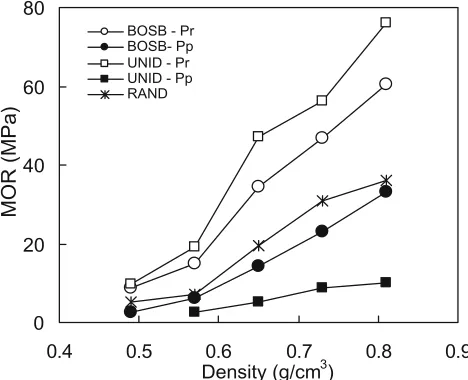
Mechanical properties were affected by both layer structure and density, as shown in Fig. 2. The MOR of each board type increased almost linearly with increasing board den-sity; many studies of the relationships between density– mechanical properties have reported similar results. The inclination of MOR seemed to be slightly greater at board densities higher than 0.57 g/cm3
compared with densities below that, at which point the board compaction ratio was around unity.
Strength ratio could be an indicator of board strand alignment and layer structure. Comparison of MORs at a density of 0.65 g/cm3
revealed that in UNID board, the
MOR in the oriented direction was 9.2 times that in the perpendicular direction, and was 2.4 times that in RAND board. These values were higher than those of sugi OSB.16 In BOSB board, the MOR in the perpendicular direction was 2.4 times that in the cross-oriented direction, and was 1.8 times that in RAND board. Comparison of MORs in BOSB and RAND board revealed that a three-layer struc-ture provided higher MOR in the parallel direction with less strength reduction in the perpendicular direction, as shown in Fig. 2.
A similar trend in density was observed in MOE, as shown in Fig. 3. The MOE ratios for UNID board in the parallel direction at a board density of 0.65 g/cm3
were 7.6 and 2.5 times, respectively, to those for the perpendicular direction of UNID board and RAND board. The MOE ra-tios for BOSB board were 3.7 and 2.0 times, respectively, to those for the cross-oriented direction of BOSB board and RAND board. These values approximate measurements of Douglas fi r strands.11
In contrast to the diffi culty in predicting MOR,24 the MOE of cross-oriented boards can be calculated on the basis of the simple combination theory of two elastic bod-ies.25,26
The dotted lines in Fig. 3 represent the predicted MOE in BOSB board, which was calculated using two MOEs from the parallel and perpendicular directions of UNID board as elastic constants for each layer of BOSB board. The calculation used the weight ratio of each layer (25 : 50 : 25) as the thickness ratio of each fabricated board. Although some deviations were observed between the the-oretical and actual values (this was expected because the modeling was so simple), the results showed that a certain extent of accuracy in prediction could be attained. Results also suggest that elastic data from unidirectional board can be used to predict the elastic properties of three-layer bam-boo board.
0.00 0.04 0.08 0.12 0.16 0.20
0
Alignment angle (rad)
Pr
obabilit
y
dens
it
y
f
unc
ti
on
Frequency
von Mises
π/2 -π/2
Fig. 1. Alignment angle distribution of bamboo strands at a 20-mm
free-fall distance and plate spacing. Curve fi tting: von Mises distribu-tion funcdistribu-tion
0 20 40 60 80
0.4 0.5 0.6 0.7 0.8 0.9
Density (g/cm3)
MOR (MPa)
BOSB - Pr BOSB- Pp UNID - Pr UNID - Pp RAND
Fig. 2. Effect of board density and layer structure on modulus of
rup-ture (MOR). RAND, randomly oriented homogenous board; UNID, unidirectionally oriented homogenous board; BOSB, three-layer board with a cross-oriented core layer; Pr, parallel direction; Pp, perpendicu-lar direction
0 2 4 6 8 10 12
0.4 0.5 0.6 0.7 0.8 0.9
Density (g/cm3 )
MOE (GPa)
BOSB-Pr-Tested BOSB-Pp-Tested UNID - Pr UNID - Pp RAND
BOSB - Pr-Predicted BOSB- Pp-Predicted
Fig. 3. Effect of board density and layer structure on modulus of
Internal bond
In general, internal bond failure occurs in the center line of board thickness because of the core’s low density. The bam-boo strandboards used in this study also exhibited failure in the middle layer of all board types. The density gradient in the thickness direction of random boards was prominent in higher density board, such as boards with densities of 0.81 g/cm3
(Fig. 4); this result is similar to those observed in typical mat-formed panel products. However, the density gradient became unclear with decreasing density; Fig. 4 presents results for a random board with a density of 0.57 g/ cm3
. One reason for this may have been the low compaction ratio at this density.
Internal bond strength of boards also exhibited a similar trend in bending properties as a function of density, as shown in Fig. 5. IB was greatly affected by density but was not affected by layer structure. This result was similar to those observed in bamboo OSB10
and wood OSB.12,15 It seems likely that alignment between parallel-oriented strands might provide better contact and bond quality than in randomly formed strands. However, this study could not verify these results because of the large variation in IB values.
Dimensional stability
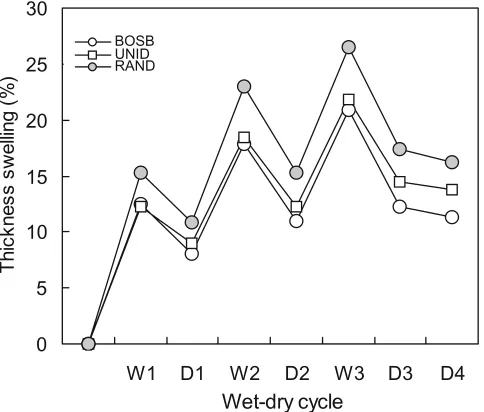
Board dimensional stability was evaluated using thickness swelling (TS) and linear expansion (LE). Figure 6 shows an example of TS for a board with a density of 0.65 g/cm3
dur-ing the cyclic wet–dry agdur-ing treatment. Results indicated that TS increased with an increased treatment cycle. Under wet conditions, TS values ranged from 12% to 17%, 18% to 24%, and 22% to 27%, respectively, for W1 (water immersion), W2 (hot water immersion), and W3 (boiling water immersion). Some differences in TS appeared be-tween board types; RAND board exhibited greater TS than
UNID or BOSB board in which there were signifi cant dif-ferences at second and third cycles. This indicates that strands of the random boards had been more damaged than those of the aligned boards, which were more uniformly compressed during the mat consolidation process.
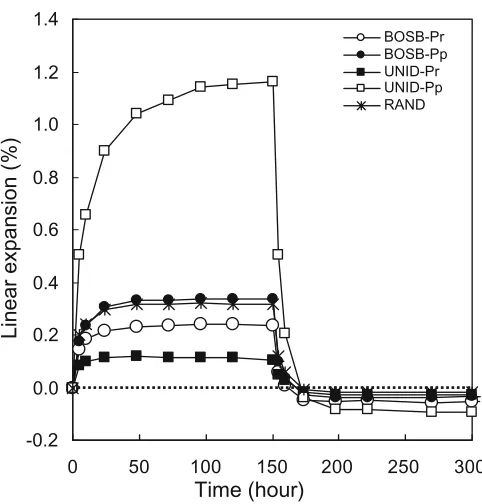
This study also measured LE, which represents another structural aspect of strandboard dimensional stability. Figure 7 presents the LE behavior in boards with a density
0.0 0.2 0.4 0.6 0.8 1.0
0 2 4 6 8 10 12
Distance from surface (mm)
Dens
it
y
(
g
/c
m
3 ) 0.57 g/cm3
0.81 g/cm3
Fig. 4. Vertical density profi les of bamboo strandboard with different
densities for RAND board
0.0 0.1 0.2 0.3 0.4 0.5 0.6
0.4 0.5 0.6 0.7 0.8 0.9
Density (g/cm3)
IB
(
M
P
a
)
BOSB UNID RAND
Fig. 5. Effect of board density and layer structure on internal bond
strength(IB). Error bars represent standard deviation
0 5 10 15 20 25 30
W1 D1 W2 D2 W3 D3 D4
Wet-dry cycle
Th
ic
k
n
es
s
s
w
elling (
%
)
BOSB UNID RAND
Fig. 6. Effect of layer structure on thickness swelling (TS) tested under
of 0.65 g/cm3
after they had been subjected to a humidity test at 40°C and 90% RH for 150 h, followed by a drying test at 60°C for 150 h. During the fi rst 50 h, LE increased rapidly; it leveled off at 150 h, producing values of 1.2% for UNID-Pp (Pp denotes perpendicular orientation), 0.3% for BOSB-Pp and RAND, 0.2% for BOSB-Pr (Pr denotes par-allel orientation), and 0.1% for UNID-Pp. In the drying stage, values became negative; Table 1 summarizes the re-sults. A board’s total LE (dLE) was defi ned as the differ-ence between LE at 150 h under humid conditions and LE at 300 h under dry conditions. During this experiment, RAND dLE was 0.33% and the corresponding total ture change (dMC) was 16.8%; thus, the LE per unit mois-ture change (LE/MC) became 0.020. This RAND board LE/MC fell between values for BOSB-Pr and BOSB-Pp. These values for random and three-layer boards are com-parable with or lower than the LE/MC values for commer-cial and laboratory-made strandboard/OSB.2,27
-0.2 0.0 0.2 0.4 0.6 0.8 1.0 1.2 1.4
0 50 100 150 200 250 300
Time (hour)
Linear expansion (%
)
BOSB-Pr BOSB-Pp UNID-Pr UNID-Pp RAND
Fig. 7. Effect of layer structure on linear expansion (LE) with
0.65 g/cm3 board density under humid conditions followed by dry conditions
Table 1. Linear expansion (LE) per unit of moisture content (MC)
change (LE/MC) based on differences in LE and MC between humid and dry conditions
Density (g/cm3) Board type dMC (%) dLE (%) LE/MC
0.65 Random 16.8 0.33 0.020
0.65 UNID-Pr 15.9 0.14 0.009
0.65 UNID-Pp 16.3 1.25 0.077
0.65 BOSB-Pr 16.7 0.29 0.017
0.65 BOSB-Pp 17.0 0.37 0.022
dMC, total MC change; dLE, total LE change; UNID, unidirectionally oriented homogenous board; BOSB, three-layer board with a cross-oriented core layer; Pr, parallel direction; Pp, perpendicular direction
Theoretically, if BOSB-Pr and BOSB-Pp had identical quantities of strands in perpendicular and parallel layers, their LE/MCs values would be the same. However, many factors other than the quantity of supply affect actual LE values. In this study, BOSB board had a LE/MC ratio of 0.80 for perpendicular to parallel directions. UNID board exhibited considerably different LE properties in each di-rection, as was expected. LE/MC for UNID-Pr was 0.009 and was 0.077 for UNID-Pp. These values can be compared with the LE per unit moisture change in solid bamboo, which a previous study1
reported as 0.001 in the longitudinal direction and 1 in the radial direction. UNID board exhib-ited more linear expansion in the parallel direction than solid bamboo, while UNID-Pp exhibited less. These differ-ences may be useful in discussing how the UNID boards compare with the ideal board in which the strands are com-pletely oriented.
Conclusions
Based on the results of this study, the effects of density and layer structure on bamboo oriented strandboard properties can be summarized as follows. The von Mises distribution function can be used to predict bamboo strand distribution. Bending properties increased with increased board density, and were also affected by layer structures. In BOSB board, the MOR in the parallel direction increased remarkably compared with the MOR in RAND board, with less strength reduction in the perpendicular direction. Elastic data from UNID board can be used to predict the elastic properties of BOSB board. IB strengths of both oriented and random boards were greatly affected by board density. TS in RAND board was slightly greater than in oriented boards, while layer structure did not appear to affect IB strength. RAND and BOSB LE/MC values ranged from 0.017 to 0.022. These values are comparable with or lower than values for com-mercial boards.
Acknowledgments We thank Professor Sobue and Mr. Ikeda,
Shi-zuoka University, for their valuable suggestions throughout the course of this study.
References
1. Lee AWC, Bai X, Peralta PN (1994) Selected physical and mechanical properties of giant timber bamboo (Phylostachys
bambusoides) grown in South California. Forest Prod J 44:40–
46
2. Chen GH (1985) Bamboo plywood: a new product of structural material with high strength properties. Proceedings of the 2nd In-ternational Bamboo Workshop, Hangzhou, China, pp 337–338 3. Nugroho N, Ando N (2000) Development of structural composite
product made from bamboo I: fundamental properties of bamboo zephyr board. J Wood Sci 46:68–74
5. Sakuno T, Han KS (2003) Manufacture and properties of boards made from fresh mosochiku bamboo. Proceedings of the Inter-national Conference on Forest Products, Daejeon, Korea, pp 325–330
6. Xu Y, Zhang Y, Wang W (2001) Study on manufacturing technol-ogy of MDF from bamboo. Proceedings of the Utilization of Ag-ricultural and Forestry Residues, Nanjing, China, pp 117–123 7. Matsumoto K, Yamauchi H, Yamada M, Taki K, Yoshida H (2001)
Manufacture and properties of fi berboard made from moso bam-boo. Mokuzai Gakkaishi 47:111–119
8. Kawai S, Ohmori Y, Han GP, Adach K, Kiyooka T (2001) A trial of manufacturing high-strength bamboo fi ber composite. Proceed-ings of the Utilization of Agricultural and Forestry Residues, Nanjing, China, pp 124–129
9. Zang HJ (2001) New structural panel composite: bamboo-based waferboards. Proceedings of the Utilization of Agricultural and Forestry Residues, Nanjing, China, pp 204–209
10. Lee AWC, Bai X, Paralta PN (1996) Physical and mechanical properties of strandboard made from moso bamboo. Forest Prod J 46:84–88
11. Canadido LS, Saito F, Suzuki S (1990) Infl uence of strand thick-ness and board density on the orthotropic properties of oriented strandboard. Mokuzai Gakkaishi 36:632–636
12. Kajita H (1987) Oriented particle board with sugi thinnings
(Cryp-tomeria japonica) I. Effects of degree of particle alignment and
board density on physical and mechanical properties. Mokuzai Gakkaishi 33:865–871
13. Xu W, Winistorfer PM (1995) Layer thickness swell and layer in-ternal bond of medium density fi berboard and oriented strand-board. Forest Prod J 45:67–71
14. Zhang M, Wong ED, Kawai S, Kwon JH (1998) Manufacture and properties of high-performance oriented strand board composite using thin strands. J Wood Sci 44:191–197
15. Canadido LS, Saito F, Suzuki S (1988) Effect of particle shape on the orthotropic properties of oriented strand board. Mokuzai Gakkaishi 34:21–27
16. Suzuki S, Takeda K (2000) Production and properties of Japanese oriented strand board I: effect of strand length and orientation on strength properties of sugi oriented strand board. J Wood Sci 46:289–295
17. Wu Q (1996) Linear expansion and its relationship to moisture content change for commercial oriented strandboard. Forest Prod J 46:79–83
18. Japanese Industrial Standard (1994) Particleboards. JIS A 5908–1994
19. American Society for Testing and Materials (1988) Standard test methods for evaluating the properties of wood-based fi ber and particle panel materials. ASTM D 1037–177, ASTM, West Con-shohocken, PA
20. Abromivit M, Stegun IA (1965) Handbook of mathematical func-tion. Downer, New York, p 1046
21. Mardia KV (1972) Statistic of directional data. Academic, New York, p 357
22. Shaler SM (1991) Comparison two measures of fl ake alignment. Wood Sci Technol 26:53–61
23. Nishimura T, Ansell MP, Ando N (2001) The relationship between the arrangement of wood strand at the surface of OSB and the modulus of rupture determined by image analysis. Wood Sci Tech-nol 35:555–562
24. Lee AWC, Bai X, Bang AP (1997) Flexural properties of bamboo-reinforced southern fi ne OSB beams. Forest Prod J 47:74–78 25. Jones RH (1975) Mechanics of composite materials.
Hemine-sphere, New York
26. Lee AWC, Bai X, Bang AP (1997) Flexural properties of bamboo-reinforced southern fi ne OSB beams. Forest Prod J 47:74–78 27. Avramidis S, Smith LA (1989) The effect of resin content and