S H O R T C O M M U N I C A T I O N
Open Access
Evolutionary analysis of the
SUB1
locus
across the
Oryza
genomes
Railson Schreinert dos Santos
1,2, Daniel da Rosa Farias
2, Camila Pegoraro
2, Cesar Valmor Rombaldi
1, Takeshi Fukao
3,
Rod A. Wing
4and Antonio Costa de Oliveira
1,2*Abstract
Background:Tolerance to complete submergence is recognized in a limited number of Asian rice (Oryza sativaL.) varieties, most of which contain submergence-inducibleSUB1Aon the polygenicSUBMERGENCE-1(SUB1) locus. It has been shown that theSUB1locus encodes twoEthylene-Responsive Factor(ERF) genes,SUB1BandSUB1C, in all
O. sativavarieties. These genes were also found inO rufipogonandO nivara, wild relatives ofO. sativa. However, detailed analysis of the polygenic locus in otherOryzaspecies has not yet been made.
Findings:Chromosomal location, phylogenetic, and gene structure analyses have revealed that theSUB1locus is conserved in the long arm of chromosome 9 in mostOryzaspecies. We also show that theSUB1A-likegene of
O. nivarais on chromosome 1 and thatLeersia perrieri, a grass-tolerant to deep-flooding, presents threeERF
genes in theSUB1locus.
Conclusion:We provide here a deeper insight into the evolutionary origin and variation of theSUB1locus and raise the possibility that an association of these genes with flooding tolerance inL. perrierimay exist.
Keywords:IOMAP,Oryza,Leersia perrieri, Submergence tolerance,SUB1 genes
Findings
Abiotic stresses such as flooding can prevent plants from attaining their full genetic potential for growth and reproduction. In Asia, the leading producers of rice (Oryza sativa L.), many flood-prone lands are used for rice production, reason why so many studies are devel-oped aiming to understand and overcome flooding re-sponse mechanisms.
A major quantitative trait locus (QTL) called SUB-MERGENCE-1 (SUB1) is responsible for conferring submergence tolerance to the rice landrace Flood Resistant 13A (FR13A). Detailed sequence analysis re-vealed that the locus encodes a variable cluster of up to
three Ethylene-Responsive Factors (ERF): SUB1A,
SUB1BandSUB1C(Fukao et al., 2006; Xu et al., 2006). All surveyed O. sativa varieties contain SUB1B and SUB1C, whereas SUB1A is present only in a limited
number of accessions. Genotypes containing submergence-inducibleSUB1Arestricts underwater ethylene production, which maintains mRNA and protein accumulation of gibberellic acid (GA) signaling repressors during sub-mergence (Fukao and Bailey-Serres, 2008; Fukao et al., 2006; Singh et al., 2014). SUB1A-mediated inhibition of GA responsiveness consequently represses genes required for starch and sucrose catabolism. This strat-egy characterized by reduced plant elongation in order to preserve the sugars needed for regrowth when water recedes is called ‘quiescence strategy’ and it is being very useful in plant breeding (Neeraja et al., 2007; Fukao and Bailey-Serres, 2008; Fukao et al., 2006; Septiningsih et al., 2009; Septiningsih et al., 2013; Iftekharuddaula et al., 2015).
Wild rice species generally lack agriculturally import-ant traits. However, they carry many desirable genes that have been lost in cultivated rice. Here, we report that previous analyses made by Fukao et al. (2009) and Niroula et al. (2012) are now extended across large part of Oryza phylogeny using sequencing data from the
International Oryza Map Alignment Project (IOMAP)
consortium (Stein et al: Sequence of 11 rice-related
* Correspondence:[email protected] 1
Technology Development Center (CDTec), Universidade Federal de Pelotas, Pelotas, Brazil
2Plant Genomics and Breeding Center (CGF), Universidade Federal de
Pelotas, Pelotas, Brazil
Full list of author information is available at the end of the article
species unveils the Oryza pan-genome and the origin of genetic innovation, submitted; Jacquemin et al., 2013): O. sativa L. ssp indica (AA), O. sativa L. ssp japonica
(AA), O. rufipogon Griff. (AA), O. nivara Sharma et
Shastry (AA), O. glumaepatula Steud. (AA), O. glaber-rimaS. (AA),O. barthii A. Chev. (AA),O. meridionalis Ng. (AA), O. punctata Kotschy ex Steud. (BB), and O. brachyanthaChev. et Roehr (FF).
Our genomic analysis identified 58 SUB1-like genes (Additional file 1: Table S1). The alignment of the AP2 domains with the signature amino acids alanine and aspartic acid at positions 13 and 18, respectively, of the AP2 domain, a characteristic of the B2 subgroup of ERF proteins, can be seen in Additional file 2: Figure S1.
Of nine species, six of them such as O. rufipogon
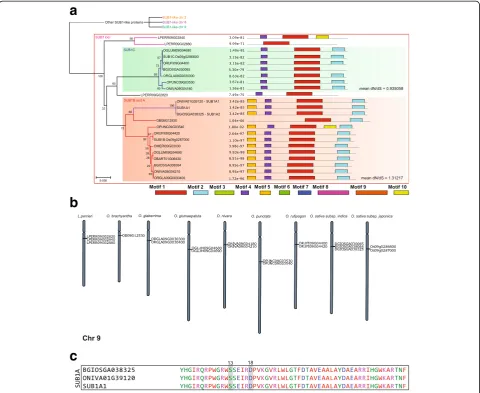
(AA), O. nivara(AA), O. glumaepatula(AA),O. glaber-rima (AA), O. sativa (AA), and O. punctata (BB) con-tained both SUB1B- and SUB1C-like genes side by side on chromosome 9 (Chr 9), as shown in Fig. 1a and b, which is consistent with the observations in multiple ac-cessions of O. sativa (AA) (Singh et al., 2010; Xu et al., 2006). According to its position in the genome and to the proximity between these genes we first divided these SUB1-like genes into two large supergroups: “Other SUB1-like proteins”and“SUB1loci”, as seen in Fig. 1a.
We further divided the supergroup called “Other
SUB1-like proteins”, which is formed by longer proteins, into three groups: "SUB1-like Chr 2" (SUB1chr2),
Fig. 1SUB1analyses across theOryzagenomes.aPhylogenetic tree generated from the protein alignment ofSUB1-like genes identified of all species analyzed, genes in red areSUB1B-like genes and green areSUB1C-like. On the right side of the tree, amino acid motifs are represented. Full version and motif logos are available in Additional file 3: Figure S2 and Additional file 11: Figure S8.bChromosomal location of theSUB1-like loci in eachOryzagenome (chromosomes 1 and 9). Full version available in Additional file 4: Figure S3.cAlignment of the AP2 domains of
"SUB1-like Chr 6" (SUB1chr6) and "SUB1-like Chr 9" (SUB1chr9) (Additional file 3: Figure S2).SUB1chr2 con-sists of genes on Chr 2, while SUB1chr6 group consists of genes at the Chr 6 with a deletion of motif 10, and an inverted region, with motif 7 after motif 2. The third group, SUB1chr9, is present on Chr 9 and genes of this group
pos-sess the motif 9 preceding motif 3. O. glumaepatula
showed the most distinct arrangement of motifs with a de-letion covering motifs 5 and 4 which made the gene much shorter in this species.O. brachyanthapresented a gene on SUB1chr9 that resembles those grouped as SUB1chr2.
TheOsERF#70(Os02g0782700), which is theSUB1chr2 gene found inO. sativais already known to interact with a Myc transcription factor called OsBP-5, coregulating the expression of thewaxygene (Zhu et al., 2003). Such infor-mation shows that the genes contained in the supergroup "Other SUB1-like genes" have the potential to interact with Myc factors. The similarities of these longer genes with those found in theSUB1locus should be better stud-ied in order to analyze their significance in altering plant tolerance to stresses and/or other important traits that may bring interesting insights about ERF evolution or that may be of interest of breeders.
The second large supergroup, which we called “SUB1 loci” (Fig. 1a), is formed by shorter genes, on the long arm of Chr 9, near the centromere (Fig. 1b). Most of these genes are positioned in a similar way as the SUB1 locus described by Xu et al. (2006). Figure 1b and Additional file 4: Figure S3 show the positions of these genes on chromosomes of different genomes.
Interestingly, we also found SUB1A- and SUB1B-like
genes on Chr 1 of O. nivara (ONIVA01G39120) and O.
barthii(OBART01G06430), respectively. To identify pos-sible translocation events related to these specific loci we aligned regions corresponding to 50 Kb upstream
and 50 Kb downstream of ONIVA01G39120 and
OBART01G06430 to SUB1 loci (Chr 9) of each Oryza species. The alignments show no similar regions when
SUB1 loci are compared to ONIVA01G39120,
neverthe-less we can identify an orthologous region (~8.5 Kb) when SUB1 loci of all genome AA species are compared to OBART01G06430 (Additional file 5: Figure S4). The region was searched for the presence of transposable ele-ments (TEs) that were possibly involved with this event, but no clear mechanism involving TEs was detected.
It is also interesting to highlight that the genomes of O. meridionalis (AA), O. barthii (AA) and O. bra-chyantha (FF) encoded only one SUB1-like gene, all of them more related toSUB1Bthan toSUB1C.
Three genes closely related toSUB1locus were found in Chr 9 of Leersia perrieri (A. Camus) Launert.
(LPERR09G02820,LPERR09G02840andLPERR09G02880)
demonstrating the presence of duplication events in the
onset of SUB1B and SUB1C, which occurred after the
divergence ofOryzeaefrom other grasses. This duplication event seems to have occurred before the speciation of L. perrieri.
SUB1A-like genes were not detected in the genomes of these rice relatives, except for O. nivara (Fig. 1c). An alignment of the gene found by Niroula et al.
(2012) (cultivar IRGC:80507), ONIVA01G39120
(culti-var IRGC:100897) and original SUB1A-1demonstrates
that, despite differences in the C-terminal region, the twoO. nivara sequences are probably variants (alleles) from the same locus.O. brachyantha also presented a
gene that was similar to SUB1(OB09G12530), but the
absence of a serine at position 13, and other differ-ences along their sequence prevented its classification as a SUB1A-like gene. It is interesting to notice that the SUB1A-like genes found in O. nivara (ONI-VA01G39120) andO. barthii(OBART01G06430), were not on Chr 9, but on Chr 1.
Constitutive and conditional expression of SUB1A
significantly increases tolerance to complete
submer-gence in O. sativa (Fukao et al., 2006; Xu et al.,
2006). Detailed genetic survey demonstrated that
submergence-tolerant accessions of O. sativa, O.
nivara and O. rufipogon possess SUB1A-1 which is
highly induced by submergence, suggesting that
SUB1A arose via tandem duplication prior to rice do-mestication (Niroula et al., 2012; Singh et al., 2010). In this study, we surveyed the entire genome se-quences of nine rice relatives to identify orthologs of SUB1A as well as SUB1B andSUB1C.
Chromosomal location of the Chr 9 SUB1 locus was
highly conserved in O. nivara, O. rufipogon, O. glumae-patula and O. glaberrima which had a locus deviation
smaller than 2.0 Mb. The deviation of O. punctata,
which also had a similar conserved structure in the long arm of Chr 9, was a little larger reaching 3.06 Mb (Fig. 1b).
To estimate how natural selection is acting on the
coding sequences of SUB1C- and SUB1B-like genes,
the ratio of synonymous/non-synonymous mutations (dN/dS) was calculated (Fig. 1a and Additional file 6: Figure S5). The mean dN/dS is 1.312 (positive
selec-tion) for SUB1B- and 0.935 (negative selection) for
SUB1C-like genes. The freedom thatSUB1B-like genes have to be modified may have been essential to the
emergence of SUB1A-like genes, which are extremely
close toSUB1Bgenes.
together with the location of polymorphisms found
when comparingSUB1A-1and SUB1A-2 alleles fromO.
sativa (Additional file 9: Figure S6) shows that diverse transcription factors, among them WRKY and ERF, may be important regulators of this gene in submergence conditions. This conclusion is based on the fact that binding sites for these TFs were detected in families where differences between the promoter regions of SUB1A-1 (upregulated by submergence) and SUB1A-2 (non-upregulated by submergence) alleles were found. Now we should further investigate the possibly tolerant
phenotype resulting from the introgression of
ONI-VA01G39120 into O. sativa elite cultivars and how is it regulated since this constitutes a very relevant informa-tion to breeders.
Integration of genome sequences with RNAseq data allowed us to construct gene structure models ofSUB1-like genes isolated from these rice relatives (Additional file 10: Figure S7). Gene structure analysis revealed the presence of an intron inside the coding sequence (CDS) ofSUB1B-like genes, except for O. glaberrima, O. rufipogon and O. glumaepatula.
SUB1Calleles ofO. sativacontain an intron in the 3’ un-translated region (UTR). However, our gene structure ana-lysis based on RNAseq data did not detect 3' UTR sequences ofSUB1C-like genes (Additional file 10: Figure S7).
There-fore, the intron in the 3’ UTR region of SUB1C-like
genes was sought within 1.5 kb downstream of the stop codon in these genes and regions highly similar to the O. sativa intron were found in ORUFI09G04400,
ONI-VA09G04180, OGLUM09G04680, OGLAB09G030300
andOPUNC09G03530indicating that mostSUB1C-like genes identified in Oryzaspecies possess traces of an in-tron in their terminal region (Additional file 11: Table S3).
In summary, here we presentSUB1-like genes identified in wild rice species through genome-wide sequence ana-lysis. Our chromosomal location, phylogenetic, and gene structure analyses have revealed that the SUB1 locus is conserved in the long arm of Chr 9 in mostOryzaspecies with AA-, BB- and FF-genomes. We also showed that the SUB1A-like gene ofO. nivarais on Chr 1 and thatL. per-rieri, a grass-tolerant deep-flooding, presents three ERF genes inSUB1locus, similar to that found in flooding toler-ant rice. This finding raises the possibility that an asso-ciation of this gene with flooding tolerance in L. perrieri exists. Along with genes found in Chr 1, SUB1-like genes found in Chr 2 and Chr 6 represent some new interesting information. These genes should now be further investi-gated in order to check their biological and agricultural significance. Allelic survey of diverse ecotypes in wild rice species is necessary to determine the evolutionary origin and biological significance of SUB1A in the genus Oryza (Additional file 12: Table S4, Additional file 13: Table S5 and Additional file 14).
Additional files
Additional file 1: Table S1.SUB1-like genes identified inOryzaspecies. (XLSX 22 kb)
Additional file 2: Figure S1.Alignment of the AP2 domains of
SUB1-like genes in rice relatives. Signature amino acids specific to B2 subgroup of ERF proteins are highlighted. (PDF 403 kb)
Additional file 3: Figure S2.Phylogenetic tree generated from the protein alignment ofSUB1-like genes identified of all species analyzed, genes in red areSUB1B-like genes and green areSUB1C-like. On the right side of the tree, amino acid motifs are represented. Motif logos are available in Additional file 11: Figure S8. (PDF 1078 kb)
Additional file 4: Figure S3.Chromosomal location of theSUB1-like loci in eachOryzagenome (chromosomes 1 and 9). (PDF 457 kb)
Additional file 5: Figure S4.Alignment ofOBART01G06430genomic region (first line) to SUB1 loci (Chr 9) regions ofOryzaspecies of AA genome. Same colors represent collinear blocks between genomes. (PDF 174 kb)
Additional file 6: Figure S5.Phylogenetic tree, motifs and evolutionary pressures on proteins quantified by the ratio of substitution rates at non-synonymous and non-synonymous sites (dN/dS) forSUB1B-likeand SUB1C-like genes. (PDF 582 kb)
Additional file 7: Figure S6.Alignment of the promoter region (1,500 bps upstream) ofSUB1A-like genes, showing polymorphisms found when comparingSUB1A-1andSUB1A-2alleles. (PDF 2215 kb)
Additional file 8: Table S2.Transcription Factor Binding Sites (TFBSs) in the promoter regions (-1,500 bps upstream) ofSUB1A-like gene ofO. nivara. Regions polymorphic when comparing (XLSX 212 kb)
Additional file 9: Figure S7.Structure of theSUB1-like genes in each of the different species. (PDF 399 kb)
Additional file 10: Table S3.BLAST analysis searching the 3’UTR intron inSUB1C-like genes. (XLSX 12 kb)
Additional file 11: Figure S8.Motifs found on the analysis of the amino acid sequences ofSUB1-like genes. (PDF 416 kb)
Additional file 12: Table S4.Genes with e-value below 1e−25found by
BLAST. (XLSX 21 kb)
Additional file 13: Table S5.Gene structure information (General feature format) about each of the analyzed genes.. (XLSX 239 kb)
Additional file 14:Methods. (DOCX 24 kb)
Abbreviations
CDS:Coding sequence; dN/dS: Ratio of synonymous/non-synonymous mutations;ERF:Ethylene-Responsive Factor; FR13A: Flood Resistant 13A; GA: Gibberellic acid; IOMAP: InternationalOryzaMap Alignment Project; QTL: Quantitative trait locus;SUB1:SUBMERGENCE-1; UTR: Untranslated region
Acknowledgments
We would like to thank the Virginia Agricultural Experimental Station and the Hatch Program of the National Institute of Food and Agriculture, U.S. Department of Agriculture. No conflict of interest declared.
Funding
This work was supported by the Brazilian Ministry of Science and Technology, National Counsel of Technological and Scientific Development (CNPq) (477083/ 2013-7); Coordination for the Improvement of Higher Education Personnel (CAPES) (2880/2011) and RS State Foundation for Research Support (FAPERGS) (2232-2551/14-6).
Availability of data and materials
Methods (Additional file 14: Methods) and other additional files are available at Rice Online.
Author contributions
performing the research and revising the manuscript, and ACO. conceived the study and supervised the research. All authors read and approved the final manuscript.
Competing interests
The authors declare that they have no competing interests.
Consent for publication Not applicable.
Author details 1
Technology Development Center (CDTec), Universidade Federal de Pelotas, Pelotas, Brazil.2Plant Genomics and Breeding Center (CGF), Universidade
Federal de Pelotas, Pelotas, Brazil.3Crop and Soil Environmental Sciences,
Virginia Tech, Blacksburg, USA.4The School of Plant Sciences, Ecology &
Evolutionary Biology, Arizona Genomics Institute, Tucson, USA.
Received: 6 August 2016 Accepted: 20 December 2016
References
Fukao T, Bailey-Serres J (2008) Submergence tolerance conferred by Sub1A is mediated by SLR1 and SLRL1 restriction of gibberellin responses in rice. Proc Natl Acad Sci U S A 105:16814–16819. doi:10.1073/pnas.0807821105 Fukao T, Harris T, Bailey-Serres J (2009) Evolutionary analysis of the Sub1 gene
cluster that confers submergence tolerance to domesticated rice. Ann Bot 103:143–150. doi:10.1093/aob/mcn172
Fukao T, Xu K, Ronald PC, Bailey-Serres J (2006) A variable cluster of ethylene response factor-like genes regulates metabolic and developmental acclimation responses to submergence in rice. Plant Cell 18:2021–2034. doi: 10.1105/tpc.106.043000
Iftekharuddaula KM, Ahmed HU, Ghosal S, Moni ZR, Amin A, Ali MS (2015) Development of New Submergence Tolerant Rice Variety for Bangladesh Using Marker-Assisted Backcrossing. Rice Sci 22:16–26. doi:10.1016/j.rsci.2015. 05.003
Jacquemin J, Bhatia D, Singh K, Wing RA (2013) The International Oryza Map Alignment Project: development of a genus-wide comparative genomics platform to help solve the 9 billion-people question. Curr Opin Plant Biol 16: 147–156. doi:10.1016/j.pbi.2013.02.014
Neeraja CN, Maghirang-Rodriguez R, Pamplona A, Heuer S, Collard BC, Septiningsih EM, Vergara G, Sanchez D, Xu K, Ismail AM, Mackill DJ (2007) A marker-assisted backcross approach for developing submergence-tolerant rice cultivars. Theor Appl Genet 115:767–776. doi:10.1007/s00122-007-0607-0 Niroula RK, Pucciariello C, Ho VT, Novi G, Fukao T, Perata P (2012)
SUB1A-dependent and -inSUB1A-dependent mechanisms are involved in the flooding tolerance of wild rice species. Plant J 72:282–293. doi:10.1111/j.1365-313X. 2012.05078.x
Septiningsih EM, Pamplona AM, Sanchez DL, Neeraja CN, Vergara GV, Heuer S, Ismail AM, Mackill DJ (2009) Development of submergence-tolerant rice cultivars: the Sub1 locus and beyond. Ann Bot 103:151–160. doi:10.1093/aob/ mcn206
Septiningsih EM, Ignacio JCI, Sendon PMD, Sanchez DL, Ismail AM, Mackill DJ (2013) QTL mapping and confirmation for tolerance of anaerobic conditions during germination derived from the rice landrace Ma-Zhan Red. Theor Appl Genet 126:1357–1366. doi:10.1007/s00122-013-2057-1
Singh N, Dang TT, Vergara GV, Pandey DM, Sanchez D, Neeraja CN, Septiningsih EM, Mendioro M, Tecson-Mendoza EM, Ismail AM et al (2010) Molecular marker survey and expression analyses of the rice submergence-tolerance gene SUB1A. Theor Appl Genet 121:1441–1453. doi:10.1007/s00122-010-1400-z
Singh S, Mackill DJ, Ismail AM (2014) Physiological basis of tolerance to complete submergence in rice involves genetic factors in addition to the SUB1 gene. AoB Plants 6. doi: 10.1093/aobpla/plu060
Xu K, Xu X, Fukao T, Canlas P, Maghirang-Rodriguez R, Heuer S, Ismail AM, Bailey-Serres J, Ronald PC, Mackill DJ (2006) Sub1A is an ethylene-response-factor-like gene that confers submergence tolerance to rice. Nature 442:705–708. doi:10.1038/nature04920
Zhu Y, Cai XL, Wang ZY, Hong MM (2003) An interaction between a MYC protein and an EREBP protein is involved in transcriptional regulation of the rice Wx gene. J Biol Chem 278:47803–47811
Submit your manuscript to a
journal and benefi t from:
7 Convenient online submission
7 Rigorous peer review
7 Immediate publication on acceptance
7 Open access: articles freely available online 7 High visibility within the fi eld
7 Retaining the copyright to your article