Article
Modelling and Optimization in Microgrids
Tobias Porsinger 1, Przemyslaw Janik 2, Zbigniew Leonowicz 2,* and Radomir Gono 3
1 50Hertz Transmission GmbH, 10415 Berlin, Germany; [email protected]
2 Department of Electrical Engineering, Wroclaw University of Science and Technology, 50-370 Wroclaw, Poland; [email protected]
3 Department of Electrical Power Engineering, VSB - Technical University of Ostrava, 708 00 Ostrava, Czech Republic; [email protected]
* Correspondence: [email protected]; Tel.: +48-71-320-2626
Abstract: The expansion of renewable energies is progressing strongly. The influence on the power supply networks by the volatility of the infeed must be met with new concepts. In this paper we investigate the possibilities of integrating microgrids as a cooperating unit in the power supply network to support further expansion of RES power plants. In this paper a differentiation of microgrids from similar network structures is established, a classification of proposed groups is made. Then, after the description of simulation of components in a microgrid, with practical advice, an example model is shown, which aids the dimensioning of the components within a microgrid to achieve a specified goal.
Keywords: microgrid; classification; simulation; optimization; renewable energy sources; storage; electric vehicles
1. Introduction
The politically promoted development of renewable energy sources (RES) in recent years is enormous. The breakdown of the RES plants by technology shows that wind energy (onshore) and photovoltaics are the most representative of the supplies in Europe [1]. Volatility of energy supply by RES is a matter of concerns and ongoing research. One of studies on the variation of PV forecast in 2013 has shown that the average percentage of day’s difference between forecast and gross annual average can be as high as 26,5% [2]. Variations in power generation and increasing harmonic distortion are main problems related to PV systems [3].
The necessary network expansion proceeds very slowly due to very lengthy administrative approval processes. The addition of renewable energy sources, especially in the low-voltage network, however, is many times faster. Already, low voltage levels in some areas partly exceed the limits of permissible voltage differences according to EN 50160. Voltage dips, swells, transients, and voltage harmonic content are the main issues [4, 5]. The further construction of new renewable energy plants is therefore thwarted [6]. To ensure secure network operation, alternative concepts are investigated. microgrids represent an alternative approach here - in opposition to Smart Grids - where additional measuring capabilities, the increased communication and controllability as well as network components are needed.
In this paper also the electric cars as a controllable load are considered together with its future potential of bidirectional operation [10]. Electric vehicle’s (EV) grid interfacing is a challenging problem [9-11] as the simple load control fail when addressing issues that require a higher control level, such as managing congestion levels or enabling EVs to participate in the electricity markets. In [12], a similar concept of balancing of local distribution grids with EV batteries is presented. In this paper, the simulation-based approach is applied to fully simulate a complex microgrid connected to a local MV distribution grid, including charging stations and EVs.
Research related to control of microgrids’ components, presented in [13, 14], shows that the simulation-based approach is able to facilitate the evaluation of smartgrid– and EV-related communication protocols, control algorithms for charging, and functionalities of local distribution grids as part of a complex, critical cyber-physical system. The resulting system can be applied to studying the balancing of local smart grids with EV batteries.
The main contributions of this paper lie in the presentation of practical considerations related to operation and modelling of microgrids, design of a complete framework for simulation and optimization of a microgrid composed of photovoltaic generation, battery storage, and electrical vehicle charging pool. The flexible optimization approach to components’ sizing is presented, as well. Most data are based on real measurements, recorded at a research facility.
The rest of the paper is organized as follows: the microgrid structures are described in Section 2, with differences presented in Section 3. In Section 4, the classification of microgrids into practically useful groups is justified and in Section 5 the simulation aspects and recommendations are presented. In Section 6 the interconnections within microgrids are discussed and in Section 7 and 8 an example of simulation and optimization task is shown. Discussion of the results and concluding remarks are provided in Section 9.
2. Microgrid structure
Similarly to Smart Grid Architectural Model (SGAM), a recognized architecture for independent analysis in the field of smart grids based on system layers, we adopt here analogous treatment of microgrids [15].
2.1. Component layer
The base of the microgrid is the component layer that contains the usual components of a network infrastructure: loads, generators and storage. Depending on the desired load characteristics it is possible to curb individual consumers, if necessary, to increase or to reschedule the demand to relevant time. Renewable energy producers as PV and wind turbines are only influenced by the energy supply and cannot be controlled in their feed. Cogeneration, biomass plants and diesel generators are also to be found in microgrids. The most common storage technology is the battery storage in the form of lead-acid or lithium-ion cells.
2.2. Communication layer
2.3. Information layer
Ensures the data processing based on the communication layer, standardized data models and a set of required data for each system component. The Standard 61850 provides definitions and models for substation automation as used in SCADA systems.
2.4. Application Layer
Controls the operation of microgrids. On this level operates the intelligent energy management system, a central control unit that interacts with communication and component layer.
2.5. Business layer
The top layer of the selected display employs the incentive schemes for an intelligent load management, marketing of the services provided by the microgrid control energy, but has to be compliant also with political and regulatory conditions.
3. Differences between microgrid and similar network structures
3.1. Standalone grid
Standalone grid describes a spatially delimited, autonomous power supply system, not permanently coupled to the public network. It contains internal loads, own generation plants and energy storage. A stand-alone grid therefore delimited primarily from the microgrid by a not (permanently) available public grid work access. The comparatively low extent of the network leads to an increased load sensitivity, whereby above-average voltage and frequency fluctuations can be caused. In addition, permanent generating capacity according to the annual peak load need to be assured, causing high power reserve costs. Standalone networks are found primarily in geographically remote areas or as an emergency power supply in certain institutions (hospitals, etc.) [15].
3.2. Hybrid power plant
A hybrid power plant describes the local association of at least two different types of power generation equipment in a closed grid. The energy supply comes directly via a grid connection point to the public transmission or distribution network. As far as renewable generators are integrated into the hybrid power plant, it allows a combination with a flexible power generation units such as a gas turbine or combined cycle plants, to balance volatile feed. The public grid is therefore less stressed.
This characteristic of a hybrid power plant thus is similar to the microgrid, but has its own network structure, has no internal loads, neither controllable nor uncontrollable. Additionally, there is only one input into the superimposed power grid [15].
3.3. Virtual Power Plant
the individual plant [15]. It is also possible to limit the supply of renewable energy plants, so that stability is ensured within the whole system.
3.4. 100RE Grid
So called 100RE grid is a defined area in the public grid where the balance of generated and of consumed energy results over a set period of time to zero. Continuous equalization of production and consumption is thereby not sought. The above-average share of renewable production leads in these areas, especially in windy and sunny days leads to strong network over-loads. Here, primary is in this concept to build a virtual motivational tool to increase the acceptance of renewable generation by the public opinion [15].
4. Classification of microgrids
The components within microgrids form a wide variety, therefore, a full list would be impractical here. Categorization into most probably occurring groups, however, provides a clear overview and proposes possible structures’ solutions within the multitude of variations.
Studies [15-17] have shown that a categorization in the three variants: urban, rural and industrial use is the most appropriate, as this categorization is based on the prevailing supply network structures. These three categories are shown below and after a brief review of their structures, a classification of the relationships between load and possible supply is made, so that the size of the storage required and the possibilities for support of secure grid operation can be roughly estimated.
4.1. Microgrids for urban use
The urban network is characterized by a high settlement and building density and thus characterized by a high load density. To increase the security of supply in these areas, grids are usually realized as partly-meshed cable networks with open separation points. PV generation plants are most often encountered. Cogeneration (Combined heat and power - CHP) is occasionally present, but the energy delivered depends heavily on the season, and CHP has the ability to smooth out the feed-in of PV systems. In the basements of the buildings the installation of battery storage is also conceivable. The grid efficiency should be examined in individual cases in detail regarding the relatively low ratio of supply to consumption in urban microgrid. Since the available roof surface is low within the city compared to the number of housing units and the additional power supply partially provided by mini-CHP also estimated as low compared to the overall demand, in such microgrids very little reduction of energy consumption from the superimposed grid can be expected. Storage, however, can reduce the burden on the public grid. A completely self-sufficient supply without connection to the higher-level grid can not be realized because of the seasonal variations of infeed by photovoltaic systems.
The urban microgrid as an individually designed combination with possibly high density of renewable energy and a sophisticated load management provides the opportunity to reduce the network load, to economically and optimally expand the space for renewable energy and to integrate local generation without affecting negatively the grid operation.
4.2. Microgrids for rural use
caused by the high infeed by distributed generation. The ratio of supply to demand will be highest in this type of microgrid.
4.3. Microgrids for industrial use
Industrial microgrid is assumed to be a grid structure of medium-sized industrial companies with loads in the hundreds of kilowatts range and annual energy consumption greater than 100 MWh. Consumers of this size are usually supplied directly from the medium voltage grid. For that reason, microgrids are in this environment usually only encountered as a separated part of the network, implemented on low-voltage level. In commercial areas or industrial sites general estimation of relationships between supply, load and storage is not possible because the design and choice of components depends on individual objectives. Thus, for example, only a portion of the load can be supplied from the storage. The variable objectives that can be implemented within microgrids (for example, increased self-consumption of energy from renewable sources) determine in this category the dimensioning of the components used.
5. Modeling of components of microgrids
5.1. Modeling of controllable loads – electric vehicles
Controllable loads have been in power supply systems, especially in the low-voltage level, only in a small proportion. In the future electric vehicles offer the greatest potential within medium and low voltage distribution systems to become the most important controllable load of the grid.
The modeling of the behavior of electric vehicles as a controllable load is considered together with its future potential of bidirectional operation.
Upon arrival of the electric vehicle at the charging station, the current state of charge (SoC) and the maximum loading capacity of the car will be automatically transferred to the control system. Furthermore, the user of the car is required to communicate its most probable departure time via a user interface. From this information, the charging characteristic is calculated for the car to be loaded during the service time. Depending on the system, it may be advantageous if the car is loaded according to different charge characteristics, e.g. at lunchtime, the grid load should be minimized.
After calculating the charge curve, the car has a defined power requirement. This power requirement cannot be always provided due to lack power or energy from the superimposed system. The system calculates for each car a coefficient of attenuation that controls the power consumption of the car. This attenuation can exceed the maximum charging power, so the car has to return own energy to the host system. From the departure time, initial SoC, and the maximum loading capacity of the car its characteristic curve can be calculated when the car needs to switch into the ‘maximum’ at the latest, so that the battery achieves a SoC of 100% for the specified departure time point.
If an additional parameter for the minimum SoC (<100%) is set for the departure time by the user, it increases the degree of freedom for the timing of maximum power charging. However, a minimal residual SoC should be always guaranteed to allow unexpected trips and emergency driving. If the characteristic curve is reached, the load attenuation is ignored and the car is loaded with maximum power. This additional power requirement must be provided by attenuation of all other loads (or some selected loads) in the system. If this is not possible for technical reasons, the car at the departure time cannot be fully charged.
Figure 1. Flowchart of a bidirectionally chargeable electric vehicles.
5.1.1. Example of a controllable load in Simulink
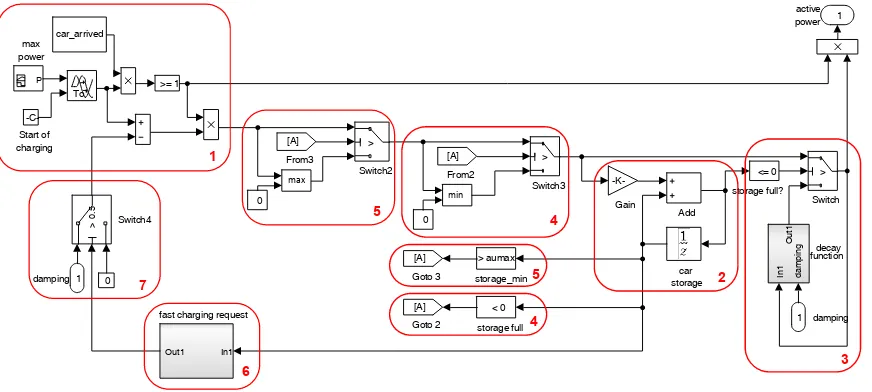
The following shows an implementation of controllable load. For clarity, only the active power is considered, since it is not presentable to include the reactive power into the model. The reactive power generation is however analogous to the active power generation. Figure 2 shows a screenshot of the Simulink model. For clarity, the model is divided into seven sections (red boxes), and subsections will be discussed separately below. The following paragraphs correspond to the order of the numbered boxes.
Figure 2. EV model in Simulink.
1. A binary block (0/1) tells if the electric vehicle is active during the day and performs initialization
(car_arrived). A signal builder generates for the charging time of the car (here determined as the average of the field test data) the maximal charge in uncontrolled load mode. Power consumption is delayed to the arrival time to the charging station.
2. The initialization state of charge of the car (determined as the averaged value from field tests)
will be loaded with the power value generated by the signal builder until the battery is fully
car storage Add -K-Gain P max power To -C-Start of charging 1 active power <= 0 storage full? > Switch >= 1 car_arrived > Switch2 > aumax storage_min 0 > Switch3 0 < 0 storage full 1 damping > 0. 5 Switch4 0 1 damping [A] From2 [A] Goto 2 [A] From3 [A] Goto 3 In1 Out1 fast charging request
charged. The exact value of the charge depends on the technology of the battery. In the absence of empirical data, a value of 99% can be assumed.
3. When the SoC threshold is achieved, the power consumption goes into a decay curve until
eventually the battery is completely loaded. Is the battery fully charged, the system goes into trickle charge. This was in the field determined with 0.2 kW, but is heavily dependent on the particular system.
4. Is the battery fully charged before the departure time set by the user is reached, no more energy
can be fed into the battery, however, the battery can be discharged to the system.
5. The battery can be discharged to supply the system only until a minimum value is reached (to
be defined by user). Subsequently, only positive values can be transferred to the battery module.
6. As described previously, the charging characteristic must define when limiting of the charging
power becomes ineffective, so that the battery at departure has the desired SoC.
7. The limit is determined from the available system power. If the available power of microgrid is
lower than the needs of all electric vehicles, all are limited to the extent that the power balance is reached. The limitation of charging power can be enforced uniformly. Limitable are all active vehicles in the system that are not fully discharged, or excluded by reaching the boundary of charging characteristic. An individual limitation of electric cars requires high computing power and would cause the simulation to be unnecessarily complicated.
5.2. Modeling of feature-dependent generation
Feature-dependent generation, as PV systems, mean by their volatility strong challenges to the secure network operation. Renewable energy sources may be disconnected only as a last resort to maintain the safe operation of the grid – according to widely adopted grid codes. In the simulation, the calculation step must be set to less than one second to reflect the strong volatility of infeed by PV systems. The loss of information about the system dynamics is at longer simulation steps not tolerable and leads to unacceptable errors [18].
Within a microgrid, the PV infeed must be cut down by the control system if the supply exceeds the load and the available storage is fully charged. Furthermore, there may be an important power surplus if the PV system is oversized. Again, appropriate action must be taken in the course of the supply-dependent feed. To record the loss by depression of the PV output, a separate measuring device is required, recording the history of the irradiation. Such a measuring device can consist of one or more measuring cells that are locally installed close to the PV system. Evidence that a PV system can be simulated accurately by a simple measuring device, shows [19]. It was demonstrated that a PV system with various geographical orientations of panels can be mapped by a few cells with
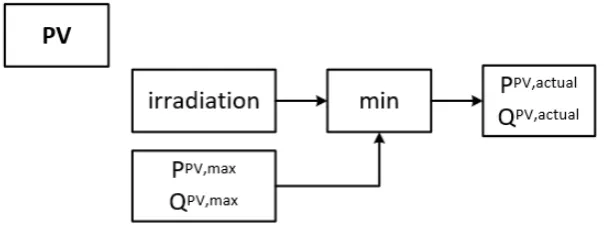
acceptable error. Figure 3 shows the flowchart of PV-irradiation model in a microgrid. PPV,max and
QPV,max represent the maximum possible feed, required at a given time point by microgrid. Current
infeed will have always the lower value. (Power generated from the current PV insolation or maximum required power by microgrid).
5.2.1. Example of PV infeed modelling in Simulink
The following shows example implementation of PV supply system, Figure 4 shows a screenshot of the Simulink model. For clarity the model is divided into four sections (red boxes). The following paragraphs correspond to the order according to the numbering of boxes.
Figure 4. Detailed PV model – example of feature-dependent generation.
Through the block “From file”, the irradiation values are input to the simulation. Here it is important to pay attention to the correct sign of the input values (for the used consumer power meter
negative values for active power are provided to the control system). By the factor K is set the size
the PV system and efficiency. It is recommended not to set the direction and angle of the PV plant
over a factor K to the simulation, but to do it beforehand about in irradiation values’ calculation. The
factor K can be adjusted during an optimization. If no measured value series to define the PV infeed
are available, the historical data from available databases can be used alternatively. However, doing so will case loss of real gradients of irradiation.
1. For the power balance within the closed unit of a microgrid, the radiation must be limited to the
power requirements of the elements of microgrid. For this purpose it is added together the maximum power feed to the storage, time power requirement of the load as well as the real-time power requirement superimposed grid. This represents the upper limit of power consumption in the microgrid. Correct sign is assured via the matcher “min / max” so the power in the system do not exceed the limit. From comparison between the input values and system set values, can be determined the possible PV irradiation limitation. This comparison has not been realized in the model shown, since it can be determined (if desired) directly from simulation system.
2. The limit on the PV infeed described in 2 must be adjusted as soon as the existing system storage
cannot absorb more energy. For this, the SoC of the storage has to be incorporated into the PV model over a “From” block. Via a relay the real-time SoC of storage is compared with a definable value. When achieved, the switch block is switched to the second path. In order to prevent an infinite loop in the circuit of the switch block (when the state of the storage corresponds to the limit value and with the switching the level drops, it forces the repeated switching), a second threshold value may be set in the relay; for that the relay is to be only switched again. For the upper limit, a value less than 100% should be selected since the microgrid elements may show a time constant, so although the switching command has been issued, the response is delayed (SoC recommendation = 99%). The lower threshold should have a distance of less than 2% of the SoC to prevent unnecessary PV limitations (SoC recommendation = 98%).
3. Is the limit of the SoC reached, the power cannot be fed into the system, resulting from the
real-time power requirement of the load and the real-real-time power demand from the grid. This summed power demand corresponds to the maximum power that is fed into the system.
PQ_PV Goto
PQ_load
PQ_GCP
>
Switch SoC_storage
curve_summer
irradiation
max max PQ_load
PQ_GCP
-K-PV-cell-factor
Relay
PQ_storage
storage maximum
2
1
4
In this model, the size and the efficiency of the PV system is set and the infeed by the PV system is regulated by the observation of the SoC of the storage. The comparison of the possible and the actual PV output is determined by the simulation. Other provisions of the infeed regulation are not necessary.
5.3. Modeling of controllable generation
Controllable feeds (feature-independent feeds) supply the system with power on desired schedule or in response to a demand for support coming from the control system. A variant of controllable feeds represent current-controlled CHPs.
From the standby state, the micro-CHP must be synchronized once to the grid after the start command issued by the control system. After this synchronization, the CHP unit can be adjusted to the desired infeed. The time constant for the change from one state to another depends on the device. The heat production (if included in the simulation) can be passed to the heat storage - if available in the system. The heat storage unit represents a limitation to the mini-CHP. When heat storage is full, the mini-CHP unit must be shut down.
In a simulation, the current-controlled mini-(micro-)CHP can be viewed as a simple infeed that can provide full power at any time. The distinction between active and reactive power is important, as both powers can be provided independently and have different minimums and maximums. Reactive power can be provided as capacitive or inductive.
Reaction times when changing between the set values of the active power can be estimated with a maximum of 5 s, as long as no measurements or manufacturer’s data are available. Reactive power can be assumed to change step-wise. For network synchronization a time constant of less than 30 s can be assumed. The thermal power of the Mini-CHP is in direct reference to the electric power. If the manufacturer’s data is not given, can as first approximation the ratio of 1: 2 be assumed (double heat output for the electric power output). With this ratio, a rough estimate can be made whether an existing size of storage is sufficient. In [20], the ratio of 1:1 for future current-controlled CHP is proposed. If the storage is completely full, the mini-CHP unit cannot be operated if no other heat dissipation in the system is available. Where the micro-CHP is connected to the district heating network, the heat production can be neglected and heat storage assumed to be infinite.
5.3.1. Example of CHP modelling in Simulink
In the following, an exemplary implementation of the mini-CHP can be carried out in Simulink. Figure 5 shows a screenshot of the Simulink model.
Figure 5. Mini-CHP model in Simulink.
PQ_CHP To
Delay
30
Rate Limiter reactive power
limit
OR >= const
damping to high?
Damping w/o CHP
Damping all cars
SoC_storage
F4 Relay
> Switch
0
CHP off active power
limit PQ_PV
F3 PQ_GCP
F2 PQ_load
F1
storage_max
1
2
1. In order to determine the active and reactive power required by the system, the real-time power values of the active components are added. Only real power is to be made available to the storage from the mini-CHP. The minimum (= 0) as well as the maximum (> 0) is limited for the active power by means of a “saturation” block. The maximum can be set by a variable during the initialization, which was defined in the workspace. As a result, the power of the mini-CHP can be easily adapted during optimization. The reactive power has independent limits of the real power, so a separate “saturation block” is necessary.
2. A logical “OR” operator is used to decide under which conditions the mini-CHP is required. On
the one hand, the mini-CHP is switched on when the storage level falls below a defined SoC (e.g. 10%). Then the mini-CHP remains switched on until the storage reaches a second threshold value (e.g. 50%). On the other hand, the mini-CHP is used as support to charge the electric cars. When limiting the charging power per car (50% of the maximum power), the mini-CHP is also switched on until the load limitation of the load drops below this value.
3. A “delay” block and a “rate limiter” block are used for the reaction time and rate of change of
the mini-CHP. The respective values can be taken from manufacturers’ data.
5.4. Modelling of storage
In a microgrid, like in any other electric power system, generation and consumption must be tuned permanently to each other. If the production is based mainly or partly on feature-dependent sources (see section 5.2), the balancing of these sources by a storage systems can take place. An overview of storage technologies according to their energy transformation type is described in [21]. Work [22] shows an overview of storage technologies categorized by discharging times in relation to the rated power.
Depending on the objectives, the appropriate storage technology can be determined for planned microgrid. Electrochemical storage (batteries) is suitable as stationary storage within microgrids by its technical maturity, market availability and reliability.
The power required by the system is retrieved from storage to its technical limits. Since batteries are connected via the inverter to the microgrid, it can be assumed that there are no delays between the load demand and infeed from the storage.
In modeling, a storage has four key parameters: active power, reactive power, actual energy content and state of charge (SoC). The storage as reactive element in the system can provide energy to the system and absorb energy to its maximum load. Between these limits the delivery and uptake must be limited, because of technical limitations of inverters.
For calculation of energy balance, the physical effects (such as voltage dips) can be neglected. But the maximum depth of discharge must be defined for a value, where such effects are negligible. Since the recommended discharge state for, e.g., lead-acid batteries is 70%, to increase number of life cycles, voltage-related data do not play a decisive role in the simulation. Voltage-related considerations, however, are included in the evaluation of the required storage size, as in the simulation only the amount of available energy can be incorporated, but not the installed energy.
5.4.1. Example of storage modelling
Figure 6. Storage model in Simulink.
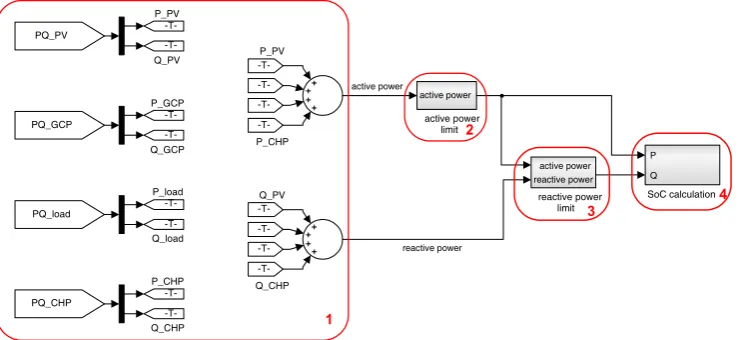
1. The real power and reactive power of all elements of the microgrid are combined. For this
purpose, the instantaneous active and power performance values of all models are imported into the model storage via a “from” block, and are then added separately according to active and reactive power.
2. Since the real power of the storage is limited, the sum of the active power of all other components
must be limited to minimum and maximum. For this purpose, an upper and lower limit value can be entered. Since all components have their own limitations, which is based on the maximum of the storage, there should be in principle no violation of the limit values. In order to be able to calculate the actual storage from the simulation, however, the occurring limit value violations, should they occur, should be included in the simulation. For example, a limit value may be briefly exceeded if an electric car is connected to a charging column. These excesses can be realized by short-term overloading of the inverter of the storage.
3. For clarity, the simple reactive power limitation and SoC determination is omitted.
6. Interconnection of components within the microgrid
In general, the three classes of components: supply, storage and load are interconnected and connected to the superimposed power grid. Any component may be connected and feed directly into any other component. The energy of the storage can be fed to both the load and the host network, and from the superimposed grid, in turn, the charging of the storage is possible. Furthermore, the load can be fed directly from the host network. From this general fully-interconnected model a specific model can be derived, required for the simulation of the real microgrid. It is also necessary to incorporate technical or regulatory constraints that may limit the flow of energy. For example, an infeed from the energy storage into the superimposed power grid must be suppressed, because the feed from a storage is not considered a renewable-source energy by the regulations. If the feed from the storage cannot be separately measured, it must be technically prevented.
7. Modelling of the power grid
In order to be able to estimate the possibilities of a microgrid operation mode, it is necessary to determine which task a microgrid should take over within the energy transmission network. The infeed of energy from the microgrid into the superimposed power network at high load times as well as the uptake of energy in weak load times - represents a meaningful task and can be used for basic considerations. The residual load at the network connection point of the selected medium voltage network to the high voltage network is the reference load profile. In order to visualize this load profile, the medium voltage network to be investigated must be simulated with all loads and feeders for a dynamic load calculation. If the medium-voltage network is not known or only insufficiently
known, various voltage benchmark networks can be used. Figure 7 shows the medium-voltage benchmark network of CIGRE with 30 nodes [23].
Figure 7. CIGRE benchmark 30-node MV grid.
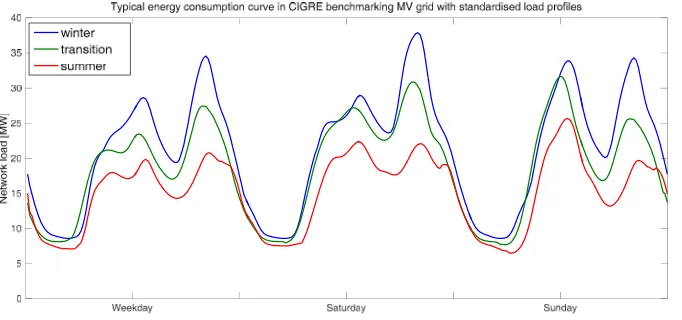
The outputs of nodes Kn00 to Kn29 represent loads for which the standard load profiles can be set if no real load profiles of the grid to be examined are available. With this modeled grid, a dynamic load flow calculation can be carried out, resulting in the load profile of the overall network. Capacity bottlenecks in the power supply network are neglected. If, however, the power supply network is sufficiently known, the integration of these real load profiles at the designated location must be taken into account in the generation of the load curves for the microgrid. The Microgrid can be connected in parallel to the grid, so the Microgrid only affects the load. Figure 8 shows the basic connection point in the benchmark network shown above (partial view was chosen for clarity).
Figure 8. Connection of a microgrid to the CIGRE benchmark network.
Figure 9. Typical load profile applied to CIGRE benchmark grid. 7.1. Modelling of a grid connection point
An exemplary implementation of the network connection point can be carried out in Simulink. Figure 10 shows a screenshot of the model.
Figure 10. Model of a grid connection point.
4. The load profile (Figure 9) is loaded into the model via a “from file” block. We assume a constant
power factor over the entire simulation time of the model. The reactive power curve can be determined accordingly.
5. If the storage can take up the energy from the grid connection point, the power that is to be fed
into the microgrid from the network can be assumed without restriction. According to these specifications, the storage must be designed in such a way that the power flow is positive as well as negative. If the storage is full, only the power that is needed as the balance of the other microgrid elements can be entered into the system.
6. This also applies to the power that the microgrid can provide to the superimposed network.
Here, as long as the storage has enough energy, an unrestricted availability can be assumed. However, if the storage is empty, only the balance of power of the other components can be assumed as available.
8. Optimization of microgrid components
Microgrids are suitable for achieving certain goals. Common to all of these goals is that the components are designed to meet the requirements of the microgrid and must be dimensioned in their critical properties. In order not to oversize the components, which adversely affects the profitability of a microgrid, the optimal component sizes have to be found [24]. In order to properly dimension the components within the microgrid, an optimization is required. For nonlinear
PQ_GCP
Goto max
MinMax >
Switch
>
Switch1
min
MinMax1 -K-Gain SoC_storage
Relay SoC_storage
Relay1
-u PQ_load
PQ_PV PQ_CHP
MG l_cr GCP profile
1
2
problems with constraints – found here – the Trust-region optimization presents a suitable method [25].
Trust region is a term used in mathematical optimization to denote the subset of the region of the objective function that is approximated using a model function (often a quadratic). If an adequate model of the objective function is found within the trust region then the region is expanded; conversely, if the approximation is poor then the region is contracted. The fit is evaluated by comparing the ratio of expected improvement from the model approximation with the actual improvement observed in the objective function. A model function is “trusted” only in the region where it provides a reasonable approximation. For clarity we do not provide more details on this optimization method. The theoretical and practical implementation aspects can be found, e.g. in [26, 27].
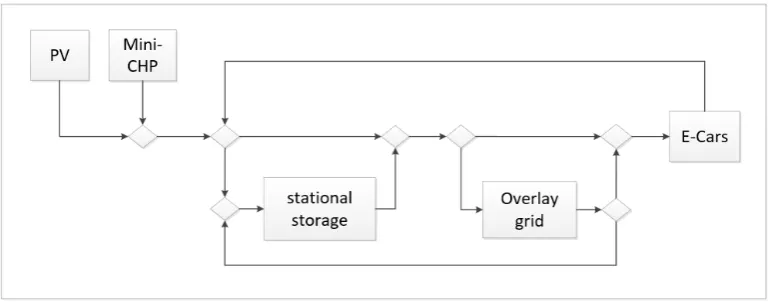
Figure 11 shows the energy flow of a sample plant where a PV plant and a mini-CHP are used as feeders, a stationary battery as energy storage, and electric cars are currently shown exclusively as a controllable load, and will be eventually considered later as bidirectional units, and a superimposed medium voltage network.
The bi-directionality is considered, although currently it is not enough scientifically documented regarding the influence, limits and possibilities of bidirectional electric cars on the superimposed energy network, in this case the microgrid. In case of such an interconnection for the simulation of a real microgrid, it must be ensured that there may be technical or regulatory limiting conditions that can restrict the flow of energy.
Figure 11. Energy flow diagram of a sample configuration of a microgrid.
In the example shown, as well as in the other chapters, it is assumed that no regulatory restrictions are to be observed. The control of each component, including the regenerative supply, as well as the supply to or from the superimposed power supply network is possible. For the bidirectional controllable electric cars it is assumed that the energy flow from the load into the storage as well as into the superimposed power supply network is possible. Technical limitations such as capacity bottlenecks of the technical network components (power cables, transformers, etc.) are not taken into consideration, as simulations as presented here are energy balancing models.
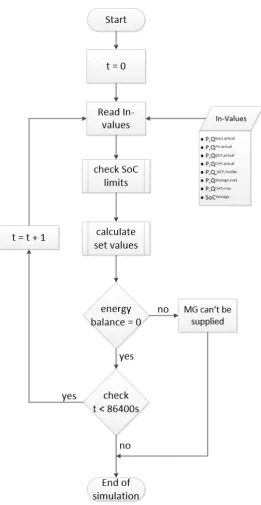
Figure 12. Exemplary flow diagram of a 24-hours simulation of a microgrid.
The limit-value check is an integral part of the simulation of a microgrid. In a simulation step, the limit values entered by the user are compared with the actual values occurring in the simulation at this time step. If the limits are not met, measures are formulated for the next simulation step. In the configuration shown here, the state of charge state (SoC) of the stationary storage is the leading quantity. If set charging states are exceeded, measures are taken for the next simulation step. If, for example, the limit value has fallen below (here SoC <20%), the mini-CHP is started as an additional supply. When the lowest limit is reached, the entire microgrid load profile is subjected to a limitation.
8.1. Control concepts for microgrids with a focus on the load supply
The premise for each control concept of a public or semi-public microgrid must be the relief of the upstream network while at the same time meeting all network requirements within the microgrid as well as the complete load supply, the latter having a very high-ranking role. A microgrid control concept, in which the load supply is not top priority, is theoretically conceivable, but will lead to a strong rejection by the users of the electric vehicles in a real implementation.
Using a priority tree, the variety of possibilities for prioritization can be demonstrated. A priority tree with 5 components, [16], shows 120 options for the priority order of the components. Taking into account the unconditional load supply and the subsequent use of all available PV energy, the reasonable possibilities are reduced to 6, which are shown in a tree structure in Figure 13. The control system in a complex system such as a microgrid model can either be defined by one of the components themselves or implemented separately by a superimposed controller.
Figure 13. Reasonable priorities for a microgrid optimization.
The stationary storage is suitable as a guide component. If, on the other hand, circular references occur between the components, that is, if mutually dependent components refer to one another, they are unsuitable as a control-guiding component. A circular cover occurs in a microgrid between supply and load. The load can only supply as much power in a closed system as the supply is currently available. The feed-in components, on the other hand, can feed only as much into the system as the load allows. This circular dependence has the effect of an infinite loop in a simulation when the PV system or the load is selected as the guide component.
selected as the guide variable, care must be taken of the delays of the components’ reaction during the control. For example, a mini-CHP has a certain initial and post-run time, so that the system can react immediately, but the desired effect is delayed. A limit values for the system reaction must be selected with a safety buffer, so that the battery is not charged above 100% or discharged to less than 0%. In order to be able to depict these effects adequately, a simulation in the millisecond clock is required. Exceeding the limit values can result in large inaccuracies during longer cycle times, as a result of which information loss may occur when limiting the values. A two-point control should always be used for a limit implementation. Such a two-point control prevents an oscillation between two states when a limit value overshoot leads to a reaction which would prevent the limit value from being exceeded. A two-point control has a dead region corresponding to a hysteresis. In this way, for example, the mini-CHP can be connected if the stationary storage falls below a defined SoC and is only switched off again when a higher SoC is reached. The mini-CHP will then be switched off again until the lower limit value is reached. Such regulations should be implemented for all supply and related components to ensure system stability.
8.2. Optimization of microgrid to support a medium voltage network
The example of a microgrid with 10 electric cars supplied by a PV system, a storage unit and a mini-CHP unit, while at the same time a load profile on the Grid Connection Point (GCP) is to be maintained. By optimizing the component sizing, the smallest possible setup of the photovoltaic system, the mini-CHP and the storage battery can be found, which can be used to supply both the load and the specified load profile at the GCP without having to down-regulate the PV system. The control algorithms and limit values are set according to the example of Figure 12, unless otherwise mentioned in the component description. The storage has a SoC of 5% at initialization of the model and is used to temporarily store the PV energy as well as to ensure the load profile. The cars are only loaded from the storage when they go into quick charge mode and the power within the microgrid is not sufficient. This microgrid model corresponds to an industrial microgrid as described in 4.3.
8.2.1. Feature-dependent generation
The solar irradiance values in a German city were recorded with a measuring instrument for a complete year for the supply-dependent feed. The measuring instrument consists of 33 measuring cells arranged on a spherical surface. As shown in [19], such a measuring instrument can be used to perform an almost exact reproduction of each photovoltaic system in the immediate vicinity of the measuring device. From the measured values an average curve for each cell was created separately for the period of summer. From a combination of different cells, a representative curve can be created for any PV plant. From all curves measured in the summer period (orientation south, angle of inclination 45 °), an average curve is formed which represents the average single-beam values for this period. These injection values are introduced into the simulation. The starting value is an installed power of the photovoltaic system of 80 kW peak, which is to be viewed as an optimization variable.
8.2.2. Storage
8.2.3. Load
Ten bi-directional electric cars for the simulation are modeled according to the procedure described in chapter 5.1. The average time of arrival and the average service life of each car were determined from the field tests carried out by electric car drivers. For the arrival time, a random value is calculated for each day in the determined time span. The average absorbed energy was calculated from the measurement data of the first three of four test periods (18 months in total).
The required energy per car is 9 - 20 kWh (total of 169 kWh). Again, the values of the test drivers measured in the field test of were used. The maximum required power per car is 9.5 kW. Each electric car can be controlled up to a minimum power of minus 9.5 kW, so that it is possible to feed the energy back from the car storage to the microgrid. Here, the state of charge of each car is considered separately. Until the time of departure, each car must be fully charged.
When the electric car is fully charged, only the power required to maintain the charge is drawn from the system until the user or the superimposed system disconnects the electric car from the charging column. Between arrival and departure, the electric car can be freely controlled within the simulation until the charging curve is reached. The load is assumed to be constant, i.e. all electric cars are simulated with corresponding power and corresponding energy requirements. They are not varied during optimization.
8.2.4. Mini-CHP
The mini-CHP modeled as in chapter 5.3 is activated in the simulation if the stationary memory falls below a critical value of 5% or the load is limited by more than 50% of the maximum power. When a load condition of 20% or a reduced load limit is reached, the mini-CHP is switched off, taking into account the start-up and stopping times. The heat component of the mini-CHP is neglected as it is assumed that the mini-CHP is connected to the heating network, so that this heating network is an infinite heat storage from the point of view of the mini-CHP. The mini-CHP is inserted into the simulation as a starting value with a power of 0 kVA. Later, it is added in increments of 5 kVA separately to illustrate the relationships between the increase in the power of the mini-CHP and the reduction in the performance of the other feeding components.
The CIGRE benchmark network, as described in chapter 7 was simulated for the transfer profile at the GCP and the standard load profiles were set at the network nodes.
8.3. Optimization of Components
With the help of an optimization, the components of a PV system, storage and mini-CHP are to be chosen in such a way that:
1. all electric cars are fully charged at the end of the day,
2. no PV energy has been lost and
3. the default load profile has been fully followed at the GCP.
The target function:
, , , = , − , , , , − , − , , , , , (1)
where: - storage power, - storage energy, - power of the PV system, - power of the
mini-CHP unit, , = default GPC load profile, , - simulated GPC load, , - input-PV
8.4. Results of Optimization and Discussion
In order to find a suitable starting point for the optimization, the energy balance within the microgrid is considered over a whole day. For this purpose the required daily energy quantity of the cars (111 kWh) and the daily energy amount at the GCP (180 kWh) are added with correct signs. The amount of energy required must be provided by the PV system and the CHP unit. Neglecting the mini-CHP, the above-described PV system has an installed power of 74 kW for an average summer day. This configuration makes it possible to determine the storage capacity of 100 kWh and a storage power of 26 kW. Figure 14 shows the real-time load profiles of the GCP, the PV system and the electric cars in kW, as well as the percentage of consumption in the load for the defined component dimensioning.
Figure 14. Microgrid profiles without mini-CHP.
It becomes clear that with the chosen storage dimensioning the energy of the PV system can be shifted in time so that no energy is lost. When the electric cars arrive, the energy available in the microgrid is not enough to charge the electric cars. It is even necessary to extract energy from the electric cars for the microgrid in order to be able to meet the default profile at the GCP. The energy flow changes as soon as enough energy is available through the PV system or from the superimposed power grid. At the end of the usage period of the electric cars, these were fully charged without violating the predefined profile at the GCP. The next step is to introduce the mini-CHP in the range from 0 kW to 30 kW in 5 kW steps into the simulation. All other components within the microgrid are not changed any further. For reasons of clarity, the representation of the performance profiles of all calculated variants is omitted.
Figure 15. Microgrid profiles with mini-CHP.
Due to the simulated control characteristics, the mini-CHP recharges the storage again if enough power is available. This behavior is programmed in the algorithm and can be modified so that the mini-CHP is only used to support the charging of the electric cars and to assure the compliance of the GCP load profile so that the storage would not be charged.
Table 1 shows the results of the optimization for the component storage and PV as a function of the selected mini-CHP power parameter. As can be clearly seen, there is almost no relation between the mini-CHP and the storage in the example shown. The storage dimensioning takes place predominantly on the basis of the predefined load profile at the GCP, specifically due to the uptake of energy from the superimposed network into the microgrid before the electric cars are connected. There is, however, a clear relation between the required PV power and the dimensioning of the mini-CHP. If the required PV power is plotted above the installed mini-CHP power, a straight line can be
approximated by a simple curve fitting, which is given by the function = 2.6 + 73.
Figure 16. Required PV power in relation to mini-CHP.
Table 1. Results of optimization of the component storage and PV as a function of the selected mini-CHP power.
Mini-CHP PV Storage
Capacity
Storage Power
0 kW 74 kW 100 kWh 26 kW
5 kW 61 kW 100 kWh 26 kW
10 kW 49 kW 96 kWh 26 kW
15 kW 35 kW 91 kWh 26 kW
20 kW 18 kW 91 kWh 26 kW
25 kW 10 kW 91 kWh 26 kW
30 kW 0 kW 91 kWh 26 kW
9. Discussion and Outlook
Although there are relations between the feed-in components for a component dimensioning, no direct relationship between the storage dimensioning and the dimensioning of the PV system or the mini-CHP could be established. The feed-in components complement each other linearly so that the available power within the microgrid can be assumed to be constant. The storage is used to vary the energy over time so that it can be assumed that the required capacity does not change with the power within the microgrid. For the sizing of the battery, the energy absorbed from the superimposed energy network is primarily decisive in the example presented here. Furthermore, it was found that the objectives of the microgrid to be defined beforehand as well as the objectives of each component strongly affect the dimensioning. A change in the control characteristics leads directly to an adaptation of the required component dimensions and must therefore be determined before the component optimization, or be treated as a optimization variable, in order to adapt the required components to own objectives.
In this paper, microgrids were generally described and classified. The diversity of the component composition and the importance of the dimensioning of each individual component for the corresponding application area were demonstrated. It was shown how optimization of component sizing is possible. For this purpose, an example microgrid is simulated. It has been found that component sizing is strongly dependent on the objectives and the target algorithm to be defined. A change in the control algorithm for a component requires the re-dimensioning of all components to be considered within the microgrid.
Further studies have shown that the nine variants resulting from the summer, winter, and transition seasons and the three working days of the week, Saturday and Sunday, lead to different dimensions of the required components despite the same goals and the unchanged algorithm. Therefore, all nine variants should be simulated and the components separately optimized in order to be able to define a variant which corresponds to the desired goals.
Acknowledgment: Partially supported by the SGS grant No. SP2016/95 and project TUCENET No. LO1404 by VSB - Technical University of Ostrava, Czech Republic.
Author Contributions: Tobias Porsinger and Przemyslaw Janik conceived and designed the simulation system and optimization; Radomir Gono supervised the research and analyzed the data; Zbigniew Leonowicz wrote the paper.
Conflicts of Interest: The authors declare no conflict of interest.
References
1. Information Platform of German Network Operators, EEG-Anlagenstammdaten, Available online: www.netztransparenz.de (accessed on 1 May 2016).
2. 50Hertz GmbH, internal company report, unpublished.
3. Eltawil M. A. and Zhao Z., “Grid-connected photovoltaic power systems: Technical and potential problems -A review,” Renewable and Sustainable Energy Review, vol. 14, no. 1, pp. 112-129, 2010.
4. Pinto R., S. Mariano, do Rosário Calado M., de Souza J. F., Impact of Rural Grid-Connected Photovoltaic Generation Systems on Power Quality, Energies 2016, 9, 739
5. Kenneth A. P., Folly K., Voltage Rise Issue with High Penetration of Grid Connected PV, 19th World Congress The International Federation of Automatic Control Cape Town, South Africa. August 24-29, 2014 6. System Integration of Renewables: Implications for Electricity Security, Report to the G7, International
Energy Agency, February 2016
7. Lasseter, R. H. MicroGrids, Proceedings of the Power Engineering Society Winter Meeting, 2002. IEEE: Piscataway, NJ, USA, 2002, pp. 305-308 vol.1.
8. Hatziargyriou, N. , Asano H., Iravani R., Marnay, C. Microgrids. IEEE Power and Energy Magazine, 2007, Volume 5, no. 4, pp. 78-94, doi: 10.1109/MPAE.2007.376583.
9. Schiffer, J., Zonetti, D., Ortega, R., Stankovic, A., Sezi, T., Raisch, J., A survey on modeling of microgrids - from fundamental physics to phasors and voltage sources, eprint arXiv:1505.00136, 05/2015, printed in Automatica, volume 74, December 2016, Pages 135–150
10. Aziz, M.; Oda, T.; Mitani, T.; Watanabe, Y.; Kashiwagi, T. Utilization of Electric Vehicles and Their Used Batteries for Peak-Load Shifting. Energies 2015, 8, 3720-3738.
11. Misak, S., Stuchly, J., Vramba, J., Vantuch, T., Seidl, D. A novel approach to adaptive active relay protection system in single phase AC coupling Off-Grid systems. Electric power systems research, 2016, volume 131, pp. 159-167
12. Lopes, J. A. P., Soares F. J., Almeida P. M. R. Integration of Electric Vehicles in the Electric Power System. Proceedings of the IEEE, 2011, vol. 99, no. 1, pp. 168-183, doi: 10.1109/JPROC.2010.2066250.
13. Latvakoski, J.; Mäki, K.; Ronkainen, J.; Julku, J.; Koivusaari, J. Simulation-Based Approach for Studying the Balancing of Local Smart Grids with Electric Vehicle Batteries. Systems 2015, 3, 81-108.
14. Guerrero, J. M. Chandorkar, M. Lee, T. L., Loh, P. C. Advanced Control Architectures for Intelligent Microgrids—Part I: Decentralized and Hierarchical Control. IEEE Transactions on Industrial Electronics, 2013, Volume 60, no. 4, pp. 1254-1262, doi: 10.1109/TIE.2012.2194969.
15. Porsinger, T.; Janik, P.; Leonowicz, Z.; Gono, R. Component modelling for microgrids. Proceedings of the 2016 IEEE 16th International Conference on Environment and Electrical Engineering, EEEIC, Florence, Italy, 7-10 June 2016, Florence, Italy; IEEE: Piscataway, NJ, USA, 2016, doi:10.1109/EEEIC.2016.7555869.
16. Porsinger, T. Contribution to the Sizing of Components of Microgrids. PhD Thesis, BTU Cottbus-Senftenberg, Cottbus, Germany, 2014.
17. Woitow, M., Influence of Microgrids on MV Network, Diploma Work, BTU Cottbus-Senftenberg, Cottbus, Germany, 2014.
18. Savadogo, S: Network Dynamics of Photovoltaic systems, BTU Cottbus-Senftenberg, Cottbus, Germany, 2011.
19. Janik P., Waclawek, Z., Schwarz, H., Porsinger, T.: Assessment of PV generation based on spherical irradiation measurements, ICREPQ ’14, Córdoba (Spain), 2014.
20. VDE-Study, “Distributed Generation in 2020“, VDE Publishing, Frankfurt/Main, 2007.
22. Bodach M.: Energy Storage in LV Network for Integration of fluctuating, distributed sources of energy, PhD Thesis, Technical University Chemnitz, 2006.
23. K. Rudion, A. Orths, Z. A. Styczynski, K. Strunz, Design of Benchmark of Medium Voltage Distribution Network for Investigation of DG Integration, IEEE Power Engineering Society General Meeting, 2006. 24. Misak, S., Stuchly, J., Platos, J., Kromer, P. A heuristic approach to Active Demand Side Management in
Off-Grid systems operated in a Smart-Grid environment. Energy and buildings, 2015, volume 96, pp. 272-284
25. Sorensen D.C.. Newton’s Method with a Model Trust Region Modification”, SIAM J. Numer. Anal., 1982, 19(2), 409–426.
26. Yuan Y. A review of trust region algorithms for optimization” in ICIAM 99: Proceedings of the Fourth International Congress on Industrial & Applied Mathematics, Edinburgh, 2000 Oxford University Press, USA.
27. Yuan, Y. “Recent Advances in Trust Region Algorithms”, Math. Program., 2015, 151(1), 249-281, doi:10.1007/s10107-015-0893-2