Article
1
A DCVS Reconstruction Algorithm for Mine Video
2
Monitoring Image Based on Block Classification
3
Xiaohu Zhao 1,2 , Xueru Shen 1,2, * , Kuan Wang1,2 and Wanmei Li1,2
4
1 The National and Local Joint Engineering Laboratory of Internet Application Technology on Mine, Xuzhou
5
221000, China; [email protected]
6
2 China University of Mining and Technology, Xuzhou 221000, China; [email protected]
7
* Correspondence: [email protected]; Tel.: +86-151-525-01697
8
9
Abstract: Aiming at the problems that large amount of video monitoring image data in underground
10
coal mines leads to difficulties in transmission and storage, compressed sensing theory is introduced
11
to encode and decode video images, and a new distributed video coding scheme is proposed. In
12
order to obtain more sparse representation and more general applicability, a block-based adaptive
13
sparse base scheme is proposed. For the acquisition of side information, fixed weight is usually used
14
to synthesize side information and the correlation between different image blocks is neglected, a
15
block-based classification weighted side information generation scheme is proposed. Experimental
16
results show that the block-based classification codec scheme can make full use of inter-frame
17
correlation. Under the appropriate sampling rate, the PSNR value of video reconstruction increases,
18
which effectively improves the quality of video frame reconstruction.
19
Keywords: compressed sensing; distributed video codec; sparse representation; side information
20
reconstruction
21
22
1. Introduction
23
Coal is an important basic energy source in China and plays a decisive role in the development
24
of economic construction [1]. As a non-renewable resource, the shallow coal mine resources are
25
gradually mined and turned to the exploitation of deep coal seams, and the dangers that come with
26
it are also increasing. Mine smart monitoring, coal seam identification and mineral detection have
27
high requirements on the quality and real-time performance of video images, especially in
28
unattended working areas in coal mines [2]. The amount of data of the monitoring image is large, so
29
the requirement for the device in terms of image transmission and storage is high. The wireless
30
sensor network (WSN) relies on low-power wireless sensor nodes, overcomes the difficulties of
31
wired transmission wiring, incomplete detection information, high deployment costs and poor
32
flexibility, and is widely used in the transmission of information in coal mines. Due to the
33
particularity of underground coal mine working environment, a large number of sensor nodes need
34
to be arranged downhole to monitor various signals such as gas concentration, temperature,
35
humidity, and mine quake signals. Therefore, the amount of data the sensor needs to process is
36
huge. However, the node energy and transmission bandwidth of the sensor are limited, and the
37
energy supply of the mine node is difficult, so it is hard to apply a large amount of data collection.
38
How to reduce the amount of information transmission and energy consumption of nodes is an
39
urgent task to extend the life cycle of wireless network nodes, and data compression is a data
40
processing technology that can effectively reduce the amount of data transmission. Compared with
41
the traditional Nyquist sampling mode, Compressed Sensing [3-4] technology is devoted to
42
searching for sparse solutions of underdetermined linear systems. The signal can be reconstructed
43
with a sampling rate much lower than the Nyquist sampling rate [5], which is suitable for signal
44
processing.
45
In the video codec scheme, traditional video coding such as MPEG/H.26X, there will be a large
46
amount of motion estimation and motion compensation [6], which makes the encoding side much
47
more complex than the decoding side, this asymmetric coding scheme is suitable for a situation
48
where multiple encodings are encoded at one time, such as broadcasting. However, more scenarios
49
require low complexity, low power consumption, and low compression ratio at the encoder end. The
50
distributed video coding (DVC) has low coding complexity and is suitable for use in scenarios
51
requiring low complexity. In a distributed video coding scheme, the decoder performs motion
52
estimation and compensation to find the correlation between adjacent frames, which makes the
53
coding side less complex than the decoding side. When using CS theory to reconstruct the signal, the
54
encoding side is less complex than the decoding side. However, using only the CS theory cannot
55
provide us with a sufficiently low sampling rate, so we combine the CS theory and the DVC theory
56
to form a new theory -- distributed compressed video sensing (DCVS) to make up for this deficiency.
57
The DCVS technology allows independent encoding of multiple statistically related signals at the
58
encoder and joint decoding at the decoder, which eliminates the need for complex motion estimation
59
and compensation at the encoder end, thereby reducing the complexity of the encoder.
60
Combining the compressed sensing theory and the characteristics of distributed video codec,
61
this paper proposes a block-based adaptive sparse representation and weighted side information
62
reconstruction scheme. Firstly, the related theories of compressed sensing and distributed video
63
coding are briefly introduced. Based on the correlation between video frames, a block-based
64
classification sparse representation and classification weighted side information reconstruction
65
scheme is proposed. Experimentally, the reconstructed PSNR value and time complexity are
66
obtained, the experimental results are analyzed to verify the effectiveness of the algorithm.
67
2. Research Background Theoretical Analysis
68
2.1.Analysis of Characteristics of Wireless Sensor Network and Video Image in Underground Coal Mine
69
Under the special working environment of coal mines, if we want to fundamentally solve the
70
problem of safe and efficient production of coal mines, the coal mining industry must shift from
71
labor-intensive to technology-intensive, making it a new industry, new business model, and new
72
model with high-tech features, and take the road of smart, few people (unmanned) and safe mining
73
[7]. Under the transition of technology-intensive, wireless sensor networks are widely used in
74
information transmission in coal mines because of their advantages such as low-power sensor nodes.
75
The communication distance between WSN nodes is limited, and a large number of sensor nodes
76
need to be arranged. However, the energy of the nodes is limited. The more data the nodes send and
77
receive, the greater the energy consumption. But the downhole power supply in coal mines is
78
difficult, so the data transmission needs to be reduced to reduce energy consumption. Large-scale
79
deployment of sensor nodes will cause different nodes in the network to transmit similar data,
80
resulting in a large amount of data redundancy and reducing transmission efficiency. Therefore, it is
81
very necessary to apply compressed sensing theory to deal with video images in coal mines. In the
82
collection of video images in underground coal mines, the collected images are mostly grayscale
83
images composed of black and white. The hue is relatively single, but the correlation between
84
adjacent images is very strong, and there is a large amount of redundant information between video
85
frames. Compressed sensing technology can compress image information better and reduce
86
transmission pressure.
87
2.2. Compressed Sensing Theory
88
The compressed sensing theory proposed by Donoho et al. is a novel sampling theory. From the
89
perspective of analog to digital conversion, the compressed sensing theory provides a method of
90
from the traditional sampling theorem, the theory points out that the precondition for the signal
92
sparse representation is that the signal is sparse. The signal
x
is thus converted to other domain93
space, represented by the sparse signal
y
. Consider an image signalx
of length N whose94
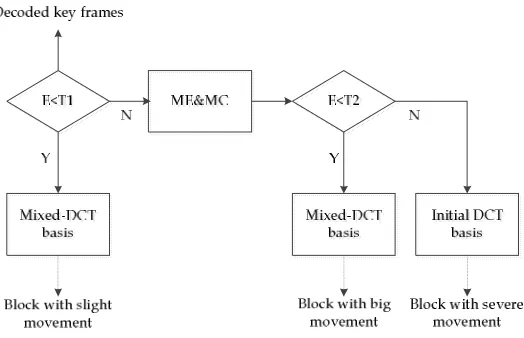
transform coefficient on some orthogonal base
is expressed as:95
x
(1)96
Where
is the coefficient vector ofx
on the orthogonal basis
, the nonzero number of
is K97
and K<<N, The signal
x
is called K-sparse signal. The linear prediction of the signalx
is98
performed using an observation matrix
M N (M<<N) that is incoherent with the orthogonal basis99
:100
y
x
(2)101
Where
y
is the observation value and
is the observation matrix. In this way, M linear102
predictions which are much smaller than N are obtained, and by solving an optimization problem,
103
the original signals
x
can be reconstructed with high probability from these few projections. It can104
be proved that such a projection contains enough information to reconstruct the signal. In this
105
theoretical framework, the sampling rate is not determined by the bandwidth of the signal, but
106
depends on the structure and content of the information in the signal.
107
2.3 Distributed Video Coding Theory
108
Distributed video coding (DVC) is a specific application of distributed source coding (DSC) in
109
video processing. DSC is the codec problem of distributed sources that are related to each other in
110
time or space. The information theory basis of DVC is Slepian-Wolf and Wyner-Ziv theorem [9].
111
Slepian-Wolf theory describes the conditions that need to be satisfied for lossless coding of related
112
sources. It is proposed that the related source "independent coding, joint decoding" can be the same
113
compression efficiency as "joint coding, and joint decoding". The Wyner-Ziv theory is supplement
114
and development based on the Slepian-Wolf theory and discusses the description of the
115
rate-distortion function
R
WZX Y/( )
D
of the relevant source coding in the case of lossy coding. The116
Wyner-Ziv rate-distortion function shows the lower limit of the code rate for distributed coding
117
under a distortion constraint. In the case of lossy coding, the rate distortion function obtained by
118
using the side information only at the decoding end and using at the codec side is consistent [6].
119
Generally, Wyner-Ziv encoding can be equivalent to quantifying sources and then performing
120
Slepian-Wolf encoding.
121
3. Video Image Sparsity Analysis and Compression Coding Processing
122
3.1.Sparse Representation of the Signal
123
3.1.1. Block-prediction and DCT Mixture Sparse Basis
124
From Fourier transform to wavelet transform to later multi-scale geometric analysis, the
125
purpose of the scientists' research is to study how to provide a more concise and direct analysis
126
method for signals in different functional spaces. All of these transformations are designed to exploit
127
the characteristics of the signal and sparsely represent it, or to improve the nonlinear function
128
energy concentration of the decomposition coefficients using a set of bases in a certain space. From
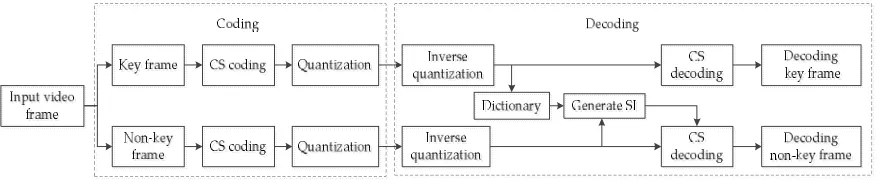
130
the perspective of signal analysis, the Fourier transform is the basis for signal and digital image
131
processing. Wavelet analysis brings signal and digital image processing to a whole new field.
132
Multi-scale geometric analysis is a new generation of signal analysis tool following wavelet analysis.
133
It has many excellent features such as multi-resolution, localization and multi-directionality. It is
134
more suitable for processing multi-dimensional signals such as images. All these studies laid the
135
foundation for the theory of compressed sensing.
136
In order to get a better sparse representation, many methods have been studied. In the
137
traditional DCVS framework, linear or orthogonal transform bases such as discrete cosine transform
138
(DCT) or discrete wavelet transform (DWT) are widely used due to their simple and efficient
139
features. Traditional video compression or distributed video coding (DVC) technology based on
140
motion estimation and motion compensation all rely on a high-cost mechanism, that is, perception
141
or sampling and compression are not performed continuously, which leads to waste of resources. In
142
other words, most of the collected raw video data may be discarded in the complex compression
143
process [10]. However, learning-based dictionaries can provide a more sparse representation of
144
image signals than these pre-specified base classes. A dictionary learned from a set of blocks globally
145
extracted from the previous reconstructed neighboring frames is used as sparse basis in [11].
146
Nevertheless, this dictionary is based on K-SVD algorithm [12] and can be only applied in some
147
specific applications. Dictionaries reported in [13] and [14] are generated by a linear combination of
148
neighboring blocks in preceding and following key frames. However, with limited reference
149
information, the learned dictionary may not be sufficiently redundant. In [15], a simple side
150
information generation technique based on correlation analysis of CS measurements is effective in
151
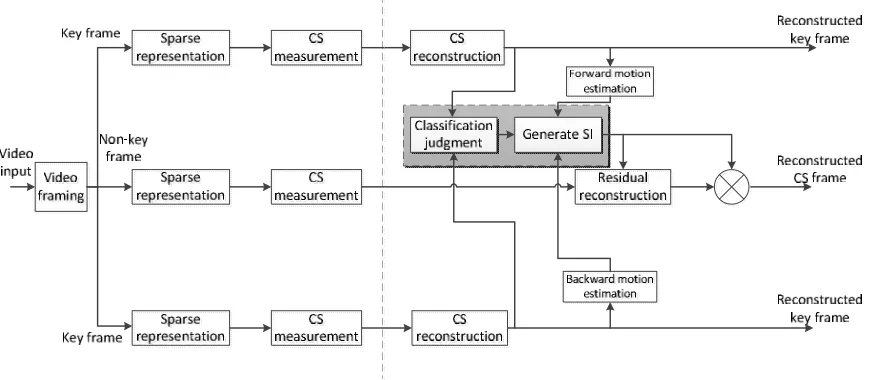
complexity reduction. But the rate-distortion performance is unsatisfying compared with other
152
schemes.
153
In the traditional video codec, a hybrid coding method combining prediction and DCT can
154
quickly reduce spatiotemporal correlation and obtain a more sparse representation of the video
155
frame. In order to obtain better rate-distortion performance, we propose a new block prediction and
156
hybrid sparse basis for non-key frames with reference to this hybrid coding method. As shown in
157
equation (3), the new sparse basis consists of two parts, the initial DCT matrix and the
158
block-prediction basis. In this way, initial DCT basis is acquired by linear transform in DCT domain
159
while block-prediction basis is based on the SI generated from the adjacent decoded key frames.
160
DCT;
inter
i (3)161
Where
DCT
R
N N is an initial DCT basis,
inter
R
N1 is a block-prediction basis and162
( 1)
N N
i
R
is a newly built hybrid DCT basis.163
3.1.2. Classification Judgment Standard
164
In order to obtain more sparse representations and more general applicability, this paper
165
proposes a new hybrid sparse scheme that combines linear DCT bases and block prediction bases to
166
solve sparse representation problems. Adaptive block-based prediction is used to generate side
167
and the time redundancy is particularly large, that is, the inter-frame correlation is very strong. By
169
utilizing the correlation between adjacent frames, the scheme can achieve more sparse
170
representation while reducing the complexity.
171
Different regions in the video sequence have different inter-frame correlations. We propose an
172
adaptive block prediction scheme for sparse representation. Perform the non-overlapping block
173
processing of the reconstruction results of the two adjacent key frames before and after the current
174
non-key frame. The difference between the i-th block
x
ti1 of the following frame and the i-th block175
i t
x
1 of the previous frame at the corresponding frame may reflect the correlation between the176
inter-frames in the video sequence. Consider the residual energy values of the two corresponding
177
frame sub-blocks as the classification criteria, and define the residual energy value as shown in
178
equation (4):
179
E x
(
ti,
x
ti)
x
ti
x
ti 21 1 1 1 2 (4)
180
However, for video frames where video scenes change rapidly, the residual energy value of the
181
corresponding position may be large. Therefore, simply using the residual energy value as the
182
classification criterion will cause the threshold value to be too dependent on the sequence itself,
183
making the algorithm less versatile. Based on this, it is thought that the ratio of the residual energy to
184
the energy block of the previous key frame is used as the classification criterion, as defined by
185
equation (5):
186
(
,
)
(
,
)
(
)
i i
i i t t
t t i
t
E x
x
e x
x
E x
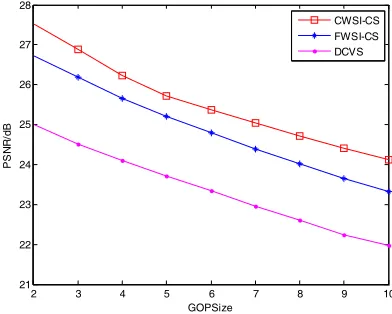
1 11 1
1
(5)
187
The video frame sub-blocks are classified using thresholds T1, T2 (T1 < T2) for video sequences.
188
Calculate the value of the judgment function of the i-th block according to equation (5).If
189
(
ti,
ti)
e x
1x
1
T
1,then the block is defined as block with slight movement; ifT1e x( ti1,xti1)T2190
,then the block is defined as block with big movement; and if ( i , i )
t t
e x1 x1 T2, then the block is
191
defined as block with severe movement. In the experiment, the video frame is subjected to block
192
classification processing. The classification judgment thresholds T1 and T2 take 0.003 and 0.015
193
respectively. After block classification of non-key frames, the classification results and
194
196
Figure 1. Block classification of non-Key frames
197
After the non-key frames are blocked according to the defined classification criteria, different
198
sparse-based strategies are proposed for different types of blocks. Algorithm 1 describes the process
199
of adaptive hybrid DCT-based learning. For the block with slight movement, predictions are
200
generated by generating the side information by performing forward and backward motion
201
estimation on adjacent decoded key frames. The block prediction basis is learned and combined with
202
the DCT basis to construct a hybrid DCT basis. For the block with big movement, by selecting
203
different weights and combining forward and backward motion estimation to obtain side
204
information, the construction method of the hybrid DCT base is similar to the block with slight
205
movement. For the block with severe movement, the inter-frame correlation between adjacent
206
frames is small, and motion estimation and compensation cannot accurately predict these
207
fast-changing blocks. Therefore, for this type of block, only the initial DCT basis can be used. The
208
description of algorithm 1 is as follows.
209
Algorithm 1: The hybrid DCT sparse basis algorithm based on block prediction.
210
Input: i1
,
i1t t
x
x
:Neighboring decoded key frames as reference for the i-th non-key frames.1. Calculate the residual energy value of the corresponding frame sub-block:
(
i,
i)
i it t t t
E x
1x
1
x
1
x
1 22;2. Calculate the ratio
(
,
)
(
,
)
(
)
i i
i i t t
t t i
t
E x
x
e x
x
E x
1 11 1
1
of the residual energy to the energy block
of the previous key frame as a classification criterion;
3. Calculate side information
SI
i
x
ti1
(
1
)
x
ti1, Where
selects different weightsaccording to the classification;
4. If
(
i,
i)
t t
e x
1x
1
T
1,
0 8
.
, int/ 255
t i
er
x
,
t( )
i
DCT;
inter
;5. If
(
i,
i)
t t
T
1
e x
1x
1
T
2,
0 5
.
, int/ 255
t i
er
x
.
0 3
,
t( )
i
DCT.Output:
t( )
i
:Hybrid DCT sparse basis for the t-th block in the i-th non-key frame.3.2. Design of Observation Matrix
211
After the sparse representation, how to design a stable
M
N
dimensional observation212
matrix Φ that is not related to the transform basis Ψ, and ensure that the important information of
213
the sparse vector
when descending from the N dimension to the M dimension is not destroyed,214
this is the second problem to be solved.
215
In compressed sensing theory, after the sparse coefficient vector
TX
of the signal is216
obtained by transformation, the observation part of the compressed sample is designed. The
217
purpose of the observation matrix design is how to sample and obtain M observations, and it can be
218
ensured that a signal X of length N or a sparse coefficient vector Ψ of the base Ψ can be
219
reconstructed from it. The importance of the observation matrix design is that if the signal X is
220
destroyed during the observation process, it is impossible to reconstruct signal successfully. The
221
observation process actually uses the M row vectors
1
M
j j of the
M
N
dimensional222
observation matrix Φ to project the sparse coefficient vector. That is, to calculate the inner product
223
between θ and each observation vector
1
M
j j , and get M observations
224
,
(
, ,...,
)
j j
y
j
1 2
M
, for the observation vectorY
( ,
y y
1 2,...,
y
M)
, that is225
T CS
Y
X
A X
(6)226
The sampling process here is adaptive, that is, θ does not have to change according to the
227
change of X, and the observed data is no longer a point sampling, but a more general K linear
228
functional of the signal.
229
Given a vector Y, finding θ from equation (6) is a linear programming problem. However,
230
since M<<N, that is, the number of equations is less than the number of unknowns, this is an
231
underdetermined problem and the deterministic solution cannot be calculated. However, if θ has
232
K-sparseness (K<<M), it is expected to find a certain solution just try to determine the appropriate
233
position of the K non-zero coefficients
i in
. Since the observation vector Y is a linear234
combination of K non-zero coefficient column vectors, a linear equation of
M
N
is formed to235
solve the specific values of these non-zero terms. For whether there are necessary and sufficient
236
conditions for determining the solution, Restricted Isometry Property (RIP)[16] gives the definition,
237
The necessary and sufficient conditions for the definition are consistent with the geometric
238
properties proposed by Candes and Tao et al that the sparse signals must maintain under the
239
observation matrix. In the reconstruction process of the signal, in order to completely reconstruct
240
the signal, it must be ensured that the observation matrix does not map two different K-term
241
coefficient signals into the same sampling set, which requires that the matrix formed by the M
242
column vectors extracted from the observation matrix is non-singular. So the key to solving such
243
problems is how to determine the position of the non-zero coefficients to form a linear system of
244
equations.
245
How to judge the RIP property of a given matrix
A
CSis a combination complexity problem.246
Finding an alternative method that can easily implement RIP characteristics is the key to
247
successfully constructing the observation matrix. If the observation matrix θ and the sparse basis
248
are guaranteed to be uncorrelated,A
CScan largely satisfy the RIP property. Irrelevant means249
that the vector
j cannot be sparsely represented by
j . The stronger the irrelevance, the250
Candes E J et al. proved that when Φ is a Gaussian random matrix, the incoherence and RIP
252
conditions can be satisfied with a large probability. Therefore, the observation matrix Φ in this
253
paper adopts a random Gauss matrix. A random Gaussian matrix has a useful property: for a
254
M
N
random Gaussian matrix Φ, it can be shown that whenM
cK
log(
N K
/
)
,
TA
CS255
satisfies the RIP property with a large probability (where c is a small constant). Therefore, a K-term
256
sparse signal length of N can be reconstructed with high probability from M observations. The
257
random Gaussian matrix is not related to the matrix formed by most fixed orthogonal bases. This
258
property determines the choice that we choose it as an observation matrix. When other orthogonal
259
bases are used as the sparse transform base, the RIP can be satisfied.
260
3.3. Compressed Codec Processing Research
261
Compressed sensing is a new way of signal acquisition that allows us to design very simple
262
video encodings that can be implemented on mobile devices with limited resources. However, the
263
CS-based video codec proposed by the predecessors either requires a conventional video encoder or
264
a feedback channel, which increases the complexity of the codec. The distributed compressed video
265
sensing (DCVS) codec scheme proposed in this paper uses CS only at the encoding end, and the
266
decoder uses a correlation between CS measurements of adjacent frames to form a new side
267
information generating scheme. The new DCVS block diagram we proposed is shown in Figure 2.
268
This codec is completely CS-based and does not involve traditional video encoders. Both key and
269
non-key frames are encoded as CS measurements and no feedback channel is required.
270
271
Figure 2. DCVS video codec scheme
272
At the encoding end, the video sequence is divided into a number of Group of Pictures (GOPs).
273
Video frames are divided into key frames and non-key frames, non-key frames also called
274
Wyner-Ziv (WZ) frames, which form a group of pictures. Each GOP contains one key frame and
275
several non-key frames. Both key frames and non-key frames are coded with similar CS theory.
276
At the encoding end, each key frame is reconstructed by the SAMP algorithm, which redefines
277
the l1 minimization problem, as shown in equation (7).
278
min
kk k k
y
A
2
2 1
1
2
(7)279
Where
y
k is the CS measurement of the key frame obtained at the decoding end,A
has280
been described in the previous,
k
R
N
1
is the sparse coefficient vector of the solution. Key281
frame
x
ˆ
k is obtained byx
ˆ
k
ˆ
k, where
ˆ
k is the optimal solution of
k in equation (7).282
The decoding of non-key frames are assisted by the side information generated by the
283
dictionary and the side information is generated by the inverse quantized CS measurement of the
284
key frame. The effect of side information is only apparent when there is sufficient correlation
285
frames in the same scene are highly correlated. Therefore, we assume that even if the CS
287
measurement process is very different from a linear transformation (such as DCT), the CS
288
measurement of such adjacent frames is highly correlated. On the one hand, the DCT coefficients
289
follow a Laplacian distribution. On the other hand, CS measurements follow a more or less normal
290
(Gaussian) distribution.
291
4. DCVS Framework Based on Block Classification Weighted Side Information
292
4.1. Description of the Framework
293
In the DCVS framework, in order to improve the reconstruction quality of non-key frames at
294
the decoding end, side information is introduced when reconstructing non-key frames. Therefore,
295
the acquisition of side information plays a very important role in the DCVS framework. Especially
296
for the reconstruction of non-key frames, if the acquisition of side information is not accurate, the
297
performance of its reconstruction will be greatly affected. The process of obtaining the side
298
information may be generated by using a K-SVD training dictionary or performing motion
299
estimation on the decoded key frame, interpolating in the time domain to generate side information.
300
Most of the traditional methods of obtaining the side information are to estimate the forward and
301
backward motion of the reconstructed values of the two key frames before and after the current
302
frame, then according to a fixed weight (usually 1/2), adding to obtain the side information to assist
303
in the reconstruction of non-key frames [17]. However, the inter-frame correlations of different
304
regions in the video sequence are different, and the varying scenes and motion levels of the video
305
are different. If the inter-frame correlation between the forward and backward motion estimation is
306
weak, still using a fixed weight does not predict the current frame very well, so the accuracy of the
307
generated side information is not high, which in turn affects the reconstruction of non-key frames.
308
Therefore, the traditional method of synthesizing side information by using fixed weight 1/2 does
309
not make good use of inter-frame correlation. According to the correlation between different blocks
310
of video frames, a DCVS framework based on different blocks is proposed. The framework is
311
shown in Figure 3.
312
313
Figure 3. Block-based classification weighted side information DCVS framework
314
At the encoding end, the current frame and the two key frames are subjected to block sparse
315
representation and CS sampling measurement. The key frames are sampled by the traditional DWT
316
algorithm, the non-key frames are sampled by the hybrid sparse algorithm, and the measurement
317
matrix still selects the random Gauss matrix. At the decoding end, the key frame is first
318
reconstructed by SAMP algorithm, and then the classification judgment method introduced in the
319
estimation on reconstructed values of adjacent key frames, different weighting schemes are used to
321
generate side information according to different block categories. And the reconstruction of
322
non-key frames requires the use of side information in conjunction with residual decoding of
323
non-key frames.
324
4.2. Non-key Frame Reconstruction
325
The reconstruction of non-key frames uses the motion estimation of the classification weights
326
to generate the side information, and then uses the side information and the measured values of the
327
current frame to reconstruct the residual of the current frame. The reconstruction result of the
328
non-key frame is the combination of the side information and the residual reconstruction.
329
Assuming that the current frame of a video is
x
and the predicted value of the current frame330
is
x
, the residual between the actual result and the predicted value of the current frame is331
r
x
x
, the predicted valuex
of the current frame is generated by predicting the current frame332
from the pre- and post-decoding key frames. Since the decoding end has not yet obtained the
333
reconstructed data of the decoded key frames before and after the current frame, so we convert the
334
residual to the measurement domain:
335
d
r
x
x
y
x
(8)336
If the difference between the actual value and the predicted value of the current frame is
337
smaller, the smaller the residual of the two is, the sparser it is, the smaller the sampling under the
338
measurement matrix is, and the better the reconstruction effect of the residual is. The reconstruction
339
result of the current frame is:
340
x
rec
x r
rec (9)341
Where
x
rec is the reconstruction result of the current frame,x
is the predicted value of the current342
frame, and
r
rec is the result of the residual reconstruction.343
In the acquisition of side information, it is necessary to utilize the reconstruction result of
344
adjacent decoding key frames [18]. First, forward and backward motion estimation is performed on
345
the reconstruction results of the i-th blocks
x
ti1 andi t
x
1 corresponding to the adjacent decoding346
key frames to obtain
ˆ
i tx
1 andˆ
i t
x
1 respectively, then find the side information of the i-th block347
according to equation (10):
348
i
ˆ
i(
)
ˆ
it t
SI
x
1
1
x
1 (10)349
Where
is the weight coefficient.350
In the previous section, the non-key frame blocks have been classified and judged. After the
351
blocks of different regions are classified, different weights
are adopted to obtain the side352
information, thereby further reconstructing the non-key frames. For the block with slight movement,
353
the ratio of the residual energy to the energy block of the previous key frame is small, and the
354
inter-frame correlation of the preceding and succeeding frames is large. According to equation (5),
355
the forward motion estimation can predict the current frame very well, and then take
to a356
larger value. Conversely, for the block with severe movement, the inter-frame correlation is small,
357
and the backward motion estimation can better predict the current frame, and then take
to a358
smaller value. For the block with big movement, the inter-frame correlation is moderate, and the
359
current frame can be predicted by weighted averaging of forward and backward motion estimation.
360
Based on the above analysis, the weights of the block with slight, big and severe movement are
361
respectively set to
0 7 0 5 0 3
. , . , .
.362
In summary, for the reconstruction process of non-key frames summarized as follows: Firstly,
363
the adjacent key frames are reconstructed, and the reconstruction results are classified and judged,
364
and the forward and backward motion estimation is performed on adjacent key frames. Combined
365
with the classification criteria and forward and backward motion estimation, the side information
366
of the non-key frame is obtained according to the equation (10). According to the motion estimation,
367
non-key frame residual is performed. The reconstruction result of the non-key frame is the sum of
369
the side information obtained by the motion estimation and the non-key frame residual
370
reconstruction.
371
Algorithm 2: The description of the non-key frame reconstruction algorithm.
372
Input:
y
,
s,
x
t1,
x
t11. Perform forward and backward motion estimation for the pre- and post-decoding key frames
x
t1 andx
t1 respectively to obtainx
ˆ
t1 andx
ˆ
t1;2. According to the classification judgment result of
x
t1 andx
t1, the side information isobtained by the formula
SI
x
t1
(
1
)
x
t1, Where
selects different weights depending on the classification;3. Calculate the residual of the measured value y and the SI in the measurement domain:
_
(
,
s)
r
y cs Encoder SI
;4. Reconstruct the residual
r
tox
r;5. Reconstruction results for non-key frames:
x
t
SI
x
r.Output:
x
t:Reconstruction of the t-th block non-key frame.5. Simulation Experiment Results and Analysis
373
The experiment selects two sets of video sequences collected in the underground coal mine to
374
test the performance of the classified weighted side information method under hybrid sparse basis.
375
In the experiment, the classification weighted side information generation method and the fixed
376
weight side information generation method under the hybrid sparse basis are compared with the
377
original DCVS algorithm. The reconstruction algorithm in the classification weighted side
378
information selects the SAMP algorithm. The measurement and reconstruction of key frames and
379
non-key frames in the video sequence are block-based. We define the first frame as the key frame.
380
Since the key frame has a great influence on the generation and reconstruction of the side
381
information, so we choose a key frame with a sampling rate of 0.9. The non-key frame sampling
382
rate is selected by comparing the PSNR values reconstructed by the classified weighted side
383
information and the fixed weighted side information at different sampling rates. Select two
384
different video scenes, and the comparison results of PSNR values at different sampling rates are
385
shown in Figure 4. The classification thresholds T1 and T2 are: T1=0.003,T2=0.015。In order to verify
386
the effect of the algorithm, by comparing the time complexity of the algorithm under different
387
sampling rates, the peak signal-to-noise ratio PSNR value is used to objectively evaluate the
388
reconstruction effect of the algorithm. To calculate the PSNR value, the value of the mean square
389
error MSE is first calculated. The MSE is defined as:
390
( , )
( , )
m n
i j
MSE
I i j
K i j
mn
1 1
2
0 0
1
(11)
391
The peak signal to noise ratio PSNR is defined as:
392
log (
(
)
)
n
PSNR
MSE
2
10
2
1
10
(12)393
It is not difficult to understand that it can be obtained from equation (12) that the smaller the
394
value of the MSE is, the closer the reconstructed video frame effect is to the original video
395
397
Figure 4. Relationship between sampling rate and time complexity of video sequences
398
399
Figure 5. PSNR value of video reconstruction quality at different sampling rates
400
As can be seen from Figure 4, the complexity of the proposed algorithm is similar to the
401
fixed-weighted side information algorithm at different sampling rates. The original DCVS
402
algorithm has the shortest running time, that is, the complexity of the algorithm is lower than the
403
former two. However, as can be seen from Figure 5, as the sampling rate increases, the PSNR value
404
increases correspondingly. The reconstruction effect is relatively good under the condition of high
405
sampling rate. Obviously, the proposed algorithm has the highest reconstruction quality. Although
406
the complexity of its reconstruction is relatively high, its complexity is within an acceptable range
407
relative to the improvement of reconstruction quality. Figure 5 shows that when the sampling rate
408
is greater than 0.3, the increase of the PSNR value is not large as the sampling rate increases.
409
Considering that, in the case of meeting the general needs, the low sampling rate requires less
410
transmission data. Therefore, the sampling rate of non-key frames is selected to be 0.3, and the
411
lesser transmission data required at low sampling rates saves energy while ensuring reconstruction
412
quality.
413
414
Figure 6. PSNR values of video reconstruction quality under different GOP sizes
415
0.1 0.2 0.3 0.4 0.5 0.6 0.7 0.8 0.9 1.4
1.6 1.8 2 2.2 2.4 2.6 2.8
Sampling Rate
T
im
e
/s
CWSI-CS FWSI-CS DCVS
0.1 0.2 0.3 0.4 0.5 0.6 0.7 0.8 0.9 1.4
1.6 1.8 2 2.2 2.4 2.6 2.8
Sampling Rate
T
im
e
/s
CWSI-CS FWSI-CS DCVS
0.1 0.2 0.3 0.4 0.5 0.6 0.7 0.8 0.9 22
23 24 25 26 27 28
Sampling Rate
P
S
N
R
/d
B
CWSI-CS FWSI-CS DCVS
0.1 0.2 0.3 0.4 0.5 0.6 0.7 0.8 0.9 23
24 25 26 27 28 29
Sampling Rate
P
S
N
R
/d
B
CWSI-CS FWSI-CS DCVS
2 3 4 5 6 7 8 9 10
21 22 23 24 25 26 27 28
GOPSize
P
S
N
R
/d
B
416
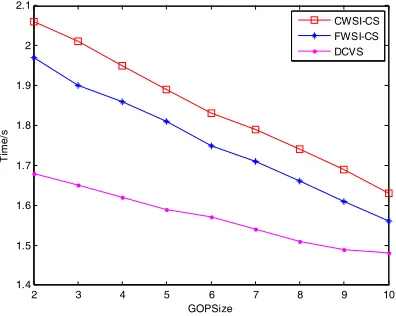
Figure 7. Time complexity under different GOP sizes
417
As can be seen from Figure 6 and Figure 7, as the number of frames in each GOP increases, the
418
inter-frame correlation becomes smaller, resulting in a decrease in the reconstructed PSNR value.
419
However, the reconstruction effect of the proposed algorithm has always been above the fixed
420
weight side information and the original DCVS algorithm, and its reconstruction complexity is
421
close to the original DCVS algorithm, which saves energy consumption while ensuring the
422
reconstruction quality.
423
Experiment to select the 30 GOPs of the video sequence, there are 3 frames in each GOP, and a
424
total of 90 frames are respectively simulated. The two frames before and after the GOP are taken as
425
key frames, and the intermediate frames are non-key frames. Through sparse representation, side
426
information generation, frame reconstruction, the quality of the two side information generation
427
method is compared between the classification weighted side information and the fixed weight side
428
information, and is objectively measured by the PSNR value. The curve of the reconstructed quality
429
PSNR value of 30 frames of non-key frames in the video sequence GOP is shown in Figure 8.
430
431
Figure 8. PSNR value of non-key frame reconstruction (sampling rate 0.3)
432
It can be seen from the figure that under the same conditions, the PSNR value of the
433
block-based classification adaptive sparse basis and the classification weighted side information is
434
improved by 0.2-0.8dB compared with the fixed weight side information reconstruction. For image
435
blocks with too high movement intensity, the correlation between adjacent frames is weak, and the
436
reconstruction effect is relatively weak, but the reconstruction effect is still improved compared
437
with the fixed weight side information. Therefore, the proposed algorithm can improve the quality
438
of video reconstruction in different video scenarios.
439
6. Conclusions
440
In order to solve the problem that the correlation between the different video sequence image
441
blocks is different in the process of applying the compressed sensing method to the video decoding
442
side to acquire the side information for assisting non-key frame reconstruction, a block-based
443
2 3 4 5 6 7 8 9 10
1.4 1.5 1.6 1.7 1.8 1.9 2 2.1
GOPSize
T
im
e
/s
CWSI-CS FWSI-CS DCVS
0 5 10 15 20 25 30
26.6 26.8 27 27.2 27.4 27.6 27.8 28
N-th frame
P
S
N
R
/d
B
CWSI-CS FWSI-CS
0 5 10 15 20 25 30
27.5 27.6 27.7 27.8 27.9 28 28.1 28.2 28.3 28.4
N-th frame
P
S
N
R
/d
B
classification weighting method is proposed for non-key frame reconstruction. In terms of the
444
sparse representation of the encoding end, the video sequence is divided into different blocks
445
according to the inter-frame correlation, and different sparse basis strategies are selected for
446
different blocks; In the decoding end of the non-key frame, in the algorithm for generating the side
447
information by motion estimation, the generation of the SI selects different weights according to the
448
difference of the inter-frame correlation. The experimental results show that the scheme can
449
adaptively select different sparse basis and side information generation schemes to assist non-key
450
frame reconstruction according to different video scenes, making full use of inter-frame correlation
451
and improving reconstruction quality.
452
Author Contributions: Conceptualization, K.W. and M.W.; Methodology, R.X.; Software, R.X.;
453
Validation, R.X., K.W. and M.W.; Formal Analysis, R.X.; Resources, K.W.; Writing-Original Draft
454
Preparation, R.X.; Writing-Review & Editing, H.X.; Visualization, R.X.; Supervision, H.X.; Project
455
Administration, H.X.; Funding Acquisition, H.X.
456
Funding: This work is supported by the National Key Research and Development Project of China
457
(No.2017YFC0804404).
458
Conflicts of Interest: The authors declare no conflict of interest.
459
References
460
1. Zhao, X.H.; Deng, Y.F.; Mu, D.C. Applied study on compressed sensing technology to mine Internet of
461
things. Coal Science and Technology, 2016, 44(7), 69-72[CrossRef].
462
2. Zhao X.H.; Liu S.S.; Shen X.R.; et al. Micro-seismic data compression and reconstruction based on
463
distributed compressed sensing. Journal of China University of Mining & Technology, 2018, 1,
464
172-182[CrossRef].
465
3. Zhang F.; Yan X.X.; Li Y.J. A novel image reconstruction method of mine intelligent surveillance based on
466
adaptive sparse representation. Journal of China Coal Society, 2017, 42(5), 1346-1354[CrossRef].
467
4. Zhang F.; Yan X.X. The block compressed sensing of mine monitoring images based on DFT basis. Journal
468
of Transduction Technology, 2017, 30(1), 94-100[CrossRef].
469
5. Wang G.; Zhao Z.K.; Ning Y.J. Design of Compressed Sensing Algorithm for Coal Mine IoT Moving
470
Measurement Data Based on a Multi-Hop Network and Total Variation. SENSORS, 2018,
471
18(6),1732[CrossRef]
472
6. Lin B.L.; Zheng B.Y.; Qian C. The reconstruction methods of frames classification of distributed video
473
compression coding. Signal Processing, 2015, 2, 201-207[CrossRef].
474
7. Zhao X.H.; Liu S.S.; Shen X.R.; et al. Research on processing algorithm of image in underground coal mine
475
based on CS framework. Coal Science and Technology, 2018, 46(2), 219-224[CrossRef].
476
8. Zhang R. A preliminary study of image reconstruction and denoising based on compressed sensing.
477
Southwest Jiaotong University, 2010[CrossRef].
478
9. Wu M.H.; Zhu X.C. Dynamic measurement rate allocation for distributed compressive video sensing.
479
Journal of Nanjing University of Posts and Telecommunications, 2013, 33(1), 62-67[CrossRef].
480
10. Dong H.; Zhuang B.; Su F.; et al. A novel distributed compressive video sensing based on hybrid sparse
481
basis. // Visual Communications and Image Processing Conference. IEEE, 2014, 320-323[CrossRef].
482
11. Chen H.W.; Kang L.W.; Lu C.S. Dictionary learning-based distributed compressive video sensing.// Picture
483
Coding Symposium. 2011, 210-213[CrossRef].
484
12. Aharon M.; Elad M.; Bruckstein A. rmK-SVD: An algorithm for designing overcomplete dictionaries for
485
sparse representation. IEEE Transactions on Signal Processing, 2006, 54(11), 4311-4322[CrossRef].
486
13. Prades N.J.; Ma Y.; Huang T. Distributed video coding using compressive sampling.// Picture Coding
487
Symposium. IEEE, 2009, 1-4[CrossRef].
488
14. Liu L.; Wang A.; Li Z.; et al. An Improved Distributed Compressive Video Sensing Based on Adaptive
489
Sparse Basis. // International Conference on Robot. IEEE, 2011, 137-140[CrossRef].
490
15. Baig Y.; Lai E.M.K.; Punchihewa A. Distributed Video Coding Based on Compressed Sensing.//IEEE
491
International Conference on Multimedia and Expo Workshops. IEEE, 2012, 131(5), 325-330[CrossRef].
492
16. Baraniuk R.; Davenport M.; Devore R.; et al. A Simple Proof of the Restricted Isometry Property for
493
17. Dai Y.Y.; Cao X.Q.; Chen R.; et al. Reconstruction algorithm with classified weighted side Information for
495
distributed video compressive sensing. Computer Technology and Development, 2017, 27(5), 87-91[CrossRef].
496
18. Jian C.; Su K.X.; Wang W.X.; et al. Residual Distributed Compressive Video Sensing Based on Double Side
497