* To whom all correspondence should be addressed.
Coordinating Constructions in Multi-Structural Languages
Liliya Rivgatovna Mirsiapova
Elabuga Institute (Branch) of Kazan Federal University, Republic of Tatarstan, 423604, Elabuga, Kazanskaya, 89, Russia.
DOI: http://dx.doi.org/10.13005/bbra/1674
(Received: 10 February 2015; accepted: 06 March 2015)
This material is enlightened least of all in the existing scientific and methodical literature, where, up until now, the essence and types of relations (syntactic relations) between the general word and the homogeneous row, both in Russian, Tatar and English languages, are not revealed deep enough. The present article considers the sentences with co-coordinating constructions, their functional and structural links, the relations between the general and homogeneous parts in different positions (in preposition, postposition and in case of simultaneous preposition and postposition). The functions of general words and homogeneous parts shall be determined in dependence on their place in sentence.
Key words: Homogeneous parts, general words, general word combinations, syntactic relation, syntactic function, postpositional general word, prepositional general world, specifying and explanatory relations.
A problem of sentences with homogeneous parts takes a significant place among the problems, considered in the syntax. Such sentences are quite commonly used, and they attract the attention of scientists. The sentences with homogeneous parts present a required element of each academic and school textbook. However, despite this fact, the problem of homogeneous parts is underdeveloped and does not have the single generally accepted solution. The problem of so-called general words, closely connected with it, is less enlightened in syntax; this problem is very important for the analysis of expanded sentences with homogeneous parts.
The relevance of the topic is conditioned by the tendency, typical of modern linguistics, for
integration of variously directed grammatical investigations to create the all-round and system description of one object, in this case, the sentence with homogeneous parts and general words. The relevance of the topic is determined even by theoretical and practical underdevelopment of some problems, connected with the structure and this type of sentences, and, particularly, by the necessity to systematize its structural variants (Barry, 1998).
Procedure
In English, Tatar and Russian linguistic literature, homogeneity belongs to one of the least studied branches of syntax. Many foreign Romance philologists do not make a distinction between homogeneity and co-ordination parataxis that is why they study the problems, connected only with co-ordination. Homogeneity stays out of sight of foreign syntacticians (Crystal, 1988).
RESULTS
The present article considers a special sentence model - a sentence, involving the rows of homogeneous parts. Such sentence model
obtained a wide circulation in the language of modern English, Russian and Tatar fiction. However, no special investigation on description of structural construction of different homogeneous rows was carried out up to present times; the relations between the general word and homogeneous parts are also insufficiently enlightened. This problem is also complicated by the fact, that the phenomenon of homogeneity of sentence parts does not have enough theoretical justification.
Homogeneity of sentence parts is closely connected with such fundamental notions, as subordination and co-ordination, syntactic functions, semantic and syntactic relations etc (Crystal, 1988).
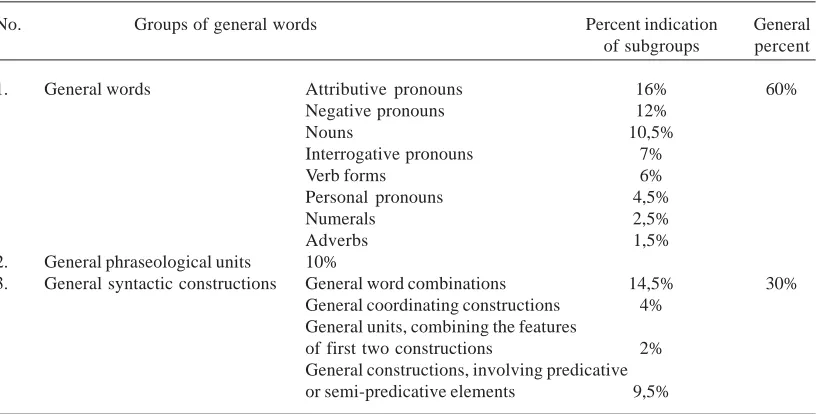
Table 1.
No. Groups of general words Percent indication General of subgroups percent
1. General words Attributive pronouns 16% 60%
Negative pronouns 12%
Nouns 10,5%
Interrogative pronouns 7%
Verb forms 6%
Personal pronouns 4,5%
Numerals 2,5%
Adverbs 1,5%
2. General phraseological units 10%
3. General syntactic constructions General word combinations 14,5% 30% General coordinating constructions 4%
General units, combining the features
of first two constructions 2% General constructions, involving predicative or semi-predicative elements 9,5%
DISCUSSION
The phenomenon of generalization in sentences with homogeneous parts presents a wide range of problems for the investigators. It involves the logical-grammatical relations between the general unit and the homogeneous row, and morphological-syntactic characteristic of general units, and the problem about what shall be considered as the general unit and homogeneous parts, and the punctuation system in the sentences with general units, and the stylistic analysis of such sentences.
The sentence can be expanded by the
to one and another sentence part, interconnected with co-coordinating relation” (Russian Grammar, 1982). Only three conditions of homogeneity are taken into consideration in this definition. Different authors enumerate different quantity of features of homogeneity. Characterizing the homogeneity of sentence parts, many investigators mention such features, as the equation of syntactic functions, the presence of co-coordinating relation between them and subordinating with the general part, similarity of row parts in logical-semantic relation, uniformity of morphological execution. I.S. Yaremchuk points at the obligatory presence of the same name (however, he does not refer here the coordinating parts, different in function). It there is no identical equation of the fulfilled functions, in his opinion, they possess another features, joining them together into homogenous row. These features, from his point of view, are as follows: similarity on the part of the meaning, the presence of equal syntactic relations, subordinating relation with the general part, morphological name similarity (Yaremchuk, 1985). V.V. Babaytseva writes that “homogeneous sentence parts are characterized by the set of the following differential features”: 1) take the position of one sentence part; 2) they are connected with one and the same sentence part with the subordinating relation; 3) they are connected with each other with the co-ordination relation; 4) they frequently have the same morphological expression; 5) they usually express the same-type notions (Babaytseva, 1987).
According to the textbook “Galkin-Fedoruk” (Galkin-Fedoruk, 1964), the syntactic conditions for the homogeneity of sentence parts are the following: “1) the syntactic relation with one and the same part, both with subordinating or dominating; 2) the uniformity of the syntactic function; 3) the lack of dependence relations between the parts of the coordinating row of relations. Semantic-syntactic condition is the clarification of the subordinate or dominant word by all homogeneous parts in one logical plane, in one relation (Galkin-Fedoruk, 1964).
M. Davletov considers, that the homogeneous parts in the sentence fulfill “1) similar semantic-syntactic function, 2) they are interconnected by means of coordinating relation, and they are connected with the word, to which
they belong each taken separately, by means of subordinating relation, 3) homogeneous parts of the sentence are mainly expressed by the part of speech of one grammatical form” (Davletov, 1989). In Tatar language, the main condition is the coordinating relation between the homogeneous parts, equal position in semantic and grammatical relation (Khangildin, 1959). M.Z. Zakiev writes, that, first of all, the subordinating relation between the homogeneous row and the dominating word shall be considered as the main condition for homogeneity. In his opinion, the homogeneous parts shall be subject to any one word and express similar meanings in relation to the general part. The scientist considers that the coordinating relation between the homogeneous parts is an obligatory condition (Zakiev, 1984).
and bear the secondary character.
The main peculiarity of homogeneous parts is the act in one sentence part and functioning of all other parts around it. The homogeneous parts in the sentence, in relation to other sentence parts, are joined in one structural-semantic block. Syntactically, they act as one sentence part. Thus, the homogeneous parts are connected with the other parts not separately, but in the view of coordinating row, which make up the structural-semantic unity. The structural-structural-semantic block of homogeneous parts is in subordinate relation with the other parts.
The term “homogeneous parts” is used in relation to syntactic links between each other, to similar syntactic functions of sentence parts. In this case, the lexical meaning is not taken into consideration, as well as the morphological expression. The sentence parts can be homogeneous, if they fulfill the similar syntactic function. Lexical meaning of words and morphological expression of sentence parts do not play the significant role. Thus, when determining the homogeneity, the fact, that “the homogeneous parts answer one and the same question”, shall not be taken into consideration. Answering one and the same question, the parts can be nonhomogeneous ones.
The main feature of homogeneity of sentence parts is the identical equation of their syntactical functions. Due to well-known disadvantages of traditional theory of sentence parts, it is difficult to evaluate objectively the unity of functions of homogeneous parts. However, it is possible to assume that they coincide not only in general, but also in main particular functions. That is why, the word forms, for instance, in the functions of predicate and adverbial modifier, subject and adverbial modifier, object and adverbial modifier object and attribute, and also direct and indirect object, cannot be considered homogeneous, even if there is a coordinating conjunction between them.
The sentences, expanded by the homogeneous verbal predicates, are formally and semantically similar to compound sentences. Thus, there are some difficulties in delimitation of simple sentences with homogeneous verbal predicates and compound sentences. The sentences with homogeneous parts in structure and semantics are
expanded. There are different viewpoints in linguistics concerning the determination of their place in the system of sentence types. The sentences with homogeneous predicates are classified either as “combined sentence”, or “as compound sentence”, or as “contracted sentence”, or as “transitional from simple to complex”.
Homogeneous subordinate parts of sentence are determined as the phenomena, not having structural potential, not changing the initial model of simple sentence. They are characterized as a “row of word forms, produced based on coordinating relations, as a coordinating group, expanding the simple sentence” (Galkin-Fedoruk, 1964).
In linguistic concept of V.V. Babaytseva, the sentences with homogeneous parts are left behind the customary division of sentences into simple and compound, as they take the “area of syncretism in the opposition simple sentence -complex sentence” (Babaytseva, 1987).
Concerning the sentences with homogeneous verbal predicates in Russian linguistics, there are the following opinions (Russian Grammar, 1982):
1. Genetically these sentences are the derivatives either from compound, or from several simple, or from simple sentence, as the initial structure.
2. These sentences refer either to simple, or to compound, or to special structures. 3. Special features of this construction involve
complex semantics, presence of general subject, multicomponent predicative row, semantic and modal-temporal relations in the row, specific type of connections of components inside the subjectival-predicative base, special syntagmatic relations, variety of intonation types of these constructions.
4. The most widely spread names of these constructions are the following: “combined”, “simple with homogeneous parts”, “complex”.
Conflicting opinions also exist in the study of Turkic languages. N.T. Sauranbaev points to the fact, that “... a complex sentence with general subject from the simple expanded sentence with homogeneous predicates differs by the fact, that each component in complex construction expresses different thought and, when pronouncing, their boundary is denoted by the pause” (Khangildin, 1959).
M. Davletov analyzes these sentences as simple ones, expanded by the homogeneous verbal predicates: “In reality, homogeneous verbal predicates, being a part of the simple sentence, refer to one subject and express its homogeneous actions” (Davletov, 1989).
Thus, there is no single opinion relatively the difference of simple sentences with homogeneous verbal predicates and compound sentences. Some studies, the sentences with homogeneous predicates are considered as simple sentences, the other studies deny the ability of homogeneous predicates to build the structure of simple sentence, and they are considered as complex sentences.
The “Russian Grammar” (Russian Grammar, 1982) provides specific criteria of difference of simple sentences, expanded by the homogeneous verbal predicates of compound sentences: “...the sentence is not considered as undoubtedly simple, if the subject, in virtue of one or another reason, breaks the chain of predicates, being placed inside it; if the intonation characteristics of the sentence are being complicated; if temporal or aspective meanings of verbs-predicates do not coincide; in case of their separate adverbial determination and in the whole number of other cases”.
In the syntax of Tatar language, there is a strict border between simple and complex sentences. In grammar of Tatar language, the sentences with homogeneous verbal predicates at one subject are considered as simple: “There are no good grounds to consider them complex: they have only one predicative base with several predicative features” (Zakiev, 1984). If this principle is broken, i.e. if there are more than two predicates within one syntactic construction, and each one separately expresses the action of different subjects, or if, together with the main subject in the last sentence, the subject, expressed by the
pronoun is used; it replaces the first subject. In such cases, the constructions fulfill the function of compound sentences.
When classifying the sentences with homogeneous parts, their syntactic function and lexico-grammatical character of word forms are taken into consideration. Many scientists consider them simple, if only secondary parts are homogeneous, and if the main parts are homogeneous, especially with homogeneous verbal predicates, then such sentences are considered as compound ones. We refer the sentences with homogeneous parts to simple expanded sentences. We consider that, if the sentences with homogeneous verbal predicates are interpreted as complex ones, the notion “homogenous predicates” is excluded on its own. In terms of homogeneity, the predicates are characterized by the same features, as the other sentence parts. The special, at first sight, status of homogeneous predicates among the other homogeneous parts, what is provided by its important role in formation of predicative core of the sentence, does not give an occasion to distinguish undisputable such sentences into complex ones.
The sentences with homogeneous parts are also characterized by the features of both simple and complex sentences. They differ from the complex sentences by the fact, that they have only one predicative core, the predicates are homogeneous between each other. They differ from simple non-expanded sentences by the fact, that they can provide a lot of information, they have the greater possibility of expansion (homogeneous parts can be expanded both themselves and their expanding parts); they have some additional predicativity and the possibility to divide them into several sentences: She sewed, (she) cleaned the rooms... (L. Tolstoy).
The subject is being repeated in this sentence, and the sentence of compound type is formed from the simple sentence with homogeneous parts.
The term “general word” has, without any meaning, logical origin. It is aimed as fixing the attention on the fact, that with the construction use, there takes place the mental transition from less general subnotions (expressed by the homogeneous parts) to more general, generic term (expressed by the “general word”), i.e. that the logical process of notion generalization takes place, as a result of which we get the general, generic notion “general word”). If, consequently, the term “general word” is right, it is only in logical, but not in grammatical meaning.
The scientists paid attention to the general words at homogeneous parts long ago. However, at the same time, the opposite opinions are expressed concerning the whole number of problems. Firstly, the important statement, what is the general unit, has not received the generally accepted decision. In Russian linguistics, it is traditionally stated that the general word can not only follow the homogeneous parts, but also precede them (Galkin-Fedoruk. 1964). Another idea is expressed in some works, that the general words “can name only general notions of resulting character, closing the row of homogeneous sentence parts” (Babaytseva, 1987). Secondly, it is impossible to agree with different variants of traditional interpretation of syntactic relations between the general unit and the row of homogeneous parts (the general unit is a supplement to the row of homogeneous parts, the row of homogeneous parts is a supplement to the general unit etc.).
At present, the sentences with general units at homogeneous parts, being the important material both in theoretical and practical relation, attracts more and more the attention of investigators. It resulted in the appearance of some new viewpoints, having great importance to understand the essence of generalizing phenomenon in the sentences with homogeneous parts (Galkina-Fedoruk, 1958).
General words are frequently used in the sentences with homogeneous parts. However, the essence and types of relations (syntactic relations) between the general words and the homogeneous parts, both in Russian and Tatar linguistics, as well as in the studies of Turkic languages, are not revealed deeply, and, sometimes, are revealed unclear. For instance, it is stated that if the general
words are in preposition, there clarifying relations are established, and in postposition - properly generalizing (Gallyamov, 2006). Another investigator considers, that “the second case also presents clarifying relations, and the function of proper generalization acts as one of its particular functions”. It is considered that the general words and homogeneous parts are the similar sentence parts, and it is simultaneously mentioned, that the general words and homogeneous parts can refer to the general word, as appositions (Valgina, 1978). However, the appositions, denoting the attribute of the subject and determinatum, denoting the subject, as the bearer of this attribute, are considered as different sentence parts.
unsolved” (Khimik, 1970).
M.I. Sapozhnikov considers, that “ the explanatory link between the general unit and the row of homogeneous parts is being established: in case of preposition of the general unit, the row of homogeneous parts presents the explanatory element, and in case of postposition - the general unit itself” (Sapozhnikov, 1985).
In the work of M.N. Pradin, main attention is paid to grammatical function of general words, it is said about the relation of construction with general words to some close syntactic constructions (with clarification, specification and apposition), the constructions with general words are delimitated from the abovementioned syntactic units. The author raises a question about the priority of “general words” (Pradin, 1967). From our point of view, it is improperly. The author explains it by the fact, that the homogeneous parts can be used without “general words”. The homogeneous parts can also be used independently as any part of the sentence.
In our opinion, explanatory (preposition) or specifying (postposition) relation exists between the general word and homogeneous parts.
I.S. Yaremchuk writes that “Homogeneous parts and general word cannot be identical in their syntactic function, as they are included to different parts of the construction” (Yaremchuk, 1985). In his opinion, “In all cases, the syntactic constructions with homogeneous parts and general word present the union of several sentences. This union differs significantly from the other syntactic constructions and presents a peculiar microcontext with close semantic and structural cohesion of components. Such microcontext distinguishes basic sentence with the general word, which functions inside it, and that sentence, where the structural-semantic component is presented by the homogeneous parts” (Yaremchuk, 1985).
General words in the sentences with homogeneous parts and specified words in the sentences with detached parts are very close to each other in semantic function. In modern grammar books, the abovementioned syntactic categories are determined in different ways. For instance, in some works on Turkic languages, the words, belonging to the word with general meaning, are considered as explaining its meaning. The ones,
that specify it, are considered as homogeneous parts; it is mentioned, that general words can be both in preposition and postposition (Galkina-Fedoruk, 1964). Thus, the homogeneous parts and detached “appositions” (specifications) are not delimitated in the abovementioned works, i.e. they are studied in undifferentiated way. The words with generalizing meaning in Kazakh language, staying behind or in the field of homogeneous parts, are considered as not general words, but the specified parts in detached sentences.
Some syntacticians consider that such grammatical phenomenon, as homogeneous parts with general word, shall be based on logical relations of type and variety. The term «gomumileshteruche suz» (general word) is used in Tatar linguistics (Zakiev, 1984). In our opinion, the term “general word” (gomumileshteruche kisek) is not precise completely, because the general parts are expressed not only by one word, but also by phraseological units, and, sometimes, even by complex syntactic constructions. Morphological classification and degrees of usage of the general words are presented in Table 1.
General parts, in their turn, are divided into “general subject”, “general predicate”, “general object”, general adverbial modifier”, “general attribute”, “general parenthesis”.
of specification, and in case of postposition, they fulfill the role of attribute (Gallyamov, 2008).
In school textbooks on syntax, they are considered as similar sentence parts (Miftakhov, 1968). The same point of view still exists in Russian linguistics: “General word fulfills the function of that sentence part, as the constituents of coordinating row (Rozental, 1976). Based on the analysis of existing literature, it is possible to make the conclusion about the fact, that the problem of “general words” is still relevant, as there is no right solution for it.
The opinion, existing in Tatar syntax, that “homogeneous parts and general word fulfill one and the same function” is incorrect, inaccurate. This mistake is made due to the fact, that the general word and homogeneous parts are referred to the same word (Zakiev, 1984). Being in the preposition of the general word, the homogeneous parts, first of all, are subject to the general word, and then to the general subordinating word, because there is the clarifying relation between them. Being in postposition of the general word, homogeneous parts are subject only to it, and there is the specifying relation between them. Thus, subordinating (clarifying or specifying relation), and not the coordinating relation is between the general word and homogeneous parts (Mirsiapova, 2014). Besides, they are not equal in meaning. The semantics of general word equals to the sum of meanings of homogeneous parts. That is why they are not the equal sentence parts and cannot fulfill similar syntactic function.
CONCLUSION
The ability to act as one sentence part and functioning of all other around it shall be considered as the main peculiarity of homogeneous parts. In the sentence, homogeneous parts, in relation to the other sentence parts, are united in one structural-semantic block. Syntactically they act as one sentence part. Thus, homogeneous parts get into connection with the other parts not individually, but in the view of coordinating row, which constitutes the structural-semantic unity. Structural-semantic block of homogeneous parts with the other parts is in subordinating relations. Homogeneous sentence parts and joined by means of coordinating conjunctions and
intonation of enumeration or only intonation of enumeration.
Syntactic homogeneity of sentence parts shall be considered in there aspects: grammatical, semantical and functional. The union of sentence parts within the syntactic row is conditioned, first of all, by the reasons of semantic character. Their functional purpose (the possibility of postpositive, detached and predicative use) can directly depend on the semantic homogeneity and notional sustainability of sentence components, as well as their grammatical presentation (the possibility to use grammatically varied forms within the syntactic row).
The functions of general words and homogeneous parts shall be determined depending on their position in sentence.
1. In preposition, the general word fulfills the function of any sentence part, and homogeneous parts act as specification, clarification. They are usually used in similar grammatical form. It is typical only of specifications.
2. Postpositive general word with homogeneous parts also cannot fulfill the similar syntactic function. Homogeneous parts are subject to general word. It is pointed out by the possessive affixes of the third person singular and plural in general words, and the affix of genitive case is clipped at homogeneous parts. In this case, homogeneous parts, acting in the view of indefinite case, fulfill the role of attribute in relation to the general word.
3. General words can be simultaneously in preposition and postposition. At that, the homogeneous parts fulfill double function: in relation to prepositive general word, they act as specification, and in relation to postpositive general word - as attribute.
General words can also be used outside the sentence: in case of logical stress, the general word with homogeneous parts is usually left behind the basic sentence.
generalization shall be studied wider, at all levels of syntax.
Thus, it is possible to underline once again, that in Tatar, Russian and English languages, the homogeneous parts and the general word stay in unequal logical, and, mainly syntactic, relations, thus they cannot be one and the same sentence parts (Quirk, 1987).
It is also necessary to mention, that in English language, the models of multielement rows of homogeneous parts, consisting of three of more homogeneous elements, possess the specific characteristics. The most frequently, these models have the structure with one closing conjunction. If the conjunctions are used before each of homogeneous elements or in case of asyndeton of all homogeneous elements, the row gets the incomplete view, fulfilling definite, as it was mentioned, stylistic loading (Quirk, 1987).
Carrying out the comparative analysis of sentence models, involving the rows of homogeneous parts in modern Russian, English and Tatar languages, we managed to determine, that similar sentence model is widely spread in the language of modern literature.
REFERENCES
1. Barry, A.K., English Grammar. Language as human behavior. New Jersey: Prentice Hall, 1998.
2. Crystal, D., The Cambridge Encyclopedia of Language. Cambr. 1988; 5.0.
3. Quirk, R., Greenbaum, S., Leech, G. & Svartvik. J., A Comprehensive grammar of the English language. Ldn. - N.Y, 1987.
4. Babaytseva, V.V. & Maksimov, L.Y., The third part. Modern Russian language. Syntax. Punctuation, 1987.
5. Valgina, N.S., Syntax of modern Russian language. Moscow: High School, 1978. 6. Galkina-Fedoruk, E.M. & Shansky, N.M.,
Modern Russian language (syntax). Moscow: MSU, 1958.
7. Gallyamov, F.G., Syntax of expanded simple sentence in Tatar language. Kazan: KSU, 2006. 8. Gallyamov, F.G., Co-ordinating constructions
in Tatar language. Elabuga: ESPU, 2008. 9. Gulomov, A.G. & Askarova, M.A., Khozirgy
Uzbek adaby tili: syntax. Tashkent: Ukituvchy, 1965.
10. Davletov, M., Structural types of simple expanded sentence in modern Karakalpay language. Tashkent, 1989.
11. Zakiev, M.Z., Syntax and punctuation on modern Tatar literary language. Kazan: Tatar Boor Publisher, 1984.
12. Mirsiapova, L.R., Repetition of general word in homogeneous parts. In the World of Scientific Discoveries, 2014; 1(49): 119.
13. Miftakhov, B.M., Methodology of Syntax in Tatar language. Kazan: Tatar Book Publisher, 1968.
14. Pradin, M.N., Syntactic construction with “general words” at homogeneous parts of sentence. Moscow, 1967.
15. Rozental, D.E., A dictionary-reference book of linguistic terms. Moscow: Enlightenment, 1976. 16. Rudnev, A.G., Syntax of expanded sentence.
Moscow: Uchpedgiz, 1956.
17. Russian grammar., The second part. AS USSR, Moscow: Science, 1982.
18. Sapozhnikov, M.I., General units in sentences with homogeneous parts. Moscow, 1985. 19. Galkina-Fedoruk, E.M., Modern Russian
language: morphology, syntax. Moscow: Moscow University Publisher, 1964.
20. Khangildin, V.N., Grammar of Tatar language: morphology and syntax. Kazan: Tatar Book Publisher, 1959.
21. Khimik, V.V., About syntactic function of homogeneous parts and general words in expanded sentence. Russian language at School, 1970; 5: 99-101.
22. Chuglov, V.I., General words and homogeneous parts. Russian Language at School, 2003; 6: 83-86.