Journal of Engineering Sciences, Volume 5, Issue 1 (2018), pp. B 1–B 6 B 1 JOURNAL OF ENGINEERING SCIENCES
ЖУРНАЛ ІНЖЕНЕРНИХ НАУК
ЖУРНАЛ ИНЖЕНЕРНЫХ НАУК
Web site: http://jes.sumdu.edu.ua DOI:
10.21272/jes.2018.5(1).b1
Volume 5, Issue 1 (2018)UDC 658.5+005.6+006
How to Assess the Performance Quality of an Enterprise
Kovalev A. I.PJSC “Khmelnytskoblenergo”, 11a Khranovskogo St., 29016, Khmelnytskyi, Ukraine
Article info:
Paper received:
The final version of the paper received: Paper accepted online:
September 30, 2017 January 14, 2018 January 18, 2018
*Corresponding Author’s Address:
[email protected]
Abstract. Proper assessment of enterprise performance quality expands opportunities of those enterprises proven by reputation, and creates favourable environment for investment. However, scientific literature does not present any research of enterprises’ performance or functioning quality models from the perspective of all possible results. The article defines, in accordance with the requirements of the international management system standards, functioning efficiency – that is, resources turning into immediate results, immediate results transforming into direct ultimate re-sults; sustained success – direct ultimate results turning into indirect ultimate results. Indirect ultimate results high-light strategic effect of an enterprise’s sustained success. Ways of assessing functioning quality are classified, on the basis of which a system of information and analysis for collecting and processing of management information is de-veloped for automation of assessment procedure.
Keywords: efficiency, sustained success, activity, functioning, automation.
1
Introduction
Quality assessment is a special type of the control function aimed at the formation of value judgments about the enterprise as an evaluated object. In accordance with ISO 9000:2015, quality is an independent characteristic of the object’s essence for which a level (degree) of the required quality is existed. This level is assessed in rela-tionship to the quality standard. This definition of quality makes it possible to provide a quantity assessment by the degree of compliance.
Quality appears “outside” through its properties. The property is an external demonstration of quality as the inner essence of the object [1]. A characteristic is the distinguishing feature, which can be own or assigned, qualitative or quantitative. The characteristic of quality is own characteristics of the enterprise arising from the requirements. The state of an enterprise is a set of charac-teristics that it possesses at the operating moment. Each characteristic has its assessment and can be determined.
The determination of quantitative characteristics of the quality of the work of enterprises is metrology, while not joint these characteristics with the justification of man-agement decisions, as is customary in qualimetry. In qualimetry, the property (attribute) is the quality of the evaluation of measured object; value is the quantitative characteristic of a measure. An indicator is the numerical value of a measure by which one can indicate the state, change or development of the enterprise’s processes. In the broadest sense of the word, an indicator is the
trans-mitter of information. In the narrow sense, indicators are those characteristics that connect the object and the sub-ject of evaluation [2]. The term “indicator” is also defined as a quantitative characteristic of one or several proper-ties of objects considered under certain parameters [3]. In this case, the terms “indicator” and “parameter” are dif-ferent. The parameter characterizes the state of an enter-prise and its structure, but the indicator characterizes properties. Hence, the parameter is a relatively constant characteristic, which changes only when the enterprise changes itself. Parameters indicate how the enterprise differs from others. Thus, we will consider as indicators variables describing the properties reflecting the target, and parameters – the characteristics of the state, reflecting the quality of the functioning of the enterprise. Interna-tional process-oriented management standards suggest the following parameters: efficiency, effectiveness, sustained success. Wherein, functioning is the behavior of the en-terprise in time, the successive change of its state. At the same time, activity includes a system of processes carried out by an enterprise for the purpose of producing prod-ucts, providing services or supporting them.
condi-B 2 MANUFACTURING ENGINEERING: Technical Regulations and Metrological Support tions of the enterprise. Establishing the range of
indica-tors is not a one-time, even if operation justified by scien-tific methods, but the process of constant adjustment. It depends on the enterprise development strategy [4].
Requirements of the standard ISO 9001:2015 concern the measurement of processes both for assessing the level of their effectiveness, and for maintaining in the managed state. In the first case, the results of the process are evalu-ated. In the second one, the indicators of its state at dif-ferent stages are determined. The system of process quali-ty indicators is divided into two groups. The first includes the implementation of the outputs of the process, and the second one – the characteristics of the dynamics of the process [5]. The first group of indicators fixes where the process comes as a result of control, and the second one – how it gets to the final state. Thus, it is necessary to con-sider both indicators of quality of activity, and indicators of quality of functioning of the enterprise. The need to assess a sustained success also requires consideration and operationalization of concepts as a final results of the enterprise’s activities, as well as the quality of function-ing. Operationalization consists in the fact that investigat-ed concepts are determininvestigat-ed through the description of special measuring operations.
The purpose of this article is to analyze the models of the quality of activity and the functioning (A&F) of the
enterprise under the point of view of all possible out-comes and the development of operational definitions of these results in the context of requirements and recom-mendations of the standards ISO 9000.
2
Research Methodology
Quality assessment A&F is the formation of value judgments about the enterprise, including an assessment of its properties and states using a set of indicators de-fined for each of the aspects (directions) of activity, e.g., resources, infrastructure, internal processes, financials, consumers, potential, and development.
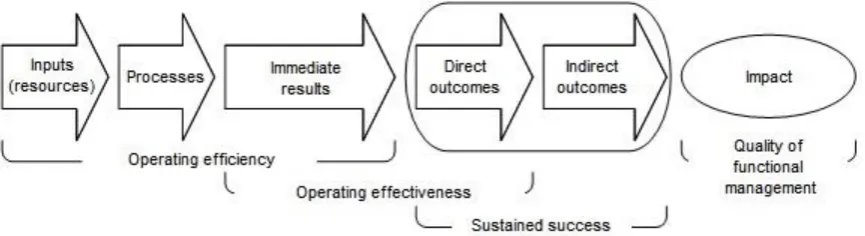
The evaluation of the performance of activities is car-ried out based on direct results as a cost saving in obtain-ing these results. Evaluation of performance and sustain-able success is carried out on the basis of final results (Fig. 1). Immediate results are what we have done, and the outcomes are what happened. Consequently, effec-tiveness is a characteristic of immediate results, produc-tivity is a characteristic of direct outcomes, sustained success is a characteristic of indirect outcomes. In con-trast to the traditional social notion of influence, it estab-lished as a strategic effect, correlated with indirect out-comes – quality of operation management, and estimated with the help of assessments of sustainable success in the long term.
Figure 1 – The relationship between efficiency, effectiveness, sustained success and the quality of management in terms of immediate and final results
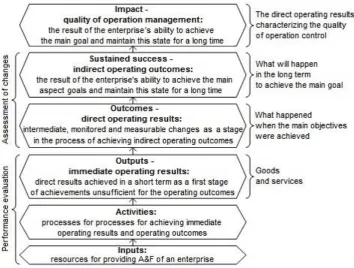
Figure 2 shows a diagram describing the company’s A&F hierarchy. It includes the company’s embedded resources, processes, immediate results (produced goods and services), as well as final results and impact (strategic effect).
Immediate results should be presented in vector form
( ) ( ) ( )
(
n)
Tx x
x
x = 1, 2,..., , (1) where x(j) – indicators characterizing various properties
of the enterprise.
Journal of Engineering Sciences, Volume 5, Issue 1 (2018), pp. B 1–B 6 B 3
Figure 2 – A flowchart of the hierarchical presentation of the enterprise’s operation
To identify possible ways of assessing the quality of A & F, providing for appropriate decision-making proce-dures, consider the following. For any object of evalua-tion (the state of the enterprise), the set of its estimates for all indicators is a vector. It contains complete infor-mation about the object. If the estimated objects are com-parable in the sense of domination, one can specify by binary relations in the space of estimations of indicators that determine the selection rule for each pair of objects of the best:
(
)
( ) ( )(
)
(
)
( ) ( ) . : , . . . , 1 ; , . . . , 1 , ; : , 1 = h k h r j k j r k r x x n h m k r x x n j ee (2)
Substantially, this means that the object er no worse
than the object ek on any of the main aspect indicators,
and, at least, one of them er is better than ek. Firstly, the
evaluated objects will be compared by the indicators of the most important aspect, then – by the indications of the next important aspect, etc.
If the objects of evaluation are incomparable with the private aspect indicators of all aspects of activity, it is advisable to resort to the scalarization of the aspect indi-cators by building the complex indiindi-cators of aspects (CIA). When constructing a CIA, it is advisable to com-pare by advantage only homogeneous indicators that measure the intensity of properties of the same nature. To do this, the normalizing functions for the transformation
( )j ( )j
0,1y
x is used
As CIA a weighted sum of indicators is applied, which for s-th aspect of i-th object of evaluation has the follow-ing form: ( ) ( )
( )
, , 1 , 1
= =nsj j i s s
i wy i m
z
where ns – number of indicators of s-th aspect; yi(j) – normalized value of j-th indicator for i-th object; ws – weights of partial indicators for s-th aspect of
activity. The decisive rule has the following form:
(
)
( ) ( )( )
(
)
( ) ( ) . : ..., , 2 , 1 ; , 1 , ; : h k h r s k s r k r z z s h m k r z z s ee (3)
This means that er object is no worse than ek for any of
CIA and at least one of CIA er is better than ek.
1. The basis of the application of the method is the as-sumption of the independence of the influence of the value of each individual indicator xi(j) or zi(j) on the
esti-mation of the preference of the object ei as a whole. In
practice, this assumption is often not satisfied. In addi-tion, the objects of estimation may not be comparable in the sense of the componentwise dominance of CIA, if each of the objects is preferable to the other for some particular indicator. It is possible to clarify the problem, to attract some additional assumptions that determine the method of estimation.
2. Additional assumptions may be related to a kind of binary relation as the lexicographic selection rule. It is used in the case of a ranking CIA according to the rank-ing of aspects of activity. Then, if the object er is
prefera-ble to ek object by CIA of the most important aspect,
then, independently of the CIA of other aspects of er, ek is preferable. If the objects are incomparable with CIA
B 4 MANUFACTURING ENGINEERING: Technical Regulations and Metrological Support 3. Recognition of the enterprise’s state is carried out
using the data matrix ( ) n m j i
y
Y= .
Two classes of states Cg, g = {1, 2} are considered,
where C1 – values of indicators correspond to the annual
planning assignments; C2 – already achieved values of
the indicators for the previous year. Distance measure
Lg(y, yg*) of the vector y to reference vectors yg* of these
classes can be taken in the following form:
(
)
(
( ) ( ))
, , 2 1 1 2 j g j N s n j s gg y y w y y
L
s
= =
=
− (4)where N – number of identified aspects of activity. The decisive rule takes the form:
( )
,
1,2 .min =
=
C L L g
y g g g (5)
4. An integral comparative evaluation characterizes the degree of similarity between two different enterprises. It can be presented by an integral measure – a linear dis-tance δrk between column vectors yr(j) and yk(j) of of the
transpose matrix Y T
( ) ( )
(
)
, , 1, ,1 1 2 2 m k r y y w N s n j j k j r s rk s = − =
= = (6)where yr(j), yk(j) – values of j-th indicator for r-th and k-th enterprises.
Columns of the matrices Y T correspond to enterprises,
and rows – to theirs indicators. An element δrk is the
measure of the difference between enterprises r and k.
The matrix m
m rk
=
Δ specifies the dual relations “to be predominant” or “equal”, or “to be no worse”, because its components are measures of the difference between en-terprises r and k. Such information is interest when con-clusions based on numerical indicators include ranking. Particularly, the purpose of a comparative study of enter-prises is ranking by the data combination.
5. in general, calculation of the global quality assess-ment of enterprise’s A&F consists in building the expo-nents of the scalar function yio in the space of indicators,
which relates each object to an estimate of its “general-ized quality”:
( ) ( )
(
)
, 1, ,1 1 2 max 2 m i y y w y N s n j j j i s o i s = − =
= = (7)where y(j)
max – components of the vector characterizing
the enterprise, chosen as a reference for comparison. For convenience of comparison for various variants of objects, estimation limiting values of indicators ymax
should correspond to the initial state – the given (norma-tive) values from the point of view of the long-term stra-tegic objectives of the enterprise. To solve the forecasting problem, it is necessary to check periodically the selected set of indicators. Thus, complex factors yio(t0), yio(t1), …
are obtained, the forecasting of which changes in sustain-able success can be predicted.
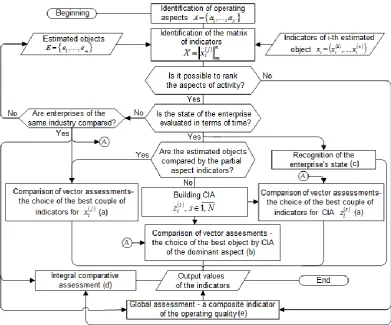
To automate the evaluation procedure (including the abovementioned method), a block diagram of the algo-rithm for the corresponding information and analytical system (IAS) (Fig. 3). The technology of estimation based on the estimation methods given by formulas (2)–(7).
IAS is devoted to improve the efficiency and quality of management decisions by automating the information and analytical activities of the enterprise. The object of auto-mation is the procedure for assessing the quality of enter-prise’s A&F based on the balanced set of indicators (in terms of activities).
All the AIS data are located in the central repository and contain the following levels: collection and primary data processing; extracting, transforming and loading data; data storage; presentation in data marts; data analy-sis.
Data marts are organized in the form of multidimen-sional databases, where reference information is present-ed by indicators and output – by quality parameters of enterprise’s A&F summarizing these indicators. Infor-mation in a multidimensional data mart is presented in terms of business in the form most accessible to users, which allows significantly reducing time for obtaining information necessary for decision-making. The use of multidimensional data marts and corresponding program for data analysis allows transforming data into useful information based on which effective decisions are made. The program for data analysis is used to access to infor-mation, visualize it, as well for the multivariate analysis, form and compose reports. An input data for the analysis is the preprocessed data from the repository or presented in a data mart.
Journal of Engineering Sciences, Volume 5, Issue 1 (2018), pp. B 1–B 6 B 5
Figure 3 – A flowchart of algorithm of information-analytical system
Management of enterprises is realized by the imple-mentation of interrelated management functions. The quality of management is characterized by a stable inter-action of managerial functions, as well as a stable interac-tion of processes is a characteristic of the quality of oper-ating activities (the transformation of materials and in-formation into a final product and delivery of the product to the consumer). Therefore, management functions should be identified for each enterprise. This fact does not exclude their repeatability, especially in the industry context. At the level of the interrelationships of functions, the differentiation of enterprises should be more signifi-cant, because the differentiation is a field of competitive advantages that distinguishes one enterprise from another one. Innovative sustainable relationships of established management functions are the part of intangible assets as an area for creating competitive advantages.
The quality of management is the subject of enterprise strategy, and the criterion of good governance is success-ful implementation of the strategy. If suppose that an enterprise firstly proposes the quality management func-tions within the standard ISO 9000: 2015 (quality plan-ning, assurance, control and improvement), then to im-plement the strategy it can concentrate efforts on detailed quality planning, neglecting, and control: there are goals, tasks, resources. So, the fulfillment of quality require-ments is delegated to units. There is another situation where documentation and close monitoring are carried out, particularly statistical control of operating activities. Perhaps, priorities to ensure consumer loyalty, create a brand will be chosen, or the path for resource investments
and improvements will be proposed (e.g. new develop-ments and technological innovations). Knowing the capa-bilities of the enterprise and identified strategies deter-mine the ways to achieve success. If success is achieved, the quality of management is high. If the success is unsuf-ficient, then with the unchanged profile of organizational capabilities and the chosen strategy, the enterprise can change the management functions, their resource supply, introduce new functions, and so on.
So, if control is carried out with the help of a set of in-terrelated functions, then the functions express an essen-tial determinateness inherent in management, due to which the management is precisely such.. Thus, the quali-ty of management is the degree of correspondence of the inherent characteristics (functions) of management to the established requirements. Particularly, this means that the identification of management functions should be based on the identified requirements of interested parties. The quality of management and the competitive advantage of the enterprise will consist in the extent to which the re-quirements and needs are investigated, as well as func-tions are adequately identified and implemented. A cer-tain set of management functions of the enterprise for the market condirions is assessed in their relationships, which allows judging the quality of management as a whole.
B 6 MANUFACTURING ENGINEERING: Technical Regulations and Metrological Support property. Enterprises can find and implement unique
functions. How an enterprise works is a consequence of a combination of individual characteristics of its internal and external environments. Consequently, management functions can also be individual.
Finally, the quality of management reflects a stable re-lationship between the constituent elements of A&F (managerial functions) characterizing the specific man-agement, which allows distinguish management ap-proaches.
3
Conclusions
In this paper, ways for the determination of the enter-prise’s A&F quality is proposed by the parameters of its condition: efficiency, effectiveness, and sustained suc-cess. The traditional presentation of operational results are immediate and final results, as well as the impact. The new approach is in the fact, that efficiency reflects the transition of resources and processes to immediate re-sults, as well as effectiveness reflects the transition of direct results to outcomes, and sustained success reflects the transition of direct outcomes to indirect ones.
In contrast to the presentation of non-productive (non-commercial) impact of the final result (e.g., social), a strategic effect of the sustainable success of the enterprise is established. If a causal relationship is established
be-tween the final (remote) results and the effect of sustained success, the outcomes are indirect evidences of it. The trend of a change in sustainable success can be assessed by periodic monitoring of the complex indicator of quali-ty A&F (7) including the identified set of the most in-formative indicators.
Methods for assessing the quality A&F are defined and corresponding IAS is developed considering the proposed approach, which allows realizing new ways of informati-zation, and intellectualization of management processes.
The quality of management of functioning is defined as a characteristic of the effectiveness of functioning in the long term. In the standard ISO 9004:2012 it is called as a steady success. This approach is reliable, if it is as-sumed that enterprises fulfill the adopted restrictions when achieving the goals. However, it is better if the satisfaction of constraints (the achievement of efficiency) is included into the set of vector’s indicators (1). If the enterprise uses such indicators (e.g., balanced containing resource (financial) components), the quality A&F (direct results and outcomes) can characterized by joint assess-ments of efficiency and effectiveness. Additionally, the quality of performance management (indirect outcomes) is assessments of efficiency and effectiveness in a long term: Permanent monitoring of the complex indicator (7) provides a tool for predicting sustainable success.
References
1. Bondarevskiy, A. S. (2008). Axiomatics of informational operations accuracy. Fundamental research, No. 6, 11–25 [in Russian]. 2. Guts, A. K., Korobitsin, V. V., Laptev, A. A., Pautova L. A., & Frolova, J. V. (2000). Mathematical Models of Social Systems.
Omsk State University Publ., Omsk, Russia.
3. Pershikov, V. I., & Savinkov, V. M. (1991). The explanatory dictionary on informatics. Finansy i statistika Publ., Moscow, Rus-sia [in RusRus-sian].
4. Konyukhov, A. G. (1990). Metrological support in instrument making. Management aspects. Izdatel’stvo standartov Publ.,
Moscow, Russia [in Russian].
5. Kovalev, A. I. (2009). Complex and dynamic processes of management. Standards and quality, No. 12, 72–73 [in Russian]. 6. Kaplan, R. S., & Norton, D. P. (1996). The Balanced Scorecard: Translating Strategy into Action. Harvard Business Press
Books, Boston, USA.
Як оцінити якість роботи підприємства
Ковальов О. І.ПАТ «Хмельницькобленерго», вул. Храновського, 29016, м. Хмельницький, Україна
Анотація. Адекватне оцінювання якості роботи підприємств розширює їх можливості, які підтверджуються репутацією, і створює сприятливі умови для залучення інвестицій. Однак у науковій літературі не представлені дослідження моделей якості діяльності та функціонування підприємств з точки зору всіх можливих результатів. У статті визначено відповідно до вимог міжнародних стандартів на системи управління ефективність діяльності, результативність функціонування, стійкий успіх підприємства і якість управління (стратегічний ефект сталого успіху) згідно логічної послідовності «ресурси – безпосередні результати – прямі і непрямі кінцеві результати». Представлена класифікація способів оцінювання якості діяльності / функціонування, на основі якої розроблена інформаційно-аналітична система збору та обробки управлінської інформації для автоматизації процедури оцінювання.