Original Research Article
Awareness about HIV and post exposure prophylaxis among students of
a nursing college from central Karnataka: a cross sectional study
Aswin Kumar, G. K. Ratnaprabha*
INTRODUCTION
National adult (15–49 yrs) HIV prevalence in India is estimated at 0.26%, it translates to approximately 21.17 lakh HIV patients in India. People living with HIV (PLHIV) always face stigma and discrimination from all corners of society including health care. With this magnitude and social impact, HIV/AIDS becomes the important public health problem. The government of India is scaling up the care given to people living with HIV (PLHIV) in India rapidly with the progress in anti retroviral therapy and management of opportunistic infections.1 Maintaining the highest level quality of life of PLHIV is possible mainly through the supportive care
from the health care workers. But at the same time provision of care to the PLHIV raises the occupational concerns for all level of health care providers.2 The accidental transmission of HIV infection to health workers during occupational exposure is the real danger today.3 HIV was isolated from different body fluids like urine, semen, cerebrospinal fluid, blood, tears, amniotic fluid, saliva, breast milk, and vaginal secretions.4,5 It has been proved that blood is the major and the strongest source of infection of not only HIV but also other pathogens and is the major route of transmission in health care employees.5 The World Health Organization (WHO) estimates that 3 million percutaneous occupational exposures to blood or other body fluids occur in health
ABSTRACT
Background: Nursing students are the integral part of health care delivery system in future prospects. The accidental transmission of HIV infection to health care workers is a real threat in present situation. Adequate knowledge about the disease and post exposure prophylaxis will help to provide care to patients and prevent infection at health care settings. The objectives of the study was to assess the knowledge of nursing students about HIV / AIDS and post exposure prophylaxis (PEP) and association of knowledge level with the different courses of nursing.
Methods: Cross sectional study was carried out among final year GNM and BSc nursing students of a nursing college in central Karnataka during December 2017, Data regarding knowledge about HIV infection and PEP was collected using self administered semi structured questionnaire.
Results: Total of 108 nursing students took part in the study. BSc nursing students contributed 66.7% of the study subjects. Mean HIV/AIDS knowledge score was 7.86±2.25. Subjects studying BSc nursing had better knowledge when compared to GNM subjects. Seventy two (66.67%) students had heard about post exposure prophylaxis. Majority were unaware about time of initiation (94.6%) and duration of PEP (86.1%).
Conclusions: Knowledge about HIV/AIDS and PEP are inadequate among nursing students. It is recommended to incorporate practical issues effectively in their teaching curriculum.
Keywords: HIV/ AIDS, Post exposure prophylaxis, Awareness, Nursing students Department ofCommunity Medicine, SSIMS & RC, Davangere, Karnataka, India
Received: 23 October 2018
Revised: 29 November 2018
Accepted: 30 November 2018
*Correspondence:
Dr. G. K. Ratnaprabha, E-mail: [email protected]
Copyright: © the author(s), publisher and licensee Medip Academy. This is an open-access article distributed under the terms of the Creative Commons Attribution Non-Commercial License, which permits unrestricted non-commercial use, distribution, and reproduction in any medium, provided the original work is properly cited.
care settings.6 More than 90% of these infections are occurring in low-income countries.7 Needlestick injuries, the cause of 95% of the HIV occupational seroconversions, are preventable with practical, low-cost measures.8 The estimated risk of HIV transmission is 0.3% after a needle stick injury and 0.09% after a mucous-membrane exposure.9 Among healthcare workers, nurses are usually at the forefront of patient care.10 They come in close contact with the blood and body fluids more frequently than any other healthcare provider. Hence nurses can be considered as priority high risk group. On the other hand nurses are also involved in the counseling of patients and relatives regarding care of the patients at home and prevention of disease transmission. To protect themselves and provide quality care, nurses need to have the basic and correct knowledge about HIV/AIDS.3
The nursing students will be caring PLHIV in future, these students should be trained adequately in taking care of PLHIV. Studies conducted in different parts of India among nursing students reported poor level of knowledge and misconception regarding HIV/AIDS.3,10 We have different nursing courses available like general nursing and Midwifery (GNM) and B.Sc. Nursing. Assessing the knowledge of different nursing courses will help us to formulate intervention which is appropriate for the specific courses.
The present study was conducted with the objective to assess the knowledge of nursing students about HIV/AIDS and post exposure prophylaxis (PEP) and association of knowledge level with the different courses of nursing.
METHODS
A cross sectional study was carried out among final year students of a Nursing Institute which is attached to SS Institute of Medical Sciences and Research Centre in Davangere, Central Karnataka which provides tertiary care in the region. Study was carried out in December 2017. Ethical approval was obtained from Institutional Ethical Review Board. Study population was derived by convenience sample. Study included all the final year students of different courses of nursing.
Study utilized a predesigned, pretested and structured questionnaire to collect data. The questionnaire consisted of three sections. The first section was having questions related to basic information like gender, age, course of nursing and source of information. Second section was covering information about awareness of HIV/AIDS like route of transmission, parent to child transmission, ART etc and third section consisted of questions related to post exposure prophylaxis like duration of PEP, regimen etc. The HIV awareness questionnaire was scored; the maximum score possible was 14.
The questionnaire was distributed to students in their class room and collected back after 20 minutes. Final year students belonging to both GNM and B.Sc. nursing were included in the study. The students who were absent at the time of data collection and those who were not willing to participate in the study were excluded from the study.
The collected data was entered into Microsoft excel and analyzed using trial version of SPSS software. Student t test was used to explore the association with course of nursing and awareness about HIV.
RESULTS
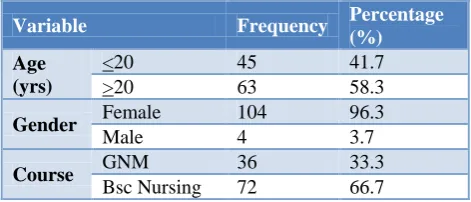
Total of 108 final year nursing students took part in the study. Mean age of the study subjects was 20.62 + 0.894 years. Majority of the study subjects were females (96.3%). BSc nursing students constituted 66.7% of the study population (Table 1).
Table 1: Background characteristics of study subjects.
Variable Frequency Percentage
(%)
Age (yrs)
<20 45 41.7 >20 63 58.3
Gender Female 104 96.3
Male 4 3.7
Course GNM 36 33.3
Bsc Nursing 72 66.7
Table 2: Source of knowledge about HIV and PEP.
Source Frequency Percentage
(%)
HIV (n=108)
Media 27 23.9
Academic/
Teacher 71 62.8 Training 6 5.3
Friends 9 8
PEP (n=72)
Media 15 20.8
Academic/
Teacher 42 58.3 Training 9 12.5 Friends 6 8.3
Source of knowledge is presented in Table 2. All study subjects had heard about HIV but only 72(66.67%) had heard about post exposure prophylaxis (PEP). Majority learnt about HIV (62.8%) and PEP (58.3) through their teachers in college.
Table 3: Awareness score of study subjects by course of nursing.
Course of nursing N Mean (SD)
GNM 36 6.72 (2.04)
BSc nursing 72 8.43 (2.15)
t=-3.962, p<0.001
The mean knowledge score was 7.86±2.25. There was an association between courses of study with HIV knowledge (Table 3), which was statistically significant (p<0.001). Subjects studying B.Sc. nursing had better knowledge when compared to GNM subjects.
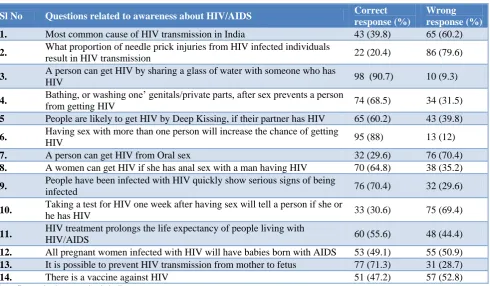
Table 4: Response of the nursing students to HV awareness questions.
Sl No Questions related to awareness about HIV/AIDS Correct
response (%)
Wrong response (%)
1. Most common cause of HIV transmission in India 43 (39.8) 65 (60.2)
2. What proportion of needle prick injuries from HIV infected individuals
result in HIV transmission 22 (20.4) 86 (79.6)
3. A person can get HIV by sharing a glass of water with someone who has
HIV 98 (90.7) 10 (9.3)
4. Bathing, or washing one’ genitals/private parts, after sex prevents a person
from getting HIV 74 (68.5) 34 (31.5)
5 People are likely to get HIV by Deep Kissing, if their partner has HIV 65 (60.2) 43 (39.8)
6. Having sex with more than one person will increase the chance of getting
HIV 95 (88) 13 (12)
7. A person can get HIV from Oral sex 32 (29.6) 76 (70.4)
8. A women can get HIV if she has anal sex with a man having HIV 70 (64.8) 38 (35.2)
9. People have been infected with HIV quickly show serious signs of being
infected 76 (70.4) 32 (29.6)
10. Taking a test for HIV one week after having sex will tell a person if she or
he has HIV 33 (30.6) 75 (69.4)
11. HIV treatment prolongs the life expectancy of people living with
HIV/AIDS 60 (55.6) 48 (44.4)
12. All pregnant women infected with HIV will have babies born with AIDS 53 (49.1) 55 (50.9)
13. It is possible to prevent HIV transmission from mother to fetus 77 (71.3) 31 (28.7)
14. There is a vaccine against HIV 51 (47.2) 57 (52.8)
Note: figures in the parenthesis indicate percentages
Table 5: Response of study subjects to PEP Awareness questions.
Sl No Questions about PEP Correct
response (%)
Wrong response (%)
1 What are the indications for PEP? 67 (93.1) 5 (6.9)
2 Within how many hours PEP should be started to be effective? 4 (5.4) 68 (94.6)
3 What is the ideal HIV-PEP regimen following needle stick injury? 3 (4.2) 69 (95.8)
4 What is the total duration of PEP? 10 (13.9) 62 (86.1)
Note: figures in the parenthesis indicate percentages
It was found that only 39.8% of the study subjects were aware of most common route of HIV transmission in India. Proportion of needle stick injuries which will result in HIV transmission was known by 20.4% of study subjects. Majority (70.4%) thought that oral sex doesn’t spread HIV and around 35.2% of subjects were unaware about HIV transmission through anal sex. Around 50% of study subjects were unaware about correct treatment of HIV and parent to child transmission. More than half (52.8%) of subjects believed that there is a vaccine to prevent HIV infection. The details about responses to individual statements about HIV knowledge is presented in Table 4.
At least one indication for PEP was identified correctly by the 93.1% of the study subjects (Table 5). But only few students were aware about time to initiate PEP to be effective (5.4%) and duration of PEP (13.9%).
DISCUSSION
study subjects, the later studies included entire classes of nursing students from first to final year but we included only final year nursing students. The awareness score was 7.86±2.25. The score indicates the average level of knowledge about HIV among nursing students. Around one third of study subjects were aware about most common mode of transmission, this was very less when compared with the other studies.2,3,10 Awareness was more than 90% in those studies regarding mode of transmission. This may be attributed to variations in the assessment tools in different studies. Mother to child transmission was known to 50% of the participants, in other studies,this was in the range of 65% to 95%.2,3,12,13 This huge variation may be because of difference in study settings. Transmission of HIV through anal sex was not known to 35.2% of the study subjects. This was less compared to the study done by Naveen et al where 87.37% of the participants were unaware about the transmission by anal intercourse.3 This may be due to the popular belief that sexual act means only vaginal sex and many are unaware that HIV also spreads through other forms of sexual act. The risk of transmission due to occupational exposure like needle stick injury is possible in nursing profession but our study found that only 20.4% were aware about the risk of transmission involved with needle stick injury. This is very important to consider as this may help them to use universal precautions and misconceptions about this may lead to denying care for the HIV patient. The knowledge was better among BSc Nursing students in comparison to GNM students. This was similar to study done by Parajulee et al in Nepal.10 This may be due to difference in entry criteria for the course and duration and syllabus of the course. One important finding of our study was awareness about vaccine against HIV infection, 52.8% of study subjects believed that there is a vaccine available to prevent transmission of HIV. This was similar to the study done in Greece by Ouzouni et al.13 These findings indicate majority had incomplete knowledge and misconceptions about mode of transmission and methods of prevention. Post exposure prophylaxis (PEP) is important tool in prevention of occupational transmission of HIV. Our study explored basic knowledge of nursing students regarding post exposure prophylaxis. In contrast to HIV, only 66.67% heard about PEP. This was similar to the study done by Sendo et al in Ethiopia, but lower when compared to study done in Tamilnadu.9,14 This variation may be attributed to difference in the study subjects. Most common source of information was again through teachers at the institute, which was similar to other studies.9,14 At least one indication for PEP was known to 93.1% of the study subjects. Majority (94.6%) were unaware about time to initiate PEP to be effective (94.6%) and duration of PEP was not known to 86.1% of study participants, which is very low when compared with the other studies.9,14 This may be due to lower level of awareness and lack of exposure.
Limitations
Convenient sampling limits the generalizability of the study results and understanding of the questions due to language issues might have influenced the results.
CONCLUSION
Study concludes that knowledge about HIV infection and PEP are inadequate among nursing students and Bsc nursing students have better knowledge than GNM students. As most common source of information cited by study subjects is teachers, it will be helpful if they teach important practical issues repetitively to the nursing students wherever it is admissible.
ACKNOWLEDGEMENTS
Authors would like to thank teaching staff of the nursing college for their support in conducting the study.
Funding: No funding sources Conflict of interest: None declared
Ethical approval: The study was approved by the Institutional Ethics Committee
REFERENCES
1. National AIDS control organization (NACO) Annual Report 2016-17. 2017. Available at: http://naco.gov.in/sites/default/files/NACO%20AN NUAL%20REPORT%202016-17.pdf Accessed on 27 May 2018.
2. Chendake MB, Mohite VR. Assess the knowledge and attitude of nursing students towards HIV/AIDS. Indian J Sci Res. 2013;4(1):69-74.
3. Goel NK, Bansal R, Pathak R, Sharma HK, Aggarwal M, Luthra SC. Knowledge and awareness of nursing students about HIV/AIDS. Health and Population: Perspectives and Issues. 2010;33(1):55-60.
4. Mason JO. Recommendations for Prevention of HIV Transmission in Health-Care Settings. Vol. 36. Centers for Disease Control and Prevention; 1987. 5. Wyżgowski P, Rosiek A, Grzela T, Leksowski K.
Occupational HIV risk for health care workers: risk factor and the risk of infection in the course of professional activities. Therap Clin Risk Management. 2016;12:989-94.
6. Wilburn S, Eijkemans G. Preventing Needlestick Injuries Among Healthcare Workers: A WHO-ICN Collaboration. Int J Occup Environ Health. 2004;10:451–6.
7. World Health Organization. Quantifying selected major risks to health In: The World Health Report. Geneva: WHO, 2002: 47–98.
9. Sendo EG. Assessment of Level of Knowledge and Practice of Nursing and Midwifery Students on HIV Post Exposure Prophylaxis in Hawassa University, Ethiopia. J HIV Clin Scientific Res. 2014;1(1):1-6. 10. Parajulee V, Selvaraj V. Knowledge of nursing
students towards HIV/AIDS in Nepal. J Col Med Sci Nepal. 2012;8(4):27-33.
11. Kamath N. Awareness on epidemiological factors of HIV/AIDS among nursing students in selected institutions in Dakshina Kannada. NUJHS 2016;6(2):20-3.
12. Adhikari K, Gupta N, Koshy AK, Jain VM, Ghimire A, Jnawali K, et al. Knowledge and attitude towards HIV/AIDS amongst nursing students in Nepal. SAARC J Tuber Lung Dis HIV/AIDS. 2015;XII(1):8-13.
13. Ouzouni C, Nakakis K. HIV / AIDS knowledge, attitudes and behaviours of student nurses. Health Sci J. 2012;6(1):129-50.
14. Celia AD, Thajudeen SM, Meenakshi B, Ramya JE. Assessment of knowledge about post exposure prophylaxis of HIV among medical, nursing and paramedical students in hospital and laboratory practice. Int J Basic Clin Pharmacol. 2017;6(10):2408-13.