Implementation of Financing Kompak for Welfare Partner Operational
System Grameen Bank in Banyumas Regency
Apik Anitasari Intan Saputri
Sekolah Tinggi Agama Islam Al Hikmah 2 Benda, Brebes, Indonesia [email protected]
Abstract
Indonesia has a variety of microfinance service providers such as Commercial Banks, Rural Banks, Non-Bank Financial Institutions (LKBB), Micro Finance Institutions (MFIs), Savings and Loans Cooperatives (KSP) and other semiformal and informal institutions operating at the local community level. One Non-Bank Financial Institution operating in Indonesia is an institution with a group finance system - commonly referred to as a Grameen bank. Its business objectives are to tackle poverty or other problems such as education, health, access to technology, and environmental issues that may threaten people and society. The research method used is field research with a sociological juridical approach. With the establishment of a poverty alleviation program involving many women, Grameen banks became one of the integrated institutions in public health programs by establishing sanitation and water programs as a health support product of its partners. This product is called KOMPAK and aims to develop financing products for the development of water quality and sanitation improvement among low-income people. Women Grameen bank actors are not only a target in the development of the business world, they also provide education on improving the quality of life and raise awareness of the importance of water hygiene and sanitation health. The company offers loans to economically active but low-income women especially those living in urban and rural areas.
Keywords: financing, sanitation, female client, grameen bank, public health
A. INTRODUCTION
Micro and small entrepreneurs until now have received less attention. Whereas in their hands, the wheel of the vast majority of business is sustained. On their shoulders, too, many people rely on life. Unfortunately, they are marginalized by the lack of access to capital and coaching. [Darsono, Ali Sakti, "Memberdayakan Keuangan Mikro Syariah Indonesia", Jakarta: Tazkia Publishing Bank Indonesia Cooperation, September 2017, p.1]
Apik Anitasari Intan Saputri
22 Ijtimā’iyya, Volume 3, Number 1, March 2018
Macro-finance institutions such as banks have numerous obstacles to overcome in order to serve community groups that are generally informal sector business actors. These enterprises typically that do not have robust record standards and financial reports. In addition to not being considered bankable, the form of business also does not meet the “five Cs” criteria (character, capacity, capital, condition, and collateral). Characteristically, Small and Medium Enterprises (SMEs) have weaknesses in their practical profile. Additionally, this segment of the business community has a relatively very low educational background. SMEs’ capital is typically too low and
has no separation between business funds and household funds. In condition, business sustainability from MSE groups are very sensitive to changes in the economy and business environment. And finally, collectively, MSE groups generally have difficulty providing collateral in obtaining financial access. [Darsono, Ali Sakti, "Memberdayakan Keuangan Mikro Syariah Indonesia", p. 7]
In Indonesia, the microfinance industry plays an important role in improving access to finance and financial inclusion in general, especially for low-income segments of the population. Micro Finance Institutions (MFIs) are expected to foster the interest of small communities to open businesses and improve local economies, MFIs should also help increase people's incomes.
MFI's goal is to improve micro-finance access to the community, help improve economic empowerment and community productivity, and help to increase the income and welfare of the community - especially the poor and/or low income. [Product Review, Consumer Education, "Pentignya Lembaga Keuangan Mikro", Jakarta: OJK, 2014, p.33]
The concept of utilising microfinance to empower women and SMEs is a new challenge and is included in Indonesia's economic development targets. UMKM presents a business that is not only oriented towards profit, but also social access becomes an important thing in business sustainability in this arena.
Financial literacy for women and SMEs is very important as an alternative to the development of the economy in poverty alleviation with the empowerment of
productive women in the business world.
Implementation of Financing Kompak for Welfare Partner Operational System ....
Ijtimā’iyya, Volume 3, Number 1, March 2018 23
mentions Grameen bank is a national bank that serves the poor in every village. The concept of the early Grameen bank is the focus in lending to women because they are capable of bringing more profit to the family. Women typically have a stronger drive to overcome poverty. Lending money to women in the countryside is an effective way of fighting the poverty of society as a whole. [Muhammad Yunus, Jakarta: PT. Gramedia Pustaka Utama, 2011, Hal: xii-xiii.]
Women who act as Grameen banks are legal subjects who need to be in good health and capable of living and working efficiently and independently. For this reason, the institute Bina Artha Ventura (which is the author's place of research) is issued the KOMPAK product with its goal to improve the quality of its partner's lives, health and management skills.
A number of problems that often become the current conversation include water access and sanitation access that has not been fully absorbed well among the poor - especially in the suburbs. There are a lot of people who are currently not educated in good hygiene and sanitation practices for healthy living starting from their own home.
Almost all regions in Indonesia are surrounded by villages or settlements full of poor people, garbage, floods, drought, famine and other kinds of problems. For example, after through interviews and data extraction, the people around us still behave BABS (Miserable Shelter)
Apik Anitasari Intan Saputri
24 Ijtimā’iyya, Volume 3, Number 1, March 2018
(USA) and Green Cross (Switzerland). The Ciliwung and Cisadane rivers are two other examples of rivers polluted by household waste and garbage. While the river hedgehog in West Kalimantan is one of the most polluted river by mining waste such as mercury which is the result of gold mining byproducts. [Masrudi Muchtar, Abdul Khair, Noraida, "Hukum Kesehatan Lingkungan (Kajian Teoritis dan Perkembangan Pemikiran), Yogyakarta: New Pustaka press, 2016, Pages: 129]
Based on the above data, the author strives to examine further how the process and implementation of the KOMPAK product can improve water and sanitation
practices for the welfare of the community, especially Grameen bank financing customers in Indonesia in order to minimize the occurrence of problems in improving the quality of life in environmental health.
B. RESEARCH METHODS
1. Type and Location of Research
This field research (field research) aims to obtain data or information directly. [Suharsimi Arikunto, Management Research, Yogyakarta: Pustaka Pelajar, 2005 Pg. 234]. Research conducted at PT. BINA ARTHA VENTURA Kabupaten Banyumas.
2. Approach Method
The approach method used is the sociological juridical qualitative approach. directly interact with the community and participant that examines the behavior or matters relating to the pattern of Grameen bank community and financing KOMPAK issued.
3. Subjects and Research Objects
The subject of this research is Product Management Officer (PMO) PT. Bina Artha Ventura (BAV) Regional 6 Central Java and Client at PT. Bina Artha Ventura Kabupaten Banyumas
The object of this research is the implementation of the application of KOMPAK product for the welfare of client of Grameen Bank operational system in PT Bina
Artha Ventura of Banyumas Regency. 4. Data Sources
Implementation of Financing Kompak for Welfare Partner Operational System ....
Ijtimā’iyya, Volume 3, Number 1, March 2018 25
Data obtained directly from the object of research in the form of information the description of the case study and interview with the Program Management Officer of PT. Bina Artha Ventura Regional 6 Central Java, Health Office, Sanitarian Puskesmas, PDAMs, Construction Partners, Village Heads and Wusan (Sanitation Entrepreneurs), (Local Programs, Water / Sanitation Policy, Data Access Sanitation, water / sanitation, areas with low sanitation access, population per sub-district and village, number of latrines, diarrhea cases, 10 most high-risk diseases in the area, common types of latrines built: cubluk, etc.).
b. Secondary Data
Secondary Data Sources are sourced from data obtained from other
parties, in other words, sources quoting from other sources such as laws and regulations, literature books, internet and documents and other sources related to research materials.
APPSANI (Association of Indonesian Sanitation Management and Empowerment), PAPSIR (Association of Sanitation Entrepreneurs), AKSANSI (Association of Indonesian Sanitation KSM) WUSAN related information can be asked directly through sanitarian at Puskesmas level.
Secondary data sources in this study are Law number 10 Year 19988 About Banking, Compilation of Sharia Economic Law, Association of Fatwa of National Sharia Council of Indonesia, Law number 11 Year 1962 about Hygiene, Book containing about Grameen bank entitled Social Business System of New Capitalism who sided with the poor Kamun of Muhammad Yunus, Masrudi Muchtar's Law on Environmental Health, as well as other supporting articles and books.
C. RESULTS AND DISCUSSION
Apik Anitasari Intan Saputri
26 Ijtimā’iyya, Volume 3, Number 1, March 2018
place or to the form or substantive form in the form of physical, chemical, or biological including behavioral changes.
Environmental health can affect public health conditions. Essentially the level and degree of human well-being are strongly influenced by the environment, and many diseases can be initiated, supported, supported or stimulated by environmental factors. So that the living environment is something that is very fundamental in influencing the survival of life and the welfare of human beings and living beings. [Masrudi Muchtar, Abdul Khair, Noraida, "Environmental Health Law (theoretical
and developmental Thought), Yogyakarta: New Library press, 2016, 18]
According to HAKLI (Association of Indonesian Environmental Health Experts) suggests that Environmental Health is an environmental condition that is able to sustain a dynamic ecological balance between humans and their environment to support the achievement of a healthy and happy human life quality.
According to WHO (World Health Organization), Environmental health is an ecological balance that must exist between humans and the environment in order to ensure healthy human condition. Environmental Health is essentially an optimum environmental condition or condition that positively affects the realization of the optimum health status as well. According to WHO there are 17 environmental health scopes, namely:
1. Provision of Drinking Water
2. Waste management and pollution control 3. Solid Solid Waste
4. Vector Control
5. Prevention/control of soil pollution by human excreta 6. Food hygiene, including milk hygiene
7. Control of pollution 8. Radiation control 9. Health work 10. Control of noise
11. Housing and settlers
Implementation of Financing Kompak for Welfare Partner Operational System ....
Ijtimā’iyya, Volume 3, Number 1, March 2018 27
14. Accident prevention
15. General recreation and tourism
16. Sanitation measures related to epidemic/epidemic states, natural disasters and population movements
17. Precautions necessary to ensure the environment.
Water.org is a US-based non-governmental organization working to improve access to water, sanitation and hygiene (WASH) with a vision of "We envision the day when everyone in the world can take a drink of water and experience the dignity of a toilet ". One of the efforts undertaken is through the Water Credit Program, which is working with financial institutions in order to develop financing products for the construction of water and sanitation facilities. Therefore, Water.org provides
technical support to PT. Bina Artha Ventura (BAV) to provide sanitation access among low-income communities.
Bina Artha Ventura is a venture company in Indonesia established in 2011 to provide financial services to low-income people in a fair, transparent, efficient and sustainable manner. The company offers loans ranging from Rp. 1-4 million to economically active but low-income women. Target BAV group credits are women with daily earnings of Rp. 20,000 - Rp. 50,000, especially those living in peri-urban and rural areas. The BAV loan approach is a joint liability of group loans without collateral requirements. In June 2017 BAV serves more than 300,000 partners and seeks to reach 1,000,000 households by 2020.
Since June 2015, Bina Artha Ventura has developed a loan product to finance household sanitation facilities, especially toilets and septic tanks named KOMPAK products. After one year of trial, Bina Artha plans to apply KOMPAK to all BAV branches. The purposes of this product are:
1. Provide access to partners to build healthy latrines for families
2. Help build a clean and healthy environment for families and communities 3. Provide access to finance for women and families to build their businesses.
The provisions for obtaining loans KOMPAK not much different from working capital loans that have already been running in Bina Artha, namely:
1. Productive women of not more than 57 years
Apik Anitasari Intan Saputri
28 Ijtimā’iyya, Volume 3, Number 1, March 2018
3. Members of the collection that are less than 2 in a set
4. Have identity in the form of ID card and KK
5. Determine the type of sanitation facility to be proposed for development 6. This application may be submitted by a new partner or next cycle partner
7. The completed facilities are built H + 14 from the date of disbursement
The purpose of financing provided to Indonesian women clients as financing targets in improving people's living standards is for business capital, both for new business capital and the addition of working capital. KOMPAK's products are water and sanitation for Bina Artha Ventura's partner who wants to improve their quality of life by having access to healthy water and good sanitation.
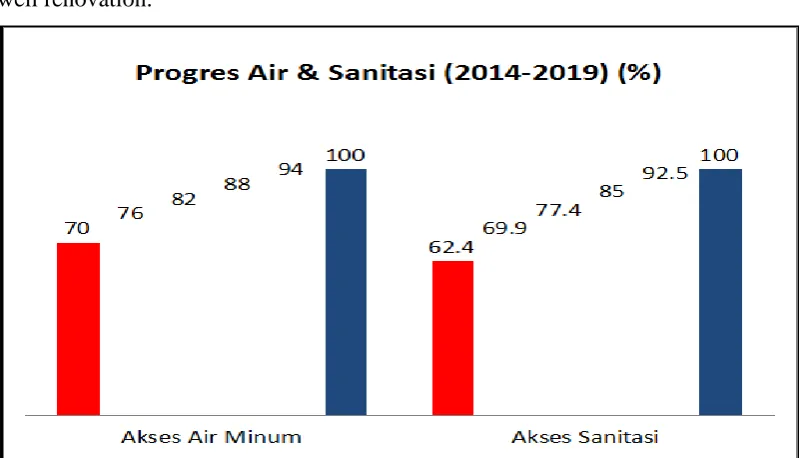
Mitra KOMPAK, which is funded by Bina Artha currently has access and a good opportunity to improve the quality of its health through KOMPAK products proclaimed by Bina Artha. The scope of KOMPAK's products is water access and sanitation access. For water access based on a quote from Media Indonesia November 2016;
"The government will work hard to reach the target because until 2015, the
achievement of access to drinking water to the community is still 70.97% and new access to sanitation 62.14%", said Minister of National Development Planning (Bappenas / Head of Bappenas) Bambang Brodjonegoro in Jakarta.
According to the Director of Environmental Health, Ministry of Health, dr. Imran Agus Nurali, Sp. KO taken from www.depkes.go.id/article published on 15 March 2017 targeting universal achievement in 2019 is 100% access to drinking water, 0% slum area and 100% access to proper sanitation. The Government seeks to make it happen with the Community Based Total Sanitation approach (STBM) in accordance with the Minister of Health Decree number 3 of 2014 on STBM [www.depkes.go.id, downloaded on 5 April 2018.t 21.32 wib]
Based on data released by STBM secretariat, up to 2015 as many as 62 million or 53% of rural residents still do not have access to proper sanitation. 34 million of them still practice haphazard defecation. It takes 400% acceleration to reach Indonesia's target of a haphazard stool (SBS) by 2019. [Depkes.go.id]
Implementation of Financing Kompak for Welfare Partner Operational System ....
Ijtimā’iyya, Volume 3, Number 1, March 2018 29
impregnation. While Water access is funded, among others, Water Filter, PDAM water channel/home connection, Toren / water tank, water pump, water trader and well renovation.
Figure 1. Graph of Progres Air & Sanitasi (2014-2019)
The partner financing procedure begins with selecting partners conducted by conducting the Partner Feasibility Test, conducting surveys and interviews, then providing Partner Group Discipline Training (LKKM) including group formation, Testing of Partner Partnership (UPKM), Monitoring of Financing Products of
KOMPAK. The process of Liquidation, Installment and Business Inspection conducted 1 month maximum after liquid for business capital is evidenced by business photos, then if inspection of KOMAK Air and Sanitasi products maximum 14 working days after liquefaction process. In connection with the above, then some things become parameters to "GREAT PARTNER" is as follows:
1. Discipline attendance in group meetings Present on time 2. Pay the exact amount
3. Joint liability
Apik Anitasari Intan Saputri
30 Ijtimā’iyya, Volume 3, Number 1, March 2018
accordance with the result of business verification after obtaining financing (eg through business monitoring and surprise visite), and partners still have business.
Preliminary process is to survey the village to be socialized KOMPAK products that are by:
1. Checks on density, type of business, red area, and community (arisan / PKK meeting)
2. Checks on similar financial institutions 3. Checks on water and sanitation conditions
4. Survey shop materials and builders 5. Go to the Village Office / Village 6. Go to the PDAM
7. Go to the Puskesmas (Sanitarian) and conduct a survey related to village latrine/latrine assistance, BABS behavior (s), access to toilet ownership, house connection installation price, pipeline coverage area.
The community socialization process begins with an interview on the habit of defecation (BAB), an explanation of the hazards of BABS and contaminated water from the side of the disease, economic impact and public comfort, the benefits of healthy latrines and good water facilities.
Target targets are people who do not have access to adequate water and sanitation facilities including:
1. Semi-Permanent Healthy Spring (JSSP) 2. Residents who are still sharing
3. Residents who still defecate carelessly / (BABS)
4. Residents who do not have access to adequate water such as not having the well of infiltration, wells that are still shallow depth so dry in the dry season, etc.
The process at the time of the SME (Test the feasibility of partners) things that need to be done among others are summarized in the following table:
Table 1
The Process at the time of the SME
No Tools to be built Photo SMEs (Client in Location
Development)
Implementation of Financing Kompak for Welfare Partner Operational System ....
Ijtimā’iyya, Volume 3, Number 1, March 2018 31
No Tools to be built Photo SMEs (Client in Location
Development)
2 Renovation of the latrine Photo of the latrine to be renovated For example: if the addition of a toilet, then the photo of the candidate location of the toilets added; etc 3 Wastewater pipes and impregnation Photo of renovated pipe section /
prospective pipe location constructed as well as photographs of candidate location of drainage that will accommodate pipe water 4 Bathroom Room Renovation Photos of locations/sections to be
renovated (eg Photo partners with prospective cement floor locations to be tiled)
5 PDAM / BPSPAM home connection Photo of the prospective home connection installation location 6 Pump installation Photo pump installation of new
pump location to be installed/ pump to be renovated and photo water source
7 Repairs/making of a well (deepening wells for example)
Photo of wells to be renovated / well fields to be made
8 Installation of water reservoirs Photo of candidate location of installation of the water tank and the photo of water source
9 Water Filter -
10 Water Merchants Photo partners with locations of water trading businesses (refill depots, etc.)
The Partner of Bina Artha cooperates in groups to improve the quality of life for the sake of family health, environmental health as well as the health of rivers, water and land in its environment by applying the financing of KOMPAK to make latrines for those who still do not have healthy latrines or drainage facilities.
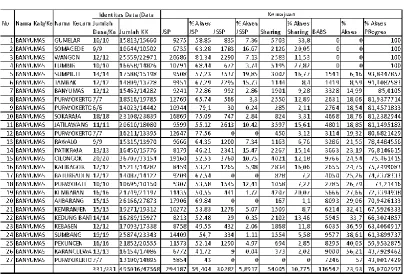
Based on data from http://stbm-indonesia.org/monev/ Total community-based
Apik Anitasari Intan Saputri
32 Ijtimā’iyya, Volume 3, Number 1, March 2018
Figure 2. Total Community Based Sanitation Source: Sanitasi Total Berbasis Masyarakat
Based on the above data, the implementation of the financing of KOMPAK in the region of Banyumas district is now a matter that needs to be socialized so that public health in the district of Banyumas can be realized well.
Implementation of Financing Kompak for Welfare Partner Operational System ....
Ijtimā’iyya, Volume 3, Number 1, March 2018 33
Figure 3. Progressed in BABS behavior
In accordance with the interview with Novita Sari, Wash Expert Manager on 26 March 2018 at 16:26 wib in Jakarta. Access to water in Indonesia is still very low at only 40% and has no legal access, therefore the Health Office makes an assessment with water.org to collaborate on financing to fund access to water and sanitation. The government has a target of 100-0-100 that is one hundred percent of the people of Indonesia have proper water and sanitation, 0% slum area and 100% decent settlement.
In Banyumas Regency, KOMPAK financing has a good rating and can be received either by Bina Artha Ventura (BAV) partner. According to Mrs. Ratem and Tohiroh who is the BAV financing client of KOMPAK in Margasana village, Karanglewas Sub-district, Banyumas District, improve access to sanitation in his home, the bathroom becomes healthier and access to the disposal does not pollute the environment.
According to them, KOMPAK Products is a product that can be used for two needs simultaneously ie working capital and sanitation facilities and clean water connection. The advantage of an installment is not increased, can choose own model
Apik Anitasari Intan Saputri
34 Ijtimā’iyya, Volume 3, Number 1, March 2018
own. The advantages of having latrines/toilet and its own clean water connection are:
1. Healthier and safer for the family
2. To avoid the risk of being bitten by a snake (rice field/ garden) or slipping in a river
3. No need to worry when the relatives stay or have guests visiting 4. More modern
5. Higher and cleaner environment
6. Save time. No longer queuing in public toilets or rivers 7. To avoid the risk of medical expenses
8. Having a water reserve during the dry season (by having its own water reservoir) After participating in the BAV KOMPAK BAV product socialization program, BAV client have awareness about the hazards of BABS and contaminated water sources due to the contamination of groundwater due to BABS, among others, severe diarrhea in children under 2 years old who can culminate death, Typhus, Worms, Stunting (inhibition of growth in children), skin diseases and poisoning.
D. CONCLUSIONS
From the discussion on Financing of KOMPAK on Water and Sanitation of Grameen Bank Operational System at PT Bina Artha Ventura area of Banyumas district, it is concluded:
1. With this information system, the Company can more easily present information about the financing of KOMPAK to its partners and be able to carry out all implementation on the socialization of water and sanitation health for partners who are all women by considering all aspects of positive law in Indonesia and for the sake of the achievement of government targets of one hundred percent achievement of access to drinking water services, zero percent of the proportion of occupied households and inadequate settlements and one hundred percent achievement of access to sanitation services.
Implementation of Financing Kompak for Welfare Partner Operational System ....
Ijtimā’iyya, Volume 3, Number 1, March 2018 35
Apik Anitasari Intan Saputri
36 Ijtimā’iyya, Volume 3, Number 1, March 2018
BIBLIOGRAPHY
Arikunto Suharsimi, Manajemen Penelitian, Yogyakarta: Pustaka Pelajar, 2005
____Edukasi konsumen,2014" Payung Pelindung Konsumen Jasa Keuangan", Jakarta: OJK
Hanintijo,Ronny Soemitro.2002, Metode Penelitian Hukum dan Jurimetri, Ghalia Indonesia: bandung
http://stbm-indonesia.org/monev/
J.R Raco,2010, Metode Penelitian Kualitatif Jenis, Karakteristik dan Keunggulannya, GRASINDO: Jakarta
____KABAR OTORITAS,2014, Edukasi Konsumen , "Persembahan Untuk Perempuan dan UMKM", Jakarta : OJK
Muhammad, 2005, "BANK SYARIAH Problem dan Prospek Perkembangan di Indonesia", Graha Ilmu, Yogyakarta.
Muhammad, 2006 "Menunggu Kiprah Penyelamat Ekonomi Rakyat" (Pengantar Sistem dan Prosedur Pendirian Baitul Mal wat-Tamwil) Yogyakarta: Citra Media
Muchtar,Masrudi Abdul Khair, Noraida,2016 “Hukum Kesehatan Lingkungan ( kajian teoritis dan perkembangan Pemikiran),Yogyakarta: Pustaka Baru press
Nasution Darmin, 2013,”DARMIN NASUTION Bank Sentral itu Harus Membumi”, Yogyakarta:Galang Pustaka
___Telaah Produk, Edukasi Konsumen, 2014, "Pentignya Lembaga Keuangan Mikro", Jakarta: OJK
Undang Undang R.I Nomor 6 Tahun 2009 tentang Bank Indonesia dan Undang Undang Republik Indonesia Nomor 21 Tahun 2008 tentang Perbankan Syariah,Bandung: Citra Umbara
Yunus Muhammad dengan Karl Weber,2011, BISNIS SOSIAL, Sistem Kapitalisme Baru Yaang Memihak Kaum Miskin, Translater: Alex Tri Kantjono, Jakarta : PT. Gramedia Pustaka Utama
Yunus Muhammad dengan Alan Jois,2007, Bank kaum Miskin, Translater: Irfan Nasution, Jakarta : Gajah hidup