1 Jibi Paul
CORRESPONDING AUTHOR
1
Jibi Paul, MPT, (PhD)
Lecturer Physiotherapy Program, School of Health Sciences,
KPJ Healthcare University College, Kota Seriemas, Nilai, Malaysia e-Mail: [email protected]
Int J Physiother. Vol 1(4), 227-232, October (2014) ISSN: 2348 - 8336
ABSTRACT
Background: Stroke is one of the most common neurological diseases that lead to disability in elderly population. Functional impairment of upper limb affects performance of activities in daily life. The primary objective of this study was to investigate and compare the effect of motor relearning program and thermal effect to improve upper limb motor function among stroke subjects.
Methods: Random sampling method was used to select subjects with right middle cerebral artery stroke. Twenty subjects were included and randomly divided into three groups by using lottery method, ten in each group A and B. Group A trained with MRP and group B with thermal stimulation. The outcomes were measured by the MMAS, and STREAM scale.
Result: Analysis of variance (ANOVA) used to find the significance of study parameters between the groups. Dependent t test was used to find the significance of study parameters between pre and post assessment within the group. According to the result Group A shows better improvement than group B, It shows that upper limb motor function improved significantly higher in Group A (P<0.001) when compared to Group B in MMAS and STREAM scale evaluation.
Conclusion: The present study concluded that physiotherapy treatment by the use of motor relearning program and thermal stimulation are effective technique in improvement of upper limb motor function among Stroke subjects. It has also proved that motor relearning program was more effective on improvement of motor functions in upper limb among MCA Stroke subjects.
Keywords: Stroke, Motor relearning program, Thermal stimulation, Modified motor assessment scale, Stroke Rehabilitation Assessment of Movements.
Received 12th September 2014, revised 22nd September 2014, accepted 01st October 2014
DOI: 10.15621/ijphy/2014/v1i4/54565
INTRODUCTION
Stroke is an acute onset of neurological dysfunction due to an abnormality in cerebral vascular circulation with resulting signs and symptoms that corresponds to focal areas of brain. The most common characteristics of MCA stroke are contra lateral spastic hemi paresis, motor and sensory disturbance of face, motor weakness of upper extremity and lower extremity with upper limb is more affected than lower limb.
Spasticity usually develops slowly with anti gravity muscles of the upper extremity and usually affects the depressors of the shoulder girdle and arm; the fixators and retractors of the scapula, the side flexors of the trunk, the adductors and internal rotators of the arm, the flexors and pronators of the elbow and wrist, the flexors and adductors of the fingers.
Physiotherapy interventions for stroke subjects are represented by various approaches, for example proprioceptive neuromuscular facilitation, Brunnstrom, Bobath and motor relearning program. There is a general opinion that physiotherapy improves the function of the stroke subjects. But the benefit seems to be statistically small and limited. In few controlled studies on these subjects there was no proper documentation
showing the effect of above mentioned
physiotherapy approaches gives better result than the other approaches. 1, 2, 3
Motor relearning program (MRP) was developed by Carr and Shepherd for stroke that incorporates many aspects of motor learning theory and provides practical guidelines for retraining functional skills. The learning of task is best to stimulate the brain to adopt and reorganize generalizations and transfer training from the rehabilitation setting into everyday life. 4, 5
Primary objective of the study was to compare the effect of MRP and thermal stimulation on its individual effect to improve upper limb motor function following stroke. Secondary objectives of this study were to investigate the individual effect of motor relearning program and thermal stimulation to improve upper limb motor function following stroke.
METHODOLOGY
The subjects of this study were diagnosed stroke patients due to middle cerebral artery occlusion. The study was conducted in the Physiotherapy department of Florence Rehabilitation Centre, Bangalore, India. Samples screened as right MCA stroke with upper limb motor function impairment and satisfied the selection criteria were included
for this study. 20 subjects were participated in this study after selection criteria.
Simple random sampling was selected so that each and every unit in the population had an equal probability of being selected in the sample. Lottery method was used to randomly divide the selected 20 subjects into two groups with 10 subjects in each group namely A and B. Group A was comprised of 5 male and 5 female subjects with age group between 55 and 65years. The subjects in group A were given MRP treatment. Group B was comprised of 6 male and 4 female with minimum age 55years and maximum age 66 years. These subjects were given treatment with thermal stimulation.
Inclusion Criteria
Subjects in this study were with age group between 50 to 70 years of both genders, right MCA infract, duration of the stroke between 6weeks to 6months and having 20 or more than 20 score in Stroke
Rehabilitation Assessment of Movement
(STREAM).
Exclusion Criteria
Subjects excluded from this study were patients with disorientation, hemorrhagic stroke, Stroke due to progressive lesion like tumors, stroke due to trauma, significant musculo tendinous or bony restrictions of the affected upper limb and with unsound mind.
Tools used for this study
1. Modified motor assessment scale (MMAS): This tool was selected for evaluate the changes in motor function following intervention in two groups. In this study items assessed were upper-arm function, hand movements and advanced hand activities. All items are assessed using a 7-point scale from 0 - 6. A score of 6 indicates optimal motor behavior 6.
2. Stroke Rehabilitation Assessment of
Movements (STREAM) Scale: The reliability of the STREAM scores was demonstrated by generalizability coefficients of 0.99 for total scores and of 0.96 to 0 .99 for subscale scores. The internal consistency of the STREAM score was greater than 0.98 on the subscales and overall. 7, 8
Materials Used
Method of collection of data
Data collected before and after the intervention program. These subjects were given motor relearning program in task oriented manner and thermal stimulation for upper limb as treatment. The intervention was applied for a period of 6weeks continuously, comprising total of 30 sessions. Each week had 5 sessions of intervention and each session was given for 30 minutes for both groups.
Statistical analysis
Analysis of variance (ANOVA) has used to find the significant effect of study parameters between the groups. Dependant t test was used to find the significance of effect between pre and post assessment within the group.
RESULT
Comparative study on effect of MRP and thermal stimulation found that MRP is more effective on improving upper limb motor function among stroke subjects between the groups (Inter group analysis by ANAOVA). The individual effect of MRP and thermal stimulation found that both interventions have effect on improving upper limb motor function of stroke subjects within the group (Intra group analysis dependent t test).
Table 1: Basic characteristics of the subjects studied
Basic
characteristics Group A Group B
Age in years;
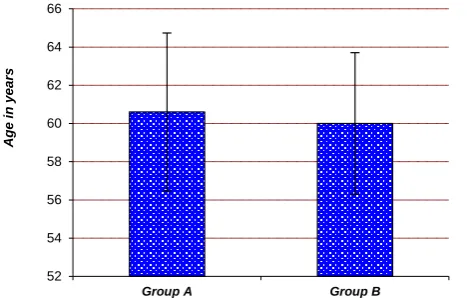
Mean SD 60.60 4.14 60.00 3.71 Sex; Male:
Female 5:5 6:4
Above table 1 show the gender ratio and mean age group of stroke patients in group A and Group B
Figure 1: Age distribution of the subjects studied
Above figure 1 show the mean age group of stroke patients in group A and Group B
Figure 2: Sex distribution of the groups studied
Above figure 2 shows the sex distribution of stroke patients in group A and Group B
Table 2: Pre-Post analysis of Modified Motor Assessment Scale in group A and B
Modified-Motor Assessment Scale
Pre-Assessment (Mean SD)
Post Assessment
(Mean SD) T -Value P-value
Group A 1.10 0.74 6.50 0.97 t=17.678 df =9 P<0.001**
Group B 1.00 0.67 4.10 0.88 t=9.858 df =9 P<0.001**
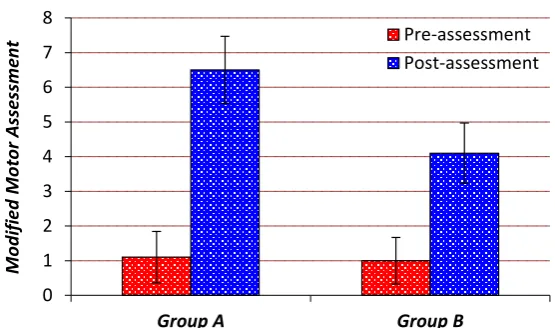
The above table 2 show, the analysis of pre and post assessment data of MMAS score for Group A and Group B .Computed data analysis showed that MMAS score improved significantly in both groups
following intervention with significant value of
P<0.001**.
Figure 3: Pre-Post analysis of MMAS in group A and B
52 54 56 58 60 62 64 66
Group A Group B
A
g
e
in
ye
ars
0 5 10 15 20 25 30 35 40 45 50 55 60 65 70
Group A Group B
Per
cen
ta
g
es
Above figure3 shows the significance in pre-post test analysis for motor assessment scale of group A and group B
Table 3: Pre-Post analysis of Stream scale in group A and B
Stream scale Pre-assessment assessment Post T -Value P-value
Group A 28.005.87 65.50 3.69 t=24.41 df =9 P<0.001**
Group B 27.506.35 58.50 4.12 t=18.98 df =9 P<0.001**
The above table 3 shows the analysis of pre and post assessment data of stream scale for Group A and Group B. Computed data analysis showed that stream score improved significantly in both groups
following intervention in group A and group B with significant value of P<0.001**.
Figure 4: Pre-Post analysis of Stream scale in group A and B
Above figure 4 shows the significance in pre-post test analysis for STREAM scale of group A and group B.
Table 4: Comparison of Modified Motor Assessment scale and Stream scale between group A and Group B
Outcome Group A (Mean SD)
Group B
( Mean SD) P-value
Modified Motor
Assessment scale 6.500.97 4.10 0.88
F=103.4
P< 0.0001****
Stream scale 65.50 3.69 58.50 4.12 F=151.7
P< 0.0001****
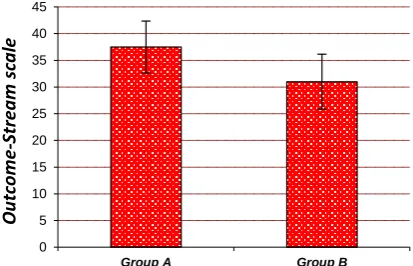
Above table 4 shows the significant difference in effect between the groups. Group A has higher
mean value with 6.500.97 and 65.50 3.69 respectively for Modified Motor Assessment scale
0 1 2 3 4 5 6 7 8
Group A Group B
M
o
dif
ied
M
o
to
r A
ss
es
sm
en
t Pre-assessment
Post-assessment
0 10 20 30 40 50 60 70 80
Group A Group B
Strea
m
s
cal
e
and Stream scale when compared with mean value of 4.10 0.88 and 58.50 4.12 of Group B .The study found significant difference in outcome between the groups A and B, with F=103.4, P< 0.0001 and F=151.7, P< 0.0001 respectively for MMAS and STREAM evaluation.
Figure 5: Comparison of Outcome –Modified Motor Assessment scale
Above figure 5 shows the significance difference in effect on Modified Motor Assessment scale between group A and group B.
Figure 6: Comparison of Outcome –Stream scale
Above figure: 6 shows the significance difference in effect on Stream scale between group A and group B
DISCUSSION
According to the assessment with MMAS and STREAM group A shows that subjects got significant (P<0.001) improvement in motor function following MRP sessions. So statically, it was proved that the individual effect of Motor Relearning Programme was found to be significant in improving motor function of upper limb in right MCA stroke subjects. This view was well supported by the recent research study conducted by Ceravolo MG, Provinciali.L He has proved that Motor Relearning Programme improved motor functions of stroke subjects.
Group B showed that subjects got improvement in motor function on MMAS, and STREAM following thermal Stimulation with P<0.001. So statically, it has proved that the individual effect of thermal
Stimulation was found to be significant in improving motor function of upper limb in right MCA stroke subjects. The same view was proved earlier by, jia- ching chen et al.In this study he proved that the performance of Brunnstrom stage, wrist extension and sensation were improved significantly after thermal stimulation in stroke subjects 9, 10, 11, 12.
Comparative effect of this study has proved that Group A with motor relearning program is more effective over Group B with thermal stimulation for improvement of upper limb motor function among stroke subjects. Individual effect of motor relearning program and thermal stimulation found effective on improvement of upper limb motor function among MCA stroke subjects. The ‘p’ value for the post test of both groups A and B for MMAS and STREAM was P<0.0001, it shows that there was significant difference in improvement of motor function after the intervention in upper limb among stroke subjects.
LIMITATIONS OF THE STUDY
In this study the sample size was relatively small. Larger sample size will help to randomize the result. This study was done for six weeks and measured upper limb motor functions by MMAS and STREAM but no long term follow up was done. The lack of follow up has drawback that it could not reveal the improvement and further change in motor function of upper limb among stroke subjects.
CONCLUSION
This study concluded that use of motor relearning program technique is more effective to improve the upper limb motor function with mild to moderate impairment in right MCA stroke subjects. Both motor relearning program and thermal stimulation techniques have shown significant changes in functional recovery of the upper limb of right MCA stroke patients.
RECOMMENDATION
The study can be replicated with a larger sample size. Follow –up and long term effects of motor function and functional recovery, upper extremity performance and changes in these parameters following withdrawal from the training program can be done. Longer duration can be chosen for the intervention in future research for better understanding of the effectiveness.
REFERENCE
0 1 2 3 4 5 6 7
Group A Group B
O
u
tco
m
e-MMS
0 5 10 15 20 25 30 35 40 45
Group A Group B
O
u
tco
m
e-Strea
m
s
cal
1. Edward C Jauch. Acute Stroke Management. Brains Disease of the nervous system. 10th edi;
2005.
2. Ward N S,Cohen LG. Mechanisms underlying
recovery of motor function after stroke. Arch Neurol. 2004;61(12):1844-8.
3. Yekutiel M, Guttman E .A controlled trial of the retraining of the sensory function of the hand in stroke patients. Journal of Neurol Neurosurg. Psychiatry, 1993; 56(3): 241–244. 4. Krutulyte G, et al. The effectiveness of physical
therapy methods (Bobath and motor relearning program) in rehabilitation of stroke subjects. Medicina. 2003; 1739(9): 889-895.
5. Chan DY, Chan CC and AU DK. Motor
Relearning Programme for stroke subject: a randomized controlled trial. Clin Rehabil. Mar. 2006; 20 (3): 191-200.
6. Loewen SC and Anderson BA. Reliability of the Modified Motor Assessment Scale and the Barthel Index, Phys Ther. 1988; 68(7):1077-81. 7. Daley K, Mayo N and Wood-Dauphinee S.
Reliability of scores on the Stroke
Rehabilitation Assessment of Movement
(STREAM) measure. Phys Ther.1999; 79(1):8-19.
8. Wang C-H, et al. Inter-rater reliability and validity of the stroke rehabilitation assessment of movement (stream) instrument. Journal of Rehabilitation Medicine. 2002; 34(1):20- 24. 9. Jia-Ching Chen. PT MS, et al. Facilitation of
sensory and Motor Recovery by Thermal Intervention for the Hemiplegic Upper Limb in
Acute Stroke Subject: A Single-Blind
Randomized Clinical Trial. Journal of the American heart association; 2005; 36: 2665-2669.
10.Bob Martin. Thermal therapy speeds limb recovery after stroke. Reuters Health; 2005, 16:00:33 -0400.
11.Tracey, Becerra L, et al. Noxious hot and cold stimulation produce common pattern of brain activation in human: a functional magnetic resonance imaging study. Neurosci Lett. 2000; 288(2):159 –162.
12.Chung-Chao Liang, et al. Effectiveness of Thermal Stimulation for the Moderately to Severely Paretic Leg After Stroke: Serial Changes at One-Year Follow-Up. Archives of Physical Medicine and Rehabilitation. 2012; 93(11):1903–1910.
Citation