MARKET STRUCTURE OF THE BANKING
INDUSTRY IN SRI LANKA
A dissertation submitted by
Senarath Lalithananda Seelanatha
MAcc, MBA, BSc. (Pub. Admin)
For the award
of
Doctor of Philosophy
School of Accounting, Economics and Finance
Faculty of Business
University of Southern Queensland
Australia
During the last 27 years, the banking industry in Sri Lanka has undergone a series of changes through financial reforms, advancement of communication and information technologies, globalisation of financial services, and economic development. Those changes should have had a considerable effect on efficiency, productivity change, market structure and performance in the banking industry. The motivation of this study is to investigate empirically the impact of those changes on the banking industry. Thus, this study aims to address three main research issues related to the banking industry in Sri Lanka, namely:
1. Whether deregulation of the financial services sector has led to improvement in efficiency and productivity gains.
2. Whether banks’ inefficiency in the banking industry in Sri Lanka is determined by a set of microeconomic and macroeconomic variables.
3. Whether the changes in efficiency or changes in market structure have influenced the overall operational performance of banks in Sri Lanka.
also to the reduction of the efficiency gap between the state-owned banks and privately-owned banks. The analysis of efficiency scores (asset transformation) of different forms of banks records a stable trend in estimated efficiency. On the other hand, estimated MPIs show that Sri Lankan banks have focused on improving productivity in the asset transformation process rather than the intermediation process.
CERTIFICATION OF DISSERTATION
I certify that the work contained in this dissertation is entirely my own effort, except where otherwise acknowledged. I also certified that the work is original and has not been previously submitted for any other award, except where otherwise acknowledged.
_______________________________
Signature of Candidature
Date……….
ENDORSEMENT
_________________________________ Signature of the Supervisor
There are many people who have directly and indirectly supported me in the completion of my PhD program. However, firstly, I would like to acknowledge my two principal supervisors, Dr. Sarath Delpachitra and Associate Professor Diana Beal. I am indebted to Dr. Delpachitra for encouraging me to do research in a banking and finance field and providing the necessary guidance for this research. I admire you immensely for your invaluable times used to motivate, support and mentor me during my PhD candidature. I am also thankful to Associate Professor Diana Beal for her support and guidance extended in this research. I also appreciated her quick readings of the draft thesis and the suggestions for improvements.
Without the financial assistance received from the Faculty of Business, University of Southern Queensland, SIDA/SAREC Staff Development Programme-University of Sri Jayewardenepura, and the National Centre for Advanced Studies in Humanities and Social Sciences-University Grant Commission-Sri Lanka, I would not have completed my studies in Australia. Therefore, I am indebted to all those institutions.
I would like to thank Dr. Martin Hovey, Head of Department (Finance and Banking), Noel Brown, Arabella Volkov, Dr. Glenda Adkins, Chris O'Reilly, Cassandra Bate, Hilary E. Silva and Dr.Y.K.Weerakoon for their support during my studies at the University of Southern Queensland.
CERTIFICATION OF DISSERTATION...iv
ACKNOWLEDGEMENT...v
TABLE OF CONTENTS...vi
LIST OF TABLES...xi
LIST OF FIGURES...xii
LIST OF ABBREVIATIONS...xiii
CHAPTER ONE: INTRODUCTION 1.1 Introduction ...1
1.2 Conceptual Framework...2
1.3 Rationale for the Research ...4
1.4 Objectives of the Research ...5
1.5 Propositions and Hypotheses...5
1.6 Methodology ...6
1.7 Contribution of the Study...7
1.8 Organisation of the Thesis...8
CHAPTER TWO: DEREGULATION, MARKET STRUCTURE AND THE BANKING INDUSTRY IN SRI LANKA 2.1 Introduction ...10
2.2 Deregulation in the Financial services Sector ...11
2.2.1 Deregulation ...11
2.2.2 Reasons for the regulation of the financial-services industry...12
2.2.3 Modes of deregulation...14
2.2.4 Impact of deregulation ...16
2.3 Financial Reforms in Sri Lanka ...18
2.3.1 Historical background ...18
2.3.2 Objectives of deregulation...19
2.3.3 Main phases in deregulation ...20
2.3.4 Setbacks to deregulation...26
2.4 Impact of Financial Reforms on the Banking Industry...27
2.4.1 Organization of the financial service sector in Sri Lanka after reforms...28
2.4.5 Ownership of commercial banks’ assets ...40
2.4.6 Banking concentration...41
2.5 Synthesise...42
CHAPTER THREE: CONCEPTS AND MEASUREMENTS OF EFFICIENCY AND PRODUCTIVITY CHANGE AND THEIR APPLICATION IN THE BANKING INDUSTRY 3.1 Introduction ...44
3.2 Productivity Concepts ...45
3.3 Production Frontier Approaches ...49
3.3.1 Parametric approaches...49
3.3.2 Non-parametric approaches ...50
3.3.3 Choice of frontier analysis methods...52
3.4 Data Envelopment Analysis...53
3.4.1 Different specifications of DEA ...55
3.4.2 Selection of the DEA model ...56
3.4.3 MPI, scale efficiency and technological change ...59
3.4.4 Restriction on number of inputs and outputs ...60
3.5 Input and Output Specification...61
3.5.1 Issue 1: Definition of inputs and outputs...61
3.5.2 Issue 2: Measurement of inputs and outputs...67
3.5.3 Issue 3: Non-traditional activities ...67
3.5.4 Issue 4: Quality aspects ...68
3.5.5 Implications of input-output specification...69
3.6 Application of DEA in the Banking Industry ...69
3.6.1 Methodological issues ...71
3.6.2 Sources of inefficiency...76
3.6.3 Policy issues ...77
INDUSTRY IN SRI LANKA
4.1 Introduction ...89
4.2 The Study Proposition ...90
4.3 Method of Estimating Banks’ Efficiency and Productivity Changes ...90
4.3.1 DEA model formulation ...91
4.3.2 Malmquist total productivity index (MPI)...98
4.4 The Banking Model ...100
4.5 Data and Sample...103
4.6 Analysis of Estimated Efficiency Scores ...105
4.6.1 Mean and standard deviation of input and output variables ...105
4.6.2 Efficiency in intermediation ...108
4.6.3 Efficiency in asset transformation...117
4.6.4 Nature of RTS...124
4.6.5 Findings of the assessment of banks’ efficiency...126
4.7 Analysis of Productivity Changes...129
4.8 Conclusion...135
CHAPTER FIVE DETERMINANTS OF EFICIENCY OF BANKS IN SRI LANKA 5.1 Introduction ... 137
5.2 Background of the Analytical Framework ... 138
5.2.1 Determinants of bank efficiency ... 138
5.2.2 Empirical approaches used in previous studies... 140
5.3.2 Determinants of banks’ efficiency in Sri Lanka ... 147
5.4 Results and Discussion... 150
5.4.1 An overview ... 150
5.4.2 Firm-specific variables... 154
5.4.3 Macroeconomic variables ... 159
5.4.4 Qualitative variables... 160
5.5 Conclusion... 163
CHAPTER SIX: MARKET STRUCTURE, EFFICIENCY AND PERFORMANCE 6.1 Introduction ...165
6.2 Market Behaviour...166
6.2.1 EFS hypothesis vs SCP hypothesis ...167
6.2.2 Measures of market concentration ...170
6.2.3 Previous applications ...171
6.3 Methodology ...173
6.3.1 Empirical model...175
6.3.2 Selection of variables ...176
6.3.3 Data ...179
6.4 Results and Discussion...179
6.5 Conclusion...186
CHAPTER SEVEN: CONCLUSION AND POLICY IMPLICATIONS 7.1 Introduction ...187
7.2 Main Findings ...188
7.2.1 Analysis of productivity and efficiency ...188
7.2.2 Determinants of technical efficiency...190
7.2.3 Market structure, efficiency and operational performance ...191
7.3 Policy Implications and Recommendations ...192
7.3.1 Speed of reforms ...193
7.3.2 Banks’ operational environment ...195
7.3.3 Institutional framework for financial reforms...196
APPENDIXES
Appendix 1: Applications of DEA in the financial services sector ...201
Appendix 2: Applications of DEA in the financial service sector; Input and output specification ...208
Appendix 3: Coefficients of variation (Input and output data) ...214
Appendix 4: Window analysis – (Mean estimated efficiency scores in individual window periods) ...215
Appendix 5: Mean estimated efficiency scores ...221
Appendix 6: Nature of return to scale...223
Appendix 7: Regression results – Determinants of technical efficiency...225
Appendix 8: Regression results - Market structure, efficiency and operational performance...226
Table 2.1: Financial-service sector reforms from 1977-2003 ... 21
Table 2.2: Infrastructural developments in deposit-taking institutions in Sri Lanka30 Table 2.3: Development in banking facilities in Sri Lanka... 33
Table 2.4: Bank market concentration (HH index) ... 42
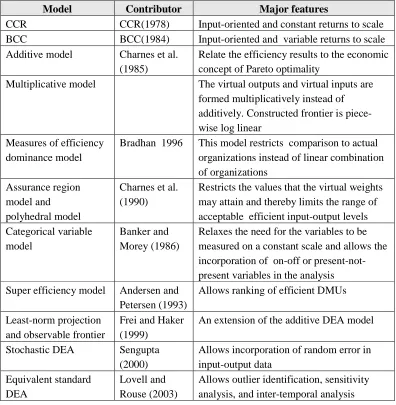
Table 3.1: Forms of DEA used in banking literature ... 56
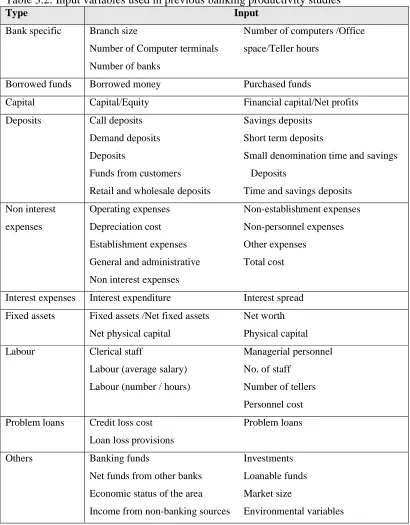
Table 3.2: Input variables used in previous banking productivity studies ... 65
Table 3.3: Output variables used in previous banking productivity studies ... 66
Table 4.1: Specification of input and output variables ...102
Table 4.2: Corresponding periods of each window ...104
Table 4.3: Descriptive statistics of input and output data ...106
Table 4.4: Correlation of input and output variables (pooled data) ...107
Table 4.5: Descriptive statistics - Efficiency in intermediation ...113
Table 4.6: Mann-Whitney test scores - Efficiency in intermediation ...114
Table 4.7: Descriptive statistics – Efficiency in asset transformation ...121
Table 4.8: Mann-Whitney test scores – Efficiency in asset transformation...123
Table 4.9: Nature of RTS (efficiency in intermediation) ...125
Table 4.10: Nature of RTS (efficiency in asset transformation) ...125
Table 4.11: Productivity gains/losses in intermediation ...130
Table 4.12: Productivity gains/losses in asset transformation...131
Table 5.1: Microeconomic, macroeconomic and other factors affecting banks’ efficiency ...139
Table 5.2: Variables and definitions ...149
Table 5.3 Descriptive statistics of firm-specific variables ...150
Table 5.4: Correlation coefficient of variables tested ...151
Table 5.5 Tobit regression results...153
Table 6.1 Variables and their definitions ...180
Table 6.2: Pearson correlation coefficient...181
Figure 1.1: Financial reform, market structure, efficiency and productivity change
of the banking industry in Sri Lanka ...4
Figure 2.1: Composition of the financial-services sector in Sri Lanka ... 29
Figure 2.2: Financial-services sector contribution to the GDP... 34
Figure 2.3: Monetary aggregates ... 35
Figure 2.4: Banks assets as proportion of GDP... 35
Figure 2.5: Domestic savings, investment and financial services sector contribution to GDP ... 36
Figure 2.6: Commercial bank lending and deposit rates ... 37
Figure 2.7: Commercial banks’ ownership of government debtas a percentage of total domestic loans... 38
Figure 2.8: Funding sources of banks... 39
Figure 2.9: Uses of commercial banks assets ... 40
Figure 2.10: Ownership of commercial banks assets ... 41
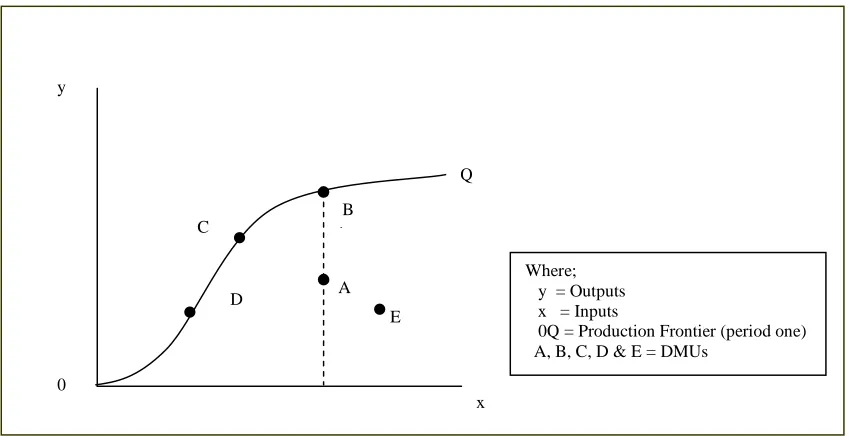
Figure 3.1: Production frontier and technical efficiency ... 45
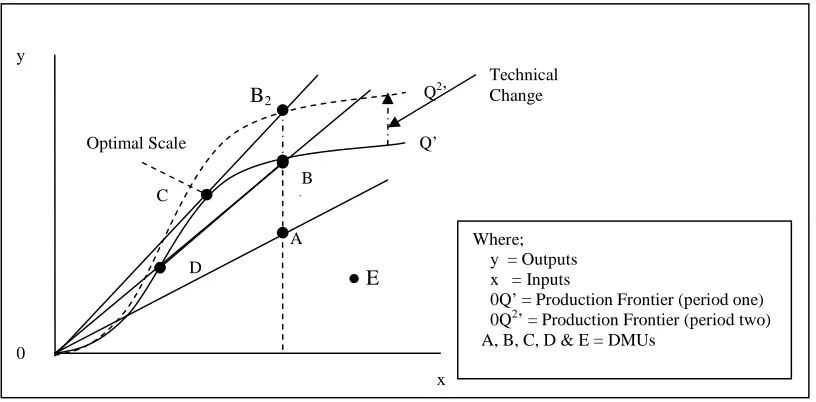
Figure 3.2: Productivity, technical efficiency and scale efficiency... 46
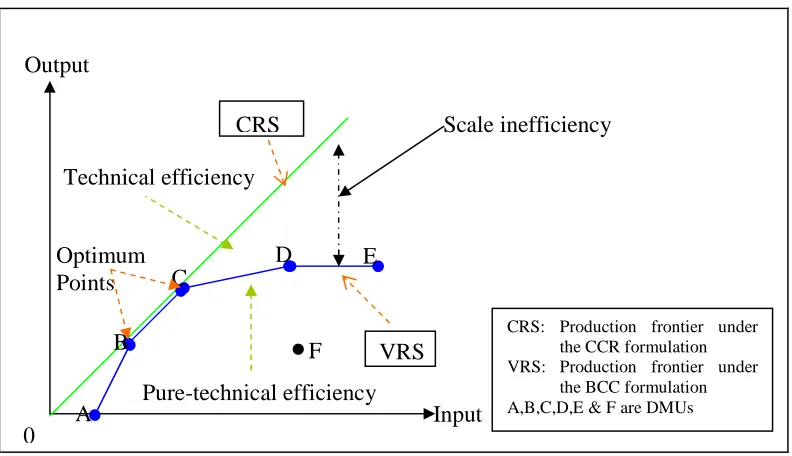
Figure 3.3: Envelopment surface under CCR and BCC formulation ... 54
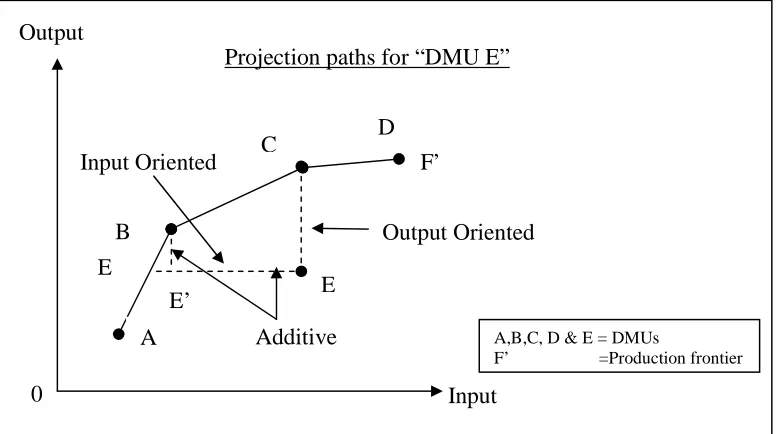
Figure 3.4: Mode of assigning efficiency indices... 55
Figure 4.1: Average TE(I) - Window analysis ...109
Figure 4.2: Average PTE(I) - Window analysis ...109
Figure 4.3: Average SE(I) - Window analysis ...109
Figure 4.4: TE(I)-Mid-year ...112
Figure 4.5: PTE(I)-Mid-year ...112
Figure 4.6: SE(I)-Mid-year...112
Figure 4.7: Average TE(A) - Window analysis...118
Figure 4.8: Average PTE(A) - Window analysis...118
Figure 4.9: Average SE(A) - Window analysis ...118
Figure 4.10: TE(A) – Mean value of mid-year...122
Figure 4.11: PTE(A) – Mean value of mid-year...122
Figure 4.12: SE(A) – Mean value of mid-year ...122
ADA - Allocative data envelopment analysis ADI - Authorised depository institutions ASP - All share price index
ATM - Automatic teller machine BCC - Banker, Charnes, and Cooper
CAMEL - Capital adequacy, assets quality, management quality, earnings ability and liquidity of banks
CAR - Capital-adequacy ratio CAT - Productivity gain on catch-up CBSL - Central Bank of Sri Lanka
CCR - Charnes, Cooper and Rhodes (1978) formulation CD - Certificate of deposits
CIB - Credit information bureau CLT - Central limit theory
COLS - Corrected ordinary least square method
CR - Concentration ratio
CRS - Constant return to scale
CSE - Colombo Stock Exchange
DEA - Data envelopment analysis DFA - Distribution free approach
DMU - Decisions making units
DRS - Decreasing return to scale
EMU - European Monetary Union
EFS - Efficient structure hypothesis FDH - Free disposal hull method FRN - Productivity gain on frontier shift GDP - Gross domestic product
GIM - Gross interest margin
GOBU - Government-owned-business-undertakings
HHI - Herfendathal Hix index
M1 - Narrow money
M2 - Time and saving deposits plus the M1
M3 - Broad money supply
MPI - Malmquist productivity index NIM - Net interest margin
NSB - National Savings Bank
PERC - Public Enterprise Reform Commission PFA - Production frontier analysis
PLC - Public limited company
PTE - Pure-technical efficiency PTE(A) - PTE in assets transformation PTE(I) - PTE in intermediations
REPO - Market for repurchasing treasury bills
RMP - Relative market power
RRDB - Regional rural development banks RTS - Return to scale
SCP - Structure conduct performance
SE - Scale efficiency
SE(A) - SE in asset transformation SE(I) - SE in intermediations SFA - Stochastic frontier approach SRR - Statutory reserve requirements
TB - Treasury bill
TE - Technical efficiency
TE(A) - TE in assets transformation TE(I) - TE in intermediations TFA - Thick frontier approach TFP - Total factor productivity
UK - United Kingdom
CHAPTER ONE
INTRODUCTION
1.1 Introduction
Efficient intermediation of funds from savers to borrowers enables the allocation of resources to their most productive uses. The more efficient a financial system is in such resource generation and in its allocation, the greater its contribution to productivity and economic growth (McKinnon 1973). Hence, an efficient financial intermediation system is a prime requirement for a country’s economic development. Consequently, improvement in real returns in the economy may result in higher savings which would presumably, in turn, produce higher resource generation. Thus, development of the financial system is essential for the general enhancement of productivity and economic growth of a country.
some drastic policy changes in relation to deregulation of the financial services sector, together with other economic reforms.
In response to the reforms, the financial services sector in Sri Lanka and the banking sector, in particular, have undergone substantial changes which may have impacted on efficiency and productivity change1, and competition and market structure. The main driving forces behind these changes were financial deregulation, development in information and communication technologies and the globalization of the financial services industry in general. The consequent changes were observable in areas such as the scope of banking operations, number of banks and bank branches, technologies used and quality of human resources in the banking industry. These changes might ultimately be reflected in efficiency and productivity gains. Even though there is a growing body of literature that focuses on efficiency and productivity gains, market structure and the performance of banking industries in other countries (see Casu & Molyneux 2003; Chakrabarti & Chawla 2002; Girardone, Molyneux & Gardener 1997; Hondroyiannis, Lolos & Papapetrou 1999; Maudos & Pastor 2002), no major study has been conducted in Sri Lanka. This study empirically explores the impact of all these forces described above on efficiency and productivity gains, and market structure and operational performance of the banking industry in Sri Lanka.
1.2 Conceptual Framework
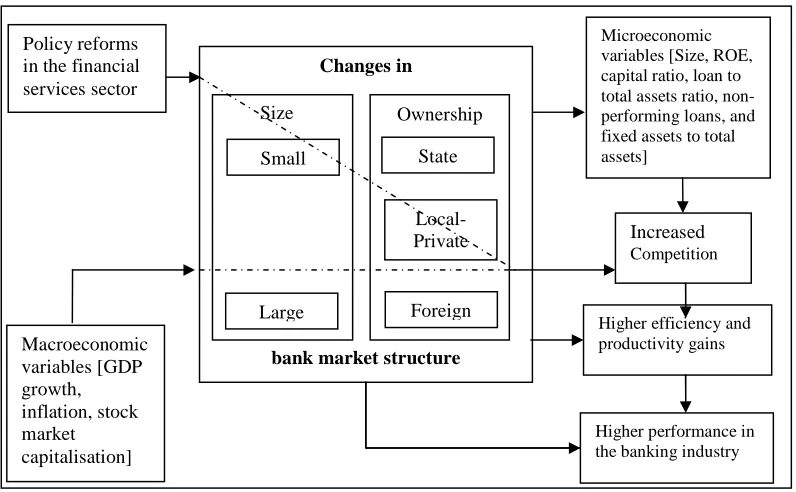
As mentioned previously, the banking industry in Sri Lanka has been influenced by the deregulation of the financial services sector, development in information and communication technologies (ICT) and globalisation of financial services industries. Figure 1.1 illustrates the way these forces have influenced the performance of the banking industry. The deregulation process, which began in 1977, is aimed at making structural changes in the financial services industries to enhance
1 Productivity is defined as a ratio of output to input in a given production situation. However,
competition. Structural changes in the overall financial services sector have affected the banking industry greatly.
Figure 1.1: Financial reform, market structure, efficiency and productivity gains of
the banking industry in Sri Lanka
The entry of new banks, as well as an expansion of branch networks in both privately-owned and state-owned banks, appeared to have increased the degree of competition in the market. Further, globalisation of the sector, together with developments in ICT, has improved the quality and quantity of products and services which are offered by banks. On the other hand, the changes in overall economic policies have improved microeconomic variables which may be directly or indirectly related to bank performance. Therefore, this study predicts that the recorded changes in the financial services industry may have affected overall bank performance through improved efficiency, productivity gains and structural changes in the banking market which enhanced the degree of competition. Based on this background, the study identifies three research issues.
1. Whether deregulation of the financial services sector has affected efficiency and productivity gains in the banking industry in Sri Lanka.
Policy reforms in the financial services sector
Increased
Competition
Higher efficiency and productivity gains
Macroeconomic variables [GDP growth, inflation, stock market capitalisation]
Changes in
bank market structure
Ownership State
Local- Private Size
Higher performance in the banking industry
Foreign Small
Large
2. Whether inefficiency in the banking industry in Sri Lanka is determined by a set of microeconomic and macroeconomic variables.
3. Whether the changes in efficiency or changes in market structure have influenced the overall performance of the banks in Sri Lanka and, if so, how.
1.3 Rationale for the Research
As explained above, efficiency and productivity gains of the banks, as well as market structure of the banking industry, have been regarded as crucial areas in contemporary public policy concerned with a country’s economic development. Empirical analysis of efficiency, productivity change, and market structure is a vital requirement for further policy changes. Accordingly, studies in these areas are important in the following aspects.
First, improvements in efficiency and productivity gains in financial institutions are a vital requirement for providing a more efficient system of asset allocation in the financial services sector. Since Sri Lanka has a bank-led financial services sector, efficiency and productivity gains in firms in the banking industry are more important for providing supportive financial infrastructure for economic development. Improvements in efficiency and productivity gains may reduce the cost of intermediation, which directly affects the intermediation margin in the market.
Secondly, this study addresses a contemporary policy issue in relation to market structure. It examines how the banking structure, improvement in efficiency and productivity change affect bank performance (measured by profitability and net interest margins). This type of analysis is essential in providing evidence for policy changes related to market competition.
intends to fill a gap in research as the first in-depth study in to efficiency, productivity, and market structure of the banking industry in Sri Lanka.
1.4 Objectives of the Research
The main objective of the research is to examine how changes which occurred in the financial services sector during the 16 year period (1989-2004) affected the efficiency, productivity change, and market structure of the banking industry in Sri Lanka. Furthermore, this research is aimed at achieving the following specific objectives:
1. To investigate the banks’ efficiency and productivity improvements gained during the post-liberalisation era by focusing on efficiency and productivity gains as a primary method for creating a more economical and efficient banking industry in Sri Lanka.
2. To undertake a comprehensive review of financial reforms and their impact on the banking industry.
3. To investigate determinants of efficiency of banks in Sri Lanka and their significance.
4. To conduct a complementary analysis using the structure-conduct-performance literature to understand the interaction of market structure, efficiency and banks’ operational performance.
1.5 Propositions and Hypotheses
Since 1977, the banking industry in Sri Lanka has undergone a transition period in response to the regulatory reforms introduced and resultant changes in the operational environment of the industry2. The regulatory reforms aimed at enhancing the efficiency and productivity gains of the industry. Those reforms also led to changes in the structure of the banking industry. Together with financial reforms, globalisation and developments in ICT have also led to changes in the operational
2 More detailed discussion on regulatory and environmental changes in the financial services
environment of the banking industry in Sri Lanka. These changes have been used as the rationale for the development of the following three propositions.
Proposition I. Financial reforms have improved the efficiency and productivity gains of the banking industry in Sri Lanka.
Proposition II. The efficiency of banks in Sri Lanka is affected by a range of microeconomic and macroeconomic factors, together with financial deregulation.
Proposition III. Improvements in efficiency have influenced the banks’ operational performance than changes in the structure of the market.
The study hypothesises that financial reforms have improved the banks’ efficiency in Sri Lanka. The above mentioned proposition are analysed in Chapter Four to Five. Chapter Four addresses the first proposition through assessing and analysing banks’ efficiency and productivity change. Chapter Five addresses the second proposition. A range of macroeconomic and microeconomic factors has been traced as factors which may influence bank efficiency. The hypothesised relationships for each factor, with estimated efficiency scores and evidence found in the study, have been recorded in the chapter. Chapter Six addresses the third proposition using four joint hypotheses. These hypotheses investigate the influence of market structure and technical efficiency on banks’ operational performance (measured in profitability and net interest margin).
1.6 Methodology
The study uses a research framework which comprises three phases to examine three research propositions. Methodologies, results and discussion in each phase are separately presented in three of the following chapters.
The first phase—Estimation and decomposition of bank efficiency (Chapter 4):
return to scale DEA models, technical efficiency, scale efficiency and pure technical efficiency are estimated. Furthermore, descriptive statistics, together with Mann-Whitney test scores, are used to identify the efficiency differences in different forms of banks. In addition, Malmquist productivity indices (MPI) are used to examine the productivity improvements recorded from different sources during the study period.
The second phase—Determinants of bank efficiency in Sri Lanka (Chapter 5):
The second phase is used to empirically investigate determinants of technical efficiency (Proposition II). Since dependent variables are estimated and limited this phase uses a truncated Tobit regression model.
The third phase—Market structure and efficiency (Chapter 6): This phase is
based on Proposition III. It investigates the influence of market structure and efficiency on banks’ operational performance measured by return on total assets and net interest margin. The research framework proposed by Berger and Hannan (1993) has been used as an appropriate empirical framework to test influences of the market structure and the estimated efficiency on banks’ operational performance.
1.7 Contribution of the Study
There are studies of financial reforms and their influence on banks’ efficiency and productivity change which have been conducted in the banking industries in other countries. However, despite financial services sector reforms first being introduced almost 27 years ago, no such study has been conducted in the banking industry in Sri Lanka. Thus, this study attempts to fill the gap in literature by providing empirical evidence to the existing body of knowledge in efficiency and productivity change, market structure and performance in the banking industry in a developing country.
to the existing literature on banking efficiency and productivity change by providing evidence from the banking industry in Sri Lanka. Thirdly, the study contributes to the existing literature in ‘structure conduct performance’ by empirically investigating the influence of market structure and efficiency on banks’ operational performance from a developing country perspective. Further, the findings of this study may assist policy makers and bankers in understanding the way the regulatory changes might affect banks’ efficiency, productivity change, market structure and operational performance.
1.8 Organisation of the Thesis
This dissertation contains seven chapters, of which three chapters are empirical by design. The first chapter presents an introduction to the study and provides the background, rationale, objectives, hypotheses, methodology and study outline.
Chapter Two reviews literature related to the financial reforms. The aim of this chapter is to highlight the operational environment of the banking industry of Sri Lanka during the pre and post-deregulation period. The issues highlighted in this chapter are used to explain the trends in estimated efficiency scores in Chapter Four. Chapter Two contains three sections which cover literature related to motives, modes and outcomes of financial deregulation processes, financial reforms in Sri Lanka and the impact of financial reforms on the banking industry in Sri Lanka.
Chapter Three reviews literature on efficiency and productivity change and their application in the banking industry. The aim of this particular chapter is to form a theoretical framework for assessment of efficiency and productivity chanage of the banking industry in Sri Lanka. Findings in this chapter have been used to formulate the analytical framework for Chapter Four.
Accordingly, the Chapter Four presents an analysis of efficiency and productivity change of the banking industry in Sri Lanka. It investigates the trends in estimated efficiency scores and the possible reasons for them. Based on the findings of that chapter, Chapter Five investigates the impact of the other macroeconomic and microeconomic factors on banks’ efficiency.
The aim of Chapter Six is to investigate the relationship between market structure and the bank efficiency. It uses structure-conduct-performance (SCP) literature to investigate the influence of efficiency and market structure on the operational performance of banks.
CHAPTER TWO
DEREGULATION, MARKET STRUCTURE AND THE
BANKING INDUSTRY IN SRI LANKA
2.1
Introduction
Currently, and in the recent past, the private-sector in Sri Lanka has been seen as vital to economic development. Governments throughout advanced nations have introduced economic policies to promote private-sector involvement in economic decision making (Fu and Heffernan, 2005; Harper and Leslie, 1993; Hogan, 1992; Maghyereh, 2004). Following the global trend, Sri Lanka also commenced economic reforms in 1977. These reforms have changed market structures and the degree of market competition in the banking industry. This chapter aims to present a comprehensive review of financial reforms and their influences on the banking industry in Sri Lanka.
2.2
Deregulation in the Financial Services Sector
This section reviews the available literature that considers deregulation and related issues. The processes, modes and influences of deregulation are discussed. Evidence and accompanying analyses from previous empirical studies of Sri Lanka’s and other nations’ deregulation processes and their evident consequences are outlined and briefly compared.
2.2.1 Deregulation
The financial services sector’s circumstances influence a nation’s capital accumulation and allocation processes throughout an economy (McKinnon, 1973). These circumstances fundamentally influence the nation’s social, economic and political environments. Since a nation’s financial sector is the major source of capital accumulation, both the government and the private-sectors play a significant role. However, economists typically have emphasised the necessity of reducing government intervention in the financial services sector through deregulation. By this political process, policy makers have focussed on improving the private-sector operations throughout their nation’s financial services industry.
Dunham and Kelegama (1996, p. 254) defined economic liberalisation as a ‘process of transition from an inward looking, heavily protected and highly regulated economic regime toward an open economy that strives for efficiency through competition in the market’. Accordingly, liberalisation of financial sectors aimed to improve the allocation of resources to lead to greater efficiency, to expand output and to accelerate growth.
McKinnon (1973) and Shaw (1973) advocate financial deregulation to free banking from financial repression, to increase deposit rates and to enhance financial deepening. Their analyses inferred that financial liberalisation may encourage greater competition among financial institutions while enhancing the efficiency and productivity gains of the sector’s financial institutions. McKinnon (1973) and Shaw (1973) also noted that removal of interest rate ceilings may encourage savings in the household sector. In their view, liberalisation of a nation’s financial services sector may lead to an increase in the volume and the quality of overall national investment (McKinnon, 1973; Shaw, 1973). However, many of the countries that deregulated their financial services industries were unable to reap the anticipated benefits because of other fundamental factors such as the prevailing social, political and economic environments (Arestis, Nissanke and Stein, 2003).
2.2.2 Reasons for the regulation of the financial services industry
welfare (Kroszner and Strahan, 1999). The public interest theory sees need for welfare-enhancing regulation but not for regulation that reduces competition (Kroszner and Strahan, 1999).
Many studies have supported the private interest theory as the theory which best describes regulation of the financial services industry. Using the event of the elimination of restrictions on bank branching in different states in the USA, Kroszner and Strahan (1999) examined the explanatory power of these two theories. Their study noted that the beneficiaries of the branching regulation had supported a coalition favouring geographical restrictions despite its cost to consumers in terms of financial services.
La-Porta, Lopez-de-Silanes and Shleifer (2002) provided two competing views regarding government intervention in the banking industry. The ‘development view’ emphasises the necessity of government intervention in financial development for economic growth. It notes that privately-owned commercial banks were the key institutions for channelling savings into industries in industrial countries in the nineteenth century. Since privately-owned banks in less-developed countries were not able to provide the basic borrowing needs of the society, governments actively intervened in the banking sector (La-Porta, Lopez-de-Silanes and Shleifer, 2002). The second view, the ‘political view’, argues that government intervention in the banking industry has resulted from the determination of politicians to control investment.
governments and poor protection of property rights. Their research revealed the countries that have higher government intervention have characteristically relatively low economic growth.
2.2.3 Modes of deregulation
As explained by Dunham and Kelegama (1996), modes of deregulation cover three aspects; (1) the speed of deregulation, (2) the stages of deregulation and (3) the order of deregulation of various segments in the market. The first, speed of deregulation, considers whether the process of deregulation should be gradual or ‘all at once’. Dunham and Kelegama (1996) pointed out that if deregulation led to a regime with a more superior, less distorted market system, it is preferable to introduce new policies as rapidly as possible. However, in reality, factors such as the social cost of adjustment which may create political consequences, microeconomic situations, income distributions and protection of local industries may limit the speed of reforms. The second, stages of deregulation, implied that an economic system may progress into a fully liberalised economic system based on a few stages, depending on the structure of the economy. The third indicates the order of liberalising different markets such as commodity, labour and financial markets.
• countries whose financial sectors are fully repressed are the ones with the strongest tendency to maintain their policy stance and hence to stay fully repressed;
• the direction of the chosen actions is not predetermined;
• different types of crises have systematically different effects on financial sector policy;
• political cycles and political orientation matter and external influence has a moderate, but not statistically significant, effect on reform.
However, reforms need not be all-or-nothing. If political conditions are such that large-scale reforms are not feasible, then it may still be worth implementing the few readily-feasible reforms (Abiad and Mody, 2000). Since the reform process tends to create its own momentum, even a small reform may potentially constitute a considerable victory for the policy makers. Secondly, there is scope for taking advantage of certain circumstances in which policy changes become more acceptable:
• Big economic crises are generally found to have led to facilitate reforms. For example, governments have used currency crises, in particular, to push through reforms (Abiad and Mody, 2000; Hoj et al., 2006).
• Reforms in trading partners tend to go along with stronger domestic product market reforms (whereas the association with labour market reforms is more ambiguous) (Abiad and Mody, 2000; Hoj et al., 2006).
• The longer the period that the governments in office contributed to further reforms but, on average, left -of- centre governments tend to undertake less reform (Hoj et al., 2006).
• The beginning of a new political term is a circumstance where policy changes are more acceptable (Abiad and Mody, 2000).
during 1978-1984 reduced the momentum of deregulation (Grifell-Tatje and Lovell, 1996). It was not until 25 years later that branching restrictions on saving banks were removed in 1995. In 1997, investment and reserve requirements were relaxed. Deregulation in the Australian context has involved a controlled removal of restrictions on the quantity, quality and pricing standards of financial services offered by banks (Hogan, 1992). To harmonise banking regulation with the European Monetary Union (EMU) the Turkish government imposed structural changes in the financial services sector (Isik and Hassan, 2003). Those changes focussed on freeing foreign exchange and interest rates from government intervention, thereby allowing foreign exchange deposits for residents and non-residents; permitting new forms of financial institutions; and granting more freedom for operational activities.
In the United Kingdom (UK), deregulation enhanced diversification and merger activities and the de-mutualization of segments of both life assurance companies and the building society industry (Drake, 2001). Deregulation and its consequences in Greece were similar to those of Spain - both were aimed at harmonising the regulatory system with the EMU by freeing interest rates; abolition of various credit controls; development of capital market; enhancement of competition from non-bank institutions; and relaxation of entry-exit norms. These examples demonstrate that the expectation, nature and extent of deregulation have differed significantly from country to country.
2.2.4 Impact of deregulation
72 countries. Their findings were that tighter regulations on bank entry and bank activities, together with the rate of inflation, increased net interest margins. Banks in countries which have strict entry controls, operational barriers on off-balance-sheet activities, high reserve requirements and greater operational restrictions have a relatively high interest rate margin. They also reported that greater economic freedom had reduced the unfavourable consequences of bank regulation.
Regulation by the government can restrict operational activities in the commercial banking sector. There are two types of entry restrictions, namely, expansion restrictions on existing banks’ branch networks and the prevention or limiting of the entry of new banks. Restricting bank branching limits a bank’s ability to diversify its portfolio risk. Both restrictions may adversely affect the free entry to and exit from the banking industry and thereby diminish market competition. Jayeratne and Strahan (1996) examined the outcomes of the removal of entry restrictions on banking efficiency in the United States of America (USA). Their research identified a sharp reduction in banks’ operating costs and loan losses after states removed the bank branching restriction within and between states. They concluded that branching restrictions reduced the performance of typical banking activities by passing economic rents to bank borrowers.
2.3
Financial Reforms in Sri Lanka
This section presents a review of the banking industry and its significance in the financial system in Sri Lanka. It begins by presenting a brief review of the historical background and follows with the deregulation process and its influences on the banking industry in Sri Lanka. The reforms and their expected consequences are discussed. The institutional structure of Sri Lanka’s financial services industry and the significance of the banking industry in the financial system are outlined. This section also shows that the microeconomic environment directly influences the performance of the financial system. It ends with a discussion of the impact of financial reforms on the banking industry in Sri Lanka.
2.3.1 Historical background
Banking in Sri Lanka was introduced by British planters in the country’s Central Province at the beginning of the nineteenth century. Sri Lanka had a liberal economic system with little direct government involvement in economic activities until the early 1950s. For example, there was neither government intervention in international trade nor exchange controls (Karunasena, 1999). Subsidiaries of foreign banks dominated the banking sector which mainly met the financial requirements of international trade and the working capital requirements of Sri Lanka’s plantation sector.
The government of Sri Lanka legislated to develop and to expand financial services to remote areas by setting up the Central Bank of Sri Lanka (CBSL) in 1950 (Fernando, 1991). In 1961, the Bank of Ceylon1 was nationalised and the Peoples’ Bank was established, thus increasing the government’s position in the financial services sector (Fernando, 1991). The state banks were allowed to increase their share of the banking sector gradually. This was achieved by legislating to allow these banks to expand their services into new areas such as specialized lending facilities, international trade finance and as the sole bankers for the government (Karunasena, 1999). The private-sector was not allowed to establish new banks or to expand existing operations. Thus, as with many other countries, the banking sector in Sri Lanka is led by the state banks, which have taken the role of assigning funds from savers to borrowers. Today, the banking sector is the main provider of the funding needs of both the corporate sector as well as the household sector.
2.3.2 Objectives of deregulation2
In 1977, the newly-elected government introduced open economic policies to encourage the private-sector to lead economic decision-making in the country (Karunasena, 1999). At the beginning, economic reforms mainly targeted trade liberalisation. Jayesundara and Indrarathna (1991) outlined five main issues which the financial reforms in Sri Lanka were intended to address:
1. Development of an effective financial system composed of efficient banking and financial institutions for the mobilisation of domestic resources;
2. Elimination of institutional barriers and removal of other policy-imposed distortions to encourage competition in the financial sector and thereby reduce intermediation costs;
3. Strengthening of the regulatory environment in the financial services sector; 4. Introduction of a market-based interest rates structure; and
5. Liberalisation of financial transactions.
1 Bank of Ceylon commenced its operations in 1931 as a private bank. Currently, both the Bank
of Ceylon and the Peoples’ Bank are functioning as state-owned banks.
2 Discussion in this section is mainly based on Central Bank of Sri Lanka (CBSL) annual reports
Financial reforms in Sri Lanka were designed to establish a finance environment favourable to rapid and sustainable economic growth through greater savings and investment. Specific government legislation focused on the private-sector, while coordinating monetary and financial policies for the development of the financial sector. As an example, CBSL (1999) identified 12 major areas to be considered in future economic reforms in Sri Lanka. Among them, four areas3 are directly related to the financial services sector.
However, the Sri Lankan government relied on ‘gradual reforms’ rather than ‘all at once reforms’. This seemed appropriate because of the lack of experience in open economic policies and a lack of the skilled human resources required. The circumstances dictated the legislation that slowed down the reform process.
2.3.3 Main phases in deregulation
Three phases are evident in the deregulation of the financial services sector in Sri Lanka (i.e. 1977-1988; 1988-1995 and after 1995 to date). The sequence of the reform process is outlined in Table 2.1. Initial reforms from 1977 to 1988 were intended to expand the institutional structure of the financial services sector. The financial reforms introduced since then focused on two main issues: promotion of financial intermediation through the establishment and promotion of sound financial infrastructure and the deregulation of interest rates. The remaining part of this section highlights the major reform measures introduced in each phase.
3 The CBSL Annual Report (1999) recognised 12 issues to be included in the future economic
Table 2.1: Financial services sector reforms from 1977-20034
Year Action
1977 • Abandonment of the former exchange control regulation by introducing a unified exchange system under a floating exchange rate regime
1979 • Relaxation of operational restrictions by:
− Opening the banking market to foreign participants
− Granting new banking licences to the private-sector
− Allowing existing banks to expand their branch networks
• National Development Bank was incorporated to provide long-term funds for the development of industrial, agricultural and commercial activities
• Banks were allowed to establish foreign currency banking units to promote offshore banking services and international money market transactions
1980 • M25and broad monetary aggregate was introduced to monitor money supply in the
economy
• The export credit refinance facility was increased by 15% to Rs.30 million
• The bank rate was increased from 10% to 12%
• Commercial banks’ lending and savings ratios were increased 1981 • Statutory reserve requirements (SRR) were increased with respect to:
− demand deposit from 12% to14%
− savings deposit from 5% to 6%
• For the first time, CBSL used quantitative measures such as open market operations and the variation of SRR to control money supply
• The American Express Bank introduced CDs to the local market. CBSL encouraged other institutions to use such instruments to attract black money to the market.
• CBSL incorporated a secondary market for treasury bills (TB) and offered TBs at discounted rates between 15% to 16%
• Government incorporated the Employee Trust Funds and National Insurance Corporations
• CBSL granted licences to establish several new finance companies
1982 • Two merchant banks were established by Bank of Ceylon and Peoples’ Bank
• Credit ceilings on bank credit to residents or companies registered in Sri Lanka for the purchase of estates or immovable property were withdrawn
• Colombo Stock Exchange Ltd was established
1983 • Credit ceilings on selected non-priority sectors were removed 1984 • National Saving Bank (NSB) was allowed to set its own deposit rates
• State Mortgage and Investment Bank was reorganised as a specialised housing bank and was authorised to accept deposits
1985 • CBSL established 17 regional rural development banks (RRDB) to enhance savings mobilisation in rural areas
1987 • Securities Council was established for regulating the Colombo stock market
• Two new private-sector commercial banks (Sampath Bank and Seylan Bank) were incorporated and commenced business
• CBSL removed the limits placed on commercial banks re the issue of CDs
4 This table was compiled using information in Ariyarathna (1993), Athukorala and Rajapatirana
(2000), Bandara (1998), Cooray (2000), Dunham and Kelegama (1997), Fernando (1991), Karunasena (1999) Karunasena and Jayatissa (1987), Karunatilaka (1986; 1988), Yapa (2003) and various issues of CBSL annual reports.
5 M
Table 2.1: Financial services sector reforms from 1977-2003 (Continued)
Year Action
1988 • The Banking Act 1988 gave more power to the CBSL for regulation and control of banking in Sri Lanka
1990 • CBSL established the Credit Information Bureau (CIB) to function as a resources base for banks in screening borrowers to avoid loan defaults
1991 • Two state-owned commercial banks have asked to make sufficient provisions for non-performed loans
1992 • Disclosure requirements and loan recovery mechanisms were introduced
1993 • CBSL established a market (REPO-market) for repurchasing treasury bills with a view to establishing the lower end of the call money market
• The private-sector started to issue commercial paper for covering short-term funding needs
1994 • Acceptance of article VIII of the International Monetary Fund (IMF) agreement allowed external ‘liberalisation’
• Commercial banks started to issue international credit cards
1998 • CBSL introduced bidding through electronic means in government bond market
1999 • The CBSL:
− further strengthened its supervising role by imposing 10% minimum capital requirements, specific areas which should be covered in auditors’ reports and measures which were to be taken on non-performing loans
− introduced specified disclosure requirements to all banks as a means of promoting a sound and efficient banking system
− set the single borrower limits to 30% of the capital of the banks as of the end of its preceding financial year
• The CBSL started to publish Sri Lanka’s inter bank offer rate (SLIBOR) from June
• The stock market was opened to foreign individual and institutional investors 2000 • Limits on foreign ownership of local commercial banks and insurance companies
were raised to 60% and 90% respectively
• CBSL allowed independent floating of the exchange rate 2002 • The financial sector reform committee was established
• The lower limit on Statutory Reserve Requirements was removed
• Minimum required maturity period of deposits in finance companies was reduced to one month from three months
• Prudential norms applicable to the domestic banking units were extended to the offshore banking units
• Stamp duty and the national security levy on financial transactions were removed
• Debit tax on all withdrawals from checking accounts was introduced 2003 • CBSL reduced the ‘repurchase rate’ and the ‘reserve repurchase rate’ by 225
basis points
• Daily determination of SRR on commercial banks’ deposits was introduced
During the first phase of reforms, the banking industry was opened to new entrants, having been closed for more than 30 years. The private-sector was allowed to establish new banks subject to minimum capital requirements. At the same time, the banking industry was opened to foreign banks. For all practical purposes, domestic banks were permitted to open new branches after gaining permission from the CBSL. Accordingly, the government was directly involved in expanding branch networks of state-owned banks throughout the country. However, the expansion of the branch networks of state-owned banks was aimed at enhancing the popularity of the governing political party. (Moreover, the government used state banks to provide employment opportunities to political supporters resulting in excess employment in the banks).
Initial steps to let market forces determine interest rates were taken by creating an open market for government treasury bills and bonds in 1993. Restrictions on the foreign exchange market were relaxed. Banks were allowed to open foreign currency banking units. However, a reversal of economic reforms occurred in the middle of the 1980s. During the initial period, Sri Lanka’s foreign exchange rate appreciated noticeably due to the huge foreign currency inflow for three major foreign-funded development projects (Dunham and Kelegama, 1997). This had the effect of decreasing the export income of the country and increasing the trade account deficit. Hence, in the mid 1980s, the government reintroduced preferential credit facilities for some sectors. On the other hand, the reform process was further undermined by the escalated ethnic crises after 1983 and the insurgencies during the 1987-1989 periods. Furthermore, as indicated by Dunham and Kelegama, (1996), consequent high interest rates, high inflation and the greater expense of welfare and defence reduced the speed of reform processes.
stabilisation of the economy and further liberalisation to promote the private-sector as an effective ‘engine of growth’. Accordingly, the government’s fiscal policy aimed to reduce the budget deficit. The privatisation process was expedited using a popular term ‘Peoplisation’ (Salih,1999). During this period many of the government corporations were privatised. The government made some unsuccessful attempts to privatise the two state banks which led to frequent work stoppages in the banking sector (CBSL, 2000).
In 1994, a third regime of reforms commenced after a left-wing alliance came into power. The alliance did not approve the economic deregulation mechanism of the previous government. However, in the political campaign, they pledged to continue economic reforms even though they believed that the state should intervene in priority sectors to provide better services. Political lobbying against the privatisation of state banks by the strong labour unions in the banking sector also affected the reforms. In 1996, the government created the Public Enterprise Reform Commission (PERC). PERC was entrusted to find alternative ways to enhance the performance of government-owned-business-undertakings (GOBU) and to stem growing public criticism.
As an alternative to the privatisation of state banks, the government decided to reorganize two state-owned banks using a process called commercialization. State-owned banks were converted into limited public companies giving some freedom to bank management to take radical decisions on the banks’ operations. Further, the government forced a write-off of non-performing assets in state-owned banks (Bank of Ceylon, 1999; People’s Bank, 1999). The state banks’ management were given authority to recruit consultants with international reputations for the reorganization. The main aim of these initiatives was to improve the banking services offered by the state banks.
Table 2.1) in the financial services sector were in the following areas (Karunasena and Jayatissa, 1987):
• Deregulation of the financial industry (relaxation of entry/exit norms, reduction in public ownership in banking industry);
• Reforms of institutions and instruments;
• Allowing interest rates to respond to market forces;
• Allowing credit to be allocated according to market dictates; • Reducing the cost of financial intermediation;
• Strengthening the legal, accounting and regulatory frameworks for financial institutions;
• Development of money, capital and debt markets; and
• Giving operational flexibility to banks in the management of their assets and liabilities.
These reforms, which were very similar to those made in Australia, facilitated the entry of new financial services providers including unit trusts, funds managers, venture capitalists and investment bankers. Removal of entry restrictions also allowed the entry of foreign banks and the expansion of the activities of the existing foreign banks. The government privatised the two major development banks, the National Development Bank and the Development Finance Corporation. Commercial banks were encouraged to offer new forms of financial products and facilities such as credit cards, automatic teller machines (ATM), non-residence foreign-currency accounts and branded deposits schemes. In 1987, Sampath Bank and Seylan Bank entered the market as privately-owned commercial banks. However, the government continued to function as the major participant in the commercial banking industry by retaining the two large commercial banks, namely the Bank of Ceylon and the Peoples’ Bank.
financial services sector at the initial stage of economic deregulation. Moreover, the reform process has taken a relatively long time. However, even today, policy makers are not able to introduce sufficient measures to deregulate the banking industry from government intervention. Previous researchers have suggested that introduction of economic reforms at the most appropriate time is a major factor underlying the success of deregulation.
2.3.4 Setbacks to deregulation
As explained previously, beginning in 1977, the government introduced various measures to deregulate the financial services sector. However, some measures have given greater freedom to the market forces and some have not. Some reforms have been reversed in subsequent policy changes. As a consequence, not all the expected benefits from economic reform have been realised after 27 years of reforms. As pointed out by Dunham and Kelegama (1997), initial conditions, economic circumstances, and the nature of the political system adversely affected the government’s attempts at reform. Further, the policy formulation conflict in stabilization and adjustment slowed the speed of the economic reform process. Similarly, Karunatilaka (1986) indicated that short-term political objectives also undermined the economic reforms.
costs as a consequence of non-performing loans (Bandara, 1998). Further, the under-developed financial system and the rigid financial institutional structure have constrained the speed and effectiveness of financial reform (Karunasena and Jayatissa, 1987).
2.4
Impact of Financial Reforms on the Banking Industry
The previous section of this chapter briefly discussed the major financial reforms implemented after 1977 and the consequent structure of the banking industry in Sri Lanka. These reforms have affected the financial services sector in different ways. Edey and Gray (1996) identified three areas which reforms can influence. These are: (1) the role of financial regulatory policies, (2) improvements in technology used in institutions and (3) changes in the cost and pricing structures of the intermediation process. In the Sri Lankan context, the reforms further changed the institutional structure of the financial services sector in general.
2.4.1 Organization of the financial services sector in Sri Lanka
after reforms
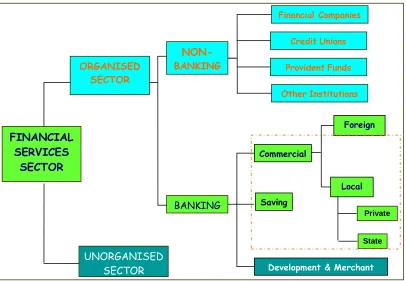
Figure 2.1 and Table 2.2 illustrate the composition of the financial services industry in Sri Lanka. It is composed of the organised sector and an unorganised sector. The organised sector includes a diverse institutional system. In contrast, the unorganised sector does not have a formal institutional framework and is based on short-term, small-scale lending markets. Even after the reforms, the banking sector dominates the financial services sector in Sri Lanka. The capital market was not able to reach the anticipated level of development. As a consequence, the debt and the stock markets have made a very low contribution to the capital accumulation process in the corporate sector.
The banking sector in Sri Lanka comprises fully-licensed banks and specialised banks. Fully-licensed banks, which are also called commercial banks, have been permitted to provide all of the banking services. There are different types of specialised banks which provide specific services to industry. These specialised banks are also allowed limited freedom to accept deposits. There are three savings banks, namely, National Savings Bank (NSB)6, Sanasa Bank and Seylan Saving Bank. NSB leads the deposits market in Sri Lanka. Savings banks can accept both long-term and short-term deposits. However, these banks are not allowed to accept demand deposits. Before 1997, NSB invested its savings mainly in government treasury bills and it had very limited autonomy to set interest rates. However, financial reforms have permitted NSB to set interest rates and to determine its lending portfolio. There are two main development banks which are authorised to accept long-term deposits and to grant long-term and medium-term loans to entrepreneurs. By divesting, the government, in effect, gave full control of the development banks to the private-sector in the late 1980s.
Financial reforms also increased the number of finance companies in the sector at the beginning. However, the formalisation of the regulatory structure of financial
companies has reduced the number of finance companies. Currently there are 25 finance companies registered with the CBSL. The increase in finance companies may enhance the competition for medium- and long-term savings in the market.
Figure 2.1: Composition of the financial services sector in Sri Lanka
The reforms introduced new forms of financial institutions. In the 1980s, three merchant banks were incorporated by the leading commercial banks to satisfy demands of entrepreneurs and to deal with capital markets. Providing consultancies, underwriting of share issues and helping to find sources of capital are the main tasks of the merchant banks. CBSL promotes venture capital institutions as a medium of providing seed capital for emerging entrepreneurs. Further, to enhance capital market operations, CBSL promoted the creation of mutual funds. Consequently, a number of fund management companies have entered the market during the last two decades. These fund management firms have established 14 unit trusts so far. Those unit trusts significantly contributed to changing the way savings are mobilised in the capital market.
FINANCIAL SERVICES
SECTOR
ORGANISED SECTOR
NON-
BANKING
Financial Companies
Commercial
Saving
Development & Merchant
CreditUnions
ProvidentFunds
Foreign
Local
UNORGANISED SECTOR
BANKING
Private
State 11
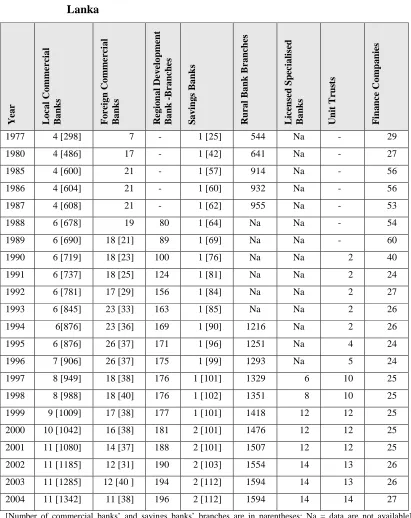
Table 2.2: Infrastructural developments in deposit-taking institutions in Sri Lanka Y ea r L o c a l C o m m er ci a l B a n k s F o re ig n C o m m er ci a l B a n k s R eg io n a l D e v el o p m en t B a n k -B r a n ch e s S a v in g s B a n k s R u ra l B a n k B ra n ch es L ic en se d S p ec ia li se d B a n k s U n it T ru st s F in a n ce C o m p a n ie s
1977 4 [298] 7 - 1 [25] 544 Na - 29 1980 4 [486] 17 - 1 [42] 641 Na - 27 1985 4 [600] 21 - 1 [57] 914 Na - 56 1986 4 [604] 21 - 1 [60] 932 Na - 56 1987 4 [608] 21 - 1 [62] 955 Na - 53 1988 6 [678] 19 80 1 [64] Na Na - 54 1989 6 [690] 18 [21] 89 1 [69] Na Na - 60 1990 6 [719] 18 [23] 100 1 [76] Na Na 2 40 1991 6 [737] 18 [25] 124 1 [81] Na Na 2 24 1992 6 [781] 17 [29] 156 1 [84] Na Na 2 27 1993 6 [845] 23 [33] 163 1 [85] Na Na 2 26 1994 6[876] 23 [36] 169 1 [90] 1216 Na 2 26 1995 6 [876] 26 [37] 171 1 [96] 1251 Na 4 24 1996 7 [906] 26 [37] 175 1 [99] 1293 Na 5 24 1997 8 [949] 18 [38] 176 1 [101] 1329 6 10 25 1998 8 [988] 18 [40] 176 1 [102] 1351 8 10 25 1999 9 [1009] 17 [38] 177 1 [101] 1418 12 12 25 2000 10 [1042] 16 [38] 181 2 [101] 1476 12 12 25 2001 11 [1080] 14 [37] 188 2 [101] 1507 12 12 25 2002 11 [1185] 12 [31] 190 2 [103] 1554 14 13 26 2003 11 [1285] 12 [40 ] 194 2 [112] 1594 14 13 26 2004 11 [1342] 11 [38] 196 2 [112] 1594 14 14 27
Table 2.2 shows the expansion of the deposit-taking institutions in Sri Lanka during the period 1977 to 2004. In 1977, Sri Lanka had only four local commercial (fully licensed) banks with 298 branches. Reforms aimed to expand the commercial banking operations throughout Sri Lanka. In 2004, there were 12 local commercial banks with 1342 branches. There were also 11 foreign banks that have established 38 branches in the country. As a consequence of the collapse of a private savings bank in 2000, the government introduced further regulatory changes to strengthen the supervisory role of the CBSL. In the deregulated environment, the rapid growth in the financial services sector blurred the differences between fully-licensed banks and the specialised financial institutions. This led to the introduction of innovative financial products by the banking institutions.
Financial reforms have reduced the monopoly of commercial banks in the financial services sector. In the early stage of the financial reforms, newly-established specialised non-bank financial institutions have taken over some traditional commercial banking functions such as granting project finance and accepting long-term deposits. Moreover, financial reforms have allowed capital markets to emerge as the main avenue of private-sector direct financing in Sri Lanka.
Fully-licensed banks have to compete with other financial institutions in lending markets as well as in the deposit markets. Most other financial institutions can offer long-term and medium-term deposit instruments to attract savers. Other financial institutions such as development banks, venture capitalist and mortgage institutions operate in the lending markets more assertively than the fully-licensed banks. On the other hand, foreign banks have emerged as main players in the domestic banking market with greater freedom in both deposit and lending markets. Those banks were allowed to offer similar banking products (both deposits and lending) to the local banks. As a consequence, fully-licensed banks are forced to diversify their product lines and to find new fee-based services instead of interest-based products.
banks and the number of branches. New financial instruments have been introduced to the market. The financial reforms allowed more freedom to open up different forms of financial intermediaries. However, the banking industry is the main intermediary in the financial services sector in Sri Lanka. Prevailing market-based interest rates offer a positive real interest rate for savers and consequently enhance domestic savings. On the other hand, trade liberalisation has increased the demand for funds. Concomitantly, the new forms of financial intermediaries have increased competition in the financial services market.
2.4.2 Operational environment of banks
Along with the structural changes, widening of operational activities of other forms of financial institutions such as insurance, leasing, unit trust and superannuation funds has increased competition in the financial services sector. The new banks have started to use ICT as part of thei