Chemistry Publications
Chemistry
2007
Nucleation and growth of Ag islands on fivefold
Al-Pd-Mn quasicrystal surfaces: Dependence of island
density on temperature and flux
Barış Ünal
Iowa State UniversityV. Fournée
Ecole des MinesKyle Schnitzenbaumer
Iowa State UniversityC. Ghosh
Iowa State UniversityCynthia J. Jenks
Iowa State University, [email protected]
See next page for additional authors
Follow this and additional works at:
http://lib.dr.iastate.edu/chem_pubs
Part of the
Materials Science and Engineering Commons
,
Mathematics Commons
, and the
Physical Chemistry Commons
The complete bibliographic information for this item can be found at
http://lib.dr.iastate.edu/
chem_pubs/32
. For information on how to cite this item, please visit
http://lib.dr.iastate.edu/
howtocite.html
.
This Article is brought to you for free and open access by the Chemistry at Iowa State University Digital Repository. It has been accepted for inclusion in Chemistry Publications by an authorized administrator of Iowa State University Digital Repository. For more information, please contact
Nucleation and growth of Ag islands on fivefold Al-Pd-Mn quasicrystal
surfaces: Dependence of island density on temperature and flux
Abstract
Scanning tunneling microscopy (STM) has been used to investigate the nucleation and growth of Ag islands
on the fivefold surface of an icosahedral Al-Pd-Mn quasicrystal. Analysis of the data as a function of
deposition temperature, from 127 K to 300 K, reveals that island density is constant, while at higher
temperature it decreases. To model this behavior, we first show that the potential energy surface describing
bonding of Ag at various locations on the surface is complex, with a few sites acting as traps for clusters of
adatoms. We then develop a rate equation model which incorporates enhanced nucleation at trap sites relative
to nucleation at regular sites on terraces. It recovers the temperature dependence of the island density, plus
previous flux-scaling data. Our model suggests that the critical size for both types of nucleation sites is
large—corresponding to stable clusters of at least 6 Ag atoms—and that binding between atoms at trap sites is
significantly stronger than at free terrace sites. The data and the model, combined, provide guidance about the
conditions of temperature and flux under which saturation of trap sites can be expected. This, in turn, provides
a general indicator of the conditions that may favor localized pseudomorphic growth at low coverage, here and
in other systems.
Keywords
Ames Laboratory, Materials Science and Engineering, Mathematics
Disciplines
Materials Science and Engineering | Mathematics | Physical Chemistry
Comments
This article is from
Physical Review B
75, no. 6 (2007): 064205, doi:
10.1103/PhysRevB.75.064205
.
Authors
Barış Ünal, V. Fournée, Kyle Schnitzenbaumer, C. Ghosh, Cynthia J. Jenks, A. R. Ross, Thomas A. Lograsso,
James W. Evans, and Patricia A. Thiel
Nucleation and growth of Ag islands on fivefold Al-Pd-Mn quasicrystal surfaces:
Dependence of island density on temperature and flux
B. Unal,1V. Fournée,2 K. J. Schnitzenbaumer,1 C. Ghosh,1C. J. Jenks,1A. R. Ross,1T. A. Lograsso,1 J. W. Evans,1and P. A. Thiel1
1Ames Laboratory and Departments of Chemistry, Materials Science and Engineering, and Mathematics,
Iowa State University, Ames, Iowa 50011, USA
2LSG2M, CNRS-UMR7584, Ecole des Mines, Parc de Saurupt, 54042, Nancy, France
共Received 31 August 2006; revised manuscript received 22 November 2006; published 9 February 2007兲 Scanning tunneling microscopy共STM兲has been used to investigate the nucleation and growth of Ag islands on the fivefold surface of an icosahedral Al-Pd-Mn quasicrystal. Analysis of the data as a function of deposition temperature, from 127 K to 300 K, reveals that island density is constant, while at higher temperature it decreases. To model this behavior, we first show that the potential energy surface describing bonding of Ag at various locations on the surface is complex, with a few sites acting as traps for clusters of adatoms. We then develop a rate equation model which incorporates enhanced nucleation at trap sites relative to nucleation at regular sites on terraces. It recovers the temperature dependence of the island density, plus previous flux-scaling data. Our model suggests that the critical size for both types of nucleation sites is large—corresponding to stable clusters of at least 6 Ag atoms—and that binding between atoms at trap sites is significantly stronger than at free terrace sites. The data and the model, combined, provide guidance about the conditions of tem-perature and flux under which saturation of trap sites can be expected. This, in turn, provides a general indicator of the conditions that may favor localized pseudomorphic growth at low coverage, here and in other systems.
DOI:10.1103/PhysRevB.75.064205 PACS number共s兲: 61.44.Br, 68.55.Ac, 68.43.Jk
I. INTRODUCTION
Quasicrystals are well ordered but nonperiodic materials.1 Their atomic structure is associated with interesting surface properties2,3such as enhanced oxidation resistance4and low friction.5In recent years, much attention has been paid to the possibility that films might be grown pseudomorphically on quasicrystal surfaces, thereby yielding surfaces that derive the benefits of the quasiperiodic structure, but with a wider range of chemical composition than is accessible in bulk samples.6–8Pseudomorphic growth was indeed demonstrated experimentally, originally by Franke et al.,9 and later by other groups, for certain types of elemental adlayers.10–12
Pseudomorphic growth has also been explored
theoretically.13,14The properties of such films remain largely unexplored, but preliminary measurements of their electronic structure suggest that they adopt the pseudogap at the Fermi edge which is associated with the underlying substrate.15
Many studies of film growth have focused on coverages of a complete monolayer共ML兲 or above, since contiguous coatings would be desirable for some applications. However, lower coverages may also be interesting. For example, indi-vidual pseudomorphic islands might exhibit peculiar mag-netic properties. Pseudomorphism could be more prevalent at submonolayer coverages, where adsorbate-adsorbate interac-tions are more localized, and distorinterac-tions from the bulk struc-ture of the film are thus more easily accommodated. This appears to be illustrated by our previous study of Al ad-sorbed on the fivefold surface of the icosahedral共i-兲 quasic-rystal Al-Cu-Fe, where small fivefold clusters were observed at a coverage of about 0.04 ML.10 In comparison, pseudo-morphism was not observed in studies of Al at or above coverages of 1 ML on a similar substrate,i-Al-Pd-Mn.16
For-mation of the pseudomorphic clusters in the former case was corroborated theoretically using a kinetic Monte Carlo
共KMC兲 simulation of an appropriate “disordered bond net-work” lattice gas model.17
An equally-important advantage of studying low cover-ages is that a wealth of information can be extracted about the kinetics of island nucleation and growth in the initial stages of film formation. This has been shown by the large body of work on crystalline substrates and films.18 For this purpose, scanning tunneling microscopy共STM兲provides in-valuable detailed insight. This is because the spatial charac-teristics of films at low coverages, such as the island density, reflect the kinetics of nonequilibrium adlayer evolution dur-ing deposition. Based upon just such data, we previously found evidence for heterogeneous nucleation of Ag on the fivefold surface of i-Al-Pd-Mn at 300 K.19 We interpreted the observed flux-independence of island density to mean that nucleation occurred preferentially at specific sites—not defect sites, but rather trap sites intrinsic to the quasicrystal-line structure. We speculated that these trap sites were analo-gous to those that stabilized the pseudomorphic Al starfish on
i-Al-Cu-Fe.
In this paper, we extend the previous Ag work by measur-ing the temperature dependence of Ag island density at⬃0.2 ML, and by showing the data to be compatible with a refined mean field-rate equation model that incorporates nucleation at trap sites. We delineate the conditions of temperature and flux under which one can expect saturation of trap sites, which provides a general indicator of the conditions that may favor localized pseudomorphic growth at low coverage, in this and other systems.
PHYSICAL REVIEW B75, 064205共2007兲
II. EXPERIMENTAL DESCRIPTION
We conduct our experiments using an Omicron variable-temperature STM in a standard UHV chamber with a base pressure of 4⫻10−11mbar. Our sample is a single grain of
icosahedral Al70.2Pd20.7Mn9.1 quasicrystal with the surface oriented perpendicular to a fivefold axis. The clean surface is prepared following procedures described elsewhere.20,21 Ag is deposited from an electron-beam-heated evaporator, an Omicron evaporator with internal flux monitor modified to resemble a Knudsen cell, onto the clean quasicrystal surface at fixed sample temperatures varying from 127 K to 420 K and at chamber pressures below 8⫻10−11mbar. STM im-ages are taken at the deposition temperature. STM data are processed using image processing freeware.22
III. EXPERIMENTAL RESULTS
Figure1shows a series of STM images taken after depo-sition of 0.1 to 0.26 monolayers 共ML兲 of Ag at a constant flux of 1⫻10−3 ML/s and various substrate temperatures. The brighter features in the images are Ag islands. For the temperature range of 127 K to 300 K, island sizes are very small as compared to those at higher temperatures, and the island density is high. A dramatic decrease in the island den-sity and corresponding increase in size is apparent for tem-peratures above 300 K. At 420 K 关Fig. 1共f兲兴, most of the deposited Ag accumulates at step edges 共not shown in the image兲. This indicates that the diffusion length has become comparable to the terrace width. However, particularly broad terraces still support island formation, an example of which is shown in Fig. 1共f兲. This allows a rough assessment of island density at this temperature.
It should also be noted that, at these low coverages, is-lands are typically two-dimensional 共2D兲 at T⬍300 K, but three-dimensional 共3D兲 at T⬎300 K. The 3D growth has been ascribed to a quantum size effect.23 While this cross-over from 2D to 3D shapes does not affect our determination and modeling of island densities, it will affect the interpreta-tion of island sizes, as discussed later in this secinterpreta-tion.
At and below 300 K, the determination of coverage or of island number density is complicated by the fact that the
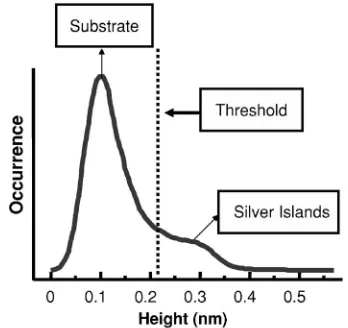
clean surface has a rather high intrinsic corrugation, together with occasional protrusions. In high-resolution images of well-ordered regions of clean terraces, the peak-to-peak cor-rugation is about 0.12 to 0.16 nm, to be compared with the expected step height for a Ag island of about 0.2 nm.共Note that these values depend somewhat on tunneling bias.兲 The corrugation and step height are sufficiently close that scan-ning across Ag islands on the quasicrystal produces a con-tinuum of heights without a clear separation of island and substrate contributions, as shown in Fig.2for a coverage of 0.2 ML at 300 K. The large maximum at about 0.1 nm rep-resents the clean substrate, whereas the smaller maximum at about 0.3 nm represents the Ag islands. To determine the island density, we introduce a threshold for height located between these peaks, chosen such that regions with heights above the threshold are mainly associated with Ag islands
[image:4.612.53.343.56.252.2]共see Fig.2兲. To further eliminate artifacts in island density estimation due to the existence of occasional protrusions on the quasicrystal surfaces,24 we employ a threshold for the minimum areal size in addition to the height cutoff. This areal cutoff affects the data only at low temperature, where the Ag islands are small. The effect is shown by the error FIG. 1. STM images 关共a兲-共f兲兴 showing the evolution of island density as a function of
temperature for deposition of Ag onto
5f-i-Al-Pd-Mn quasicrystal. The size of images is 100⫻100 nm2. The tunneling conditions are
[image:4.612.349.523.529.693.2]0.97– 0.99 V and 0.31– 0.47 nA.
FIG. 2. An area based height histogram taken from an STM image at= 0.2 ML andT= 300 K. Dotted line shows the threshold which partially separates silver islands from the QC substrate.
UNALet al. PHYSICAL REVIEW B75, 064205共2007兲
bars at and below 300 K in Fig.3. The error bars demarcate minimum areal island sizes of 0.5 and 1.5 nm2共the first
cor-responding roughly to single atoms25 and the last to larger clusters of⬃6 atoms兲.10The data points are obtained with a middle value of 1.0 nm2. At and below 300 K, in Figs.3and 4, the statistics are very good since the data are obtained from STM images after counting thousands of islands span-ning an area equal to 1⫻106 nm2. Thus the statistical uncer-tainty is much smaller than the error bars shown, at these low temperatures. In contrast, at higher temperatures islands are identified unambiguously, and uncertainties are due to the limited number of islands. These uncertainties are fairly in-significant, at least on the log scale of Fig.3.
Figure3shows quantitatively the temperature dependence of average island density for a deposition flux of F= 1
⫻10−3ML/ s. The island density is roughly constant up to
300 K, but abruptly decreases for higher temperatures. This
is an indication that heterogeneous nucleation at trap sites dominates behavior at lower temperatures.
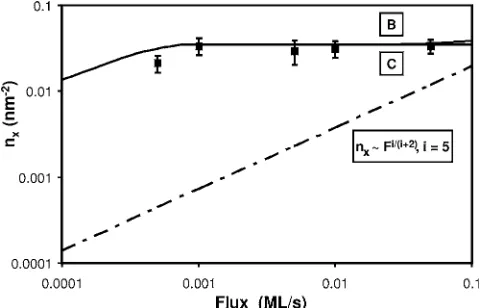
We also determine the influence of flux on the island den-sity at constant temperature, 300 K. 共The flux-scaling data were published previously; here, we present a reanalysis that employs the height- and size-thresholds described above.兲 From Fig.4, it can be seen that the island density is insen-sitive to flux over the range 5⫻10−2to 1⫻10−3 ML/ s 共
al-though there may be a slight drop-off at lowest flux兲. An independence of island density on deposition flux is also consistent with heterogeneous nucleation at specific trap sites on the surface.
Further analysis of the STM data yields the island size distribution共ISD兲. Results for 300 K were presented previ-ously, although there was considerable ambiguity in deter-mining the true ISD as it was combined with the distribution of higher substrate protrusions.19Figure5shows new results from analysis of 365 K data. The total number of islands is about 100, so the statistics are somewhat limited共and histo-gram bins are necessarily chosen to be quite broad兲. One could measure island size either in terms of lateral area, or in terms of the total number of atoms共i.e., in terms of volume兲. The latter is somewhat more generic. The two approaches are equivalent for the single layer islands at lower T, but not when there is a mixture of multilayer islands of different heights as at higherT. The 365 K data reveal a monotoni-cally decreasing ISD when size is measured as number of atoms. Such a monotonic decrease contrasts the monomodal shape of the distribution typical for homoepitaxial or het-eroepitaxial growth.26This type of ISD could reflect unusu-ally persistent island nucleation, and/or a diminution of growth rate with coverage.27Plausibly, for this system, island growth is inhibited with increasing size共a feature not incor-porated into our simple rate equation analysis—see follow-ing sections兲due to the fivefold symmetry of the substrate.
[image:5.612.55.295.54.230.2]As an aside, we note that if the ISD at 365 K is deter-mined by taking size as lateral area, it is instead monomodal, reflecting the feature that the largest islands are not single layer, but tend to have heights of two to four layers in this experiment.23
FIG. 3. Temperature dependence of the average island density,
nx, at F= 0.001 ML/ s. Solid lines show the predictions obtained from the rate equation model. The inset shows the model’s predic-tion for the number of islands on regular terrace sites 共nxf兲 as a function of temperature.
[image:5.612.319.558.56.198.2]FIG. 4. Average island density, nx, versus flux for= 0.2 ML andT= 300 K. The solid lines depict predictions from the rate equa-tion model for two cases, setB and set C. The expected scaling behavior for homogeneous nucleation fori= 5 is shown by the dash-dotted line.
FIG. 5. Island size distribution from STM images for Ag/ Al-Pd-Mn at 365 K, 0.26 ML, andF= 1⫻10−3ML/ s.
NUCLEATION AND GROWTH OF Ag ISLANDS ON FIVEFOLD… PHYSICAL REVIEW B75, 064205共2007兲
[image:5.612.54.296.516.670.2]IV. DEVELOPMENT OF THE MODEL FOR NUCLEATION AND GROWTH OF ISLANDS
A. Potential energy surface
In developing a model for formation of Ag islands on fivefold Al-Pd-Mn surfaces, it is valuable first to have a qualitative picture of the potential energy surface共PES兲 de-scribing the binding energy of Ag as a function of lateral position on this substrate. In previous work,28we did this for Al adatoms, and here we extend the analysis to Ag adatoms.
关Other authors have recently used LJ parameters to generate the PES of various adsorbates on quasicrystals, successfully explaining experimental structures of equilibrated Al mono-layers and noble gas monomono-layers.16,29,30 Our work differs in that it focuses on the kinetics of formation of localized struc-ture.兴 In our previous work, we identified a subset of physically-reasonable fivefold terminations of the Boudard model for bulk Al-Pd-Mn structure. We adopt one such ter-mination here. We use pairwise-additive Lennard-Jones共LJ兲 potentials to describe the interaction of Ag with the substrate atoms. Parameters for the LJ potentials are chosen to recover diffusion barriers and adsorption site heights for several benchmark systems consisting of Ag on single crystal Al and Pd substrates.31 With these interactions, we determine the binding energy of Ag as a function of lateral position while keeping substrate atoms frozen共apart from a contraction of the top layer spacings, as guided by experiment兲.3,32–38
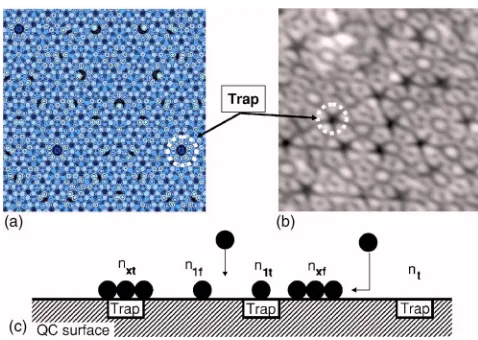
A portion of this PES is shown in Fig. 6共a兲. One can identify three regions of strong bonding, each with local fivefold symmetry, in the upper left, lower left, and lower right areas of the figure. One of these is labeled “trap site.” Five other regions of strong bonding, where the local five-fold symmetry is broken, are apparent in the upper middle and right portion of the figure. In our previous study of Al
binding on the related i-Al-Cu-Fe surface, these same gions provided the strongest bonding, the former being re-ferred to as starfish 共SF兲 sites and the latter as incomplete starfish共ISF兲sites. In addition, there is a significant number of a third type of localized strong binding site.
Corresponding features in an STM image of the fivefold Al-Pd-Mn surface are shown in Fig.6共b兲. Here, we identify the SF sites with the “dark stars” often resolved in STM images of these surfaces. Experiments have proven that the dark stars are the adsorption sites of Al starfish on
i-Al-Cu-Fe.6,10 The SF and ISF sites, and equivalently the dark star sites, are strong candidates for the trap sites that are manifest so clearly in the experimental data of Figs.3and4. In a complete analysis of the PES, we have identified all local minima or binding sites, which include a large number of shallower binding sites in addition to the above-mentioned deep sites. Analysis of⬃600 sites in a 10⫻10 nm2region of the model39finds 0.5% of sites are SF, 1% are ISF, 4.5% are other localized deep sites, and 94% are shallow sites. The average separation between adjacent minima, regardless of depth, is ⬃0.4 nm. We will use this value as the typical nearest-neighbor separation between adatoms in the model-ing that follows.
Utilizing the above information, we can provide the fol-lowing overview of the deposition process共cf. Refs.17and
28兲: Ag atoms are deposited primarily at shallow adsorption sites, and hop between such adjacent sites; occasionally they reach strong bonding “trap” sites where they remain longer and are more likely to become incorporated into stable Ag islands. 共We emphasize that these trap sites are intrinsic to the surface quasicrystalline structure, and are not defects.兲In principle, aggregation into islands on regions of the terrace associated with shallow sites is also possible. In our previous modeling of Al deposition on Al-Cu-Fe and Al-Pd-Mn, six atom clusters forming at SF sites共and also smaller clusters forming at ISF sites兲 were stabilized more effectively than clusters at non-共I兲SF sites, since neighboring Al adatoms could readily reduce their separation below the typical value of ⬃0.4 nm noted above to maximize Al-Al adatom bond-ing. This stabilization was not so readily achieved at other terrace sites since the large adatom separation of⬃0.4 nm is not compatible with strong Al-Al bonding. We adopt this feature—namely, different adatom interaction strengths at different types of nucleation sites—in the Ag modeling below.
B. Rate equation analysis
Rate equations are developed for a model of competitive island formation at trap sites and on terraces, similar to the ones in the literature for nucleation of metal clusters on ox-ide surfaces with defects.40Figure6共c兲shows a schematic of the model. The model parameters describing the system are as follows: the trap density共nt兲; the trap energy共Et⬎0兲
re-flecting the additional binding at trap sites; the critical nucleus size 共i兲 above which islands are stable 共and for which we allow different valuesitfor islands at traps, andif
on trap-free terrace regions兲; the effective diffusion barrier
[image:6.612.53.292.54.224.2]共Ed⬎0兲, which describes diffusion between heterogeneous
FIG. 6. 共Color online兲 共a兲 Potential energy surface 共8.6
⫻8.6nm2兲for Ag oni-Al-Pd-Mn QC. Darker shades indicate
stron-ger interactions. 共b兲 8.6⫻8.6 nm2 STM image of clean fivefold surface ofi-Al-Pd-Mn QC共+0.97 V, 0.47 nA兲. One of the traps is
marked both on the STM image and on the PES. 共c兲 Model for
nucleation at “trap” sites.n1tis the density of trapped single ada-toms; nt is the density of traps, n1f is the density of free single
adatoms,nxf is the density of critical clusters formed on terraces, andnxtis the density of trapped stable clusters.
UNALet al. PHYSICAL REVIEW B75, 064205共2007兲
weaker-binding adsorption sites; and the pairwise-additive nearest-neighbor adatom binding energy共Eb⬎0兲. We allow Eb to take different values at traps 共Ebt兲 than on the “free”
parts of the terraces共Ebf兲, and setEbf=REbt withR艋1 for
reasons discussed above. The effective hop rate between neighboring sites on terraces is given byh=e−Ed/共kT兲where
= 1013s−1. The trap density, n
t, is determined
experimen-tally from the plateau value in Fig.3.
Key variables to be determined by integration of the rate equations are the density of isolated adatoms,n1 共which is
the sum of contributions from traps, n1t, and from “free”
terrace regions, n1f兲 and the density of stable islands, nx 共which also is a sum of contributions from traps, nxt, and
terraces, nxf兲. In this model, stable clusters are regarded as
immobile. We adjust values of the model parameters de-scribed above until the predicted total island density, nx,
matches experimental behavior.
We assume that a quasiequilibrium is established between the adatom densities at the traps共n1t兲and on the free terrace
regions 共n1f兲. Accounting for the feature that adatoms are
bound more strongly at traps by an amountEtand that stable
islands at traps 共with density nxt兲 block the occupation of
those traps by adatoms, this quasiequilibrium assumption yields the relation共cf. Ref.40兲
n1t nt−nxt
⬇ n1feEt/共kT兲
1 +n1feEt/共kT兲
, 共1兲
where we assume thatn1fⰆ1. The rate equations for
densi-ties of stable islands are determined by the nucleation rates
dnxt
dt =Knuct⬀hn1fnit 共2兲
and
dnxf
dt =Knucf⬀hn1fnif, 共3兲
wherenif共nit兲is the density of critical clusters ofiatoms at
free terrace 共trap兲 sites which are stabilized by addition of one further adatom. In determining these densities, we also adopt a quasiequilibrium Walton relation nif⬇eEif/共kT兲共n1f兲if
andnit⬇eEit/共kT兲n1t共n1f兲it−1. Here,Ei=miEbdenotes the
bind-ing energy for critical clusters, which is determined by add-ing the appropriate number,mi, of bond energies, with
rel-evant values of i andEb for islands at traps or on terraces.
The aggregation rates Kaggf⬀h共n1f兲nxf and Kaggt⬀h共n1f兲nxt
also appear in the rate equation for the adatom density
dn1f
dt ⬇F−Kaggf−Kaggt−共if+ 1兲Knucf−共it兲Knuct. 共4兲
The constants of proportionality共not shown兲 in the expres-sions for nucleation rates and aggregation rates are the cap-ture numbers for critical and stable clusters, respectively. These are always of order unity, and are set equal to unity in the following analysis. We also note that these rate equations are numerically stiff, so a natural rescaling41 is applied be-fore numerical integration in order to facilitate integration.
In general, the value of mi depends upon the assumed
cluster geometry. The two cluster sizes that will be most useful in the modeling will contain 5 and 11 atoms, for which we countmi= 7 and 16, respectively.
C. Model limitations and simplifications
A significant potential limitation of the rate equation analysis is the assumption of a quasiequilibrium between the population of isolated adatoms at trap sites and free terrace sites, and between the population of atoms and critical clus-ters共i.e., the Walton relation兲. This assumption is expected to be valid at high temperatures, but less so at low tempera-tures, where slow diffusion is expected to inhibit equilibra-tion. A second simplification is the fact that the model uses averages or effective values for certain quantities instead of distributions. An example is the assumption of a single value ofEbf for atoms in clusters on the free terrace sites. On the
real surface, there is a distribution of separations between adsorption sites, and also of the binding energy at those sites.
关Again, see Fig.6共a兲.兴This means that interactions between adatoms probably vary as well. A third assumption is that bond energies,Eb, are pairwise additive within the Ag
clus-ters. Because of these limitations, we do not regard the model as quantitatively reliable. We do regard it as useful, however, for showing major trends and providing physical insight into the relative importance of the various processes in fitting the experimental data.
V. MODELING RESULTS
First, let us consider the simplest case, whereit=if= 1共Ag
adatom pairs form stable nuclei兲and thusEbis not relevant.
Such a model has only two adjustable parameters:EtandEd.
In this case, Fig.3 shows that the model can reproduce av-erage island density in the low temperature regime whenEd
andEtare 0.18 and 0.60 eV, respectively.共We denote this set
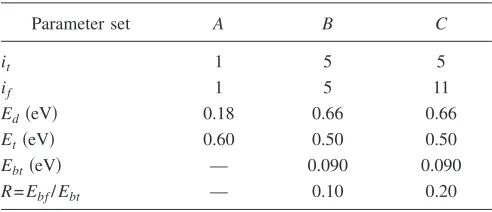
of parameters as setA, and summarize it in Table I.兲While the model reproduces the low-temperature plateau, it fails to produce a sufficiently rapid decrease in island density above 300 K with these parameters.
Next, we allowit=if⬎1, withEbfixed at a single nonzero
value, i.e.,Ebf=EbtsoR=Ebf/Ebt= 1. In this case, the model
[image:7.612.314.560.84.190.2]fails to fit the plateau in island density below 300 K. The reason is that, for a single binding energy and single critical size, there is no difference between the formation of stable TABLE I. Parameters for best fits of the rate equation model to the experimental data.
Parameter set A B C
it 1 5 5
if 1 5 11
Ed共eV兲 0.18 0.66 0.66
Et共eV兲 0.60 0.50 0.50
Ebt共eV兲 — 0.090 0.090
R=Ebf/Ebt — 0.10 0.20
NUCLEATION AND GROWTH OF Ag ISLANDS ON FIVEFOLD… PHYSICAL REVIEW B75, 064205共2007兲
clusters at free terrace sites and at trap sites. The vastly higher density of the free terrace sites favors nucleation there. Indeed, depending on the adjustable parameters below 300 K the number of islands on free terrace sites is 5 to 20 times larger than at trap sites, since the latter are limited by
nt.共Changingntwithin the limits of experimental uncertainty
does not help.兲In our model, this problem cannot be avoided by allowing the two critical sizes to take different values. This is true at least for 2⬍if⬍20 and 2⬍it⬍5.共We regard
these two ranges as having physically-reasonable limits.兲 This shows that introducing a larger critical size at free sites does not provide sufficient bias against nucleation at those sites.
In order to fit the entire range of data, we find it necessary to allowEbtandEbfto take independent values, i.e., to useR,
their ratio, as an adjustable parameter. As mentioned in Sec. IV, values ofR⬍1 have some physical justification from the potential energy surface. In the rate equation model, intro-ducingR⬍1 gives a way to strongly destabilize clusters on free terraces. In this case, the trends in the experimental data can be reasonably well captured共see Fig. 3兲by choosing a single value of critical size, it=if= 5, together with Ebt
= 0.090 eV,Ed= 0.66 eV, andR= 0.10. We denote this set of
parameters as setB. It does much better than setAin match-ing the high-temperature data.
However,R= 0.10 is perhaps unrealistically low. Indeed, using the LJ potentials for bulk Ag, we estimate that the ratio of the binding energies for Ag-Ag bonds at their equilibrium separation, relative to Ag-Ag bonds elongated to 0.40 nm, is 0.33. Consequently, we explore the possibility of using higher values ofR, coupled with two distinct critical sizes for trap and free sites withif⬎it. Choosing a larger critical size
for free terrace sites provides some bias against nucleation on free terraces, which compensates for the higher values of
R. While keepingit= 5, we find that experimental data can be
fit well for a range ofif艌8 andR= 0.15– 0.20. The best fit is
obtained whenit= 5 andif= 11, together withEbt= 0.090 eV, Ed= 0.66 eV, andR= 0.20. See Fig.3. We call this setC. The
parameters for the three best-fit models are summarized in TableI.
The inset in Fig.3shows the island density on free terrace sites as a function of temperature, using setsB andC. This indicates that some Ag island nucleation does occur on regu-lar terrace sites between 200 K and 300. However, it should also be emphasized that the contribution of free sites to av-erage island density is low compared to that of trap sites, with these parameters.
What features of the deposition process produce the par-ticular form ofnx共T兲shown in Fig.3? Insight is provided by
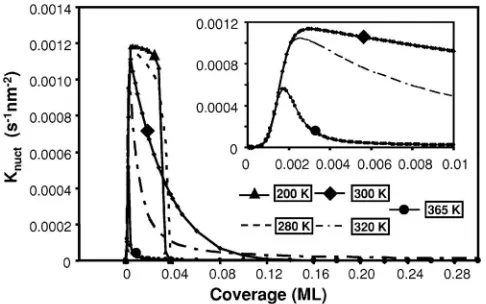
Fig. 7. Here, the rate of nucleation at trap sites, Knuct, is
shown as a function of coverage, for four different values of
T. The value ofKnuctpeaks at low coverage and decays. The
peak is higher and the decay is faster at lowT. At 300 K or below,Knucthas effectively decayed to zero by 0.2 ML, i.e.,
all traps are saturated by 0.2 ML. For higherT, the slower decay ofKnuctmeans that traps are not saturated by 0.2 ML,
sonx共T兲in Fig. 3drops to lower values. It follows that the
temperature at whichnxbegins to fall in Fig.3would shift to
higher values for higher coverages.
Finally, the flux independence of the island density at 300 K can also be fit well. The solid lines in Fig.4represent
the results for setsBandC. It can be seen that with both sets of parameters, the model shows no significant variation with flux for F⬎1⫻10−3 ML/s. However, below this value, the
model indicates that traps sites are not saturated共at this tem-perature and coverage兲, sonxfalls with decreasing flux.
Flux scaling for homogeneous nucleation of stable islands that require aggregation of i艌1 diffusing adatoms in the steady-state regime suggestsnx⬀Fi/共i+2兲.26,42The dash-dotted
line in Fig. 4 reflects this scaling relationship for i= 5. Clearly this behavior does not fit experimental observations. Using our model, we can predictnxversusF at different
deposition temperatures共Fig.8兲. The model suggests that at high temperatures such as 345 K and above, the density de-pends on flux for the typical experimental range of fluxes shown共in contrast to behavior at 300 K and below兲. It would be interesting to test this prediction experimentally. The lines are slightly curved at low flux, but straighten as temperature increases. At 420 K, where the relationship is very linear, analysis of the scaling with flux indicates that nx⬀F0.66,
[image:8.612.316.559.56.208.2]rather than the relationship given above for homogeneous FIG. 7. The rate of nucleation at trap sites,Knuct, versus cover-age from the rate equation model for set C: nt= 0.035 nm−2, Ed
= 0.66 eV,Ebt= 0.090 eV,m11= 16,R= 0.20,if= 11, andit= 5. The
inset is an expanded view of the variation inKnuctwith coverage for the three lowest temperatures. Flux is 0.001 ML/s.
FIG. 8. Predictions for average island density,nx, as a function
of flux from the rate equation model. Parameter values correspond to setC:nt= 0.035 nm−2,E
d= 0.66 eV,Ebt= 0.090 eV,m11= 16,R
= 0.20,if= 11, andit= 5.
UNALet al. PHYSICAL REVIEW B75, 064205共2007兲
[image:8.612.318.558.528.683.2]nucleation withi= 5, which would benx⬀F5/7=F0.71. To
un-derstand this discrepancy, we note that in this regime,nxf is
negligible and most traps are saturated with single adatoms, son1t⬇nt.共Clusters are rare at the traps, sincenx⬍ntin the
curves of Fig.8.兲Thus, in our rate equation analysis, one can neglect nxf and simplify the equation for nxt to dnxt/dt ⬀共n1f兲it. Then using a steady-state approximation that F
−Kaggt⬇0, it follows immediately thatnx⬀F共it−1兲/共it+1兲. This
yields an exponent of 2 / 3, consistent with the numerical re-sults forit= 5.
VI. DISCUSSION
The main result is the experimental observation that, for a typical flux, the island density is independent of temperature up to 300 K but decreases abruptly above 300 K, for a cov-erage of about 0.2 ML. This signifies that the island density equals the density of intrinsic surface traps up to 300 K, but falls at higherT because inhibited nucleation prevents trap saturation. The experimental flux dependence ofnxat 300 K
shows no significant variation, except perhaps at lowest flux. Our interpretation is that the island density is again equal to the trap density. Limited data are also presented for the ex-perimental island size distribution, showing a monotonic de-crease at a single coverage, temperature, and flux.
A rate equation model shows that two main features must be incorporated to fit the temperature-dependent data:共1兲the critical size must be significantly greater than 1, both at trap and free terrace sites; and共2兲the binding energy of adatoms in the critical cluster must be significantly higher at traps than at free terrace sites. The model parameters that provide good fits for the temperature-dependence ofnxalso provide
good fits for the flux dependence ofnx. The model predicts
significant flux dependence at T⬎300 K, where nx is well
below the trap density so that the effect of traps is reduced. The growth dynamics that are incorporated into the model can be envisioned as follows. Adatoms are deposited on the surface and then diffuse, sometimes visiting trap sites. Addi-tional atoms can join to form clusters, potentially either at trap sites or on terraces. However, these clusters constantly dissolve and reform if they are below the size of a stable nucleus,i+ 1. In order for nucleation to be favored at traps, the population of critical clusters of sizeimust be enhanced at the traps. In the casei= 1共when critical clusters aresingle atoms兲, the only important factor is the population ofsingle atoms at trap sites relative to free terrace sites, which is determined in our model by the trap site energy, Et. As i
increases above 1, the binding energy of additional atoms at traps relative to that on terraces, defined in our model byR, becomes increasingly important, since this determines the stability ofother atomsin a trap cluster relative to its free-terrace counterpart. For large critical sizes, such as those in our best solutions共setsBandC兲, varyingEtactually has far
less effect than varyingR, ifEtis above a minimum value. In
fact, ifEt艌0.40 eV, it has no effect at all, which effectively
reduces the number of variable parameters. In summary, our model shows that traps are most effective for nucleation when i= 1 because traps have a higher population of single atoms, and also wheni⬎1 because traps have a higher af-finity for additional atoms.
Although the values of the best-fit parameters are not ab-solute because of the model limitations noted in Sec. IV, the value of 0.66 eV forEd is somewhat high when compared
with simpler crystalline surfaces. For instance, Ed is about
0.5 eV both for Ag/ Al共100兲 and Ag/ Pd共100兲, and Ed is
much lower—about 0.1 eV—for the 共111兲 faces.31 In gen-eral, for single crystals, one finds that Ed increases as the
surface becomes more corrugated and less close packed.43 Thus, a relatively high value ofEd on the quasicrystal
sur-face may be physically reasonable in light of its intrinsic roughness. It should be noted that in the rate equation analy-sis, Ed is an effective diffusion barrier on the free terrace.
Clearly, the surface heterogeneity results in a distribution of barriers that separate adjacent minima关Fig.6共a兲兴. The effec-tive diffusion barrier reflects not only the distribution of real barrier heights but also the sampled diffusion paths. This concept of an effective barrier is standard in extensive treat-ments of transport in disordered systems based on homog-enization or effective medium theories.44 For our specific application, the effective barrier will be primarily controlled by the higher barriers for diffusion on the terrace.
It is interesting that the best value ofit is 5, exactly the
value expected given the stability of the 6 atom starfish clus-ters observed and modeled for Al on i-Al-Cu-Fe.28 These clusters contained 1 atom at the center and 5 atoms at the arms, thus reflecting the local fivefold symmetry of the sur-face sites. Hence, the value of the critical cluster size at trap sites may be fundamentally related to the fivefold symmetry of the quasicrystalline surface.
This system bears certain similarities to transition metal clusters that form at defects on oxide45,46and fluoride40 sur-faces. In some of those systems, the dependence of island density on temperature has been measured,40,45 showing a plateau and then a decline.40,45
For one system, Pd/ MgO, these data were initially inter-preted in terms of a model like the one we have used, incor-porating strong trapping of adatoms at defects and subse-quent island nucleation 共with i= 1兲 below the threshold temperature.45 However, this model was challenged on the basis of density functional theory共DFT兲calculations, which indicated that cluster diffusion, as well as monomer diffu-sion, should be operative, and that the surface dimer binding energy necessary to fit the data, 1.2 eV, was unreasonably high.47,48
We regard cluster diffusion in our system, however, as unlikely. This is because there are two primary scenarios wherein diffusion of small clusters on surfaces is expected to significantly affect growth:共1兲weak bonding to the surface compared to intracluster bonding—as is the case for Pd/ MgO;48 or 共2兲 a PES for the cluster amenable to con-certed cluster motion, as for dimers in metal homoepitaxial systems where twisting or shearing motion is facile.49 Nei-ther scenario is operative for Ag on Al-Pd-Mn where Ag binds strongly to the surface. Inspection of the spatial distri-bution of adsorption sites on the surface 共e.g., from the LJ PES兲suggests no easy twisting pathway. In fact, intracluster binding is likely weak due to a large typical separation be-tween neighboring adsorption sites so clusters are more likely to dissociate than diffuse. Weak intracluster binding is supported by the low value ofEb, 0.090 eV. It is also
impos-NUCLEATION AND GROWTH OF Ag ISLANDS ON FIVEFOLD… PHYSICAL REVIEW B75, 064205共2007兲
sible for clusters to migrate along with the underlying traps, as has been suggested for Au clusters on TiO2.46
Our model is also qualitatively different regarding the metal-metal binding energy, which was disputed in the Pd/ MgO system.47,48 Our values of E
b are low: 0.090 eV
within the traps, and less on the free terraces by a factor ofR. For comparison, the Ag-Ag dimer binding energy on a Ag共100兲 surface is 0.22– 0.26 eV.50 The distortion from the equilibrium bond length that is imposed by the quasicrystal substrate makes the lower value of 0.090 eV plausible. There are also other differences. For instance, critical size was quite small in the rate equation analysis of the Pd/ MgO sys-tem and so Et was an important parameter. Our fits imply
large critical sizes and hence virtually no dependence onEt,
for reasons discussed above. In spite of these differences, the approach that was pioneered by Haaset al.45 appears to be very useful in interpreting results from the present system.
Finally, consider the possibility of place exchange be-tween Ag and the quasicrystal substrate. We see no evidence of such a process, but if it occurred, its effect on island density would be different than our experimental observa-tions. Typically, place exchange is an activated process, with a barrier higher than that for hopping diffusion. Growth of islands at exchange sites competes with homogeneous nucle-ation and growth. These two factors mean that typically, is-land density vsT or T−1 is aV-shaped共or even more
com-plex兲 curve, as has been reported for Ni/ Ag共100兲51 and Co/ Cu共100兲.52 In the case of island nucleation mediated en-tirely by place exchange, there is also a 共predicted兲 strong dependence of island density on T, contrasting our experi-mental observations.53Hence, place exchange cannot explain our experimental observation of a plateau, followed by a decline at highT.
VII. CONCLUSIONS
A main result in this paper is that the Ag island density on the fivefold surface of icosahedral Al-Pd-Mn is independent
of temperature up to 300 K, but decreases abruptly above 300 K, for a typical flux. This indicates that nucleation is dominated by trap sites at and below 300 K. This conclusion is reinforced by the experimental flux dependence of the av-erage island density at 300 K. A rate equation model is de-veloped, guided in part by a potential energy surface gener-ated from Lennard-Jones potentials. For certain parameters, the model is consistent with all of the data. The optimal parameters indicate strong Ag-Ag binding at trap sites rela-tive to free terrace sites, and large critical sizes at both types of sites. The island size distribution at 365 K is also pre-sented, showing a broad monotonic decrease.
The data and the modeling, taken together, indicate that saturation of trap sites at low coverage is favored by low temperature and high flux. These qualitative guidelines may prove useful in searches for pseudomorphic clusters on qua-sicrystals at submonolayer coverages.
Note added in proof.Recently, it has come to our attention that a considerable body of work deals with heterogeneous nucleation of Co on Au, which exhibits some strong similari-ties to this system. See, for instance, Ref.54.
ACKNOWLEDGMENTS
B.U., C.J.J., A.R.R., T.A.L., and P.A.T. were supported for this work by the Office of Science, Basic Energy Sciences, Materials Science Division of the U.S. Department of Energy
共USDOE兲. V.F., K.J.S., C.G., and J.W.E. were supported by NSF Grant No. CHE-0414378. The work was performed at Ames Laboratory, which is operated for the USDOE by Iowa State University under Contract No. W-7405-Eng-82. We are thankful to Da-Jiang Liu for DFT energetics and his help during the writing of the Mathematica codes.
1D. Shechtman, I. Blech, D. Gratias, and J. W. Cahn, Phys. Rev.
Lett. 53, 1951共1984兲.
2J. M. Dubois,Useful Quasicrystals共World Scientific, Singapore,
2005兲.
3P. A. Thiel, A. I. Goldman, and C. J. Jenks, inPhysical Properties
of Quasicrystals, edited by Z. M. Stadnik 共Springer, Berlin, 1999兲, Vol. 126, p. 327.
4D. Rouxel, M. Gil-Gavatz, P. Pigeat, and B. Weber, J. Non-Cryst.
Solids 351, 802共2005兲.
5J. M. Dubois, P. Brunet, W. Costin, and A. Merstallinger, J.
Non-Cryst. Solids 334, 475共2004兲.
6V. Fournée and P. A. Thiel, J. Phys. D 38, R83共2005兲.
7R. McGrath, J. Ledieu, E. J. Cox, and R. D. Diehl, J. Phys.:
Condens. Matter 14, R119共2002兲.
8R. McGrath, J. Ledieu, E. J. Cox, N. Ferralis, and R. D. Diehl, J.
Non-Cryst. Solids 334, 500共2004兲.
9K. J. Franke, H. R. Sharma, W. Theis, P. Gille, P. Ebert, and K. H.
Reider, Phys. Rev. Lett. 92, 135507共2002兲.
10T. Cai, J. Ledieu, R. McGrath, V. Fournee, T. Lograsso, A. Ross,
and P. Thiel, Surf. Sci. 526, 115共2003兲.
11J. Ledieu, J. T. Hoeft, R. E. Reid, R. D. Diehl, T. A. Lograsso, A.
R. Ross, R. McGrath, and J. A. Smerdon, Phys. Rev. Lett. 92, 135507共2004兲.
12J. Ledieu, J. T. Hoeft, D. E. Reid, J. A. Smerdon, R. D. Diehl, N.
Ferralis, T. A. Lograsso, A. R. Ross, and R. McGrath, Phys. Rev. B 72, 035420共2005兲.
13M. Krajci and J. Hafner, Phys. Rev. B 71, 184207共2005兲. 14M. Krajci and J. Hafner, Philos. Mag. 86, 825共2006兲. 15V. Fournée共unpublished results兲.
16B. Bollinger, V. E. Dmitrienko, M. Erbudak, R. Luscher, H.-U.
Nissen, and A. R. Kortan, Phys. Rev. B 63, 052203共2001兲.
17C. Ghosh, D.-J. Liu, K. J. Schnitzenbaumer, C. J. Jenks, P. A.
Thiel, and J. W. Evans, Surf. Sci. 600, 2200共2006兲.
18P. A. Thiel and J. W. Evans, J. Phys. Chem. B 104, 1663共2000兲. 19V. Fournée, T. C. Cai, A. R. Ross, T. A. Lograsso, J. W. Evans,
and P. A. Thiel, Phys. Rev. B 67, 033406共2003兲.
UNALet al. PHYSICAL REVIEW B75, 064205共2007兲
20B. Unal, T. A. Lograsso, A. Ross, C. J. Jenks, and P. A. Thiel,
Phys. Rev. B 71, 165411共2005兲.
21B. Unal, T. A. Lograsso, A. R. Ross, C. J. Jenks, and P. A. Thiel,
Philos. Mag. 86, 819共2006兲.
22WSxM 4.0 Develop 7.71 Copyright May 2005 Nanotec
Elec-tronica S. L. Available from具http://www.nanotec.es典.
23V. Fournée, H. R. Sharma, M. Shimoda, A. P. Tsai, B. Unal, A. R.
Ross, T. A. Lograsso, and P. A. Thiel, Phys. Rev. Lett. 95, 155504共2005兲.
24J. Ledieu, A. W. Munz, T. M. Parker, R. McGrath, R. D. Diehl, D.
W. Delaney, and T. A. Lograsso, Surf. Sci. 433–435, 666
共1999兲.
25M. Bott, M. Hohage, M. Morgenstern, T. Michely, and G. Comsa,
Phys. Rev. Lett. 76, 1304共1996兲.
26J. W. Evans, P. A. Thiel, and M. C. Bartelt, Surf. Sci. Rep. 61, 1 共2006兲.
27We present a simple deterministic theory共cf. D. Robertson and G.
M. Pound, J. Cryst. Growth 19, 269共1973兲兲for the distribution,
f共s兲, of island sizes, s, at the final coverage, . Assume that islands are nucleated at rateKnuc共兲, and all grow at the same rate,Ragg共兲, dependent on the instantaneous coverage,. The
final size of an island nucleated at coverage⬘⬍satisfiess共⬘兲
␣兰⬘⬍⬍dRagg共兲, with maximum smax=s共0兲. One then has
f共s兲 ␣Knuc关⬘共s兲兴/Ragg关⬘共s兲兴, for s⬍smax. Here, ⬘共s兲 is the unique nucleation coverage producing an island of size s, so
⬘共s兲 decreases with increasing s. Thus, Kagg共兲/Ragg共兲
in-creasing withproducesf共s兲 decreasing withs.
28C. Ghosh, D.-J. Liu, C. J. Jenks, P. A. Thiel, and J. W. Evans,
Philos. Mag. 86, 831共2006兲.
29S. Curtarolo, W. Setyawan, N. Ferralis, R. D. Diehl, and M. W.
Cole, Phys. Rev. Lett. 95, 136104共2005兲.
30R. A. Trasca, N. Ferralis, R. D. Diehl, and M. W. Cole, J. Phys.:
Condens. Matter 16, S2911共2004兲.
31DFT calculations by Da-Jiang Liu共unpublished兲indicate that the
diffusion barrier for Ag/ Al共100兲is 0.53 eV and for Ag/ Pd共100兲 is 0.48 eV. Furthermore, diffusion barriers of Ag on the “smooth”共111兲faces are much lower, around 0.1 eV, as is ex-pected. Fitting the values for the共100兲surfaces suggests similar strengths for the LJ Ag-Al and Al-Pd interaction parameter.
32C. J. Jenks and R. Bastasz, Prog. Surf. Sci. 75, 147共2004兲.
33C. J. Jenks, A. R. Ross, T. A. Lograsso, J. A. Whaley, and R.
Bastasz, Surf. Sci. 521, 34共2002兲.
34M. J. Capitan, Y. Calvayrac, D. Gratias, and J. Alvarez, Physica B
283, 79共2000兲.
35M. Gierer, M. A. V. Hove, A. I. Goldman, Z. Shen, S.-L. Chang,
P. J. Pinhero, C. J. Jenks, J. W. Anderegg, C.-M. Zhang, and P. A. Thiel, Phys. Rev. B 57, 7628共1998兲.
36M. Gierer, M. A. V. Hove, A. I. Goldman, Z. Shen, S.-L. Chang,
C. J. Jenks, C.-M. Zhang, and P. A. Thiel, Phys. Rev. Lett. 78, 467共1997兲.
37A. I. Goldman and P. A. Thiel, inQuasicrystals the State of the
Art, edited by D. P. DiVincenzo and P. J. Steinhardt 共World Scientific, Singapore, 1999兲, Vol. 16, p. 561.
38J.-C. Zheng, C. H. A. Huan, A. T. S. Wee, M. A. V. Hove, C. S.
Fadley, F. J. Shi, E. Rotenberg, S. R. Barman, J. J. Paggel, K. Horn, P. Ebert, and K. Urban, Phys. Rev. B 69, 134107共2004兲.
39Coverage is defined as the ratio of the density of adsorbed
par-ticles to the density of adsorption sites. From the PES, the den-sity of sites corresponds to area per adsorption site of 0.167 nm2/site.
40K. R. Heim, S. T. Coyle, G. G. Hembree, J. A. Venables, and M.
R. Scheinfein, J. Appl. Phys. 80, 1161共1996兲.
41J. W. Evans and M. C. Bartelt, Langmuir 12, 217共1996兲. 42D. Robertson and G. M. Pound, J. Cryst. Growth 19, 269共1973兲.
43G. L. Kellogg, Surf. Sci. Rep. 21, 1共1994兲.
44L. Sanchez-Palencia and E. Zaoui, Homogenization techniques
for composite media共Springer-Verlag, Berlin, 1985兲.
45G. Haas, A. Menck, H. Brune, J. V. Barth, J. A. Venables, and K.
Kern, Phys. Rev. B 61, 11105共2000兲.
46E. Wahlstrom, N. Lopez, R. Schaub, P. Thostrup, A. Ronnau, C.
Affrich, E. Laegsgaard, J. K. Norskov, and F. Besenbacher, Phys. Rev. Lett. 90, 026101共4兲 共2003兲.
47L. Xu, G. Henkelman, C. T. Campbell, and H. Jónsson, Phys.
Rev. Lett. 95, 146103共2005兲.
48L. Xu, G. Henkelman, C. T. Campbell, and H. Jónsson, Surf. Sci.
600, 1351共2006兲.
49Z.-P. Shi, Z. Zhang, A. K. Swan, and J. F. Wendelken, Phys. Rev.
Lett. 76, 4927共1996兲.
50P. A. Thiel and J. W. Evans, J. Phys. Chem. B 108, 14428共2004兲. 51J. A. Meyer and R. J. Behm, Surf. Sci. 322, L275共1995兲. 52R. Pentcheva, K. A. Fichthorn, M. Scheffler, T. Bernhard, R.
Pfandzelter, and H. Winter, Phys. Rev. Lett. 90, 076101共2003兲.
53D. D. Chambliss and K. E. Johnson, Phys. Rev. B 50, 5012
共1994兲.
54V. Repain, S. Rohat, Y. Girard, A. Tejeda, and S. Rousset, J.
Phys.: Condens. Matter 18, S17共2006兲.
NUCLEATION AND GROWTH OF Ag ISLANDS ON FIVEFOLD… PHYSICAL REVIEW B75, 064205共2007兲