Annales Geophysicae, 23, 2775–2784, 2005 SRef-ID: 1432-0576/ag/2005-23-2775 © European Geosciences Union 2005
Annales
Geophysicae
First results of Chinese particle instruments in the Double Star
Program
J. B. Cao1, Z. X. Liu1, C. X. Yan1, C. L. Cai1, L. Y. Li1, G. W. Zhu2, S. J. Wang2, H. Zhao2, J. B. Liang2, Q. Y. Ren2, Y. Y. Zai2, H. R‘eme3, I. Dandouras3, C. Aoustin3, P. Escoubet4, A. Fazakerley5, S. McKenna-Lawlor6, and
M. Dunlop7
1Key laboratory for space weather, CSSAR, Beijing, 100080, China 2Center for Space Science and Applied Research, Beijing, 100080, China 3Centre d’Etude Spatiale des Rayonnements, 31028, Toulouse, France 4ESA/ESTEC, Noordwijk, The Netherlands
5Mullard Space Science Laboratory, Surrey, UK
6STIL, National University of Ireland, Maynooth, Ireland 7The Blackett Laboratory, Imperial College, London, UK
Received: 15 February 2005 – Revised: 9 May 2005 – Accepted: 20 June 2005 – Published: 8 November 2005 Part of Special Issue “Double Star – First Results”
Abstract. Double Star Program (DSP) aims to investigate the trigger mechanism and physical models of geomagnetic storms and substorms. The DSP involves two satellites: the equatorial satellite of DSP (TC-1 in China) and the polar satellite of DSP (TC-2 in China). On board the two satellites of TC-1 and TC-2, there are four kinds of particle instru-ments developed by the Center for Space Science and Ap-plied Research (CSSAR), namely: the High Energy Electron Detector (HEED, TC-1, 2), the High Energy Proton Detec-tor (HEPD, TC-1, 2), the High Energy Heavy Ion DetecDetec-tor (HID, 1, 2) and the Low Energy Ion Detector (LEID, TC-2). HEED, HEPD and HID were developed and calibrated in China. The LEID was developed in China and calibrated in France. This paper introduces the scientific objectives and characteristics of each instrument, their status and some pre-liminary results.
Keywords. Magnetospheric Physics (Instruments and tech-niques; Storms and substorms; Energetic particles, trapped)
1 Introduction
Double Star Program (DSP) is the first joint endeavour be-tween the China National Space Administration (CNSA) and the European Space Agency (ESA). The DSP consists of two satellites: the equatorial satellite of DSP (TC-1 in China) and the polar satellite of DSP (TC-2 in China). The TC-1 is at an eccentric equatorial orbit with an apogee of about 13.4RE and the TC-2 is at a polar orbit with an apogee of Correspondence to: J. B. Cao
about 6.0RE. The equatorial satellite of DSP with on-board
particle and field instruments will detect the physical pro-cesses of magnetic storms and magnetospheric substorms in the near-Earth magnetotail, as well as the energy transfer from the solar wind to the magnetosphere via the dayside magnetopause. The polar satellite of DSP, capable of making remote sensing observations as well, will detect energy trans-fer from the solar wind and the near-Earth magnetotail to the polar ionosphere and upper atmosphere, as well as ionized particle transfer from the ionosphere to the magnetosphere.
The main goal of DSP is to investigate the trigger mech-anism and physical models of geomagnetic storms and sub-storms. The geospace environment comprises magnetic and electric fields, as well as particles of various energies and species. During geomagnetic storms and magnetospheric substorms, the behaviour of particles in the magnetosphere changes abruptly. For example, during a substorm, particle precipitation is greatly enhanced and produces strong auro-ral activity. During magnetic storms, a ring current can form and the high energy electron flux in the inner magnetosphere becomes significantly enhanced (Baker et al., 1998; Li et al., 1999; Zhou et al., 2001; Cao et al., 2002; Li et al., 2005a). So the scientific objectives of DSP require the ability to make observations of particles of different species and energies.
2776 J. B. Cao et al.: First results of Chinese particle instruments in the Double Star Program
Fig. 1. Flight model of HEPD on board of TC-1.
Fig. 2. Flight model of LEID on board of TC-2.
2 Instrument descriptions
2.1 Technical descriptions of HEED, HEPD and HID There are three Chinese high-energy particle instruments on board both TC-1 and TC-2:
- The High Energy Electron Detectors (HEED) measure high energy electrons in the range of 200 keV to 10 MeV.
- The High Energy Proton Detectors (HEPD) measure high energy protons in the energy range 3 MeV to 400 MeV.
- The Hot Ion Detectors (HID) measure high energy heavy ions in the energy range 10 MeV (He) to 8 GeV (Fe) with atomic numbers from 2 (He) to 26 (Fe).
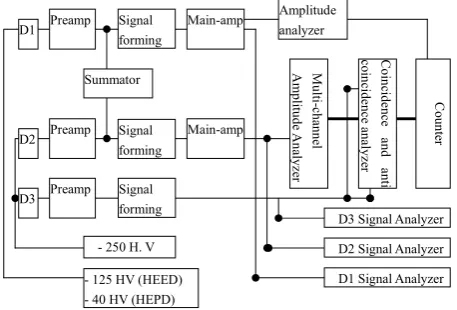
The detailed design of these Chinese particle instruments can be found in Zhu et al. (2002). Inside each instrument of HEED, HEPD and HID, there are three solid-state detectors (SSD): D1, D2 and D3. Energy loss measurements in these
D1 Signal
forming
Main-amp Amplitude
analyzer
Summator
D2 Preamp
Signal forming
Preamp Main-amp
D3 Preamp Signal forming
- 250 H. V
- 125 HV (HEED) - 40 HV (HEPD)
D1 Signal Analyzer D2 Signal Analyzer
M
ult
i-channe
l
Am
pli
tude A
na
ly
ze
r
C
oun
te
r
D3 Signal Analyzer
C
oin
cid
en
ce an
d
an
ti
co
in
cid
en
ce a
nal
yze
[image:2.595.314.543.68.223.2]r
Fig. 3. Block diagrams of HEED and HEPD.
three SSDs make it possible to separate electrons, protons, and heavy ions.
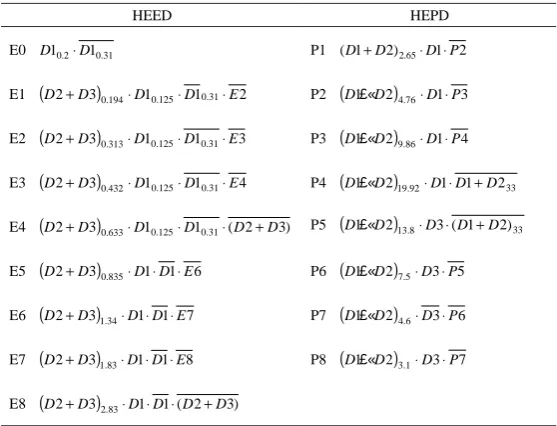
A set of amplitude and coincidence-logic based on differ-ent thresholds enables determinations of particle iddiffer-entifica- identifica-tion and energy. The coincidence and anti-coincidence ana-lyzer allows for a separation of electrons from protons.
Figure 3 shows the common block diagram of HEED and HEPD. Although the block diagrams of HEED and HEPD are similar, their software and thresholds are different.
HEED has 9 energy channels and HEPD has 8 energy channels. Table 1 shows the determination criteria of elec-trons of HEED and protons of HEPD. The subscript indi-cates the thresholds of energy deposited in the SSD in the unit MeV. The symbolEnmeans that the counts in the n en-ergy channel should be removed.
Figure 4 shows the block diagram of HID. Since the dy-namic range of signals from the SSD is too large, two addi-tional logarithmic amplifiers are used for HID.
HEED and HEPD have an opening angle of 30◦. Since the focus of the design of HID is to measure cosmic rays, that is, particles of very low abundance, HID has a larger opening angle (60◦) and correspondingly, a large geometric factor. 2.2 HEED
The main scientific objectives of HEED are as follows: • To study spatial and temporal variations in the distri-bution of high energy electrons in the radiation belts during magnetospheric substorms and magnetic storms;
•To study the acceleration mechanism affecting high en-ergy electrons in the near-Earth magnetosphere during CMEs (Coronal Mass Ejection);
•To study the precipitation processes of the high energy electrons, as well as the altitude and latitude distribution of their fluxes during magnetospheric substorms and magnetic storms;
[image:2.595.49.284.296.478.2]J. B. Cao et al.: First results of Chinese particle instruments in the Double Star Program 2777
[image:3.595.157.436.89.302.2]Table 1. Determination criteria of electrons of HEED and protons of HEPD.
Table 1 Determination criteria of electrons of HEED and protons of HEPD.
HEED HEPD
E0 D10.2⋅D10.31
E1 (D2+D3)0.194⋅D10.125⋅D10.31⋅E2
E2 (D2+D3)0.313⋅D10.125⋅D10.31⋅E3
E3 (D2+D3)0.432⋅D10.125⋅D10.31⋅E4
E4 (D2+D3)0.633⋅D10.125⋅D10.31⋅(D2+D3)
E5 (D2+D3)0.835⋅D1⋅D1⋅E6
E6 (D2+D3)1.34⋅D1⋅D1⋅E7
E7 (D2+D3)1.83⋅D1⋅D1⋅E8
E8 (D2+D3)2.83⋅D1⋅D1⋅(D2+D3)
P1 (D1+D2)2.65⋅D1⋅P2
P2 (D1£«D2)4.76⋅D1⋅P3
P3 (D1£«D2)9.86⋅D1⋅P4
P4 (D1£«D2)19.92⋅D1⋅D1+D233
P5 (D1£«D2)13.8⋅D3⋅(D1+D2)33
P6 (D1£«D2)7.5⋅D3⋅P5
P7 (D1£«D2)4.6⋅D3⋅P6
P8 (D1£«D2)3.1⋅D3⋅P7
their injection towards the radiation belt and ring current re-gions.
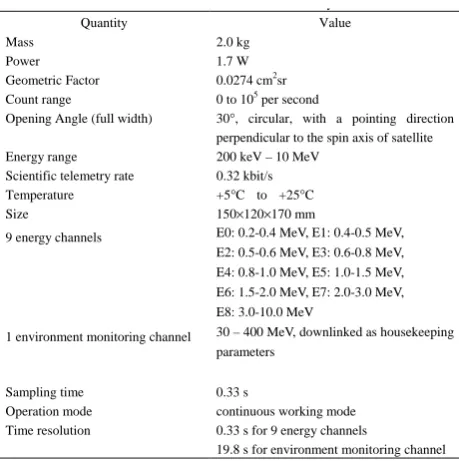
The instrument data summary of HEED is given in Table 2.
2.3 HEPD
The main scientific objectives of HEPD are as follows: •To study the energy spectrum and flux of solar cosmic rays (solar proton events) and galactic cosmic rays in the near-Earth magnetosphere;
•To study the temporal and spatial variations of high en-ergy protons in the radiation belt during magnetospheric sub-storms and magnetic sub-storms;
•To study variations in the radiation belts during the pe-riod of solar proton events;
•To study the transport processes of solar protons from the cleft, polar cap and auroral zone into the ionosphere, and in particular the resulting influence on the ionosphere in the polar region.
The instrument data summary of HEPD is given in Table 3.
2.4 HID
The main scientific objectives of HID are as follows: •To measure and study the species, energy spectrum and flux of heavy ions of galactic cosmic rays;
•To measure and study solar cosmic rays in the radiation belts;
• To measure the species of heavy ions having medium and high energies in the magnetosphere.
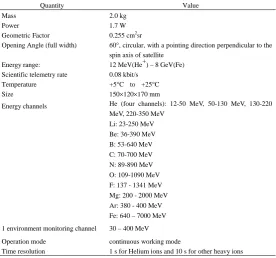
The instrument data summary of HID is given in Table 4.
Lo g-am p Lo g-am p Su mma tor
D1 Signal forming Main-amp Signal Filtre
Summator
D2 Preamp
Signal forming
Preamp Main-amp
D3 Preamp Signal forming
- 250 H. V
- 45 HV D1 Signal Analyzer D2 Signal Analyzer
M ulti -c ha nnel A m pli tud e A na lyz er Co un te r
D3 Signal Analyzer
[image:3.595.310.544.339.492.2]C oin ci de nc e an d an ti co in ci de nc e a nal yz er Signal Filtre
Fig. 4. Block diagram of HID.
2.5 LEID
Table 2. Instrument data summary of HEED.
Table 2 Instrument data summary of HEED
Quantity Value
Mass 2.0 kg
Power 1.7 W
Geometric Factor 0.0274 cm2sr
Count range 0 to 105 per second
Opening Angle (full width) 30°, circular, with a pointing direction
perpendicular to the spin axis of satellite
Energy range 200 keV – 10 MeV
Scientific telemetry rate 0.32 kbit/s
Temperature +5°C to +25°C
Size 150×120×170 mm
9 energy channels E0: 0.2-0.4 MeV, E1: 0.4-0.5 MeV,
E2: 0.5-0.6 MeV, E3: 0.6-0.8 MeV, E4: 0.8-1.0 MeV, E5: 1.0-1.5 MeV, E6: 1.5-2.0 MeV, E7: 2.0-3.0 MeV, E8: 3.0-10.0 MeV
1 environment monitoring channel 30 – 400 MeV, downlinked as housekeeping parameters
Sampling time 0.33 s
Operation mode continuous working mode
Time resolution 0.33 s for 9 energy channels
19.8 s for environment monitoring channel
Table 3. Instrument data summary of HEPD.
Quantity Value
Mass 2.0 kg
Power 1.7 W
Geometric Factor 0.1105 cm2sr
Count range 0 to 105 per second
Opening Angle (full width) 30°, circular, with a pointing direction
perpendicular to the spin axis of satellite
Energy range: 3 – 400 MeV
Scientific telemetry rate 0.32 kbit/s
Temperature +5°C to +25°C
Size 150×120×170 mm
8 energy channels P1:3.0 - 5.0 MeV
P2: 5.0 – 10.0 MeV P3: 10.0 – 20.0 MeV P4: 20 - 30 MeV P5: 30 - 50 MeV P6: 50 - 100 MeV P7: 100 - 200 MeV P8: 200 - 400 MeV
1 environment monitoring channel 30 – 400 MeV, summation of P5, P6, P7 and
P8, downlinked as housekeeping parameters
Sampling time 0.33 s
Operation mode continuous working mode
Time resolution 0.33 s for 8 energy channels
19.8 s for environment monitoring channel
LEID was calibrated in December 2003 and March 2004 in Centre d’Etude Spatiale des Rayonnements in Toulouse, France. The ground calibration results showed that LEID had a good performance and a similar energy resolution to that of HIA on TC-1.
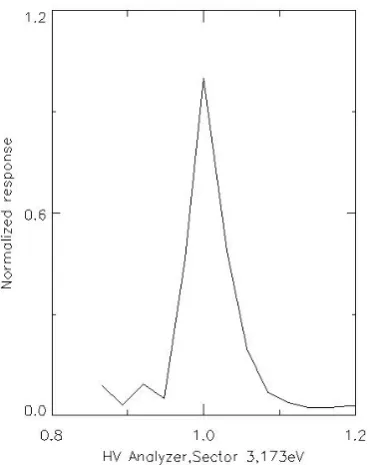
There are 8 anode sectors distributed within the polar an-gle range 0◦–180◦, which are numbered Sectors 1 to 8 (from 0◦–180◦). Figure 6 shows the normalized energy response of
Sector 3 at the energy level of 173 eV. The analyzer resolu-tion (FWHM) of Sector 3 is about 13%. Figure 7 shows the intrinsic azimuthal resolution of Sector 3 at the energy level of 173 eV. It can be seen from Fig. 7 that the alpha angle res-olution (FWHM) of Sector 3 is 5.6◦. The calibration results also show that the energy response and alpha angle resolution are almost independent of the sectors. The full energy sweep with 16 contiguous energy channels is performed 16 times per spin. Thus, the azimuthal angle resolution is 22.5◦.
The scientific objectives of LEID are as follows:
•To study the transport process and acceleration mecha-nism of upflowing ions in the auroral ionosphere;
• To study the transport process of upflowing ions via the cleft from the ionosphere to both the high-latitude mag-netopause boundary layer and the magmag-netopause boundary layer on the dayside;
• To study the transport process of magnetosheath ions into the ionosphere and plasma sheet through the cleft and the high-latitude magnetopause boundary layer;
•To study the transport process of polar wind ions into the magnetosphere.
The instrument data summary of LEID is given in Table 5.
3 First results of HEED, HEPD and HID of TC-1
TC-1 was launched on 30 December 2003. After the com-missioning phase, HEED, HEPD and HID were powered on at 12:30 BLT (Beijing Local Time) on 3 January 2004, and powered off at 17:30. On 5 January, the three Chinese instru-ments were powered on again and they have operated contin-uously since then.
In the commissioning phase, the housekeeping data showed that all three instruments work normally. However, the scientific data of HEED and HEPD are abnormal. The scientific data of the 9 energy channels of HEED in the cen-tral regions of the inner and outer radiation belts are satu-rated due to contamination by protons. The scientific data from the 8 energy channels of HEPD are abnormal. The ground data treatment cannot solve these problems. Thus, for HEED, only data prior to saturation are useable. For HEPD, only data from the proton monitoring channel (30– 400 MeV), which are downlinked through the housekeeping data channel, are useable.
3.1 First results of HEED of TC-1
[image:4.595.53.283.358.620.2]J. B. Cao et al.: First results of Chinese particle instruments in the Double Star Program 2779
Table 4. Instrument data summary of HID.
Quantity Value
Mass 2.0 kg
Power 1.7 W
Geometric Factor 0.255 cm2sr
Opening Angle (full width) 60°, circular, with a pointing direction perpendicular to the spin axis of satellite
Energy range: 12 MeV(He+) – 8 GeV(Fe)
Scientific telemetry rate 0.08 kbit/s
Temperature +5°C to +25°C
Size 150×120×170 mm
Energy channels He (four channels): 12-50 MeV, 50-130 MeV, 130-220
MeV, 220-350 MeV
Li: 23-250 MeV Be: 36-390 MeV B: 53-640 MeV
C: 70-700 MeV N: 89-890 MeV O: 109-1090 MeV F: 137 - 1341 MeV
Mg: 200 - 2000 MeV Ar: 380 - 400 MeV Fe: 640 – 7000 MeV
1 environment monitoring channel 30 – 400 MeV
Operation mode continuous working mode
Time resolution 1 s for Helium ions and 10 s for other heavy ions
increasing. Thus, only the data of HEED outside the geosyn-chronous orbit is reliable. Between 42 000 km and 43 000 km the lines for E2 and E3 begin to separate. The housekeeping data shows that the instrument was not saturated around that time. So, the farther from the Earth, the more rapidly the high energy flux decreases with the increase in energy.
The designed count range of HEED can reach 105/s, which is 5 times larger than the model predicted peak values in the radiation belt. Thus, it was not the high energy electrons that saturated HEED. A malfunction analysis showed that this abnormality might be due to proton contamination. It was found that the threshold value of a coincidence and anti-coincidence circuit was somewhat low. HEED adopts coinci-dence and anti-coincicoinci-dence circuit technology to remove the influence of high energy protons. If the threshold value is too low, many high energy protons will be counted as elec-trons. In this case, the sensor will be saturated and cannot work correctly.
Figure 9 shows the temporal variation of the high energy electron flux at E0 (0.2–0.4 MeV) during the time interval 05:40:00–05:40:20 on 3 January 2004. At 05:40:00 the satel-lite is at the position (2.45, 6.73, 1.23)RE in GSE
[image:5.595.308.547.375.475.2]coordi-nates, outside the center of the outer radiation belt. In each spin period, HEED makes about 12 measurements. The rel-evant azimuthal angle resolution is about 30 deg. In Fig. 9, the high energy electron flux has periodic variations, which are caused by the spin of the satellite. It can be deduced from the amplitude of the pitch angle variation that the an-gle between the magnetic field and the spin axis was about 16 deg. Thus, at this time, the spin of the satellite limited
Fig. 5. Block diagram of LEID.
HEED measurements in the pitch angle range 74◦–106◦. The periodic variations of electron flux show that the high energy electrons are still quasi-trapped electrons. Since the satellite is outside the geosynchronous orbit, the periodic variation signatures (trapped particle signatures) become weaker and weaker, and almost disappear at the end of the time interval. 3.2 First results of HEPD of TC-1
Fig. 6. Normalized energy response of Sector 3 at energy level of 173 eV.
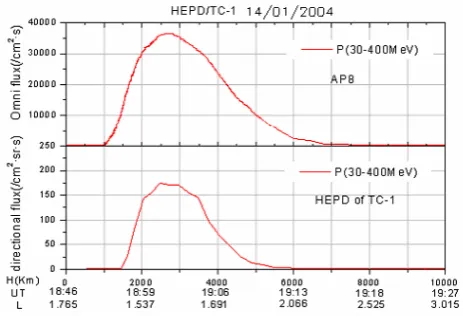
For the instrument HEPD, there is another monitoring channel which indicates high energy proton counts in the range 30–400 MeV. This monitoring channel was designed with the purpose of monitoring the working status of HEPD and its data are downlinked through the transfer line for housekeeping data. Figure 10 shows a comparison between AP8-predicted high energy proton omni-directional flux and the directional flux of HEPD/TC-1 on 14 January 2004. The data of HEPD come from the monitoring channel. The peak position and the altitude dependence are consistent with those predicted by the AP8-model.
3.3 First results of HID of TC-1
Figure 11 shows the flux of Helium ions in the energy chan-nels He1 and He2 on 15 January 2004. The Helium ion flux in the energy range 12-50 MeV (He1) is much higher than the Helium ion flux in the range 50–130 MeV (He 2). Both flux peaks are in the central region of the inner radiation belt. The peak position of the Helium ion flux at higher energy is closer to the Earth than the peak position of the Helium ion flux at lower energy. In addition, the Helium ions in the en-ergy channel He1 (12–50 MeV) are measured over a larger height range than the Helium ions in the energy channel He2 (50–130 MeV).
4 First results of HEED, HEPD, HID and LEID of TC-2
The spacecraft TC-2 of the DSP mission was successfully launched on 25 July 2004. The commissioning of the in-struments HEED, HEPD, HID and LFEW started on 28 July. LEID started its commissioning on 1 August 2004.
Fig. 7. Intrinsic azimuthal angle resolution of Sector 3 at energy level of 173 eV.
Fig. 8. The minute-averaged high energy electron flux in energy channels E0, E2 and E3 observed by HEED/TC-1 on 18 February 2004.
4.1 HEED of TC-2
[image:6.595.76.263.64.297.2] [image:6.595.338.514.69.296.2] [image:6.595.313.545.354.500.2]J. B. Cao et al.: First results of Chinese particle instruments in the Double Star Program 2781
Table 5. Instrument data summary of LEID.
Quantity Value
Mass 3.92 kg
Power 2.9 W
Geometric Factor 8.1×10⁻⁴ E (cm2 sr )
Polar angle resolution 22.5° (8 sectors)
Azimuthal angle resolution: 22.5
Measurement range: 50 eV - 25 keV
Scientific telemetry rate 3 kbit/s
Temperature +5°C to +25°C
Size Electronic box 300×150×130 mm
Sensor 125×115×130 mm
Energy channels 50, 75.7 115, 173, 262, 396, 601, 909, 1375, 2081, 3150,
4767, 7214, 10916, 16520, 25000 (eV)
Energy resolution ∆E/E 13%
Operation mode continuous working mode
Time resolution One spin period (4 s) every three spin periods (12 s)
Fig. 9. Temporal variation of the high energy electron flux at E0 (0.2–0.4 MeV) during the time interval 05:40:00–05:40:20 on 3 Jan-uary 2004.
[image:7.595.311.543.283.441.2]that recorded during ground tests. This means that the noise level in space is lower than that experienced on the ground.
[image:7.595.66.263.287.503.2]Figure 12 shows the high energy electron fluxes recorded in energy channels E0, E3 and E6 on 12 August 2004. Here, negative values of height denote the inbound height of the satellite and positive height values denote the outbound height. The fluxes reached their maximum inside the radi-ation belt, and decreased by about one order of magnitude outside the radiation belt. The fluxes in the energy range 0.2– 0.4 MeV were much larger than those in the energy range 0.6–0.8 MeV. In the outer radiation belt, similar to the He-lium ions, the peak position of the electron flux at higher energy is closer to the Earth than the peak position of the
Fig. 10. Comparison between AP8-predicted high energy proton omni-flux and the directional flux of HEPD/TC-1 on 14 January 2004.
[image:7.595.312.544.500.681.2]Fig. 12. The minute-averaged high energy electron fluxes recorded in energy channels E0, E3 and E6 on 12 August 2004.
Fig. 13. SubstormAU,ALandAEindex recorded on 14 September
2004.
electron flux at lower energy. The high energy electrons in energy channel E0 can exist in the whole orbit, while the high energy electrons in energy channel E6 can only exist in the center regions of the radiation belt.
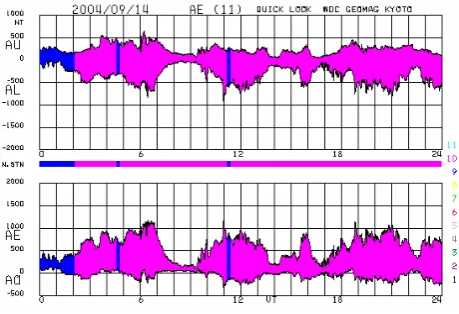
Since the launch, TC-2 has experienced the arrival of two large Coronal Mass Ejections (CME). One of them occurred on 12 September 2004. This event caused strong distur-bances in the magnetosphere. Figure 13 shows the substorm
AU,ALandAE indices recorded on 14 September 2004. It
can be seen that, within one day, four large substorms oc-curred. HEED, HEPD and HID recorded the high energy particle response to this composite event.
Figure 14 shows theDst index and high energy electron
flux (0.2–1.0 MeV and 1–10 MeV) observed by HEED on 14 September 2004. It can be seen that the high energy elec-tron flux corresponds relatively well to theAE andDST
in-dices. The first two peaks in the high energy electron record (at 06:00 and 11:00 UT) occurred when the absolute values of theDST index and theAE index have reached their
max-imum values. Although the third peak did not correspond to the peak in the AE andDst indices, it occurred at the
Fig. 14. TheDST index and high energy electron flux (0.2–1.0 MeV
and 1–10 MeV) observed by HEED/TC-2 on 14 September 2004.
Fig. 15. The minute-averaged high energy proton flux in energy channels P1, P2 and P4 on 11 September 2004.
beginning of the expansion phase of the substorm and origi-nated from substorm-injected energetic electrons as expected by some theoretical works (Li et al., 2005b).
4.2 HEPD of TC-2
HEPD was powered on at 11:30 UT on 27 July 2004. The housekeeping data showed that HEPD was in good condition after the launch and it works nominally.
Figure 15 shows the high energy proton flux in energy channels P1, P2 and P4 on 11 September 2004. The abso-lute values of theDst index and theAE index are very low,
indicating that the magnetosphere was quiet on 11 Septem-ber 2004. As in the case of the high energy electron fluxes, the peaks of the high energy proton fluxes are found in the central regions of the inner and outer radiation belts. The flux in the inner belt is smaller than that in the outer radia-tion belt. Outside the radiaradia-tion belts, the high energy proton flux is very low.
[image:8.595.56.280.62.220.2] [image:8.595.314.541.74.211.2] [image:8.595.311.542.274.429.2] [image:8.595.52.282.277.434.2]J. B. Cao et al.: First results of Chinese particle instruments in the Double Star Program 2783
Fig. 16. The minute-averaged high energy proton flux in energy channels P1, P2 and P4 on 14 September 2004.
Fig. 17. The minute-averaged helium ion flux in energy channels He1, He2 and He4 observed by HID on 11 September 2004 (a quiet time).
14 September events. Figure 16 shows the minute averaged proton fluxes in the channels P1, P2 and P4 on 14 September 2004. We compared Fig. 15 (quiet time) and Fig. 16 (active time), and found that the maximum peak flux in the radi-ation belt increased from around 150 cm−2sr−1s−1(a quiet time value) to around 280 cm−2sr−1s−1. The increased high energy proton flux was caused directly by the high energy protons associated with the CME. In addition, in contrast to quiet time conditions, the whole orbit traversed by TC-2 out-side the radiation belts was suffused with high energy pro-tons.
4.3 HID of TC-2
HID was powered on at 11:30 UT on 27 July 2004. The housekeeping data showed that HID was in good condition after the launch and it works nominally.
Figure 17 shows the fluxes of Helium ions in energy chan-nels He1, He2 and He4 observed by HID on 11 September 2004. Similar to high energy electrons, the flux of Helium ions decreased rapidly with increasing energy. As in the case
Fig. 18. The minute-averaged helium ion flux in energy channels He1, He2 and He4 observed by HID on 14 September 2004 (after CME arrival).
[image:9.595.53.281.64.217.2]of high energy protons, the counts recorded by the instrument were very low outside the radiation belts.
Figure 18 shows the high energy Helium ion flux observed by HID on 14 September 2004. In contrast to the high energy proton measurements, the maximum Helium flux in the radi-ation belt displayed no obvious change. However, outside the radiation belt, the high energy Helium fluxes increased sig-nificantly, and became much larger than the quiet time val-ues. These high energy Helium ions come from the CME. This means that the high energy Helium ion flux from the so-lar fso-lare was much lower than the quiet flux in the radiation belt and thus could not greatly increase the peak flux value in the radiation belt. However, the high energy helium ion flux from the solar flare was obviously larger than the quiet flux outside the central regions of the radiation belt and could thus fill the whole magnetosphere with high energy Helium ions.
4.4 LEID of TC-2
LEID was powered on 9 August 2004. The housekeep-ing data showed that the instrument was workhousekeep-ing nominally. However, the scientific data showed that the second sector had almost no data. After 5 September the counts in the first sector also decreased to almost zero and soon had no data.
A preliminary analysis showed that there are two reasons for this malfunction: (1) the sensor performance degraded in space; (2) the electromagnetic interference damaged the pre-amplifier.
[image:9.595.312.543.66.218.2] [image:9.595.53.282.269.420.2]inherent errors, which change according to the region moni-tored.
In addition, there is also solar UV contamination in the data when LEID faces the Sun. Thus, the low energy ion flux in the anti-sunward direction is higher than the true value. For the above reasons, we have not obtained reliable scien-tific data from LEID. More work needs to be done in the future.
5 Conclusions
This paper briefly presents the Chinese particle instruments, their data status and first results. Although HEED, HEPD and HID are mounted aboard both TC-1 and TC-2, the de-signs of HEED and HEPD of TC-2 were updated based on the experience gained from TC-1. Thus, the performances of HEED and HEPD on 2 are better than those on TC-1. Since LEID is the first Chinese low energy ion detec-tor, we lacked experience with such an instrument. The fail-ure of two sectors and UV contamination make the scientific data not very precise. It is hoped that in the future, we can improve the design of these instruments and construct high quality particle detectors.
Acknowledgements. This work is supported by NSFC Grant
40390153 and by the International Collaboration Research Team Program of the Chinese Academy of Sciences. We are very grateful to Center d’Etude Spatiale des Rayonnements of France for their kind help in the calibration of LEID. Their help is also very impor-tant for the improvement of the LEID design in the future Chinese missions. The authors also thank the WDC for Geomagnetism, Ky-oto and relevant AE stations.
Topical Editor T. Pulkkinen thanks C. M. Carr and another ref-eree for their help in evaluating this paper.
References
Baker, D. N., Pulkkinen, T. I., Li, X., Kanekal, S. G., Blake, J. B., Selesnick, R. S., Henderson, M. G., Reeves, G. D., Spence, H. E., and Rostoker, G.: Coronal mass ejections, magnetic clouds, and relativistic magnetospheric electron events: ISTP, J. Geophys. Res., 103, 17 279–17 291, 1998.
Cao, J. B., Zhou, G. C., Wang, X. Y., Wang, D. J., and Cai, C. L.: Relationship among the electron event in April–May 1998, the magnetic storm and interplanetary condition, 2002 Western Pacific Geophysics Meeting, AGU, Wellington, New Zealand, 2002.
Li, X., Baker, D. N., Temerin, M., Cayton, T. E., Reeves, E. G. D., Selesnick, R. S., Blake, J. B., Lu, G., Kanekal, S. G., and Singer, H.: Rapid enhancements of relativistic electrons deep in the magnetosphere during May 15, 1997 magnetic storm, J. Geo-phys. Res., 104, 4467–4476, 1999.
Li, L. Y., Cao, J. B., and Zhou, G. C.: Relation of the relativis-tic electron flux change and storm/substorm in the geomagneto-sphere, Chin. J. Geophys., in press, 2005a.
Li, L. Y., Cao, J. B., and Zhou, G. C.: Combined acceler-ation of electrons by whistler-mode and compressional ULF Turbulences near the geosynchronous orbit, J. Geophys. Res., doi:10.1029/2004JA010628, 2005b.
R`eme, H., Bosqued, J. M., Sauvaud, J. A., Cros, A., et al.: The Cluster Ion Spectrometry (CIS) Experiment, Space Sci. Rev., 79, 303–350, 1997.