Programmable State-Variable Filter with Wide
Frequency and Q Tuning Range
Alma Delić-Ibukić, Steven Mikes, Zhiguo Lai, and Dev V. Gupta
Newlans, Inc., Acton, MA, USAEmail: {adelic, smikes, zlai, dgupta}@newlans.com
Abstract—This paper presents a state-variable bandpass filter with wide frequency range coverage and wide Q tuning range. The state-variable filter was chosen because it can be easily extended to a universal biquad filter structure [1]. A digital tuning technique with a novel Q-tuning algorithm was implemented in Verilog-A, and a real-time tuning of center frequency fc and Q was demonstrated. The technique is accurate as long as there is no phase error in the system. In the presence of phase error and for high Q filter requirements, tuning algorithm based on magnitude detection was demonstrated. A bandpass filter was simulated in 45nm CMOS technology using RF components for more accurate modeling of the fets. Filter simulation results showed frequency range coverage from 520MHz to 2.2GHz, and Q range from 2 to 400. For a filter with Q=33, simulation results showed a dynamic range of 55dB over a 3dB bandwidth at fc=1.5GHz. The current consumption of the designed filter is 75mA at 1.2V.
Index Terms—programmable filter, calibration, biquad, analog signal processing
I. INTRODUCTION
Programmable continuous-time universal filter structures are still actively researched due to interest in applications such as analog signal processing, communication, and neural networks [2]-[6]. The most common approach in designing tunable active filters is by using transconductor-capacitor (Gm-C) circuits (i.e., integrators) [3], [4], [7]-[12]. Integrator structures suitable for high frequencies that can provide filters with good linearity have been reported in [8], [12]. In [8] a tunable integrator based on inverters and suitable for GHz applications was reported, and in [12] it was shown that the given integrator structure can be optimized for linearity. Also, different digital tuning techniques have been reported [8], [13]-[15] that have shown to be effective in tuning the center frequency fc and the quality factor Q of the filter.
In this paper, a programmable state-variable filter with wide frequency and Q tuning range is proposed. Such a filter can be expanded to a universal filter structure and cascaded to realize higher order filters. Using 45nm CMOS technology, basic building blocks of the state-variable filter are designed and optimized to work at high frequencies. A novel Q-tuning algorithm is proposed and
Manuscript received April 15, 2014; revised June 27, 2014.
real-time digital tuning of fc and Q is demonstrated using Verilog-A blocks.
This paper is organized as follows: In Section II, the proposed state-variable filter implementation is discussed and simulation results are presented. In Section III, the digital tuning algorithm is discussed and simulation results showing real-time tuning are presented. This is followed by the summary in Section IV.
II. STATE-VARIABLE FILTER
A. Implementation
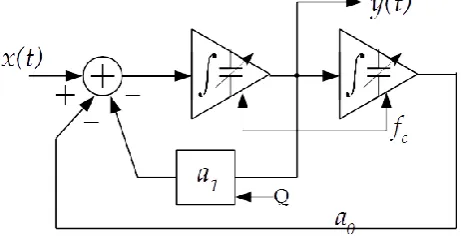
Fig. 1 shows the block diagram of the proposed programmable state-variable filter. The structure consists of two integrators, two variable capacitors, a summing block, and a variable coefficient pad a1. The transfer function is given by
( ) (1)
where ωc=2πfcis the center frequency of the filter, a1=1/Q, and a0=1.
Figure 1. Second order state-variable filter structure.
The filter structure in Fig. 1 is desirable because once the basic building blocks are realized (i.e., summer, integrator, variable capacitor, and variable coefficient pad), complex filter systems can be implemented (i.e., high-pass, low-pass, band-stop, and all-pass) [1]. From (1), the center frequency fc of the filter is controlled by the variable capacitor block, and the Q of the filter is controlled by the variable coefficient pad a1.
accomplished through design of a wide-range variable capacitor. The variable capacitor controls the GBW product of the integrators and in turn controls the center frequency of the filter. The variable capacitor is shown in Fig. 2 and is implemented using 1.8V moscap varactors, switches, and MOM capacitors. In the given design, large capacitor step sizes are controlled by switching in/out fixed capacitor sections, while fine tuning is controlled by varactors. Because 1.8V moscap varactors are used, control voltage Vfc can change from 0 to 2V which allows for 1.66 varactor range. For this design, three fixed capacitor sections were used: C, 2C, and 4C with C=0.5pF. This corresponds to a 3-bit control requirement in addition to a DC control Vfc. The implemented structure has continuous capacitance coverage from 2.1pF to 10.46pF, which allows for continuous frequency coverage from 520MHz to 2.2GHz.
Figure 2. Circuit implementation of variable capacitor block where
n ≥1.
The variable coefficient pad circuit is shown in Fig. 3(a). It is a common source amplifier with a variable degeneration resistor. Controlling R2 changes the loss of the circuit. The maximum loss is set by the largest setting on R2 and the minimum loss is set by voltage divider formed by R1 and the pmos transistor when R2 is at the minimum setting.
Figure 3. Circuit implementation of (a) variable coefficient pad a1 and
(b) summing block.
The summing block circuit is shown in Fig. 3(b). The design was adopted from [16] and optimized for wideband, high-linearity applications. The three-input summing block is designed to have a gain of 0dB with
respect to each input. The gain is set by resistors R1 and R2.
B. Simulation Results
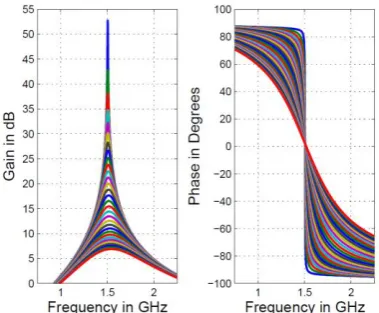
Filter in Fig. 1 was designed in 45nm CMOS technology using RF models. Fig. 4 shows the frequency range coverage from 520MHz to 2.2GHz. Filters in Fig. 4 were designed for Q=33. At any given frequency within the range, Q from 2 to 400 can be obtained through variable coefficient pad a1. Fig. 5 and Fig. 6 show the Q sensitivity to a1 and the AC-response of the filter at 1.5GHz as a1 is swept, respectively.
Figure 4. Continuous frequency coverage of the proposed filter is
from 520MHz to 2.2GHz.
Figure 5. Q turning rage as the coefficient pad a1 is varied.
The dynamic range and linearity for the design were also looked at. Fig. 7 shows the IIP3 for a filter centered at 1.5GHz with Q=33. The simulated IIP3 is -24dBm and the input referred noise over 3dB bandwidth centered at 1.5GHz was found to be -79dBm. This corresponds to a dynamic range of 55dB while consuming 90mW of power. For every doubling of power, the dynamic range will increase by 3dB.
The following sections will discuss the real-time tuning of the above discussed filter.
Figure 7. IIP3 is -24dBm for a filter centered at 1.5GHz with Q=33.
III. TUNING ALGORITHM
A. Implementation Based on Phase Detection
Fig. 8 shows the block diagram of a tuning circuit that will set the center frequency fc and Q of the filter structure discussed in Section II. Filter tuning is implemented as two separate control loops, fc-tuning and Q-tuning. The center frequency tuning routine runs first, followed by Q-tuning. Since there may be a small cross-effect on center frequency and Q by their opposite controls, the algorithm can be repeated for several iterations to improve accuracy.
Figure 8. Implementation of a digital tuning circuit for fc and Q
adjustments.
Center frequency tuning is based on the method described in [17]. This work used a digital control loop, however, with no charge pump. The input and output signals of the filter are sent through limiting amplifiers, then compared with a bang-bang phase detector. The output of the phase detector (PD) is used by the control logic to detect the zero-phase crossing of the filter, which corresponds to the center frequency. The tuning voltage is
controlled by a DAC and adjusted until the PD switching point is within one LSB of the DAC.
Q-tuning is initiated once the fc tuning is completed. Several Q-tuning schemes have been reported in [13]-[15]. The magnitude-locked loop (MLL) and Q-locked loop (QLL) reported in [14], [15] prove to be difficult to implement at frequencies above 1GHz. In the case of the MLL, an accurate variable attenuator is needed with a bandwidth of several GHz. For the QLL, generating an accurate 45º phase shift at GHz frequencies is challenging. Instead, a novel Q-tuning scheme is proposed which exploits the known magnitude response of the desired filter. Once the center frequency has been tuned, the reference tone is in the center of the bandpass filter. The Q-tuning path includes a variable attenuator that has an accurate 3dB step. The magnitude of the filter output is first attenuated by 3dB, and then measured by squaring it with an analog multiplier and lowpass filtering. The resulting DC value is sent to an ADC and stored digitally. Next, the reference tone is set to -3dB frequency, given by f3dB=fc(1-0.5/Q). The process is repeated, but this time the attenuator is set to the 0dB setting. The resulting value is compared with the stored value from the center frequency. The digital controller adjusts the Q control and repeats this process until the two values are equal. This algorithm is more suited to GHz operation because it requires only an accurate 3dB step attenuator. The ADC operates at DC, and therefore should not represent a design challenge. It should be noted that this algorithm assumes that a controllable reference tone is available.
B. Simulation Results
Real-time digital tuning of fc and Q was demonstrated using Verilog-A. Verilog-A models were used for control logic and some analog circuits (limiting amplifier, multiplier, and 3dB accurate attenuator). Fig. 9 shows the AC response of the filter before and after tuning at two different temperature settings (27ºC and 54ºC) to demonstrate the algorithm and filter adaptability. The center frequency was set to 1.03GHz and Q=16. Fig. 10 shows the control voltages for the center frequency fc and Q over time. Fig. 11 shows the AC response for a high-Q filter tuning. For a high-Q filter, multiple iterations of the algorithm are required. For the case of Q=64, two algorithm iterations were necessary.
Figure 9. Filter tuning to fc = 1.03GHz and Q=16 at two different
Figure 10. Tuning algorithm settling time at two different temperatures for the filter shown in Fig. 9.
Figure 11. Filter tuning to fc=1.03GHz and Q =64.
C. Implementation and Results Based on Magnitude Detection
The issue with the above discussed algorithm is that the center frequency is set by using a phase detector and searching for a zero degree phase frequency point. This works well at low Q, but for high Q the phase error causes significant fc and Q deviations. To mitigate this problem, the magnitude detection for both, center frequency and Q adjustments can be used.
Fig. 12 shows a tuning algorithm based on magnitude detection. This requires the ability to have accurate tones at center frequency and ±3dB frequencies. A binary search is used to find the initial value for the variable capacitor Vfc that sets the center frequency. At each Vfc setting, the input tone is set to first -3dB frequency, then to +3dB frequency. The magnitudes are compared and the sign of the difference is used to adjust the Vfc. If the absolute value of the difference is within a set tolerance, the search is considered finished.
Figure 12. Implementation of a digital tuning circuit for fc and Q
adjustments using magnitude detector.
To adjust the Q, the tone is swept between the three points: f-3dB, fc, and f+3dB. Also, at fc, the 3dB attenuator is switched on. For the correct Q the three frequencies should agree in magnitude (or be within some specified tolerance). If the values at f-3dB and f+3dB fall out of this tolerance, the center frequency of the filter is assumed to have changed (due to change in VQ), and therefore Vfc needs to be adjusted accordingly. Initially, VQ is set to a value known to yield a low Q, then gradually adjusted towards higher Q settings, stopping when the correct value is reached. This method avoids crossing into an unstable region for the biquad.
Fig. 13 shows the AC response for the tuning algorithm implemented using magnitude detection. The center frequency was fixed at 1.5GHz and filter was tuned to three different Q settings, namely 10, 50, and 100.
IV. CONCLUSION
In this paper a tunable filter with wide frequency and Q tuning range was discussed and demonstrated. The filter has a frequency tuning range from 520MHz to 2.2GHz and Q-tuning range from 2 to 400. Also, a digital tuning technique (with novel Q-tuning) that accurately sets fc and Q was discussed and demonstrated. For high Q filters, additional tuning technique is discussed that relies only on magnitude detection. Simulation results showed a dynamic range of 55dB measured over the 3dB bandwidth at the fc.
Figure 13. Filter tuning to fc = 1.5GHz and different Q values.
The discussed state-variable filter can be easily extended to a reconfigurable universal filter structure by introducing a set of b coefficients and an additional summing block [1]. Furthermore, this is a voltage mode filter which makes it ideal for cascading to obtain higher order filter structures.
REFERENCES
[1] D. Gupta, D. V. Gupta, Z. Lai, I.-S. Shin, A. Mathew, and P. Kelly, “State-variable wideband tunable filter,” presented at the SDR Technical Conference and Product Exposition, Washington, DC, December 2009.
digital all-pass filters,” IET Circuits, Devices, and Systems, vol. 4, pp. 346-364, Jul. 2010.
[3] M. Kumngerrn, P. Suwanjan, and K. Dejhan, “Electronically tunable voltage mode SIMO OTA-C universal biquad filter,” in Proc.Asia-Pacific Conference on Communications,Malaysia, Oct. 2011, pp. 774-777.
[4] S. Maheshwari, S. Sing, and D. Chauhan, “Electronically tunable low-voltage mixed-mode universal filter,” IET Circuits, Devices, and Systems, vol. 5, pp. 149-158, May 2011.
[5] S. Mahershwari, “Analog signal processing applications using a new circuit topology,” IET Circuits, Devices, and Systems, vol. 3, pp. 106-115, Jun. 2009.
[6] H. Kuntman, “New trends in circuit design for analog signal processing,” in Proc. International Conference on Applied Electronics,Pilsen, Sep. 2012, pp. 1-9.
[7] E. Sanchez-Sinencio and J. Silva-Martinez, “CMOS transconductance amplifiers, architectures and active filters: a tutorial,” IEE Proceedings on Circuits, Devices, and Systems,vol. 147, pp. 3-12, Feb. 2012.
[8] B. Nauta, “A CMOS transconductance-C filter technique for very high frequencies,” IEEE Journal of Solid-State Circuits, vol. 27, pp. 142-153, Feb. 1992.
[9] A. Zjajo and M. Song, “Digitally programmable continuous time biquad filter in 65nm CMOS,” in Proc. IEEE International symposium on Radio-Frequency Integration Technology, Singapore, Dec. 2009, pp. 339-341.
[10] Y. Chen and Y. Zhou, “A low power CMOS mixed-integrator based continuous time filter,” in Proc. IEEE 8th International
Conference on ASIC,Changsha, Hunan, Oct. 2009, pp. 274-276. [11] Y. Choi and H. C. Loung, “A hig-Q and wide dynamic range
70-MHz CMOS bandpass filter for wireless receivers,” IEEE Transactions on Circuits and Systems-II, vol. 48, pp. 433-440, May 2011.
[12] P. Crombez, J. Craninckx, P. Wambacq, and M. Steyaert, “Linearity guidelines for gm-C biquad filter design using architecture optimization with volterra analysis,” in Proc. 18th
European Conference on Circuit Theory and Design, Seville, Aug. 2007, pp. 216-219.
[13] J.-M. Stevenson and E. Sanches-Sinencio, “An accurate quality factor tuning scheme for IF and high Q continuous time filters,” IEEE Journal of Solid-State Circuits, vol. 33, pp. 1970-1978, Dec. 1998.
[14] A. Kumar, “A wide dynamic range high-Q high-frequency bandpass filter with an automatic quality factor tuning scheme,” Ph.D. dissertation, Dept. Elect. And Comp. Eng., Georgia Institute of Technology, Atlanta, GA, 2009.
[15] C. S. Park and R. Schaumann, “Design of a 4-MHz analog integrated CMOS transconductance-C bandpass filter,” IEEE Journal of Solid-State Circuits, vol. 23, pp. 987-996, Aug. 1988. [16] A. Monpapassorn, “High frequency/low voltage CMOS adder,”
Thammasat International Journal of Science and Technology,vol. 5, pp. 49-52, May 2000.
[17] H. Liu and A. I. Karsilayan, “A high frequency bandpass continuous-time filter with automatic frequency and Q-factor tuning,” in Proc.IEEE International Symposium on Circuits and Systems, Sydney, NSW, May 2001, pp. 328-331.
Alma Delić-Ibukić was born in Bihać,
Bosnia-Herzegovina. She received the B.S., M.S., and PhD degrees in electrical engineering from the University of Maine, Orono, ME, in 2002, 2004, and 2008 respectively.
From 2008 to 2009 she was a visiting faculty at Bucknell University, Lewisburg, PA. From 2009 to 2010 she was an Assistant Professor in the Electrical and Computer Engineering Department at California State University, Fresno, CA. In summer 2010, she joined Newlans, Inc.,
Acton, MA as a CMOS Analog Design Engineer. Her current research interests include wideband programmable CMOS filters and analog signal processing in deep-submicron CMOS technology.
Steven Mikes received B.S. and M.S. degrees
in Electrical and Computer Engineering from Carnegie Mellon University in Pittsburgh, PA in 2008. From 2008 to 2011 he was with IBM in Research Triangle Park, NC as an Analog Circuit Design Engineer working on high speed serial links. He joined Newlans in 2011 and has been working on broadband reconfigurable RF circuits. Starting fall 2014 he will be starting his PhD program under the supervision of Dr. Michael Flynn at the University of Michigan, Ann Arbor, MI.
Zhiguo Lai received the B.S. degree in
mechanical engineering from Tsinghua University, Beijing, China, the M.S. degree in electrical and computer engineering from University of Alaska, Fairbanks, AK, and the Ph.D. degree in electrical engineering from University of Massachusetts, Amherst, MA, in 1999, 2002, and 2007, respectively. From 2005 to 2007, he was a technical contributor of IEEE 802.15.3c and ECMA-TC48 standards for wireless personal area network devices. From summer of 2007 to summer of 2009, he was a postdoctoral fellow at University of Massachusetts, Amherst, MA, working on narrowband interference mitigation for UWB systems. Since 2009, he has been with Newlans, Inc., Acton, MA. His research interests include design of programmable CMOS filters, wideband analog signal processing, and quantum computation. He is currently working on analog computation using deep-submicron CMOS technology.
Dev V. Gupta received his Ph.D. in 1977
from the University of Massachusetts, Amherst. He held various engineering positions at the Bell Laboratories in Andover, MA, from 1977 to 1985. He was the General Manager at Integrated Network Corporation, a manufacturer of DSL access products, from 1985 to 1995.
Dr. Gupta founded two companies, Dagaz Technologies and Maxcomm, which were acquired by Cisco Systems in 1997 and 1999 respectively. These companies developed and manufactured telephone exchange and voice and data equipment for DSL. He was Cisco’s VP of Architecture in the access business unit between founding Dagaz Technologies and Maxcomm.